Category Archives: Analysis

Syria: The view from Moscow

Christopher Phillips writes: Of all the states involved in the Syria crisis, Russia has arguably been the most insulated from its fallout. Western states and their regional allies have been frustrated as their policies to topple President Bashar al-Assad repeatedly fail, while threatening jihadists such as ISIS have thrived in the chaos. Refugees have flooded Syria’s neighbours. Even Assad’s other ally, Iran, has seen its hard-earned regional reputation shattered. In contrast, the costs to Moscow have been limited.

However, the conflict’s echoes are finally being felt. In early December, Islamist gunmen fought Russian forces in Grozny, killing 20, prompting fears of ISIS-inspired violence in the northern Caucasus. The oil price has plummeted to $65, partly the result of Saudi Arabian machinations to punish both Iran and Russia. This is 35 percent below the Kremlin’s budgeted price and, along with western sanctions over Ukraine and the tumbling value of the Ruble, looks set to cripple Russia’s economy. However, contrary to some claims, this seems unlikely to prompt any major reconsideration of President Vladimir Putin’s Syria policy.

It is important to understand the view of Syria from Moscow. At the beginning of the crisis, Western analysts mistakenly believed Putin’s support was about preserving Russia’s interests in Syria: a tiny naval installation in Tartous and a modest arms market. Yet such material interests are, in reality, marginal. Instead, Putin sees Syria primarily through a geo-strategic lens. While Qatar, Saudi Arabia and Turkey have all taken leading roles in the campaign against Assad, Russia sees the West and particularly the US as chief instigator. [Continue reading…]

Facebooktwittermail

Is Erdogan on the path to dictatorship?

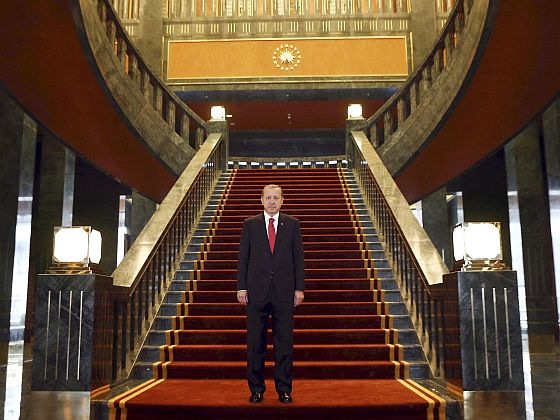
Erdogan-palace

Jenny White writes: Something substantially different is shaping up in today’s Turkey. Given the many variables in play, no one can be sure what the country will look like in 10 years. The recent autocratic turn of the pious former prime minister and now president, Recep Tayyip Erdoğan, cannot be explained simply as a form of Islamic radicalization. After more than a decade of economic growth and social reform under the Justice and Development Party (AKP), Muslim and Turkish identities have been transformed to such an extent that it is nearly impossible to assign people to one end or the other of a secular-Islamist divide, particularly that half of the population that is under 30. Many young people have heterogeneous identities, composed of seemingly contradictory positions and affiliations. Turkey is now split along more complex lines, pitting Sunni against Sunni, Sunni against Alevi (a heterodox Shia sect that makes up more than 10 percent of the population), and both pious and secular nationalists against Kurds. It could be argued that a lust for power and profit on the part of one man and his inner circle, rather than a wider cohort, has driven recent events as much as religion. This is no novelty in the world of dictators, which may well be the direction Turkey is taking.

Part of the answer to what is happening in the present lies in the past, in Kemalist practices (the legacy of Mustafa Kemal Atatürk, who founded the modern Turkish state in 1923) that still powerfully shape social and political life today. Erdoğan, threatened by recent street protests and the actions of a rival Islamic movement, has returned to the fearmongering and aggressive political paternalism that were ingrained in the Turkish psyche for much of the twentieth century, making them powerful tools for social manipulation. Kemalism has been largely dethroned, but the levers of power it developed remain in place. In the absence of Kemalist symbolism, AKP rule has taken on an Ottoman and Sunni Muslim veneer.

What is fundamentally different, though, is that Erdoğan has begun, for the first time, to dismantle the democratic structures that, creaky and biased though they were, provided a balance of power among institutions. Under Erdoğan, these institutions, from universities and the media to police, prosecutors, and judges, have been forced to answer not to a party, but essentially to one man who has taken control of most mechanisms of rule. This is a new and worrisome development, out of step with the AKP’s (and Erdoğan’s) accomplishments over the previous decade. Those who claim to have seen this coming could have done so only by closing their eyes to what the party accomplished — and what these newest developments put at risk. [Continue reading…]

Facebooktwittermail

Syrian rebels see U.S. abandoning them

Josh Rogin writes: As Congress struggles to pass a bill to fund the government for the rest of the year, one curious and significant item was left on the cutting room floor: a request from the Barack Obama administration for $300 million to expand the secret CIA program to arm the “moderate” Syrian rebels.

The request, which administration officials had been lobbying for in recent weeks, was held up by the House Intelligence Committee, which has serious doubts about the Free Syrian Army and other rebel groups that for years have been receiving arms secretly from the U.S. and its allies, two administration officials told me. Without the money, Syrian opposition leaders say, the FSA will struggle to hold its remaining positions in northern Syria, much less make progress against Islamic State and the Bashar al-Assad regime.

“The requested funds are a crucial indication of the partnership between the United States and Syrian freedom fighters. This comes at a particularly important time,” said Oubai Shahbandar, a senior adviser for the Syrian National Coalition.

Nonetheless, not everyone in the White House will lament the decision to drop it from the spending bill: Congress’s disenchantment with the Syrian rebels is shared by many officials inside the administration, following the rebels’ losses to Assad, IS and the al-Nusra Front in northern Syrian cities such as Idlib. There is particular frustration that these setbacks resulted in some advanced American weaponry falling into extremist hands.

Reflecting that dissatisfaction, the Obama administration has taken a series of steps in recent weeks to distance the U.S. from the moderate rebels in the north, by cutting off their weapons flow and refusing to allow them to meet with U.S. military officials, right at the time they are struggling to survive in and around Aleppo, Syria’s largest city. [Continue reading…]

Facebooktwittermail

Syria’s military and ISIS have been ‘ignoring’ each other on battlefield, data suggests

NBC News reports: Syria’s military and ISIS may be sworn enemies but instead of wiping each other off the battlefield they have been delicately dancing around each other, according to new data exclusively obtained by NBC News.

Both sides in the bloody conflict appear to be eliminating smaller rivals ahead of a possible final showdown.

Around 64 percent of verifiable ISIS attacks in Syria this year targeted other non-state groups, an analysis of the IHS Jane’s Terrorism and Insurgency Center’s (JTIC) database showed. Just 13 percent of the militants’ attacks during the same period — the year through Nov. 21 — targeted Syrian security forces. That’s a stark contrast to the Sunni extremist group’s operations in Iraq, where more than half of ISIS attacks (54 percent) were aimed at security forces. [Continue reading…]

Facebooktwittermail

Israeli missile found in Syria after airstrikes

IHS Jane’s Defence Weekly reports: Syria’s claims that Israel carried out airstrikes on 7 December appear to have been confirmed by amateur video footage and images of the wreckage of an Israeli munition recovered in the southwest of the Arab country.

The Syrian authorities have claimed that Israel carried out two airstrikes: one at Damascus International Airport, the other near Al-Dimas, a town near the Lebanese border.

The claim was corroborated by the Syrian Observatory for Human Rights, a London-based group that monitors the conflict in Syria using a network of sources. It reported that 10 explosions were heard near Al-Dimas and that a warehouse area was targeted at the airport. [Continue reading…]

Facebooktwittermail

ISIS fanboy @ShamiWitness outed by Channel 4 News

Channel 4 News: He spent his mornings, afternoons and evenings sending thousands of tweets of propaganda about the Islamic State militant group, acting as the leading conduit of information between jihadis, supporters, and recruits.

His tweets, written under the name Shami Witness, were seen two million times each month, making him perhaps the most influential Islamic State Twitter account, with over 17,700 followers.

BBC News reports: The unmasking of an English-speaking online jihad supporter based in India, who was popular among foreign fighters in Syria, casts light on the decentralised nature of the media operations of the group known as Islamic State (IS).

The Twitter activist Shami Witness played an important role in amplifying the message of IS and had over 17,000 followers before he disappeared – more than some of the key jihadist media groups.

But he was just one of an army of online supporters the group relies on to spread its message in a range of languages – none of whom operate officially on behalf of the group.

Facebooktwittermail

State Dept: Rebels are never going to defeat Assad militarily

Foreign Policy reports: In a grim assessment of the U.S.-backed Syrian rebels, a senior State Department official said on Wednesday that the country’s armed opposition will not be able to topple the regime of Syrian President Bashar al-Assad now or in the foreseeable future, despite the existence of a Pentagon program to train and equip 5,000 rebels per year.

“We do not see a situation in which the rebels are able to remove him from power,” Brett McGurk, one of the State Department’s point men in managing the ad hoc international coalition battling the Islamic State, told the House Foreign Affairs Committee. “It will have to be a diplomatic process.”

In recent weeks, the situation for Syria’s beleaguered moderate opposition has gone from bad to worse, as they continue to lose ground in the crucial northern provinces of Idlib and Aleppo. The near-extinction of many moderate rebel groups has coincided with increasing gains by Salafist groups tied to al Qaeda or the Islamic State. For the remaining “moderates,” aligning with Washington poses a deadly risk, as U.S. airstrikes against al Qaeda-aligned militant groups in Syria fuel conspiracies that Washington tacitly supports Assad.

That’s a problem for the Obama administration’s Syria policy, which relies in part on recruiting and training moderate rebels to combat Islamic State militants before taking the fight to the Syrian government. [Continue reading…]

Facebooktwittermail

Nineveh’s police: A force to fight ISIS has manpower, but little firepower

The New York Times reports: Smoking cigarettes in a tent with a dirt floor just outside an isolated village in northern Iraq, the police officers recalled the heady days working alongside American forces and launching dozens of operations to kill and capture Qaeda militants in Mosul, Iraq’s second-largest city.

The Americans are long gone, Al Qaeda in Mesopotamia has morphed into the Islamic State and the Iraqi government has not paid their salaries in months, leaving the officers grappling with their fate in a cold tent in what is supposed to be a training camp.

“We are in a camp like refugees, without work or salaries,” said Seif Ahmed, a SWAT team member wearing a “U.S. Army” T-shirt. “ISIS is our target, but what are we supposed to fight it with?”

As the United States dispatches military advisers to help Iraq build a force to fight the Islamic State, often referred to as ISIS, the police of Nineveh Province, who have experience and self-interest in actually battling the jihadists, have been largely abandoned. In a region that the Islamic State now controls, lingering distrust by the Shiite-led central government has stymied efforts by provincial officials to turn the former police into a local force. The central government fears that the police officers, who are mostly Sunni, will sell their weapons to the jihadists — or join them.

The marginalization of Nineveh’s police force is one example of how the key to rebuilding Iraq may rest less in the airpower and bombing runs of the United States and its allies than in bridging the differences between the Shiite-led central government and Sunni communities. Shortly after the jihadists seized most of the province in June, the Iraqi government was so distrustful it cut off the officers’ salaries, rendering most of them destitute. [Continue reading…]

Facebooktwittermail

I interrogated the top terrorist in U.S. custody. Then the CIA came to town

Ali Soufan writes: In the middle of my interrogation of the high-ranking terrorist Abu Zubaydah at a black-site prison 12 years ago, my intelligence work wasn’t just cut short for so-called enhanced interrogation techniques to begin. After I left the black site, those who took over left, too – for 47 days. For personal time and to “confer with headquarters”.

For nearly the entire summer of 2002, Abu Zubaydah was kept in isolation. That was valuable lost time, and that doesn’t square with claims about the “ticking bomb scenarios” that were the basis for America’s enhanced interrogation program, or with the commitment to getting life-saving, actionable intelligence from valuable detainees. The techniques were justified by those who said Zubaydah “stopped all cooperation” around the time my fellow FBI agent and I left. If Zubaydah was in isolation the whole time, that’s not really a surprise.

One of the hardest things we struggled to make sense of, back then, was why US officials were authorizing harsh techniques when our interrogations were working and their harsh techniques weren’t. The answer, as the long-awaited Senate Intelligence Committee report now makes clear, is that the architects of the program were taking credit for our success, from the unmasking of Khalid Sheikh Mohammed as the mastermind of 9/11 to the uncovering of the “dirty bomber” Jose Padilla. The claims made by government officials for years about the efficacy of “enhanced interrogation”, in secret memos and in public, are false. “Enhanced interrogation” doesn’t work. [Continue reading…]

Facebooktwittermail

Details of how U.S. rebuked foreign regimes while using same torture methods

James Ross writes: So the CIA doesn’t consider “waterboarding” — mock execution by near drowning — to be torture, but the U.S. State Department does.

State Department reports from 2003 to 2007 concluded that Sri Lanka’s use of “near-drowning” of detainees was among “methods of torture.” Its reports on Tunisia from 1996 to 2004 classified “submersion of the head in water” as “torture.” In fact, the U.S. military has prosecuted variants of waterboarding for more than 100 years — going back to the U.S. occupation of the Philippines in the early 1900s.

If you want to know whether the U.S. government considers the “enhanced interrogation techniques” described in the Senate Intelligence Committee’s report summary on the CIA’s interrogation program to be torture, you could read President Barack Obama’s 2009 statement rejecting the use of waterboarding — or you could click on the State Department’s annual Country Reports on human rights conditions. It turns out that all those methods carried out by the CIA would be torture or cruel, inhuman or degrading treatment if committed by other governments.

The grotesque and previously unreported “anal feeding” and “anal rehydration” discussed in the Senate report may not have been used elsewhere, but the State Department has reported on analogous sexual assault of prisoners as a form of torture. Its 2012 report on Syria described as custodial torture the “forcing of objects into the rectum.”

Stress positions and forced standing also can amount to torture. The State Department’s 2006 report on Jordan said that subjecting detainees to “forced standing in painful positions for prolonged periods” was torture. It also described as torture the Iranian practice of “suspension for long periods in contorted positions.”

The same holds true for sleep deprivation and blaring music. In State Department reports on Indonesia, Iran, Jordan, Libya, and Saudi Arabia, sleep deprivation was classified as torture. The 2002 report on Turkey lists “loud music” as a torture method. [Continue reading…]

Facebooktwittermail

Bush and Cheney must have known about the CIA’s use of torture

Fred Kaplan writes: Of all the shocks and revelations in the Senate Intelligence Committee’s report on CIA torture, one seems very strange and unlikely: that the agency misinformed the White House and didn’t even brief President George W. Bush about its controversial program until April 2006.

The question of the claim’s truth or implausibility is not trivial or academic; it goes well beyond score-settling, Bush-bashing, or scapegoating. Rather, it speaks to an issue that’s central in the report in the long history of CIA scandals, and in debates over whether and how policy should be changed: Did the torture begin, and did it get out of hand, because the CIA’s detention and interrogation program devolved into a rogue operation? Or were the program’s managers actually doing the president’s dirty business?

If the former was the case, then heads should roll, grand juries should be assembled, organizational charts should be reshuffled, and mechanisms of oversight should be tightened. If the latter was the case, well, that’s what elections are for. “Enhanced-interrogation techniques” were formally ended by President Obama after the 2008 election, and perhaps future presidents will read the report with an eye toward avoiding the mistakes of the past.

But which was it? Were the CIA’s directorate of operations and its counterterrorism center freelancing after the Sept. 11 attacks, or were they exchanging winks and nods with the commander-in-chief?

The annals of history suggest the latter, and in a few passages, so does the report. [Continue reading…]

Facebooktwittermail

American identity, torture and the game of political indignation

Adversarial Journalism™ is a gimmick that far from serving as an agent of change, functions much more as an opiate of the people, sustaining the status quo.

Whenever politics is reduced to us and them, it goes without saying that the problem is them.

And when this polarity is between a powerful political establishment and weak but loud voices of dissent, dissent becomes inclined to follow the path of least resistance. The path of least resistance is one that leads nowhere because it predicts that change is impossible.

Those taking a stand against imperial power do so while insisting it is deaf to its critics.

Thus the master du jour of adversarial journalism, Glenn Greenwald, wrote this in response to the release of the Senate torture report:

Any decent person, by definition, would react with revulsion to today’s report, but nobody should react with confidence that its release will help prevent future occurrences by a national security state that resides far beyond democratic accountability, let alone the law.

Even though there is some truth to this conclusion it nevertheless employs a polemical deceit which is to implicitly absolve America culturally and nationally for the use of torture and locates them — the bad guys — all inside the national security state.

Ironically, this is the same strategy for damage control so often used inside government: avoid facing systemic problems by focusing attention on a few bad apples.

In American adversarial journalism, America’s bad apple is Washington.

In an interview in Salon today, Elias Isquith asks Greenwald whether he sees in the torture story, the story of “a society-wide failure,” but Greenwald frames his response in terms of the culpability of the political and media establishment and a society that has passively become desensitized. Rather than see society-wide failure, he seems to prefer to cast American society as another victim — a view that supports the us vs. them mentality of his American audience, which has a strong preference for railing against Power rather than looking in the mirror.

Dissent which opposes and yet never proposes is ultimately a game that justifies apathy and cynicism. It presents a picture of a rotten world in which our power extends no further than our ability to occasionally express our outrage.

But there is an alternative.

The starting point here is to acknowledge that the torture story is not just a story about the CIA, or the national security state, or Washington, or the media establishment, or post-9/11 America, but rather it is a story about America itself, its people and its history.

Those who remain stuck in the deeply worn tracks of political discourse are not so inclined to speak and think in such broad terms because once you start looking through the prisms of culture, history, and psychology, politics itself loses much of its dramatic significance.

The wide-angle view to which I allude is uncommon but thankfully I just stumbled across an example from Philip Kennicott.

During the thirteen years that I have been running this site, some of the most interesting and insightful commentaries I have highlighted came from Kennicott, the Art and Architecture Critic for the Washington Post.

His interest in form, its construction and its effect, naturally translates into a consideration of the contours of American identity in light and shadow.

Kennicott writes:

Our belief in the national image is astonishingly resilient. Over more than two centuries, our conviction that we are a benign people, with only the best of intentions, has absorbed the blows of darker truths, and returned unassailable. We have assimilated the facts of slavery and ethnic cleansing of Native Americans, and we are still a good people; we became an empire, but an entirely benevolent one; we bombed Southeast Asia on a scale without precedent, but it had to be done, because we are a good people.

Even the atrocities of Abu Ghraib have been neutralized in our conscience by the overwhelming conviction that the national image transcends the particulars of a few exceptional cases. And now the Senate torture report has made the unimaginable entirely too imaginable, documenting murder, torture, physical and sexual abuse, and lies, none of them isolated crimes, but systematic policy, endorsed at the highest levels, and still defended by many who approved and committed them.

Again, it has become a conversation about the national image, this phoenix of self-deception that magically transforms conversations about what we have done into debates about what we look like. The report, claimed headlines, “painted a picture of an agency out of control,” and “portrays a broken CIA devoted to a failed approach.” The blow to the U.S. reputation abroad was seen as equally newsworthy as the details themselves, and the appalling possibility that there will never be any accountability for having broken our own laws, international law and the fundamental laws of human decency.

He concludes by saying: “we must learn that the national image is a hollow conceit. What we desperately need is a national conscience.”

For America to re-envision itself, for it to shed its vanity, maybe this doesn’t just require questioning how America defines itself but also who defines what it means to be American.

There are millions of Americans who (like me) are not Americans.

The process of so-called naturalization, even though it involves a ceremonial rebirth — acquiring citizenship and making the pledge of allegiance get staged like a religious conversion — doesn’t erase history.

Every American who grew up somewhere else, knows another culture and knows what America looks like from the outside.

America welcomes its immigrants, calls itself a nation of immigrants and yet those who were not born here are somehow not fully qualified to say what it means to be an American. The naturalization process can only ever be partially successful. We inevitably remain sullied by some impurities and the Constitution ensures that the sanctum sanctorum of American identity, the White House, will never be tainted by an occupant born on foreign soil.

America’s self-aggrandizing tendencies, it’s need to see itself as exceptional, what to the outsider can often look like simple arrogance, seems to me more like a relentless self-affirmation driven by an unspoken insecurity.

The myth of America’s greatness needs to be perpetually propped up as though if it was not pronounced often enough and not enough flags were flown, the image would swiftly collapse. America’s grandiosity is not matched by self-assurance. What other country is there whose leaders and citizens expend as much energy telling each other and themselves about the greatness of their nation?

This sense that America can only be sustained by its own self-worship, speaks to the fact that a society made up of people who virtually all came from somewhere else — directly or indirectly — has a national identity held together by weak glue.

Still, America’s disparate roots are in fact its greatest strength and its identity problem stems from a struggle to be what it is not while denying its real nature.

Those Americans who became torturers, thought they were defending America, and yet what they were really clinging onto was an identity that constructed an unbridgeable gulf between American and foreign. The only thing about which they had no doubt was that their victims were not American.

For Americans to stop dehumanizing others, they need to start embracing their own otherness.

Facebooktwittermail

ISIS: The inside story

Martin Chulov reports: In the summer of 2004, a young jihadist in shackles and chains was walked by his captors slowly into the Camp Bucca prison in southern Iraq. He was nervous as two American soldiers led him through three brightly-lit buildings and then a maze of wire corridors, into an open yard, where men with middle-distance stares, wearing brightly-coloured prison uniforms, stood back warily, watching him.

“I knew some of them straight away,” he told me last month. “I had feared Bucca all the way down on the plane. But when I got there, it was much better than I thought. In every way.”

The jihadist, who uses the nom de guerre Abu Ahmed, entered Camp Bucca as a young man a decade ago, and is now a senior official within Islamic State (Isis) – having risen through its ranks with many of the men who served time alongside him in prison. Like him, the other detainees had been snatched by US soldiers from Iraq’s towns and cities and flown to a place that had already become infamous: a foreboding desert fortress that would shape the legacy of the US presence in Iraq.

The other prisoners did not take long to warm to him, Abu Ahmed recalled. They had also been terrified of Bucca, but quickly realised that far from their worst fears, the US-run prison provided an extraordinary opportunity. “We could never have all got together like this in Baghdad, or anywhere else,” he told me. “It would have been impossibly dangerous. Here, we were not only safe, but we were only a few hundred metres away from the entire al-Qaida leadership.”

It was at Camp Bucca that Abu Ahmed first met Abu Bakr al-Baghdadi, the emir of Isis who is now frequently described as the world’s most dangerous terrorist leader. From the beginning, Abu Ahmed said, others in the camp seemed to defer to him. “Even then, he was Abu Bakr. But none of us knew he would ever end up as leader.”

Abu Ahmed was an essential member of the earliest incarnation of the group. He had been galvanised into militancy as a young man by an American occupation that he and many like him believed was trying to impose a power shift in Iraq, favouring the country’s larger Shia population at the expense of the dominant Sunnis. His early role in what would become Isis led naturally to the senior position he now occupies within a revitalised insurgency that has spilled across the border into Syria. Most of his colleagues regard the crumbling order in the region as a fulfilment of their ambitions in Iraq – which had remained unfinished business, until the war in Syria gave them a new arena.

He agreed to speak publicly after more than two years of discussions, over the course of which he revealed his own past as one of Iraq’s most formidable and connected militants – and shared his deepening worry about Isis and its vision for the region. With Iraq and Syria ablaze, and the Middle East apparently condemned to another generation of upheaval and bloodshed at the hands of his fellow ideologues, Abu Ahmed is having second thoughts. The brutality of Isis is increasingly at odds with his own views, which have mellowed with age as he has come to believe that the teachings of the Koran can be interpreted and not read literally.

His misgivings about what the Islamic State has become led him to speak to the Guardian in a series of expansive conversations, which offer unique insight into its enigmatic leader and the nascent days of the terror group – stretching from 2004, when he met Abu Bakr al-Baghdadi in Camp Bucca, to 2011, when the Iraqi insurgency crossed the border into Syria. [Continue reading…]

Facebooktwittermail

Jihadi groups killed more than 5,000 people in November

The Guardian reports: Jihadi groups killed more than 5,000 people last month, with Iraq topping the league table of deaths, followed by Nigeria, Afghanistan and Syria.

In 664 incidents recorded in November by the BBC World Service and researched jointly with King’s College London, the overall death toll was 5,042, or an average of 168 deaths per day and nearly twice the number of people who were killed in the 11 September 2001 attacks on America.

After Iraq, Nigeria, Afghanistan and Syria, Yemen was fifth in the deadly league table, tying with Somalia, with 37 incidents each.

The data, shared with the Guardian, provides a unique insight into the human cost, intensity, scale and geographical distribution of a phenomenon that has captured headlines and driven political and security agendas across the world. [Continue reading…]

Facebooktwittermail

CIA ‘torture’ practices started long before 9/11 attacks

Jeff Stein reports: “The CIA,” according to the Senate Intelligence Committee, had “historical experience using coercive forms of interrogation.” Indeed, it had plenty, said the committee’s report released Tuesday: about 50 years’ worth. Deep in the committee’s 500-page summary of a still-classified 6,700-page report on the agency’s use of “enhanced interrogation techniques” after 9/11 there is a brief reference to KUBARK, the code name for a 1963 instruction manual on interrogation, which was used on subjects ranging from suspected Soviet double agents to Latin American dissidents and guerrillas.

The techniques will sound familiar to anybody who has followed the raging debate over interrogation techniques adopted by the CIA to break Al-Qaeda suspects in secret prisons around the world. When the going got tough, the CIA got rough.

The 1963 KUBARK manual included the “principal coercive techniques of interrogation: arrest, detention, deprivation of sensory stimuli through solitary confinement or similar methods, threats and fear, debility, pain, heightened suggestibility and hypnosis, narcosis and induced regression,” the committee wrote. [Continue reading…]

Facebooktwittermail

James Carroll: The Pentagon as President Obama’s Great White Whale

There’s finally good news when it comes to the renewal of the Faith.  I’m talking, of course, about the nuclear faith.  In case you happen to have forgotten, that’s the Cold War belief that a U.S. arsenal big enough to destroy several Earth-sized planets and on a hair-trigger alert remains crucial to the preservation of the American way of life and, at a more mundane level, that an Air Force career as a “missileer” isn’t a dead-end path in a terrorism obsessed century.  For years, it’s seemed like sitting in a silo in the American West with your proverbial finger on the trigger might be the definition of military meaninglessness.  And it can’t have helped that, early in his first term, President Obama committed himself to banishing from the planet the very weapons the missileers were guarding and preparing to launch one of these days, or that there had even been discussions inside the Pentagon about shrinking the force.  Talk about corrosive or, as one deputy commander of operations and missileer put it, a “rot” in the ranks!  In religious terms, think of this as a loss of confidence among the military priesthood in what had once been the Only True Faith, and a fear that “thinking the unthinkable” — as it was called in the nuclear arsenal’s Cold War heyday — might someday actually become unthinkable.

As a spate of news articles in recent years has indicated, the “rot” has been all too real.  There was that widely reported “cheating” scandal when it came to nuclear “proficiency” exams resulting in the axing of nine Air Force commanders; there were those nuclear weapons flown across the U.S. by mistake, those missile silo blast doors left open while their guards slept soundly, and those suspensions of missileers for “incompetence,” drug problems, and sexual harassment, among other issues.  There was the firing of a general in charge of “three wings of nuclear-armed intercontinental ballistic missiles with 450 ICBMs” for “misconduct” while in Moscow, including gross and repeated drunkenness, “associating” with two women who might have been spies, offending his hosts, and so on.  There was even a distinctly Biblical “infestation” of rats in a force reputedly “rusting its way to disarmament.”

And last but hardly least, there was the loss of crucial funds for equipment highlighted by the single wrench “required to tighten bolts on the warhead end of the Minuteman 3 missile” that had to be FedExed between three ICBM bases in North Dakota, Wyoming, and Montana.  Of course, that problem could have been solved if, in line with the president’s stated thinking, two of those three bases had been closed and their missiles disarmed and destroyed.  But we’re talking about the renewal of a faith here, not anything as utopian as nuclear disarmament, so that wouldn’t do.  Instead, the U.S. nuclear force is to be “modernized,” which means refurbished to the tune of an estimated trillion dollars in the decades to come, and our disarming president has just nominated as his new secretary of defense a man long committed to such a course of action.

If there’s anyone to take the measure of this moment of nuclear “renewal,” it’s Boston Globe columnist James Carroll.  After all, dedicated to exploring the religious roots of violence, he experienced the American cult of violence up close and personal in his own youth.  His father was the founding director of the Defense Intelligence Agency, something he’s described in his memoir American Requiem: God, My Father, and the War That Came Between Us.  He’s written eloquently about the American cult of violence that we like to call the Pentagon in House of War, and about the more traditionally religious roots of violence in his bestseller Constantine’s Sword and in Jerusalem, Jerusalem. His newest book, Christ Actually: The Son of God for the Secular Age, focuses on the way in which Jesus has historically been used to justify the very violence he rejected. So Carroll’s look at Washington’s urge to renew America’s waning nuclear faith today couldn’t be more appropriate. Tom Engelhardt

The abolition of abolition
How the president who pledged to banish nuclear weapons is enabling their renewal
By James Carroll

Mark these days. A long-dreaded transformation from hope to doom is taking place as the United States of America ushers the world onto the no-turning-back road of nuclear perdition. Once, we could believe there was another way to go. Indeed, we were invited to take that path by the man who is, even today, overseeing the blocking of it, probably forever.

Continue reading

Facebooktwittermail

Palestine minister’s autopsy results disputed

Al Jazeera reports: A Palestinian official has said that the autopsy on Ziad Abu Ein’s body proves that Israel’s actions led to the death of a Palestinian minister, while Israel disagrees with the findings of the same autopsy.

Abu Ein died on Wednesday shortly after an Israeli border policeman shoved and grabbed him by the throat during a protest in the occupied West Bank.

Thousands of Palestinians attended his funeral in Ramallah on Thursday. Israel has beefed up its security forces in the West Bank as fresh protests were expected over the minister’s death.

The head of the Palestinian civil affairs, Hussein Al Sheikh, told a Palestinian radio that the autopsy, which was carried out overnight, showed Abu Ein died because of a beating by Israeli soldiers and inhaling large amounts of tear gas, adding that Israelis delayed his transfer to the hospital.

He also said the Israeli forensic expert, who was present at the postmortem, agreed to the findings of the autopsy.

However, the Israeli side rejected agreeing to the findings.

“Israeli officials said that heart attack was the reason why the minister died, adding that it might have been brought on when was he grabbed in the neck by an Israeli soldier,” Al Jazeera’s Imtiaz Tyab, reporting from West Jerusalem, said. [Continue reading…]

Human Rights Watch: Multiple witnesses have described how a senior Palestinian official who died on December 10, 2014 had been assaulted by at least three Israeli border police. The witnesses all stated that the official, Ziad Abu Ein, 55, had not used any force against the Israeli forces, and that the security forces were suppressing a peaceful demonstration against Israel’s unlawful West Bank settlements. The evidence of the witnesses all suggested that Abu Ein could not reasonably have been seen to pose any threat to the security forces, meaning the assaults on him were unlawful.

The border police had blocked Abu Ein, the Palestinian Authority minister responsible for dealing with Israeli settlements and the separation barrier in the West Bank, and a group of about 120 other people from reaching an area near Turmus Ayya, a Palestinian town north of Ramallah, where they planned to plant olive trees. Four witnesses said that the protest was peaceful, accounts that video recordings and photographs of the confrontation by news media and protest participants corroborated.

“Israeli forces marked Human Rights Day by assaulting Palestinians peacefully attempting to plant olive trees, including a senior official who posed no physical threat and then died,” said Joe Stork, deputy Middle East and North Africa director at Human Rights Watch. “Israel’s allies should demand accountability for the assault, and for an end to the illegal settlement land-grabs that Abu Ein was protesting.”

Facebooktwittermail