U.S. News & World Report: The 480th operates one of many hubs the Air Force uses to receive, process and disseminate intelligence, surveillance and reconnaissance information from spy aircraft it flies, known in military jargon as a Distributed Common Ground System. It works with all branches of the U.S. military and with some allied countries, and receives requests from all levels of the chain of command for the detailed intelligence it provides, such as images, videos or live information.
Right now, U.S. troops are embedded with the land component of the Iraqi army to teach its fighters how to file an efficient request for the Air Force’s information.
[Air Force Gen. Herbert “Hawk” Carlisle, the commander of Air Combat Command] points to the intense difficulty of managing so much information about environments as ethnically complex as the Middle East, a task some say is further hampered by the mandate passed down from President Barack Obama: No U.S. combat troops will be deployed to Iraq or Syria. That includes Joint Terminal Attack Controllers, or JTACs – special operations forces who work in deep enemy territory to help find targets and call in airstrikes from above .
“It does make it more difficult” to develop intelligence without human sources on the ground, said Jennifer, a senior master sergeant, who like many of her fellow analysts could not reveal her last name for security reasons. A personal perspective can lead to much stronger intelligence.
“They’re the ones feeling and smelling and tasting better than we can,” she said. “The closest thing to human intelligence we have is the embassy.”
These analysts instead must rely on seasoned veterans with multiple tours of Iraq – many of them now back home and serving in the Air Force Reserve – to provide some on-the-ground insights.
The number of clear targets in the conflict also may be shrinking. U.S. warplanes have conducted more than 9,500 flights over Iraq and Syria since Aug. 8 when combat operations began, 950 of which have resulted in direct strikes. But the Islamic State group has quickly learned it can no longer operate out in the open, waving its ominous black banner. Fighters now must hide themselves among innocent civilian populations that fear them. [Continue reading…]
Category Archives: Analysis
Religious extremism main cause of terrorism, according to report
The Guardian reports: Religious extremism has become the main driver of terrorism in recent years, according to this year’s Global Terrorism Index.
The report recorded 18,000 deaths in 2013, a rise of 60% on the previous year. The majority (66%) of these were attributable to just four groups: Islamic State (Isis) in Iraq and Syria, Boko Haram in Nigeria, the Taliban in Afghanistan and al-Qaida.
Overall there has been a fivefold increase in deaths from terrorism since the 9/11 suicide attacks.
The report’s authors attribute the majority of incidents over the past few years to groups with a religious agenda. [Continue reading…]
The drone war in Pakistan
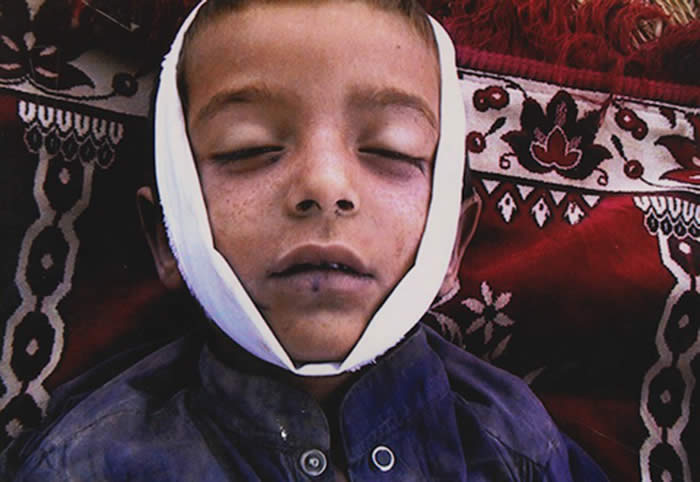
Steve Coll writes: At the Pearl Continental Hotel, in Peshawar, a concrete tower enveloped by flowering gardens, the management has adopted security precautions that have become common in Pakistan’s upscale hospitality industry: razor wire, vehicle barricades, and police crouching in bunkers, fingering machine guns. In June, on a hot weekday morning, Noor Behram arrived at the gate carrying a white plastic shopping bag full of photographs. He had a four-inch black beard and wore a blue shalwar kameez and a flat Chitrali hat. He met me in the lobby. We sat down, and Behram spilled his photos onto a table. Some of the prints were curled and faded. For the past seven years, he said, he has driven around North Waziristan on a small red Honda motorcycle, visiting the sites of American drone missile strikes as soon after an attack as possible.
Behram is a journalist from North Waziristan, in northwestern Pakistan, and also works as a private investigator. He has been documenting the drone attacks for the Foundation for Fundamental Rights, a Pakistani nonprofit that is seeking redress for civilian casualties. In the beginning, he said, he had no training and only a cheap camera. I picked up a photo that showed Behram outdoors, in a mountainous area, holding up a shredded piece of women’s underwear. He said it was taken during his first investigation, in June, 2007, after an aerial attack on a training camp. American and Pakistani newspapers reported at the time that drone missiles had killed Al Qaeda-linked militants. There were women nearby as well. Although he was unable to photograph the victims’ bodies, he said, “I found charred, torn women’s clothing—that was the evidence.”
Since then, he went on, he has photographed about a hundred other sites in North Waziristan, creating a partial record of the dead, the wounded, and their detritus. Many of the faces before us were young. Behram said he learned from conversations with editors and other journalists that if a drone missile killed an innocent adult male civilian, such as a vegetable vender or a fruit seller, the victim’s long hair and beard would be enough to stereotype him as a militant. So he decided to focus on children.Syed Wali Shah, a seven-year-old boy was killed in a 2009 drone strike, along with his parents.
Many of the prints had dates scrawled on the back. I looked at one from September 10, 2010. It showed a bandaged boy weeping; he appeared to be about seven years old. There was a photo of a girl with a badly broken arm, and one of another boy, also in tears, apparently sitting in a hospital. A print from August 23, 2010, showed a dead boy of perhaps ten, the son of an Afghan refugee named Bismillah Khan, who lived near a compound associated with the Taliban fighting group known as the Haqqani network. The boy’s skull had been bashed in. [Continue reading…]
Iran will do a deal with the West — but only if there’s no loss of dignity
Hooman Majd writes: Iran and what we would once have called the great powers – the five permanent members of the UN security council plus Germany – have been engaged in negotiations over the Iranian nuclear programme for well over a decade now. At times the US has been directly involved, and at other less friendly times, indirectly – but never in the years since, to great alarm if not outright panic, the world discovered that Iran possessed a nuclear programme have we been as close to resolving its fate as we are now.
The reasons are myriad; certainly primary among them is the election of a pragmatist US president in 2008, one who, unlike his we-don’t-talk-to-evil predecessor, promised to engage directly with Iran on its nuclear program as well as on other issues of contention between the two countries, and the election of an Iranian president in 2013 who, unlike his predecessor, promised to pursue a “win-win” solution to the crisis. There are other reasons long debated in foreign policy circles. None of them, however, correctly stated or not, are important now.
What is important is to recognise that with only days left to reach a comprehensive agreement – one that would satisfy the minimum requirements of the US and Iran (and the truth is that it is only theirs that matter, despite the presence of other powers at the table) – there may not be another opportunity for a generation. This is the diplomatic perfect storm, if you will, to begin the process of US-Iranian reconciliation. [Continue reading…]
Iran uses China bank to transfer funds to Quds-linked companies
Reuters reports: There is no trace of Shenzhen Lanhao Days Electronic Technology Co Ltd at its listed address in the beige and pink-tiled “Fragrant Villa” apartment complex in this southern Chinese city. The building’s managers say they’ve never heard of it.
But a Western intelligence report reviewed by Reuters says Shenzhen Lanhao is one of several companies in China that receives money from Iran through a Chinese bank. Such transfers help to finance international operations of the Islamic Revolutionary Guards Corps’ elite Quds Force, the report said.
The Quds provides arms, aid and training for pro-Iranian militant groups in the Middle East, such as Hezbollah, Hamas and Shi’ite Muslim militias in Iraq. They have also armed and trained government forces in Syria’s civil war in violation of a U.N. arms embargo, U.S. and European officials say. [Continue reading…]
The Keystone XL’s Senate failure isn’t the end of the pipeline as an act of war
Vi Waln writes: My Lakota people have a phrase – Mni Wiconi – which means “water of life”. Water is also Pejuta – our primary medicine. It is an extremely sacred element without which we cannot live, yet many people take it for granted. They do not realize: when our drinking-water sources are gone or contaminated, humanity will perish.
Water is also present in every single Lakota ceremony at which I pray – it is essential to our ceremonial way of life. Like our ancestors who sacrificed their very lives for our survival, many of us pray for the descendants who will soon stand in our place, and one of our most important prayers is for our descendants to always have an abundance of clean drinking water.
But TransCanada’s Keystone XL oil pipeline (KXL), which the company has proposed building directly over the Ogallala Aquifer, is still an immediate threat to all of us who drink water from that underground reservoir.
The Ogallala Aquifer is a major water supply for eight states, from here in North Dakota down to Texas and all the way out to New Mexico. Without clean water, these eight states will become uninhabitable. Many people – Indian and non-Indian alike – are prepared to fight the pipeline’s construction to protect the water and land, no matter the result of Tuesday evening’s vote in the US Senate.
Many Lakota people in particular view the construction of this pipeline through our treaty territory as a true act of war. [Continue reading…]
The Guardian reports: The most significant attempt yet to force US government approval of the Keystone XL oil pipeline failed narrowly to clear the Senate on Tuesday night as a coalition of Republicans and moderate Democrats fell one vote short of the 60 votes needed for the legislation to pass.
Fourteen Democrats, led by Louisiana senator Mary Landrieu, joined all 45 Republicans in voting for the bill, which called for the controversial energy project to be given immediate go-ahead after years of delay due to environmental concerns.
A similar bill was passed in the House of Representatives on Friday.
But, as expected, the bipartisan coalition failed to win over sufficient wavering Democrats, such as Jay Rockefeller of West Virginia and independent Maine senator Angus King, who joined the party’s leadership and opposed the bill for a total of 41 votes against.
Landrieu, who is fighting to hold on to her seat in a run-off election next month, had called for the bill in a last-ditch effort to shore up her support in Louisiana. She attempted to heal party rifts afterwards, telling reporters in the Senate: “there is no blame, there is only joy in the fight”.
Nevertheless the size of the Democratic rebellion may put additional pressure on the White House to approve construction of the pipeline in future if, as promised, Republicans make a fresh attempt to pass legislation when the new Senate is sworn in next January. [Continue reading…]
Welcome to Netanyahu’s ‘resolution’ to the conflict
Noam Sheizaf writes: Following this morning’s horrifying terror attack, it’s not so difficult to imagine how Naftali Bennett, Avigdor Liberman or Benjamin Netanyahu might describe the current government if they weren’t its leaders. You can almost see them showing up at the scene of the attack and screaming into the microphones denouncing the “wicked government,” recalling every last pogrom in Jewish history.
But no dice. Netanyahu has been prime minister for five years now and Liberman and the settlers, his partners in it. This is all taking place on their watch. If they think that Mahmoud Abbas is the problem — as their public statements declared this morning — then they should deal with him. We all know that’s not going to happen. This government needs Abbas much more than the Palestinians need him. The Palestinian leader has a dual role: he maintains quiet in the West Bank, and is also the punching bag the Israeli Right uses to explain away its reverberating failures.
Netanyahu promised Israelis prosperity and quiet without having to solve the Palestinian conflict. That has been his promise since the 1990s. To Netanyahu, terrorism is just card we’ve been dealt, and only military force can resolve it. There is no problem with continuing to build in the settlements, including inside the Palestinian neighborhoods of Jerusalem, because there is no connection between the settlements and the actions of the Palestinians. That’s what Netanyahu has been saying for decades already — both to the world and to Israelis. There’s no reason to give Palestinians their rights because that endangers Israel: they can make due with “economic peace.” It’s okay to discriminate and legislate against Israel’s Arab citizens. Hell, they should be saying thank you that we even let them live here; things are much worse in every other country in the Middle East. The government is here to serve the Jews, and the Jews only. And if we continue to act this way, aggressively and determinedly, we’ll enjoy stability, security and economic prosperity. That’s Netanyahu’s theory, and the Israeli public bought it because the price was so low and the payoff sky high. We’re not responsible for anything that happens and we don’t have to make any compromises on anything.
At this point any reasonable person should realize what nonsense Bibi has been selling. In recent years Netanyahu has benefited from mere coincidence: Palestinians were tired from the intifada; Abbas decided to try the diplomatic track; the Arab world imploded; and Israel’s high-tech economy was booming. It seems as if Netanyahu has been delivering, but none of those things had anything to do with him. It was all an illusion, an ongoing deception. Since this June we have woken up to the true meaning of Netanyahu’s vision, in which Israel rules over 6 million Palestinians — Israeli citizens, East Jerusalem residents, the subjects of military rule in the West Bank and those besieged in Gaza — and the only thing he’s offering them is more of the same: the cruel hand of the military law, discrimination, violence, land expropriation, home demolitions, mass arrests and bombs from the sky. [Continue reading…]
This is not yet an intifada, Palestinians say
Philip Weiss reports: Palestinians across East Jerusalem say that the violence that is shaking Jerusalem is not an intifada — yet. It is an unorganized Palestinian response to Israeli aggressive actions, including the visits by religious Jews to the Haram al Sharif or Temple Mount in the Old City. But it is not an uprising all over Palestine, as a third intifada would be.
That could begin in the blink of an eye. “Before you will open your eyes– it is a third intifada and bigger than the first and the second,” said Said Radi abu Snad, 75, a man whose house has six times been demolished in Silwan.
I interviewed two dozen Palestinians in East Jerusalem neighborhoods over the last week, and many said that they hope for another intifada. “During the first intifada my shop was only open three hours a day,” a Palestinian businessman who wished to be anonymous explained to me. “But I am crying for those days. We need a third intifada to end the occupation.” He said even businessmen feel they have nothing to lose because Israel has so encircled Jerusalem with checkpoints and Jewish settlements that the Palestinian economy is choked.
A second businessman entered his store and shook his head at the idea. “An intifada will makes things worse. It won’t end the occupation.”
It may be more accurate to describe the violence of the last three months as Benjamin Netanyahu’s intifada. The Israeli prime minister has escalated violent tensions again and again. He encouraged Jewish revenge for the three Israeli teens’ abduction and murders in June, creating fear across East Jerusalem; he conducted raids across the West Bank in June and July before escalating a conflict with Gaza leading to the massacres of hundreds; and lately he has encouraged far-right Jewish zealots to assert their claims at the Al Aqsa mosque and used Palestinian children’s stone-throwing in East Jerusalem to clamp down on those neighborhoods.
“People are willing to do anything because they are losing the hope. I think it could be worse than first intifada,” says Jawad Siyam, an activist against the occupation in Silwan who has been arrested many times. “The Israelis will not take a step back. They will keep attacking Al Aqsa.” [Continue reading…]
Almost 36 million people live in modern slavery
BBC News reports: Nearly 36 million people worldwide, or 0.5% of the world’s population, live as slaves, a survey by anti-slavery campaign group Walk Free says.
The group’s Global Slavery Index says India has the most slaves overall and Mauritania has the highest percentage.
The total is 20% higher than for 2013 because of better methodology.
The report defines slaves as people subject to forced labour, debt bondage, trafficking, sexual exploitation for money and forced or servile marriage.
It uses slavery in a modern sense of the term, rather than as a reference to the broadly outlawed traditional practice where people were held in bondage and treated as another person’s property.
The Global Slavery Index’s estimate is higher than other attempts to quantify modern slavery. In 2012, the International Labour Organisation estimated that almost 21 million people were victims of forced labour. [Continue reading…]
Jerusalem: Historical illiteracy and political exploitation
Nervana Mahmoud writes: While handing me Karen Armstrong’s book A History of Jerusalem, my Jordanian colleague said, “Start from the eighth chapter, the earlier chapters are irrelevant.” Like many Arabs, my colleague has never been interested in the early history of the holy city. He said, “Why should we be? The modern history is more relevant to the city.”
The perpetual turmoil in the city comes from all sides choosing to have a selective memory. Arabs want to ignore the city’s ancient history, which is largely a Jewish history. This Arab indifference is equally matched by Jewish bias against the Arab and Muslim history of the city. In other words, both choose to consider — and twist — half the story of the holy site and ignore the other half. Historical illiteracy does not help in any political fight; in fact it only creates strife.
This mindset on both sides of selectivity and indifference fuels the current tension regarding sanctuary at the Al-Aqsa mosque versus the right of Jews to pray inside the Temple Mount. Ironically, both sides cover and report the recent tension in the Temple Mount in a similar, selective way. Israeli media reported on October 29th how a prominent U.S.-born right-wing activist, who campaigned for greater Jewish access to the Temple Mount was seriously wounded in a Jerusalem shooting. Meanwhile Arabic and Turkish media stressed later clashes on November 5th between Israeli police, settlers and Palestinians at the al-Aqsa mosque.
Tracing a logical, accurate sequence of events in any news related to Jerusalem is always a difficult task. Nonetheless, the basic story here is that Jewish religious groups see the compound as their holy site, and want to lift the ban forbidding Jewish prayer inside. In contrast, Palestinian inhabitants see this group as invaders who want to disrupt the sanctuary of the holy Muslim site. This is a recipe for an explosive environment that can flare up at any time. [Continue reading…]
Deaths linked to terrorism are up 60 percent, study finds
The New York Times reports: As Western governments grapple with heightened apprehension about the spread of Islamic militancy, an independent study on Tuesday offered little solace, saying the number of fatalities related to terrorism soared 60 percent last year.
Pointing to a geographic imbalance, the report by the nonprofit Institute for Economics and Peace said five countries — Afghanistan, Iraq, Nigeria, Pakistan and Syria — accounted for four-fifths of the almost 18,000 fatalities attributed to terrorism last year. Iraq had the bloodiest record of all, with more than 6,300 fatalities.
At the same time, the statistics in the organization’s Global Terrorism Index suggested that the world’s industrialized nations — often the target of threats by groups such as Al Qaeda and the Islamic State, which is also known as ISIS or ISIL — had suffered relatively few attacks on their soil since the Sept. 11, 2001, onslaught in the United States and the July 7, 2005, suicide bombings in London. [Continue reading…]
The roots of Turkish mistrust
Mustafa Akyol writes: A poll by the Pew Research Center in October highlighted a trend in Turkish society with foreign policy implications: Turks hold deeply unfavorable views of other nations. The most disliked nation proved to be Israel, with only 2% of Turks expressing any sympathy for the Jewish state. The United States also turned out to be highly unpopular, with only 19% of polled Turks expressing sympathy. Similarly unpopular were the European Union, China, Brazil and Russia.
One could suspect that Turks’ views of other nations are based on a distaste for all non-Muslims, as Turkey is a predominantly Muslim nation. However, Iran and Saudi Arabia — fellow Muslim nations — proved to be unpopular in the same poll, too. “In fact,” the Pew researchers concluded, “it is hard to find any country or organization the Turkish people really like, except, of course, Turkey itself.”
Yet, one could doubt this conclusion as well, because other polls have shown that the opinions of Turks of one another are not terribly positive either. Different surveys about levels of global “interpersonal trust” have repeatedly shown Turkey is one of the most extreme examples of a distrustful society. In a 2008 poll by World Values Survey, for example, Turkey was at the bottom of a list of 60 different countries rated according to interpersonal trust. Only 4.9% of Turks agreed with the statement, “Most people can be trusted,” equaling the answers from Rwandans, who suffered a genocide 14 years prior to the poll. (In contrast, the highest levels of trust turned out to be in Norway and Sweden, where around 70% of citizens agree with the same statement.) [Continue reading…]
40,000 Maasai told to leave their ancestral land to make way for UAE big-game hunting company

The Guardian reports: Tanzania has been accused of reneging on its promise to 40,000 Masai pastoralists by going ahead with plans to evict them and turn their ancestral land into a reserve for the royal family of Dubai to hunt big game.
Activists celebrated last year when the government said it had backed down over a proposed 1,500 sq km “wildlife corridor” bordering the Serengeti national park that would serve a commercial hunting and safari company based in the United Arab Emirates.
Now the deal appears to be back on and the Masai have been ordered to quit their traditional lands by the end of the year. Masai representatives will meet the prime minister, Mizengo Pinda, in Dodoma on Tuesday to express their anger. They insist the sale of the land would rob them of their heritage and directly or indirectly affect the livelihoods of 80,000 people. The area is crucial for grazing livestock on which the nomadic Masai depend.
Unlike last year, the government is offering compensation of 1 billion shillings (£369,350), not to be paid directly but to be channelled into socio-economic development projects. The Masai have dismissed the offer.
“I feel betrayed,” said Samwel Nangiria, co-ordinator of the local Ngonett civil society group. “One billion is very little and you cannot compare that with land. It’s inherited. Their mothers and grandmothers are buried in that land. There’s nothing you can compare with it.”
Nangiria said he believes the government never truly intended to abandon the scheme in the Loliondo district but was wary of global attention. “They had to pretend they were dropping the agenda to fool the international press.” [Continue reading…]
As Proudhon wrote, property is theft.
The land on which indigenous populations depend is invariably land upon which no conception of ownership has ever been imposed.
The people belong to the land.
Conquest and settlement invert this relationship, create property, and then assert exclusive rights over that property.
These assertions are inherently abusive because they mean that the land has been enslaved and now exists in the service of its owners.
In the case of the Maasai ancestral lands, the fact that these lands will be turned over to big-game hunters to indulge in regal rituals of slaughter — opportunities for sclerotic, impotent tycoons to pretend they are more virile than lions — fittingly illustrates the destructive nature of ownership.
All signs point toward ethnocracy, not democracy, in Israel
Aeyal Gross writes: In 2000, the High Court of Justice ruled in the Kadan case that the state must not discriminate in the allocation of state lands, and was thus forbidden to build on its lands communities that exclude Arabs. If the proposed Basic Law on Israel as the Nation-State of the Jewish People being advanced by coalition chairman MK Zeev Elkin (Likud) passes, this ruling is liable to be overridden.
Elkin’s bill states that the government is permitted to allow members of the same nationality or religion to develop separate communities. Essentially, this means it would be constitutionally valid to allocate separate lands for Jews and Arabs – and separate, as we well know, is never equal. This echoes the justification given in South Africa for their apartheid regimes and separate land allocations. Each group, it was argued then, was entitled to its “separate development.”
Another court ruling that could fall by the wayside requires the municipalities of mixed cities to display dual-language (Hebrew and Arabic) signage. While the proposed basic law speaks of Arabic’s “special” status, Hebrew would be the state’s only official language if the bill passes.
Both these examples demonstrate how the proposed law could bring about a retreat in the realm of equality – although, even now, the situation is far from ideal. [Continue reading…]
The whole world needs feminism, but the Middle East needs it acutely
Elif Shafak writes: After a talk I gave in London a woman in the audience approached me: middle-aged, tall, and wearing a designer dress. Although she agreed with me on various issues she could not understand why I was critical of military takeovers. “In the Middle East a coup d’état is the only way forward,” she said. “If it weren’t for [Egypt’s president] General Sisi, modern women like me, like yourself, would end up in a burka. He’s there to protect the likes of us.”
As I listened to her, I recalled scenes from my childhood in Turkey. I remembered my mother saying that we should be grateful to General Kenan Evren, who led the coup d’état in 1980, for protecting women’s rights. After the military seized power, a number of pro-women steps were taken, including the legalisation of abortion. Yet the coup would eventually bring about massive human rights violations and systematic torture in police headquarters and prisons, particularly against the Kurds, maiming Turkey’s civil society and democracy for decades to come.
Female adulation of male autocrats is widespread throughout the Middle East. I have met Syrian women who have tried to convince me that Bashar al-Assad is the best option for modern women. The Syrian regime seems aware of this rhetoric, recruiting hundreds of so-called Lionesses for National Defense , who are said to be fighting against Islamic fundamentalism and defending women’s freedom. [Continue reading…]
Digital doublethink: Playing truth or dare with Putin, Assad and ISIS
Christopher Dickey writes: The videos of American and British hostages being beheaded are so valuable to ISIS as memes of power and fear that now it has murdered a convert to Islam: Peter Kassig, 26, whose sole desire after serving in Iraq was to return to the region to help suffering civilians. Kassig had acknowledged the one God and His one Messenger, taken the name Abdel Rahman (Servant of the Merciful) and prayed five times a day, according to his parents. The Prophet would have understood, and spared him. The thugs of ISIS simply used him.
Such is the world of doublethink and triplethink.
Orwell put his finger on the core problem years before he wrote 1984. In wars, everybody lies. We do, they do, the victimizers and the victims do, too. But totalitarianism is different. Putin, Assad and ISIS all aspire to the kind of complete control that Stalin, Hitler, or the caliphs once had: total domination over their own people, brutal intimidation of their enemies. And, as Orwell wrote in a 1944 essay, “the really frightening thing about totalitarianism is not that it commits ‘atrocities’ but that it attacks the concept of objective truth: it claims to control the past as well as the future.”
Orwell hoped, without complete confidence, that “the liberal habit of mind, which thinks of truth as something outside yourself, something to be discovered, and not as something you can make up as you go along, will survive.”
One hopes. But 70 years after Orwell wrote those words, doublethink seems to be winning.
How journalists became worth more dead than alive
Jeffrey Goldberg writes: The extremists don’t need us anymore. Fourteen years ago, while I was staying at the Taliban madrasa [outside of Peshawar, in Pakistan], its administrators were launching a Web site. I remember being amused by this. I shouldn’t have been. There is no need for a middleman now. Journalists have been replaced by YouTube and Twitter. And when there is no need for us, we become targets.
Three years ago, Dexter [Filkins] and I both found ourselves in Pakistan again, staying in the same anonymous guesthouse in Islamabad, which seemed safer than any alternative. Especially after the killing of Osama bin Laden, when so many people in Pakistan were contemplating revenge, the large hotels had become irresistible targets for terrorists. They were also infested with agents of the Inter-Services Intelligence (ISI) directorate, the handmaiden of many of the terrorist groups.
I was reporting on the security of Pakistan’s nuclear weapons; Dexter was investigating the murder of a Pakistani journalist who was killed, apparently, by agents of the ISI. Both topics were dangerous territory, and we came under harassment. I was followed; Dexter’s phone was tapped. Each time I returned to the guesthouse, I could tell that strangers had been in my room. One day, I got a call from someone who identified himself as a reporter for a major Urdu daily newspaper. “We understand that you’re a prominent Zionist, and we want to write about you on the front page,” he said.
Such an article would have gotten me killed. The reporter’s call represented an invitation from the ISI to leave Pakistan right away. I knocked on Dexter’s door. He had been in the country for a month, and he seemed haunted. His room reminded me of Martin Sheen’s in the opening scene of Apocalypse Now. Time to go, I said. In the taxi to the airport, we discovered that Dexter’s visa had expired. We edited his passport with a Sharpie, while standing behind a tree outside the terminal. The ISI did not impede our departure.
Each unhappy place has its own rules. In Iran, Western reporters are often welcome, and sometimes arrested while performing their duties. In Gaza over the summer, Hamas, the Muslim Brotherhood’s Palestinian branch, was both eager to help reporters inspect the damage done by Israeli air strikes, and rigorous about denying reporters access to the rocket crews launching attacks on Israeli civilians. In Lebanon, Hezbollah maintains a sophisticated media-relations operation designed in part to thwart independent reporting.
I no longer spend much time with Islamist groups. Today, even places that shouldn’t be dangerous for journalists are dangerous. Whole stretches of Muslim countries are becoming off-limits. This is a minor facet of a much larger calamity, but it has consequences: the problems of Afghanistan and Pakistan and Syria and Iraq are not going away; our ability to see these problems, however, is becoming progressively more circumscribed. [Continue reading…]
Why moral character is the key to personal identity
Nina Strohminger writes: One morning after her accident, a woman I’ll call Kate awoke in a daze. She looked at the man next to her in bed. He resembled her husband, with the same coppery beard and freckles dusted across his shoulders. But this man was definitely not her husband.
Panicked, she packed a small bag and headed to her psychiatrist’s office. On the bus, there was a man she had been encountering with increasing frequency over the past several weeks. The man was clever, he was a spy. He always appeared in a different form: one day as a little girl in a sundress, another time as a bike courier who smirked at her knowingly. She explained these bizarre developments to her doctor, who was quickly becoming one of the last voices in this world she could trust. But as he spoke, her stomach sank with a dreaded realisation: this man, too, was an impostor.
Kate has Capgras syndrome, the unshakeable belief that someone – often a loved one, sometimes oneself – has been replaced with an exact replica. She also has Fregoli syndrome, the delusion that the same person is taking on a variety of shapes, like an actor donning an expert disguise. Capgras and Fregoli delusions offer hints about an extraordinary cognitive mechanism active in the healthy mind, a mechanism so exquisitely tuned that we are hardly ever aware of it. This mechanism ascribes to each person a unique identity, and then meticulously tracks and updates it. This mechanism is crucial to virtually every human interaction, from navigating a party to navigating a marriage. Without it, we quickly fall apart. [Continue reading…]