Category Archives: Analysis

Europe’s bird population has fallen by over 420 million in three decades

The Guardian reports: Bird populations across Europe have decreased by over 420 million in the past 30 years, according to a study that brings together the results of scientific surveys in 25 countries. While some rarer species have seen an increase in numbers due to concerted conservation efforts, more common species across Europe are facing a steep decline.

Some of the birds that have suffered the most alarming declines are the most well known species including the house sparrow which has fallen in number by 147m or 62%, the starling (53%) and skylark (46%).

The study looked at 144 species across Europe between 1980 and 2009. Dividing the species up into four groups, from extremely rare to most common, analysts found that a small number of common species declined by over 350 million –over 80% of the total population decline of birds in that time period overall. Rarer birds, in contrast, increased by over 21,000 in the same time period.

The results indicate that efforts at conserving rarer species seem to be having an impact but may be too narrow an approach, possibly at the expense of more common species. [Continue reading…]

Facebooktwittermail

Kobanê resists ISIS — but Turkey still can’t get the Kurdish question right

By Cengiz Gunes, The Open University

The biggest new development in the ongoing conflict between the Kurds and Islamic State has been the growing co-operation between the Kurdish movements in Iraq and Syria – a phase change that forces to upend the whole question of Kurdish politics.

The link-up between Kurdish movements across borders has been a major security coup. It first paved the way for a US airdrop of weapons, ammunition and medical supplies on October 20, resources which were sent to defend the town of Kobanê, which has been under siege from IS for seven weeks. We’ve also seen the deployment of Iraqi-Kurdish Peshmerga fighters, armed with heavy weapons such as artillery and anti-tank missiles.

These events have run contrary to many analysts’ initial expectation that Kobanê’s fall to IS was a foregone conclusion – and the exemplary resistance of Kurdish forces has drawn the support of both the international coalition and the Peshmerga forces.

But winning the support of the international coalition is a major development for the Kurds’ entire political cause, not just for their fight against IS.

Previously, the US authorities rejected the idea of working with the Kurds in Syria at all, on the grounds that the main Kurdish political party in Syria – Democratic Union Party (PYD) – has links to the Kurdistan Workers’ Party (PKK), which is on the US’s list of terrorist organisations.

But the Kurds’ response was astute and effective – and has forced the US’s hand. The Syrian Kurdish political parties met in Duhok, in the Kurdistan Region of Iraq, to establish a joint administration for Syria’s Kurdish-controlled areas. The Kurds of Syria and Iraq knew that closer co-operation could make them an important force in the international fight against IS – which in turn is likely to increase their clout in regional politics in general.

But even with this new-found solidarity, any effort to properly integrate the Kurds into the existing regional power equation will have to clear significant hurdles.

Continue reading

Facebooktwittermail

The Kurds’ lonely fight against ISIS

Der Spiegel reports: The headquarters of one the world’s mightiest terrorist organization is located in the mountains northeast of Erbil, Iraq. Or is it the nerve center of one of the Western world’s most crucial allies? It all depends on how one chooses to look at the Kurdistan Workers’ Party (PKK).

All visits to the site in northern Iraq’s Qandil Mountains must first be authorized by PKK leaders, and the process is not immediate. But after days of waiting, our phone finally rings. “Get ready, we’re sending our driver,” the voice at the other end of the line says. He picks us up in the morning and silently drives us up the winding roads into the mountains. At one point, we pass the burned out remains of a car destroyed by Turkish bombs three years ago, killing the family inside. The wreckage has been left as a kind of memorial. The driver points to it and breaks his silence. “Erdogan has gone nuts,” he says.

Just behind the Kurdish autonomous government’s final checkpoint, the car rounds a bend in the road and suddenly Abdullah Öcalan’s iconic moustache appears, part of a giant mural made of colored stones on the opposite hillside. The machine-gun toting guards wear the same mustache. “Do you have a permit, colleagues?” they ask.

Officially, we’re in the Kurdish autonomous region in northern Iraq. Really, though, it is a PKK state. A region of 50 square kilometers (19 square miles) of rugged, mountainous territory, it provides a home for PKK leadership in addition to training camps for fighters. It also has its own police force and courts. The surrounding hillsides are idyllic with their pomegranate trees, flocks of sheep and small stone huts. But they are also dotted with Humvees, captured by the PKK from the Islamic State terrorist militia, which had stolen them from the Iraqi army.

It is here in the Qandil Mountains that PKK leaders coordinate their fight against Islamic State jihadists in the Syrian town of Kobani and in the Iraqi metropolis of Kirkuk in addition to the ongoing battle in the Sinjar Mountains. Turkey, some fear, could soon be added to the list. [Continue reading…]

Facebooktwittermail

The motivations of Syrian Islamist fighters

Vera Mironova, Loubna Mrie, and Sam Whitt write: With the Syrian civil war now well into its third year, there are scores of armed rebel forces fighting against the Bashar al-Assad regime, as well as against one another. In the marketplace of rebel groups vying for support, rebel fighters are offered incentives and face coercive pressures to join one group over another. The weakening of the Free Syrian Army (FSA) over the past year has led many Syrian rebels to rethink their allegiances on the battlefield. Possible suitors include nominally “Islamist” groups, including moderate revolutionary organizations like Ahrar al-Sham. A growing concern, however, is that rebels may be driven into the ranks of more extremist organizations such as Jabhat al-Nusra (JN) and the Islamic State in Iraq and the Levant (ISIL). This leads to a key question: what inspires thousands of ordinary Syrian people to join up with Islamist groups in Syria and Iraq?

To understand who these Syrian fighters are and what motivates them, the authors have been conducting survey research from inside Syria. Over the past year, the authors have surveyed more than 300 FSA fighters as well as Syrian civilians and refugees and 50 Syrian Islamist fighters in the Islamic Front (Ahrar al-Sham) and JN, the latter of which is al-Qa`ida’s affiliate in Syria.

This article proceeds by presenting a series of questions as the authors gave them to the interview subjects. It then discusses the implications that arise from their answers. To briefly summarize the findings, the interviews reveal that in contrast to foreign fighters, who have generally come to Syria on a quest for spiritual fulfillment and to build an Islamic state through jihad, Syrian fighters are joining Islamist groups primarily for instrumental purposes. Islamic groups are perceived as better equipped, led, and organized, and therefore are seen as more capable of defeating the al-Assad regime, which remains the primary goal of Syrian rebels. [Continue reading…]

Facebooktwittermail

Insurgent in-fighting — how far will the Jabhat al-Nusra offensive go?

Scott Lucas writes: Headlines from Syria continue to be seized by the insurgent in-fighting in Idlib Province in the northwest, with the Islamist faction Jabhat al-Nusra taking the main positions of the Syrian Revolutionary Front and the Harakat Hazm brigade, both of whom have received support from the US.

There were no further reports of Jabhat al-Nusra advances on Sunday, after the faction took the main bases of the SRF and Harakat al-Hazm on Friday and Saturday.

The in-fighting began last Monday, amid claims that the SRF was “sitting on its hands” as other insurgents — led by Jabhat al-Nusra — pursued an offensive against the regime in Idlib city. After SRF fighters defected to other brigades, the SRF leader Jamal Maarouf tried to recover their weapons with raids on houses and reportedly some shelling of villages.

Jabhat al-Nusra, joined by the faction Jund al-Aqsa — which is mainly made up of foreign fighters — hit back hard. In the process, they attacked checkpoints of Harakat Hazm which tried to block their reinforcements.

Jabhat al-Nusra declared a unilateral ceasefire on Saturday, but demanded that the SRF and Maarouf appear in a Sharia court which is dominated by the Islamist faction. There is no sign of Maarouf’s compliance.

Meanwhile, other groups in the insurgency, including the Free Syrian Army and the Islamic Front, have called for a lasting cease-fire and a concentration on the fight against the Assad regime. They have also called for submission of disputes to a Sharia court — meaning an alternative Idlib court, not the one dominated by Jabhat al-Nusra.

Jabhat al-Nusra’s offensive was based in part on long-standing grievances with the SRF, which has been accused of war profiteering, corruption, and theft of supplies and weapons from other groups in the insurgency. This autumn, Jabhat al-Nusra and the Islamic Front announced a drive against “corruption” in northwest Syria which led to some skirmishes with SRF members.

The offensive may also be a response to the US, which attacked Jabhat al-Nusra positions in Idlib and Aleppo Provinces last month, on the first day of its aerial intervention in Syria. More than 60 Jabhat al-Nusra fighters and at least 14 civilians died in the missile strikes.

Leading activists said the US attacks bolstered support for Jabhat al-Nusra among Syrians. [Continue reading…]

Facebooktwittermail

Who controls which area in Syria, November 1, 2014

Facebooktwittermail

Breaking the power of the fossil fuel industry won’t be easy

Bill McKibben writes: The scientists have done their job [describing the effects of climate change]; no sentient person, including GOP Senate candidates, can any longer believe in their heart of hearts that there’s not a problem here. The scientific method has triumphed: over a quarter of a century, researchers have reached astonishing consensus on a basic problem in chemistry and physics.

And the engineers have done just as well. The price of a solar panel has dropped more than 90% over the last 25 years, and continues to plummet. In the few places they’ve actually been deployed at scale, the results are astonishing: there were days this summer when Germany generated 75% of its power from the wind and the sun.

That, of course, is not because Germany is so richly endowed with sunlight (it’s a rare person who books a North Sea beach holiday). It’s because the Germans have produced a remarkable quantity of political will, and put it to good use.

As opposed to the rest of the world, where the fossil fuel industry has produced an enormous amount of fear in the political class, and kept things from changing. Their vast piles of money have so far weighed more in the political balance than the vast piles of data accumulated by the scientists. In fact, the IPCC can calculate the size of the gap with great exactness. To get on the right track, they estimate, the world would have to cut fossil fuel investments by annually between now and 2029, and use the money instead to push the pace of renewables.

That’s a hard task, but not an impossible one. Indeed, the people’s movement symbolised by September’s mammoth climate march in New York, has begun to make an impact in dollars and cents. A new report this week shows that by delaying the Keystone pipeline in North America protesters have prevented at least $17bn in new investments in the tar sands of Canada – investments that would have produced carbon equivalent to 735 coal-fired power plants. That’s pretty good work. [Continue reading…]

Facebooktwittermail

Effects of climate change ‘irreversible,’ IPCC warns in new report

The Guardian reports: The Earth is locked on an “irreversible” course of climatic disruption from the buildup of greenhouse gases in the atmosphere, and the impacts will only worsen unless nations agree to dramatic cuts in pollution, an international panel of climate scientists warned Sunday.

The planet faces a future of extreme weather, rising sea levels and melting polar ice from soaring levels of carbon dioxide and other gases, the U.N. panel said. Only an unprecedented global effort to slash emissions within a relatively short time period will prevent temperatures from crossing a threshold that scientists say could trigger far more dangerous disruptions, the panel warned.

“Continued emission of greenhouse gases will cause further warming and long-lasting changes in all components of the climate system, increasing the likelihood of severe, pervasive and irreversible impacts,” concluded the report by the United Nations’ Intergovernmental Panel on Climate Change (IPCC), which draws on contributions from thousands of scientists from around the world.

The report said some impacts of climate change will “continue for centuries,” even if all emissions from fossil-fuel burning were to stop. The question facing governments is whether they can act to slow warming to a pace at which humans and natural ecosystems can adapt, or risk “abrupt and irreversible changes” as the atmosphere and oceans absorb ever-greater amounts of thermal energy within a blanket of heat-trapping gases, according to scientists who contributed to the report.

“The window of opportunity for acting in a cost-effective way — or in an effective way — is closing fast,” said Michael Oppenheimer, a Princeton University geosciences professor and contributing author to the report. [Continue reading…]

See the 40-page summary of the Climate Change 2014 Synthesis Report and the 116-page complete report.

Facebooktwittermail

Tackling climate change: America’s failure to lead by example

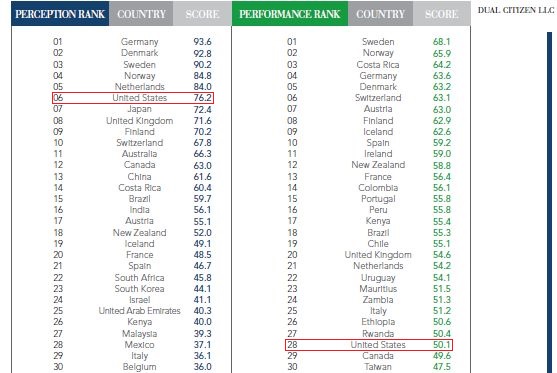
Since 2010, the Global Green Economy Index has been tracking the transition away from fossil-fuel based economies, consider two elements of a green economy: perception and performance. Countries with a high perception score are viewed as environmentally conscious leaders, while performance measures actual investment in green energy, overall infrastructure and development.

In these terms, the U.S. ranks #6 in perception, just behind the leading northern European countries, but #28 in performance, ranking below countries such as Costa Rica, Colombia, Peru, Kenya, Brazil, Chile, Uruguay, Mauritius, Zambia, Ethiopia, and Rwanda.

Global-Green-Economy-Index

China and India are also failing to match performance with perception — China ranks #13 in perception and #55 in performance, while India ranks #16 and #49.

Sweden and Norway stand out in having performance rankings (#1 and #2) that are slightly better than their perception rankings (#3 and #4) — two countries that face the high energy demands created by cold climates, short winter days, and extensive road systems.

Facebooktwittermail

Why Republicans keep telling everyone they’re not scientists

The New York Times reports: Gov. Rick Scott of Florida, a Republican who is fighting a Democratic challenge from former Gov. Charlie Crist, was asked by The Miami Herald if he believes climate change is significantly affecting the weather. “Well, I’m not a scientist,” he said.

Senator Mitch McConnell of Kentucky, who is locked in a tight re-election race, was asked this month by The Cincinnati Enquirer if he believes that climate change is a problem. “I’m not a scientist,” he said.

House Speaker John A. Boehner, when asked by reporters if climate change will play a role in the Republican agenda, came up with a now-familiar formulation. “I’m not qualified to debate the science over climate change,” he said.

“I’m not a scientist,” or a close variation, has become the go-to talking point for Republicans questioned about climate change in the 2014 campaigns. In the past, many Republican candidates questioned or denied the science of climate change, but polls show that a majority of Americans accept it — and support government policies to mitigate it — making the Republican position increasingly challenging ahead of the 2016 presidential elections.

“It’s got to be the dumbest answer I’ve ever heard,” said Michael McKenna, a Republican energy lobbyist who has advised House Republicans and conservative political advocacy groups on energy and climate change messaging. “Using that logic would disqualify politicians from voting on anything. Most politicians aren’t scientists, but they vote on science policy. They have opinions on Ebola, but they’re not epidemiologists. They shape highway and infrastructure laws, but they’re not engineers.” [Continue reading…]

Facebooktwittermail

White House-Pentagon friction reveals weakness of coalition against ISIS

Mark Perry writes: When U.S. President Barack Obama appointed retired Marine Gen. John Allen to serve as his special envoy to the global coalition against the Islamic State, the news was greeted with applause from the jihadi group’s greatest enemies. Kurdish and Iraqi Sunni leaders welcomed the appointment, with good reason — these same leaders had requested that Allen, widely known as one of Obama’s favorite generals, be appointed to the position.

But not everyone was pleased, especially at the Pentagon, where top generals had deep misgivings over how Obama had chosen to manage the campaign against the Islamic State.

Among the dissenters was the head of U.S. Central Command, Gen. Lloyd Austin, who took a dim view of Allen’s role. Austin complained to aides that Allen would report directly to the president — bypassing both himself and Gen. Martin Dempsey, the chairman of the Joint Chiefs of Staff. Austin believed that Allen’s appointment would lead to confusion about who was really leading the effort, a senior U.S. officer who serves with Austin told me several days after the appointment. “Why the hell do we need a special envoy — isn’t that what [Secretary of State] John Kerry’s for?” this senior officer asked.

Austin’s private doubts echoed the deep skepticism among a host of serving and retired officers who served in the region, this same senior officer said. [Continue reading…]

The Daily Beast reports: Top military leaders in the Pentagon and in the field are growing increasingly frustrated by the tight constraints the White House has placed on the plans to fight ISIS and train a new Syrian rebel army.

As the American-led battle against ISIS stretches into its fourth month, the generals and Pentagon officials leading the air campaign and preparing to train Syrian rebels are working under strict White House orders to keep the war contained within policy limits. The National Security Council has given precise instructions on which rebels can be engaged, who can be trained, and what exactly those fighters will do when they return to Syria. Most of the rebels to be trained by the U.S. will never be sent to fight against ISIS.

Making matters worse, military officers and civilian Pentagon leaders tell The Daily Beast, is the ISIS war’s decision-making process, run by National Security Adviser Susan Rice. It’s been manic and obsessed with the tiniest of details. Officials talk of sudden and frequent meetings of the National Security Council and the so-called Principals Committee of top defense, intelligence, and foreign policy officials (an NSC and three PCs in one week this month); a barrage of questions from the NSC to the agencies that create mountains of paperwork for overworked staffers; and NSC insistence on deciding minor issues even at the operational level.

“We are getting a lot of micromanagement from the White House. Basic decisions that should take hours are taking days sometimes,” one senior defense official told The Daily Beast.

Other gripes among the top Pentagon and military brass are about the White House’s decision not to work with what’s left of the existing Syrian moderate opposition on the ground, which prevents intelligence sharing on fighting ISIS and prevents the military from using trained fighters to build the new rebel army that President Obama has said is needed to push Syrian President Bashar al-Assad into a political negotiation to end the conflict. [Continue reading…]

Facebooktwittermail

Hustlers, con men & dupes cashing in on the war on terror

Jeff Stein writes: At long last we can retire Bob Woodward and Carl Bernstein as the icons of investigative reporting. With his second book probing the dark tunnels of the so-called war on terror, James Risen has established himself as the finest national security reporter of this generation, a field crowded with first-rank talent at The Washington Post, Wall Street Journal, Associated Press, Reuters, McClatchy Newspapers and the New York Times, his employer and sometimes bane.

Bane, because in 2004, the executive editor of the Times, cowed by Bush administration officials, twice spiked Risen’s story revealing that the National Security Agency had launched a massive, covert wiretapping program that was riffling through the personal communications of hundreds of millions of Americans without even a secret court order. Unbowed, Risen got a contract for a book that would reveal the NSA’s extralegal program. Only when the publication of State of War: The Secret History of the CIA and the Bush Administration appeared imminent did his editors, cornered, allow Risen to publish a version of it (co-authored with his colleague Eric Lichtblau) in the paper. And that disturbing saga provides the backdrop to Risen’s new book, Pay Any Price: Greed, Power and Endless War.

After turning the last page of his latest volume, one might wonder what other important stories the Times has spiked in recent years. Although parts of Risen’s new revelations have been published in the Times or elsewhere, here they are fleshed out in richly reported chapters studded with eye-popping new charges. Read together, they offer an original and deeply disturbing perspective on the war on terror. It is, Risen writes, a story of “how greed and the hunt for cash have all too often become the main objects of the war on terror.”

In fine detail, he demonstrates how the courts, Congress and the national security and law enforcement agencies of the executive branches – aided and abetted by the high priests of the media – have been corrupted in the hugely profitable business of pursuing terrorists. “[T]he search for money and power have become the hallmarks of the war on terror,” Risen writes of one of the many unsavory episodes in the book. “The story,” he says of another episode, “shows how, during the war on terror, greed and ambition have been married to unlimited rivers of cash in the sudden deregulation of American national security to create a climate in which clever men could seemingly create rogue intelligence operations with little or no adult supervision.”

The U.S.-led war in Iraq, as we already know, was rife with lax supervision and thievery. But Risen adds an astonishing new chapter to that reprehensible folly. He tells the story of how billions of dollars intended to rebuild Iraq, shrink-wrapped in packets of $100 bills, were shipped out of a Federal Reserve warehouse in New Jersey to Baghdad and eventually made their way to secret Lebanese bunkers (an account excerpted by the Times last week).

“Approximately $2 billion of the money that was flown from the United States to Baghdad” to prop up the Iraqi government after Saddam Hussein was toppled, “was stolen and secretly transported out of Iraq in what may be one of the largest robberies in modern history,” he writes. “…In addition to cash, hundreds of millions of dollars worth of gold was stolen from the Iraqi government and is also being hidden in Lebanon, current and former U.S. officials have said.”

One might assume that U.S. officials would be deeply interested in finding out what happened to that money, not to mention eager to get it back. But, no. [Continue reading…]

Facebooktwittermail

Evidence of Assad’s use of mass murder provokes outrage but nothing more from the U.S.

The New York Times reports: Wearing a blue hood to shield his identity, a former Syrian police photographer briefed a congressional committee over the summer on the photos he had smuggled out of the country to document the deaths of thousands of prisoners killed in President Bashar al-Assad’s jails. At a White House meeting, President Obama’s senior aides welcomed him as a man of uncommon courage who had revealed unspeakable atrocities.

But now the Syrian government’s most celebrated defector, who uses the pseudonym Caesar, is no longer optimistic that the United States has the will to stop the abuses that have shocked the conscience of the world.

His photographs have generated outrage but no fresh action against the Assad government. And instead of intervening militarily to support opponents of Mr. Assad, Mr. Obama is mounting airstrikes to defend Kurds, Yazidis and Turkmen in Syria and Iraq from the Islamic State.

“I completely understand how he came to the defense of two American victims killed by the extremist ISIS terror group,” Caesar said in a message earlier this month from an undisclosed location in Europe that was conveyed by the Coalition for Democratic Syria, a Syrian-American organization that sponsored his trip to Washington. “But I and millions of Syrians feel depressed when we see that the killer of thousands of prisoners is left unchecked,” he added. “I believe my cause demands action and a clear position by the president of the United States.”

Caesar’s complaint reflects a broader discontent within the moderate Syrian opposition that is posing a new challenge for the Obama administration’s strategy to counter the Islamic State, which is also known as ISIS or ISIL. While ruling out United States military intervention against Mr. Assad, the administration has committed to training thousands of opposition fighters in Saudi Arabia and Turkey so they can eventually defend territory in Syria that is wrested from the Islamic State’s control. But those fighters must come from the same constituency that has been increasingly troubled by the American reluctance to act more forcefully against Mr. Assad.

“There is a sense that there is discrimination against them, that the atrocities they are suffering at the hands of Assad are somehow less deserving than what is befalling other communities,” said Emile Hokayem, an expert on Middle East affairs at the International Institute for Strategic Studies. “For most of these rebels, Assad is the greatest evil, not ISIL. For the U.S., it is the opposite,” he said. [Continue reading…]

Facebooktwittermail

The U.S. can’t effectively promote democracy abroad unless it works better at home

Larry Diamond writes: In the global democracy promotion community, few actors are paying attention to the growing signs of fragility in the more liberal developing democracies, not to mention the more illiberal ones.

Broadly, we know why democracy and freedom are slipping back. What Francis Fukuyama calls “neo-patrimonial” tendencies are resurgent. Leaders who think they can get away with it are eroding democratic checks and balances, hollowing out accountability institutions, overriding term limits and normative restraints, and accumulating power and wealth for themselves and their families, cronies, clients, and parties.

Space for opposition parties, civil society, and the media is shrinking, and international support for them is drying up. Ethnic, religious, and other identity cleavages polarize many societies that lack well-designed democratic institutions to manage those cleavages. State structures are too often weak and porous, unable to secure order, protect rights, meet the most basic social needs, or rise above corrupt, clientelistic, and predatory impulses. Democratic institutions — parties and parliaments — are often poorly developed, and the bureaucracy lacks the policy expertise, and even more so the independence, neutrality, and authority, to effectively manage the economy. So weak economic performance, and certainly rising inequality, is added to the mix.

It isn’t easy to develop democracy in poor countries and weak states. And there is a significant failure rate even in middle-income countries. But if we don’t become more focused, more creative, more determined, more resourceful, and less apologetic in promoting democracy, the democratic recession is going to mutate into a wave of democratic regression, a bleak period for freedom, political stability, and the American national interest.

So what is to be done?

We need to begin by disaggregating the problem. Let’s start at the top of the hierarchy of democratic development and work down. I used to add at the end of this kind of lecture a reflective caveat,

“Physician, heal thyself.” In other words, we can’t be credible and effective in promoting democracy abroad if we don’t reform and improve its functioning at home. That was usually the last imperative I mentioned. Now it needs to be the first.

Like many of you who travel widely, I am increasingly alarmed by how pervasive and corrosive is the worldwide perception — in both autocracies and democracies — that American democracy has become dysfunctional and is no longer a model worth emulating. Fortunately, there are many possible models, and most American political scientists never recommended that emerging democracies copy our own excessively veto-ridden institutions. Nevertheless the prestige, the desirability, and the momentum of democracy globally are heavily influenced by perceptions of how it is performing in its leading examples. If we do not mobilize institutional reforms and operational innovations to reduce partisan polarization, encourage moderation and compromise, energize executive functioning, and reduce the outsized influence of money and special interests in our own politics, how are we going to be effective in tackling these kinds of challenges abroad? [Continue reading…]

Facebooktwittermail

Airstrikes against ISIS do not seem to have affected flow of fighters to Syria

The Washington Post reports: More than 1,000 foreign fighters are streaming into Syria each month, a rate that has so far been unchanged by airstrikes against the Islamic State and efforts by other countries to stem the flow of departures, according to U.S. intelligence and counterterrorism officials.

The magnitude of the ongoing migration suggests that the U.S.-led air campaign has neither deterred significant numbers of militants from traveling to the region nor triggered such outrage that even more are flocking to the fight because of American intervention.

“The flow of fighters making their way to Syria remains constant, so the overall number continues to rise,” a U.S. intelligence official said. U.S. officials cautioned, however, that there is a lag in the intelligence being examined by the CIA and other spy agencies, meaning it could be weeks before a change becomes apparent.

The trend line established over the past year would mean that the total number of foreign fighters in Syria exceeds 16,000, and the pace eclipses that of any comparable conflict in recent decades, including the 1980s war in Afghanistan. [Continue reading…]

No one needs to be a foreign policy sage to understand that as much as anything else, ISIS is a product of the war in Iraq. But this observation barely qualifies as analysis — it’s more of a harumph; a way of bemoaning another of the consequences of a catastrophic military misadventure. Least of all should it be taken as a prescription for courses of action to be taken or avoided.

To say, for instance, that ISIS is a product of war and therefore more war will have the same effect is to treat war as having a homogeneous nature which in truth it lacks.

As is oft repeated: war is the continuation of politics by other means. But ISIS repeatedly makes it clear how it insists on practicing politics — submit to its rule or face death. It is ISIS which precludes non-military alternatives.

There really shouldn’t be much debate about whether ISIS needs to be fought. The real questions are about who fights, what are realistic goals, and what is the strategic context?

But the fight against ISIS should be a catalyst for and not a distraction from consideration of the region’s deeper ailments only some of which can be attributed to interference by external powers and the injurious effect of Zionism.

Either this continues to be a region that perceives itself through its own divisions or it engages in the long struggle of finding a common purpose. Hopefully that struggle does not have to postponed until after the death of every current national leader.

Facebooktwittermail

Foreign jihadists flocking to Iraq and Syria on ‘unprecedented scale’ says U.N. report

The Guardian reports: The United Nations has warned that foreign jihadists are swarming into the twin conflicts in Iraq and Syria on “an unprecedented scale” and from countries that had not previously contributed combatants to global terrorism.

A report by the UN security council, obtained by the Guardian, finds that 15,000 people have travelled to Syria and Iraq to fight alongside the Islamic State (Isis) and similar extremist groups. They come from more than 80 countries, the report states, “including a tail of countries that have not previously faced challenges relating to al-Qaida”.

The UN said it was uncertain whether al-Qaida would benefit from the surge. Ayman al-Zawahiri, the leader of al-Qaida who booted Isis out of his organisation, “appears to be maneuvering for relevance”, the report says.

The UN’s numbers bolster recent estimates from US intelligence about the scope of the foreign fighter problem, which the UN report finds to have spread despite the Obama administration’s aggressive counter-terrorism strikes and global surveillance dragnets. [Continue reading…]

Before anyone jumps to the conclusion that this surge in jihadists is the result of Obama’s newly-declared war on ISIS, it should be noted that this influx of foreign fighters has occurred post-2010, the magnet being the war in Syria. Those who argue that fighting against ISIS promotes its growth are in denial about the fact that ignoring ISIS has allowed it to grow even faster.

Facebooktwittermail

Iran: Rafsanjani v. the hardliners — the battlelines are drawn

Scott Lucas writes: While most of the world’s attention to Iran is on nuclear talks and regional maneuvers in Iraq and Syria, an important power struggle is being waged inside the Islamic Republic.

Former President Hashemi Rafsanjani, whose political career was buried by some analysts amid regime in-fighting after the disputed 2009 Presidential election, resurged to become a leading force behind the Rouhani Government. Vocal on both domestic and foreign policy initiatives — such as “engagement” with the US and Saudi Arabia — Rafsanjani even ventured to press the Supreme Leader for the release of political prisoners, including opposition leaders Mir Hossein Mousavi and Mehdi Karroubi.

That resurgence has worried hardliners, who still consider Rafsanjani an appeaser — or even collaborator — over the “sedition” of the mass protests from 2009. So, while challenging the Rouhani Government, they have searched for a way to put the former President back in a political box.

The occasion for the showdown will be the election of the head of the Assembly of Experts, due in early 2015, to replace the recently-deceased Ayatollah Mahdavi Kani — the cleric who ended Rafsanjani’s leadership of the body in 2011.

The Assembly selects the Supreme Leader and has the nominal authority to replace him. However, its significance is more in symbolism than a role in policy: the election of its head marks out the factions and individuals who are “winning” the internal political contest. [Continue reading…]

Facebooktwittermail