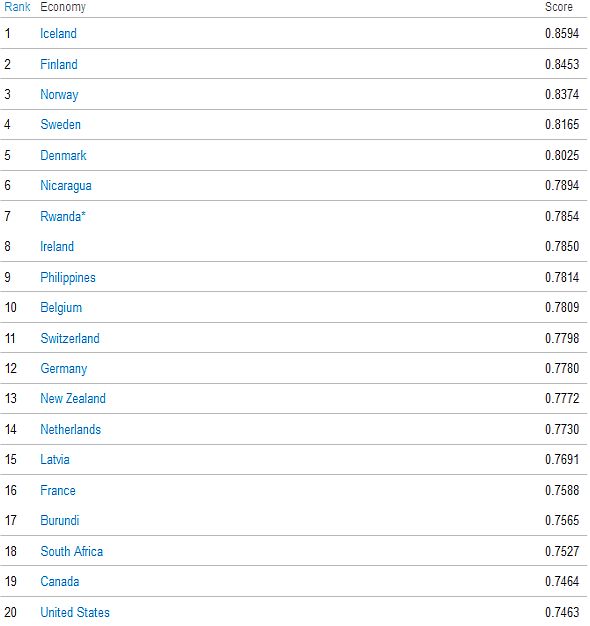
Minna Salami writes: A report this week has exposed how progress towards gender equality is slowing down in the west. The Global Gender Gap Report showed that Europe has undergone the smallest change in terms of closing the gender gap. In terms of political empowerment, from Britain to Austria to Spain, in only nine years, women’s rankings have sunk sharply.
By contrast, the region with the largest positive change is Latin America where, just last weekend, Brazil re-elected a woman president, Dilma Rousseff. Also known as the world’s most powerful feminist, Rousseff will lead the world’s seventh-largest economy and fifth-largest nation for another four years. Voters in sub-Saharan Africa, Asia and the Caribbean have also done a better job of electing women presidents and prime ministers. Today, only three of the 22 female heads of government are in the west (Germany, Denmark and Norway).
It’s commonly perceived that the western world is at the forefront of the campaign for women’s rights. State bodies such as the British Department for International Development, organisations such as the Cherie Blair Foundation and celebrities such as Madonna and Angelina Jolie all invest in women’s empowerment in the developing world, which is often seen as lagging well behind. But in truth, as the survey shows, when it comes to having women at the top levels of political leadership, industrialised western countries actually lag behind developing ones. Of 142 countries, Britain came just 63rd for the number of women in parliament and 75th for the number of women in ministerial jobs. The US was 83rd and 25th. [Continue reading…]
Category Archives: Analysis
U.S., Iran relations move to détente
The Wall Street Journal reports: The Obama administration and Iran, engaged in direct nuclear negotiations and facing a common threat from Islamic State militants, have moved into an effective state of détente over the past year, according to senior U.S. and Arab officials.
The shift could drastically alter the balance of power in the region, and risks alienating key U.S. allies such as Saudi Arabia and United Arab Emirates who are central to the coalition fighting Islamic State. Sunni Arab leaders view the threat posed by Shiite Iran as equal to or greater than that posed by the Sunni radical group Islamic State, also known as ISIS or ISIL.
Israel contends the U.S. has weakened the terms of its negotiations with Iran and played down Tehran’s destabilizing role in the region.
Over the past decade, Washington and Tehran have engaged in fierce battles for influence and power in Iraq, Syria, Lebanon and Afghanistan fueled by the U.S. overthrow of Iraqi strongman Saddam Hussein and the Arab Spring revolutions that began in late 2010. U.S. officials still say the option of military action remains on the table to thwart Iran’s nuclear program.
But recent months have ushered in a change as the two countries have grown into alignment on a spectrum of causes, chief among them promoting peaceful political transitions in Baghdad and Kabul and pursuing military operations against Islamic State fighters in Iraq and Syria, according to these officials.
The Obama administration also has markedly softened its confrontational stance toward Iran’s most important nonstate allies, the Palestinian militant group Hamas and the Lebanese militant and political organization, Hezbollah. American diplomats, including Secretary of State John Kerry , negotiated with Hamas leaders through Turkish and Qatari intermediaries during cease-fire talks in July that were aimed at ending the Palestinian group’s rocket attacks on Israel, according to senior U.S. officials.
U.S. intelligence agencies have repeatedly tipped off Lebanese law-enforcement bodies close to Hezbollah about threats posed to Beirut’s government by Sunni extremist groups, including al Qaeda and its affiliate Nusra Front in Syria, Lebanese and U.S. officials said. [Continue reading…]
ISIS uses intelligence to purge opponents
Ali Mamouri reports: The Islamic State (IS) differs from its predecessors and similar groups by running a powerful intelligence apparatus that is strong and has plenty of security experience acquired by intelligence officers from the previous regime. The IS intelligence apparatus carries out various types of operations, similar to other intelligence apparatuses around the world. One of its most important operations is to monitor and identify its opponents, to eliminate them immediately and to avoid the possibility of the Iraqi government, and other local and regional opposing parties, to infiltrate its intelligence apparatus, or a military opposition to emerge on its territory.
Based on IS operations, the list of people to eliminate includes tribal sheikhs who have previously cooperated with the government, members of the Awakening movement who have participated in fighting jihadist groups in the past, clerics who oppose IS’ extremism and anyone suspected of delivering security information to governmental parties or other cooperating parties.
The policy of eliminating opponents as soon as they take over large areas is considered an established IS method that was adopted when it evolved in Iraq after the 2003 invasion. In addition to the security reasons, this technique is also based on IS’ extremist Salafist principles, which aim to purge the land of any opposition party, to create a unified Salafist community without religious or political differences. [Continue reading…]
The Sunni town Iraqi forces destroyed in order to save it from ISIS
The Washington Post reports: Iraq renamed this town on the banks of the Euphrates this week to reflect the triumph of its security forces here against Islamic State militants, who were driven out last week. Jurf al-Sakhar, or “rocky bank,” became Jurf al-Nasr, or “victory bank.”
But a visit to the Sunni settlement Tuesday laid bare the huge cost of that victory. The town is now emptied of its 80,000 residents, and building after building has been annihilated — from airstrikes, bombings and artillery fire.
After four months of battles between the Islamic State and the Iraqi army, about 10,000 pro-government Shiite militiamen were poured into the area for a final push, according to Hadi al-Amiri, who leads the Iranian-backed Badr Brigade and coordinated the operation. Defeating the militants involved clearing out all of the residents and leaving the town near-flattened, underscoring the challenge the Shiite-led government faces in areas where demographics do not work in its favor. [Continue reading…]
The success of Tunisian secularists might not be advancing democracy
Monica Marks writes: A self-styled, secular, modernist party called Nidaa Tounes won against the Islamist Ennahda party in the Tunisian election this week. For many, the subsequent headline – “Secularist party wins Tunisia elections” – will seem more impressive than the fact Tunisia just completed its second genuinely competitive, peaceful elections since 2011.
Indeed, in a region wracked by extremism and civil war, the secularists’ victory will strike many as further proof that Tunisia is moving forward and is the sole bright spot in a gloomy region. Some may prematurely celebrate, yet again, the death of political Islam, arguing that Tunisians achieved through the ballot box what Egyptians achieved through a popular coup, rejecting the Brotherhood and its cousin-like movements once and for all. We should exercise caution, however, in labelling Nidaa Tounes’s victory part of a seamless sweep of democratic achievements, or seeing Sunday’s vote as a clear referendum against all varieties of political Islam.
Despite feeling kinship with the party because of its secular label, westerners understand surprisingly little about Nidaa Tounes, mainly because they’ve tended to hold the magnifying glass of critical inquiry up to Islamists but not secularists over the past three years. Counter-intuitively, Nidaa Tounes’s internal structure is noticeably more authoritarian than Ennahda, which boasts representative decision-making structures from its grassroots to national leadership. [Continue reading…]
The quantum edge
Johnjoe McFadden writes: The point of the most famous thought-experiment in quantum physics is that the quantum world is different from our familiar one. Imagine, suggested the Austrian physicist Erwin Schrödinger, that we seal a cat inside a box. The cat’s fate is linked to the quantum world through a poison that will be released only if a single radioactive atom decays. Quantum mechanics says that the atom must exist in a peculiar state called ‘superposition’ until it is observed, a state in which it has both decayed and not decayed. Furthermore, because the cat’s survival depends on what the atom does, it would appear that the cat must also exist as a superposition of a live and a dead cat until somebody opens the box and observes it. After all, the cat’s life depends on the state of the atom, and the state of the atom has not yet been decided.
Yet nobody really believes that a cat can be simultaneously dead and alive. There is a profound difference between fundamental particles, such as atoms, which do weird quantum stuff (existing in two states at once, occupying two positions at once, tunnelling through impenetrable barriers etc) and familiar classical objects, such as cats, that apparently do none of these things. Why don’t they? Simply put, because the weird quantum stuff is very fragile.
Quantum mechanics insists that all particles are also waves. But if you want to see strange quantum effects, the waves all have to line up, so that the peaks and troughs coincide. Physicists call this property coherence: it’s rather like musical notes being in tune. If the waves don’t line up, the peaks and troughs cancel each other out, destroying coherence, and you won’t see anything odd. When you’re dealing only with a single particle’s wave, on the other hand, it’s easy to keep it ‘in tune’ – it has to line up only with itself. But lining up the waves of hundreds, millions or trillions of particles is pretty much impossible. And so the weirdness gets cancelled out inside big objects. That’s why there doesn’t seem to be anything very indeterminate about a cat.
Nevertheless, wrote Schrödinger in What Is Life? (1944), some of life’s most fundamental building blocks must, like unobserved radioactive atoms, be quantum entities able to perform counterintuitive tricks. Indeed, he went on to propose that life is different from the inanimate world precisely because it inhabits a borderland between the quantum and classical world: a region we might call the quantum edge. [Continue reading…]
The collapse of order in the Middle East
In a speech delivered in Washington DC today, Chas Freeman said: Da`ish [ISIS] and the 15,000 foreign jihadis it has attracted are an existential threat to Arab societies and a potential menace to Muslim societies everywhere. Da`ish poses no comparable threat to the United States. Some Americans argue therefore that Da`ish doesn’t matter. A few suggest that, because tight oil and shale gas production is making North America energy self-sufficient, what happens in the Middle East as a whole should also no longer matter much to Americans. But the Persian Gulf is where international oil prices are set. If you doubt this, ask an American tight oil producer what’s happening in today’s energy markets and why. Without stability in West Asia, the global economy is also unstable.
Da`ish aspires not only to destroy the states of the Mashriq – the Arab East – but to conquer their territories and use their resources to mount attacks on the United States, European countries, Russia, and China. It wants to get its hands on the world’s major energy reserves. Its depredations are a current threat only to stability in West Asia, but its recruitment efforts are as global as its aspirations. Quite aside from the responsibility the United States bears for creating the conditions in which this dangerous cult could be born and flourish, Da`ish threatens American interests abroad today. It promises to threaten American domestic tranquility tomorrow. It sees inflicting harm on the West as a central element of its mission.
For all these reasons, Da`ish cannot be ignored by the United States or other nations outside the Middle East. It requires a response from us. But Da`ish must be actively countered first and foremost by those it targets within the region, not by the United States and its Western allies. This means that our response must be measured, limited, and calculated to avoid relieving regional players of the primary responsibility for protecting themselves from the menace to them that Da`ish represents.
Muslims – whether Shiite or Sunni or Arab, Kurd, Persian, or Turk – now have an expanding piece of Hell in their part of the Earth, a growing foulness near the center of Islam. It is almost certainly a greater threat to all of them than they have ever posed to each other. Da`ish will not be contained and defeated unless the nations and sects on its regional target list – Shiite and Sunni alike – all do their part. We should not delude ourselves. The obstacles to this happening are formidable.
Virtually every group now fighting or being victimized in Iraq, Syria, and Lebanon has engaged in or been accused of terrorism by the others. Sectarian violence continues to stoke hatred in the region. The religious animosities between Shi`ites and Sunnis are more intense than ever. The geopolitical rivalry between Iran and the Gulf Arabs remains acute. The political resentments between Turks, Kurds, and Arabs and between Arabs and Persians are entrenched. Each describes the other as part of the problem, not part of the solution.
Unity of command, discipline, and morale are the keys to both military and political success. Da`ish has all three. Its opponents do not. Some are dedicated to the defense of Shiite privilege. Others assign priority to dislodging Shiite or secular authority. Some insist on regime change. Others seek to prevent it. A few support Islamist democratic movements. Others seek to suppress and eradicate them. Some fear terrorism from the victims and enemies of Da`ish more than they fear Da`ish itself. Most treat opposing Da`ish as a secondary strategic objective or a means of enlisting American and other foreign support in the achievement of other priorities, not as their primary aim.
With few exceptions, the states of the region have habitually looked to outside powers for leadership as well as firepower and manpower with which to respond to major security challenges. Despite vast imports of foreign weapons systems, confidence in outside backing has enabled the countries in the region to assume that they could avoid ultimate responsibility for their own defense, relying instead on their ability to summon their American and European security partners in times of crisis. But only a coalition with a strong Muslim identity can hope to contain and shrink Da`ish.
There is no such coalition at present. Every actor in the region has an agenda that is only partially congruent with the Da`ish-related agendas of others. And every actor focuses on the reasons it cannot abide or work with some or all of the others, not on exploring the points it has in common with them. [Continue reading…]
The crisis in U.S.-Israel relations is officially here
Jeffrey Goldberg writes: The other day I was talking to a senior Obama administration official about the foreign leader who seems to frustrate the White House and the State Department the most. “The thing about Bibi is, he’s a chickenshit,” this official said, referring to the Israeli prime minister, Benjamin Netanyahu, by his nickname.
This comment is representative of the gloves-off manner in which American and Israeli officials now talk about each other behind closed doors, and is yet another sign that relations between the Obama and Netanyahu governments have moved toward a full-blown crisis. The relationship between these two administrations— dual guarantors of the putatively “unbreakable” bond between the U.S. and Israel—is now the worst it’s ever been, and it stands to get significantly worse after the November midterm elections. By next year, the Obama administration may actually withdraw diplomatic cover for Israel at the United Nations, but even before that, both sides are expecting a showdown over Iran, should an agreement be reached about the future of its nuclear program.
The fault for this breakdown in relations can be assigned in good part to the junior partner in the relationship, Netanyahu, and in particular, to the behavior of his cabinet. Netanyahu has told several people I’ve spoken to in recent days that he has “written off” the Obama administration, and plans to speak directly to Congress and to the American people should an Iran nuclear deal be reached. For their part, Obama administration officials express, in the words of one official, a “red-hot anger” at Netanyahu for pursuing settlement policies on the West Bank, and building policies in Jerusalem, that they believe have fatally undermined Secretary of State John Kerry’s peace process.
Over the years, Obama administration officials have described Netanyahu to me as recalcitrant, myopic, reactionary, obtuse, blustering, pompous, and “Aspergery.” (These are verbatim descriptions; I keep a running list.) But I had not previously heard Netanyahu described as a “chickenshit.” [Continue reading…]
How the Left abandoned the Kurds by getting stuck up its anti-imperialist cul-de-sac
Yasin Sunca writes: One can simply put hundreds of reasons as to why the left has to oppose and react against the ISIS and what they have been doing to innocent people throughout last two years. However, those who are supposed to speak out against the ISIS, primarily the left wing parties and organisations, have simply failed to come up with a comprehensive approach, are even devoid of understanding what is going on exactly and, unfortunately for them, are stuck in the orthodox interpretation of socialism against imperialism. They have once again stuck to the marginal track to blame their respective governments as imperialist, which in fact, means almost nothing, either for the government or for the society.
In the specific case of the ongoing resistance of the Kurds in Rojava (Syrian Kurdistan) the Popular Protection Units (YPG) have been resisting against both the brutal attacks of the jihadists and the military aggressions of the Syrian regime. The Kurds have not opted for cooperation either with the regime or the mainstream opposition groups due to very convincing and understandable reasons. The regime has been oppressing the Kurds, among others, for a very long time and therefore, it was impossible for the Kurds to go along with the regime politically. However, facing political and military difficulties in the context of the ongoing war, the regime decided to focus on the strategic areas in their war with the opposition groups and intelligibly, have not carried out heavy military offensives against the Kurdish self-declared cantons, compared to other regions of the country. Furthermore, the declaration of the Kurdish cantons in Rojava would pose certain problems to Turkey which has been amongst the most vocally critical countries of the Syrian regime. Thus, we can talk about a political convergence between the regime and the Kurds rather than a strategically motivated agreement. Besides, the Kurds could not have cooperated with the mainline Syrian opposition because of two core issues. The first, the Arab opposition have not recognised any collective rights of the Kurds and postponed all Kurdish demands to a probable post-Assad period. The second, the Arab opposition did not have a clear agenda for the future of Syria. The question such as whether it would be a new dictatorship or a democracy has not a clear and convincing answer and the Kurds remained sceptical about the will of the opposition in relation to democratisation.
Taking all this background into account, the Kurds opted for a third line policy and started to build their cantons with a new democratic understanding, inclusive of all the different factions of the population. The Kurdish cantons have never carried out any offensives against any group unless a military attack was the case. The current resistance of the Kobane canton is due to the brutal attack of the jihadist ISIS and it is a war of self-defence. The Kurds are carrying out a socialist experiment in the Middle-East, one of the most challenging regions of the world, and the international left is equally responsible for the protection of this emerging socialist hope. This experiment needs the unconditional support of the socialists of the world and internationalist solidarity. (For those who are interested in the new model in Rojava here is an article, available online: http://roarmag.org/2014/07/rojava-autonomy-syrian-kurds/)
However, the left wing parties and groups in Europe are far from understanding what is going on exactly in Kurdistan and in Kobane, nor do they have any plans to understand the ideological background of the Rojava Cantons. They have to admit that they were unable to understand the third line policy and, just like the mainstream media have been doing, positioned the Kurds together with the Assad regime despite the fact that the Kurds clearly declaring and practically manifesting a billion times that they are an opposition group. They kept on blaming the Kurds to be the proxy of the regime. Besides, some other groups adopted a restrictive approach and claimed that if the Kurds are not with Bashar al-Assad then they have to be with the opposition. Yet one should remind people of the fact that being against the regime doesn’t automatically mean accepting all analyses and projections of the mainline opposition in Syria. Moreover, the mainline opposition in Syria is also supported by “imperialists” against the regime. So, the Kurds clearly understood the right place to stand was a third line. [Continue reading…]
The Global Gender Gap Report 2014
Global Gender Gap Index 2014. The highest possible score is 1 (equality) and the lowest possible score is 0 (inequality). Click on the table below to see all 142 rankings.
The secret life of an ISIS warlord
The Daily Beast reports: The name that [ISIS commander] Abu Omar al-Shishani grew up with was Tarkhan. And because we are here in his hometown talking to the people who once loved him, and perhaps still do, we’ll use that name, too. Tarkhan’s father, Temur, a grizzled, eccentric, well-read old Christian with a bitter sense of self-irony, tells his sons’ story in an extensive — almost bizarre — interview with The Daily Beast at his small gray house in the village of Birkiani, where his boys grew up.
“I am like a hobo,” the old man declares. “My son is one of the founders of Islamic caliphate and I’m here, dying in poverty! Look! Look where I live!” According to Temur, his son even invited him to Syria. “He told me, ‘Dad, come with me. You’ll live like you are in paradise.’ I told him, ‘Save your paradise for yourself, I prefer my home here.’”
Despite Tarkhan’s fame as a holy warrior, the father doesn’t see him as particularly pious, his mother came from a Muslim family, but he didn’t show much interest. The old man claims that, in fact, before Tarkhan went to prison, he wasn’t religious at all. He supposedly warned his older brothers about the dangers of fanatical Islam, especially his brother Tamaz, who was fighting in Chechnya: “‘Be citizens of Georgia,’ Tarkhan would say to Tamaz, ‘You are in a war, you may fight there, but do not pick up their beliefs.’ And now look what happened! Do you see how a man can change?”
Like so many of the world’s most brutal dictators, military leaders, tyrants, and jihadists, it appears Tarkhan was trained by the very best: the United States government. [Continue reading…]
An army of child soldiers being raised by ISIS
Kate Brannen writes: They stand in the front row at public beheadings and crucifixions held in Raqqa, the Islamic State’s stronghold in Syria. They’re used for blood transfusions when Islamic State fighters are injured. They are paid to inform on people who are disloyal or speak out against the Islamic State. They are trained to become suicide bombers. They are children as young as 6 years old, and they are being transformed into the Islamic State’s soldiers of the future.
The Islamic State has put in place a far-reaching and well-organized system for recruiting children, indoctrinating them with the group’s extremist beliefs, and then teaching them rudimentary fighting skills. The militants are preparing for a long war against the West, and hope the young warriors being trained today will still be fighting years from now.
While there are no hard figures for how many children are involved, refugee stories and evidence collected by the United Nations, human rights groups, and journalists suggest that the indoctrination and military training of children is widespread.
Child soldiers aren’t new to war. Dozens of African armies and militias use young boys as fighters, in part because research has shown that children lack fully formed moral compasses and can easily be persuaded to commit acts of cruelty and violence.
The young fighters of the Islamic State could pose a particularly dangerous long-term threat because they’re being kept away from their normal schools and instead inculcated with a steady diet of Islamist propaganda designed to dehumanize others and persuade them of the nobility of fighting and dying for their faith. [Continue reading…]
How Democratic Confederalism has been practised by Kurds in Syria
Tatort Kurdistan reports: Even before the rebellions in Syria began, the Kurds of Rojava [Syrian Kurdistan] had already created the first councils and committees and thereby began to institute a radical democratic organization of most of the region’s population. Starting on June 19, 2012, the cities of Kobanê, Afrîn, Dêrik, and many other places were one by one freed from regime control; the strength of the reorganization then revealed itself. Military bases were reconfigured, and the vastly outnumbered regime troops were offered the option of withdrawal. Only in Dêrik did the situation lead to a struggle, with a few casualties. But even here, as people in Dêrik told us, the new self-organization prevented violent attacks and acts of destruction and revenge.
Self-Defense and the “Third Way”
As we considered this phase and the politics of the Kurdish movement in Rojava, we also observed the implementation of another paradigm of Democratic Confederalism: self-defense and the primacy of nonviolent solutions. The Kurdish movement and especially the PYD were organized before the Syrian revolution began resisting the Assad regime. At that time they saw it as a matter of democratic transformation; a militarization of the conflict was to be avoided. But with the outbreak of war, Islamization, and the heteronomy of the Syrian revolt, the Kurdish movement in Rojava decided to go a third way: it would side neither with the regime nor with the opposition. It would defend itself, but it would not wage war. The movement has remained this politics up to the present [July 2014]. Thus in Qamişlo, in the quarters that were inhabited by regime supporters, regime military units were still tolerated. The same was true for the airport. The goal was and is always to reach a political, democratic solution for all of Syria.
The Commune as the Center of Society
“The creation of an operational level where all kinds of social and political groups, religious communities, or intellectual tendencies can express themselves directly in all local decision-making processes can also be called participative democracy.” — Abdullah Öcalan, Democratic Confederalism (London, 2011), p. 26.
Democratic Confederalism has as its goal the autonomy of society: in other words, instead of the state governing society, a politicized society manages itself. As against capitalist modernity, it proposes democratic modernity. In Rojava, to make this system possible, the center of the social system became the commune. The commune, the self-management of the streets, would emerge as the hub of the society.
Decision making in the communes requires that quotas be met—that is, in order to make a decision, here and in all councils in Rojava, at least 40 percent of those who participate in the discussions must be women. In the communes, current issues of administration, energy, and food supply, as well as social problems like patriarchal violence, family conflicts, and much else, are discussed and if possible resolved. The communes have commissions that address all social questions, everything from the organization of defense to justice to infrastructure to youth to the economy and the construction of individual cooperatives—such as bakeries, clothing production, and agricultural projects. The ecology commissions concern themselves with urban sanitation as well as specifically ecological problems. At the forefront is the imperative to strengthen the social position of women: committees for women’s economy help women develop economic independence.
The commune, as the mala gel (people’s house), lends support in all questions; it is simultaneously an institution of support and a kind of court. Central to its processes is the ideal of agreement and compensation; for general offenses, the causes of an infraction are investigated and overcome, and the victim is protected. For patriarchal violence and all attacks that affect women, the mala jinan (women’s house) is in charge; it is attached to the women’s council, a parallel structure to the commune’s mixed-gender council. [Continue reading…]
What ISIS hostages endured in Syria
The New York Times reports: The kidnappings, which were carried out by different groups of fighters jousting for influence and territory in Syria, became more frequent. In June 2013, four French journalists were abducted. In September, the militants grabbed three Spanish journalists.
Checkpoints became human nets, and last October, insurgents waited at one for Peter Kassig, 25, an emergency medical technician from Indianapolis who was delivering medical supplies. In December, Alan Henning, a British taxi driver, disappeared at another. Mr. Henning had cashed in his savings to buy a used ambulance, hoping to join an aid caravan to Syria. He was kidnapped 30 minutes after crossing into the country.
The last to vanish were five aid workers from Doctors Without Borders, who were plucked in January from the field hospital in rural Syria where they had been working.
At gunpoint, Mr. Sotloff and Mr. Abobaker were driven to a textile factory in a village outside Aleppo, Syria, where they were placed in separate cells. Mr. Abobaker, who was freed two weeks later, heard their captors take Mr. Sotloff into an adjoining room. Then he heard the Arabic-speaking interrogator say in English: “Password.”
It was a process to be repeated with several other hostages. The kidnappers seized their laptops, cellphones and cameras and demanded the passwords to their accounts. They scanned their Facebook timelines, their Skype chats, their image archives and their emails, looking for evidence of collusion with Western spy agencies and militaries.
“They took me to a building that was specifically for the interrogation,” said Marcin Suder, a 37-year-old Polish photojournalist kidnapped in July 2013 in Saraqib, Syria, where the jihadists were known to be operating. He was passed among several groups before managing to escape four months later.
“They checked my camera,” Mr. Suder said. “They checked my tablet. Then they undressed me completely. I was naked. They looked to see if there was a GPS chip under my skin or in my clothes. Then they started beating me. They Googled ‘Marcin Suder and C.I.A.,’ ‘Marcin Suder and K.G.B.’ They accused me of being a spy.”
Mr. Suder — who was never told the name of the group holding him, and who never met the other hostages because he escaped before they were transferred to the same location — remarked on the typically English vocabulary his interrogators had used.
During one session, they kept telling him he had been “naughty” — a word that hostages who were held with Mr. Foley also recalled their guards’ using during the most brutal torture.
It was in the course of these interrogations that the jihadists found images of American military personnel on Mr. Foley’s laptop, taken during his assignments in Afghanistan and Iraq.
“In the archive of photographs he had personally taken, there were images glorifying the American crusaders,” they wrote in an article published after Mr. Foley’s death. “Alas for James, this archive was with him at the time of his arrest.”
A British hostage, David Cawthorne Haines, was forced to acknowledge his military background: It was listed on his LinkedIn profile.
The militants also discovered that Mr. Kassig, the aid worker from Indiana, was a former Army Ranger and a veteran of the Iraq war. Both facts are easy to find online, because CNN featured Mr. Kassig’s humanitarian work prominently before his capture.
The punishment for any perceived offense was torture.
“You could see the scars on his ankles,” Jejoen Bontinck, 19, of Belgium, a teenage convert to Islam who spent three weeks in the summer of 2013 in the same cell as Mr. Foley, said of him. “He told me how they had chained his feet to a bar and then hung the bar so that he was upside down from the ceiling. Then they left him there.”
Mr. Bontinck, who was released late last year, spoke about his experiences for the first time for this article in his hometown, Antwerp, where he is one of 46 Belgian youths on trial on charges of belonging to a terrorist organization.
At first, the abuse did not appear to have a larger purpose. Nor did the jihadists seem to have a plan for their growing number of hostages.
Mr. Bontinck said Mr. Foley and Mr. Cantlie had first been held by the Nusra Front, a Qaeda affiliate. Their guards, an English-speaking trio whom they nicknamed “the Beatles,” seemed to take pleasure in brutalizing them.
Later, they were handed over to a group called the Mujahedeen Shura Council, led by French speakers. [Continue reading…]

How congressional hawks plan to kill Obama’s Iran deal
Trita Parsi writes: Negotiations with Iran over the future of its nuclear program have not even concluded yet some members of Congress are preparing to manufacture a political crisis over a deal. Their beef? President Barack Obama may initially bypass Congress and suspend sanctions imposed on Iran to make a deal possible and only later ask lawmakers to end them permanently when it is determined that Iran has complied fully with its obligations under the deal.
Of course, many of the lawmakers complaining about the potential presidential end run voted to give him the right to waive sanctions when they passed sanctions legislation in 2010 and 2011. And, of course, only Congress can lift the sanctions permanently, so there wouldn’t be any circumventing to begin with.
So what’s really going on?
It’s very simple: If you prefer war with Iran over a deal with Iran – even one that would prevent it from building a bomb — your best and possibly last opportunity to kill the deal is immediately after the nuclear talks have concluded. That’s when distrust of Iran’s intentions will remain pervasive and when its commitment to carry out its side of the deal will still have to be demonstrated. Former House Majority Leader Eric Cantor pursued this tactic in January after an interim agreement was reached in November last year. [Continue reading…]
The revolutionary thinking behind the fight in Kobane
Adam Curtis writes: In the battle for Kobane on the Syrian border everyone talks about the enemy – IS – and the frightening ideas that drive them. No-one talks about the Kurdish defenders and what inspires them.
But the moment you look into what the Kurds are fighting for – what you discover is absolutely fascinating. They have a vision of creating a completely new kind of society that is based on the ideas of a forgotten American revolutionary thinker.
He wanted to create a future world in which there would be no hierarchies, no systems that exercise power and control individuals. And the Kurds in Kobane are trying to build a model of that world.
It means that the battle we are watching night after night is not just between good and evil. It is also a struggle of an optimistic vision of the future against a dark conservative idea drawn from the past.
It is a struggle that may also have great relevance to us in the west. Because the revolutionary ideas that have inspired the Kurds also shine a powerful light on the system of power in Britain today. They argue that we in the west are controlled by a new kind of hierarchical power that we don’t fully see or understand.
There are two men at the heart of this story.
One is the American revolutionary thinker. He is called Murray Bookchin. Here is a picture of Bookchin looking revolutionary.
The other man is called Abdullah Ocalan. He is the leader of the Kurdish revolutionary group in Turkey – the PKK
Here he is in 1999 after he had been captured by Turkish security forces and was on his way to a jail on a tiny island in the Sea of Marmara where he would be the only prisoner.
In his solitude he would start to read the theories of Murray Bookchin and decide they were the template for a future world.
Both men began as hardline marxists.
Murray Bookchin was born in New York in 1921. In the 1930s he joined the American Communist Party. But after the second world war he began to question the whole theory that underpinned revolutionary marxism.
What changed everything for him was the experience of working in a factory. Bookchin had gone to work for General Motors – and he realized as he watched his fellow workers that Marx, Lenin and all the other theorists were wrong about the working class.
The Marxist theory said that once working men and women came together in factories the scales would fall from their eyes – and they would see clearly how they were being oppressed. They would also see how they could bond together to become a powerful force that would overthrow the capitalists.
Bookchin saw that the very opposite was happening. This was because the factory was organised as a hierarchy – a system of organisation and control that the workers lived with and experienced every second of the day. As they did so, that hierarchical system became firmly embedded in their minds – and made them more passive and more accepting of their oppression.
But Bookchin didn’t do what most disillusioned American Marxists in the 1950s did – either run away to academia, or become a cynical neo-conservative. Instead he remained an optimist and decided to completely rework revolutionary theory. [Continue reading…]
West waging a ‘CNN war’ in Syria as ISIS makes gains in Iraq
The Telegraph reports: On the barren wastes of Mount Sinjar, the Yazidis are once more surrounded and fighting for their lives.
“We saw Isil, there are daily clashes with Isil. Today and yesterday there was heavy fighting,” said one stranded Yazidi man, Dre’i Shamo, last week. “The situation is very tragic and critical.”
Further south, the advance of the jihadists of Islamic State of Iraq and the Levant on Baghdad continues, slower than before but still with no sign of a reversal of fortune. Another district fell last week, after a major military base the week before, while scores more innocent civilians have died in a rise in bombings in the city itself.
The jihadists have also reached Ramadi, the capital of Anbar province and the last major city in western Iraq not in Isil’s hands.
The world’s attention has been focused on the medium-sized Kurdish town of Kobane, on the Syria-Turkey border, whose accessibility has provided countless opportunities for telegenic news coverage of American air strikes, which have multiplied in size and number. But Kobane is a secondary focus of the war that has been waging in Syria for more than three years; and that war is itself supposed to be secondary in strategic heft for America and its allies, including Britain.
They have deemed Iraq the first target of the fight against Isil. Yet the number of air strikes in supposedly less significant Syria has now reached double that in Iraq, as America and its allies seek to bolster Kobane’s defences.
Analysts and some Iraqis now wonder whether President Barack Obama’s declared strategy in the Middle East has been abandoned in favour of pursuing a short-term agenda dictated by the news agenda: that the “CNN factor was at play”, as Ben Barry, a former British Army brigadier, put it after compiling a detailed analysis of the military situation in Iraq.
Isil may even have drawn the West into a trap – pouring second-grade but eager foreign recruits into the battle for Kobane, while pursuing their more important goals next door, he said.
“Kobane is right against the border,” he told The Telegraph. “It may be that Isil deliberately took the decision to attack there to draw US air power away from Anbar.” [Continue reading…]
For Iraq’s Sunnis, sectarian militias pose an extra threat
Sarah Margon writes: The traffic on the road to Tuz Khurmato, a town about an hour south of Kirkuk, was light on a recent morning when we set out to meet senior officials from the Kurdish security forces, the pesh merga. Their fortified bases, lean-tos flying various Shiite militia flags and makeshift camps for displaced families dotted the side of the highway. Official Iraqi security forces were nowhere to be seen, even at checkpoints.
Inside a dusty office at the pesh merga base, a field commander relayed what he had seen during recent weeks of fighting. “They don’t respect human rights, they arrest anyone,” he said. “They kill, they behead, they burn houses.” He was referring not to the Islamic State but to the government-backed Shiite militias alongside whom the pesh merga are fighting the Sunni extremist group in an uneasy marriage of convenience.
The lines between Shiite militias and official security forces have been blurred for years. But with the Iraqi army’s near-total collapse this summer, their strength has increased. Politicians, security force personnel and civilians alike have told Human Rights Watch that these militias “control security” throughout much of Iraq, a point only reinforced by the recent appointment of Mohammed Ghabban, a Shiite politician with strong links to the Badr Brigade, a notorious militia, as Iraq’s interior minister.
In certain parts of Iraq under siege by the Islamic State, the militias continued the fight even after U.S.-led coalition airstrikes shifted to other targets. They did this primarily by attacking Sunnis who didn’t flee the Islamic State advance, considering any remaining families “collaborators,” and ransacking, burning and even demolishing scores of Sunni villages. In some cases, they traveled from village to village in U.S. Army-issued Humvees, which were probably obtained from the Iraqi government. [Continue reading…]