Time reports: The Trump Administration is intensifying America’s involvement in the ground war in Syria, having announced on March 9 that it is sending 400 more troops to join the fight against ISIS there.
The new deployment of Army Rangers and a U.S. Marine artillery unit raises fresh questions about the scope and timeline of the U.S. mission in Syria, where the number of American troops is now approaching a high of around a thousand (Washington has not disclosed an exact number). The U.S. is also sending another 2,500 troops to a staging base in Kuwait, awaiting possible deployment to Iraq or Syria.
Recent comments from U.S. officials suggest that the military is contemplating a deployment in Syria that extends far beyond the defeat of ISIS as a conventional armed force. In his testimony to the Senate Armed Services Committee on March 9, Army General Joseph Votel, who leads the U.S. Central Command, said additional forces may be needed in the future to help with “stability and other aspects of the operations.” The Pentagon is also considering lifting a formal cap of roughly 500 U.S. troops permitted on the ground in Syria, a limitation imposed by former President Barack Obama, according to the Washington Post.
The near doubling of the U.S. military deployment in eastern Syria, along with Votel’s comments, suggest a shift toward a more open-ended commitment of forces to Syria, echoing the prolonged U.S. military presence in Iraq or Afghanistan. But the escalation is also prompting calls to define the objectives of the mission over the long term in order to avoid a costly occupation both in terms of lives and resources. [Continue reading…]
Category Archives: Analysis
Don’t roll back the vehicle fuel standards
Jody Freeman writes: One of the signal achievements of the Obama administration was reaching an agreement with the auto industry to dramatically increase fuel efficiency standards for vehicles, doubling them to 54.5 miles per gallon by 2025.
The industry now wants to renege. At its behest, the Trump administration is expected to initiate a rollback.
Weakening these standards would be a mistake for consumers, the environment and the auto industry itself. They are the most important action the United States has taken to address climate change and reduce the nation’s dependence on oil.
From 2022-25 alone, they are projected to reduce American oil consumption by 1.2 billion barrels, cut half a billion metric tons of carbon pollution and save consumers millions of dollars in fuel costs, according to the Environmental Protection Agency. The net benefits to society are estimated at $100 billion. And these gains are on top of those achieved through 2016 and expected through 2021. [Continue reading…]
Sweden, immigrants and Trump’s post-Enlightenment world
Anne Applebaum writes: The Enlightenment belief that we can know and understand reality — that we can measure it, weigh it, judge it, use reason to explain it — underlies all of the achievements of Western civilization, from the scientific revolution to the Industrial Revolution to democracy itself. Ever since René Descartes asked himself how it was possible to know that melting wax is the same thing as a candle, we have believed that reason, not mythology, sensibility, emotion or instinct, provides a superior way to understand the world. But is that still true?
If the strange case of Sweden and its immigrants is anything to go by, then the answer is probably no. This odd story began last month, when President Trump began ranting, memorably, about dangerous immigrants at a rally in Florida: “You look at what’s happening last night, in Sweden! Sweden! Who would believe this, Sweden!” The following morning, puzzled Swedes woke up to find the world’s media asking them what, actually, had happened last night. The answer — other than some road closures — was nothing.
In an Enlightenment world, that would have been the end of the story. In our post-Enlightenment world, things got more complicated. Trump explained that what he had seen “last night” was not a terrorist attack — though that was certainly implied in his speech — but a filmmaker named Ami Horowitz who was interviewed by Tucker Carlson on Fox News. The interview was indeed terrifying: For those unfamiliar with the techniques of emotional manipulation — and they are the same, whether used by Fox News or Russia Today — it should be mandatory viewing. As the two were speaking, a clip of an aggressive, brown-skinned man hitting a policeman, presumably in Sweden, alternated in the background, over and over, with a clip of a burning car. The repetitive, frightening images were bolstered by more clips from Horowitz’s film, in which Swedish police officers appeared to be confirming a massive rise in crime linked to immigration. Carlson, meanwhile, marveled at the stupidity and naivete of the Swedish nation helpless to confront this menace. No wonder the president was upset.
But the next day, the Swedish police officers protested: Horowitz had never asked them about immigration, and had cut their interviews to make it seem as if they were answering different questions. Moreover, while Sweden did — generously and admirably — accept 160,000 refugees in 2015, and while there are genuine problems absorbing and acculturating them, Swedish crime rates remain low, particularly if you compare them with crime rates in, say, Florida.
A faked film had inspired the president to cite an imaginary crisis — but the story didn’t end there. [Continue reading…]
The spat between Turkey and the Netherlands is all about winning votes
Ishaan Tharoor writes: The escalating crisis between Turkey and the Netherlands is a startling example of how this year’s crucial election campaigns can flare into international incidents.
The Dutch go to the polls this Wednesday for a parliamentary election seen as a bellwether for Europe’s political future, and all eyes are focused on far-right, Euroskeptic, anti-Islam populist Geert Wilders. Meanwhile, Turkey will hold a referendum next month on constitutional revisions that would scrap the country’s parliamentary system in favor of an executive presidency under the powerful President Recep Tayyip Erdogan. In their electoral bids, Erdogan and Wilders have found useful bogeymen in one another’s nations.
“The explanation for the Dutch-Turkish ‘crisis’ this weekend is pretty straightforward,” wrote Dutch political scientist Cas Mudde in a message to Today’s WorldView. “Both countries are currently engulfed in electoral campaigns that are dominated by authoritarian nativism.” [Continue reading…]
‘I didn’t know you could have emotions out loud’
Laura Collins-Hughes writes: Stephan Wolfert was drunk when he hopped off an Amtrak train somewhere in Montana, toting a rucksack of clothes and a cooler stocked with ice, peanut butter, bread and Miller High Life — bottles, not cans. It was 1991, he was 24, and he had recently seen his best friend fatally wounded in a military training exercise.
His mind in need of a salve, he went to a play: “Richard III,” the story of a king who was also a soldier. In Shakespeare’s words, he heard an echo of his own experience, and though he had been raised to believe that being a tough guy was the only way to be a man, something cracked open inside him.
“I was sobbing,” Mr. Wolfert, now 50 and an actor, said recently over coffee in Chelsea. “I didn’t know you could have emotions out loud.”
That road-to-Damascus moment — not coming to Jesus, but coming to Shakespeare — is part of the story that Mr. Wolfert tells in his solo show, “Cry Havoc!,” which starts performances Wednesday, March 15, at the New Ohio Theater. Taking its title from Mark Antony’s speech over the slain Caesar in “Julius Caesar,” it intercuts Mr. Wolfert’s own memories with text borrowed from Shakespeare. Decoupling those lines from their plays, Mr. Wolfert uses them to explore strength and duty, bravery and trauma, examining what it is to be in the military and what it is to carry that experience back into civilian life. [Continue reading…]
A Vermont mayor wanted to take in refugees. He lost his job
Slate reports: For the past year, the national drama over refugees has played out in miniature in the small city of Rutland, nestled in Vermont’s Green Mountains.
The mayor, Christopher Louras, hatched a plan in 2015 for Rutland to settle 100 refugees from Syria and Iraq. The initiative was publicly announced last March, and in September, Rutland was granted State Department approval. It was the right thing to do, supporters said. But Louras, a five-term mayor who was first elected as a Republican but is now an independent, made an economic case for the program.
“The benefits, economically and culturally, that we will recognize is exactly what the community needs at this time,” he told the Boston Globe in May. “As much as I want to say it’s for compassionate reasons, I realize that there is not a vibrant, growing, successful community in the country right now that is not embracing new Americans.”
On Tuesday, the backlash swept Louras from office. His opponent, city Alderman David Allaire, strongly criticized the secrecy surrounding the town’s decision to accept refugees. Announcing his candidacy in December, Allaire stressed that he was not anti-refugee. “I’m sure if this had been handled differently, you would not see the divide you see in this community right now,” he said at the time. “We are a thoughtful, helpful community.”
But the opposition group that supported Allaire, Rutland First, was more evidently against any refugee deal. In addition to local politics, its Facebook page shares content like the Sweden refugee video that prompted Donald Trump’s famous “last night in Sweden” outburst. [Continue reading…]
The Washington Post reports: A Florida man who attempted to set fire to a convenience store told deputies that he assumed the owner was Muslim and that he wanted to “run the Arabs out of our country,” according to the St. Lucie County Sheriff’s Office.
The sheriff later said the store owners are actually Indian, appearing to make this the latest in a string of incidents targeting South Asians mistaken for people of Arab descent.
Around 7:40 a.m. Friday, police received calls that a white male was acting suspiciously in front of the Met Mart convenience store in Port St. Lucie, officials said.
Deputies arrived to find the store closed, with its security shutters intact — as well as a 64-year-old man named Richard Leslie Lloyd near a flaming dumpster.
“When the deputies arrived, they noticed the dumpster had been rolled in front of the doors and the contents were lit on fire,” St. Lucie County Sheriff Ken Mascara said in a statement posted on Facebook. “Upon seeing our deputies, the man put his hands behind his back and said ‘take me away.’ ”
Lloyd “told deputies that he pushed the dumpster to the front of the building, tore down signs posted to the outside of the store and lit the contents of the dumpster on fire to ‘run the Arabs out of our country,’ ” Mascara said. [Continue reading…]
The Rutland voters who thought that putting Rutland first required excluding 100 refugees and the Florida man who took the law into his own hands in trying to drive foreigners out of America, can be described as xenophobes, nativists or in several other ways. But beneath these multifaceted expressions of fear lies one simple emotion: cowardice.
Cowardice is what brought Trump to power and is what animates the fear and hatred that can now be found all across this nation.

Donald Trump and the new dawn of tyranny
Timothy Snyder writes: The Founding Fathers designed the constitution to prevent some Americans from exercising tyranny. Alert to the classical examples they knew, the decline of ancient Greece and Rome into oligarchy and empire, they established the rule of law, checks and balances, and regular elections as the means of preserving the new republic. Thus far, it has worked. But it need not work forever.
We might imagine that the American system must somehow always sustain itself. But a broader look at the history of democratic republics established since our own revolution reveals that most of them have failed. Politicians who emerge from democratic practices can then work to undo democratic institutions. This was true in the rise of fascism in the 1920s and 1930s, as well as during the spread of communism in the 1940s, and indeed in the new wave of authoritarian regime changes of the 21st century. Indeed, absent a truly decisive revolution, which is a rare event, a regime change depends upon such people — regime changers — emerging in one system and transforming it into another.
It is in this light that we should consider President Donald Trump and his closest advisors and spokespeople. Although they occupy the positions they do thanks to an election, there is little reason to believe that they support the American constitutional system as it stands, and much to remind us of authoritarian regimes changes of the recent past. A basic weapon of regime changers, as fascists realized nearly a century ago, is to destroy the concept of truth. Democracy requires the rule of law, the rule of law depends upon trust, and trust depends upon citizens’ acceptance of factuality. The president and his aides actively seek to destroy Americans’ sense of reality. Not only does the White House spread “alternative facts,” but Kellyanne Conway openly proclaims this as right and good. Post-factuality is pre-fascism. [Continue reading…]
Congressman Steve King endorses ‘Dutch Trump,’ Geert Wilders, in battle over ‘civilization’
Wilders understands that culture and demographics are our destiny. We can't restore our civilization with somebody else's babies. https://t.co/4nxLipafWO
— Steve King (@SteveKingIA) March 12, 2017
The Daily Beast reports: The Republican Party has long been a comfortable home for anti-Europeanism, from the “America First” opponents of U.S. participation in World War II to the “let them eat Freedom Fries” movement responsible for renaming French fries in congressional cafeterias during the lead-up to the Iraq War in 2003.
But as far-right political parties gain power and prominence on the Continent, many members of the Grand Old Party are cozying up to European politicos with unprecedented enthusiasm — well, nearly unprecedented.
Among the most fawning of the newly Europositive wing of the Republican party: Rep. Steve King (R-IA), a nativist hawk from the heartland with a long and unapologetic history of making incendiary statements regarding immigrants, Islam, and racial “sub-groups.” On Sunday, however, King surprised even his sharpest critics by tweeting what amounts to an endorsement of Dutch parliamentarian Geert Wilders, founder and leader of the right-wing Party for Freedom who is days away from his potential election as prime minister of the Netherlands. [Continue reading…]
Why Geert Wilders is unlikely to become the Netherlands’ next prime minister
Dina Pardijs writes: In the Netherlands, the system of direct representation and the increasingly split vote means that election night is only the start of the process of forming a government. A record number of parties have signed up for the elections this year, revealing an epidemic of identity politics: voters can choose between the entrepreneur party, the 50 Plus party, the non-voter party, a party for minorities, and three different parties from the group that launched the Ukraine referendum. Forming a coalition government is the norm in the Netherlands, but in most years these consist of two or three parties. The way the polls look at the moment, a government will likely have to comprise four or even five parties.
The formation is like the Dutch version of a cricket world cup: a drawn-out, mildly suspenseful quadrennial event, that you can tune in and out of without missing too much.
Party leaders start discussing coalitions, divide up ministries and policy points, and give cryptic messages to the journalists enjoying the sunshine on the Binnenhof. In 2010, negotiators went back and forth over five possible coalitions across the political spectrum through June, July, August, and September. All of which means that attaining power in the Dutch system requires a huge amount of compromise.
If the PVV wins the most votes, Geert Wilders would start off this process. But it seems highly unlikely that he will be able to form a government. For one, compromise is not his forte. Not only that, but most of the other major parties are staunchly opposed to entering a coalition with the PVV. One reason the 2010 formation process took 127 days was that the supporters of some parties protested their leaders even being in a negotiating room with the PVV. Party leaders have likely learned from this experience. They will also have learned that Wilders is not a reliable partner. In 2010 he agreed to give electoral support to a minority coalition, only for the government to collapse less than two years later when Wilders withdrew his support. [Continue reading…]
Pro-Trump media sets the agenda with lies. Here’s how traditional media can take it back
Margaret Sullivan writes: To save Tinkerbell, all you had to do was clap your hands and really, really believe in fairies.
To send a conspiracy theory on its vicious way around the world, you need to do more than just believe. You need help.
Luckily for those who wanted to elect Donald Trump, that help was available during the presidential campaign, and still is. It comes from a collection of new right-wing hyperpartisan media outlets that are having a huge effect on politics.
Consider, for example, one outlandish idea from just last week: that the CIA hacked the Democratic National Committee’s emails, gave them to WikiLeaks and then framed Russia.
Business Insider traced it: from replies to the WikiLeaks Twitter account, through conservative radio and then Breitbart News, and out into the semi-mainstream — Sean Hannity on Fox News — all within 48 hours.
Similarly, the right-wing radio host Mark Levin may have started the evidence-free idea that President Barack Obama ordered the wiretapping of now-President Trump. It made its way quickly through the media ecosystem, after Trump saw it, apparently on Breitbart News.
Once the president tweets it, it’s undeniably news, picked up everywhere and re-amplified — especially by right-wing sites.
Derek Thompson of the Atlantic called this a “conspiracy-theory feedback loop.” And a very effective one it is.
A major new study, published in Columbia Journalism Review, detailed just how influential the new media ecosystem has become, calling it a determining factor in Trump’s election. [Continue reading…]
Russian espionage piggybacks on a cybercriminal’s hacking
The New York Times reports: To the F.B.I., Evgeniy M. Bogachev is the most wanted cybercriminal in the world. The bureau has announced a $3 million bounty for his capture, the most ever for computer crimes, and has been trying to track his movements in hopes of grabbing him if he strays outside his home turf in Russia.
He has been indicted in the United States, accused of creating a sprawling network of virus-infected computers to siphon hundreds of millions of dollars from bank accounts around the world, targeting anyone with enough money worth stealing — from a pest control company in North Carolina to a police department in Massachusetts to a Native American tribe in Washington.
In December, the Obama administration announced sanctions against Mr. Bogachev and five others in response to intelligence agencies’ conclusions that Russia had meddled in the presidential election. Publicly, law enforcement officials said it was his criminal exploits that landed Mr. Bogachev on the sanctions list, not any specific role in the hacking of the Democratic National Committee.
But it is clear that for Russia, he is more than just a criminal. At one point, Mr. Bogachev had control over as many as a million computers in multiple countries, with possible access to everything from family vacation photographs and term papers to business proposals and highly confidential personal information. It is almost certain that computers belonging to government officials and contractors in a number of countries were among the infected devices. For Russia’s surveillance-obsessed intelligence community, Mr. Bogachev’s exploits may have created an irresistible opportunity for espionage. [Continue reading…]
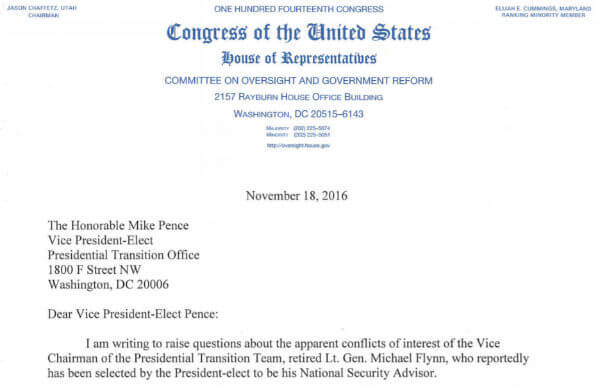
Mike Flynn and Trump administration defined by conflicts of interest
The Washington Post reports: Attorneys for Michael Flynn, President Trump’s former national security adviser, informed the incoming White House legal counsel during the transition that Flynn might need to register with the government as a foreign agent — a phone call that raised no alarms within Trump’s team, despite the unusual circumstance of having a top national security post filled by someone whose work may have benefited a foreign government.
The firm Flynn headed, Flynn Intel Group, was hired last year when Flynn was an adviser to the Trump campaign by the Netherlands-based firm Inovo BV, which is owned by Turkish businessman Ekim Alptekin. Alptekin has close ties to Turkish President Recep Tayyip Erdogan. [Continue reading…]
It is impossible that Mike Pence didn't know about Mike Flynn. https://t.co/aVb9itSdVQ
— Maddow Blog (@MaddowBlog) March 11, 2017
The Daily Caller reports: While serving as a top adviser on Donald Trump’s presidential campaign, Michael Flynn signed a contract in which he agreed to utilize an “investigative laboratory” made up of elite former intelligence officials, including a former CIA director, to conduct research and make “criminal referrals” on behalf of a Dutch shell company linked to the Turkish government, federal records show.
But Flynn appears to have over-promised on the contract, which was signed on Aug. 9 between his firm, Flynn Intel Group, and Inovo BV, the shell company.
R. James Woolsey, the former CIA director identified by his title in the contract as a member of Flynn Intel’s “investigative laboratory,” says he was not aware of and never agreed to perform any of the work laid out in the contract.
The investigative work promised by Flynn Intel was most likely focused on Fethullah Gulen, a Muslim cleric exiled in the U.S. whose extradition is being sought by the Turkish government. [Continue reading…]
Turkey’s testy campaign over ‘executive presidency’ sows divisions at home and abroad
The Washington Post reports: So far in a rancorous election season, the Turkish government or its opponents have invoked Nazi Germany, terrorist groups, fifth columnists and a Latin American dictator.
And that was in the campaign’s first two weeks.
There is more than a month to go before a referendum in April that will allow Turks to vote on a series of constitutional amendments that could give Turkey’s dominating leader, President Recep Tayyip Erdogan, vast new powers and allow him to remain in office for more than a decade.
But already, the poisonous rhetoric surrounding the campaign has aggravated tensions in this sharply divided nation, raising fears about the aftermath of the vote — and surged beyond Turkey’s borders, upending its foreign alliances. On Sunday, as part of an escalating feud with the Dutch government, Erdogan warned that the Dutch would “pay a price” after Turkish ministers were prevented from visiting the Netherlands over the past two days, according to Reuters. [Continue reading…]
The Dutch far right’s election donors are almost exclusively American
Quartz reports: While Europe has been busy fretting about Russian meddling in its politics, a few Americans have been quietly doing their part to boost the continent’s far right.
Wealthy American conservatives have poured large sums into the electoral campaign of far-right leader Geert Wilders of the Netherlands’ Dutch Freedom Party, in support of his anti-Islam, anti-EU views.
Three American donors gave €141,668 ($150,430) to Dutch political parties between 2015 and 2017, according to campaign finance documents released this week by the Dutch interior ministry. Two of these donors funded the far-right Dutch Freedom Party. [Continue reading…]
Geert Wilders: The peroxide-blond crusader who could soon top Dutch elections
The Washington Post reports: He warns about the perils of Muslim immigrants. A single well-lobbed tweet can ignite his nation’s political scene for days. And in a time of relative prosperity, he has succeeded in focusing dark fears about what is happening in mosques across his land.
The peroxide-blond Dutch politician Geert Wilders was executing the Trump playbook long before the U.S. president started his insurgent campaign for the White House. And in Dutch elections Wednesday, Wilders has a strong chance to come out on top, cementing the influence of a politician who wants to ban the Koran, shut down mosques and upend his nation’s sleepy political scene.
Nervous leaders across Europe are looking to the Netherlands this week for clues about elections this year in France and Germany. There, anti-Islam, anti-European Union candidates also are capitalizing on fears about a wave of mostly Muslim refugees and migrants who have surged over their borders in recent years. [Continue reading…]
Trump’s Panama problem
Anna Lenzer writes: It was a big moment for Donald Trump.
On July 6, 2011, the future president was beaming as he celebrated the opening of his first international real-estate deal, the Ocean Club in Panama City, Panama. The flashy hotel-condo complex featured a 72-story tower that transformed the skyline of the city with its sail-shaped design. After a ceremony featuring dancers in traditional Panamanian dress, Trump stood at a podium, flanked by his two oldest sons, Don Jr. and Eric, paused during his remarks, gently leaned over and offered a special thanks to Ricardo Martinelli, the president of Panama.“You’re my friend. Great honor.”
Standing next to Trump’s children, Martinelli smiled back. The white-haired, stocky president was flattered, proud of the fact that the complex had the potential to transform his small country into a destination for the rich and famous. As they both delivered their remarks that afternoon, the sky broke open and a torrential rain flooded the streets, turning the peninsula on which the complex stood into a “swamp island.” Trump and Martinelli had to ride out through the flooded streets in their separate chauffeured SUVs.
More than five years later, Trump has taken over the Oval Office and Martinelli is a fugitive from justice wanted on multiple corruption charges and investigations, ranging from allegedly helping to embezzle $45 million from a government school lunch program to insider trading to using public funds to spy on more than 150 political opponents, lawyers, doctors, and activists. But their paths could intertwine again very soon in what may be a thorny dilemma for the Trump administration. At the end of September, Panama’s Supreme Court asked the United States to extradite Martinelli, who left office in 2014 and now lives in exile in a luxury waterfront condo in Miami.
While the United States has codified policies to deny visas to foreign officials facing criminal charges in their home countries, and Trump’s recent executive order on immigration enforcement targets for removal individuals with even unresolved criminal charges, Martinelli entered the U.S. in 2015 on a visitor visa as the criminal investigations around him and his inner circle were tightening and has reportedly remained since.
Before fleeing Panama, Martinelli sat on the board of a bank that became the co-trustee for the Ocean Club, a role that left it in charge of managing funds coming in from rentals and sales, and of disbursing money to Trump, who gets millions in fees from the project. The Ocean Club has been Trump’s largest individual source of branding fees, reports the Economist, earning Trump “at least $50 million on the project on virtually zero investment,” reported the Washington Post in January.
Now, the extradition request highlights the potential conflicts of interest that have swirled around Trump: A decision that is usually made on the merits by career diplomats could be complicated by the president’s personal and business ties to Panama. Officials at the State Department could be inclined to approve the extradition, mindful of not antagonizing the current government of Panama, which exerts plenty of influence over the fate of a development that makes millions for the president’s family — or to decline the request out of their awareness of Martinelli’s support for the Ocean Club and his admiration and kind words for Trump. [Continue reading…]
Gangster paradise: Assad’s control erodes as warlords gain upper hand
Der Spiegel reports: On a cool morning, an elderly man is standing at his espresso machine on a street in eastern Aleppo. It’s shortly after 8 a.m., and this part of the city — destroyed in the war and reconquered by the regime in December — is waking up. Green grocers arrive and set out their boxes of produce on the rubble piled in front of their stores. Others are shoveling debris from the roads.
The name of the man with the espresso machine must go unmentioned, otherwise he would soon be dead. A fire is burning in a metal drum next to his improvised coffee counter, and he is using it to periodically warm his hands. Several weeks ago, just after the neighborhood was retaken, he returned to the small workshop where he had run a motorcycle repair shop — but it was already too late. He immediately saw that someone had shot open the lock.
Inside, he found uniformed fighters from a militia affiliated with the regime. They were in the process, he says, of removing a motorcycle, his German tools and all replacement parts from the garage. Two of the militia members, he says, silently threatened him with their Kalashnikovs, leaving him no choice but to leave as the men loaded his belonging into a pick-up truck.
As he relates his story, other civilians approach the fire and begin nodding. One of them, the owner of a general store, says that regular army soldiers had hardly left before militia members began emptying out his store. Another relates the story of how militia members murdered his brother. The brother had been lying wounded in bed when five fighters forced their way into his apartment. “Bring him out,” the fighters ordered before claiming the apartment as their own. The man protested, saying his brother was unable to walk — whereupon one of the militia members pulled out his gun and shot the brother in the head. Then the fighters looted the apartment.
More and more men from the neighborhood assemble at the coffee machine and tell their own stories of looting, but suddenly, the men at the fire fall silent. A militia fighter can be seen walking down the street with a golden hawk on his uniform, the emblem of the Desert Hawks, one of the two most powerful militias in the territory controlled by Syrian President Bashar Assad.
For months, Assad’s army has been on the advance across Syria. But its military success has only been possible due to the significant assistance the president’s troops have received from Iran and Russia — and from local Syrian militias. Now, these fighters are taking over control in many areas, committing murder, looting and harassing civilians. And nobody can stop them, not even Assad himself. Indeed, the militias are now more powerful than even the country’s leader and have become the real holders of power in Syria. [Continue reading…]
Sessions ordered 46 U.S. attorneys to resign immediately but New York’s Preet Bharara has yet to do so
Harry Siegel writes: Preet Bharara, the crusading U.S. Attorney for the Southern District of New York who was asked to submit his resignation letter Friday, along with the 45 other U.S. Attorneys held over from the Obama administration, has yet to do so, a federal law enforcement official tells The Daily Beast.
Bharara — whose office is in the end stages of an investigation of New York Mayor Bill de Blasio, about to begin the trials of two close allies of Governor Andrew Cuomo, and also appears to be investigating how Fox News structured settlements of sexual harassment and other claims brought by its employees — met with Donald Trump shortly after the election and was told that he would stay. Just this week, Attorney General Jeff Sessions assured him in a phone conversation that he’d remain atop the Southern District, according to the federal law enforcement official.
Since receiving the letter demanding his resignation Friday afternoon, Bharara has yet to speak to the press or to his full office. Friday evening, the law enforcement official said, Bharara told his section chiefs that he’d yet to submit the requested letter and may instead challenge Sessions to fire him.
The request for Bharara’s resignation came a week to the day after he’d started a personal Twitter feed where he’d Tweeted Monday: “This Senate hearing on political interference @ DOJ was 10 yrs ago today. Is that me in background? Boy I’ve aged.”
Bharara, then the chief counselor to Sen. Charles Schumer, helped lead the Senate’s probe into the midterm dismissals of eight U.S. Attorneys that in turn led to the resignation of Attorney General Alberto Gonzales. [Continue reading…]