Category Archives: ISIS

Islamic State of Iraq and Syria

As #ISIS advances it acquires the assets it needs for running a state

Bloomberg reports: Islamic State militants who last week captured the Mosul Dam, Iraq’s largest, had one demand for workers: Keep it going.

Arriving in their Toyota pickup trucks, armed with Kalashnikov assault rifles and wearing a patchwork of military uniforms, robes and turbans, jubilant militants from the al-Qaeda breakaway group told workers hiding in management offices they would get their salaries as long as the dam continued to produce electricity for the region under their control, according to a technician who was at the dam when nearly 500 militants drove off Kurdish troops.

Islamic State’s rampage through northern Iraq has inspired terror as stories spread of beheadings and crucifixions. At the same time, its fighters are capturing the strategic assets needed to fund the Islamic caliphate it announced in June and strengthen its grip on the territory already captured.

“These extremists are not just mad,” said Salman Shaikh, director of the Brookings Institution’s Doha Center in Qatar. “There’s a method to their madness, because they’ve managed to amass cash and natural resources, both oil and water, the two most important things. And of course they are going to use those as a way of continuing to grow and strengthen.”

The dam is the most important asset the group captured since taking Nineveh province in June. The group controls several oil and gas fields in western Iraq and eastern Syria, generating millions of dollars in daily revenue. [Continue reading…]

Facebooktwittermail

How #ISIS made a comeback a year after it looked all but finished in Syria and Iraq

Hassan Hassan reports: The group, which became known as the Islamic State of Iraq and Syria (Isis) after it broke away from the al-Qaida-affiliated Jabhat al-Nusra in April last year, had been driven out of most of Syria, and rebel factions and al-Qaida affiliates threatened to chase it out of Iraq. But the group has made a remarkable comeback, seizing stretches of at least seven provinces in the two countries, and marching steadily into other areas.

In the last two weeks alone, Isis has fought on five fronts: against the Iraqi army, the Kurdish peshmerga, the Syrian regime, the Syrian opposition and the Lebanese army. In Syria the group has all but consolidated control of the eastern provinces of Raqqa and Deir Ezzor, as it made advances against government forces in Raqqa and subdued most of the rebel forces in Deir Ezzor. It is also advancing into Aleppo, reaching the city’s eastern outskirts, and in Hasaka, and is battling the Kurdish militias in the north-east. In Iraq it has advanced to a point only half an hour’s drive from Irbil, the Kurdish capital.

Yet these advances appear to be only the tip of the iceberg. Away from the publicised gains, Isis is quietly making progress on other fronts. Perhaps the most worrying is the fact that armed groups backed by the US have been co-opted by Isis.

After its sweeping military success in Iraq in June, Isis moved to take over the strategic province in Deir Ezzor, where the rebels controlled lucrative oil and gas resources. To the surprise of many, the group quickly controlled towns and villages that were home to some of the group’s most powerful adversaries, including Jabhat al-Nusra and locally rooted tribal militias. [Continue reading…]

Facebooktwittermail

Fighters abandoning al Qaeda affiliates to join #ISIS, U.S. officials say

The Washington Post reports: Even before its assault on Kurdish territories in northern Iraq this month, analysts said the Islamic State had shown an almost impulsive character in its pursuit of territory and recruits, with little patience for the elaborate and often time-consuming terror plots favored by al-Qaeda.

Counterterrorism analysts at the CIA and other agencies have so far seen no indication that an entire al-Qaeda node or any of its senior leaders are prepared to switch sides. But officials said they have begun watching for signs of such a development.

The launching of U.S. airstrikes has raised new questions, including whether the bombings will hurt the Islamic State’s ability to draw recruits or elevate its status among jihadists. “Does that increase the spigot or close it?” said a senior U.S. counterterrorism official, who, like others, spoke on the condition of anonymity and noted that U.S. military operations in Afghanistan and elsewhere have crippled al-Qaeda but also served as rallying cries against the United States.

Longer-term, U.S. officials expressed concern that the Islamic State, which so far has been focused predominantly on its goal of reestablishing an Islamic caliphate, may now place greater emphasis on carrying out attacks against the United States and its allies. [Continue reading…]

Hillary Clinton:

“One of the reasons why I worry about what’s happening in the Middle East right now is because of the breakout capacity of jihadist groups that can affect Europe, can affect the United States,” she said. “Jihadist groups are governing territory. They will never stay there, though. They are driven to expand. Their raison d’etre is to be against the West, against the Crusaders, against the fill-in-the-blank—and we all fit into one of these categories. How do we try to contain that? I’m thinking a lot about containment, deterrence, and defeat.”

The breakout capacity of jihadist groups? I strongly suspect that phrase was a gift from GOP strategist Frank Luntz. It offers a subliminal connection between terrorism and Iran’s nuclear program without having to make any substantive assertion to that effect. Instead, it conjures up jihadist groups as metaphorical weapons of mass destruction. Is this how a President Clinton would frame her iteration of the War on Terrorism?

More importantly, Clinton is echoing the U.S.-centric narcissistic view of terrorism that still prevails in this country: that extremists of every description have no greater desire than to find ways of killing Americans.

No doubt, ISIS has issued blood-curdling warnings, saying that the U.S. will be severely punished if it tries to obstruct the growth of the Islamic State, but the very fact that it has made these warnings is an indication that the group has vastly more interest in its caliphate project than it has in waging war with the U.S..

ISIS is not at war with America — it’s enemy is the Shia.

That’s not to imply that the rest of the world has any justification for being complacent about the level of mayhem ISIS can and already has created. It’s simply a suggestion that “American lives are at stake” should not be the only rationale guiding U.S. foreign affairs.

Facebooktwittermail

The chaos in Baghdad explains why #Obama isn’t trying to destroy #ISIS

Tweet from U.S. Deputy Assistant Secretary of State for Near Eastern Affairs (Iraq and Iran):

Vox: Iraqi Prime Minister Nouri al-Maliki threw the country’s political system into crisis on Sunday, when he announced that he would be staying on as Prime Minister after a deadline to form a new government expired without an agreement at 12 am Baghdad time. Maliki announced a plan to sue Iraq’s President, Fuad Masum, for violating the country’s constitution, and it’s now totally unclear when, if ever, Iraq will return to normal democratic procedures.

All of this underscores why, on his Saturday press conference about the US intervention on Iraq, President Obama emphasized the need for Iraqi political reform to solve the ISIS crisis. “Ultimately, there’s not going to be an American military solution to this problem,” President Obama told reporters. “There’s going to have to be an Iraqi solution.” This is the key line to understand if you want to grasp the administration’s approach to Iraq — and why the goals of the US military campaign are more narrow than you might think.

The American objectives for Obama’s airstrikes in Iraq are very clear, and very limited. American airpower will protect Iraqi Kurdistan from the advance of militants from Islamic State (ISIS), and will attempt to break the ISIS siege that’s starving up to 40,000 members of the Yazidi minority on an isolated mountain.

So why is the US stopping there? ISIS controls a huge swath of land about the size of Belgium in Iraq and Syria. The group poses a serious threat to the Iraqi government and possibly even the stability of the entire region. If the United States can beat ISIS back in Kurdistan, why not elsewhere?

That line about an Iraqi solution is the administration’s answer. In fact, the Obama administration has been consistent on this question since June, when ISIS first took control of big chunks of Iraq. They see ISIS as, at its heart, a political problem — one that can’t be solved solely with force. But the march on Kurdistan and the siege on Sinjar are narrow military problems, and thus merit military solutions. This distinction between military and political problems is at the heart of the Obama administration’s thinking on Iraq. [Continue reading…]

Facebooktwittermail

Exodus from the mountain: Yazidis flood back into Iraq following U.S. airstrikes

The Washington Post reports: Burned by the sun, blistered with thirst and weak from exhaustion, thousands of Yazidis fled the mountain on which they had been trapped for a week on Sunday, streaming into Iraq’s northern Kurdistan region after a harrowing escape from extremist fighters that some said was aided by U.S. airstrikes.

Hungry, thirsty and tired, they limped across a narrow bridge spanning the Tigris on the Iraqi-Syrian border hauling their few belongings, some of them barefoot, others in sleeping clothes because they ran for their lives at night.

It was the last leg of a nightmarish journey that some have not survived — and many more may not.

Thousands are still stranded on the mountain, either because they are surrounded in their villages by militants with the Islamic State or are simply too weak to walk, according to those arriving in the remote Iraqi border post of Fishkhabour. Others have died trying to reach safety, falling by the wayside on the barren, rocky mountain for lack of food and water. [Continue reading…]

Facebooktwittermail

U.S. air support helps Kurdish forces expel #ISIS fighters from two Iraqi towns

The Washington Post reports: Aided by U.S. airstrikes, embattled Kurdish forces began to reverse a string of losses on Sunday, expelling Islamic State extremists from two northern Iraqi towns.

Makhmour and Gweir, the first areas targeted in the U.S. air campaign that began Friday night, were cleared of the al-Qaeda-inspired militants on Sunday, Kurdish officials said.

“It’s thanks to the strikes that we have been able to move forward,” said Mahmood Haji, an official in the Kurdish Interior Ministry. The Kurdish television channel Rudaw showed live footage of security forces advancing in Makhmour, and later crowding around a government building in the town, where the Kurdish flag had been raised once more.

President Obama said Saturday that the American air campaign would not expand beyond the limited objectives he has outlined. He tied more extensive assistance to the formation of an inclusive Iraqi government in Baghdad. [Continue reading…]

BasNews reports: Most Arab tribes that border the Kurdistan Region geographically are helping Islamic State (IS) insurgents as well as helping them to get close or enter Kurdish villages and cities in northern Iraq.

Facebooktwittermail

A piecemeal parochial approach won’t solve the Middle East crisis

Chris Doyle writes: “The lamps are going out all over the Middle East”, to update Sir Edward Grey’s doom-laden warning to Europe a hundred years ago. The areas of calm and stability seem like small oases in a multitude of firestorms. Many areas are literally without lights. Gaza has around two hours electricity a day. The power cuts in Yemen are worse and worse, leading to major protests. But, more worryingly, the lights of the democratic, liberal, pluralistic forces that for many months in 2011 lit up the region are also dimming, overshadowed by the twin forces of brutal dictatorship and brutal religious sectarian extremism.

Syria and Iraq are divided and near ungovernable, in the waiting room for failed-state status. The so-called Islamic caliphate or Isis, which in reality bears no resemblance to any caliphates of the past, covers an ever-expanding area, larger than the United Kingdom, including 35 per cent of Syria. Libya is being terrorised by rival militias. Palestinians in Gaza, for the fourth time since 2006, are at the wrong end of an Israeli military aggression that pits one of the world’s most sophisticated militaries against a captive population inside the world’s largest prison. The collective pile of rubble from these conflicts would grace a mountain range.

Those states and areas that enjoy calm become refugee camps. Lebanon and Jordan host almost two million Syrian refugees between them, as well as 2.5 million Palestinians. Tunisia is confronted with a mass Libyan exodus; while Iraqi Kurdistan is home to more than 300,000 Iraqis displaced only since June, as well as 220,000 Syrian refugees. In each case, the numbers are rocketing up – with the number of Syrian refugees alone expected to reach four million by the end of the year. Each humanitarian appeal is underfunded.

Will it get worse? The signs are worrying. The fighting in Lebanon last week, in Arsal in the north Bekaa valley, is yet another example of why the Syrian crisis threatens to move from spilling over, to swamping, its smaller neighbour. The instability could spread to Jordan. Saudi Arabia and the Gulf states will not be immune to the regional changes.

Given the epidemic of crises in an area of the world vital to our trade, energy and security interests, the minimal expectation would be an energetic and engaged response. Yet, when asked about Western policy towards the region, my instinctive response is, “There is one?”

The failure is first and foremost one of leadership, at an international and regional level. Who are great international statesmen in the West or in the Middle East? Who do young Arabs, who make up most of the population, look to for inspiration? President Obama has been blasted for his indecisiveness but he is not alone. George W Bush and Tony Blair were decisive over Iraq and destroyed the country. There is no strategy, and often the debate is reduced to a question of to bomb or not to bomb. [Continue reading…]

Facebooktwittermail

Send them parasols?

CODEPINK asks: “Why does our President want to take sides and get involved in a civil war? The US is not the target of ISIS, but if we become involved, we will be.”
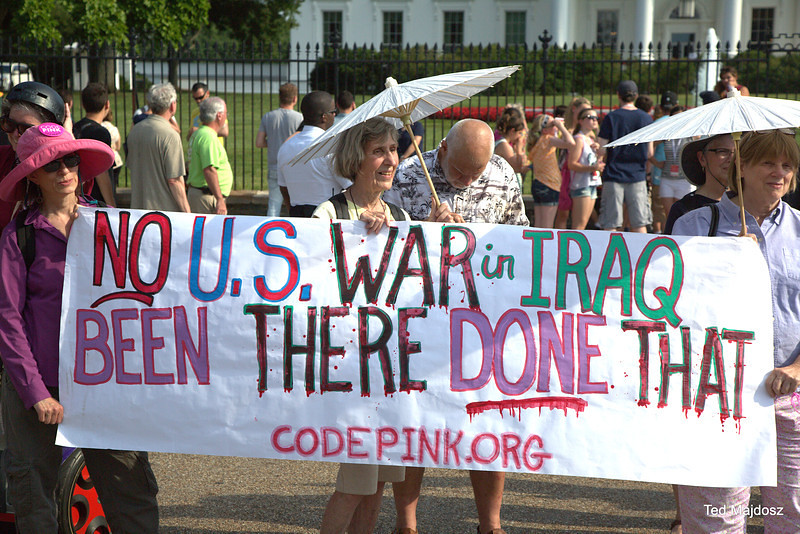
A lot of Americans these days, some of whom regard themselves as impeccable humanitarians, have formed the conviction that when it comes to the Middle East (or pretty much anywhere else in the world), intervention by the United States — especially military intervention — can do nothing but harm.

President Obama’s concerns about the Iraqi humanitarian crisis and the safety of US personnel can be solved without dropping bombs. Helping the besieged civilians in Iraq should be an orchestrated international effort, not carried out just by the US — the country that unleashed the sectarian turmoil in the first place. (CODEPINK)

Tens of thousands of Iraqis fled from ISIS, taking refuge on a mountain top where they have no food, water, or shelter. How long could anyone survive in these conditions when daytime temperatures often exceed 100F?

By the time CODEPINK’s wished for international effort could be orchestrated, thousands of those in need of help would be dead.


Channel 4 News
spoke to a Yazidi refugee, Barakat al-Issa, who is trapped in the Sinjar mountains: “the situation is very tragic, more than 100 thousand people are trapped in the mountains here, in need of water and food.”

The Americans and Turkish have carried out air drops of aid, but the effort was not sufficient said Mr al-Issa: “They are saying that planes are dropping aid, but this aid is only getting to some 5 per cent of the people who are trapped here, because of the mountainous terrain.”

“People are waiting here for international forces to intervene, in the hope that this will become a safe haven for aid to be delivered.”

“Most of the people here are civilians and they hope a peacekeeping force will come from Iraq or Nato.”

He accused the Islamic State militants of kidnapping at least 500 Yazidi women, whose fate remains unknown, and said that dozens of families had been murdered in the south of the Sinjar mountains as they tried to flee. He also repeated allegations that militants had been seen executing women and children.

To advocate neutrality in this conflict seems indicative of either being willfully deluded about the nature of ISIS or the result of simply not paying attention to what has been happening in Syria and Iraq over the last two years.

ISIS, or the Islamic State as it now prefers to be known, is utterly uncompromising. These men have chosen to fight a war that they will either win or lose — don’t expect them to ever send a delegation of negotiators to Geneva or start talking about how they want to live peacefully side by side with anyone. Coexistence is not part of their vocabulary.

Anyone in CODEPINK who is averse to taking sides should watch the video below — or at least as much of it as they can stomach — to witness how these jihadists whose passion for killing has no limit choose to portray themselves.

Some of the latest military action in Iraq appears to already by paying off but the situation remains dire, as Rudaw reports:

Local officials said today that 10,000 Yezidis who were stranded on Mount Shingal for one week were rescued and settled in the town of Zakho.

Medical teams and aid organizations in Zakho have rushed in to assist the rescued families, said Rudaw reporter.

Ashti Kocher, Zakho’s security chief said that Kurdish armed forces have opened a safe corridor for the Yezidis at Mount Shingal.

“We have also cleared about 30 kilometers of the ISIL forces in order to open a road for those families,” said Kocher, who currently leads a Peshmerga unit at Sinune village near Shingal.

Kocher said that the rescued civilians were transported to the Kurdistan Region through Rojava (Syrian Kurdistan) which is under the control of Kurdish forces known as the Peoples Protection Units (YPG).

Barakat Issa, Rudaw reporter on Mount Shingal said that the number of Yezidis stranded on the mountain is higher than initially reported. He said that nearly 100,000 people are hiding on the mountain.

Issa said that in the past few days 60 children and elderly have [died] … of hunger and thirst while there is fear that Islamic militants controlling the town of Shingal and other villages have massacred hundreds of others.

Stephen Walt proposes a course of inaction for the U.S. in the Middle East on the grounds that U.S. intervention never has its desired effects, but he adds this caveat:

[T]his argument would not preclude limited U.S. action for purely humanitarian purposes — such as humanitarian airdrops for the beleaguered religious minorities now threatened with starvation in Iraq. That’s not “deep engagement”; that’s merely trying to help people threatened with imminent death. But I would not send U.S. forces — including drones or aircraft — out to win a battle that the Iraqi government or the Kurds cannot win for themselves.

So the anti-interventionist “humanitarian” perspective is this — if I understand it correctly: we should try to make sure the Yazidi do not starve to death on the mountaintop. If, however, they manage to come back down only later to be slaughtered by ISIS, that’s their problem.

Facebooktwittermail

U.S. expands airstrikes against Islamic State militants in northern Iraq

The Washington Post reports: The U.S. military ramped up its campaign against Islamist militants in northern Iraq on Friday, with fighter jets and drones conducting additional airstrikes outside the Kurdish regional capital of Irbil, officials said.

The Pentagon said the strikes “successfully eliminated” militant targets and destroyed artillery being used by the Islamic State extremist group to shell Kurdish forces.

The first strikes took place at dawn, Washington time, with two F/A-18 combat jets flying from the aircraft carrier USS George H.W. Bush in the Persian Gulf. The aircraft dropped 500-pound laser-guided bombs on a “mobile artillery piece” near Irbil, said Rear Adm. John F. Kirby, the Pentagon press secretary.

Islamic State fighters were “using this artillery to shell Kurdish forces defending Irbil where U.S. personnel are located,” he said in a statement. “As the president made clear, the United States military will continue to take direct action against [Islamic State militants] when they threaten our personnel and facilities.”

Hours later, an MQ-1 Predator drone armed with Hellfire missiles struck an Islamic State mortar position. When “fighters returned to the site moments later, the terrorists were attacked again and successfully eliminated,” Kirby said. [Continue reading…]

Facebooktwittermail

U.S. warplanes strike #ISIS artillery to protect Kurds

Reuters reports: U.S. warplanes struck Iraq on Friday for the first time since American troops pulled out in 2011, attacking Islamist fighters advancing towards the Kurdish region after President Barack Obama said Washington must act to prevent “genocide.”

The fighters had advanced to within a half hour’s drive of Arbil, capital of Iraq’s Kurdish region and a hub for U.S. oil companies. A Pentagon spokesman said two F/A-18 aircraft dropped laser-guided bombs on a mobile artillery piece used by Islamic State fighters to shell Kurdish forces defending Arbil. [Continue reading…]

Facebooktwittermail

Nun removes ‘jihadi’ flag from gates of East London housing estate

The London Evening Standard reports: A nun has taken down a black flag similar to those flown by jihadist fighters in Iraq and Syria after it was spotted flying at the gates of an east London housing estate.

The controversial flag sparked outrage after it was pictured flying above the Will Crooks estate in Tower Hamlets, alongside a number of Palestinian flags and slogans in support of Gaza.

But when council officers went to the site, in Poplar High Street, they were told the flag had been removed by Sister Christine Frost, a Roman Catholic nun who runs a charity supporting vulnerable residents in the area.

A spokesman said: “The council can confirm that following reports this morning of a flag erected on the Will Crooks Estate, council officials took steps to remove it but found it had already been taken down by Sister Christine Frost, a well-known local activist and promoter of community cohesion.

“The flag was removed following concerns that it could cause community tension.”

Sister Christine is believed to have gone on a day-trip to Clacton-on-Sea today after taking the flag down overnight. A source said she may have travelled to the seaside with the youths who had erected the flag.

Facebooktwittermail

The jihadi gift shop in Istanbul

Joseph Dana visited the only known clothing store, located in the suburb of Bagcilar in Istanbul, which specializes in selling ISIS-branded merchandize: The idea of ISIS T-shirts shouldn’t actually be that surprising. For a terrorist organization hell-bent on creating a state based on a puritanical and bigoted form of Islam, ISIS has an incredibly savvy marketing and branding campaign. The group uses social media platforms, especially Twitter, to mold a specific media narrative and recruit funds, as well as fighters, from across the globe. Clothing targeting young men has come to be a central component of the group’s branding. By most accounts, the production and design inspiration of ISIS clothing stems from East Asia.

The Indonesian company Zirah Moslem has emerged as the world’s leading seller of ISIS merchandise. T-shirts are generally priced under $15 and, until recently, could be found on its Facebook page. Before Facebook removed the page for violating its terms of service, Zirah Moslem had more than 9,000 likes. The company still sells clothing on its website and likely acts as a wholesaler to smaller operations around the world, like Istanbul’s Islami Giyim. While it might be easy to buy ISIS T-shirts and other articles of clothing online, to date Islami Giyim is the only brick-and-mortar establishment to receive any press.

The popularity of ISIS clothing — most notably T-shirts emblazoned with the group’s initials flanked by AK-47s — demonstrates the next phase of ISIS’s international branding campaign. Islami Giyim’s Facebook page already has 6,400 likes and prominently displays a variety of ISIS-related clothing items. Without revealing exact sales figures, the store’s owner said that business was good. So good, in fact, that he plans to open more locations throughout Istanbul in the coming months. [Continue reading…]

Facebooktwittermail

Kurdish commander: ‘If [the Americans] plan to help they had better do it now’

McClatchy reports: Jet aircraft attacked Islamic State positions outside the town of Kalak, 25 miles northwest of Irbil, the capital of Iraq’s autonomous Kurdish region, a resident of Kalak told McClatchy early Friday.

The resident, reached by phone from Irbil, said she had seen the aircraft and had heard the explosions coming from behind Islamic State lines, which are slightly more than a mile away. The resident said because it was dark she could not see any markings on the aircraft.

Kurdish television reported that the bombers were American. There was no confirmation from U.S. officials in Washington.

The reported bombing came after a day of panic in the Kurdish capital following Islamic State militants’ seizure of four strategic towns on a key highway and their advance to positions just minutes from Irbil.

Hundreds of Kurdish peshmerga militiamen built earthen berms near Kalak on the highway that links Irbil with Mosul, the Iraqi city whose fall to Islamic State militants in early June touched off a sweep across northern and western Iraq that until Thursday had spared Kurdish areas.

But that quiet appeared to be over, with the Islamic State boldly saying in an Internet posting Thursday that it intended to capture Irbil, a city previously thought so secure that the United States two months ago chose it as one of two Iraqi cities safe enough to receive scores of staffers evacuated from the U.S. Embassy in Baghdad.

“The Americans keep saying they will help us,” said Rosg Nuri Shawess, a top Kurdish military commander who was overseeing the defensive preparations. “Well, if they plan to help they had better do it now.” [Continue reading…]

Facebooktwittermail

ISIS offensive sparks mass Iraq exodus of largest Christian town

Middle East Eye: Militants took over Iraq’s largest Christian town Qaraqosh and surrounding areas on Thursday and sent tens of thousands of panicked residents fleeing towards autonomous Kurdistan, officials and witnesses said.

Islamic State (IS) militants moved in overnight after the withdrawal of Kurdish peshmerga troops, who are stretched thin across several fronts in Iraq, residents said.

“I now know that the towns of Qaraqosh, Tal Kayf, Bartella and Karamlesh have been emptied of their original population and are now under the control of the militants,” Joseph Thomas, the Chaldean archbishop of Kirkuk and Sulaimaniyah, told AFP.

Qaraqosh is an entirely Christian town which lies between Mosul, the militants main hub in Iraq, and Erbil, the Kurdish region’s capital. It usually has a population of around 50,000.

“It’s a catastrophe, a tragic situation. We call on the UN Security Council to immediately intervene. Tens of thousands of terrified people are being displaced as we speak, it cannot be described,” the archbishop said.

Tal Kayf, the home of a significant Christian community as well as members of the Shabak Shiite minority, also emptied overnight. [Continue reading…]

Facebooktwittermail
