Amnesty International has gathered evidence pointing to a pattern of extrajudicial executions of detainees by government forces and Shi’a militias in the Iraqi cities of Tal ‘Afar, Mosul and Ba’quba.
Surviving detainees and relatives of those killed gave graphic accounts that suggest Iraqi forces had carried out a series of vengeful attacks against Sunni detainees before withdrawing from Tal ‘Afar and Mosulf in northern Iraq. Both are now controlled by the Islamic State in Iraq and al-Sham (ISIS). In Ba’quba, central Iraq, government forces and Shi’a militias have been fending off attempts by ISIS to capture the city.
“Reports of multiple incidents where Sunni detainees have been killed in cold blood while in the custody of Iraqi forces are deeply alarming. The killings suggest a worrying pattern of reprisal attacks against Sunnis in retaliation for ISIS gains,” said Donatella Rovera, Amnesty International’s Senior Crisis Response Adviser, who is currently in northern Iraq.
“Even in the midst of war there are rules that must never be transgressed. Killing prisoners is a war crime. The government must immediately order an impartial and independent investigation into the killings, and ensure that those responsible are brought to justice.” [Continue reading…]
Category Archives: ISIS
HRW: ISIS kidnaps Shia Turkmen, destroys shrines
Human Rights Watch: Forces of the Islamic State of Iraq and Sham (ISIS) kidnapped at least 40 Shia Turkmen, dynamited four Shia places of worship, and ransacked homes and farms in two Shia villages bordering the Iraqi city of Mosul, Human Rights Watch said today. The assaults took place during a violent three-day spree that began on June 23, 2014.
ISIS ordered all 950 Shia Turkmen families to leave the two adjacent farming villages of Guba and Shireekhan, according to nine displaced residents, two local activists, and local journalists. The displaced residents told Human Rights Watch they heard from the few remaining villagers, all Sunni, that ISIS had killed at least some of the kidnapped men, but none had seen bodies or could provide other confirmation. ISIS, an armed extremist Sunni group, remains in control of the two villages.
“This ISIS rampage is part of a long pattern of attacks by armed Sunni extremists on Turkmen and other minorities,” said Letta Tayler, senior terrorism and counterterrorism researcher at Human Rights Watch. “The killing, bombing, and pillaging threatens to displace entire communities, possibly forever.” [Continue reading…]
Many Iranians want military to intervene against ISIS
The Guardian reports: Merila, 30, has no love for Iran’s Islamic Revolutionary Guard Corps, but she is so alarmed by the Sunni Muslim militants battling to control neighbouring Iraq that she wants her country’s military to bring the fight to them or risk war at home.
Merila teaches English to young children in a day-care centre in Saadatabad, west Tehran, but her usual peace of mind has deserted her. “Isis is really frightening, and I’m scared,” she said. “I feel like they could pose a serious threat to us.”
The Islamic State in Iraq and the Levant, known as Isis, follows a virulent form of Sunni Islam that is deeply hostile to Shi’ism, the majority sect in both Iraq and Iran. Isis has publicised its execution of Shia Muslims after its capture of cities in northern Iraq including Mosul, the country’s second largest.
In pressing on towards Baghdad, Isis has threatened the Iraqi government, which is led by Shia Muslim parties and which has turned to its ally Iran, as well as the United States, for help.
For many Iranians, events have brought back memories of the “imposed war” of 1980-88 when Saddam Hussein unleashed Iraq’s powerful army against Iran. Even those not old enough to remember air-raids and mass casualties at the front have grown up in a society scarred by that conflict. [Continue reading…]
Jabhat al-Nusra, ISIS, Assad, and the Syrian revolution
Rania Abouzeid writes: The eight men, beards trimmed, explosive belts fastened, pistols and grenades concealed in their clothing, waited until nightfall before stealing across the flat, porous Iraqi border. They navigated the berms and trenches along the frontier, traversing two-way smuggling routes used to ferry cigarettes, livestock, weapons — and jihadis to enter the northeastern Syrian province of Hasaka. It was August 2011, the Muslim holy month of Ramadan, and Syria was five months into a still largely peaceful uprising against President Bashar al-Assad.
Their leader was a Syrian emissary from the al Qaeda affiliate forged in the bloody conflict next door. He called himself Abu Mohammad al-Golani, and the young fighter, about whom little is known for sure except that he is a veteran of that war against the Americans in Iraq, had been authorized by his boss, Abu Bakr al-Baghdadi, and al Qaeda’s central command to set up a Syrian offshoot of the notorious group. His mission, made clear in subsequent public statements, was nothing less than to bring down the Assad regime and establish an Islamic state in its place. No one knew it at the time, but that trip across the border would turn out to be a crucial turning point in the Syrian civil war, a key factor in the metastasizing of an internal conflict into a regional conflagration that now threatens the regime in Iraq as well as Syria.
Before Golani’s nighttime trek from Iraq into Syria, al Qaeda was looking increasingly like a spent force. Osama bin Laden had been killed a few months earlier. His successor, Ayman al-Zawahiri, had bin Laden’s passion but little of his charisma, and the Middle East was still in the throes of the so-called Arab Spring, experimenting with peaceful protests rather than violence as a means to bring about change.
But over the next few years, at times even aided by the cynical Assad regime, Golani would rejuvenate the al Qaeda brand and establish a firm base in Syria. His group, called Jabhat al-Nusra l’Ahl as-Sham (meaning Support Front for the People of the Sham, an Arabic term encompassing Damascus, Syria and the Levant), would create a whole new generation of jihadists from around the Islamic world, fighters who have become a crucial force in a Syrian civil war that has claimed well over 140,000 lives and displaced nine million Syrians, both internally and into neighboring countries.
Just as dangerously, Nusra’s very success would create a massive rift with its jihadist parent organization, the al Qaeda affiliate known as the Islamic State of Iraq. By April of 2013, that group would rebrand itself as the Islamic State in Iraq and the Levant, or ISIL, a new name that indicated its transnational ambitions. By this June, ISIL (also known as ISIS) had become so powerful that it would brazenly undertake a blitzkrieg-like advance across northern and western Iraq, rapidly capturing the Iraqi cities of Mosul and Tikrit and underscoring the seeming irrelevance of Zawahiri and the old al Qaeda leadership, somewhere in hiding off in South Asia, far from the newest jihadi battlefields.
Now, as a result of ISIL’s victories, U.S. President Barack Obama, a man who campaigned on extricating the United States from “dumb” wars in the Middle East, finds himself potentially embroiled in another one. He is sending a small contingent of special forces to work with the Iraqi military, but many in Washington are urging him to take more decisive action against the ISIL militants sweeping across Iraq, seizing territory and oil facilities and threatening to sow chaos in Baghdad and beyond.
This was not inevitable. The Syrian revolution—and the hesitant, confused international reaction to it—paved the way for the resurrection of a militant Islam that would turn vast regions of Iraq and Syria into borderless jihadi strongholds and inch closer to redrawing the map of the Middle East—in practical terms if not on paper. This is the story, pieced together over several trips into Syria and rare interviews with highly placed jihadi commanders on the front lines, of how it happened. [Continue reading…]
The fractures in Iraq’s Sunni revolt
Reuters reports: According to a high-level Iraqi security official, who specializes in Sunni militant groups, ISIL has about 2,300 fighters, including foreigners, who have led the speedy assault from Mosul through other northern towns, including Hawija, west of oil-rich Kirkuk; Baiji, home of Iraq’s biggest refinery; and Saddam Hussein’s birthplace Tikrit.
The high-level official told Reuters that as ISIL has raced on from Mosul, the north’s biggest city which they dominate, other Iraqi Sunni groups have seized much of the newly-gained rural territory because ISIL is short on manpower.
The different groups appear to be following ISIL’s lead in the bigger communities it has captured like Tikrit and Baiji.
But as the new order settles in Iraq’s Sunni north, the high-level security officer predicted: “They will soon be fighting each other.”
Mustafa Alani, an Iraqi security expert with good contacts in Gulf Arab governments, also expects friction to grow.
“How long can this honeymoon last?” he said. “ISIL is not acceptable among the people, either socially or politically.”
If the rebel alliance does fracture, battles could drag Sunni regions of Iraq into a state of permanent internecine war. [Continue reading…]
Iraq: ISIS mass execution site located
Human Rights Watch: Analysis of photographs and satellite imagery strongly indicates that the Islamic State of Iraq and Syria (ISIS) conducted mass executions in Tikrit after seizing control of the city on June 11, 2014.
The analysis suggests that ISIS killed between 160 and 190 men in at least two locations between June 11 and 14. The number of victims may well be much higher, but the difficulty of locating bodies and accessing the area has prevented a full investigation, Human Rights Watch said.
On June 12, ISIS claimed to have executed 1,700 “Shi’a members of the army” in Tikrit. Two days later, it posted to a website photographs with groups of apparently executed men. On June 22, Iraq’s human rights minister announced that ISIS had executed 175 Iraqi Air Force recruits in Tikrit.
“The photos and satellite images from Tikrit provide strong evidence of a horrible war crime that needs further investigation,” said Peter Bouckaert, emergencies director. “ISIS apparently executed at the very least 160 people in Tikrit.” [Continue reading…]
Maliki and ISIS are both enemies of democracy
Michael Weiss writes: The American military official best acquainted with the social fabric of northern and central Iraq says that the disintegration of the country was entirely preventable. Col. Rick Welch spent just under seven years in Iraq and served as Gen. David Petraeus’s chief liaison to the Sunni tribes of Fallujah and Ramadi and to various Shia tribal militia groups, including Muqtada al-Sadr’s now-reconstituted Mahdi Army.
Welch was integral to the so-called “Anbar Awakening,” which turned a lot of former insurgents – or insurgency sympathizers – into US allies against Al-Qaeda. Since retiring from the army, he has resumed his law practice in Ohio but has kept up with these hard-won friends, who have painted a dire picture of what life is like under the Nouri al-Maliki government. If the Islamic State of Iraq and al-Sham (ISIS) and the former Ba’athists of the Army of the Men of the Naqshbandi Order have managed to plow through Anbar Province with such ease, Welch argues, it is because the Sunnis of Iraq felt they had no recourse but to align with such elements.
“Maliki, in my opinion, is just as much an enemy to democracy in Iraq as ISIS is,” Welch told me last week in a wide-ranging interview. “He pushed them so far that they had to rise up. They tried to get reforms, but they couldn’t get them. There were dragnet arrests; Sunni women were thrown in prison to get to the men. Tribal honor was on the line and revenge thinking was on the line. Maliki made this crisis.” And it was abetted, the colonel says, by US obliviousness of or indifference to what was a noticeable degeneration in Baghdad even before the American troop withdrawal in 2011. [Continue reading…]
Maliki welcomes Syrian air strikes on Iraq
The Guardian reports: The Iraqi prime minister, Nouri al-Maliki, on Thursday followed US officials in confirming that Syrian warplanes had bombed Sunni militant positions in Iraq.
The cross-border raids have deepened fears that the insurgency now spanning Syria and Iraq could become an even wider regional conflict. Maliki told the BBC he had not requested the air strikes but welcomed them.
The Syrian warplanes struck near the border crossing in the town of Qaim on Tuesday, US military officials told the Associated Press, hitting the Islamic State in Iraq and the Levant (Isis), which seeks to carve out a purist Islamic enclave across the Syria-Iraq border.
The White House spokesman Joshua Earnest said Washington had “no reason to dispute” the reports. Details are, however, sketchy. For its part, Syria’s state news agency denied that Damascus had carried out the attacks. It said its source “refuted allegations made by malicious media outlets who claimed that the Syrian air force shelled areas within the borders of Iraq”.
Syrian opposition activists have claimed that the al-Qaim strikes missed Isis’s main bases and killed 30 civilians. [Continue reading…]
Reuters reports: Online backers of the Sunni Islamist militants who seized swaths of Iraq this month have said that any U.S. air strikes on the fighters will lead to attacks on Americans.
U.S. President Barack Obama has offered up to 300 American advisers to Iraq to help halt the advance by militants from al Qaeda offshoot the Islamic State in Iraq and the Levant (ISIL).
Washington has so far held off granting a request by Prime Minister Nuri al-Maliki’s Shi’ite-led government for air strikes.
A Twitter account with 21,000 followers naming itself the “League of Supporters” called for ISIL sympathizers to post messages online on Friday warning the U.S. not to carry out any strikes.
“This campaign reflects the messages sent by all the Sunni people all over the world to the American people … (It’s) a threat to every American in the event of an American strike on Iraq,” the message read.
Among hundreds of supportive responses, one user posted, “As our martyred sheikh Osama bin Laden said, you need not consult anyone about killing Americans.”
ISIS steps up international recruitment drive
The Wall Street Journal reports: A Sunni jihadist group that has seized vast territories in Iraq and Syria is parlaying its battlefield successes into a recruitment drive that is attracting more foreign fighters, say Western and Arab officials.
The message from the Islamic State of Iraq and al-Sham, or ISIS: Join us in forming a Sunni-led religious state spanning from the Mediterranean to the Persian Gulf.
One recruitment video, released on Friday, shows gun-toting militants, speaking with British and Australian accents, extolling the virtues of jihad and inviting viewers to join their battle in Syria and Iraq.
It isn’t the first time ISIS has tried to recruit Islamists while carefully crafting its image on social media to raise its appeal among jihadists.
But the video, disseminated last week on ISIS’s first non-Arabic Twitter accounts in English, German and Russian, is the group’s first English-language drive for foot soldiers, and reflects its attempt to burnish its jihadist credentials farther afield. [Continue reading…]
The Sunni revolution in Iraq
Sheik Ali Hatem Suleiman, head of the Dulaim tribe, the largest Arab tribe in Iraq: “America shouldn’t think that the Maliki government can stop ISIS. Maliki is the real danger to us. We can get rid of ISIS whenever we want.”
Sheikh Ahmed al-Dabash, a founder of the Islamic Army of Iraq: “We brought ISIS in to defend our religion, our money, our land and our people. We do not agree with dividing Iraq but think it should be governed as three autonomous regions. The Iraqi government is making it sound like ISIS is destroying everybody. They make it sound like all the Sunnis in Iraq are ISIS, and this is wrong.
Anonymous Sunni fighter interviewed by the BBC: “I want to say to America and the world, this is not an ISIS revolution. This is a Sunni revolution. We ask the EU and America to support the Sunni people. We are not terrorists.”
The fighters’ political spokesman: “The Sunnis reject ISIS. There is a vendetta between the tribes and ISIS because of crimes they have committed before. The battle with them is simply postponed.”
Saddam Hussein’s faithful friend, the King of Clubs, might be the key to saving Iraq
Michael Knights writes: Over the weekend, in what the Telegraph described as “a potential sign of the fraying of the Sunni insurgent alliance that has overrun vast stretches of territory north of Baghdad in less than two weeks,” a deadly firefight broke out west of Kirkuk, Iraq, between members of the Islamic State of Iraq and Al-Sham and a rival insurgent group called Jaysh Rijal al-Tariq al-Naqshbandi, or the Army of the Men of the Naqshbandi. JRTN now represents the main obstacle to ISIS’s creation of an Islamic caliphate spanning Iraq and Syria, and is most likely being led by Saddam Hussein’s old friend Izzat Ibrahim al-Douri, the King of Clubs from the infamous deck of cards of most-wanted Iraqis — that is, if he’s not dead.
Born in 1942, Douri came from Dawr, a town of 35,000 people on the east bank of the Tigris and just 20 miles from Hussein’s birthplace (and burial place) of Al-Awja. Growing up poor, Douri worked for an ice-seller as a boy but quickly turned to violent revolutionary politics in his late teenage years. He worked alongside Hussein, who, being a few years older, was Douri’s mentor. They both served in the intelligence and peasantry offices of the Baath Party and later spent time in jail together after the Baath’s brief seizure of power in 1963. Douri remained as Hussein’s eyes and ears in Iraq while Hussein was abroad for the five years preceding the Baathist return to power in 1968.
Back in power, Douri and Hussein picked up where they left off — as inseparable partners. Douri was rewarded for his loyalty by inheriting Hussein’s prior position, the vice presidency and deputy chairmanship of the Iraqi Revolutionary Command Council. Until Hussein’s capture in 2003, Douri served as his most trusted deputy, always careful not to threaten Hussein’s position. The Douris consistently backed Hussein, and the two families even merged for a time. In a show of loyalty, Douri consented to marry his daughter to Hussein’s eldest son, the infamous sadist Uday. As Iraqi tribal expert Amatzia Baram told me years ago, Douri’s sway with Hussein was so substantial that he could even levy a condition — that the union would not be consummated — and later made a successful petition that his daughter be permitted to divorce Hussein’s homicidal offspring.
But aside from keeping Hussein happy and in charge, Douri also had a personal project, a patronage network that he jealously guarded for himself. The name of that network was the Men of the Naqshbandi. [Continue reading…]
Among Brits, ISIS is now more popular than the Army Reserve
Channel 4 News: “More than twice as many Brits have now signed up to wage jihad in Iraq and Syria as joined the army reserve here last year.”
ITN News: “Gun-toting children paraded through the streets of Mosul in Iraq yesterday. An ITV News video shows an ISIS convoy travelling through the city, with the militants showing off the weapons and vehicle they seized as the Iraqi army fled. The footage shows two small boys, one armed with an assault rifle, which has a telescopic sight attached. Humans Rights Watch says that in Syria, ISIS has already recruited young children as ‘snipers’ – this could be an indication that the Iraq conflict may see the same.”
Iraq’s cities ‘under ISIS control’
As the news networks display maps showing the extent of ISIS’s gains across Iraq, I keep on wondering what it actually means to describe a city as having come under ISIS’s control.
Obviously the central government no longer maintains security forces in these locations, but what kind of a footprint can ISIS actually impose?
Who knows whether the number is accurate, but the most frequently cited estimate is that ISIS has a total of about 10,000 fighters. An intelligence official speaking to CBS News says that these forces are distributed with about 7,000 in Syria and 3,000 in Iraq.
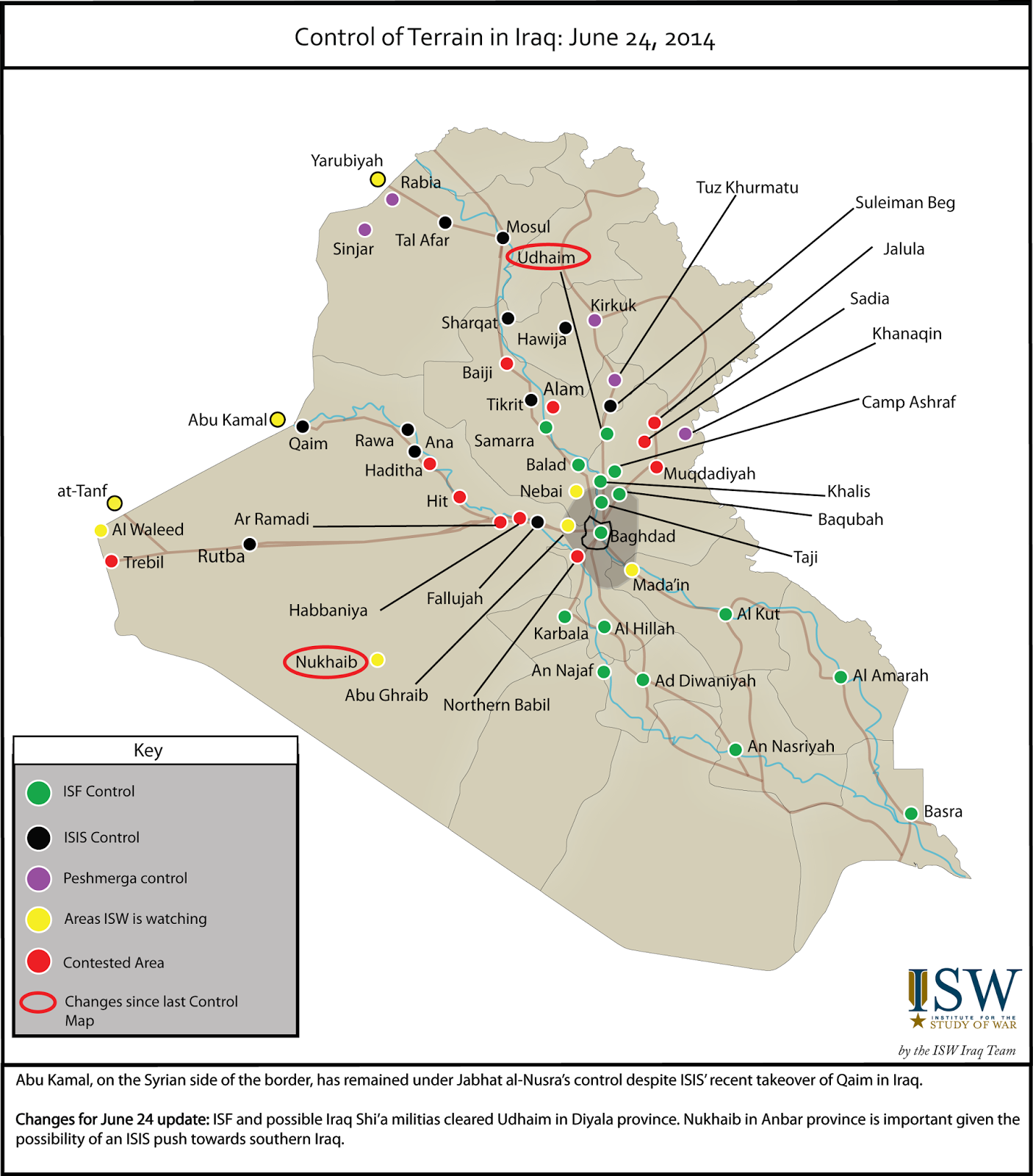
The most recent map from the Institute for the Study of War, shows ISIS in control of Ar Rutbah, Al-Qa’im, Rawa, Sharqat, Anah, Fallujah, Sulaiman Bek, Tikrit, Hawijah, Mosul, and Tal Afar.
A conservative estimate of the combined populations of these cities is 2,878,000 residents.
This would mean that there are approximately 1,000 Iraqi civilians per ISIS fighter. But that number is low, since significant numbers of fighters have been engaged in securing strategic locations — such as the oil refinery at Baiji — as well as manning checkpoints between cities. So maybe there is no more than one ISIS member per 1,500 or even 2,000 people in most of these cities.
For comparison, in New York City there is one police officer per 239 residents, and during the US-led occupation of Iraq, the ratio averaged about one foreign soldier per 200 Iraqis.
I dare say that in much of ISIS-controlled Iraq there are a lot of Iraqis who have yet to even set eyes on any of these infamous fighters.
That isn’t to minimize the threat that ISIS poses, yet its media visibility surely vastly exceeds its visibility on the ground.
New map of Syria and Iraq showing ISIS presence
Click here to see larger map.
New map of #Syria and #Iraq civil wars showing #ISIS presence https://t.co/tHug6twj3o pic.twitter.com/5obH2PY0Re
— Agathocle deSyracuse (@deSyracuse) June 25, 2014
Syrian warplanes strike in Iraq, killing 57 civilians, official says
CNN reports: Reports that Syrian warplanes carried out a cross-border attack on Iraqi towns this week is further evidence of the blurring between the two countries’ borders as they face an offensive by Islamic extremists.
At least 57 Iraqi civilians were killed and more than 120 others were wounded by what local officials say were Syrian warplanes that struck several border areas of Anbar province Tuesday.
These border cities are among those under the control of the Islamic State in Iraq and Syria, or ISIS, which seeks to create an Islamic caliphate that encompasses parts of both Iraq in Syria.
The reports of the Syrian incursion into Iraq is a reminder that the civil war in Syria and the unrest in Iraq are not isolated, but linked in ways that threaten the security of both.
Sabah Karkhout, the head of Iraq’s Anbar provincial council, told CNN that Tuesday’s air attacks struck markets and fuel stations in areas such as Rutba, al-Walid and Al-Qaim.
“Unfortunately, (the) Syrian regime carried out barbarian attacks against civilians in Anbar province,” he said Wednesday.
Karkhout said he was certain the warplanes were Syrian because they bore the image of the Syrian flag.
“Also, the planes flew directly from Syrian airspace and went back to Syria,” he said. [Continue reading…]
Kurds tell Kerry: ‘We are facing a new reality and a new Iraq’
Rudaw reports: When the US delegation that was arriving in Baghdad asked Iraqi Kurdistan’s top leaders to be there to meet with them, the Kurds reportedly refused.
In that rejection, and the reception they gave to Kerry in their own capital of Erbil on Tuesday, the Iraqi Kurds showcased their newfound confidence, strength and unity.
Knowing full well this was the last thing Washington’s top diplomat wanted to hear, the autonomous Kurdistan Region’s President Massoud Barzani brought up what his people wanted to talk about: independence.
Kerry was in Erbil to urge the Kurds to back the formation of a new, inclusive government in Baghdad, as insurgents that include the Islamic State of Iraq and Syria (ISIS) rack up stunning military victories against the Iraqi army and threaten to splinter Iraq.
Barzani told Kerry it could no longer be business as usual. “We are facing a new reality and a new Iraq.”
And while he did not reject Kerry’s request that the Kurds be part of a new, inclusive government in Baghdad, Barzani insisted that would have to be on Erbil’s terms. [Continue reading…]
ISIS recruits Kurdish youths, creating a potential new risk in a peaceful part of Iraq
The Washington Post reports: This town near the Iranian border has long been a symbol of Kurdish resistance, and it is best known as the site of a gruesome chemical-weapons attack by Saddam Hussein in 1988.
These days, residents say, it is increasingly known for something else — although few want to talk about it.
Kurdish authorities say a small contingent of Kurdish youths — around 150 in all, about a third of whom are from Halabja — has in recent months joined the Islamic State of Iraq and Syria (ISIS), which has seized a vast swath of Iraqi territory.
The young men’s allegiance to the extremist militant group represents a potential danger for the Kurds, who share the jihadists’ resentment of Iraqi Prime Minister Nouri al-Maliki’s Shiite-dominated government but are wary of the extremists now massed on the edge of their territory. The Kurds have hoped to keep their largely autonomous region in northern Iraq from being entangled in the country’s increasingly bloody conflict.
Some Kurdish intelligence officials fear that with ISIS’s gains, more local youths will join the jihadists and that the radical ideology could creep beyond Arab Iraq and into Iraqi Kurdistan, which has so far remained an oasis of calm and order. [Continue reading…]
ISIS, Israel and a nuclear threat
While no one knows yet how far ISIS’s dominion will extend or the true magnitude of the threat it poses across the Middle East, one of the wildest recent reports comes from a former Bush administration official and current staff writer for WorldNetDaily, Michael Maloof.
The former defense department employee who has a history of promoting bogus intelligence, has an “exclusive” headlined: “Iraq invaders threaten nuke attack on Israel.”
The well-organized army of the Islamic State of Iraq and Syria, or ISIS, claims it has access to nuclear weapons and a will to use them to “liberate” Palestine from Israel as part of its “Islamic Spring,” according to a WND source in the region.
Wow! One minute we see ISIS proudly driving around in American-made Humvees and the next they are threatening a nuclear strike on Israel?
Who is Maloof’s “source in the region” making this extraordinary claim?
It turns out it’s Franklin Lamb, an American political activist and retired law professor based in Beirut whose reporting/commentary appears regularly at Counterpunch and PressTV, among other places.
The WND source said ISIS appears “eager” to fight Israeli armed forces “in the near future despite expectation that the regime will use nuclear weapons.”
“Do you think that we do not have access to nuclear devices?” Lamb quoted the ISIS member as saying. “The Zionists know that we do, and if we ever believe they are about to use theirs, we will not hesitate. After the Zionists are gone, Palestine will have to be decontaminated and rebuilt just like areas where there has been radiation released.”
Neither Lamb, his ISIS source, nor Maloof address the fact that in this nuclear scenario, the Palestinians could hardly avoiding meeting the same fate as the Israelis. Neither does Maloof report the fact that Lamb was talking to his source inside a Palestinian refugee camp. Go figure.
Although Maloof’s report, which was posted on the WND website on June 23 is billed as an “exclusive,” every single quote from Lamb can be found in a report Lamb himself posted at Counterpunch on June 20. Indeed every single quote appears in the original in the same order as Maloof used them as he presumably pasted together his “exclusive.”
Having gleaned the raw material for his piece from Lamb — who knows whether the two men have ever been in direct communication — Maloof then goes on to embellish the story with his own unsourced claims, such as that the Saudis have “provided billions of dollars to ISIS” along with speculation that Saudi Arabia already possesses Pakistani-made nuclear weapons. (Anyone who like Maloof believes that ISIS depends on Saudi funding or any other major source of foreign financing should read yesterday’s McClatchy report on the group’s self-funded business structure.)
Alarm bells must be ringing in Israel in the face of this new existential threat — but apparently not.
On the contrary, Prime Minister Benyamin Netanyahu is quite content to see the region go up in flames.
Echoing calls from many quarters in the United States, the Israeli leader wants the U.S. to remain on the sidelines.
Threatening a borderless conflict between “extremist Shi’ites,” funded by leadership of the Islamic Republic of Iran, and equally extreme Sunnis — a soft “alliance” between ISIS and al Qaeda — the Israeli prime minister suggested the United States should largely stay out of the fight, and instead allow the parties to weaken one another.
“Don’t strengthen either of them. Weaken both,” Netanyahu said.
This argument is a reprise of a similar view in Washington that was being applied to Syria a year ago by some of those who then opposed military intervention after the August chemical attacks. At that time, the military strategist, Edward Luttwak, wrote:
There is only one outcome that the United States can possibly favor: an indefinite draw.
The risk Israel faces of being destroyed in a nuclear strike from ISIS might be minimal, but what should concern everyone at this moment are the repercussions from a propaganda war that ISIS is already winning.
Eight years ago after surviving the extensive bombing of Southern Beirut, Hassan Nasrallah, the leader of Hezbollah was being celebrated across the Arab world by Shia and Sunnis alike as the great champion of Resistance.
A war that left hundreds of Lebanese civilians dead and many thousands homeless was nevertheless hailed (at least by Hezbollah’s leadership) as a “divine victory.”
The success of ISIS has gone far beyond that kind of symbolic victory and there must be many young radicals across the region who view old guard resistance movements such as Hezbollah and Hamas as spent forces — organizations whose principal accomplishment across the decades has been self-preservation.
In Lamb’s article, which is based on interviews with ISIS members and sympathizers in Ain al-Hilweh, the largest Palestinian refugee camp in Lebanon (where ISIS is referred to by the acronym derived from its Arabic name, DAASH) he writes:
Several reasons were given as to why Palestinians should hold out hope for ISIS succeeding in their cause when all other Arab, Muslim, and Western claimed Resistance supporters have been abject failures and invariably end up benefiting the Zionist occupation regime terrorizing Palestine. “All countries in this region are playing the sectarian card just as they have long played the Palestinian card but the difference with ISIS is that we are serious about Palestine and they are not. Tel Aviv will fall as fast as Mosul when the time is right”, a DAASH ally explained.
When asked about Hezbollah’s 22 day war with the Zionists in South Lebanon in July of 2006 and its sacrifices in terms of lives which is to this day widely believed to be a victory for the “Resistance” and a blow to the Zionist occupation. An angry middle aged Iraqi Baathist, now a ISIS heavy weapons trainer, interrupted, “The difference between DAASH and Hezbollah is that we would have fought our way to Al Quds [Jerusalem] in 2006 and established a permanent organization. Hezbollah quit too soon and they will only fight if and when Iran tells them to.” He added, “What has the Hezbollah Resistance ever done for the Palestinians in Lebanon except resist their civil rights in Lebanon. Should Palestinians believe them?” Another gentleman insisted, “DAASH will fight where no one else is willing.”
A report in the Assad/Hezbollah-friendly Al-Akhbar from the north Lebanon city of Tripoli attempts to downplay the level of local support for ISIS, yet those who might not choose to fight in its ranks may at some point nevertheless form a significant welcoming party.
Upon sitting with vendors selling vegetables near the Abu Ali Roundabout in Tripoli, one comes out with the impression that ISIS is participating in the World Cup. In between every few cars covered with the Brazilian and German flags, one will spot a car displaying ISIS’ black banner. And just like many like to emulate their favorite football players in their hairstyles, tattoos, and so on, some youths in the city like to emulate ISIS fighters, in their hairstyle, loose beards, and miserly look.
News of ISIS’ victories overshadow the news about its fatwas, the consequences of its excommunication of its opponents, and the nebulous nature of its religious authority. Vendors asking their customers, “Who are you with?” – referring to the World Cup – often hear back, “with ISIS.”
As ISIS advances on the ground wiping away the boundary between Syria and Iraq, it is simultaneously crossing more distant borders, gaining a foothold in the imagination of those who dream of a caliphate and of capturing Jerusalem.
While opposition to U.S. intervention in a crisis that was itself in part triggered by an earlier American intervention comes frequently through expressions of opposition to war, paradoxically, those who insist we started this are also now saying, it’s not our problem.
Providing further evidence that this has indeed become a borderless conflict, there are reports today that Syria has conducted air strikes against ISIS positions in Iraq.
Bashar al-Assad, Hassan Nasrallah, Nouri al-Maliki, Muqtada al-Sadr, Ali Khamenei, Qasem Soleimani — are these the men who are going to bring stability to the Middle East and pacify the threat from ISIS? I think not.
Francesca Borri, an independent journalist covering the war in Syria, recently spoke on Skype to M., an ISIS fighter in Al-Bab, north east of Allepo:
I asked M. if his movement was bent on redrawing the map of the Middle East, to which he replied, “There is no map. … Where you see borders, we see only your interests.”
M., embodying the ISIS ideology, railed against the aspirations for democracy in the Arab world.
“Look at Egypt. Look at the way it ended for Muslims who cast their vote for [deposed President] Mohammed Morsi and believed in your democracy, in your lies. Democracy doesn’t exist. Do you think you are free? The West is ruled by banks, not by parliaments, and you know that. You know that you’re just a pawn, except you have no courage. You think of yourself, your job, your house … because you know you have no power. But fortunately, the jihad has started. Islam will get to you and bring you freedom.”
It is to be expected that an ISIS fighter would pour scorn on democracy, yet these days democracy’s genuine defenders seem increasingly hard to find.