Category Archives: ISIS

Islamic State of Iraq and Syria

Apostates can be killed for food or organ transplants, ISIS says

Baghdadi

By Brian Whitaker, December 28, 2015

Documents reportedly captured from the Islamic State and circulated by the US government include what appears to be an official fatwa authorising the killing of “apostates” for food or organ transplants.

According to a US government translation, IS’s Research and Fatwa Committee was asked to consider whether it is “permissible to take the captured apostate’s body organs and give them to Muslims who are in need of them”.

The committee’s reply, issued last January as Fatwa Number 68, was as follows:

“Saving a Muslim from death or deterioration is an Islamic legal duty that should be performed with every legitimate way or financial means.

“The jurists of the Shafi’i and Hanbali schools [of Islamic jurisprudence] and others permitted, when necessary, the killing of the infidel combatant or the apostate should one need to consume their flesh for the purpose of saving his own life. 

“If the jurists had permitted, when necessary, the consumption of human flesh as a means to counter death or harm, then it is even more appropriate to transplant organs from the apostate to save the life of the latter. This is especially the case since it was ruled that the apostate’s life and organs are not protected. On the contrary, the apostate’s life and organs don’t have to be respected and may be taken with impunity.”

Killing an apostate by removing body parts for use in transplants is “not prohibited”, it said.

Continue reading

Facebooktwittermail

Terror: After Paris, Tunisia and California, can we stop it spreading?

shadow7

Jason Burke writes: On a bleak day in November, Annelise Augustyns led her two children to the playground near their home in Brussels. Just over a week before, Islamist militants had killed 130 people and injured many more in a series of attacks in Paris. The Belgian capital had been under unprecedented lockdown for three days amid fears of a new attack there. Several of the Paris attackers had been traced to the Brussels neighbourhood of Molenbeek, a few miles from Augustyns’ apartment. They included at least one man who was now on the run.

To protect the population, the Belgian government had shut schools, cancelled sporting events and deployed soldiers on the streets. If the scenes were reminiscent of earlier conflicts, the enemy now was very different: a hybrid terrorist and insurgent entity in the Middle East calling itself the Islamic State.

Augustyns, a local government administrator, glanced at the armoured vehicle posted outside the entrance of the Gare du Midi. “We are worried of course,” she told me. “But what to do? We have to get on with our lives.”

Her words summed up the feelings of many across Europe that week, and indeed across much of the world last year. If 2014 was a year that set a grisly new record in the number of casualties inflicted by terrorist attacks – 33,000 people were killed, almost double the year before – then 2015 appears to have been worse. [Continue reading…]

Facebooktwittermail

The most unconventional weapon in Syria: Wheat

wheat

Annia Ciezadlo writes: In the fall of 2012, fighters from the Free Syrian Army took over Eastern Ghouta, a semi-agricultural area about eight miles northeast of Damascus. Government forces responded by placing the area under siege, cutting off water, electricity, gas, medical assistance and bread.

The regime’s goal was to starve the people of Eastern Ghouta into submission, and it was working: The price of bread and rice went up 50 times. Locals were living on animal feed or sometimes eating nothing at all. “They began to wage war against the people even through their daily bread,” says Majd al-Dik, an aid worker for a Syrian humanitarian group called Spring of Life.

Nine months later, the Free Syrian Army mounted a military operation in a regime-controlled area called al-Matahin, the Mills, just outside Eastern Ghouta. Its objective was a flour mill, flanked by two rows of grain silos that housed part of the Syrian government’s strategic wheat reserves — a potent weapon in the conflict that now, after 4 1/2 years, has killed at least a quarter of a million people. If the opposition could capture the mill, it could keep the wheat, break the siege, gain a strategic point on the airport road — and perhaps even make some money.

The firefight lasted a day and a half. Before the battle ended on the second day, anti-government fighters sent a message via walkie-talkie to aid workers waiting inside Eastern Ghouta: We are in partial control of the mill. Come and help us get the flour. Dik and other volunteers drove toward the mill, taking a back road to avoid government snipers.

When they arrived, they were alarmed to see about 80 people, mostly civilians. Everyone in Eastern Ghouta had heard that there would be flour, and some people were desperate enough to run through shelling and sniper fire to get it. Locals climbed out of their cars and rushed toward the mill, eager to grab the sacks of flour inside the central storage area. The fighters tried to stop them, but they kept coming.

“They explained that they were hungry,” Dik says, “and they were ready to die just to be able to eat.” Too many of them would make exactly that sacrifice.

Bread is the staple food in the Middle East. Daily bread is “liqmet aeesh” — a Levantine idiom that translates as “morsel of life.” In addition to its crucial carbohydrates, it is the main source of protein for many people in poor and rural areas. “You can’t imagine life without bread,” says a Syrian aid worker from Aleppo, who spoke on the condition of anonymity. “The calories, the energy it gives you, is equivalent to anything else you eat. Except it’s a lot cheaper. So there’s a chance for survival.”

The Syrian government understands the importance of bread. So does the Islamic State, as well as the constellation of other armed groups vying to control the country’s land and its people. Strategically, bread is as important as oil or water. Civilians are dependent on the authority that distributes it, and profiteers are eager to resell it to hungry people at grotesque prices. “When you control bread and fuel,” says a Syrian analyst from Damascus who spoke on the condition of anonymity, “you control the whole society.” [Continue reading…]

Facebooktwittermail

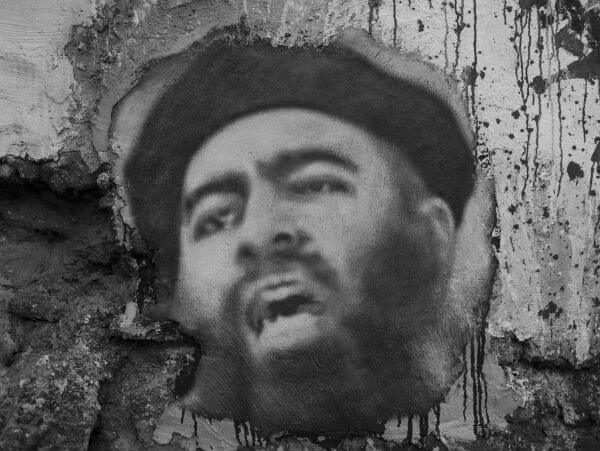
ISIS leader challenges U.S. and allies in appeal to followers

Baghdadi-bw

The Wall Street Journal reports: The leader of Islamic State challenged the U.S. and its European and Arab allies to confront his extremist group on the ground in Iraq and Syria, while telling his followers to persevere despite major recent battlefields setbacks, according to a purported audio message released on Saturday.

“Here are the Christian Crusaders and the nations of disbelief and their group with them, and behind them the Jews. They do not dare to come here on the ground to fight a small group of mujahedeen,” said Abu Bakr al-Baghdadi in the audio message, transcribed and translated by the U.S.-based monitoring agency Site Intelligence Group.

“They do not dare to come, because their hearts are full of fear from the mujahedeen,” he added in what is believed to be his first message since May.

In the audio message, Mr. Baghdadi consoled his followers for what he described as recent hardships and tragedies but promised them they would come out stronger and victorious if they persevered. He reminded them of the early trials of the group when it was formed in 2006 as an offshoot of al Qaeda, known as Islamic State of Iraq, only to be weakened by the U.S. and its local Iraqi allies. The group then made a major comeback starting in 2013 when it split from al Qaeda and captured large swaths of Iraq and Syria the following year.

“So the hardship must become more and the tragedies greater so that hypocrisy escapes and belief becomes stronger, and so that victory is laid down,” he said.

“So be steadfast O mujahedeen. In front of you are one of the two good things: either victory or martyrdom,” he added.

Mr. Baghdadi said the fact that major world powers have decided to destroy the group was proof Islamic State was on the righteous path. He accused the West and its allies of waging war against Islam by targeting his group and chastised Muslims everywhere for not realizing this and rising up to defend their faith.

“We are putting you all on alert everywhere and specifically the sons of the Land of the Two Holy Mosques,” he said, referring to Saudi Arabia. “Mobilize, whether you are light or heavy, old and young.”

He rebuked Saudi Arabia’s ruling family for announcing a coalition to fight Islamic State instead of defending Sunni Muslims in Iraq and Syria. [Continue reading…]

Facebooktwittermail

Syria rebel group will survive leader’s death

Hassan Hassan writes: Zahran Alloush, the former leader of Jaish Al Islam who was killed by Russian air strikes on Friday evening near Damascus, was more widely mourned than any other opposition figure since the start of the Syrian conflict. He has also been condemned for having made sectarian statements alluding to the extermination of Shia in Syria.

Sectarian statements are unjustifiable because they stoke tensions in an already polarised landscape. Jaish Al Islam was guilty of playing a cynical game of religious one-upmanship against extremist groups, especially at the height of religious polarisation in late 2013, during the Hizbollah-led offensive inside Syria. But it is a mistake to equate the group with extremist organisations, especially since such statements by no means reflect the group’s intentions or actions.

People who met Alloush and members of his faction, including members of Syria’s religious minorities, challenged such perceived views. Bassam Malouf, a Christian dissident, for example, recalled a meeting he had with Alloush, in which the former warned against targeting Christian churches in the suburbs of Damascus where the faction operated. Alloush replied, according to Mr Malouf, referring to Christians, by saying: “You are part of us and we are part of you. We will not allow anybody to violate the sanctity of homes, churches or people. Even Alawites, they are not our enemies, they are victims of the regime.”

Mr Malouf added: “His religious discourse was meant to encourage young people living under siege to join Jaish Al Islam and pull them away from ISIL.”

Alloush was one of the earliest, if not the earliest, rebel leader to unequivocally and consistently combat ISIL. Unlike other forces that reluctantly or intermittently fought ISIL, Jaish Al Islam can be credited for single-handedly preventing ISIL from establishing a foothold for itself in the areas it controlled near Damascus. If ISIL is a minor player at the outskirts of Damascus, it is because of Jaish Al Islam. [Continue reading…]

Facebooktwittermail

Syrian rebel leader killed in airstrike: Who was Zahran Alloush?

Aron Lund writes: Mohammed Zahran Alloush (1971-2015), also known as Abu Abdullah, was a salafi activist from Douma, a town east of Damascus in the Ghouta region. His father, Abdullah Alloush, is a salafi theologian resident in Saudi Arabia.

Alloush was arrested several times before the uprising for his religious and political activism and sent to the ”Islamist wing” of the Seidnaia prison north of Damascus. There, he formed close connections to many other Syrian Islamists, including people who now run large rebel factions like Ahrar al-Sham. He was released from jail in June 2011 and quickly joined the armed uprising, eventually emerging as the strongman of his home region in the Eastern Ghouta and one of the most powerful rebel leaders in all of Syria.

He was also one of the most controversial ones. His supporters were taken in by his forceful personality and his personal bravery, as a commander who lived with his men in the warzone and visited the frontline. They admired his knack for organization and politics and credited him with the semi-stability that reigned inside the besieged Eastern Ghouta enclave—a bombed out and starved suburban region that resembles nothing so much as a giant version of the Gaza Strip in Palestine. The Ghouta has been under constant pressure since the marginalized Sunni suburbs of Damascus, where hatred against Bashar al-Assad and his government ran strong, began to throw out the police and security servies in 2011 and 2012. Since then, the region has been under siege and functioned as a world of its own. Holding the frontline in Damascus, where Assad has concentrated so much of his army, was no small feat and it was much thanks to Alloush’s men. Coordinating the rebels there and limiting their infighting was no less of an achievement, especially considering the all-out chaos that reigned in other areas of Syria, where conditions were much better. For many supporters of the opposition, defending and stabilizing the Eastern Ghouta despite unceasing war and artillery bombardment, including with nerve gas, was enough to make Zahran Alloush a hero of the Syrian revolution. Continue reading

Facebooktwittermail

ISIS puts up heavy fight to slow Iraqi troop advance on Ramadi

The Associated Press reports: Islamic State fighters are putting up a tough fight in the militant-held city of Ramadi, slowing down the advance of Iraqi forces, a senior Iraqi commander said Sunday.

Iraq launched the long-awaited operation to retake the Anbar provincial capital, which was captured by IS militants in May, but after an initial push across the Euphrates River, their progress stalled.

Gen. Ismail al-Mahlawi, head of the Anbar military operations, told The Associated Press that the advance was hampered by suicide bombers, snipers and booby traps. [Continue reading…]

Facebooktwittermail

Iraqi forces to retake Mosul from ISIS after Ramadi secured, says PM

Reuters reports: Iraq’s armed forces will move to retake the major northern city of Mosul from Islamic State once they capture the western city of Ramadi, Prime Minister Haider al-Abadi said on Friday.

Capturing Mosul would deprive the militant group of its biggest population center in both Iraq and Syria, effectively abolishing the state structure of IS in Iraq, depriving it of a major source of funding and dealing a blow to its influence.

The capture of Ramadi would give the army a major psychological boost in its move toward Mosul. [Continue reading…]

Facebooktwittermail

ISIS sanctioned organ harvesting in document taken in U.S. raid

Reuters reports: Islamic State has sanctioned the harvesting of human organs in a previously undisclosed ruling by the group’s Islamic scholars, raising concerns that the violent extremist group may be trafficking in body parts.

The ruling, contained in a January 31, 2015 document reviewed by Reuters, says taking organs from a living captive to save a Muslim’s life, even if it is fatal for the captive, is permissible.

For a U.S. government translation of the document, click here

Reuters couldn’t independently confirm the authenticity of the document. U.S. officials say it was among a trove of data and other information obtained by U.S. special forces in a raid in eastern Syria in May.

“The apostate’s life and organs don’t have to be respected and may be taken with impunity,” says the document, which is in the form of a fatwa, or religious ruling, from the Islamic State’s Research and Fatwa Committee. [Continue reading…]

Facebooktwittermail

ISIS’s countercultural appeal is real

ISIS-catwalk

Simon Cottee writes: If you want to get a sense of what attracts westernized Muslims to ISIS, you could do worse than listen to one of its sympathizers, as opposed to its legion of opponents, who are liable to pathologize the group’s appeal as an ideological contagion that infects the weak, instead of taking it seriously as a revolutionary movement that speaks to the young and the strong-minded.

Check out, as just one of many examples, the Twitter user “Bint Emergent”: an apparent ISIS fangirl and keen observer of the jihadist scene. (Bint Emergent has not disclosed her identity, or gender, but bint is an honorific Arabic word for girl or daughter; like umm — mother in Arabic — bint features prominently in the Twitter display names of female ISIS sympathizers.)

“Jihadis,” she explains on her blog BintChaos, “look cool — like ninjas or video game warriors — gangstah and thuggish even — the opposition doesnt.” She concedes that “There aren’t a lot of jihadist ‘poster-girls’ displayed—they all wear niqab [face veil], but sometimes its tastefully accessorized with an AK47 or a bomb belt.” By contrast, “Team CVE [a reference to Countering Violent Extremism, or Anglo-American counterterrorism entrepreneurs whose role, state- or self-appointed, is to challenge “extremist” narratives],” consists “mostly [of] middleaged white guys with a smidgin of scared straight ex-mujahids [ex-jihadists] and a couple middleaged women.” [Continue reading…]

Facebooktwittermail

Russia gives intelligence to Taliban and weapons to their enemy, the Afghan government

The Washington Post reports: A Kremlin official said Wednesday that Russia was exchanging information with the Taliban, the Islamist insurgency that the United States has been fighting in Afghanistan since 2001, as a bulwark against the spread of the Islamic State militant group in that country.

Zamir Kabulov, a Foreign Ministry department head and President Vladimir Putin’s special representative for Afghanistan, told the Interfax news agency that “the Taliban interest objectively coincides with ours” in the fight against the Islamic State, which has captured broad swaths of territory in Syria and Iraq.

“I have already said earlier that we and the Taliban have channels for exchanging information,” Kabulov added, in remarks reported by Interfax and confirmed to The Washington Post by a ministry spokesman.

A limited partnership with the Taliban, which announced last week that it would send “special forces” to fight the Islamic State, is a striking, and somewhat confusing, twist in Russia’s war on terror. Although Russia plunged enthusiastically into its airstrike campaign against the Islamic State in Syria in September (critics say Russia is mainly there to prop up President Bashar al-Assad), Moscow has opposed the Taliban for more than a decade as a potential vehicle for terror and instability in the former Soviet Union. [Continue reading…]

Facebooktwittermail

ISIS and the war in Iraq

shadow1

Those who brand others as heretics are not generally amenable to the proposition that the heretic deserves a fair hearing. Which is to say: the very idea of a heresy is that it represents a form of belief that must be dealt with by suppression rather than analysis.

Kyle Orton, a young Middle East analyst from England, has just been granted the opportunity to propagate an unthinkable heresy on the op-ed pages of the New York Times: he asserts that ISIS did not come into existence as a result of the war in Iraq but instead that its emergence can be traced to a process of Islamization in Iraq that began in the 1980s.

A kneejerk response comes from Glenn Greenwald:


As someone who so often likes to deploy a lazy guilt-by-association line of attack, Greenwald dismisses the article by branding it as having come from a neocon think tank — that being the Henry Jackson Society — along with an implicit rebuke directed at the New York Times.

Sal Rotman makes an appropriate response:


Indeed, but for Greenwald to make such a critique, he’d probably have to know much more about Iraq’s recent history than he does — so he opts for the easy route of denunciation by branding. Call someone a neocon and it goes without saying — supposedly — than anything they say can be dismissed.

The question as to whether Orton is a neocon (even if one accepts the label being applied to his employer), seems somewhat trivial — unless one is convinced that a neocon is someone whose every utterance is false. Which is to say: unless one views a neocon as a kind of heretic.

The only serious question is whether Orton’s historical analysis is sound — a judgement that many of us are not in a position to make. What many of us can do, however, is assess the coherence of the argument, its plausibility and the extent to which it rings true.

Interestingly, although Greenwald thinks Orton is exonerating the war in Iraq, he apparently missed the fact that Orton views the trend of Islamization in the 1990s as having occured while “Iraqis fell back on their faith for solace under the harsh international sanctions.”

One might argue, therefore, that ISIS was just as much a product of the 1991 Gulf War as it was the 2003 Iraq War — but not wholly a product of either.

Orton writes:

It’s true that disbanding the Iraqi Army after 2003 put professional soldiers at the service of the Sunni insurgency. It’s also true that Al Qaeda in Iraq — the small, foreign-led nucleus of what became the Islamic State — used poorly run American prisons like Camp Bucca to recruit former regime elements. But the significant fact is that those who assumed leadership roles in the Islamic State’s military council had been radicalized earlier, under Mr. Hussein’s regime.

There was never any “Baathist coup” of former regime elements inside the Islamic State, as some analysts assume, because these men had long since abandoned Baathism. They joined Al Qaeda in Iraq early after the invasion as an act of ideological conviction, and when Al Qaeda in Iraq’s leadership was nearly destroyed in 2008-10, these officers were the last men standing precisely because of their superior counterintelligence and security skills.

It was these Salafized former military intelligence officers — led by Samir al-Khlifawi, also known as Haji Bakr, who had joined the group in 2003 and rose to be the so-called caliph’s deputy, until he was killed in 2014 — who planned the Islamic State’s dramatic expansion into Syria. There, they set up a Saddam Hussein-style authoritarian regime that was the launchpad for the jihadists’ invasion of Iraq in 2014.

From a cursory look at his earlier blog posts, it appears Orton’s analysis is based in part on the research findings of Samuel Helfont, whose PhD dissertation on religion and politics in Saddam Hussein’s Iraq was itself based on newly-released records from the Iraqi state and Baath Party. That sounds like a stronger foundation for a thesis than would be provided, for instance, by an individual like “curveball.” It’s certainly worth more careful consideration than for it to simply be dismissed with a tweet.

For those still concerned about which political litmus tests Orton might pass or fail, I would point out that the route he followed in order to recently get hired by the Henry Jackson Society did not seem to be distinctly ideological.

On the “about” page on his blog, Orton writes:

After a misbegotten degree in zoology (biology), I completed a social science Masters in Humanitarian Studies at the Liverpool School of Tropical Medicine that comprised elements of geopolitics, history, and practical skills in running a humanitarian program, the logical end-point of which would be work with a non-governmental organisation.

I have travelled quite widely, especially in Eastern Europe having been to all of the old Soviet satellite States except Romania, and in the Balkans — Bosnia, Serbia, and Croatia. I have also been to Turkey and Israel, took part in a voluntary course (teaching) in Kenya, and worked in Lebanon for my Masters on the healthcare system for the Syrian refugees.

Having long been interested in the Arab world, and especially in ways that it might be reformed, I was very interested when the rebellions came to that region at the end of 2010, and followed the course of this “Arab Spring” from its inception. The carnage in Syria and its obvious importance for that whole region have made the subject my primary focus.

Facebooktwittermail

Iraq’s battle for Ramadi isn’t just about defeating ISIS

By Balsam Mustafa, University of Birmingham and Scott Lucas, University of Birmingham

After days of mounting expectation, the Iraqi government finally announced a serious offensive to retake the city of Ramadi, the capital of western Iraq’s Anbar Province, from Islamic State (IS).

This is far from the first announcement of the imminent recapture of Ramadi, occupied by IS since May 2015 after months of attacks. However, the Iraqi military and allied militias have been foiled before by IS’s tactics of improvised explosive devices, bomb-laden trucks, and booby traps, as well as the destruction of all major bridges into the city.

This has only raised the stakes for the reclaiming of Ramadi. Strategically, it is the “vein of Baghdad”, which is just over 100km to the east, and is close to the holy city of Karbala to the south and to the borders of Saudi Arabia, Syria, and Jordan. IS could use this position both to claim its ascendancy in Iraq – Ramadi is the capital of Anbar, the country’s largest province – and to maintain a route to Raqqa, its central position in Syria.

The loss of Ramadi further challenged the Iraqi Government’s already shaky authority. Thousands of Iraqi families were displaced, and many of them are still trapped on Bzeibiz Bridge. Amid fears that IS-linked men are among the homeless, officials have restricted access to the capital.

So the Iraqi joint military operations command declared its plans to retake the city – but only now has it begun to act on them.

Continue reading

Facebooktwittermail

Iraqi troops expected to drive ISIS from Ramadi in days

Reuters reports: Iraq’s army chief was quoted on Wednesday as saying he needed only days to drive Islamic State from Ramadi, the city whose fall in May exposed the weakness of the Baghdad government and dampened hopes of restoring control in the north and west.

Iraqi troops began advancing on Tuesday in an offensive complicated by rivalries and suspicions harbored by local Sunni tribes and by Shi’ite militia backed by Iran. U.S. officials, concerned also by militant operations over the border in Syria, have expressed frustration at delays in seizing back the city.

“In the coming days will be announced the good news of the complete liberation of Ramadi,” Iraqia TV cited army chief of staff Lt. General Othman al-Ghanemi as saying.

Government troops are now concentrating on the last district held by the militants in the center of Ramadi, a Sunni Muslim city on the river Euphrates some 100 km (60 miles) west of Baghdad and capital of Anbar province. [Continue reading…]

Residents of Ramadi welcoming Iraqi troops:

Facebooktwittermail

ISIS boasts about deaths of its own teenage soldiers

Facebooktwittermail

How a misreported story is changing U.S. immigration policy

The Atlantic reports: On Sunday, The New York Times published a scorching story alleging that one of the killers in the San Bernardino attack had previously “talked openly on social media about her views on violent jihad.”

But by Thursday, the Times admitted it had gotten parts of the story wrong. Tashfeen Malik had not posted publicly about violent jihad before moving to the U.S. Instead, according to the FBI, she had written about violent jihad only in private messages—not public posts. The Times changed its story, issued a correction, and endured a par­tic­u­larly bru­tal pub­lic flog­ging at the hands of its public editor.

That correction, however, came far too late to put the genie back in the bottle. News of the so-called “public” posts had already rocketed around the Internet, been cited repeatedly in the Republican presidential debate, and, apparently, made quite an impression on Capitol Hill.

On Tuesday, Senator John McCain pointed to the Times report in an­noun­cing legislation to require the Department of Homeland Security to “search all public records, including Internet sites and social media profiles” when vetting applicants to enter the U.S.

The same day, nearly two dozen Democrats wrote to Homeland Security Secretary Jeh Johnson calling for “more robust social media background check process for all visitors and immigrants to the United States.” The let­ter references press ac­counts in­dic­at­ing that such work had been done inconsistently. And it says Ma­lik “may have ex­pressed rad­ic­al ji­hadist sentiments on so­cial me­dia platforms.” [Continue reading…]

Facebooktwittermail

French police make 2,700 raids in month, raising tension with Muslims

The New York Times reports: The French authorities have conducted more than 2,700 police raids under a nationwide state of emergency instituted after last month’s deadly terrorist attacks in Paris.

Using extraordinary powers granted by France’s National Assembly, officers have conducted searches without warrants of dozens of homes, arrested hundreds of people and even shut down mosques and Muslim prayer rooms for fear they were preaching radicalization.

The use of such tactics has increased tensions between the government and Muslim communities.

“The Muslim minority in France feels like it’s being treated as the public enemy,” said Yasser Louati, spokesman for the Collective Against Islamophobia in France. “They are afraid of the government.”

At least 20 court complaints have been filed against the government, Reuters recently reported, citing six independent lawyers involved in the complaints. And Muslim leaders in France have said that the police tactics are excessive and unfairly target Muslims. [Continue reading…]

Facebooktwittermail

What would Clausewitz recommend we do about ISIS?

destruction11

Mark Perry recently posed this theoretical question to a number of military strategists and found a broad consensus: Oddly, those most familiar with Clausewitz’s thinking issue nearly identical responses to this question. “Clausewitz would start by asking us what it is that we want to accomplish,” the Rand Corporation’s David Johnson, a retired U.S. Army Colonel says. Johnson, who has read On War “from cover to cover numerous times” notes that, for Clausewitz, finding answers to fundamental questions is the key to shaping a military strategy. “You have to understand the war you’re in, and I would bet that, with ISIS, Clausewitz would say that we haven’t done that. We’re too enthralled with trying to figure out who ISIS is  — instead of focusing on what they do. In truth, I don’t think it’s much of a mystery. If you go to Istanbul and look south the Caliphate is right there. You can point to it. It’s a state that views us as an enemy. What’s the mystery?”

[Historian and Clausewitz scholar Christopher] Bassford agrees. “I think the first thing ‘Chuck’ Clausewitz would do is wonder why the U.S. government, and the West in general, is reluctant to acknowledge ISIS as a ‘state,’” he wrote to me in an email. “ISIS controls territory, has a capital city in Raqaa, and for the most part practices a fundamentally conventional, though particularly vicious, kind of warfare. It uses terrorism, but it’s not just a terrorist group. And I also think Clausewitz would wonder why the French say they’re surprised to find themselves ‘at war’ after the Paris attack. They have been bombing ISIS for months.” While Clausewitz’s ideas are not restricted to state-on-state warfare, Bassford argues that we should accept that, for practical purposes, ISIS is a state. Indeed, in a strategy he calls “Let-the-Wookiee-Win,” we should do what we can to make ISIS more state-like. “After all, we know how to destroy states  —  we’re very good at it,” he argues.

One of the things that [U.S. Naval War College professor Donald] Stoker, Bassford, Johnson and many in the military find compelling about Clausewitz is that he views war as a subject that can be studied, understood and that, like engineering (say) or architecture, or any other discipline, improved on. It is possible to get good at killing, and if you’re better at it than your enemy  — if you break your enemy’s will to resist (as he would say)  —  you’ll win. On War provides a slew of these undiluted but axiomatic understandings. Though Clausewitz was a civilized man who recognized war’s horrors, he issued these axioms with a stern warning: “Kind-hearted people might think there was some ingenious way to disarm or defeat an enemy without too much bloodshed,” he writes, “and might imagine this is the true goal of the art of war. Pleasant as it sounds, it is a fallacy that must be exposed: war is such a most dangerous business that the mistakes which come from kindness are the very worst . . . This is how the matter must be seen. It would be futile  —  even wrong  —  to try and shut one’s eyes to what war really is from sheer distress at its brutality.”

It is this unblinking ability to call war what it is that has given Clausewitz such a dedicated following that large numbers of military officers have worked to grasp his thinking, and vocabulary. “Clausewitz says that the purpose of war is to achieve a particular political end,” Stoker says. “He argues that the best route to doing this is to attack the enemy’s center of gravity, the center of his strength. That might seem obvious now, but many of the most important parts of our current military thinking were first identified by him.”

Of course much of what Clausewitz tapped into in On War was a reflection of what professional soldiers already knew, and know. Thus, Union General William Tecumseh Sherman issued his famously Clausewitzian statement on war without, apparently, ever having read him. “War is cruelty. There is no use trying to reform it,” he said. “The crueler it is, the sooner it will be over.” Sherman’s unflinching calculus (that true humanity consists in waging war unrelentingly, so as to end it sooner) is, in many ways, a perfect distillation of the U.S. military’s traditional mistrust of the narrative propounded by counterinsurgency advocates that the “center of gravity in a counterinsurgency is the protection of the population that hosts it.” That might have been true in western Iraq, but few would argue that it’s the case with ISIS  —  particularly after the attacks in Paris. “The Germans and Japanese were held in a vice grip by their leaders in World War Two,” Christopher Bassford says, “but that didn’t stop us from burning down their cities. If it’s safer to be with ISIS than against it, ISIS will retain its hold on the population it now controls.”

In fact, Bassford’s views reflect a growing consensus inside the U.S. military’s upper echelons that a cruel war against ISIS now, no matter how distasteful, will save the lives of many decent people  —  including many Americans  — later. [Continue reading…]

“I think in Syria the primary focus now must be destroying ISIS,” says Bernie Sanders.

Donald Trump promises that if he becomes president, he will “bomb the hell out of ISIS.”

There’s no shortage of tough talk among those who want to become commander-in-chief.

But how would these words be translated into action when it comes to the major population centers under ISIS’s control?

Does destroying ISIS in Mosul, for instance, mean destroying a city in which more than a million Iraqi civilians still live?

Clearly, if the remedy for dealing with ISIS ends up being more destructive than ISIS itself, it is no remedy at all.

Moreover, as much as it is true that ISIS needs to be recognized as a state, it is also more than a state. It has a physical base in the territory under its control, but its ideological base is globally dispersed.

For ISIS followers, already convinced that the world stands in violent opposition to Islam, the destruction of their embryonic state is less likely to represent defeat than have the opposite effect by empowering a death-defying passion for revenge.

The flaws in what is physically manifest can easily be forgotten if through its destruction, ISIS as a state is then reinvigorated as an inspiring legend.

Bombs can destroy buildings and kill people, but they don’t destroy ideas.

As American presidential candidates currently vie with each other in a contest over who can make the most compelling expression of their desire to crush ISIS, they are, as much as anything else, articulating a view of America’s rightful dominance in the world. In the eyes of ISIS fighters and their supporters, they themselves are thus made the underdog in a contest between right and might.

In reality, it is ISIS which is the oppressive force which must be toppled from below rather than above.

ISIS can only be destroyed by those who will directly benefit from its elimination.

If liberation from ISIS only brings renewed subjugation from Damascus and Baghdad, then those who might take up this fight are being told what they must fight against without being offered any real reward.

Clausewitz’s answer to the question, what do we do about ISIS?, might be less blunt than the military analysts are assuming. Indeed, he may well have said it’s the wrong question.

Without changing the basic conditions that facilitated ISIS’s emergence, it’s destruction is likely to be impossible.

ISIS is the beneficiary of the status quo which is sustained above all by the Assad regime, Iran, Hezbollah, and Russia — a coalition of armies, air forces, and militias that in spite of their declared opposition to ISIS, have actually done little to inhibit its growth.

Facebooktwittermail