Category Archives: Obama administration

U.S. surveillance has gone too far, John Kerry admits

The Guardian reports: John Kerry, the US secretary of state, conceded on Thursday that some of the country’s surveillance activities had gone too far, saying that certain practices had occurred “on autopilot” without the knowledge of senior officials in the Obama administration.

In the most stark comments yet by a senior administration official, Kerry promised that a previously announced review of surveillance practices would be thorough and that some activities would end altogether.

“The president and I have learned of some things that have been happening in many ways on an automatic pilot, because the technology is there and the ability is there,” he told a conference in London via video link.

“In some cases, some of these actions have reached too far and we are going to try to make sure it doesn’t happen in the future.” [Continue reading…]

Facebooktwittermail

Diplomacy is key to a deal with Iran

Paul Pillar writes: There are popular fundamental misconceptions about Iran’s nuclear program: that the Iranian leadership has a fixed goal of acquiring a nuclear weapon, that if left alone Iran would build such a weapon and that this presumed ambition will be thwarted only if the rest of the world imposes enough costs and barriers. These misconceptions infuse much of the U.S. discourse on Iran, as reflected in frequent, erroneous references to Iran’s “nuclear weapons program.” These mistakes encourage a posture toward Iran that makes it more, not less, likely that Tehran will decide someday to build a bomb.

Public U.S. intelligence assessments are that Iran has not made any such decision and might never do so. Iranians have been interested in the option of a nuclear weapon, and some of their nuclear activities have helped to preserve that option. Whether they ever exercise the option depends primarily on the state of their relationship with the rest of the world, particularly the United States. As they sit down for their next round of talks with Foreign Minister Mohammad Javad Zarif, the United States and its negotiating partners have an opportunity to forge a relationship with an Iran that remains a non-nuclear-weapons state — not so much because of technical barriers they might raise, but because the relationship would be one in which the Iranians would not want a nuclear weapon. [Continue reading…]

Facebooktwittermail

Fear of al Qaeda has become more harmful than al Qaeda

David Rohde writes: Three disclosures this week show that the United States is losing its way in the struggle against terrorism. Sweeping government efforts to stop attacks are backfiring abroad and infringing on basic rights at home.

CIA drone strikes are killing scores of civilians in Pakistan and Yemen. The National Security Agency is eavesdropping on tens of millions of phone calls worldwide — including those of 35 foreign leaders — in the name of U.S. security.

And the Department of Homeland Security is using algorithms to “prescreen” travelers before they board domestic flights, reviewing government and private databases that include Americans’ tax identification numbers, car registrations and property records.

Will we create a Minority Report-style Department of Precrime next?

Obama administration officials have a duty to protect Americans from terrorism. But out-of-control NSA surveillance, an ever-expanding culture of secrecy and still-classified rules for how and when foreigners and even Americans can be killed by drone strikes are excessive, unnecessary and destructive.

Twelve years after September 11, 2001, the United States’ obsession with al Qaeda is doing more damage to the nation than the terrorist group itself. [Continue reading…]

Facebooktwittermail

Drone warfare as a form of terrorism

In their efforts to deflect criticism of drone warfare, President Obama and senior officials overseeing strikes in Pakistan and Yemen have repeatedly insisted that missiles are only fired when there is minimal risk to civilians and that the primary virtue of this weapons system is its precision.

This week, after Rafiq Rehman and his two children came all the way from Waziristan to testify before Congress on the impact of drone warfare, only five lawmakers bothered to show up. The assumption among campaigners seems to have been that the consciences of ordinary Americans would be stirred if they were to hear children describe what it’s like witnessing your 67-year-old grandmother getting blown up in a drone strike.

The death of Momina Bibi exactly a year ago illustrates how little value precision has if the target is a nameless figure on a computer screen. Yet the testimony of the Rehman family seems unlikely to have much impact on public opinion when Washington finds it so easy to ignore.

Al Jazeera reports:

[E]ven after what his family has been through, Rafiq Rehman said he does not resent the United States. In fact, even after witnessing his first Halloween weekend in the States, he does not believe all that much separates him from Americans.

“It’s very peaceful here. For the most part, there’s a lot of freedom and people get along with each other. They’re nice, they respect each other, and I appreciate that,” Rafiq told Al Jazeera.

“We’re all human beings,” he said. “I knew that Americans would have a heart, that they would be sympathetic to me. That’s why I came here — I thought if they heard my story, they would want to listen to me and influence their politicians.”

The attitude of the Obama administration seems to have been reflected in the decision to prevent the family’s lawyer, Shahzad Akbar, from accompanying them on their visit.

Akbar, a legal fellow with Reprieve, the U.K.-based advocacy organization that helped bring the family to the Washington, believes that his work has something to do with the denial. He only had trouble obtaining a visa after he started to litigate on the behalf of drone victims.

In an interview at his Islamabad office, Akbar told me that he was first denied entry to the United States in 2010, even though he had an open visa at the time. He said that the head of visa services at the U.S. embassy in Islamabad told him his visa could not be processed there because of his history. “And I looked at her and I said what do you mean by history? She just smiled and she said, ‘You know very well what I mean by history.’”

He assumes she was referring to his decision that year to sue the CIA station chief in Islamabad. “It’s very simple,” Akbar said. “You mess with [the] CIA and they mess with you to the extent they can.”

Even if Akbar had been there and even if the hearings had been well attended, I suspect that many lawmakers and other Americans would find it easy to marginalize the Rehman family’s experience.

America never tires of expressing its good intentions. We mean well. Accidents happen. Momina Bibi’s death was a mistake.

This month the Obama administration decided to release more than $1.6 billion in military and economic aid to Pakistan and in what looks like a rather transparent quid pro quo, the Pakistani government today issued a statement drastically reducing its claims about the number of civilians killed in drone attacks.

They now say that since 2008, 2,160 militants and 67 civilians have been killed.

There was no indication why the new data seem to differ so much from past government calculations and outside estimates.

A U.N. expert investigating drone strikes, Ben Emmerson, said this month that the Pakistani Foreign Ministry told him that at least 400 civilians have been killed by drone attacks in the country since they started in 2004.

Emmerson called on the Islamabad government to explain the apparent discrepancy, with the Foreign Ministry figure indicating a much higher percentage of civilian casualties.

The Bureau of Investigative Journalism, based in London, has estimated that drones have killed at least 300 civilians in Pakistan since 2008, while the Washington-based New America Foundation puts the figure at 185 civilians. Such estimates are often compiled from news media reports about the attacks.

Having made drone warfare one of the signatures of his presidency, Barack Obama’s level of comfort in utilizing this form of technology can be seen both through his willingness to joke about it, and his insistence on its judicious use. In his mind, the drone has somehow been turned into a symbol of restraint. Shock and awe has been replaced by carefully calibrated violence — even while it employs the far too infrequently cited brand: Hellfire.

The propaganda campaign the Obama administration has engaged in — now with the collusion of the Pakistani government — has always been a numbers game. It attempts to justify drone warfare on the basis of its supposed efficiency. Through a false equivalence — that drone strikes kill far fewer people and do less damage than air strikes — the drone is cast as the lesser of two evils. (This is a false equivalence because drone strikes are rarely employed as an alternative to an air strike. The 317 drone strikes in Pakistan Obama has authorized could not have been substituted by 317 air strikes.) And the measure of the drones’ success can be reduced to a numerical formula such as the one Pakistan just produced.

The effect of claiming that “just” 67 civilians have been killed (leaving aside the issue that this number is implausibly low) is that it masks the wider effect of drone warfare: that it has terrorized the populations in the areas where its use has become prevalent.

A reporter for the Washington Post interviewed a journalist in Pakistan and tried to get a sense of the psychological impact of drones. Was it, she asked, like living somewhere where there are lots of drive-by shootings? (Fear of random acts of violence might usefully offer some common ground, though the comparison might be a bit more realistic if one imagines a neighborhood where the shooters are armed with shoulder-launched missiles rather than handguns.)

Kiran Nazish describes what the presence of drones really means: that the fear of sudden death becomes ever-present.

Along with the few victims that Washington acknowledges, there are thousands more. Facing the risk of missile strikes, these are people afraid to go to market or to leave their own homes. And when the sky is blue, the danger rises, as high above, unseen but constantly heard, drones circle like vultures in search of their prey.

Powerless and with nowhere to flee, for the living victims of drone warfare, America has become an invisible and blind executioner.

Facebooktwittermail

Spying known at top levels of admininistration, intelligence officials say

The New York Times reports: The nation’s top spymaster said on Tuesday that the White House had long been aware in general terms of the National Security Agency’s overseas eavesdropping, stoutly defending the agency’s intelligence-gathering methods and suggesting possible divisions within the Obama administration.

The official, James R. Clapper Jr., the director of national intelligence, testified before the House Intelligence Committee that the N.S.A. had kept senior officials in the National Security Council informed of surveillance it was conducting in foreign countries. He did not specifically say whether President Obama was told of these spying efforts, but he appeared to challenge assertions in recent days that the White House had been in the dark about some of the agency’s practices.

Mr. Clapper and the agency’s director, Gen. Keith B. Alexander, vigorously rejected suggestions that the agency was a rogue institution, trawling for information on ordinary citizens and leaders of America’s closest allies, without the knowledge of its Washington overseers.

Their testimony came amid mounting questions about how the N.S.A. collects information overseas, with Republicans and Democrats calling for a congressional review, lawmakers introducing a bill that would curb its activities and Mr. Obama poised to impose his own constraints, particularly on monitoring the leaders of friendly nations. At the same time, current and former American intelligence officials say there is a growing sense of anger with the White House for what they see as attempts by the administration to pin the blame for the controversy squarely on them.

General Alexander said news media reports that the N.S.A. had vacuumed up tens of millions of telephone calls in France, Italy and Spain were “completely false.” That data, he said, is at least partly collected by the intelligence services of those countries and provided to the N.S.A.

Still, both he and Mr. Clapper said that spying on foreign leaders — even those of allies — was a basic tenet of intelligence tradecraft and had gone on for decades. European countries, Mr. Clapper said, routinely seek to listen in on the conversations of American leaders. [Continue reading…]

Facebooktwittermail

Obama orders curbs on NSA spying on UN headquarters

Reuters reports: President Barack Obama recently ordered the National Security Agency to curtail eavesdropping on the United Nations headquarters in New York as part of a review of U.S. electronic surveillance, according to a U.S. official familiar with the decision.

Obama’s order is the latest known move by the White House to limit the NSA’s vast intelligence collection, in the wake of protests by allies, including German Chancellor Angela Merkel, over U.S. spying on foreign heads of state.

The full extent of U.S. eavesdropping on the United Nations is not publicly known, nor is it clear whether the United States has stopped all monitoring of diplomats assigned to the U.N. in New York or elsewhere around the world.

“The United States is not conducting electronic surveillance targeting the United Nations headquarters in New York,” said a senior Obama administration official, who spoke on condition of anonymity.

The official did not address past surveillance of the world body. Such programs are highly classified, although some details have been leaked by former NSA contractor Edward Snowden. [Continue reading…]

Facebooktwittermail

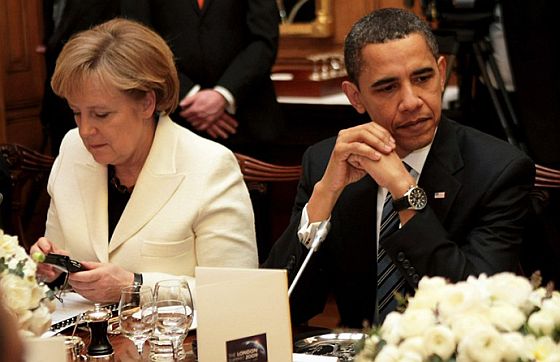
Intelligence officials confirm Obama misled Merkel

Obama pretending he can't see Merkel's text message.

Obama pretending he can't see Merkel texting.

The Los Angeles Times reports: The White House and State Department signed off on surveillance targeting phone conversations of friendly foreign leaders, current and former U.S. intelligence officials said Monday, pushing back against assertions that President Obama and his aides were unaware of the high-level eavesdropping.

Professional staff members at the National Security Agency and other U.S. intelligence agencies are angry, these officials say, believing the president has cast them adrift as he tries to distance himself from the disclosures by former NSA contractor Edward Snowden that have strained ties with close allies.

The resistance emerged as the White House said it would curtail foreign intelligence collection in some cases and two senior U.S. senators called for investigations of the practice.

Precisely how the surveillance is conducted is unclear. But if a foreign leader is targeted for eavesdropping, the relevant U.S. ambassador and the National Security Council staffer at the White House who deals with the country are given regular reports, said two former senior intelligence officials, who spoke on condition of anonymity in discussing classified information.

Obama may not have been specifically briefed on NSA operations targeting a foreign leader’s cellphone or email communications, one of the officials said. “But certainly the National Security Council and senior people across the intelligence community knew exactly what was going on, and to suggest otherwise is ridiculous.”

If U.S. spying on key foreign leaders was news to the White House, current and former officials said, then White House officials have not been reading their briefing books.

Some U.S. intelligence officials said they were being blamed by the White House for conducting surveillance that was authorized under the law and utilized at the White House.

“People are furious,” said a senior intelligence official who would not be identified discussing classified information. “This is officially the White House cutting off the intelligence community.”

Any decision to spy on friendly foreign leaders is made with input from the State Department, which considers the political risk, the official said. Any useful intelligence is then given to the president’s counter-terrorism advisor, Lisa Monaco, among other White House officials.

When Angela Merkel phoned Barack Obama to tell him she didn’t appreciate being spied on by the NSA, it’s not as though Obama got blind-sided by the call. “You have a call on line one Mr President. It’s a woman with a German accent. She sounds pissed off.

On the contrary, it’s reasonable to assume that Obama, in consultation with his staff, had time to craft a response, and if that response was not exactly crafted then it should at least have sounded halfway plausible.

Senior White House adviser: Just tell her you knew nothing about it but you promise it’ll never happen again.

Obama: But that’s going to sound like the lame excuse a 12-year-old would give in response to a reprimand from a school teacher.

Adviser: You got any better ideas?

The Most Powerful Man in the World: ….

What should he have said? How about:

I am aware of the reports you are referring to. I understand your concerns. I have ordered a comprehensive review of our surveillance policies and I am fully committed to taking whatever steps are necessary to restore trust between the United States and Germany. To that end, I’d like to invite you to send a team of your intelligence officials to meet their counterparts in Washington and in that context we will be able to address more specific issues and hopefully arrive at a common understanding.

You remain dear to my heart, Angela.

Well, maybe not the last bit.

Facebooktwittermail

A president who claims not to know much

Dana Milbank writes: The Associated Press’s Josh Lederman led off Monday’s White House briefing with an obvious question: “Was the president kept out of the loop about what the NSA was doing?”

“I am not going to get into details of internal discussions,” press secretary Jay Carney replied, repeating previous promises that “we do not and will not monitor the chancellor’s communications.” This formulation conspicuously omits the phrase “did not.”

CNN’s Jim Acosta cited the HealthCare.gov rollout and the IRS targeting, which Obama said he learned about through news reports. “Is there a concern,” Acosta asked, “that the president is being kept in the dark on some of these issues?”

Carney told Acosta he had “conflated a bunch of very disparate issues.”

“Republican critics,” Acosta said, “are making the case, though, that the president appears to be in the dark about some pretty significant stories that are swirling around this White House.”

“Well, Republican critics say a lot of things, Jim,” Carney replied icily.

That’s true. But in this case, the Republicans understated the number of issues on which the president has claimed to be in the dark. A compilation by the Republican National Committee titled “The Bystander President” cited the NSA spying on Merkel, the Obamacare rollout and an investigation of the IRS’s targeting of political groups (the White House counsel knew of the inquiry but said she didn’t inform Obama). The RNC also mentioned the failure of clean-energy company Solyndra, which had received government funding (Carney had said Obama read about it in “news accounts”), and the attempts to go after reporters’ phone and e-mail records (which the president also found out about from reading the news, Carney said).

The RNC didn’t mention that Obama had allegedly known nothing about an FBI investigation of an affair involving David Petraeus that led him to resign as CIA director. Neither did it mention two other claims that conservatives often question: Obama’s ignorance of a guns-on-the-border sting operation called “Fast and Furious” that went awry, and his unawareness of requests for additional diplomatic security in Libya before a U.S. outpost in Benghazi was attacked.

There’s no reason Obama should have known about Fast and Furious or diplomatic security requests. But how could he not know his spies were bugging the German chancellor?

“Is it believable that the president would not know about surveillance of the head of state of a close American ally?” ABC News’s Jon Karl asked Carney. “Does that sound plausible to you?”

This finally provoked a hint from Carney that Obama did, in fact, know that the NSA was bugging Merkel. “The Wall Street Journal probably doesn’t appreciate the suggestion that their story is wrong,” he said, referring to a report that said Obama learned of the activity in the summer, “but I would say simply that we’re not going to comment on specific activities reported in the press,” he said.

Facebooktwittermail

Obama may ban spying on heads of allied states — including Israel?

The New York Times reports: President Obama is poised to order the National Security Agency to stop eavesdropping on the leaders of American allies, administration and Congressional officials said Monday, responding to a deepening diplomatic crisis over reports that the agency had for years targeted the cellphone of Chancellor Angela Merkel of Germany.

The White House informed a leading Democratic lawmaker, Senator Dianne Feinstein of California, of its plans, which grew out of a broader internal review of intelligence-gathering methods, prompted by the leak of N.S.A. documents by a former contractor, Edward J. Snowden.

In a statement on Monday, Senator Feinstein, chairwoman of the Senate Intelligence Committee, said, “I do not believe the United States should be collecting phone calls or emails of friendly presidents and prime ministers.” Ms. Feinstein, who has been a stalwart defender of the administration’s surveillance policies, said her committee would begin a “major review of all intelligence collection programs.”

The White House said Monday evening that no final decision had been made on the monitoring of friendly foreign leaders. But the disclosure that it is moving to prohibit it marks a landmark shift for the N.S.A., which has had nearly unfettered powers to collect data on tens of millions of people around the world, from ordinary citizens to heads of state, including the leaders of Brazil and Mexico.

It is also likely to prompt a fierce debate on what constitutes an American ally. [Continue reading…]

The 2013 ‘black budget’ for the U.S. intelligence community, provided to the Washington Post by Edward Snowden and published at the end of August, states that although overall the budget was declining it was being increased in specific areas:

“[W]e are investing in target surveillance and offensive CI [counterintelligence] against key targets, such as China, Russia, Iran, Israel, Pakistan, and Cuba.”

Monitoring the communications of the leaders of Israel, a country that has repeatedly made explicit threats that it might trigger another major conflict in the Middle East, would appear to serve the interests of both the U.S. and most of its allies.

Facebooktwittermail

Alexander did not ‘discuss’ Merkel surveillance with Obama, but was he briefed?

I think the main thing I want to emphasize is I don’t have an interest and the people at the NSA don’t have an interest in doing anything other than making sure that where we can prevent a terrorist attack, where we can get information ahead of time, that we’re able to carry out that critical task. We do not have an interest in doing anything other than that. — President Obama, August 9, 2013.

A report in the German newspaper Bild cites NSA sources claiming that in 2010, Gen. Keith Alexander briefed President Obama on the targeting of Chancellor Angela Merkel’s cellphone.

The NSA has responded with a statement saying:

[General] Alexander did not discuss with President Obama in 2010 an alleged foreign intelligence operation involving German Chancellor Merkel, nor has he ever discussed alleged operations involving Chancellor Merkel.

That sounds very much like a non-denial denial.

Given that as it was widely reported in the English-language press that Obama had been “briefed” on the surveillance, an unambiguous denial from the NSA would have simply said that Obama had not been briefed on this matter. He had not been briefed by Alexander or anyone else in the intelligence community.

A briefing involves nothing more than the exchange of information. Whether that exchange provokes discussion is another matter. Every U.S. president will be briefed on matters every single day during which he is a passive recipient of information.

That Obama presents the appearance of being a disengaged president, is well documented.

If Alexander presented Obama with a list of heads of state currently under U.S. surveillance — a list including Merkel’s name and/or position — and Obama scanned the list, noting who was being spied on and for how long, but this information provoked neither comments nor questions from the president, then he could certainly have been briefed while having no discussion.

Officials choose their words very carefully precisely because they are afraid of accused of lying. That they might at the same time be engaged in an effort to be deceptive is another matter, since in response to the suggestion that a statement might be misleading, they can always plead ignorance or regret or blame the press. Sorry if that wasn’t clear. Sorry if there’s a misunderstanding. You misinterpreted my statement.

The charade of a press briefing won’t, however, alleviate the credibility issue that Obama now has with Merkel. In her eyes the U.S. president must now appear to be either a liar, incompetent, or both.

Facebooktwittermail

Barack Obama: a disengaged president

Obama reflectingFor Barack Obama, the turning point in the 2008 presidential election came as a gift, courtesy of the collapse of Lehman Brothers. While his opponent, Sen. John McCain, reacted to the crisis like a headless chicken, Obama emerged as the man who looked like a cool and competent economic manager — a better bet for steering the nation at a time of financial turmoil. But bear in mind that prior to the collapse on Wall Street, the Obama campaign was struggling to figure out how to respond to another awesome challenge… that posed by Sarah Palin.

So, we should never forget that to the extent that Obama entered office with an aura of competence, that was never more than competence defined by contrast with the scary prospect of a McCain-Palin administration.

In his book, The Amateur, Edward Klein writes:

While on vacation in Martha’s Vineyard [in August 2010], Obama invited New York mayor Michael Bloomberg to play a round of golf at the Vineyard Golf Club in Edgartown, Massachusetts. A self-made billionaire, Bloomberg had been touted as a possible replacement for Timothy Geithner as secretary of the treasury. Bloomberg flew to the island on his private jet, eager to give Obama advice on how to get the country moving again. Obama and Bloomberg were joined by Vernon Jordan, a Lazard Frères & Co. senior managing director and longtime Democratic Party wise man, and Marvin Nicholson, the White House trip director who keeps Obama organized and on schedule. When the round of golf was over, the president left immediately. Bloomberg looked nonplussed. He turned to his golfing colleagues and said, “I played four hours of golf with the president and he didn’t ask me a goddam thing.”

It’s worth noting that at that time, a White House spokesman made a point of noting that Obama’s round of golf had been preceded by a 15-minute discussion with Bloomberg on the economy. The intended image was of a president who goes on vacation but refuses to leave work behind.

Bloomberg’s own account, however, paints a picture of a man who not only gladly disengages from work but also from the people around him.

Given the unique challenges Obama faced from day one, it’s easy to see that sooner or later he might become over-burdened, but there are accounts of his lack of engagement right from the beginning.

[Gen. Stanley McChrystal who in early 2009 was Director of the Joint Staff] first encountered Obama a week after he took office, when the president met with a dozen senior military officials in a room at the Pentagon known as the Tank. According to sources familiar with the meeting, McChrystal thought Obama looked “uncomfortable and intimidated” by the roomful of military brass. Their first one-on-one meeting took place in the Oval Office four months later, after McChrystal got the Afghanistan job, and it didn’t go much better. “It was a 10-minute photo op,” says an adviser to McChrystal. “Obama clearly didn’t know anything about him, who he was. Here’s the guy who’s going to run his fucking war, but he didn’t seem very engaged.”

Four years later, Obama still created the sense that he was disengaged when faced with challenging issues.

Even as the debate about arming the rebels [in Syria] took on a new urgency, Mr. Obama rarely voiced strong opinions during senior staff meetings. But current and former officials said his body language was telling: he often appeared impatient or disengaged while listening to the debate, sometimes scrolling through messages on his BlackBerry or slouching and chewing gum.

While many of Obama’s most ardent admirers have been overseas — their admiration largely being inspired by his character seeming to be the antithesis of George Bush’s — they do not include Angela Merkel.

Merkel’s connection to Obama wasn’t particularly good before the spying scandal. The chancellor is said to consider the president overrated — a politician who talks a lot but does little, and is unreliable to boot.

One example, from Berlin’s perspective, was the military operation in Libya almost three years ago, which Obama initially rejected. When then-Secretary of State Hillary Clinton convinced him to change his mind, he did so without consulting his allies. Berlin saw this as evidence of his fickleness and disregard for their concerns.

The chancellor also finds Washington’s regular advice on how to solve the euro crisis irritating. She would prefer not to receive instruction from the country that caused the collapse of the global financial system in the first place.

Facebooktwittermail

What did the president know and when did he know it?

I haven’t evolved in my assessment of the actual [surveillance] programs. I consistently have said that when I came into office I evaluated them. — President Obama, August 2013.

The Wall Street Journal reports: The National Security Agency ended a program used to spy on German Chancellor Angela Merkel and a number of other world leaders after an internal Obama administration review started this summer revealed to the White House the existence of the operation, U.S. officials said.

Officials said the internal review turned up NSA monitoring of some 35 world leaders, in the U.S. government’s first public acknowledgment that it tapped the phones of world leaders. European leaders have joined international outrage over revelations of U.S. surveillance of Ms. Merkel’s phone and of NSA’s monitoring of telephone call data in France.

The White House cut off some monitoring programs after learning of them, including the one tracking Ms. Merkel and some other world leaders, a senior U.S. official said. Other programs have been slated for termination but haven’t been phased out completely yet, officials said.

The account suggests President Barack Obama went nearly five years without knowing his own spies were bugging the phones of world leaders. Officials said the NSA has so many eavesdropping operations under way that it wouldn’t have been practical to brief him on all of them.

They added that the president was briefed on and approved of broader intelligence-collection “priorities,” but that those below him make decisions about specific intelligence targets.

The senior U.S. official said that the current practice has been for these types of surveillance decisions to be made at the agency level. “These decisions are made at NSA,” the official said. “The president doesn’t sign off on this stuff.” That protocol now is under review, the official added.

Facebooktwittermail

Could Merkel have been spied on without Obama’s approval?

Der Spiegel reports: Among the politically decisive questions is whether the spying was authorized from the top: from the US president. If the data is accurate, the operation was authorized under former President George W. Bush and his NSA chief, Michael Hayden. But it would have had to be repeatedly approved, including after Obama took office and up to the present time. Is it conceivable that the NSA made the German chancellor a surveillance target without the president’s knowledge?

The White House and the US intelligence agencies periodically put together a list of priorities. Listed by country and theme, the result is a matrix of global surveillance: What are the intelligence targets in various countries? How important is this reconnaissance? The list is called the “National Intelligence Priorities Framework” and is “presidentially approved.”

One category in this list is “Leadership Intentions,” the goals and objectives of a country’s political leadership. The intentions of China’s leadership are of high interest to the US government. They are marked with a “1” on a scale of 1 to 5. Mexico and Brazil each receive a “3” in this category.

Germany appears on this list as well. The US intelligence agencies are mainly interested in the country’s economic stability and foreign policy objectives (both “3”), as well as in its advanced weapons systems and a few other sub-items, all of which are marked “4.” The “Leadership Intention” field is empty. So based on the list, it wouldn’t appear that Merkel should be monitored.

Former NSA employee Thomas Drake does not see this as a contradiction. “After the attacks of September 11, 2001, Germany became intelligence target number one in Europe,” he says. The US government did not trust Germany, because some of the Sept. 11 suicide pilots had lived in Hamburg. Evidence suggests that the NSA recorded Merkel once and then became intoxicated with success, says Drake. “It has always been the NSA’s motto to conduct as much surveillance as possible,” he adds.

Facebooktwittermail

Obama lied to Merkel when claiming to know nothing about NSA bugging her phone, says new report

BBC News reports: Mrs Merkel phoned the US president when she first heard of the spying allegations on Wednesday.

President Barack Obama apologised to the German chancellor and promised Mrs Merkel he knew nothing of the alleged phone monitoring and would have stopped it if he had, Der Spiegel reports.

But on Sunday Bild newspaper quoted US intelligence sources as saying NSA head Keith Alexander personally briefed the president about the covert operation targeting Mrs Merkel in 2010.

“Obama did not halt the operation but rather let it continue,” the newspaper quoted a senior NSA official as saying.

Her number was still on a surveillance list in 2013.

Bild is a tabloid that does not have a reputation for journalistic excellence. Even so, if a conflict between the NSA and the White House is escalating, then an NSA source might turn to this type of publication as a way of making a veiled threat. The report has the effect of sowing doubt about Obama’s statements even if NSA officials now make dismissive responses, pointing out the unreliability of the press.

Obama has a dilemma. On the one hand it is becoming increasingly evident that he will need to steer some kind of reform in the NSA’s operations. But at the same time he doesn’t want to foster the appearance of the agency having become a rogue operation since that would also make him look like a negligent, ineffectual president. Neither does he want to get into an open fight since by their nature, intelligence agencies are dirty fighters. He can be reasonably confident that none of his communications are being monitored by any foreign intelligence agencies, yet why should he assume the NSA would never spy on an American president?

In a speech NSA chief Keith Alexander gave this summer, as he referred to when Obama “first came on board,” either unconsciously or intentionally, the four-star general seemed to be alluding to the transience of elected officials. The president, his cabinet, and members of Congress, sustain the facade of democracy, but the captains of the state like Alexander generally move around in the background, loyal to the president and the Constitution as they like to declare, yet harboring the conceit that they are America’s most stalwart defenders.

Facebooktwittermail

Obama’s diplomatic deficit

The idea that heads of state can become bosom buddies is a bit contrived, yet the ability to develop friendly relationships with foreign counterparts would seem like a job requirement. It’s part of the job in which Barack Obama has displayed little interest.

Back in 2009 when Obama was a global celebrity, other world leaders eagerly jostled for opportunities to be photographed alongside the new political rock star. Obama’s response seems to suggest he didn’t anticipate that his presidency might last far longer than his popularity. Indeed, it even casts some doubt about whether he recognizes the value of making friends.

Gregor Peter Schmitz writes: Obama was scheduled to visit the Church of Our Lady cathedral in Dresden during a June 2009 whistle-stop visit to Germany. Diplomats from the German Foreign Ministry had painstakingly planned every last detail. They were looking forward to the photographs of Chancellor Angela Merkel with the US president in front of cheering crowds.

But the White House bristled. The president didn’t want to do that — that was the word in Washington. He reportedly placed little value on such photo ops, and he had to leave as quickly as possible, to get to an appearance at the Buchenwald concentration camp. The haggling went back and forth for weeks, and in the end the White House gave in, but only a little. Obama raced through Dresden. After their visit inside the church, Merkel had to shake hands with visitors by herself. The president had already disappeared.

On this day, at the latest, it must have dawned on diplomats that this US president was different from his predecessors. He was someone who did not attach value to diplomatic niceties nor to the sensitivities of his close friends, which he already had proven as a presidential candidate. At that time he put Chancellor Merkel in an awkward position by wanting to make a campaign speech in front of the Brandenburg Gate. This site was traditionally set aside for sitting presidents, which Obama also knew.

The Democrat, who prefers to spend his evenings with his family or alone in front of his computer, has made it no secret in Washington that he does not want to make new friends. That maxim especially applies to his foreign diplomacy. Unlike his predecessor George W. Bush, Obama is loved by the people of the world, but much less by their heads of government. On the heels of recent revelations that US spy agencies might have monitored Chancellor Merkel’s cell phone, the complaints about Merkel’s “lost friend” Obama are misplaced. Obama doesn’t want to be a friend.

During a recent visit by a European head of government to Washington, the atmosphere was described as frosty by those in the entourage from Europe. Obama didn’t find the time for even a little small talk, the sources said, and “it seemed to some like an appointment with a lawyer.” [Continue reading…]

Facebooktwittermail

Obama’s tired of the Middle East — but is that a policy?

A New York Times report on a major reappraisal of President Obama’s approach to the Middle East tosses this sentence in close to the end:

After vigorous debate, the group decided to make the Middle East peace process a top priority — even after failing to broker an agreement during the administration’s first term — in part because Mr. Kerry had already thrown himself into the role of peacemaker.

Top priority? More like an afterthought.

The actual conclusion of the White House review — and note, this was a foreign policy review that didn’t actually involve the State Department (whose domain is what?) — was that the Middle East is very troublesome and the U.S. has no influence, so let’s just move on.

Each Saturday morning in July and August, Susan E. Rice, President Obama’s new national security adviser, gathered half a dozen aides in her corner office in the White House to plot America’s future in the Middle East. The policy review, a kind of midcourse correction, has set the United States on a new heading in the world’s most turbulent region.

At the United Nations last month, Mr. Obama laid out the priorities he has adopted as a result of the review. The United States, he declared, would focus on negotiating a nuclear deal with Iran, brokering peace between the Israelis and the Palestinians and mitigating the strife in Syria. Everything else would take a back seat.

That includes Egypt, which was once a central pillar of American foreign policy. Mr. Obama, who hailed the crowds on the streets of Cairo in 2011 and pledged to heed the cries for change across the region, made clear that there were limits to what the United States would do to nurture democracy, whether there, or in Bahrain, Libya, Tunisia or Yemen.

The president’s goal, said Ms. Rice, who discussed the review for the first time in an interview last week, is to avoid having events in the Middle East swallow his foreign policy agenda, as it had those of presidents before him.

“We can’t just be consumed 24/7 by one region, important as it is,” she said, adding, “He thought it was a good time to step back and reassess, in a very critical and kind of no-holds-barred way, how we conceive the region.”

Not only does the new approach have little in common with the “freedom agenda” of George W. Bush, but it is also a scaling back of the more expansive American role that Mr. Obama himself articulated two years ago, before the Arab Spring mutated into sectarian violence, extremism and brutal repression.

The blueprint drawn up on those summer weekends at the White House is a model of pragmatism — eschewing the use of force, except to respond to acts of aggression against the United States or its allies, disruption of oil supplies, terrorist networks or weapons of mass destruction. Tellingly, it does not designate the spread of democracy as a core interest. [Continue reading…]

A model of pragmatism? Or apathy.

Facebooktwittermail

As Iraq seeks U.S. arms, bombs kill another 55

Reuters reports: A dozen bombings in Iraq killed 55 people on Sunday as the prime minister prepares to travel to Washington to seek President Barack Obama’s help in confronting a wave of sectarian violence fuelled by Syria’s civil war.

Killings, mostly blamed by the Shi’ite-led government on Sunni Islamists from al Qaeda, are running at daily rates not seen in five years and Nuri al-Maliki will ask Obama on Friday to speed up promised deliveries of drones and F-16 jets that he believes can help staunch the long desert border with Syria.

Iraq’s own security forces, trained and equipped by the U.S. troops who withdrew in late 2011 after a nine-year occupation, have been unable to prevent a surge in violence which has taken the civilian death toll so far this year to about 7,000. Sealing the Syrian border would only address part of the problem.

On Sunday, police reported 11 vehicles blowing up in mainly Shi’ite Muslim areas in and around Baghdad, killing 41 people in an apparently coordinated series of explosions typical of al Qaeda. A further 14 people were killed when a suicide bomber drove up to a line of soldiers waiting to collect their pay from a bank in the northern city of Mosul and detonated his car.

Facebooktwittermail

Please tell me, Mr President, why a U.S. drone assassinated my mother

Rafiq ur Rehman writes: The last time I saw my mother, Momina Bibi, was the evening before Eid al-Adha. She was preparing my children’s clothing and showing them how to make sewaiyaan, a traditional sweet made of milk. She always used to say: the joy of Eid is the excitement it brings to the children.

Last year, she never had that experience. The next day, 24 October 2012, she was dead, killed by a US drone that rained fire down upon her as she tended her garden.

Nobody has ever told me why my mother was targeted that day. The media reported that the attack was on a car, but there is no road alongside my mother’s house. Several reported the attack was on a house. But the missiles hit a nearby field, not a house. All reported that five militants were killed. Only one person was killed – a 65-year-old grandmother of nine.

My three children – 13-year-old Zubair, nine-year-old Nabila and five-year-old Asma – were playing nearby when their grandmother was killed. All of them were injured and rushed to hospitals. Were these children the “militants” the news reports spoke of? Or perhaps, it was my brother’s children? They, too, were there. They are aged three, seven, 12, 14, 15 and 17 years old. The eldest four had just returned from a day at school, not long before the missile struck.

But the United States and its citizens probably do not know this. No one ever asked us who was killed or injured that day. Not the United States or my own government. Nobody has come to investigate nor has anyone been held accountable. Quite simply, nobody seems to care. [Continue reading…]

Facebooktwittermail