Category Archives: Obama administration

U.S. officially halts millions in military aid to Egypt

CBS News reports: The U.S. is cutting hundreds of millions of dollars in aid to Egypt following the ouster of President Mohamed Morsi and the subsequent crackdown by the military-backed government.

The U.S. provides $1.5 billion in aid each year to Egypt. While the State Department did not provide a dollar amount of the aid being cut, it amounts to hundreds of millions in mostly military aid. The move had been debated for some time.
As CBS News State Department correspondent Margaret Brennan reports, how to deal with Egypt since the military coup has been one of the most vexing foreign policy questions for the Obama administration.

State Department spokeswoman Jen Psaki says the U.S. will withhold delivery of certain large-scale military systems as well as cash assistance to the Egyptian government until “credible progress” is made toward an inclusive government set up through free and fair elections.

The U.S. will continue to provide health and education assistance and money to help Egypt secure its borders, counter terrorism and ensure security in the Sinai.

Facebooktwittermail

U.S. plans to curb military aid to Egypt

The Washington Post reports: The Obama administration will announce curbs on a significant part of nonessential military aid to Egypt within a few days, U.S. officials said Tuesday, marking a shift in America’s relations with one of its key Arab allies.

Officials would not provide figures about how much of the annual $1.2 billion in military aid would be withheld, but they said the primary focus will be a hold on the shipment of a dozen AH-64D Apache helicopters from an order placed four years ago.

Provision of crucial spare parts for the extensive U.S. military equipment that Egypt already has and training for the country’s armed forces will continue, officials said. They said aid that supports counterterrorism initiatives and Egypt’s relations with Israel, including security efforts in the Sinai Peninsula and monitoring along the border with the Gaza Strip, would also continue.

U.S. officials described the decision — which comes three months after a military coup toppled Mohamed Morsi, Egypt’s first democratically elected president — on the condition of anonymity. Neither Congress nor Egyptian officials have been notified of the decision, and the announcement could be postponed. [Continue reading…]

Facebooktwittermail

Under Obama, U.S. leads the world in oil and gas production

Slate reports: The United States will pass Russia this year to lead the world in production of oil and natural gas, the U.S. Energy Information Administration reports.

America has been closing in on Russia since 2008 thanks to a boom in both oil and gas production, primarily on private lands. This year it’s on track to out-produce it by a substantial margin. Saudi Arabia is third overall and remains the world’s largest oil producer — though the United States may be on track to take that title as well.

“This is a remarkable turn of events,” the head of the EIA told the Wall Street Journal. “This is a new era of thinking about market conditions, and opportunities created by these conditions, that you wouldn’t in a million years have dreamed about.”

As recently as 2007, economists were writing things like, “the amount of oil produced in America each year has been on a path of inexorable decline now for two generations.” Turns out the path was exorable after all. All it took was a whole lot of fracking. [Continue reading…]

DeSmogBlog: What’s it like living in a small town that’s gone from rust belt farmland to fracking boomtown?

First, residents often say, there’s the traffic. Communities have been unexpectedly flooded with heavy tractor trailers that locals say turn 10 minute commutes into hour-long ordeals, choke back roads and decimate pavement so badly that in some areas, drilling companies are barred from entering until they agree to pay for road repairs. “The traffic here is horrendous,” Towanda, PA resident Joe Benjamin told NPR.

Others often describe the impacts on the social fabric – a “wild west” atmosphere that brings with it increased crime and public health problems.

But these reports have been largely anecdotal, with little to quantify how big these impacts are or how much of it is due to fracking. Until now.

A new report by Food and Water Watch examines the social impacts of fracking, comparing traffic, crime and sexually transmitted infections in rural Pennsylvania counties. Using a decade worth of county-level data, they compare the differences between counties with substantial fracking and without, and how these counties have changed over time, from before the boom until after it set in. [Continue reading…]

Facebooktwittermail

U.S. Tripoli raid deepens sense of chaos in Libya

Time reports: Two days after U.S. Special Forces seized one of the FBI’s most wanted al-Qaeda operatives in broad daylight in Libya’s capital, officials of that oil-rich nation are scrambling to explain what they knew in advance about a major foreign commando raid on their territory—an operation that could well provoke jihadist attacks in Libya and destabilize an already fragile government.

The U.S. operation was audacious: Early on Saturday morning, at least two carloads of armed men ambushed Anas al-Liby, one of the suspected masterminds of the 1998 bombings of U.S. embassies in Nairobi and Dar el-Salaam, which killed more than 200 people. As al-Liby returned from dawn prayers to his home in central Tripoli, the men cut off his black Hyundai sedan with their vehicles, smashed the window, pulled him out of the car and flew him out of Libya—all without the Libyan government’s knowledge or approval, or so the authorities in Tripoli claim.

To the U.S., al-Liby’s capture was a long time coming. At 49, al-Liby, whose real name is Nazih Abdul-Hamed al-Ruqai, was a key computer expert for al-Qaeda, who logged time with Osama bin Laden in Sudan and Afghanistan during the 1990s and whom U.S. officials believe acted as a scout and planner for the organization. In 2000, the U.S. indicted him in absentia and others for the embassy bombings. Pentagon officials said on Sunday that al-Liby was “lawfully detained by the U.S. military in a secure location outside of Libya,” which was assumed by some to be a naval vessel in the Mediterranean. The operation’s stunning success was in stark contrast to a second commando raid before dawn on Saturday. U.S. Navy SEALs had tried to storm a house in southern Somalia, the suspected base of key al-Shabab operatives, when they came under a blaze of gunfire and were forced to withdraw before confirming if their target was dead.

Yet despite the success of the Libya operation, the fallout has already begun—and could deepen Libya’s already unstable security situation and shake its fragile government. On Sunday Libyan officials fumed in an official statement that the arrest was a “kidnapping,” and that they have “been in touch with the U.S. government and have asked for clarification on this matter.” Secretary of State John Kerry refused to say on Sunday whether the U.S. had sought Libya’s approval beforehand. But the statement from Libyan Prime Minister Ali Zeidan’s office insisted the government was caught unawares. [Continue reading…]

Wayne White writes: This weekend’s US capture of Nazih Abdul-Hamed Nabih al-Ruqai’I, better known by his alias, Anas al-Libi, might net only limited information of current intelligence value while potentially resulting in militant Islamist payback in what remains a very fragile Libya. Of no less than three al-Qaeda operatives bearing the alias al-Libi (simply “the Libyan” in Arabic), Anas al-Libi could be the least significant overall. And should a Libyan militant Islamic group or militia decide to retaliate for this bold US grab, they are capable of doing significant harm.

Anas al-Libi’s former association with al-Qaeda is well-known, as are standing US indictments against him for actions related to the horrific 1998 East Africa bombing. Yet, relatively little seems to be known about how active he remained over the past few years. So the information he has might not be particularly useful if, for example, he was not knowledgeable about or involved in last year’s Benghazi consulate attack or other recent operations. US authorities apparently believe he has been working to expand al-Qaeda’s network in Libya (although perhaps not a certainty since he has been living in Tripoli without security). [Continue reading…]

Facebooktwittermail

Iran hints at nuclear concessions, wants to see endgame

Barbara Slavin reports: US Secretary of State John Kerry and Iranian Foreign Minister Mohammad Javad Zarif were all smiles after their historic 30-minute meeting on Sept. 26, on the sidelines of the UN General Assembly.

But their optimism could fade quickly if the two sides fail to meet mutual expectations in Geneva next week. The Americans and the other permanent members of the UN Security Council plus Germany (P5+1) are waiting for the Iranians to table a serious new proposal, while the Iranians expect to learn what they will receive in return, both immediately and at the end of the negotiating process.

Iranian officials in New York for UN meetings over the past two weeks have told the Americans that they are willing to offer significant concessions in Geneva on Oct. 15-16, but need to know “the endgame” before taking the first steps.

European diplomats have told Al-Monitor that the P5+1 are still debating how to respond to various possible initial Iranian concessions.

The crux of a deal is likely to be international acknowledgement that Iran can continue enriching uranium at a low level under stringent conditions. In the short term, Iranians appear to be expecting US President Barack Obama to waive or slow implementation of some punishing sanctions in return for curbing or suspending key elements of their nuclear program; at the end, they envision removal of all nuclear-related penalties on Iran’s oil exports and international financial transactions in exchange for permanent limits on the program and enhanced international monitoring. [Continue reading…]

Facebooktwittermail

Kerry praises Assad while Assad continues bombing Syria

Remember the refrain that used to come from all quarters of the Obama administration? Assad must go!

This was Secretary of State John Kerry speaking in London on February 25:

Less than two months after chemical attacks outside Damascus killed hundreds of Syrians, not only have U.S. officials stopped insisting Assad must go, but today Kerry praised the Syrian president. Kerry praised Assad even as his air force continued its daily bombing of Syrian cities. Of course none of those bombs were armed with chemical warheads.

Kerry is “very pleased” at progress in the chemical weapons disarmament plan which he called “a terrific example of global cooperation.” He added, “I think it is also credit to the Assad regime for complying rapidly as they are supposed to.”

Even among those observers who remain skeptical about the Assad regime’s responsibility for the August 21 chemical attacks, there should nevertheless be little debate about who has benefited, diplomatically, politically, and strategically: Bashar al-Assad.

The following videos of air attacks on several cities were uploaded to YouTube today and appeared on the Facebook page of the Local Coordination Committees of Syria.

Barrel bombs dropped on Kafr-Zeita, Hama:

An air strike on Dael, Daraa

An air strike on Hrak, Daraa

An air strike on Tafas, Daraa

Meanwhile, the Associated Press reports: Syrian government forces have reopened a key road leading to the embattled northern city of Aleppo after heavy fighting with rebels that left casualties on both sides, state media and activists said Monday.

The state news agency and the Britain-based Syrian Observatory for Human Rights said regime troops wrested control of the road Sunday night. It had been closed since rebels captured villages along the road in August.

President Bashar Assad’s regime built the desert road to bypass contested areas after rebels took the town of Maaret al-Numan late last year, cutting the main highway between the capital, Damascus, and Aleppo, Syria’s largest city.

“This road was a matter of life or death to the regime,” said Observatory director Rami Abdul-Rahman. He added that government troops now can send supplies to the north although the road remains “very dangerous.”

Facebooktwittermail

How Obama’s effort to get re-elected may have prolonged the war in Syria

Michael Hirsh reports: Despite Secretary of State John Kerry’s frenetic efforts, preparations for the “Geneva II” peace conference on Syria’s civil war are already foundering. The rebel movement has become increasingly radicalized against Syrian dictator Bashar al-Assad and more fractured. A newly confident Assad, meanwhile, has somewhat relegitimized himself as a signatory to a new chemical-weapons ban negotiated by the United States and Russia under U.N. auspices, which his government is tasked with implementing over the next year. Defying global opprobrium over his use of sarin gas, Assad has also positioned himself in a series of high-profile TV interviews as a preferable alternative to Islamist rebels who want to create a fundamentalist state.

All of which should prompt a reexamination of the first Geneva conference in the summer of 2012, on which Kerry’s new push for peace is based. According to some officials involved, perhaps the greatest tragedy of Syria is that, some 80,000 lives ago, President Obama might have had within his grasp a workable plan to end the violence, one that is far less possible now. But amid the politics of the 2012 presidential election—when GOP nominee Mitt Romney regularly accused Obama of being “soft”—the administration did little to make it work and simply took a hard line against Assad, angering the special U.N. Syria envoy, Kofi Annan, and prompting the former U.N. secretary-general to quit, according to several officials involved.

Former members of Annan’s negotiating team say that after then-Secretary of State Hillary Rodham Clinton and Russian Foreign Minister Sergei Lavrov on June 30, 2012, jointly signed a communique drafted by Annan, which called for a political “transition” in Syria, there was as much momentum for a deal then as Kerry achieved a year later on chemical weapons. Afterward, Annan flew from Geneva to Moscow and gained what he believed to be Russian President Vladimir Putin’s consent to begin to quietly push Assad out. But suddenly both the U.S. and Britain issued public calls for Assad’s ouster, and Annan felt blindsided. Immediately afterward, against his advice, then-U.N. Ambassador Susan Rice offered up a “Chapter 7” resolution opening the door to force against Assad, which Annan felt was premature.

Annan resigned a month later. At the time, the soft-spoken Ghanaian diplomat was cagey about his reasons, appearing to blame all sides. “I did not receive all the support that the cause deserved,” Annan told reporters in Geneva. He also criticized what he called “finger-pointing and name-calling in the Security Council.” But former senior aides and U.N. officials say in private that Annan blamed the Obama administration in large part. “The U.S. couldn’t even stand by an agreement that the secretary of State had signed in Geneva,” said one former close Annan aide who would discuss the talks only on condition of anonymity. “He quit in frustration. I think it was clear that the White House was very worried about seeming to do a deal with the Russians and being soft on Putin during the campaign.” One of the biggest Republican criticisms of Obama at the time was that he had, in an embarrassing “open mike” moment, promised Moscow more “flexibility” on missile defense after the election. [Continue reading…]

Facebooktwittermail

Imagine

Graham E. Fuller writes: Is it possible that President Obama — without articulating it, perhaps without even fully intending it — may have strayed into the radical reforging of American foreign policy?

For the first time since the fall of the Soviet Union — or even the end of World War II — a linked body of enshrined foreign policy axioms may be quietly unraveling: American exceptionalism, American unilateralism, America as world policeman, moral commentator and hector, global hegemon and architect of a “world order.” Yesterday bombs were about to fall on Syria, now they are suspended. After months — years, decades — of talk about possible air strikes on Iran, suddenly we receive accounts of civil exchanges between the American and the Iranian presidents. These may only be false starts, but the larger implications beckon and burgeon. They start with the Middle East but radiate out to touch relations with Russia, China, Israel and the U.N., for starters.

Neoconservatives, hawks and liberal interventionists are aghast; progressives are heartened but holding their breath. Witness the mirror imaging in the U.S. media around these developments. The traditional nostrums don’t vary: The U.S. must draw red lines; lines once drawn must be acted upon; U.S. credibility is at stake; military readiness must be pumped to permanent alert in the Middle East to meet permanent security threats; American monopoly of decision-making must be jealously husbanded on all that moves in the world. Hawks stand with liberal interventionists, fearful that Obama is giving away the American store in acts of colossal naiveté, weakness and inexperience. Progressives perceive in these same acts the first glimmers of wisdom and rationality creeping into U.S. policy formulation — hints of strategic perestroika that just might rescue the U.S. from spiraling decades of foreign policy disasters that have undermined the country in countless ways: wartime presidents, global recoil from our policies, massive defense budgets, self-fulfilling proclamation of enemies, interventions, national paranoia, the building of a national security state, and pervasive intrusion into citizens’ private lives in the quest to keep America safe from tireless enemies. [Continue reading…]

Facebooktwittermail

Obama decision on Syria good for U.S. democracy, but his case is weak

Peter Beinart writes: Everything about President Obama’s decision to ask Congress to approve military action in Syria is terrific — except for the action he’s asking it to approve.

By going to Congress, Obama is doing something profound. He’s acknowledging that the rules of the foreign policy game must change. Over the past 40 years, America’s presidents have gutted two key restraints on their ability to go to war. In 1973, Richard Nixon created an all-volunteer military, thus confining the direct burdens of war to a small subset of Americans who were legally barred from political protest and virtually ensuring that nothing as noisy and chaotic as the anti-Vietnam movement would occur again. Then, in the 1980s, Ronald Reagan and George H.W. Bush cut out Congress—launching invasions of Grenada and Panama on their own authority despite efforts by Congress itself (the War Powers Act) and the framers of the Constitution (Article One, Section Eight) to make certain it couldn’t happen.

The result was the creation of a “hubris bubble” in foreign policy analogous to the one that grew during the same stretch of time on Wall Street. Like the titans of Wall Street, America’s presidents kept making bets that paid off: Grenada, Panama, Gulf War, Bosnia, Kosovo. And the more they did, the more dismissive they became of the need for public oversight. It all went swimmingly. Until Iraq, when the deregulation of presidential war-making powers produced the foreign policy equivalent of a stock market crash. [Continue reading…]

Facebooktwittermail

Obama is closer to Nixon than to MLK

Paul Rosenberg writes: Because Barack Obama is the United States’ first black president, there are many who still automatically associate him with Dr Martin Luther King, Jr. And with the 50th anniversary of the March on Washington for Jobs and Freedom, it’s virtually a knee-jerk reaction to associate his presidency with the fulfillment of King’s dream.

But, as the almost-simultaneous sentencing of Chelsea nee Bradley Manning to 35 years in prison should remind us, a more accurate historical comparison to that time would link Obama to Richard Nixon, rather than King. Nixon, after all, tried to have Daniel Ellsberg jailed for revealing the Pentagon Papers, and Ellsberg himself has said, “I’m sure that President Obama would have sought a life sentence in my case.”

Elaborating further, Ellsberg said, “Various things that were counted as unconstitutional then have been put in the president’s hands now. He’s become an elected monarch. Nixon’s slogan, ‘when the president does it, it’s not illegal’, is pretty much endorsed now. Meaning not only Obama but the people who come after him will have powers that no previous president had.” [Continue reading…]

Facebooktwittermail

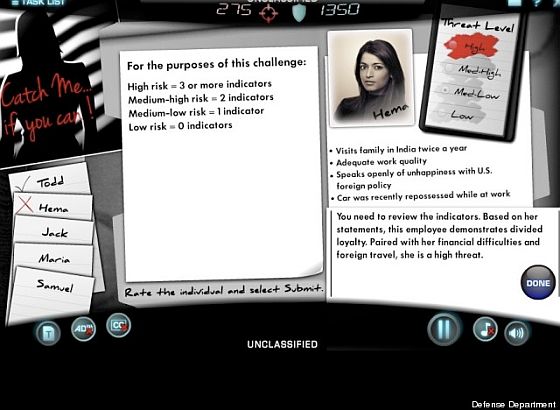
The new McCarthyism: Unhappy with U.S. foreign policy? Obama administration thinks you might be a threat to America

A Defense Information Systems Agency (DISA) slide profiles an 'insider threat.'

The Huffington Post reports: Watch out for “Hema.”

A security training test created by a Defense Department agency warns federal workers that they should consider the hypothetical Indian-American woman a “high threat” because she frequently visits family abroad, has money troubles and “speaks openly of unhappiness with U.S. foreign policy.”

That slide, from the Defense Information Systems Agency (DISA), is a startling demonstration of the Obama administration’s obsession with leakers and other “insider threats.” One goal of its broader “Insider Threat” program is to stop the next Bradley Manning or Edward Snowden from spilling classified or sensitive information.

But critics have charged that the Insider Threat program, as McClatchy first reported, treats leakers acting in the public interest as traitors — and may not even accomplish its goal of preventing classified leaks.

DISA’s test, dubbed the “CyberAwareness Challenge,” was produced in October 2012, a month before the Obama administration finalized its Insider Threat policy. The slide about Hema is included in a section of the training about “insider threats,” which are defined by an accompanying guide as “threats from people who have access to the organization’s information systems and may cause loss of physical inventory, data, and other security risks.” [Continue reading…]

Facebooktwittermail

How Obama is undermining democracy around the world

Matt Lee reports: For decades, foreign armies that received U.S. assistance were on notice that toppling their freely elected civilian leaders would mean an aid suspension.

After Egypt, that seems no more, despite a law requiring just that if Washington determined a coup had taken place.

The Obama administration made a technically legal move to decide not to decide if the Egyptian military’s ouster of the country’s first democratically elected president was a “coup.”

That’s now created a wide opening to skirt legislation intended to support the rule of law, good governance and human rights around the world — principles long deemed inviolable American values.

Previous U.S. administrations have endured criticism for appearing to pay them only lip service. But this new and unprecedented finding sends a confusing message that probably will resonate beyond Egypt to other fragile — and perhaps not so fragile — democracies where soldiers are unhappy with ballot box results or the policies of their elected commanders in chief.

“The law does not require us to make a formal determination … as to whether a coup took place, and it is not in our national interest to make such a determination,” State Department spokeswoman Jen Psaki said Friday. She spoke in the administration’s only on-camera news briefing a day after members of Congress were informed privately that the U.S. laws was no longer necessarily applicable.

That interpretation of the 1961 Foreign Assistance Act might come as a surprise to juntas and militaries in Mali, Madagascar, Honduras and Pakistan. All of them, and others, have coped with U.S. aid suspensions over the past decade or so because of coups. In each case, there was a presumption that the United States would make a coup determination based on the law, and it did. [Continue reading…]

Facebooktwittermail

America no longer has a functioning judicial system

Washington’s Blog: The Department of Justice told a federal court this week that the NSA’s spying “cannot be challenged in a court of law”.

(This is especially dramatic given that numerous federal judges and legal scholars – including a former FISA judge – say that the FISA spying “court” is nothing but a kangaroo court.)

Also this week, the Department of Justice told a federal court that the courts cannot review the legality of the government’s assassination by drone of Americans abroad:

“‘Are you saying that a US citizen targeted by the United States in a foreign country has no constitutional rights?’ [the judge] asked Brian Hauck, a deputy assistant attorney general. ‘How broadly are you asserting the right of the United States to target an American citizen? Where is the limit to this?’

“She provided her own answer: ‘The limit is the courthouse door’ . . . .

“‘Mr. Hauck acknowledged that Americans targeted overseas do have rights, but he said they could not be enforced in court either before or after the Americans were killed.’”

(Indeed, the Obama administration has previously claimed the power to be judge, jury and executioner in both drone and cyber-attacks. This violates Anglo-Saxon laws which have been on the books in England and America for 800 years.)

Facebooktwittermail

Obama’s ‘Insider Threat’ policy equates whistleblowers, spies, and terrorists

Steven Aftergood writes: A national policy on “insider threats” was developed by the Obama Administration in order to protect against actions by government employees who would harm the security of the nation. But under the rubric of insider threats, the policy subsumes the seemingly disparate acts of spies, terrorists, and those who leak classified information.

The insider threat is defined as “the threat that an insider will use his/her authorized access, wittingly or unwittingly, to do harm to the security of the United States. This threat can include damage to the United States through espionage, terrorism, [or] unauthorized disclosure of national security information,” according to the newly disclosed National Insider Threat Policy, issued in November 2012.

One of the implications of aggregating spies, terrorists and leakers in a single category is that the nation’s spy-hunters and counterterrorism specialists can now be trained upon those who are suspected of leaking classified information.

The National Insider Threat Policy directs agencies to “leverag[e] counterintelligence (CI), security, information assurance, and other relevant functions and resources to identify and counter the insider threat.”

“Agency heads shall ensure personnel assigned to the insider threat program are fully trained in… counterintelligence and security fundamentals….”

Agency heads are directed to grant insider threat program personnel access to “all relevant databases and files” needed to identify, analyze, and resolve insider threat matters.

The National Insider Threat Policy was developed by the Insider Threat Task Force that was established in 2011 by executive order 13587. The Policy document itself was issued by the White House via Presidential Memorandum on November 21, 2012 but it was not publicly released until last week. [Continue reading…]

Facebooktwittermail

Obama sells ambassadorships for $1.8m per post

The Guardian reports: Barack Obama has rewarded some of his most active campaign donors with plum jobs in foreign embassies, with the average amount raised by recent or imminent appointees soaring to $1.8m per post, according to a Guardian analysis.

The practice is hardly a new feature of US politics, but career diplomats in Washington are increasingly alarmed at how it has grown. One former ambassador described it as the selling of public office.

On Tuesday, Obama’s chief money-raiser Matthew Barzun became the latest major donor to be nominated as an ambassador, when the White House put him forward as the next representative to the Court of St James’s, a sought-after posting whose plush residence comes with a garden second only in size to that of Buckingham Palace.

As campaign finance chairman, Barzun helped raise $700m to fund President Obama’s 2012 re-election campaign. More than $2.3m of this was raised personally by Barzun, pictured, according to party records leaked to the New York Times, even though he had only just finished a posting as ambassador to Sweden after contributing to Obama’s first campaign. [Continue reading…]

Facebooktwittermail

Obama administration infighting suddenly goes public

Shane Harris and Noah Shachtman write: Usually, the Obama administration and the Pentagon do their bureaucratic knife fighting in private. Not so in the latest investigation of a national security leak.

This time the target is one of the highest-profile — and perhaps most controversial — senior military officers in the United States, Gen. James Cartwright. The former vice chairman of the Joint Chiefs of Staff is now allegedly a top target in the FBI’s investigation of who leaked details about the Stuxnet cyberweapon that hit Iran’s nuclear program.

NBC News broke the story last night. (Who leaked word to them is unknown; the possibilities are vast.) Cartwright, however, saw this coming. In recent months, he believed that his communications were being monitored and that he was being watched. He knew he was a target of the investigation. And with good reason. Aside from the fact that he was identified in David Sanger’s book Confront and Conceal as a mastermind of the Stuxnet project, Cartwright is also one of the most politically contentious military officers in Washington.

Cartwright has taken contrarian and politically risky positions on major policy decisions, most notably when he broke with many of his fellow generals and opposed a troop surge in Afghanistan. This brought him closer to the commander in chief (Cartwright had been called Obama’s favorite general), but it alienated him from his own cohort, including David Petraeus and Stanley McChrystal.

Cartwright also loved to talk about cyberconflict. He took the lead in establishing what would become the Pentagon’s Cyber Command. He pushed to make the United States’ own cyberattack capabilities “credible,” which some took to mean public. Being the guy who likes to talk about things like Stuxnet makes him a logical suspect for leaking about Stuxnet.

A close reading of Sanger’s book shows he had sources on Stuxnet that went far beyond Cartwright, and far beyond the White House. Sanger also had the project approved at the highest levels. “We certainly didn’t lock him out,” jokes one former administration official. [Continue reading…]

Facebooktwittermail