Category Archives: Obama administration

The U.S. and Iranian nuclear talks may be close to a historic breakthrough

Fred Kaplan writes: Readers glancing away from the debt ceiling showdown may have noticed the hopeful headlines on some other unlikely negotiations in Geneva over the fate of Iran’s nuclear program. Two points are missing from most of the stories about these talks. First, the chances for a truly historic breakthrough are pretty good — which, at this stage in talks of such magnitude, is astonishing. Second, the Iranians’ main demands—at least what we know of them — are pretty reasonable.

Toward the end of Iranian President Hassan Rouhani’s ground-shaking trip to New York last month, it was announced that his foreign minister, Mohammad Javad Zarif, would meet Tuesday and Wednesday in Geneva with delegates from the P5+1 states — the five nuclear powers (the United States, Russia, China, France, and Britain) plus Germany — with the goal of finishing an accord within a year.

Many saw this timetable as way too ambitious, and given how talks of this sort typically proceed, it was. But these talks—the first round anyway — turned out to be far from typical. Rather than recite boilerplate principles and opening gambits, Zarif presented an hourlong PowerPoint briefing — in English, so there would be no misunderstandings — laying out a path for negotiations and a description of a possible settlement, replete with technical detail.

Not only that, but after the first day of meetings, the U.S. and Iranian delegations broke away for an hourlong bilateral session, which American officials described as “useful” in clearing up ambiguities. After the second day, another meeting was set for Nov. 7–8. Some said it would be at the “ministerial” level, which, if true, would mean Secretary of State John Kerry would head the American delegation. A U.S. secretary of state doesn’t usually become so visibly involved until much closer to the end of a negotiation, suggesting that maybe we’re closer to the end than anyone could have imagined.

This is remarkably fast work for any set of nations negotiating any issue — much less for nations that haven’t had diplomatic relations in 34 years, and on an issue that ranks among the globe’s most perilous and contentious. [Continue reading…]

Barbara Slavin adds: Iran has put forward a new proposal to resolve the nuclear crisis that includes a freeze on production of 20% enriched uranium, a pledge to convert its stockpile to fuel rods and an agreement to relinquish spent fuel for a still-to-be completed heavy water reactor, according to an Iranian source who has proven reliable in the past.

The offers, combined with increased scrutiny by the International Atomic Energy Agency (IAEA), are meant to provide confidence that Iran could not quickly break out of its nuclear obligations and make nuclear weapons.

The Iranian, who asked not to be identified because the negotiations that resumed Tuesday, Oct. 16, in Geneva are supposed to be confidential, said the proposal presented by Iranian Foreign Minister Mohammad Javad Zarif included two stages, each to last a maximum six months.

In the first stage, the source said, Iran would stop producing 20% enriched uranium and “try to convert the stock” it has amassed to fuel rods for the Tehran Research Reactor, an old American-origin facility that produces medical isotopes.

Iran has already converted or set aside the bulk of the more than 370 kilograms [815 pounds] of uranium it has enriched to 20% — which is easy to further enrich to weapons grade — but it isn’t clear whether Iranians have the know-how to produce workable fuel rods. [Continue reading…]


Facebooktwittermail

The New York Times v. Obama

In an editorial, the Washington Times says: The New York Times intends to take its case against the Obama administration to the Supreme Court. In July, the 4th U.S. Circuit Court of Appeals sided with administration lawyers in ruling that New York Times reporter James Risen must reveal the confidential sources he used for a series of articles and a 2006 book, “State of War,” about the CIA’s bungled efforts to stop Iran’s nuclear program. On Tuesday, the 4th Circuit refused to change its mind, leaving the Supreme Court with the final say in the matter.

Mr. Risen’s investigative work has assumed new significance now that we’ve learned the breathtaking scope of the National Security Agency collection of telephone calls, emails and GPS location data. Mr. Risen won the 2006 Pulitzer Prize for exposing the existence of a domestic wiretapping program. This was a thin slice of the larger program, but it was a hotly guarded secret at the time. Attorney General Eric H. Holder Jr. personally authorized government agents to go after Mr. Risen in court, which gives his instructions every appearance of payback.

The federal government should never be allowed to engage in vendettas against the press, and this is not special pleading for newspapers. Exposing embarrassing foreign-policy failures and the existence of constitutionally questionable domestic surveillance enterprises is precisely the job of reporters in a free society. The Founding Fathers understood this, which is why the language of the First Amendment plainly says that Congress can’t do anything to abridge the freedom of the press. James Madison explained further that “the liberty of conscience and of the press cannot be canceled, abridged, restrained or modified by any authority of the United States.” Abridging press freedom is abridging the speech of everyone. [Continue reading…]

Facebooktwittermail

Four good reasons why Iran doesn’t trust America

Michael Crowley writes: [A]s the nuclear talks move forward, it’s worth remembering that the U.S. bears some blame for the poisoned state of the relationship between the two countries.

Consider the way Bill Clinton — then seeking a thaw with Iran — once put it. “It may be that the Iranian people have been taught to hate or distrust the United States or the West on the grounds that we are infidels and outside the faith,” Clinton said in April 1999. “I think it is important to recognize, however, that Iran … has been the subject of quite a lot of abuse from various Western nations. And I think sometimes it’s quite important to tell people, ‘Look, you have a right to be angry’” at things the U.S. has done.

Crowley then describes four grounds for Iranian anger: the 1953 coup and the Shah; Iraq and chemical weapons; the U.S. attack on Iran Air flight 655 in 1988 killing all 290 civilians on board, for which America never apologized; and the branding of Iran as part of the “axis of evil” even while Iran was supporting the U.S. war against the Taliban.

Facebooktwittermail

The psychological parallels between Barack Obama and Richard Nixon

Robert W Merry writes: In 1972, Duke University professor James David Barber brought out a book that immediately was heralded as a seminal study of presidential character. Titled The Presidential Character: Predicting Performance in the White House, the book looked at qualities of temperament and personality in assessing how the country’s chief executives approached the presidency—and how that in turn contributed to their success or failure in the office.

Although there were flaws in Barber’s approach, particularly in his efforts to typecast the personalities of various presidents, it does indeed lay before us an interesting and worthy matrix for assessing how various presidents approach the job and the ultimate quality of their leadership. So let’s apply the Barber matrix to the presidential incumbent, Barack Obama.

Barber, who died in 2004, assessed presidents based on two indices: first, whether they were “positive” or “negative”; and, second, whether they were “active” or “passive.” The first index—the positive/negative one—assesses how presidents regarded themselves in relation to the challenges of the office; so, for example, did they embrace the job with a joyful optimism or regard it as a necessary martyrdom they must sustain in order to prove their own self-worth? The second index—active vs. passive—measures their degree of wanting to accomplish big things or retreat into a reactive governing mode.

These two indices produce four categories of presidents, to wit:

Active-Positive: These are presidents with big national ambitions who are self-confident, flexible, optimistic, joyful in the exercise of power, possessing a certain philosophical detachment toward what they regard as a great game.

Active-Negative: These are compulsive people with low self-esteem, seekers of power as a means of self-actualization, given to rigidity and pessimism, driven, sometimes overly aggressive. But they harbor big dreams for bringing about accomplishments of large historical dimension.

Passive-Positive: These are compliant presidents who react to events rather than initiating them. They want to be loved and are thus ingratiating—and easily manipulated. They are “superficially optimistic” and harbor generally modest ambitions for their presidential years. But they are healthy in both ego and self-esteem.

Passive-Negative: These are withdrawn people with low self-esteem and little zest for the give-and-take of politics and the glad-handing requirements of the game. They avoid conflict and take no joy in the uses of power. They tend to get themselves boxed up through a preoccupation with principles, rules and procedures. [Continue reading…]

Facebooktwittermail

Saudis fret about U.S.-Iran ‘thaw’

Ian Black writes: Big changes make governments nervous, so it is striking to observe the jitters emanating from Saudi Arabia at the incipient thaw in relations between the US and Iran. Riyadh had long been rumbling with discontent over Washington’s responses to the Arab spring but their differences burst into the open with last month’s US-Russian deal to destroy Syria’s chemical weapons — putting Bashar al-Assad out of range of punitive air strikes. Now the prospect of agreement on the Islamic Republic’s nuclear programme is said to be giving the Saudi royals bad dreams.

Saudi Arabia and Iran have been strategic rivals since before the 1979 revolution – the shah was known as the “policeman of the Gulf” – as well as the respective leaders of the Sunni and Shia branches of Islam. Iran’s position was inadvertently strengthened by the US-led invasion of Iraq and the installation of a Shia government in Baghdad. Tehran backs Assad and Hizbullah in Lebanon while Riyadh openly advocates regime change in Damascus. Syria’s conflict is indeed, in some ways, a proxy war.

The Saudis also fear Iran’s nuclear ambitions – King Abdullah famously urged the US to “cut off the head of the snake” – and have repeatedly signalled that they will acquire nuclear weapons if Iran does. They blame Tehran – though without much evidence – for encouraging Shia opposition to the Sunni monarchy in neighbouring Bahrain. Shias in the kingdom’s eastern provinces face state repression and Saudi clerics have used inflammatory sectarian language over Syria, especially Assad’s Alawite community.

Saudi diplomacy is unusually opaque, so the signs of anxiety are subtle but unmistakable. Saud al-Faisal, the foreign minister, cancelled his speech to the UN general assembly out of pique at the Syria CW agreement. In private conversations senior Saudis are scathing about President Obama’s preference for inspections and disarmament over military action. Obama’s high-profile phone call with Hassan Rouhani, Iran’s new president, is another big factor in this diplo-sulk. Like the Israelis, the Saudis do not believe, or do not want to believe, that Rouhani is a genuine moderate or can overcome hardline elements at home. Their fear is that in a much-touted “grand bargain” between Washington and Tehran, the Gulf states will be the losers. [Continue reading…]

Facebooktwittermail

Ignoring Bahrain’s iron fist

Sarah Margon and Mary Laurie write: For two years, as the United States has condemned massive abuses of protesters throughout the Middle East, it has largely turned a blind eye to equally horrific treatment in Bahrain, a small but significant ally. As the situation in Manama shows no sign of abating, the United States needs to step up its game– before it’s too late.

Last week, a Bahraini court sentenced 50 Shiites, including the human rights activist Naji Fateel, to harsh prison terms of up to 15 years after a mass trial allegedly linking the activists to the “February 14” movement, which it claims is working to overthrow the government. February 14 is the date in 2011 when the recent protest movement began. The leaders of those largely peaceful protests remain in prison and have been joined over the past two years by other activists convicted solely for exercising their rights to freedom of expression, association, and peaceful assembly.

A week before the sentencing, U.S. President Barack Obama made an unexpected reference to Bahrain, alongside Iraq and Syria, as a country fraught with sectarian tensions that challenge democracy and regional stability in his September 24 address to the U.N. General Assembly. This reference prompted the Bahraini foreign affairs minister to issue a statement extolling the country’s culture as tolerant. Bahrain’s U.S. ambassador also responded, contending the speech did not properly portray Bahrain’s progressive and open-minded society.

The presidential mention ruffled feathers in Manama — a sure sign of U.S. diplomatic leverage there — but it was not enough to stop last week’s sentencing. [Continue reading…]

Facebooktwittermail

Naming the dead: the victims of U.S. drone attacks in Pakistan

The Bureau of Investigative Journalism: Over the past nine years, the tribal region of Pakistan’s north west has been hit by hundreds of drone attacks as the CIA has sought to stamp out al Qaeda fighters and the militant groups that have given them shelter.

Missiles launched from these high-tech, unmanned aircraft have hit homes, cars, schools, shops and gatherings. At least 2,500 people have been killed, according to data already collected by the Bureau as part of our wider Covert Drone War research.

Senior US officials have described drones as highly precise weapons that target and kill enemies of the US. John Brennan, who oversaw the development of the drone campaign and is now director of the CIA, has called drone technology an ‘essential tool’ for its ‘surgical precision – the ability, with laser-like focus, to eliminate the cancerous tumour called an al Qaeda terrorist while limiting damage to the tissue around it.’

Those killed by drones include high-ranking militant leaders – figures such as Abu Yahya al Libi, al Qaeda’s feared second-in-command, or Baitullah Mehsud, commander of the Pakistan Taliban (TTP).

But according to credible media reports analysed by the Bureau, the dead also include at least 400 civilians. Some were unlucky enough to be nearby when militants were attacked. Others were killed alongside their husbands or fathers, who were believed to be militants. Still others were mistaken for terrorists by drone operators sitting thousands of miles away.

In most cases, there is little information available about who the drones are really killing. Most of the dead – an estimated four-fifths of those killed – are believed to be militants. But their deaths are typically reported as a number – their names, origins and livelihoods remain a mystery.

For so many people to die in obscurity, unnamed and unacknowledged, is a tragedy. But it is a further tragedy that the public, and even policy makers, are unable to properly test whether drones are ‘highly precise weapons’ when so little is known about who is actually dying.

Through Naming the Dead, the Bureau aims to increase the transparency around this conflict and inform the public debate. Initially this project will record all names published in open-source material – in credible reports by journalists, in legal documents presented in court, in academic studies and in field investigations carried out by human rights groups. [Continue reading…]

Facebooktwittermail

Gov’t moves to keep NSA surveillance lawsuit away from Supreme Court

Ars Technica: Not long after widespread NSA phone surveillance was revealed by a series of leaks this summer, the Electronic Privacy Information Center, a privacy-oriented nonprofit, tried a bold and novel legal tactic: it appealed straight to the Supreme Court, asking for an immediate shutdown of the program.

The high court was the only place to turn, wrote EPIC, because it can’t go to Foreign Intelligence Surveillance Court (FISC), which actually authorized the orders. EPIC’s argument was straightforward: the FISC could only authorize NSA spying on foreigners, not Americans.

Now Solicitor General Donald Verrilli, who represents the Obama Administration at the Supreme Court, has advised the justices not to take the case. It’s not a surprising move. Just the publicity of a Supreme Court debate over NSA spying would be a giant headache for the administration; not to mention, the government obviously doesn’t want the program shut down.

Facebooktwittermail

America’s war against tribal Islam

Malise Ruthven writes: Tolstoy’s novella Hadji Murad opens with the image of a beautiful thistle flower, wrenched from a ditch, that the narrator seeks to add to his bouquet. His effort to pluck it, however,

proved a very difficult task. Not only did the stalk prick on every side—even through the handkerchief I wrapped round my hand—but it was so tough that I had to struggle with it for nearly five minutes, breaking the fibres one by one; and when I had at last plucked it, the stalk was all frayed, and the flower itself no longer seemed so fresh and beautiful…. But what energy and tenacity! With what determination it defended itself, and how dearly it sold its life!

This late masterpiece, written in 1904 but never published in Tolstoy’s lifetime, was based on a real-life episode. In 1851 the Avar warlord Hajimurad al-Khunzaki, a confederate of the Imam Shamil, who led the resistance to Russia’s annexation of the Caucasus, betrayed his ally and went over to the Russians. In Tolstoy’s story he is driven by ambition, hoping to govern the Caucasian tribes under the “white tsar.”

The most telling portrayals in the story — apart from Hadji Murad himself, with his thistle-like mix of bravery, integrity, cunning, confusion, and childlike candor — are the complementary, almost symmetrical descriptions of Tsar Nicholas I and the Imam Shamil, both of whom are depicted as cold-eyed, ruthless autocrats who represent opposing forces of absolutism. As Tolstoy himself explained:

It is not only Haji Murad and his tragic end that interest me. I am fascinated by the parallel between the two main figures pitted against each other: Shamil and Nicholas I. They represent the two poles of absolutism — Asiatic and European.

The reality, however, was a great deal more complicated than a clash of absolutisms. Far from being the cold and ruthless autocrat depicted by Tolstoy, Shamil, as the murshid, or spiritual guide, of the orthodox Muslim Khalidiyya-Naqshbandiyya order, was a leader who sustained the loyalty of the warring Caucasian tribes by diplomacy rather than force. A Russian source described him as “a man of great tact and a subtle politician.” His charismatic appeal was underpinned by his reputation for piety and evenhandedness in dispensing justice in accordance with Islamic sharia norms. These had been severely tested when the Russians introduced alcohol into the region, corrupting, by sharia standards, the tribal chiefs who became their clients.

As a renowned warlord and tribal leader, Hadji Murad had been a Russian loyalist, defending Avaristan in the eastern part of Daghestan against Shamil’s encroachments. It was only after the Russians had replaced him as their client in Avaristan by a rival who had him arrested and abused that Hadji Murad responded to Shamil’s overtures and joined the jihad.

thistle-droneThe result of his defection in January 1841 had been dramatic: by April Shamil ruled an area three times as large as at the beginning of 1840, with a cascade of formerly compliant clans joining the jihad. Hadji Murad’s rift with Shamil was a classic example of hubris. Hoping to be named his successor as imam, he refused to recognize the nomination of Shamil’s eldest son, Ghazi Muhammad. Faced with this challenge to his authority, Shamil convened a secret council that charged Hadji Murad with treason and sentenced him to death. Warned by friends, he redefected to the Russians in November 1851.

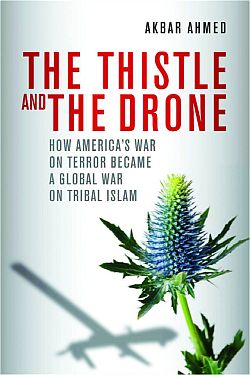
As an anthropologist with deep knowledge and direct experience of tribal systems, Akbar Ahmed demonstrates in The Thistle and the Drone how richly Tolstoy’s thistle metaphor applies to contemporary conditions in regions, distant from urban centers, where clans resist the writ of government while also engaging with it. He points to their “love of freedom” to act without external constraints, as well as

egalitarianism, [and] a tribal lineage system defined by common ancestors and clans, a martial tradition, and a highly developed code of honor and revenge — these are the thistle-like characteristics of the tribal societies…. Moreover, as with the thistle, there is a clear correlation between their prickliness, or toughness, and the level of force used by those who wish to subdue these societies, as the Americans discovered after 9/11.

Ahmed is especially troubled by the use of drones against Muslim tribal groups in Afghanistan, Pakistan, Yemen, and Somalia, but his analysis of the nature of the state and its relation with tribal peoples has application far beyond the condition of Muslim tribal societies. [Continue reading…]

Facebooktwittermail

Malala Yousafzai meets President Obama, asks him to stop drone attacks

Gawker: Malala Yousafzai, the 16-year-old Pakistani woman who was shot in the head by the Taliban for believing that women have a right to education, met with President Obama on Friday, thanking him for his support of education and asking him to stop drone strikes in Pakistan.

Passed over for a Nobel Peace Prize on Friday morning, Yousafzai met with the President, the First Lady, and their 15-year-old daughter, Malia, on Friday afternoon. While thanking the President for his support of education and assistance to Syrian refugees, Yousafzai pressed the President on the issue of drone strikes, a counterterrorism method he supports.

“I thanked President Obama for the United States’ work in supporting education in Pakistan and Afghanistan and for Syrian refugees,” Yousafzai said in a statement after the meeting. “I also expressed my concerns that drone attacks are fueling terrorism. Innocent victims are killed in these acts, and they lead to resentment among the Pakistani people. If we refocus efforts on education it will make a big impact.”

Facebooktwittermail

NSA veterans: The White House is hanging us out to dry

At Foreign Policy (via Matthew Aid) Shane Harris writes: Gen. Keith Alexander and his senior leadership team at the National Security Agency are angry and dispirited by what they see as the White House’s failure to defend the spy agency against criticism of its surveillance programs, according to four people familiar with the NSA chiefs’ thinking. The top brass of the country’s biggest spy agency feels they’ve been left twisting in the wind, abandoned by the White House and left largely to defend themselves in public and in Congress against allegations of unconstitutional spying on Americans.

Former intelligence officials closely aligned with the NSA criticized President Obama for saying little publicly to defend the agency, and for not emphasizing that some leaked or officially disclosed documents arguably show the NSA operating within its legal authorities.

“There has been no support for the agency from the President or his staff or senior administration officials, and this has not gone unnoticed by both senior officials and the rank and file at the Fort,” said Joel Brenner, the NSA’s one-time inspector general, referring to the agency’s headquarters at Ft. Meade, Maryland.

The weak backing from top administration officials has aggravated the relationship between Alexander and the White House, where he has never been warmly embraced. The NSA now finds itself without the strong, visible support of the President at a time of extraordinary political vulnerability, with the agency’s secrets laid bare and its future in doubt. [Continue reading…]

Facebooktwittermail

Obama administration’s Egypt policy is missing in action

Jonathan Guyer writes: In early July, Apache helicopters roamed low above Cairo, an expression of force following the military’s overthrow of President Mohammed Morsi. Early this month, sixteen F16s flew in formation over the city, practicing for the commemoration of the October 1973 war. Since Morsi’s ouster, U.S. military hardware has been a stark feature of Cairo’s skyline. But American policy — the reason for that military aid to Egypt — remains ambiguous.

This week Washington announced a downgrading of aid to Cairo, which flows annually to the tune of $1.3 billion. The U.S. will withhold $260 million in cash funding and halt deliveries of military hardware, as part of a “recalibration” overseen by President Barack Obama. Despite the cuts, most security cooperation persists. In a conference call with journalists on October 9, a senior U.S. official speaking on condition of anonymity said that Washington would “continue assistance that advances our vital security objectives like countering terrorism, countering proliferation, and ensuring security in the Sinai. We will also continue support like military training and education, and will continue spare parts, replacement parts, and related services for the military equipment that we provide.” The freezing of aid was merely a symbolic gesture, and another example that the Obama administration’s Egypt policy is missing in action.

Washington has been unsure of how to address a post-Mubarak Egypt from the get-go. In January 2011, the Obama administration was slow in acknowledging the popular uprising underway in Tahrir Square. In January 2012, Obama’s deputy national security advisor Ben Rhodes told me, “We’re supporting the government as they take steps to implement the transition, and we want to see them follow that road map.” What’s amazing is that nearly two years later, statements from official quarters are equally bereft of substance. Moreover, the U.S. has gone through pains to avoid discussing whether Morsi’s ejection can be called a coup—a word with legal implications for Washington, as U.S. law forbids aid to countries whose elected governments are ousted by the military. My favorite example of such rhetorical acrobatics came from an unnamed U.S. official speaking to the New York Times in July: “We will not say it was a coup, we will not say it was not a coup, we will just not say.” Orwell would scoff at Washington’s reliance on the most “ugly and inaccurate” aspects of the English language. It’s no substitute for strategy. [Continue reading…]

Facebooktwittermail

Egypt surprised by planned U.S. aid cut

The Wall Street Journal reports: Egypt bristled over Washington’s plan to reduce military aid to Egypt, saying the country would consider altering certain agreements with the U.S.

Some accords, such as American ships’ special access to the Suez Canal, should be “adjusted,” said Col. Ahmed Ali, the spokesman for the Egyptian military. “The U.S. is abandoning Egypt as it fights a serious war against terror,” he said. “This is a stance that doesn’t coincide with such a strong, long-standing relationship.”

Col. Ali said he wouldn’t comment further until after talking with Gen. Abdel Fattah Al Sisi, Egypt’s minister of defense and commander of the armed forces, who was informed of the decision by Defense Secretary Chuck Hagel.

The planned cuts come after a weekend in which more than 60 supporters of former President Mohammed Morsi were killed in street-level fights with security services. More than 1,000 Muslim Brotherhood supporters have now been killed by security forces and hundreds more arrested since the military ousted Mr. Morsi on July 3.

The crackdown on the Brotherhood showed no signs of abating on Wednesday, as prosecutors said Mr. Morsi, Egypt’s first-ever freely elected president, would face trial on Nov. 4 for inciting his followers to kill protesters against his rule late last year.

The announcement of the aid censure marks a new low point in the already frosty relationship between the U.S. and Egypt, once one of America’s closest security partners in the Middle East.

It is also emblematic of the shortfalls in U.S. messaging that have left both sides of Egypt’s tense political divide bitter over Washington’s role in the country, said Egyptian diplomats, analysts and policy makers.

The move was unlikely to exert strong pressure on Egypt’s military to abide by human-rights norms, experts say. At the same time, as news of the decision emerged late on Tuesday it reinforced the impression among many Egyptians that the Obama administration was supporting the ousted leadership of the Muslim Brotherhood, while not winning any points with Brotherhood supporters, either.

“What the U.S. is doing is the worst of both worlds right now,” said Shadi Hamid, an Egypt expert and head of research at the Brookings Institution’s Doha Center. “They’re not putting pressure on the military but they’re still going to anger the Egyptian population and make it seem like they’re punishing the military and suspending aid.” [Continue reading…]

Facebooktwittermail

The Obama administration and the press: Leak investigations and surveillance in post-9/11 America

In a report for the Committee to Protect Journalists, Leonard Downie Jr., former editor of the Washington Post, writes: In the Obama administration’s Washington, government officials are increasingly afraid to talk to the press. Those suspected of discussing with reporters anything that the government has classified as secret are subject to investigation, including lie-detector tests and scrutiny of their telephone and e-mail records. An “Insider Threat Program” being implemented in every government department requires all federal employees to help prevent unauthorized disclosures of information by monitoring the behavior of their colleagues.

Six government employees, plus two contractors including Edward Snowden, have been subjects of felony criminal prosecutions since 2009 under the 1917 Espionage Act, accused of leaking classified information to the press — compared with a total of three such prosecutions in all previous U.S. administrations. Still more criminal investigations into leaks are under way. Reporters’ phone logs and e-mails were secretly subpoenaed and seized by the Justice Department in two of the investigations, and a Fox News reporter was accused in an affidavit for one of those subpoenas of being “an aider, abettor and/or conspirator” of an indicted leak defendant, exposing him to possible prosecution for doing his job as a journalist. In another leak case, a New York Times reporter has been ordered to testify against a defendant or go to jail.

Compounding the concerns of journalists and the government officials they contact, news stories based on classified documents obtained from Snowden have revealed extensive surveillance of Americans’ telephone and e-mail traffic by the National Security Agency. Numerous Washington-based journalists told me that officials are reluctant to discuss even unclassified information with them because they fear that leak investigations and government surveillance make it more difficult for reporters to protect them as sources. “I worry now about calling somebody because the contact can be found out through a check of phone records or e-mails,” said veteran national security journalist R. Jeffrey Smith of the Center for Public Integrity, an influential nonprofit government accountability news organization in Washington. “It leaves a digital trail that makes it easier for the government to monitor those contacts,” he said.

“I think we have a real problem,” said New York Times national security reporter Scott Shane. “Most people are deterred by those leaks prosecutions. They’re scared to death. There’s a gray zone between classified and unclassified information, and most sources were in that gray zone. Sources are now afraid to enter that gray zone. It’s having a deterrent effect. If we consider aggressive press coverage of government activities being at the core of American democracy, this tips the balance heavily in favor of the government.”

At the same time, the journalists told me, designated administration spokesmen are often unresponsive or hostile to press inquiries, even when reporters have been sent to them by officials who won’t talk on their own. Despite President Barack Obama’s repeated promise that his administration would be the most open and transparent in American history, reporters and government transparency advocates said they are disappointed by its performance in improving access to the information they need.

“This is the most closed, control freak administration I’ve ever covered,” said David E. Sanger, veteran chief Washington correspondent of The New York Times.

The Obama administration has notably used social media, videos, and its own sophisticated websites to provide the public with administration-generated information about its activities, along with considerable government data useful for consumers and businesses. However, with some exceptions, such as putting the White House visitors’ logs on the whitehouse.gov website and selected declassified documents on the new U.S. Intelligence Community website, it discloses too little of the information most needed by the press and public to hold the administration accountable for its policies and actions. “Government should be transparent,” Obama stated on the White House website, as he has repeatedly in presidential directives. “Transparency promotes accountability and provides information for citizens about what their government is doing.”

But his administration’s actions have too often contradicted Obama’s stated intentions. “Instead,” New York Times public editor Margaret Sullivan wrote earlier this year, “it’s turning out to be the administration of unprecedented secrecy and unprecedented attacks on a free press.”

“President Obama had said that default should be disclosure,” Times reporter Shane told me. “The culture they’ve created is not one that favors disclosure.” [Continue reading…]

Facebooktwittermail

Syrian Electronic Army attacks linked to Obama’s mentions of Syria

Mashable reports: The frequency of attacks that the infamous Syrian Electronic Army carries out may correlate with the number of President Obama’s public statements about Syria and its civil war.

Researchers at Recorded Future, a firm that analyzes publicly available data to assess and predict cyberattacks, call the link a “remarkable correlation.”

To put it simply, the more Obama talks about Syria, the more the Syrian hackers strike American media targets. It’s a full-blown propaganda war.

In fact, when Obama discussed military action in retaliation against the alleged chemical attack in Damascus, the SEA ramped up its campaign against American media, hitting the New York Times, Twitter and others.

After the United States and Russia agreed on a diplomatic solution to the crisis, which requires Syria to destroy its chemical arsenal, the SEA backed off and remained relatively quiet. [Continue reading…]

Facebooktwittermail

Iran readies offer to limit its nuclear program

The Wall Street Journal reports: Iran is preparing a package of proposals to halt production of near-weapons-grade nuclear fuel, a key demand of the U.S. and other global powers, according to officials briefed on diplomacy ahead of talks in Geneva next week.

Tehran in return will request that the U.S. and European Union begin scaling back sanctions that have left it largely frozen out of the international financial system and isolated its oil industry, the officials said.

“The Iranians are preparing to go to Geneva with a serious package,” said a former Western diplomat who has discussed the incentives with senior Iranian diplomats in recent weeks. “These include limits on the numbers of centrifuges operating, enrichment amounts and the need for verification.”

The package from the new government of President Hasan Rouhani could revitalize long-stalled negotiations over Iran’s nuclear program and underpin an emerging diplomatic thaw between Washington and Tehran.

But it also stands to test the unity of the U.S. and other international powers meeting with Iranian diplomats in Geneva in a bid to reach an accord to curtail Iran’s nuclear work.

By falling short of a complete shutdown of enrichment, the anticipated Iranian offer could divide the U.S. from its closest Middle East allies, particularly Israel, Saudi Arabia and the United Arab Emirates, who have cautioned the White House against moving too quickly to improve ties with Tehran, according to American and Mideast officials.

In an opening salvo in the negotiations, Tehran is expected to offer to stop enriching uranium to levels of 20% purity, which international powers consider dangerously close to a weapons-grade capability.

Iran is also expected to offer to open the country’s nuclear facilities to more intrusive international inspections, the officials said. And Iran is considering offering the closure of an underground uranium-enrichment facility near the holy city of Qom, which the U.S. and Israel have charged is part of a covert Iranian weapons program, which Tehran denies. [Continue reading…]

Facebooktwittermail

Saudis brace for ‘nightmare’ of U.S.-Iran rapprochement

Reuters reports: When Saudi Arabia’s veteran foreign minister, Prince Saud al-Faisal, made no annual address to the United Nations General Assembly last week for the first time ever, his unspoken message could hardly have been louder.

For most countries, refusing to give a scheduled speech would count as little more than a diplomatic slap on the wrist, but for staid Saudi Arabia, which prefers backroom politicking to the public arena, it was uncharacteristically forthright.

Engaged in what they see as a life-and-death struggle for the future of the Middle East with arch-rival Iran, Saudi rulers are furious that the international body has taken no action over Syria, where they and Tehran back opposing sides.

Unlike in years past, they are not only angry with permanent Security Council members China and Russia, however, but with the United States, which they believe has repeatedly let down its Arab friends with policies they see as both weak and naive.

Like Washington’s other main Middle Eastern ally, Israel, the Saudis fear that President Barack Obama has in the process allowed mutual enemies to gain an upper hand. [Continue reading…]

Facebooktwittermail

Libyan PM freed after being seized over U.S. raid

Reuters reports: Former rebel gunmen freed Libya’s prime minister on Thursday after holding him for several hours in reprisal for the capture by U.S. forces at the weekend of a Libyan al Qaeda suspect in Tripoli, officials said.

“The prime minister has been released,” a government official confirmed. A security source also said Zeidan was free.

A Reuters journalist outside the Interior Ministry building where the prime minister was held by militiamen linked to the government said people demanding his release had opened fire at one point. Zeidan was seized at dawn from a luxury hotel where he lives under tight security and was held for about six hours.

Two years after a revolution ended Muammar Gaddafi’s 42-year rule, Libya is in turmoil, with its vulnerable central government and nascent armed forces struggling to contain rival tribal militias and Islamist militants who control parts of the country.

The militia, which had been hired by the government to provide security in Tripoli, said it “arrested” Zeidan after U.S. Secretary of State John Kerry said Libya had a role in the weekend capture in the city of Abu Anas al-Liby.

“His arrest comes after … (Kerry) said the Libyan government was aware of the operation,” a spokesman for the group, known as the Operations Room of Libya’s Revolutionaries, told Reuters.

Geoff Porter of North Africa Risk consulting said: “His kidnapping clearly indicates that his government is not cohesive, and that not only is his government not in control of the country, but that he is not in control of his government.” [Continue reading…]

Facebooktwittermail