Category Archives: Obama administration

Hezbollah and the U.S. government — tangled ties to drug cartels

Make of this tangled web, what you will. All I can say is that the key words — ties and links — don’t have a lot of substance.

Lebanon is a small country inside which Hezbollah is the most powerful political organization. To identify a person or a business in Lebanon as having ties to Hezbollah doesn’t say a great deal.

A New York Times report alleges that an investigation of the books of the Lebanese Canadian Bank (LCB) “offer evidence of an intricate global money-laundering apparatus that, with the bank as its hub, appeared to let Hezbollah move huge sums of money into the legitimate financial system, despite sanctions aimed at cutting off its economic lifeblood.”

(The LCB was recently acquired by the Lebanese subsidiary of the major European bank, Societe Generale, which itself happens to have been the largest beneficiary of the U.S. government’s bailout of AIG, receiving $16.5 billion — but that’s a whole other banking story!)

The report says:

While law enforcement agencies around the world have long believed that Hezbollah is a passive beneficiary of contributions from loyalists abroad involved in drug trafficking and a grab bag of other criminal enterprises, intelligence from several countries points to the direct involvement of high-level Hezbollah officials in the South American cocaine trade.

One agent involved in the investigation compared Hezbollah to the Mafia, saying, “They operate like the Gambinos on steroids.”

But once the report goes into details, the substance of the ties to Hezbollah amounts to facts like these: one individual involved turns out to be “a relative of a former Hezbollah commander”; Shiite businessmen, “many of them known Hezbollah supporters,” are involved; and Ayman Joumaa, a Sunni Lebanese hotel owner at the center of the scheme possessed cell phones that “linked him to Shiites in Hezbollah strongholds in southern Lebanon.”

The evidence of the laundering scheme may be strong but the ties to Hezbollah seem a bit sketchy. Moreover, the desire of U.S. officials to tar the Shiite movement is quite explicit.

As the case traveled up the administration’s chain of command beginning in the fall of 2010, some officials proposed leaving the Hezbollah link unsaid. They argued that simply blacklisting the bank would disrupt the network while insulating the United States from suspicions of playing politics, especially amid American alarm about ebbing influence in the Middle East. But the prevailing view was that the case offered what one official called “a great opportunity to dirty up Hezbollah” by pointing out the hypocrisy of the “Party of God” profiting from criminal activity.

If Hezbollah is worried about protecting its reputation, it probably has less to fear from the U.S. government than it does from reactions to its response to the uprising in Syria.

Larbi Sadiki writes:

Faced with the Syrian people’s uprising against President Bashar al-Assad and a democratic tsunami sweeping the Middle East, Hezbollah’s alignment with Mr. Assad is destroying its reputation across the Arab world.

The Syrian masses who once worshiped the Hezbollah leader Hassan Nasrallah today curse him when they parade in public squares. The posters of Mr. Assad and Mr. Nasrallah that once adorned car windows and walls throughout Syria are now regularly torched.

Until recently, Mr. Nasrallah, a Shiite, was a pan-Arab icon. His standing as Hezbollah’s chairman and commander of the 2006 war against Israel elevated him to new heights of popularity among Shiites and Sunnis alike, reminiscent of the former Egyptian president Gamal Abdel Nasser’s political stardom following the nationalization of the Suez Canal in 1956.

Not only did Mr. Nasrallah fight Israel next door; he defied pro-American Arab states, trained and protected Hamas in Lebanon, backed Moktada al-Sadr’s Shiite militia as it killed Americans in Iraq, and showed absolute loyalty to Iran. His fans were in the millions. The Arab multitude from Casablanca to Mecca saw him as a genuine hero who talked the talk and fought the good fight.

But when such a wildly popular resistance movement abandons the ideal, much less the practice, of liberation in support of tyranny, it loses credibility with the public.

Fighting Israel as a Syrian proxy is one thing, but opposing the Syrian people’s desire for democratic change is something else entirely.

The Assads are mortals who are today burdened by a moribund political system. Mr. Assad, his brother Maher and their henchmen have managed to trap themselves in a macabre machine of oppression that has left the stench of death in its wake, from Homs to Hama.

Now, Mr. Nasrallah has reason to worry. In one speech, he defensively denied that his troops partake in repressing Syrian protesters. In another, he ignored the Syrian uprising altogether.

Syrians, in Mr. Nasrallah’s eyes, apparently, do not deserve democracy because that would mean the downfall of Hezbollah’s patron in Damascus, not to mention the destruction of the “axis of resistance” that reaches from southern Beirut to Syria and Iran.

Hezbollah’s fellow “resistance” movement, Hamas, has been more politically savvy. It has adapted to the new political landscape, navigating the uncharted territory of the Syrian uprising by impressing onlookers by what it didn’t do and say rather than what it did or said.

Thanassis Cambanis points out that in spite of the criticisms it currently faces, Hezbollah remains a strong force.

[It] boasts the most formidable militia in the Arab world and commands the undivided loyalty of its core supporters, even if the casual fans are drifting away. For the time being, the movement also can count on Iran’s funding, which is critical for them. Even in the year of the Arab uprisings, Nasrallah scored as the most popular Arab leader on the Annual Arab Public Opinion Survey [PDF] (although some non-Arabs did better; Nasrallah was tied with Iranian President Mahmoud Ahmedinejad and behind Turkey’s leader Recep Tayyip Erdogan).

So Hezbollah is unlikely in the short term to diminish as a player.

And Hezbollah’s unmasking of CIA agents in Lebanon serves as a stark reminder that the Party of God is a force with real tools in its arsenal, not just a rhetorically gifted leader who plays well on television. This week, Al Manar aired the name of a man it claims is the current CIA station chief in Beirut; the agency has replaced top officers in Pakistan twice in the last two years when their names were published.

However dim Hezbollah’s long-term prospects, it will remain a critical player in the short term. And if history is any indicator, it might just find a way to emerge from a self-induced crisis that threatens to consign it to irrelevance — once again — even stronger.

Meanwhile, when it comes to investigating ties to the Mexican drug cartels, the operations of the investigators themselves seem to warrant as much scrutiny as the subjects of their investigations.

Earlier this month, the New York Times reported:

Undercover American narcotics agents have laundered or smuggled millions of dollars in drug proceeds as part of Washington’s expanding role in Mexico’s fight against drug cartels, according to current and former federal law enforcement officials.

The agents, primarily with the Drug Enforcement Administration, have handled shipments of hundreds of thousands of dollars in illegal cash across borders, those officials said, to identify how criminal organizations move their money, where they keep their assets and, most important, who their leaders are.

They said agents had deposited the drug proceeds in accounts designated by traffickers, or in shell accounts set up by agents.

The officials said that while the D.E.A. conducted such operations in other countries, it began doing so in Mexico only in the past few years. The high-risk activities raise delicate questions about the agency’s effectiveness in bringing down drug kingpins, underscore diplomatic concerns about Mexican sovereignty, and blur the line between surveillance and facilitating crime. As it launders drug money, the agency often allows cartels to continue their operations over months or even years before making seizures or arrests.

Agency officials declined to publicly discuss details of their work, citing concerns about compromising their investigations. But Michael S. Vigil, a former senior agency official who is currently working for a private contracting company called Mission Essential Personnel, said, “We tried to make sure there was always close supervision of these operations so that we were accomplishing our objectives, and agents weren’t laundering money for the sake of laundering money.”

Another former agency official, who asked not to be identified speaking publicly about delicate operations, said, “My rule was that if we are going to launder money, we better show results. Otherwise, the D.E.A. could wind up being the largest money launderer in the business, and that money results in violence and deaths.”

Those are precisely the kinds of concerns members of Congress have raised about a gun-smuggling operation known as Fast and Furious, in which agents of the Bureau of Alcohol, Tobacco, Firearms and Explosives allowed people suspected of being low-level smugglers to buy and transport guns across the border in the hope that they would lead to higher-level operatives working for Mexican cartels. After the agency lost track of hundreds of weapons, some later turned up in Mexico; two were found on the United States side of the border where an American Border Patrol agent had been shot to death.

So, the DEA is laundering cartel money and the ATF is providing them with guns. What next? Drug kingpins on the CIA payroll? Oh, I guess that’s just old news.

The CIA — which seems to have been down on its luck recently with officers exposed in Beirut, operatives arrested in Iran and a stealth drone captured by Iran’s Revolutionary Guard — does indeed show up in the Times Lebanon story.

The trail began with a man known as Taliban, overheard on Colombian wiretaps of a Medellín cartel, La Oficina de Envigado. Actually, he was a Lebanese transplant, Chekri Mahmoud Harb, and in June 2007, he met in Bogotá with an undercover agent for the Drug Enforcement Administration and sketched out his route.

Cocaine was shipped by sea to Port Aqaba, Jordan, then smuggled into Syria. After Mr. Harb bragged that he could deliver 950 kilos into Lebanon within hours, the undercover agent casually remarked that he must have Hezbollah connections. Mr. Harb smiled and nodded, the agent reported.

A nod and a smile? This is the kind of detail that’s good for a new report, but it would hardly have any value in a trial. But then again, since this is a case that probably won’t ever reach trial, the political value of the indictment seems to figure more prominently than any likely legal outcome.

(Jordanian officials, after extensive surveillance, later told the D.E.A. that the Syrian leg of the shipment was coordinated by a Syrian intelligence officer assigned as a liaison to Hezbollah. From there, multiple sources reported, Hezbollah operatives charged a tax to guarantee shipments into Lebanon.)

Soon the cartel was giving the agent money to launder: $20 million in all. But before Mr. Harb could reveal the entire scheme and identify his Hezbollah contacts, the operation broke down: The C.I.A., initially skeptical of a Hezbollah link, now wanted in on the case. On the eve of a planned meeting in Jordan, it forced the undercover agent to postpone. His quarry spooked. In the end, Mr. Harb was convicted on federal drug trafficking and money-laundering charges, but the window into the organization’s heart had slammed shut.

Lastly, for a story in which Hezbollah figures so prominently, here’s perhaps the most curious detail about the legal case around which the story revolves: the indictment unveiled by the U.S. Attorney in the Eastern District of Virginia on Tuesday does not mention Hezbollah.


Facebooktwittermail

New evidence that Iran hijacked U.S. stealth drone — updated

Updated: I guess the egg’s on my face this time. Turns out the video the Iranians broadcast (see below) is not an RQ-170 — it’s a Lockheed Polecat on a test flight. (Thanks goes to reader “blowback” for pointing this out.)

As the story about Iran’s capture of an RQ-170 stealth drone continues to unfold, it is the credibility of American officials that keeps on getting shredded.

Here’s the latest from the Associated Press:

Officers in the Revolutionary Guard, Iran’s most powerful military force, have claimed the country’s armed forces brought down the surveillance aircraft with an electronic ambush, causing minimum damage to the drone.

American officials have said that U.S. intelligence assessments indicate that Iran neither shot the drone down, nor used electronic or cybertechnology to force it from the sky. They contend the drone malfunctioned.

Is this how a malfunctioning drone makes a perfect landing on an Iranian airstrip?

President Obama says the U.S. has asked for its drone back. But Iran has no intention of returning it and claims to be in the final stages of extracting data from it according to one lawmaker.

The Washington Post reports:

Parviz Sorouri, a key member of the parliament’s national security and foreign policy committee, told Iranian state television that the extracted information would be used to file a lawsuit against the United States over the “invasion” by the unmanned aircraft.

He asserted that Iran would “soon” start to reproduce the drone after a nearly finished process of reverse engineering was completed. “In the near future, we will be able to mass produce it. . . . Iranian engineers will soon build an aircraft superior to the American [drone] using reverse engineering,” he was quoted as saying.

Sorouri also said the country’s armed forces would soon conduct an exercise on closing the Strait of Hormuz, the narrow waterway between the Gulf of Oman and the oil-rich Persian Gulf.

Noting the strategic importance of the strait, Sorouri said, “We will hold a military maneuver on how to close the Strait of Hormuz soon,” the Iranian Students’ News Agency reported. “If the world wants to make the region insecure, we will make the world insecure.”

Facebooktwittermail

U.S.-Pakistan relations deteriorate

Al Jazeera reports: The US has vacated the Shamsi air base in Pakistan’s Balochistan province after a 15-day ultimatum given by Islamabad, prompted by the deaths of at least 24 of its soldiers in a NATO air raid last month.

Sunday’s withdrawal was completed when the final flight carrying US personnel and equiptment flew out.

Nine planes carrying personnel and 20 carrying equiptment – including drone aircraft and weapons – left for neighbouring Afghanistan, officials said.

Shamsi was believed to be the staging post for US drones operating in northwest Pakistan and neighbouring Afghanistan.

Meanwhile, a senior Pakistani military official told a US television network on Sunday that his country “will shoot down any US drone that enters its territory”.

Al Jazeera’s Kamal Hyder, reporting from Islamabad, said that Pakistani parliamentarians had “asked their air chief whether they had the capability to shoot down the drones if they were to violate their frontiers”.

“The air chief told them point blank that the decision to shoot down the drones was a political one and if they were ordered to do so they would comply,” he said.

Facebooktwittermail

America’s secret terrorist prison system

The New York Times reports: It is the other Guantánamo, an archipelago of federal prisons that stretches across the country, hidden away on back roads. Today, it houses far more men convicted in terrorism cases than the shrunken population of the prison in Cuba that has generated so much debate.

An aggressive prosecution strategy, aimed at prevention as much as punishment, has sent away scores of people. They serve long sentences, often in restrictive, Muslim-majority units, under intensive monitoring by prison officers. Their world is spare.

Among them is Ismail Royer, serving 20 years for helping friends go to an extremist training camp in Pakistan. In a letter from the highest-security prison in the United States, Mr. Royer describes his remarkable neighbors at twice-a-week outdoor exercise sessions, each prisoner alone in his own wire cage under the Colorado sky. “That’s really the only interaction I have with other inmates,” he wrote from the federal Supermax, 100 miles south of Denver.

There is Richard Reid, the shoe bomber, Mr. Royer wrote. Terry Nichols, who conspired to blow up the Oklahoma City federal building. Ahmed Ressam, the would-be “millennium bomber,” who plotted to attack Los Angeles International Airport. And Eric Rudolph, who bombed abortion clinics and the 1996 Summer Olympics in Atlanta.

In recent weeks, Congress has reignited an old debate, with some arguing that only military justice is appropriate for terrorist suspects. But military tribunals have proved excruciatingly slow and imprisonment at Guantánamo hugely costly — $800,000 per inmate a year, compared with $25,000 in federal prison.

The criminal justice system, meanwhile, has absorbed the surge of terrorism cases since 2001 without calamity, and without the international criticism that Guantánamo has attracted for holding prisoners without trial.

Facebooktwittermail

AIPAC posterizes Obama in Senate, 100-0

Philip Weiss writes: If you want to understand the pressure that Obama is under from the Israel lobby, consider this greasy story: Last week three high Obama officials urged Senators not to pass an amendment to the huge Defense Authorization Act that would apply far stiffer sanctions to Iran’s central bank than the Obama administration wanted. Two of the officials went to the Hill, and said the amendment would send oil prices higher, among other damaging effects.

But the Senate rebuffed the administration and voted  unanimously, 100-0, for the sanctions.

Why did the Senate put aside appeals from Treasury secretary Tim Geithner, under secretary of the Treasury David Cohen, and Wendy Sherman, #3 at the State Department, all saying that the bill would be bad for business and bad for the U.S.’s efforts to build a coalition on Iran? Why did John Kerry, chairman of Senate Foreign Relations, acknowledge Tim Geithner’s letter against the legislation, and then vote against his president? 

The clear evidence is: because the lobby wanted this amendment and these guys feared for their political lives. AIPAC led the charge. AIPAC rolled the amendment out 3 weeks ago, and then led a letter-writing campaign to US Senators on the amendment, known as Kirk-Menendez (in part for the Senator from AIPAC, Mark Kirk of Illinois). Here’s the AIPAC memo from last month:

Time is running out to prevent Iran from obtaining sufficient quantities of higher enriched uranium to facilitate a quick breakout to produce a nuclear weapon. Together with like-minded nations, the United States must act quickly and with the full force of our remaining economic tools to prevent such a nightmare scenario. 

The president should immediately designate the CBI [Central Bank of Iran] as a weapons proliferator or terror supporter under Executive Order 13224 or 13338. This designation would prohibit foreign banks with operations in the United States from conducting business with the CBI.

The Jewish Institute for National Security Affairs also applauded the amendment. And the Israeli government tweeted a celebration of the “UNANIMOUS” vote last Thursday.

And AIPAC took its scalp: It promptly organized a campaign to thank the Senators for voting for the sanctions.

Facebooktwittermail

The neocons have finally snapped

M.J. Rosenberg writes: Any doubt we might have that the Israeli right has lost its mind should be eliminated by the latest column from one of its most prominent media figures, Caroline Glick of the Jerusalem Post.

Glick, a dual citizen of the United States and Israel, has flipped out over some remarks (which we’ll get to later) made last week by Secretary of State Hillary Clinton, Secretary of Defense Leon Panetta, and Ambassador to Belgium Howard Gutman. And here is how she explains those remarks.

Her first explanation is that “the Obama administration is an ideological echo chamber in which only certain positions are permitted.”

Restrained by ideological thought police that outlaw critical thought about the dominant forces in the Islamic world today, US officials have little choice but to place all the blame for everything that goes wrong on the one society they are free to criticize — Israel.

That, in itself, borders on hilarious.

Anyone who pays even a modicum of attention to the Middle East knows that rather than “place all the blame for everything” on Israel, the Obama administration blames Israel for nothing while providing more foreign aid to Israel than to any other country, supporting it on every issue at the United Nations — often against America’s own interests — and never, ever attaching any conditions to our aid or support (as we do with every other country in the world).

The only thing President Obama has asked of Israel during his entire term is for a three-month settlement freeze, to which Israel said no. (Prime Minister Netanyahu himself says Obama has earned a “badge of honor” for his uncritical support for Israel.)

Facebooktwittermail

Why Afghans have come to hate Americans

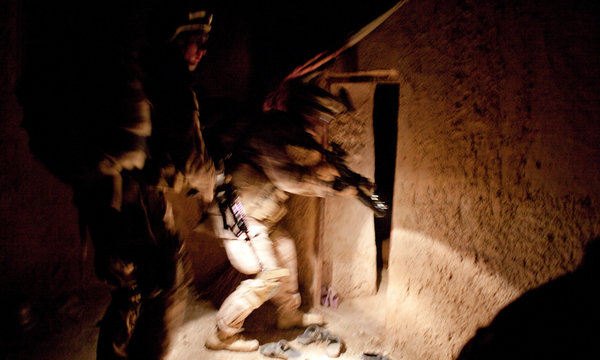
U.S. and Afghan government officials are struggling to reach a strategic long-term agreement — the sticking point is Afghan opposition to night raids which have surged under the Obama administration and now happen as often as 40 times a night.

NATO officials say they have modified how night raids are conducted in response to the Afghan government’s concerns.

“Ninety-five percent of all night operations at this stage are already partnered,” said Brig. Gen. Carsten Jacobson, the NATO spokesman in Afghanistan. “So basically the recommendation of the traditional loya jirga is already put into action.”

“It is in our combined interest that as soon as possible, Afghanization is accomplished,” he added, referring to an Afghan takeover of security responsibility.

Mr. Faizi was unimpressed by that argument. “According to reports from our officials in different provinces, the Afghan security forces are leaving with the American forces to go conduct night operations without being informed directly where they are going, which house they are searching and who is the target,” he said.

While General Jacobson said night raids averaged 10 a night now, a recent study of night raids by the Open Society Foundations, financed by George Soros, estimated that 19 a night were taking place during the first three months of 2011.

The American military is so enamored of the tactic that some generals have said that without night raids, the United States may as well go home.

General Jacobson said that 85 percent of night raids took place without a single shot fired, and that over all such operations accounted for less than one percent of all civilian casualties.

Statistics might calm the doubts of feeble-minded U.S. senators, but they will have little to no impact on the perceptions of Afghans whose homes are being violated. To live in a country where there is an ever-present risk of foreign soldiers breaking into your house in the middle of the night is to live in a state of oppression. This is the nature of occupation.

[Aimal Faizi, the spokesman for President Hamid Karzai,] said the raids were the biggest complaints that Mr. Karzai heard when visitors from the provinces met with him.

“If one of the messages of the United States is to win the hearts and minds of the Afghan people, then these night raids are totally against this,” he said. “People are becoming more and more against the international presence in Afghanistan.”

On the frontlines of southern Helmand Province, the governor of Sangin district, Mohammad Sharif, is a critic of the practice, even though his district has been the center of some of the toughest fighting of the war, with among the highest casualty rates for NATO forces. He said the Special Operations forces that carried out the raids often got the wrong people, including many pro-government people. “People are not happy, and they feel bad toward Americans,” he said.

A high-ranking official in Helmand Province saw the matter differently, although he did not want to be quoted by name endorsing night raids because of their unpopularity. “So many Taliban commanders have been killed or detained in night raids, and if it wasn’t for them, we would not have the peace we now have,” he said. “Taliban commanders are like snakes: it’s hard to catch them, and night raids are their charmers.”

He also noted that trying to arrest a Taliban commander during the day would inevitably mean a battle, which might well cause casualties among bystanders.

Mr. Faizi said the president was concerned that in many cases, Afghan families were forced to give food and shelter to insurgents, and then later were blamed for doing so and arrested. “We think that all these night raids, they bring the conflict directly to the homes of the Afghan people,” he said. “It has to be the opposite, the fight has to be fought somewhere else.”

Facebooktwittermail

The we-are-at-war! mentality

Glenn Greenwald writes: Two significant events happened on Thursday: (1) the Democratic-led Senate rejuvenated and expanded the War on Terror by, among other things, passing a law authorizing military detention on U.S. soil and expanding the formal scope of the War; and (2) Obama lawyers, for the first time, publicly justified the President’s asserted (and seized) power to target U.S. citizens for assassination without any transparency or due process. I wrote extensively about the first episode on Thursday, and now have a question for those supporting the assassination theories just offered by the President’s lawyers.

To pose that question, I’d like to harken back for a moment to the controversy over the Guantanamo detention system. Democrats universally purported to be appalled that the Bush administration was indefinitely imprisoning people without any charges or due process. Barack Obama, as a Senator from Illinois, denounced “the Bush Administration’s attempt to create a legal black hole at Guantanamo” — i.e., that people would be put in cages, possibly forever,with no charges. But Bush lawyers offered a theory for why due-process-free imprisonment was justifiable. The theory had these four fairly simple premises:

(1) Terrorism is not primarily a criminal offense. It is an act of war. Thus: We Are At War With The Terrorists.

(2) Those who try to harm the U.S. as part of this War are combatants and Terrorists — not criminals — and are thus entitled to no due process or any other rights to which accused criminals are entitled. It is the U.S. military (led by the Commander-in-Chief) — not courts — which decides who is and is not a combatant and Terrorist.

(3) Whether someone is a combatant or Terrorist is decided by only one thing: the President’s unilateral decree. Once the President decrees someone a combatant or Terrorist — including one of his own citizens — that person by definition becomes one, and he can then be treated as such without any further judicial process or Constitutional protection. Once that presidential accusatory decree issues, protections of the Constitution and law disappear. In sum, presidential accusations that someone is a Terrorist are the same as proof and a verdict of guilt.

(4) Unlike virtually every other war ever fought, the “battlefield” of this War is not found where opposing forces are shooting at each other, but is rather defined as: wherever an accused Terrorist is found anywhere in the world. Thus, the President’s battlefield powers — which are limitless: unilateral targeting for death, indefinite imprisonment without charges, spying on communications without any oversight – are not confined to any geographical location, but instead can be applied everywhere. Wherever an accused combatant or Terrorist physically exists — sleeping in a bed, riding in a car with his children, thousands of miles away from any actual shooting — is the “battlefield.”

Those were the once-controversial theoretical premises offered repeatedly by Bush lawyers and other defenders to justify the Guantanamo detention system. More generally, these theories were (and remain) the heart and soul of the neocon view of the War on Terror. Once you accept those four premises, there is no coherent way to oppose Guantanamo. So here is my question:

At this point, do Obama defenders reject any of these four premises? I mean this literally: I cannot count how many times I have heard exactly this same theory offered by Obama supporters justifying his assassination powers (the President is entitled to target citizens for death because we are at War, and once you take up arms against the U.S. (meaning: once the President accuses you of doing so) you have no due process rights). Indeed, there simply is no possible way to defend the assassination powers claimed by Obama without embracing each of these theories. And therefore, here is what Obama lawyers said on Thursday:

U.S. citizens are legitimate military targets when they take up arms with al-Qaida, top national security lawyers in the Obama administration said Thursday. The lawyers were asked at a national security conference about the CIA killing of Anwar al-Awlaki, a U.S. citizen and leading al-Qaida figure. . . .

The government lawyers, CIA counsel Stephen Preston and Pentagon counsel Jeh Johnson, did not directly address the al-Awlaki case. But they said U.S. citizens do not have immunity when they are at war with the United States.

Johnson said only the executive branch, not the courts, is equipped to make military battlefield targeting decisions about who qualifies as an enemy.

When Obama lawyers refer to “U.S. citizens who take up arms with al-Qaida,” what they mean is this: those whom the President accuses (in secret, with no due process or evidence presented) of having taken up arms with al-Qaida. When they refer to “battlefield targeting decisions,” they do not mean a place where there is active fighting, but rather: anywhere in the world an accused Terrorist is found (leaving no doubt about that, Johnson decreed that the limits of “battlefield v. non battlefield is a distinction that is growing stale“). In other words: the whole world is the battlefield, a claim Obama officials have long embraced, and someone is a Terrorist the minute the President declares him to be one: the President is the sole judge, the sole jury, and now even the sole executioner.

So my question to defenders of Obama’s assassination powers is this: which of those four core Bush/Cheney War on Terror premises do you reject, if any?

Facebooktwittermail

Senate votes not to vote on indefinite detention on Americans

Adam Serwer writes: Can Americans be indefinitely detained by the military on suspicion of terrorism if arrested on American soil? Thursday evening the Senate added a compromise amendment to the defense spending bill that states: Maybe. Specifically, it says the bill does not alter current authorities relating to detention, leaving either side free to argue whether current law allows or prohibits indefinite military detention of Americans captured in the US.

The compromise amendment passed by a 99-1 after a previous effort by Senator Dianne Feinstein (D-Calif) that would have explicitly prevented the indefinite detention of Americans without trial failed 45-55. Several Democrats joined Republicans in blocking the latter amendment with Republican Senators Mike Lee (R-Utah) Rand Paul (R-Ky) and Mark Kirk (R-Ill) joining most Democrats in voting for Feinstein’s amendment.

The reason the compromise amendment worked is that it leaves the question of domestic military detention open, leaving the matter for Supreme Court to resolve should a future president decide to assert the authority to detain a US citizen on American soil. Senators who defended the detention provisions can continue to say that current law allows Americans to be detained based on the 2004 Hamdi v Rumsfeld case in which an American captured fighting in Afghanistan was held in military detention. Opponents can continue to point out that the Hamdi case doesn’t resolve whether or not Americans can be detained indefinitely without charge if captured in their own country, far from any declared battlefield. They have the better of the argument.

Dahlia Lithwick writes: The detainee language only makes us all safer if you assume that “they” are always guilty whenever the government says so. It’s the job of the courts to decide whether the government is right. Justice Antonin Scalia himself put it this way: “Where the Government accuses a citizen of waging war against it, our constitutional tradition has been to prosecute him in federal court for treason or some other crime. … The very core of liberty secured by our Anglo-Saxon system of separated powers has been freedom from indefinite imprisonment at the will of the Executive.”

One of the two Republican senators to vote for the Udall Amendment yesterday was Sen. Rand Paul, who quoted Thomas Jefferson: “The means of defense against foreign danger historically have become instruments of tyranny at home.” No. Truer. Words. At this moment in America we seem to be so fond of dividing Americans into us and them that we have created all sorts of intriguing new legal double standards for the thems. Don’t think for a minute that these new powers will be used only against suspected terrorists. We already know that suspected illegal immigrants, suspected environmental activists, and suspected protesters have very different legal rights—which is to say, far more limited rights—than anyone else. And as Benjamin Wallace Wells detailed last August, the landmark anti-terror legislation known as the Patriot Act has, in the 10 years since its passage, been used in 1,618 drug cases and 15 terrorism cases. You’d never know it from watching the GOP hopefuls joyfully demonize women, immigrants, the poor, the prisoners, OWS protesters, and union members, but at some point, them always becomes us.

Facebooktwittermail

The undeclared war against Iran

Jeffrey Goldberg often sounds like he’s agitating for war on Iran, but even for impartial observers, there is as he notes, plenty of evidence that the war has already begun.

Following a (perhaps not-so-mysterious) explosion on a military base last month that took with it the life of Gen. Hassan Tehrani Moghaddam — one of the Iranian missile program’s most distinguished OGs — comes news of a second explosion in Isfahan this past Monday, which according to sources “struck the uranium enrichment facility there, despite denials by Tehran.”

Of course, accurate news out of Tehran is hard to come by, but if you want to take this a step further, one might consider Tuesday’s (perhaps not-so-spontaneous) storming of the British embassy by Iranian “students” to be quite an effective smokescreen in keeping news of this second explosion from making serious waves. If you’ve had a lot of coffee, it’s also worthy to note that on Monday evening, following the explosion in Iran, four missiles fired from southern Lebanon struck Israel–the first such incident in over two years.

I’m not entirely convinced, but it’s not unreasonable to group these recent explosions with the Stuxnet virus of last summer that haywired an uranium enrichment facility in Natanz; last October’s explosion at a Shahab missile factory; the killing of three Iranian nuclear scientists in the past two years, last November’s attempted assassination of Fereydoun Abbasi-Davan — a senior official in the nuclear program — and rumblings of a second supervirus deployed this month as proof that the West’s war on Iran’s nuclear program is getting less covert by the minute.

Greg Scoblete spells out why Washington has not and will not seek public support for this war.

If President Obama told the public that America was working with Israel to murder Iranian scientists and blow up Iranian buildings and sabotage Iranian infrastructure and that the Iranians might seek to retaliate in kind, it would implicitly cast Iranian motives as rational.

As we saw in the run up to the Iraq war, one of the key arguments advanced against Saddam Hussein is that he would do something irrational (hand over WMD to al-Qaeda) and hence couldn’t be trusted. Iranian irrationality and religious fanaticism is also a critical component in the case for taking military action against their nuclear program. A key to sustaining the aura of irrationality is to strip out any of the strategic context of Iranian actions.

This is how the Soviet Union handled political dissent: portray your political enemies as insane. Then you can refuse to listen to whatever they say and justify whatever sanction is deemed necessary for their restraint.

Facebooktwittermail

Will the U.S. get dragged into Israel’s next war?

Reuters reports: The top U.S. military officer told Reuters on Wednesday he did not know whether Israel would alert the United States ahead of time if it decided to take military action against Iran.

General Martin Dempsey, the chairman of the Joint Chiefs of Staff, also acknowledged differences in perspective between the United States and Israel over the best way to handle Iran and its nuclear program.

He said the United States was convinced that sanctions and diplomatic pressure was the right path to take on Iran, along with “the stated intent not to take any options off the table” – language that leaves open the possibility of future military action.

“I’m not sure the Israelis share our assessment of that. And because they don’t and because to them this is an existential threat, I think probably that it’s fair to say that our expectations are different right now,” Dempsey said in an interview as he flew to Washington from London.

Asked whether he was talking about the differences between Israeli and U.S. expectations over sanctions, or differences in perspective about the future course of events, Dempsey said: “All of the above.” He did not elaborate.

He also did not disclose whether he believed Israel was prepared to strike Iran.

Meanwhile, Israel’s Defense Minister Ehud Barak told Israel Radio on Thursday: “Israel is a sovereign state and it is the government of Israel, the Israeli army and security forces who are responsible for Israel’s security, future and survival.”

Ali Gharib notes:

Barak reportedly rebuffed U.S. Defense Secretary Leon Panetta last month when Panetta sought assurances that Israel would give the U.S. a heads up if it decided to attack Iran. Barak refused to “give any assurances that Israel would first seek Washington’s permission, or even inform the White House in advance” of an impending attack, according to an unnamed source in the U.K.’s Telegraph newspaper.

So here’s the question Panetta, Dempsey, President Obama, and all the GOP presidential candidates need to answer: In the event that without warning or contrary to U.S. advice, Israel preemptively attacks Iran, will the United States nevertheless be obliged to intervene on Israel’s behalf?

In other words, is the United States a pawn that Israel is free to move whenever it chooses?

Facebooktwittermail

Pakistan to boycott meeting on Afghanistan after NATO strike kills troops

Bloomberg reports: Pakistan stepped up its protests over a NATO airstrike that killed 24 of its soldiers, deciding to boycott an international conference on Afghanistan to be held in Germany next week.

The decision to pull out from the Dec. 5 summit in Bonn was agreed at a meeting of the federal Cabinet yesterday, according to a government statement. The nuclear-armed nation had already closed border crossings to trucks carrying supplies for U.S.-led forces in Afghanistan and ordered American personnel to vacate the Shamsi airbase in Pakistan’s southwest that has served as a launching point for Predator unmanned aircraft.

Pakistan still supports “stability and peace in Afghanistan and the importance of an Afghan-led, Afghan-owned process of reconciliation,” the government said in the statement. “In view of the developments and prevailing circumstances, the country has decided not to participate in the conference.”

The U.S. wants the Bonn meeting to cement a sustained international commitment to stabilize Afghanistan, and prevent any Taliban takeover, following the planned U.S. pullout of its main combat forces by 2014. The U.S. and Afghan governments have said Pakistan’s role is critical as it wields influence with the Taliban and could press the guerrillas for concessions in a peace process.
‘Beyond Rhetoric’

Following the Nov. 25 airstrike, “there’s a lot of domestic pressure in Pakistan that’s forcing the government to move beyond rhetoric,” Shaheen Akhter, an analyst at the Institute of Regional Studies in Islamabad, said yesterday. Still, Pakistan can’t afford “to remain on the sidelines as the international community decides on the future of Afghanistan. They will be back at the table soon.”

The Economist‘s correspondent in Lahore notes: Pakistan’s leaders know the Americans are still deeply dependant on them. In the past few months NATO—and especially the Americans—have done an impressive job of reducing their reliance on land transport corridors through Pakistan to supply Western soldiers in Afghanistan. Over the past 120 days, for example, of the materiel received by the Americans in Afghanistan, around 30% was flown in and 40% was driven over Afghanistan’s northern borders from Central Asia, leaving just 30% to come via Pakistan’s roads. That is a sharp reduction on previous years. Thus the immediate and predictable closing of the Pakistan route, in response to the deaths on the border, should prove less disruptive than it once would have been.

But America relies on Pakistan in other ways. A military base, Shamsi, used by America inside Pakistan, apparently to launch drones, has been ordered closed within 15 days. That may be smoke and mirrors (it was quite possibly no longer used by the Americans anyway, after a previous clash), but is a sign of the sort of co-operation the Americans have quietly enjoyed on Pakistan’s account as they hunted al-Qaeda and other extremist leaders whom Pakistan does not regard as allies. Intelligence co-operation (however flawed) from Pakistan, against individuals plotting attacks on the West will also continue to be crucial in the coming years. Keeping close tabs on Pakistan’s large (perhaps 100-warhead strong) and fast-growing nuclear arsenal is also a long-term priority for the Americans.

Yet America and Pakistan could decide it is better to wind down their relationship to something minimal. A strong cohort within the Pentagon—especially after attacks on America’s embassy in Kabul, in September, by fighters seen as allied with Pakistan—has been demanding direct American military intervention in North Waziristan, possibly including American soldiers on the ground, even if Pakistan’s government opposes the idea. Pakistan is blamed for NATO and Afghan army forces’ failure to defeat the Taliban and other insurgents in Afghanistan, and for the Taliban’s refusal to consider peace talks. American lawmakers have also grown increasingly hostile over civilian and military aid to Pakistan, especially once it appeared that bin Laden had been harboured in Pakistan.

Within Pakistan, a breaking point could be near. One factor may be the rise of Imran Khan, a populist figure who makes a big deal of his opposition to America’s role in the ongoing fighting. As important may be the rise of younger, more religious army officers who are instinctively more anti-American than previous generals. After a year of crises and confrontations, the relationship, though troubled, survives. But the moment when one side or the other decides it is better to cut aid, reduce military co-operation and weaken diplomatic ties is growing nearer.

Facebooktwittermail