The New York Times reports: Iran issued a blunt warning on Tuesday that it would block the Strait of Hormuz, the world’s most important oil transit point, if Western powers attempt to impose an embargo on Iranian petroleum exports in their campaign to isolate the country over its suspect nuclear energy program.
The warning, issued by Vice President Mohammad Reza Rahimi, came as Iran’s naval forces were in the midst of a 10-day war games exercise in a vast area of the Arabian Sea and Gulf of Oman. The Strait of Hormuz, a narrow passage that connects the Gulf of Oman to the Persian Gulf, is the route for one third of the world’s oil-tanker traffic.
“If Iran oil is banned not a single drop of oil will pass through Hormuz Strait,” Mr. Rahimi was quoted as saying by the official Islamic Republic News Agency at a conference in Tehran.
“We are not interested in any hostility,” he was quoted as saying. “Our motto is friendship and brotherhood, but Westerners are not willing to abandon their plots.”
Category Archives: Obama administration
U.S. no longer able to disregard Pakistan’s sovereignty
The New York Times reports: With the United States facing the reality that its broad security partnership with Pakistan is over, American officials are seeking to salvage a more limited counterterrorism alliance that they acknowledge will complicate their ability to launch attacks against extremists and move supplies into Afghanistan.
The United States will be forced to restrict drone strikes, limit the number of its spies and soldiers on the ground and spend more to transport supplies through Pakistan to allied troops in Afghanistan, American and Pakistani officials said. United States aid to Pakistan will also be reduced sharply, they said.
“We’ve closed the chapter on the post-9/11 period,” said a senior United States official, who requested anonymity to avoid antagonizing Pakistani officials. “Pakistan has told us very clearly that they are re-evaluating the entire relationship.”
American officials say that the relationship will endure in some form, but that the contours will not be clear until Pakistan completes its wide-ranging review in the coming weeks.
The Obama administration got a taste of the new terms immediately after an American airstrike killed 26 Pakistani soldiers near the Afghan border last month. Pakistan closed the supply routes into Afghanistan, boycotted a conference in Germany on the future of Afghanistan and forced the United States to shut its drone operations at a base in southwestern Pakistan.
Mushahid Hussain Sayed, the secretary general of the Pakistan Muslim League-Q, an opposition political party, summed up the anger that he said many harbored: “We feel like the U.S. treats Pakistan like a rainy-day girlfriend.”
Whatever emerges will be a shadow of the sweeping strategic relationship that Richard C. Holbrooke, President Obama’s special envoy for Afghanistan and Pakistan, championed before his death a year ago. Officials from both countries filled more than a dozen committees to work on issues like health, the rule of law and economic development.
All of that has been abandoned and will most likely be replaced by a much narrower set of agreements on core priorities — countering terrorists, stabilizing Afghanistan and ensuring the safety of Pakistan’s arsenal of more than 100 nuclear weapons — that Pakistan will want spelled out in writing and agreed to in advance.
With American diplomats essentially waiting quietly and Central Intelligence Agency drone strikes on hold since Nov. 16 — the longest pause since 2008 — Pakistan’s government is drawing up what Prime Minister Yousaf Raza Gilani called “red lines” for a new relationship that protects his country’s sovereignty and territorial integrity.
Said an American official: “Both countries recognize the benefits of partnering against common threats, but those must be balanced against national interests as well. The balancing is a continuous process.”
First, officials said, will likely be a series of step-by-step agreements on military cooperation, intelligence sharing and counterterrorism operations, including revamped “kill boxes,” the term for flight zones over Pakistan’s largely ungoverned borderlands where C.I.A. drones will be allowed to hunt a shrinking number of Al Qaeda leaders and other militants.
The C.I.A. has conducted 64 missile attacks in Pakistan using drones this year, compared with 117 last year and 53 in 2009, according to The Long War Journal, a Web site that tracks the strikes.
In one of the most visible signs of rising anti-American sentiment in this country, tens of thousands of protesters took to the streets of Lahore and Peshawar this month. And on Sunday in Karachi, Pakistan’s biggest city, at least 100,000 people rallied to support Imran Khan, a cricket celebrity and rising opposition politician who is outspoken in his criticism of the drone strikes and ties with the United States.
The supposed threat posed by Imran Khan is nothing more than the danger that Pakistan might get a government that was more loyal to the will of the Pakistani people than its paymasters in Washington. Khan’s promise, if his party was to gain power, is to purge the country of corruption. Those who regard him as a threat must presumably see corruption as their friend.
The year secrecy jumped the shark
Electronic Frontier Foundation notes a few of the examples in which the Obama administration has pushed secrecy to absurd degrees in 2011:
- Government report concludes the government classified 77 million documents in 2010, a 40% increase on the year before. The number of people with security clearances exceeded 4.2. million, more people than the city of Los Angeles.
- Government tells Air Force families, including their kids, it’s illegal to read WikiLeaks. The month before, the Air Force barred its service members fighting abroad from reading the New York Times—the country’s Paper of Record.
- Lawyers for Guantanamo detainees were barred from reading the WikiLeaks Guantanamo files, despite their contents being plastered on the front page of the New York Times.
- President Obama refuses to say the words “drone” or “C.I.A” despite the C.I.A. drone program being on the front pages of the nation’s newspapers every day.
- CIA refuses to release even a single passage from its center studying global warming, claiming it would damage national security. As Secrecy News’ Steven Aftergood said, “That’s a familiar song, and it became tiresome long ago.”
- The CIA demands former FBI agent Ali Soufan censor his book criticizing the CIA’s post 9/11 interrogation tactics of terrorism suspects. Much of the material, according to the New York Times, “has previously been disclosed in open Congressional hearings, the report of the national commission on 9/11 and even the 2007 memoir of George J. Tenet, the former C.I.A. director.”
- Department of Homeland Security has become so bloated with secrecy that even the “office’s budget, including how many employees and contractors it has, is classified,” according to the Center for Investigative reporting. Yet their intelligence reports “produce almost nothing you can’t find on Google,” said a former undersecretary.
- Headline from the Wall Street Journal in September: “Anonymous US officials push open government.”
Lawrence Wilkerson on the strategic implications of the ‘end’ of the war in Iraq
Should Bradley Manning be on trial?
With indefinite detention bill, has Congress also expanded rendition of U.S. citizens abroad?
Drone warfare and the stress induced by premeditated murder
A recent study by the U.S. Air Force School of Aerospace Medicine assessed the level of stress involved in remote warfare being conducted by Air Force drone operators. The New York Times reports:
4 percent or less of operators were at high risk of developing post-traumatic stress disorder, the severe anxiety disorder that can include flashbacks, nightmares, anger, hypervigilance or avoidance of people, places or situations. In those cases, the authors suggested, the operators had seen close-up video of what the military calls collateral damage, casualties of women, children or other civilians. “Collateral damage is unnerving or unsettling to these guys,” Colonel McDonald said.
The percentage of troops returning from Iraq and Afghanistan at risk of developing post-traumatic stress disorder was 12 to 17 percent, the authors said.
In contrast to nearly half of drone operators’ reporting “high operational stress,” 36 percent of a control group of 600 Air Force members in logistics or support jobs reported stress. The Air Force did not compare the stress levels of the drone operators with military pilots who fly planes in the air.
The biggest sources of stress for drone operators remained long hours and frequent shift changes because of staff shortages.
Glenn Greenwald comments:
[A]t least some of these drone pilots have enough of a conscience to be seriously disturbed by the horrific results of these strikes. If only the general citizenry — who are typically kept blissfully unaware of the human devastation their government is causing — were as affected.
But to suggest that a measure of conscience is the way these pilots react to the unintended effects of their actions, doesn’t really say much about what is going on here.
In a recent edition of “The Stream” on Al Jazeera, former CentCom spokesman Josh Rushing, made these observations. (Watch the following video from 20min 22 sec till 21min 22sec.)
As unprecedented as it might seem for a killer to so closely study his target, this really isn’t new. Indeed, there is a commonly used term we associate with this kind of planning: premeditation.
Murder of the worst kind involves cold calculation and emotional detachment. The idea that a drone operator might end up with PTSD simply as a result of seeing innocent people get killed, ignores the effect of his spending hours or days anticipating an intentional killing.
The military precursor of the drone operator is the sniper and the non-military correlate of both is the hitman.
Randall Collins notes that inside the military, the sniper stands apart.
Snipers tend to be disliked even by their fellow soldiers, or at least regarded with uneasiness. A British sniper officer in World War I noted that infantrymen did not like to mingle with the snipers “for there was something about them that set them apart from ordinary men and made the soldiers uncomfortable”… World War II soldiers sometimes jeered at them. U.S. snipers in Vietnam were met with the comment: “Here comes Murder Incorporated.”
Josh Rushing notes that the Pentagon’s shift in favor of remote warfare is a reflection of a political reality: that if Americans are not taxed to support this country’s wars, and if wars can be fought without American soldiers getting killed, then Washington faces few political constraints in starting new wars about which the public will show little interest.
The Air Force is now recruiting more drone pilots than fighter and bomber pilots combined, but the continued success in recruitment requires that the job of these armchair pilots be glamorized and tied into a traditional warfighting culture. Hence the creation of commercials like this:
But note the irony: the stated target in this portrayal of 21st century warfare is the “enemy sniper” and the role of the drone pilot is to protect ordinary American soldiers.
In the battlefields that the Pentagon prefers however, there are no American soldiers, death comes by decree and those getting killed — however they might be labelled — are utterly defenseless.
Don’t stop at Iraq: Why the U.S. should withdraw from the entire Persian Gulf
Toby C. Jones writes: The U.S. is finally drawing down its military presence from Iraq, but why stop there? Why not reduce or outright remove our military presence from the entire Persian Gulf? The U.S. has been waging war in the Gulf for more than two and a half decades, since it took up arms against in Iran in the closing stages of the Iran-Iraq war. The human and environmental costs have been catastrophic. The presumptive gains of what has amounted to one long war have proven elusive at best. More often that not, the justifications for war have been either ill-conceived or manufactured. The Persian Gulf today is hardly stable or secure. But permanent war, and our militarization of the Gulf, isn’t so much a reflection of regional instability as it is the cause.
Today, it’s still not clear what the United States’ strategic priorities are in the Gulf. Are we there to secure access to oil? Protect friendly regimes from unfriendly ones? American policymaking is muddled, a combination of concern about energy security, Iranian aggression, and terrorism. This uncertainty is perilous. And the reality is that none of these challenges really require a significant military presence. Indeed, if recent history is any guide, a large military footprint in the Gulf will generate more rather than less risk.
Historically, oil and “energy security” have been at the heart of American strategy in the Gulf. It is home to the richest oil and natural gas deposits on the planet. It was President Jimmy Carter who most clearly made protecting the flow of oil to global markets a national priority. Carter declared oil a “vital interest” and that any assault on it would “be repelled by any means necessary, including military force.” Protecting oil meant protecting its producers. Indeed, much of the war-fighting of the last two decades has been rationalized as necessary to defend Kuwait and Saudi Arabia, and their oil, from neighborhood threats. The economic logic that has underpinned all this is based mostly on an assumption that oil is a scarce resource, that there is a tight gap between supply and demand, that ensuring supply is essential to stabilize prices and to protect the global economy from potentially devastating disruptions.
None of that is really true. For most of the 20th century, oil companies and oil producing states regularly collaborated to regulate supply in order to limit competition and control prices. There never has been a global oil market. Instead, oil’s production and delivery has been managed by a small network of corporate and national energy elites, whose primary concern has been serving their own interests and maintaining their bottom line.
Obama and the rule of law
Jeff Connaughton writes: Long silent and now contradictory, President Obama needs to deliver a clarifying speech about our financial markets and the rule of law. Speaking in Kansas on December 6, he said, “Too often, we’ve seen Wall Street firms violating major anti-fraud laws because the penalties are too weak and there’s no price for being a repeat offender.” Just five days later on 60 Minutes, he said, “Some of the least ethical behavior on Wall Street wasn’t illegal.” Which is it? Have there been no prosecutions because Wall Street acted legally (albeit unethically)? Or did Wall Street repeatedly violate major anti-fraud laws (and should thus find itself in the dock)?
The President is confusing “legal” with “difficult to prosecute successfully.” The Justice Department’s repeated decisions not to risk losing at trial against Wall Street executives don’t make these person’s actions legal. (If a district attorney can’t prove the actual thief stole your wallet, that doesn’t make stealing legal. It simply means that, regrettably, a malefactor goes unpunished.) As Securities and Exchange Commission Enforcement Director Robert Khuzami said in Senate testimony in 2009, Wall Street perpetrators “are smart people who understand that they are crossing the line” and “are plotting their defense at the same time they’re committing their crime.”
Moreover, the President is misleading us when he says that Wall Street firms violate anti-fraud law because the penalties are too weak. Repeat financial fraudsters don’t pay relatively paltry — and therefore painless — penalties because of statutory caps on such penalties. Rather, regulatory officials, appointed by Obama, negotiated these comparatively trifling fines. This week, the F.D.I.C. settled a suit against Washington Mutual officials for just $64 million, an amount that will be covered mostly by insurance policies WaMu took out on behalf of executives, who themselves will pay just $400,000. And recently a federal judge rejected the S.E.C.’s latest settlement with Citigroup, an action even the Wall Street Journal called “a rebuke of the cozy relationship between regulators and the regulated that too often leaves justice as an orphan.”
The Obama Justice Department hasn’t tried a single Wall Street executive in a criminal court. Against a handful, it decided to let the S.E.C. bring civil charges of fraud, which are easier to prove. So if defendants’ wrists are merely being slapped by the S.E.C. instead of cuffed by the Justice Department, Obama has only his appointees to blame.
For three important reasons, the President needs to explain why the Justice Department has filed away its investigations of big banks and Wall Street firms without indicting anyone. First, American confidence in the system is deeply shaken. Second, it strains credulity for millions of Americans — and has impelled thousands of them to occupy public places in protest — that no banking or insurance executive deserves criminal prosecution for the actions that brought on the financial crisis. Third, by failing to prosecute a single high-profile Wall Street actor today, the Administration is failing to deter financial fraud tomorrow.
The secret program empowering Obama to kill anyone, anywhere, without any explanation
The Washington Post reports: Since September, at least 60 people have died in 14 reported CIA drone strikes in Pakistan’s tribal regions. The Obama administration has named only one of the dead, hailing the elimination of Janbaz Zadran, a top official in the Haqqani insurgent network, as a counterterrorism victory.
The identities of the rest remain classified, as does the existence of the drone program itself. Because the names of the dead and the threat they were believed to pose are secret, it is impossible for anyone without access to U.S. intelligence to assess whether the deaths were justified.
The administration has said that its covert, targeted killings with remote-controlled aircraft in Pakistan, Yemen, Somalia and potentially beyond are proper under both domestic and international law. It has said that the targets are chosen under strict criteria, with rigorous internal oversight.
It has parried reports of collateral damage and the alleged killing of innocents by saying that drones, with their surveillance capabilities and precision missiles, result in far fewer mistakes than less sophisticated weapons.
Yet in carrying out hundreds of strikes over three years — resulting in an estimated 1,350 to 2,250 deaths in Pakistan — it has provided virtually no details to support those assertions.
In outlining its legal reasoning, the administration has cited broad congressional authorizations and presidential approvals, the international laws of war and the right to self-defense. But it has not offered the American public, uneasy allies or international authorities any specifics that would make it possible to judge how it is applying those laws. [Continue reading…]
Time for U.S. policy shift on North Korea
Obama administration considers censoring Twitter
How dangerous can 140 characters be?
Apparently if those 140 characters are being fired onto the web through the Twitter account of al Shabib, Somalia’s militant jihadist movement, then the national security of the United States could be in jeopardy.
The New York Times reports:
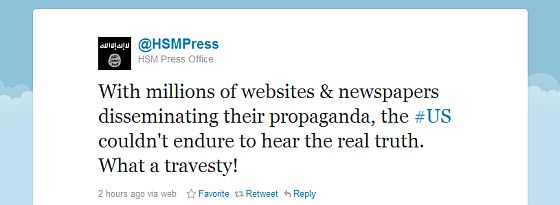
American officials say they may have the legal authority to demand that Twitter close the Shabab’s account, @HSMPress, which had more than 4,600 followers as of Monday night.
The most immediate effect of the Obama administration’s threat appears to have been that @HSMPress (which has so far only made 114 tweets) has subsequently gained hundreds of new followers.
Is Twitter itself about to take a stand in defense of freedom of speech?
A company spokesman, Matt Graves, said [to a Times reporter] on Monday, “I appreciate your offer for Twitter to provide perspective for the story, but we are declining comment on this one.”
Last Wednesday, the New York Times reported from Nairobi in Kenya:
Somalia’s powerful Islamist insurgents, the Shabab, best known for chopping off hands and starving their own people, just opened a Twitter account, and in the past week they have been writing up a storm, bragging about recent attacks and taunting their enemies.
“Your inexperienced boys flee from confrontation & flinch in the face of death,” the Shabab wrote in a post to the Kenyan Army.
It is an odd, almost downright hypocritical move from brutal militants in one of world’s most broken-down countries, where millions of people do not have enough food to eat, let alone a laptop. The Shabab have vehemently rejected Western practices — banning Western music, movies, haircuts and bras, and even blocking Western aid for famine victims, all in the name of their brand of puritanical Islam — only to embrace Twitter, one of the icons of a modern, networked society.
On top of that, the Shabab clearly have their hands full right now, facing thousands of African Union peacekeepers, the Kenyan military, the Ethiopian military and the occasional American drone strike all at the same time.
But terrorism experts say that Twitter terrorism is part of an emerging trend and that several other Qaeda franchises — a few years ago the Shabab pledged allegiance to Al Qaeda — are increasingly using social media like Facebook, MySpace, YouTube and Twitter. The Qaeda branch in Yemen has proved especially adept at disseminating teachings and commentary through several different social media networks.
“Social media has helped terrorist groups recruit individuals, fund-raise and distribute propaganda more efficiently than they have in the past,” said Seth G. Jones, a political scientist at the RAND Corporation.
The Times reporter, Jeffrey Gettleman, sounds quite indignant that al Shabib should have the audacity to be using Twitter, so he can hardly have been surprised that his article prompted this exchange between @HSMPress and one of their followers:
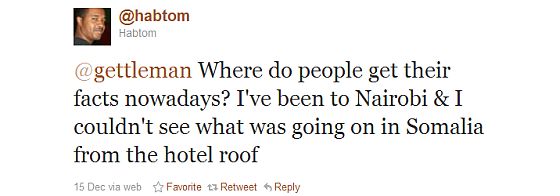
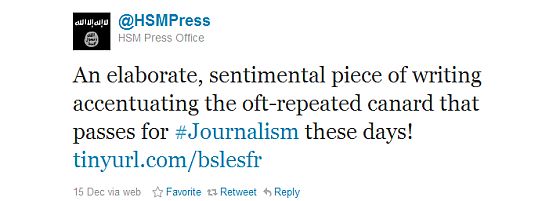
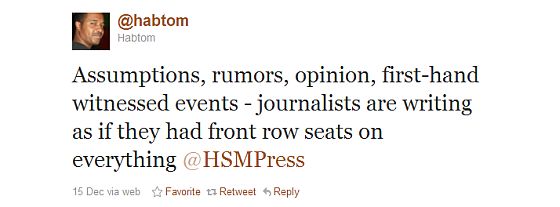
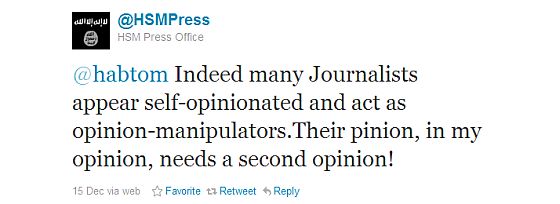
Somalia is not the only front in the new war on Twitter.
The Washington Post reports on Twitter battles in Afghanistan:
U.S. military officials assigned to the International Security Assistance Force, or ISAF, as the coalition is known, took the first shot in what has become a near-daily battle waged with broadsides that must be kept to 140 characters.
“How much longer will terrorists put innocent Afghans in harm’s way,” @isafmedia demanded of the Taliban spokesman on the second day of the embassy attack, in which militants lobbed rockets and sprayed gunfire from a building under construction.
“I dnt knw. U hve bn pttng thm n ‘harm’s way’ fr da pst 10 yrs. Razd whole vilgs n mrkts. n stil hv da nrve to tlk bout ‘harm’s way,’ ” responded Abdulqahar Balkhi, one of the Taliban’s Twitter warriors, who uses the handle @ABalkhi….
U.S. military officials say the dramatic assault on the diplomatic compound convinced them that they needed to seize the propaganda initiative — and that in Twitter, they had a tool at hand that could shape the narrative much more quickly than news releases or responses to individual queries.
“That was the day ISAF turned the page from being passive,” said Navy Lt. Cmdr. Brian Badura, a military spokesman, explaining how @isafmedia evolved after the attack. “It used to be a tool to regurgitate the company line. We’ve turned it into what it can be.”
So how’s @isafmedia exploiting the power of Twitter? With tweets like this?
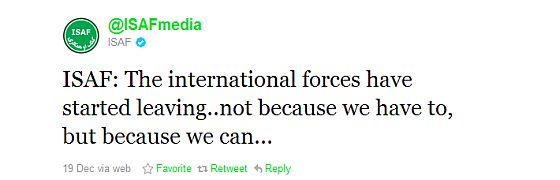
A we’re-winning-the-war tweet like this might sound good inside ISAF’s Twitter Command Center, but I don’t think it’s going to impress anyone else.
The problem the Obama administration is up against is not the threat posed by its adversaries on Twitter; it is that its own ventures into social media are predictably inept. Official tweets lack wit and tend to sound like the clumsy propaganda. But when losing an argument, the solution is not to look for ways to gag your opponent — that’s how dictators operate.
The Pentagon prides itself on its smart bombs. Can’t it come up with a few smart tweets?

Secret U.S., Taliban talks reach turning point
Reuters reports: After 10 months of secret dialogue with Afghanistan’s Taliban insurgents, senior U.S. officials say the talks have reached a critical juncture and they will soon know whether a breakthrough is possible, leading to peace talks whose ultimate goal is to end the Afghan war.
As part of the accelerating, high-stakes diplomacy, Reuters has learned, the United States is considering the transfer of an unspecified number of Taliban prisoners from the Guantanamo Bay military prison into Afghan government custody.
It has asked representatives of the Taliban to match that confidence-building measure with some of their own. Those could include a denunciation of international terrorism and a public willingness to enter formal political talks with the government headed by Afghan President Hamid Karzai.
The officials acknowledged that the Afghanistan diplomacy, which has reached a delicate stage in recent weeks, remains a long shot. Among the complications: U.S. troops are drawing down and will be mostly gone by the end of 2014, potentially reducing the incentive for the Taliban to negotiate.
Still, the senior officials, all of whom insisted on anonymity to share new details of the mostly secret effort, suggested it has been a much larger piece of President Barack Obama’s Afghanistan policy than is publicly known.
U.S. officials have held about half a dozen meetings with their insurgent contacts, mostly in Germany and Doha with representatives of Mullah Omar, leader of the Taliban’s Quetta Shura, the officials said.
The stakes in the diplomatic effort could not be higher. Failure would likely condemn Afghanistan to continued conflict, perhaps even civil war, after NATO troops finish turning security over to Karzai’s weak government by the end of 2014.
Success would mean a political end to the war and the possibility that parts of the Taliban – some hardliners seem likely to reject the talks – could be reconciled.
The effort is now at a pivot point.
“We imagine that we’re on the edge of passing into the next phase. Which is actually deciding that we’ve got a viable channel and being in a position to deliver” on mutual confidence-building measures, said a senior U.S. official.
While some U.S.-Taliban contacts have been previously reported, the extent of the underlying diplomacy and the possible prisoner transfer have not been made public until now.
How the U.S. is helping crush Bahrain’s pro-democracy movement
Nicholas Kristof writes: When President Obama decides soon whether to approve a $53 million arms sale to our close but despotic ally Bahrain, he must weigh the fact that America has a major naval base here and that Bahrain is a moderate, modernizing bulwark against Iran.
Yet he should also understand the systematic, violent repression here, the kind that apparently killed a 14-year-old boy, Ali al-Sheikh, and continues to torment his family.
Ali grew up here in Sitra, a collection of poor villages far from the gleaming bank towers of Bahrain’s skyline. Almost every day pro-democracy protests still bubble up in Sitra, and even when they are completely peaceful they are crushed with a barrage of American-made tear gas.
People here admire much about America and welcomed me into their homes, but there is also anger that the tear gas shells that they sweep off the streets each morning are made by a Pennsylvania company, NonLethal Technologies. It is a private company that declined to comment, but the American government grants it a license for these exports — and every shell fired undermines our image.
In August, Ali joined one of the protests. A policeman fired a shell at Ali from less than 15 feet away, according to the account of the family and human-rights groups. The shell apparently hit the boy in the back of the neck, and he died almost immediately, a couple of minutes’ walk from his home.

NonLethal Technologies, Inc., Homer City, Pennsylvania
Big Oil and Canada thwarted U.S. carbon standards
Salon reports: When President Barack Obama decided in early November to delay a decision on TransCanada’s Keystone XL pipeline until after the next election, America’s environmental movement celebrated one of its biggest victories in recent memory. And no doubt the news came as a blow to Alberta’s tar sands industry, and to Canada’s oft-stated dream of becoming the next global energy superpower.
But behind activists’ jubilation lurked a somber reality, an untold story with much wider implications. The broader fight to reform Alberta’s tar sands, the one which actually stood a chance of breaking America’s addiction to the continent’s most polluting road fuel, has been quietly abandoned over the past several years. For that we can thank the planet’s richest oil companies and their Canadian government allies, who’ve together waged a stealthy war against President Obama’s climate change ambitions.
Their battle-plan is revealed in more 300 pages of personal emails obtained through a Freedom of Information request to the Alberta government. The story in the emails, reported for the first time here in Salon and The Tyee, Canada’s leading independent online news site, traces a year in the relationship of Michael Whatley, a GOP-connected oil industry lobbyist and his friend, Gary Mar, a smooth-talking and ambitious diplomat at the Canadian embassy in the Washington, DC.
The messages lay bare a sophisticated and stealthy public relations offensive, one designed to manipulate the U.S. political system; to deluge the media with messages favorable to the tar-sands industry; to sway key legislators at state and federal levels; and most importantly, to defeat any attempt to make the gasoline and diesel pumped everyday into U.S. vehicles less damaging to the climate. The goal of it all? “Defeat” Obama’s effort to reduce carbon consumption and keep America hooked on Canada’s $441 billion tar sands industry, no matter what the cost to our planet’s future.
That campaign has largely succeeded too, with only a small group of players any the wiser.
Reuters reports: Environmental opponents of the Keystone XL tar sands pipeline aimed to deluge the White House and Congress with phone calls on Friday, slamming a Republican plan to speed approval of the project in exchange for extending a payroll tax cut.
“Red alert – call the White House and tell them not to back down to big oil on Keystone,” environmental activist Bill McKibben said in a tweet. McKibben mobilized some 10,000 demonstrators outside the White House earlier this year to protest the pipeline.
A spokesman for Friends of the Earth said a call for grassroots opposition to the deal generated more than 10,000 phone calls to U.S. senators on Friday.
“We are surprised at the extent to which the Republicans have decided to go to bat for Big Oil here,” said Nick Berning, a spokesman for the group. “We’re urging the Democrats to stand strong with the position they’ve articulated and not to cave.”
House Republicans warned last week they planned to include approval of the Keystone pipeline to a payroll tax cut bill, a challenge to President Barack Obama, who has said he would veto such a bill if the pipeline deal is part of it.
But on Friday, a White House spokesman left open the possibility that Obama might consider approving the legislation to get the extended tax cut.
US-made tear gas becomes fatal ingredient of protests
Joseph Dana writes: Residents of Nabi Saleh in the West Bank have been demonstrating, each week for the past two years, against the slow encroachment on their land by Israeli settlers.
Gathering in the village centre on Friday afternoons, villagers along with Israeli and international activists attempt to march, under the watchful eye of soldiers, to a disputed agricultural spring which was confiscated recently by Israeli settlers.
Often protesters never even reach the edge of the village; crowd-control measures by the military regularly include barrages of tear gas and rubber bullets.
Palestinian villagers claim that hundreds of protesters have been injured, some seriously, in the Nabi Saleh demonstrations.
But no one had been killed there – until last week.
The death of 28-year-old Mustafa Tamimi may seem to have little in common with the more numerous deaths of protesters in Cairo over the past few days.
Indeed the demonstrations are different from each other in many ways. But in protests from Tunis to Cairo to little Nabi Saleh, the use of tear gas by authorities, and the increasing number of related fatalities, has become a common thread in recent months.
Iran says its delayed news of U.S. drone capture
The Associated Press reports: Iran deliberately delayed its announcement that it had captured an American surveillance drone to test U.S. reaction, the country’s foreign minister said Saturday.
Ali Akbar Salehi said Tehran finally went public with its possession of the RQ-170 Sentinel stealth drone to disprove contradictory statements from U.S. officials.
Iran, which put the aircraft on display last week, has tried to trumpet the downing of the drone as a feat of Iran’s military in a complicated technological and intelligence battle with the U.S. Tehran also has rejected a formal U.S. request to return the plane, calling it’s incursion an “invasion” and a “hostile act.”
“When our armed forces nicely brought down the stealth American surveillance drone, we didn’t announce it for several days to see what the other party (U.S.) says and to test their reaction,” Salehi told the official IRNA news agency. “Days after Americans made contradictory statements, our friends at the armed forces put this drone on display.”