Category Archives: Obama administration

Obama’s folly

Obama’s folly

Through war, Bush set out to transform the greater Middle East. Despite immense expenditures of blood and treasure, that effort failed. In choosing Obama rather than John McCain to succeed Bush, the American people acknowledged that failure as definitive. Obama’s election was to mark a new beginning, an opportunity to “reset” America’s approach to the world.

The president’s chosen course of action for Afghanistan suggests he may well squander that opportunity. Rather than renouncing Bush’s legacy, Obama apparently aims to salvage something of value. In Afghanistan, he will expend yet more blood and more treasure hoping to attenuate or at least paper over the wreckage left over from the Bush era.

However improbable, Obama thereby finds himself following in the footsteps of Richard Nixon. Running for president in 1968, Nixon promised to end the Vietnam War. Once elected, he balked at doing so. Obsessed with projecting an image of toughness and resolve — U.S. credibility was supposedly on the line — Nixon chose to extend and even to expand that war. Apart from driving up the costs that Americans were called on to pay, this accomplished nothing. [continued…]

President Obama’s secret: only 100 al Qaeda now in Afghanistan

As he justified sending 30,000 more troops to Afghanistan at a cost of $30 billion a year, President Barack Obama’s description Tuesday of the al Qaeda “cancer” in that country left out one key fact: U.S. intelligence officials have concluded there are only about 100 al Qaeda fighters in the entire country.

A senior U.S. intelligence official told ABCNews.com the approximate estimate of 100 al Qaeda members left in Afghanistan reflects the conclusion of American intelligence agencies and the Defense Department. The relatively small number was part of the intelligence passed on to the White House as President Obama conducted his deliberations. [continued…]

Brzezinski calls anti-corruption crusade in Afghanistan hypocritical

One of the most respected foreign policy voices in Democratic circles expressed “serious reservations” with components of a U.S. troop escalation in Afghanistan during an interview on Tuesday.

Former national security adviser Zbigniew Brzezinski, who was an early skeptic about increasing troops in Afghanistan, said he was not necessarily opposed to Obama’s decision to send an additional 30,000 troops there. But he stressed that the mission had to be defined properly.

For starters, he argued that if America’s military efforts lack a sufficient multilateral component, “it will in fact help to feed the insurgency.” Brzezinski also cautioned that it would be hypocritical and counterproductive for America to stress that Afghan President Hamid Karzai’s government be purged of corruption. [continued…]

Facebooktwittermail

US strategy in Afghanistan

Something from nothing

McChrystal’s announcements of new rules of engagement were part of a larger change of strategy in the eight-year-old war: a move to counterinsurgency (COIN).

In March 2009 the Obama administration gave itself one year to “shift the momentum” in the war—meaning, to stop losing. Three months later, Defense Secretary Robert Gates asked for McKiernan’s resignation. He was replaced by McChrystal, who, in late August, recommended increasing U.S.-troop deployment by 40,000 and implementing a COIN strategy. In his December 1 speech at West Point, Obama did not give McChrystal everything he asked for, but he largely embraced McChrystal’s analysis and fully accepted his COIN recommendations.

More than a specific code of action, COIN is about priorities. In a population-centric counterinsurgency campaign, the chief priority is protecting the population, not killing the enemy. The idea is to win over the people with security and services attentive to local needs, thereby depriving insurgents of popular support, dividing them from the people, and eventually affording an opportunity to kill or “reconcile” them.

In a near-fanatical fight for influence, proponents of COIN spent much of the past decade exhorting the U.S. military and government to embrace the strategy in the global war on terrorism. COIN shaped the “Surge” in Iraq in 2007, and its alleged success in reducing violence earned its military proponents a dominant role in strategic thinking. COIN’s biggest proponent is General David Petraeus, who is credited with designing the Surge and now oversees the wars in Iraq and Afghanistan as head of Central Command. Petraeus coauthored the latest edition of The U.S. Army/Marine Corps Counterinsurgency Field Manual, a seminal book in the COIN community. The Field Manual cites the view of “General Chang Ting-chen of Mao Zedong’s central committee . . . that revolutionary war was 80 percent political action and only 20 percent military.” According to the Field Manual, “such an assertion is arguable and certainly depends on the insurgency’s stage of development; it does, however, capture the fact that political factors have primacy in COIN” (emphasis added).

The team of ‘experts’ who advised McChrystal on his report—only one was expert on Afghanistan—included many celebrity pundits.

Opponents in the defense establishment warn that this emphasis on “political factors” undermines conventional war-fighting ability. They point to the Israeli military, bogged down as an occupying army for years and defeated by Hezbollah in conventional warfare in 2006. Some of these skeptics acknowledge COIN’s successes in the Iraq Surge. But Afghanistan, they argue, is a different case.

One circumstantial difference is that while General Petraeus conducted his Iraq review with people who knew the country well, McChrystal, a “hunter-killer” whose background in counterterrorism worried some supporters of COIN, called in advisors already committed to a population-centric COIN strategy. The team of “experts” who advised McChrystal on his August report—only one was expert on Afghanistan—included many celebrity pundits from both sides of the political divide in Washington, including Frederick Kagan, Stephen Biddle, Anthony Cordesman, and Michael O’Hanlon. It was a savvy move, sure to help win political support in Congress, but it had little to do with realities on the ground.

More fundamentally, COIN helped to control violence in Iraq because sectarian bloodshed—which changed the conflict from an anti-occupation struggle to a civil war, displaced millions, and resulted in the deaths of hundreds of thousands—was already exhausting itself when the Surge started in 2007. The Sunnis were willing to cooperate with the Americans because the Sunnis knew they had been defeated by the time the “Sunni Awakening” began in Anbar Province in September 2006; the victorious Shias were divided, and militias degenerated into gangsterism. In comparison with al Qaeda in Iraq and Shia gangs, the Americans looked good. They could step into the void without escalating the conflict, even as casualties rose temporarily. Moreover, with more than two-thirds of Iraqis in cities, the U.S. efforts could focus on large urban centers, especially Baghdad, the epicenter of the civil war.

In Afghanistan, there is no comparable exhaustion of the population, more than two-thirds of which lives in hard-to-reach rural areas. In addition, population protection—the core of COIN—is more complicated in Afghanistan. The Taliban only attack Afghan civilians who collaborate with the Americans and their puppet government or who are suspected of violating the extremely harsh interpretation of Islamic law that many Afghans accept. And unlike in Iraq, where innocent civilians were targeted only by predatory militias, civilians in Afghanistan are as likely to be targeted by their “own” government as by paramilitary groups. Afghanistan has not fallen into civil war—although tension between Pashtuns and Tajiks is increasing—so the United States cannot be its savior. You can’t build walls around thousands of remote Afghan villages; you can’t punish the entire Pashtun population, the largest group in the country, the way the minority Sunnis of Iraq were punished. [continued…]

Facebooktwittermail

Between the lines, an expansion in Pakistan

Between the lines, an expansion in Pakistan

President Obama focused his speech on Afghanistan. He left much unsaid about Pakistan, where the main terrorists he is targeting are located, but where he can send no troops.

Mr. Obama could not be very specific about his Pakistan strategy, his advisers conceded on Monday evening. American operations there are classified, most run by the Central Intelligence Agency. Any overt American presence would only fuel anti-Americanism in a country that reacts sharply to every missile strike against extremists that kills civilians as well, and that fears the United States is plotting to run its government and seize its nuclear weapons.

Yet quietly, Mr. Obama has authorized an expansion of the war in Pakistan as well — if only he can get a weak, divided, suspicious Pakistani government to agree to the terms. [continued…]

Pakistan at odds with Obama’s vision

Pakistan, increasingly driven by the military establishment, is bent on looking after its own interests, regardless of the damage it might cause to the US’s plans. Pakistan is most worried of a spillover of the Afghan war into its territory – it is already fighting militants in the tribal areas.

In a recent letter to Pakistani President Asif Ali Zardari, Obama offered Pakistan an expanded strategic partnership, including the carrot of additional military and economic cooperation, along with the stick of a warning with unusual bluntness that Pakistan’s use of insurgent groups to pursue its policy goals would not be tolerated.

The two-page letter, which included an offer to help reduce tensions between Pakistan and India, was delivered to Zardari by National Security Adviser James Jones. It was accompanied by assurances from Jones that the US would increase its military and civilian efforts in Afghanistan and that it planned no early withdrawal.

Pakistan’s present focus is squarely on cleaning up the mess in the tribal areas through military operations against anti-establishment militants. At the same time, it wants to limit its role in the US-led “war on terror”, in which it has played a part since 2001, by striking peace deals with those groups which do not harm its national security. [continued…]

Facebooktwittermail

America’s Afghan can-do folly

Going beyond necessity

Over the course of eight years in Afghanistan, the United States has failed to demonstrate an ability to make a clear distinction between what it wants to do and what it can do. In many ways this represents a failing embedded in the American can-do spirit.

Will should never be confused with skill.

As Rory Stewart has pointed out:

The language of modern policy does not help us to declare the limits to our power and capacity; to concede that we can do less than we pretend or that our enemies can do less than we pretend; to confess how little we know about a country like Afghanistan or how little we can predict about its future; or to acknowledge that we might be unwelcome or that our presence might be perceived as illegitimate or that it might make things worse.

As President Obama finally rolls out his long-awaited war strategy today, it’s fair to assume that it will be carefully studied by the Taliban’s leading commanders, but has Obama given as close attention to their pronouncements?

Ahmed Rashid notes:

Mullah Mohammed Omar, the Taliban leader, has already issued a long message to the world, pre-empting Mr. Obama’s speech and pouring detailed scorn on many of the points that the President is likely to make. He called upon his fighters to continue the jihad and drive out foreign forces from Afghanistan, as “the arrogant enemy is facing both defeat and disgrace.”

Mullah Omar’s 10-page message, delivered by e-mail to journalists in English and two Afghan languages on the eve of Eid, the major religious festival in the Muslim calendar that celebrates the end of the hajj, is an unprecedented propaganda blitz.

His cleverly worded text mixes Koranic injunctions to continue the jihad and appeals to Afghan patriotism and nationalism, which had helped previous Afghan generations defeat the British Empire and the Soviet Union.

Here are just a couple of noteworthy segments:

Afghanistan is our home and nobody negotiates with anyone about the ownership of their home and about how to share sovereignty and management responsibilities of their home. Nobody will give up their right to be the owner of their home and nobody will wilfully lose their authority in their own home. The foreigners have taken over the home of the Afghans by force and cruelty. If they want a solution to the problem, they should first end their occupation of Afghanistan.

Addressing his own fighters he says:

Pay special attention to targeting occupiers, their mercenaries and important targets only while launching martyrdom (self-sacrificing) operations. It is a religious duty of every Muslim to avoid harming ordinary people. There is no Islamic justification for killing and injuring ordinary people nor is there any space in our holy religion for such an act.

The cunning enemy wants to defame mojahedin by launching bloody attacks among the people (in religious centres, mosques and similar places) and then call their attacks martyrdom attacks. Mojahedin should be vigilant about enemy tactics and never engage in this kind of activity.

You should prioritize pleasure of Allah and wellbeing of your oppressed nation. You should respect elders and prominent figures and be kind to youngsters. Ensure justice in social affairs and make sure that everyone’s rights are upheld.

America’s foreign misadventures now, as so often in the past, are spurred by a missionary zeal. However cynical many a policymaker’s motives might be, there are plenty of young Americans on the ground who sincerely believe that they are in Afghanistan to help. But as Nick Mills wisely observes:

… the great conundrum of our efforts in Afghanistan is, the more we try to fight for the Afghans, the more we seem to fight against them. There are ways to help the Afghans, but occupying their country with an army isn’t one of them.

Ever since the Pottery Barn Rule was invoked to underline America’s moral responsibility for the fate of Iraq, we have been burdened by a false sense of duty — a duty to set right what we have fractured.

What we should instead keep in mind is what might be called the Rear End Rule: if you slam in to the back of someone else’s car, don’t expect the owner of the other car to be grateful when you solemnly promise to repair the damage yourself. Where there’s a will there isn’t always a way.

Facebooktwittermail

Washington can give an Israeli attack on Iran the red light

Washington can give an Israeli attack on Iran the red light

On August 2, 1990, almost a year after the fall of the Berlin Wall and the end of the Iron Curtain divide, Iraq invaded Kuwait. Within months, the George H. W. Bush administration carefully assembled a coalition of states under the UN flag and defeated the Iraqi army and restored Kuwait’s ruling family, the House of Sabah. The Bush senior administration saw particular value in ensuring that the international coalition contained numerous Arab states. But to get the Arab’s to join a war alongside the US and against another Arab power, Israel needed to be kept out of the coalition.

This turned out to be a tricky issue, particularly when Saddam Hussein hurled thirty-four Scud missiles at Tel Aviv and other Israeli cities, in an obvious attempt to lure Israel into the war. Then-National Security Advisor, General Brent Scowcroft, told me in an interview that the United States told Israel “in the strongest possible words” that it needed to keep itself out of the Iraq operation because Israeli retaliation would cause the collapse of Washington’s alliance against Iraq.

For the government of Prime Minister Yitzhak Shamir, this was a very tough decision. Saddam’s missile attacks damaged Israel’s public morale; the country’s otherwise lively and noisy capital quickly turned into a ghost town. Bush sent Undersecretary of State Lawrence Eagleburger to Israel to assure Israeli leaders that the United States was doing all it could to destroy the Iraqi missile launchers.

But neither the Israel Defense Forces nor the Ministry of Defense was convinced. Instead, a feeling prevailed among Israel’s leaders that Washington was untrustworthy and that it could not be relied upon when it came to Israel’s existence. Bad blood was created between Israel and the United States, according to Efraim Halevi, the former head of the Mossad. Washington’s protection of Israel was ineffective, and the image that Israel was relying on the United States for protection was hard to stomach for ordinary Israelis. Shamir’s decision to accommodate the Americans was extremely unpopular, because it was believed that it “would cause irreparable damage to Israel’s deterrent capabilities,” Halevi told me. To make matters worse, people around Shamir felt that the United States did not reward Israel for, in their view, effectively enabling the coalition to remain intact by refusing to retaliate against Iraq.

Just as Israeli retaliation against Iraq in 1991 would have been devastating for the US, an Israeli preventive attack against Iran today would spell disaster for US national security. [continued…]

A defiant Iran vows to build nuclear plants

Iran angrily refused Sunday to comply with a demand by the United Nations nuclear agency to cease work on a once-secret nuclear fuel enrichment plant, and escalated the confrontation by declaring it would construct 10 more such plants.

The response to the demand came as Iran’s president, Mahmoud Ahmadinejad, said his cabinet would also order a study of what it would take for Iran to further enrich its existing stockpile of nuclear fuel for use in a medical reactor — rather than rely on Russia or another nation, as agreed to in an earlier tentative deal.

On Monday, Russia, a sponsor of the nuclear agency’s resolution, said it was “seriously concerned by the latest statements from the Iranian leadership,” according to news reports. France, which also supported the resolution by the United Nations International Atomic Energy Agency in Vienna last week, said Iran should be given a “last chance” to discuss the future of its nuclear program, Reuters reported. But, referring to the agency by its initials, Foreign Minister Bernard Kouchner said Monday, “The fact that Iran persists in ignoring the demands of a big independent agency like the I.A.E.A., that’s very dangerous.”

The agency’s move also drew criticism from a former Iranian president and still influential politician, Ali Akbar Hashemi Rafsanjani, who said the demand had been made “out of sheer spite,” the state-run broadcaster, Press TV, said Monday. “This resolution targets the entire panoply of Iran’s feats and accomplishments in nuclear research and technology,” he said, urging that Iran respond with “active diplomacy on the international scale.” [continued…]

Iran seizes five British sailors to raise stakes in stand-off with West

Diplomatic tension between Britain and Iran deepened yesterday with the news that Tehran is holding five British sailors after their yacht apparently strayed into Iranian waters.

The Foreign and Commonwealth Office said that the crew members were taken from their yacht Kingdom of Bahrain on November 25 after she was stopped by Iranian naval vessels while sailing from Bahrain to Dubai.

Sources named the five Britons as Oliver Smith, 31, an experienced sailor from Southampton, as well as Sam Usher, Oliver Young, 21, from Saltash in Cornwall, Luke Porter, 21, from Weston-super-Mare and Dave Bloomer, a presenter on Radio Bahrain. Mr Porter is reported to have spoken to his father Charles yesterday. [continued…]

Senior cleric denounces Iranian militia for crackdown

Iran’s most senior cleric denounced the role of the volunteer militia force known as the Basij in the crackdown against protesters, saying the force’s actions were against religion and “in the path of Satan.”

The cleric, Grand Ayatollah Hossein Ali Montazeri, condemned the force in a statement posted on an opposition Web site, mowjcamp.com, decreeing that “the assailants have acted against religion and must pay blood money” to those who were wounded or to their families.

It was the harshest criticism of the militia to date by the ayatollah, who has sided with the opposition leaders. The Basij militia has played an instrumental role in the crackdown; the opposition has said that at least 73 people have been killed since the post-election protests began in June. [continued…]

Facebooktwittermail

Secret jails and torture under Obama’s watch

2 Afghans allege abuse at U.S. site

Two Afghan teenagers held in U.S. detention north of Kabul this year said they were beaten by American guards, photographed naked, deprived of sleep and held in solitary confinement in concrete cells for at least two weeks while undergoing daily interrogation about their alleged links to the Taliban.

The accounts could not be independently substantiated. But in successive, on-the-record interviews, the teenagers presented a detailed, consistent portrait suggesting that the abusive treatment of suspected insurgents has in some cases continued under the Obama administration, despite steps that President Obama has said would put an end to the harsh interrogation practices authorized by the Bush administration after the Sept. 11, 2001, attacks.

The two teenagers — Issa Mohammad, 17, and Abdul Rashid, who said he is younger than 16 — said in interviews this week that they were punched and slapped in the face by their captors during their time at Bagram air base, where they were held in individual cells. Rashid said his interrogator forced him to look at pornography alongside a photograph of his mother. [continued…]

Afghans detail detention in ‘black jail’ at U.S. base

An American military detention camp in Afghanistan is still holding inmates, sometimes for weeks at a time, without access to the International Committee of the Red Cross, according to human rights researchers and former detainees held at the site on the Bagram Air Base.

The site, known to detainees as the black jail, consists of individual windowless concrete cells, each illuminated by a single light bulb glowing 24 hours a day. In interviews, former detainees said that their only human contact was at twice-daily interrogation sessions.

“The black jail was the most dangerous and fearful place,” said Hamidullah, a spare-parts dealer in Kandahar who said he was detained there in June. “They don’t let the I.C.R.C. officials or any other civilians see or communicate with the people they keep there. Because I did not know what time it was, I did not know when to pray.”

The jail’s operation highlights a tension between President Obama’s goal to improve detention conditions that had drawn condemnation under the Bush administration and his stated desire to give military commanders leeway to operate. While Mr. Obama signed an order to eliminate so-called black sites run by the Central Intelligence Agency in January, it did not also close this jail, which is run by military Special Operations forces. [continued…]

Matthew Hoh speaks grim truth to power

The rare resignation on principle is always telling in American government. When Matthew Hoh recently left the State Department — a Marine Captain in Iraq who became a diplomat in Afghanistan — his act was significant far beyond the first reports.

Hoh speaks grim truth to power. His message is that to pursue the Afghan war policy in any guise — regardless of the troop level President Obama now chooses — will be utter folly, trapping America in an unwinnable civil war in the Hindu Kush, and only fueling terrorism. [continued…]

Senate report explores 2001 escape by bin Laden from Afghan mountains

As President Obama vows to “finish the job” in Afghanistan by sending more troops, the Senate Foreign Relations Committee has completed a detailed look back at a crucial failure early in the battle against Al Qaeda: the escape of Osama bin Laden from American forces in the Afghan mountains of Tora Bora in December 2001.

“Removing the Al Qaeda leader from the battlefield eight years ago would not have eliminated the worldwide extremist threat,” the committee’s report concludes. “But the decisions that opened the door for his escape to Pakistan allowed bin Laden to emerge as a potent symbolic figure who continues to attract a steady flow of money and inspire fanatics worldwide.”

The report, based in part on a little-noticed 2007 history of the Tora Bora episode by the military’s Special Operations Command, asserts that the consequences of not sending American troops in 2001 to block Mr. bin Laden’s escape into Pakistan are still being felt.

The report blames the lapse for “laying the foundation for today’s protracted Afghan insurgency and inflaming the internal strife now endangering Pakistan.”

Its release comes just as the Obama administration is preparing to announce an increase in forces in Afghanistan. [continued…]

Facebooktwittermail

Release of secret reports delayed

Release of secret reports delayed

President Obama will maintain a lid of secrecy on millions of pages of military and intelligence documents that were scheduled to be declassified by the end of the year, according to administration officials.

The missed deadline spells trouble for the White House’s promises to introduce an era of government openness, say advocates, who believe that releasing historical information enforces a key check on government behavior. They cite as an example the abuses by the Central Intelligence Agency during the Cold War, including domestic spying and assassinations of foreign officials, that were publicly outlined in a set of agency documents known as the “family jewels.’’

The documents in question – all more than 25 years old – were scheduled to be declassified on Dec. 31 under an order originally signed by President Bill Clinton and amended by President George W. Bush. [continued…]

Facebooktwittermail

Approval of Obama on Afghan war dives

Approval of Obama on Afghan war dives

Public approval of President Obama’s handling of the war in Afghanistan has plummeted, a USA TODAY/Gallup Poll finds, amid rising pessimism about the course of the conflict.

The nation is divided over what to do next: Nearly half of those surveyed endorse deploying thousands of additional U.S. troops, while four in 10 say it’s time to begin withdrawing forces. [continued…]

Two sides of the Coin

The proponents of Coin – or “Coinistas”, as they have come to be known – point to the success of the 2007 US military “surge” in troop numbers in Iraq under the leadership of General David Petraeus, which they credit with reducing the levels of violence and insurgency across the country.

It is this “surge narrative” that has emboldened the Coinistas, but traditionalists, such as Colonel Gian Gentile, director of the military history programme at the US Military Academy at West Point, remain unconvinced.

The dramatic drop in violence in Iraq was the result of “a decision by senior American leaders in 2007 to pay large amounts of money to Sunni insurgents to stop attacking Americans and join the fight against al-Qaeda”, says Gentile, who remains an outspoken critic of Coin despite being an active-duty officer. “Coupled with this was the decision by the Shia militia leader Moqtada al-Sadr to refrain from attacking coalition forces.”

Gentile, who commanded a cavalry squad­ron in west Baghdad before the surge, says his “fundamental mission was to protect the people” and the “overall methods that the US army employed at the small-unit level where [he] operated were no different from the so-called new counter-insurgency methods used today”.

Aside from the Iraq surge, Coinistas also point to earlier examples from history where counter-insurgency methods seem to have succeeded – in particular, the British colonial experience in Malaya (now Malaysia) between 1948 and 1960.

“Malaya is the ‘gold standard’ for Coin,” says the historian Michael Vlahos, a member of the national security assessment team at Johns Hopkins University. But, he argues, this is a mistaken view: the Chinese Communist insurgents were a tiny and unpopular outside movement removed from the population, the British had a close and credible relationship with the ruling princes, and the local people were politically passive. And, it should be noted, it still took the British a dozen years to prevail. [continued…]

Merkel under fire as general resigns over Kunduz massacre

The head of Germany’s armed forces has resigned over allegations of a military cover-up following a Nato air strike in Afghanistan that killed dozens of civilians. General Wolfgang Schneiderhan’s resignation caps a deeply embarrassing episode for Chancellor Angela Merkel and her government over the country’s policy in Afghanistan.

The 4 September bombing of two oil tankers in the northern Afghan town of Kunduz caused carnage, and was the deadliest incident involving German troops since the Second World War. At first the German Nato forces, which had ordered the attack, claimed that all those killed in the incident were insurgents, although later the government in Berlin expressed regrets if innocent people had been among the victims.

Yesterday General Schneiderhan, the highest ranking official in the Germany armed forces, asked to be relieved of his duties for failing to pass on crucial information to ministers. Peter Wichert, a deputy defence minister who was in office at the time of the attack also stepped down. The resignations came after Bild newspaper published photographs from a secret army video indicating that civilian deaths were known about even as the then defence minister, Franz Josef Jung, was insisting that there was no evidence to show anyone but Taliban fighters had died. [continued…]

Taliban leader says U.S. faces defeat in Afghanistan

As President Obama prepares to unveil his long-deliberated war strategy, the Taliban’s supreme commander declared Wednesday that U.S.-led forces would find only defeat, dishonor and “a bed of thorns” in Afghanistan.

The statement came as the White House announced that Obama will deliver a televised speech about the war Tuesday from the U.S. Military Academy at West Point. He is expected to announce higher troop levels for Afghanistan and detail a plan for ultimately withdrawing U.S. forces. [continued…]

Pakistan Taliban regrouping outside Waziristan

Since the Pakistani army launched a long-awaited offensive last month to destroy the Taliban in South Waziristan, many militants have fled to nearby districts and begun to establish new strongholds, a strategy that suggests they will regroup and remain a potent threat to the country’s weak, U.S.-backed government.

Pakistani Taliban militants have escaped primarily to Kurram and Orakzai, districts outside the battle zone but still within Pakistan’s largely ungoverned tribal areas along the Afghan border, villagers there say. The military lacks a significant presence in much of these areas, making them an ideal environment for the Islamic militants to regroup.

Newly arrived militants have terrorized Pashtun residents and replenished their coffers through kidnappings and robberies, villagers said during interviews in the Kurram and Orakzai districts. With AK-47s and rocket launchers slung over their shoulders, the militants have begun patrols through the new territory and have set up checkpoints. [continued…]

Facebooktwittermail

Why we should still talk with Iran

Why we should still talk with Iran

Since I was released from Tehran’s notorious Evin Prison last month, the questions have come again and again: Can we still talk to these people? Should the Obama administration engage in dialogue with Iran? What should the West do in nuclear negotiations? After being jailed, interrogated and beaten by the Revolutionary Guards for 118 days for reporting honestly on the disputed June 12 presidential elections, I am often expected to oppose any dialogue. But the West still needs Iran and should continue talking to it — no matter what it has done to people like me.

Inside Evin, I was forced to confess that I was part of an insidious Western media conspiracy to overthrow the regime. I was forced to apologize to Iran’s supreme leader, Ayatollah Khamenei. I was released as suddenly as I was arrested, without explanation. But my interrogator told me to send a message to the world: “We are a superpower. America’s power is waning, and we will soon overtake them. Now that Americans have started this war against us, we will not let them rest in peace.” He paused, perhaps realizing that he sounded defensive. I was a jailed journalist wearing a blindfold, not some sort of spy. (I’m not even American.) He changed the subject to “soft” war, a term Tehran uses to refer to an imaginary war that it says is promoted by the media against the “holy government of the Islamic Republic.” “We will answer their attacks with all our might,” he said.

The Revolutionary Guards are a schizophrenic bunch, plagued by both deep insecurities and a superiority complex. They have ambitions to take over the government and expand their business empire in Iran. At the same time, they are terrified of individuals and groups that question their grip on power. The Guards are the real power base of Khamenei. They are the main supporters of his claim to be Allah’s representative on Earth. One of the most serious charges against me was insulting Khamenei. In a private e-mail I had wondered whether Khamenei has been blinded by power and had lost touch with his people, and if that was why he was answering people’s peaceful demands with brute force. That was enough for my interrogator to kick and punch me for days and to threaten me with execution. [continued…]

Iranian-American faces new spying charge

An Iranian-American scholar, Kian Tajbakhsh, already serving a 15-year prison sentence for spying, is facing a new charge of spying, a family member said Wednesday.

Mr. Tajbakhsh told his wife during a visit at Evin prison in Tehran that he was taken before the Revolutionary Court on Monday, where a judge read new charges against him of “spying for the George Soros foundation,” a reference to the Open Society Institute, a pro-democracy group founded by Mr. Soros, a prominent financier and philanthropist. The accusation was brought by the intelligence section of the Revolutionary Guards, said the family member, who spoke on condition of anonymity for fear of complicating the case.

Mr. Tajbakhsh, an urban planner with a doctorate from Columbia University, was arrested in June after protests broke out over that month’s disputed presidential election, which the opposition says was fraudulent. [continued…]

Hezbollah’s Man in Iran

Ever since his right arm was blown off in Iran’s Damascus embassy in the early 1980’s, he has become more careful about where he goes, and whom with. Some Iranians believe that the beautiful book on Shiite Islam which contained the bomb was sent by the Israelis to Iran’s embassy in Damascus, where he had been working. According to Mohtashamipour, he is lucky that he placed the book on the table first, and opened it sideways. Had he opened it in front of his face, his head would have been ripped off from the explosion.

Although it cannot be confirmed, there is reason to believe the accusations suggesting Israel’s involvement. Ali Akbar Mohtashamipour is, after all, the Iranian who established Hezbollah in Lebanon. The first man who tried and failed was Mostafa Chamran. The U.S.-educated Chamran had a Ph.D. in Electrical Engineering from the University of California, Berkeley. He was then hired as a senior research staff scientist at Bell Laboratories and NASA. However, once the Islamic opposition against the Shah grew, the religious Chamran found his calling back in Iran amongst his fellow revolutionaries. A fervent Islamist who later became Iran’s Defense Minister, he tried at the beginning of 1980 to establish a pro-Iranian group amongst Lebanon’s Shiites. His main target was the Amal movement, which back then was the main representative of the Shiites in Lebanon’s political arena. However, he found that he was unable to convince them to accept Iran’s Velayat-e Faqih (Guardianship of the Jurists) system, whereby Iran’s Supreme Leader would be accepted by them as God’s representative on earth to all the Shiites. Chamran was killed on the battlefront during the war against Iraq in 1981.

In 1982, Mohtashamipour succeeded where Chamran had failed by convincing the new Hezbollah movement to accept Ayatollah Khomeini’s religious authority. The rest, as they say, is history.

You would be forgiven for thinking that Mohtashamipour is treated like a hero in Iran, but the reality is quite different. Many conservatives hate him; despite the fact that he created what many believe is Islamic Iran’s most successful political and military ally in the Middle East. The reason is simple: he is a reformist. [continued…]

Facebooktwittermail

Obama plans to send 34,000 more troops to Afghanistan

Obama plans to send 34,000 more troops to Afghanistan

President Barack Obama met Monday evening with his national security team to finalize a plan to dispatch some 34,000 additional U.S. troops over the next year to what he’s called “a war of necessity” in Afghanistan, U.S. officials told McClatchy.

Obama is expected to announce his long-awaited decision on Dec. 1, followed by meetings on Capitol Hill aimed at winning congressional support amid opposition by some Democrats who are worried about the strain on the U.S. Treasury and whether Afghanistan has become a quagmire, the officials said.

The U.S. officials all spoke on condition of anonymity because they weren’t authorized to discuss the issue publicly and because, one official said, the White House is incensed by leaks on its Afghanistan policy that didn’t originate in the White House. [continued…]

We can’t buy peace in Afghanistan

So now we know the secret weapon of the the new western plan to pacify Afghanistan: cash. As President Obama prepares to announce the expected dispatch of tens of thousands more troops to America’s eight-year-old war and occupation, US and British commanders on the ground have already begun to fund and equip Afghan militias to help fight the Taliban.

The idea behind the homely sounding Community Defence Initiative is to buy off disaffected fighters and create loyal tribal auxiliaries to support Nato occupation forces and the Afghan government. It’s the other leg of US General McChrystal’s plan for a military surge to turn round the deepening crisis of the Afghan war – and is directly modelled on the US surge of 2007 in Iraq.

That combined a large increase in US troop numbers with the creation of American-funded “awakening councils” out of parts of Iraq’s Sunni-based resistance who had come into conflict with al-Qaida. It led to an initial increase in violence and American deaths, followed by a sharp decrease in both thereafter. [continued…]

Why they hate us (I): on military occupation

One of the many barriers to developing a saner U.S. foreign policy is our collective failure to appreciate why military occupations generate so much hatred, resentment, and resistance, and why we should therefore go to enormous lengths to avoid getting mired in them. Costly occupations are an activity you hope your adversaries undertake, especially in areas of little intrinsic strategic value. We blundered into Somalia in the early 1990s without realizing that we weren’t welcome; we invaded Iraq thinking we would be greeted as liberators, and we still don’t fully understand why many Afghans resent our presence and why some are driven to take up arms against us.

The American experience is hardly unique: Britain’s occupation of Iraq after World War I triggered fierce opposition, and British forces in Mandate Palestine eventually faced armed resistance from both Arab and Zionist groups. French rule in Algeria, Syria, Lebanon, and Indochina spawned several violent resistance movements, and Russia has fought Chechen insurgents in the 19th, 20th and 21st centuries. The Shiite population of southern Lebanon initially welcomed Israel’s invasion in 1982, but the IDF behaved badly and stayed too long, which led directly to the formation of Hezbollah. Israelis were also surprised by the first intifida in 1987, having mistakenly assumed that their occupation of the West Bank was benevolent and that the Palestinians there would be content to be governed by the IDF forever. [continued…]

Facebooktwittermail

Gideon Levy on Israel’s addiction

Gideon Levy on Israel’s addiction

Gaza militant groups agree to stop firing rockets into Israel

Hamas has won an agreement from other militant groups in Gaza to halt rocket fire into Israel for the first time in almost a year, asboth sides indicated progress on a deal to release a captured Israeli soldier.

The agreement, announced , appears to be an attempt by the Palestinian Islamist movement to prevent another descent into fighting at a time when reconstruction has barely begun almost 12 months after the devastating conflict with Israel.

It also reflected more progress in secretly mediated talks to release Gilad Shalit, the soldier captured more than three years ago, in exchange for the return of hundreds of Palestinian prisoners. [continued…]

Gaza water unfit for human consumption: Palestinians

Water in the Gaza Strip is so salty that it is unfit for human consumption, a Palestinian official in charge of water supplies inside the besieged coastal territory said on Saturday.

“The water is no longer fit for human consumption, with analysis and international studies showing that just 10 percent of water in the Gaza Strip is usable… threatening the lives of Palestinians,” Munzir Shiblak warned.

He called in a statement for “the necessary measures to be taken to end the problem of salinity in Gaza water supplies, a problem that is getting worse.” [continued…]

Obama must deal with important questions of the Mideast conflict

For 41 years, Washington turned a blind eye. It protested a bit, scolded a bit, and mostly made do with periodically stating that its policy has not changed – it still opposes settlements in the territories and does not recognize the annexation of East Jerusalem or the Golan Heights. Suddenly, it gave us a resounding slap, but one of the frustrating kind that misses the cheek and flies through empty air. Because the American demand that we freeze construction in the settlements, that “strong message” containing a threat, has become a personal duel between Prime Minister Benjamin Netanyahu and U.S. President Barack Obama, in place of a clear policy presented by the latter.

Obama will win, of course. He can set a meeting with Netanyahu late at night, not answer the prime minister’s phone calls, warn him from the Great Wall of China and even order his officials to give Israel’s requests the cold shoulder. Obama already has managed to garner international support for his demand that Israel freeze settlement construction, even in Jerusalem, and American public opinion is on his side. If Obama wants to undermine Israel’s trust in the United States, or to prove to Netanyahu who is stronger, he does not have to work hard.

The American demand is proper, even if it is very late and unusually aggressive. However, its lack of context is infuriating. Freezing settlements is not a policy. Its entire purpose is to give Mahmoud Abbas, the resigning Palestinian Authority president, a reason to get back to negotiations. But negotiations cannot be a final goal, just as freezing settlements cannot be considered the ultimate achievement. What then? Is Abbas doomed to be a constant negotiator in endless negotiations? Does Washington have a plan for continuing negotiations? Continue reading

Facebooktwittermail

US pours millions into anti-Taliban militias in Afghanistan

US pours millions into anti-Taliban militias in Afghanistan

U.S. special forces are supporting anti-Taliban militias in at least 14 areas of Afghanistan as part of a secretive programme that experts warn could fuel long-term instability in the country.

The Community Defence Initiative (CDI) is enthusiastically backed by Stanley McChrystal, the US general commanding Nato forces in Afghanistan, but details about the programme have been held back from non-US alliance members who are likely to strongly protest.

The attempt to create what one official described as “pockets of tribal resistance” to the Taliban involves US special forces embedding themselves with armed groups and even disgruntled insurgents who are then given training and support.

In return for stabilising their local area the militia helps to win development aid for their local communities, although they will not receive arms, a US official said.

Special forces will be able to access money from a US military fund to pay for the projects. The hope is that the militias supplement the Nato and Afghan forces fighting the Taliban. But the prospect of re-empowering militias after billions of international dollars were spent after the US-led invasion in 2001 to disarm illegally armed groups alarms many experts. [continued…]

Obama’s Afghanistan dilemma

The sum we are already spending annually on Afghanistan is greater than its gross domestic product. Are there nonmilitary ways we could deploy that sum which would advance our goals as efficaciously? Would even forty thousand additional troops suffice for anything resembling the ambitious nation-building program that General Stanley McChrystal, the top military commander in Afghanistan, has proposed? (Counterinsurgency theory suggests that it would take more than ten times that many; would forty—or ten, or twenty—thousand be only a first installment?) Any counterinsurgency campaign, we’re told, requires a very long commitment. Is the voluntary association of democracies called NATO, organized to deter war more than to wage it, capable of sustaining a twenty or thirty years’ war? For that matter, does the United States—a decentralized populist democracy struggling with economic decline and political gridlock—have that capacity? And what about Pakistan?

The President has come under heavy criticism for taking the time to ponder the imponderables. “The urgent necessity,” a respected Washington columnist wrote the other day, “is to make a decision—whether or not it is right.” Really? Does the columnist suppose that a country unable to find the patience for weeks (even months) of thinking could summon the stamina for years (even decades) of killing and dying? What Obama seems to have discovered is that this is no longer the war that began eight years ago. That war was an act of retribution and prevention. But now who are we punishing? What are we preventing? The old narrative is broken. [continued…]

Militants could be invited to Afghan “Jirga”

Afghan President Hamid Karzai could invite militants to attend a “Loya Jirga,” or grand council meeting, aiming to seek peace and reconciliation with the Taliban, a spokesman said on Sunday.

The plans signal a more public effort to engage with militants during Karzai’s second term as leader, measures that Washington has encouraged in its counter-insurgency strategy.

Afghanistan’s constitution recognizes the Loya Jirga — Pashtu for grand assembly — as “the highest manifestation of the will of the people of Afghanistan.” [continued…]

Escaping Taliban may widen war as Pakistan pays cost

Taliban fleeing a Pakistani offensive are regrouping in the country’s northwest, threatening to spread and prolong a conflict that has strained the nation’s economy and may hamper efforts to attract foreign investment.

While Pakistan says its month-old offensive in South Waziristan has destroyed the largest Taliban sanctuary, some militants are falling back to Orakzai, a mountain region less than 16 kilometers (10 miles) south of Peshawar, the capital of North West Frontier Province, said Talat Masood, an independent military analyst in Islamabad.

Rising violence in the region last year prompted London- based Tullow Oil Plc to give up operational control of drilling operations near Orakzai. A wider conflict may make it harder to attract companies like Mol Nyrt., Hungary’s largest oil refiner, which this month started natural gas production in the province. [continued…]

Facebooktwittermail

Three key lessons from Obama’s China tour

Three key lessons from Obama’s China tour

Russia may be engaged in a geopolitical chess game with the U.S. aimed at recovering from the demise of its great power status, but China is different. It pushes back against U.S. initiatives only when those are deemed inimical to its national interests. Iran is a good example. Beijing’s heavy investment in and reliance on Iran’s energy sector make it extremely averse to serious sanctions or strategies that create political turmoil in Tehran. While insisting on compliance with the non-proliferation regime, Beijing does not believe Iran represents an imminent nuclear weapons threat. And its response to North Korea going nuclear suggests that a nuclear armed Iran is something it could live with.

Obama went to China arguing that its emergence as a major power gives it greater responsibility, as a partner to the U.S., in helping run the world and tackle such global challenges as climate change and Iran. Indeed, there was a collective shudder in Europe’s corridors of power at the idea of global leadership being concentrated in a “G2” partnership between Washington and Beijing. They needn’t have worried. China’s response to Obama could be read as: “Running the world is your gig, we’re focused on running our own country, and ensuring security in our immediate neighborhood. We want harmonious relations with you, but don’t expect us to do anything that we deem harmful to our national interests.” That means no serious sanctions against Iran, regardless of what deals are struck between Washington and Moscow, because China’s national interests require growing Iran’s energy exports. [continued…]

Facebooktwittermail

U.S. talks tougher on dealing with Iran

U.S. talks tougher on dealing with Iran

The international spokesman for Iran’s main opposition movement called for President Barack Obama to increase his public support for Iranian democrats and significantly intensify financial pressure on Tehran’s elite military unit, the Iranian Revolutionary Guard Corps.

Mohsen Makhmalbaf, during an unofficial visit to Washington, also said Thursday that Iranian opposition leaders supported U.S. efforts to use diplomacy to contain the nuclear ambitions of President Mahmoud Ahmadinejad’s government.

Mr. Makhmalbaf’s remarks came just hours after President Obama expressed growing doubt Thursday during the final day of his Asian tour about his administration’s ability to engage Mr. Ahmadinejad’s government on the nuclear issue.

Mr. Obama emphasized in Seoul that the window for diplomacy was closing and that the U.S. and its allies would begin developing a new set of sanctions against Iran.

“Iran has taken weeks now and has not shown its willingness to say yes to this proposal…and so as a consequence we have begun discussions with our international partners about the importance of having consequences,” Mr. Obama said at a joint news conference with South Korean President Lee Myung-bak.

Mr. Makhmalbaf, who was the campaign spokesman for Iranian presidential challenger Mir Hossein Mousavi, said he believes the current Iranian leadership is incapable of cutting a deal with the West, because the nuclear program is now fundamental to its political survival.

“If they agree not to pursue a nuclear bomb and start negotiations, they will lose their supporters,” Mr. Makhmalbaf said at a lunch hosted by the Carnegie Endowment for International Peace. “Definitely dialogue is better than war. … But can you continue your dialogue without any results?” [continued…]

Editor’s Comment — Well, if you want to use the Israeli-Palestinian conflict as a measure, Washington’s interest in promoting dialogue without results apparently knows no limit.

Facebooktwittermail

Obama’s word — a fire that has turned to ashes

Little behind Obama’s tough Mideast talk: analysts

The Obama administration is hardening its tone against Israel, but analysts warned Wednesday the tough talk was mere bluster hiding the lack of a viable plan to revive the Middle East peace process.

“You’ve had three ‘no’s’ to an American president in his first year,” Aaron David Miller, who has served as advisor on Middle East peacemaking to previous US administrations, told AFP.

President Barack Obama is now “faced with the default position, which is words,” said Miller from the Woodrow Wilson International Center for Scholars.

“And the louder they shout, the more there is a paradox. The tougher the words are, the weaker we look.” [continued…]

Editor’s Comment — In an interview with Barbara Walters on Tuesday, Sarah Palin said: “I don’t think that the Obama administration has any right to tell Israel that the Jewish settlements cannot expand.”

Americans for Peace Now quickly shot back: “Gov. Palin may not be aware of it, but every American president in the past 40 years — Republican and Democrat alike — has opposed West Bank settlements. They have done so because settlement expansion is bad for American national security interests and because they have cared about Israel’s well-being.”

It’s curious at this juncture that anyone would think the best way to press the argument against settlements is by citing the consistency of Washington’s opposition — opposition that for 40 years has proved to be utterly ineffectual.

To consistently oppose settlement growth while settlements relentlessly expand suggests that Washington is either convinced that it possesses no leverage, or, that its opposition is disingenuous.

Early on, the Obama administration signaled to Israel that it would distinguish itself from its predecessor by saying what it meant: there would be no contradiction between its public and private declarations.

What Obama now needs to grasp is that the greatest asset he held when he came into office — the power of his word — is a fire that has largely turned to ashes.

There may be a few embers in there, but the only way to rebuild the fire is for the president to show the world what he can do. We no longer have any interest in what he has to say.

Israel building Jewish homes with one hand, destroying Arab homes with the other

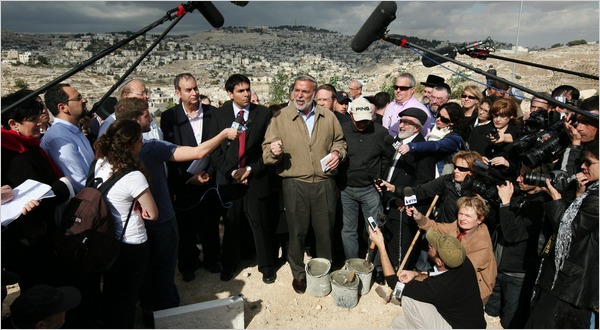
The World Likud movement held a cornerstone-laying ceremony yesterday for the expansion of the neighborhood of Nof Zion, despite – or possibly because of – American pressure against building in East Jerusalem. The Jewish settlement is in the middle of the Arab village of Jabal Mukkaber. Meanwhile, the Jerusalem municipality razed two Palestinian homes in East Jerusalem yesterday.

The plan is to add to Nof Zion 105 new apartments to the 90 ones that are already there, most of which are already occupied. The neighborhood is considered “prestigious,” but the developers ran into trouble a few years ago after they failed to sell the apartments to Jews from overseas. About a year ago the developers changed their marketing strategy to target the local national-religious market – and the apartments began selling quickly. The developers expect the same for the new part of the neighborhood.

The World Likud’s announcement of the ceremony said the neighborhood was near Jabal Mukkaber, “bounded by terraces and with olive trees and grapevines.”

In fact, however, Nof Zion is in the middle of the village, near Palestinian homes. In September Haaretz reported that the family of the late actor-comedian Shaike Ophir criticized the municipality’s decision to name a street in Nof Zion after him.

A group of American Jews interested in buying apartments in Nof Zion attended yesterday’s ceremony. New York State Assemblyman Dov Hikind, who is considered a staunch supporter of the settlers, headed the group. Continue reading

Facebooktwittermail

From Gaza to Obama: An open letter

From Gaza to Obama: An open letter

Mr President,

The whole world celebrated your election as the first African-American president of the US. I did not. Neither did the inhabitants of the concentration camp where I live. Your sympathetic visit to Sderot—an Israeli town which was the Palestinian village of Najd until 1948 when its people were ethnically cleansed—three years after your first visit to a Kibbutz in northern Israel in support of its residents, and after your pledge to be committed to the security of the State of Israel and its “right” to retain unified Jerusalem as the capital city of the Jewish people—to give but few examples—were all clear indications of where your heart lies.

Another reason for the writing of this letter is shock at the indifference and arrogance with which Secretary of State Hillary Clinton dismissed Palestinian concerns about Israel’s illegal Jewish-only settlements in the West Bank. Only a few weeks ago you made the admirable statement that all Jewish settlement must halt, and you made it clear that this included expansion of existing settlements as well as the construction of new settlements. However, when Netanyahu let it be known that he had no intention of stopping settlements, you missed an historic opportunity to draw a line: no more billions and no more weapons for Israel unless and until this condition is met. Now Clinton has the Herculean task of pretending that your position on Jewish settlements has not changed, although it is clear you have chosen not to use the very real power at your disposal to bring Israeli policy into line. [continued…] (h/t Rob Browne)

Barack Obama rewards big donors with plum jobs overseas

He may have promised to change Washington, but President Barack Obama is continuing one of its most renowned patronage traditions: bestowing prized ambassadorships on big donors.

Of the nearly 80 ambassadorship nominations or confirmations since Obama’s Inauguration, 56 percent were given to political appointees and 44 percent have gone to career diplomats, according to records kept by the American Foreign Service Association.

The latest nomination came this week, when Beatrice Wilkinson Welters was nominated to serve as ambassador to the island nation of Trinidad and Tobago in the Caribbean.

Welters, a longtime advocate for underprivileged children, and her husband, Anthony, an executive with UnitedHealth Group, generated between $200,000 and $500,000 in donations to Obama’s presidential campaign and an additional $100,000 for his Inauguration, according to the Center for Responsive Politics, a nonpartisan group that tracks political giving. [continued…]

The gaffes of Hillary Clinton

Though none of these comments had a tangible impact on U.S. foreign policy, the same can’t be said about two episodes in which Clinton veered away from the White House’s message on the Middle East peace process. The first came in May, when Clinton revealed at a press conference that Obama’s call for an Israeli settlement freeze included any “natural growth” within existing settlements. The circumstances remain murky, but two sources with detailed knowledge of the U.S.-Israeli relationship say that the Obama team was not yet prepared to make public this departure from Bush-era policy. Rather than leave his secretary of state twisting in the wind, says one of the sources, Obama wound up repeating her formulation a few days later, touching off months of tension with the Israelis. [continued…]

Facebooktwittermail

The Afghan speech Obama should give (but won’t)

‘This administration ended, rather than extended, two wars’… The Afghan speech Obama should give (but won’t)

Sure, the quote in the over-title is only my fantasy. No one in Washington — no less President Obama — ever said, “This administration ended, rather than extended, two wars,” and right now, it looks as if no one in an official capacity is likely to do so any time soon. It’s common knowledge that a president — but above all a Democratic president — who tried to de-escalate a war like the one now expanding in Afghanistan and parts of Pakistan, and withdraw American troops, would be so much domestic political dead meat.

This everyday bit of engrained Washington wisdom is, in fact, based on not a shred of evidence in the historical record. We do, however, know something about what could happen to a president who escalated a counterinsurgency war: Lyndon Johnson comes to mind for expanding his inherited war in Vietnam out of fear that he would be labeled the president who “lost” that country to the communists (as Harry Truman had supposedly “lost” China). And then there was Vice President Hubert Humphrey who — incapable of rejecting Johnson’s war policy — lost the 1968 election to Richard Nixon, a candidate pushing a fraudulent “peace with honor” formula for downsizing the war.

Still, we have no evidence about how American voters would deal with a president who didn’t take the Johnson approach to a losing war. The only example might be John F. Kennedy, who reputedly pushed back against escalatory advice over Vietnam, and certainly did so against his military high command during the Cuban Missile Crisis. In both cases, however, he acted in private, offering quite a different face to the world. [continued…]

Facebooktwittermail

Who’s in charge of the language here?

“… who is in charge of the language here?”

After Israeli officials flatly refused a US request to block the approval for the construction of 900 new housing units in occupied East Jerusalem, the Obama administration “lashed out” (CBS) with “anger” (New York Times) and “sharply criticized” (Wall Street Journal) Israel’s decision.

The White House unleashed a shocking display of… “dismay.”

We are dismayed at the Jerusalem Planning Committee’s decision to move forward on the approval process for the expansion of Gilo in Jerusalem.

Thankfully, AP’s Matt Lee wasn’t as obliging as some of his colleagues in their efforts to pump vigor into a pathetic statement.

Challenging State Department spokesman Ian Kelly, Lee asked:

You can’t come up with anything stronger than “dismaying”? I mean, this flies in the face of everything you’ve been talking about for months and months and months.

Kelly: It’s dismaying.

Lee: Yeah, you can’t offer a condemnation of it or anything like that? (Laughter.) I mean, who is in charge of the language here?

On the other side of the Atlantic, Britain’s Foreign Office was a tad more forthright if not quite fiery: “this decision is wrong and we oppose it.”

That kind of language is apparently too strong for this White House. In fact, having originally put out a statement referring to planned “Settlement Expansion in Jerusalem”, the mamby pamdys in charge of language in the most powerful executive office in the world decided to retract “settlement expansion” and simply titled it a statement “on Jerusalem”.

So, the Obama administration is “dismayed” by Israel’s behavior.

It may well be that the word was chosen with exquisite care. It’s etymology is all too appropriate:

Middle English dismaien, from Anglo-Norman *desmaiier : probably de-, intensive pref.; see de- + Old French esmaier, to frighten (from Vulgar Latin *exmagāre, to deprive of power : Latin ex-, ex- + Germanic *magan, to be able to).

The White House could have said:

Prime Minister Netanyahu. You have exposed our impotence. Alas, we have no power.

Should anyone be dismayed at the White House’s language?

Only if you’ve been ignoring the news for the last few months and still imagine that Obama’s speech in Cairo was genuinely a highlight of his presidency.

Bibi goes nuclear on Jerusalem settlements

The plan, if implemented, will allow the construction of 844 units, and these units won’t be inside the existing footprint of the settlement. Rather, they will be on the settlement’s southwestern flank, expanding Gilo in the direction of the Palestinian village of Wallajeh (a village in which a large number of the homes are fighting Israeli demolition orders). This new Gilo plan clearly dovetails with another plan to build a new settlement, called Givat Yael, which would straddle the Jerusalem border and significantly extend Israeli Jerusalem to the south, further sealing the city off from the Bethlehem area and the West Bank (and connecting it to the Etzion settlement bloc). That plan, it was reported yesterday, also appears to be suddenly gaining steam. (for a map showing both the Gilo plan and Givat Yael, click here.)

The Gilo plan is thus extremely provocative on several levels. It represents a clear and public statement from the Netanyahu government that it is neither “freezing” nor acting with “restraint” in East Jerusalem. It compels the Palestinians to respond, just as it compels other regional actors to respond. Finally, it has important strategic implications, since the plan, implemented, would impact on border options for Jerusalem under a future peace agreement.

Today’s crisis was by no means inevitable. Nobody (except for those of us who obsessively follow Jerusalem at its most minute level) had any idea this Gilo plan was on the agenda for today. This means that Bibi could easily have responded positively to US concerns and quietly quashed or delayed the project, without any political cost. Alternatively, he could have offered another (deceptively) constructive course, like allowing it to be deposited for public review but promising to find other ways to hold it up later. Or he could simply have refused to intervene, but kept quiet about it – letting today’s technical approval process run it course and only react publicly, after the fact.

Bibi had a number of conventional options; he chose to go nuclear.

If this feels familiar, it should. This is basically what happened earlier this year with the Shepherds Hotel settlement in Sheikh Jarrah. The plan was on the agenda, Washington weighed in firmly but quietly, hoping for firm but quiet action by Netanyahu – and instead they got a story leaked to the Israeli media (in fact, to the same journalist who broke today’s Gilo story), turning it into an opportunity for Netanyahu to burnish his Jerusalem credentials, at the expense of the prospects for peace. [continued…]

Facebooktwittermail