Category Archives: Obama administration

Obama’s Afghan dilemma: missing security forces
Obama’s Afghan dilemma: missing security forces

The simple answer to the Administration’s dilemma, in the minds of many in Washington, is to train and equip Afghans to do the job themselves. Obama reportedly rejected all four options offered by his national-security staff on Nov. 11 — ranging from a relatively light increase of some 10,000 troops, mostly for training purposes, to the 40,000 reinforcements requested by McChrystal to wage a counterinsurgency fight — because they failed to make clear how and when responsibility for the war would be transferred to Afghan forces. By doing so, Obama may have pointed to the elephant in the room. On present indications, the Afghan forces are unlikely anytime in the near future to be ready and willing to take over the fight against the Taliban.

The Afghan National Army (ANA) comprises some 94,000 troops, although even by the official numbers, only half of those are combat-ready. The reality of the recent U.S. and British operations in Helmand province, however, suggests that a lot fewer may be capable of being deployed to fight effectively alongside NATO forces, much less on their own. The desertion rate of troops trained in the ANA stands at 20% — and is reportedly even higher among forces deployed in combat. Afghan field officers are in short supply, and the top echelon of the officer corps is dominated by ethnic Tajiks who are often viewed with suspicion by Pashtuns, the country’s largest ethnic group and the one in which the Taliban is based. And the recent killing of five British soldiers by an Afghan policeman they had been mentoring, who then ran off to join the Taliban, highlights the risk of infiltration in efforts to expand the Afghan security forces.

The Karzai government’s poor standing among the Afghan people is generally acknowledged as a problem in that not many Afghans are going to be willing to risk their lives to defend it. [continued…]

Anatomy of an Afghan culture of corruption

Every morning, dozens of trucks laden with diesel from Turkmenistan lumber out of the northern Afghan border town of Hairaton on a two-day trek across the Hindu Kush down to Afghanistan’s capital, Kabul. Among the dozens of businesses dispatching these trucks are two extremely well connected companies — Ghazanfar and Zahid Walid — that helped to swell the election coffers of President Hamid Karzai as well as the family business of his running mate, the country’s new vice president, warlord Mohammed Qasim Fahim.

Some of the trucks are on their way to two power stations in the northern part of the capital: a recently refurbished, if inefficient, plant that has served Kabul for a little more than a quarter of a century, and a brand new facility scheduled for completion next year and built with money from the U.S. Agency for International Development (USAID).

Afghan political analysts observe that Ghazanfar and Zahid Walid are striking examples of the multimillion-dollar business conglomerates, financed by American as well as Afghan tax dollars and connected to powerful political figures, that have, since the fall of the Taliban in 2001, emerged as part of a pervasive culture of corruption here. Nasrullah Stanikzai, a professor of law and political science at Kabul University, says of the companies in the pocket of the vice-president: “Everybody knows who is Ghazanfar. Everybody knows who is Zahid Walid. The [government elite] directly or indirectly have companies, licenses, and sign contracts. But corruption is not confined just to the Afghans. The international community bears a share of this blame.” [continued…]

Taliban make gains in Afghanistan’s forgotten north

The insurgents’ tactics are familiar. Night letters warn village elders to cooperate or face death. Religious “taxes” must be paid, and fiery sermons in mosques attack the Karzai government and international forces.

The locale is startling, however: Afghanistan’s northern Balkh province, which in the years after the fall of the Taliban emerged as one of the most stable – and in its urban hub of Mazar-i-Sharif – most prosperous places in Afghanistan. [continued…]

The big impact of small footprint

A growing number of people, led by Vice President Joe Biden, are advocating a so-called “small footprint” approach to the U.S. military mission in Afghanistan. They propose a significantly reduced military presence that focuses more on destroying al Qaeda than on building Afghanistan, and relies more on airstrikes and special forces than on conventional tactics. America will get about as much security as before, the argument goes, but at a much lower price. A return of the Taliban to power is not necessarily a problem, small footprint proponents argue, because the regime can be deterred from hosting al Qaeda by the threat of U.S. airstrikes or another invasion.

One of the many assumptions behind this tempting argument is that there is a certain level of proportionality between the amount of force we use and the level of resistance we encounter. If we stop occupying Afghanistan and limit violence to the really bad guys, al Qaeda will be unable, and other radicalized Muslims unwilling, to attack the United States.

This may be true for local insurgencies such as the Taliban, but not for small transnational movements such as al Qaeda. In fact, a significantly smaller U.S. presence in Afghanistan may paradoxically generate more anti-Americanism outside Afghanistan and ultimately more anti-Western terrorism than a more conventional military approach. This is because jihadi propaganda today relies on visually powerful symbols to mobilize people, and intermittent “surgical” strikes, and the casualties they cause, may create more such symbols than continuous conventional warfare. [continued…]

Editor’s Comment — Among the administration’s many considerations in revising its Afghan strategy, the one that has nothing to do with the internal logic of “success” or “failure” is the one the ultimately probably concerns Americans more than any other: how much this war is costing.

Upon learning that 25% of American children are now struggling to get enough to eat, President Obama is reported to have found that number “unsettling”. But knowing that the US government is spending a million dollars a year for every single soldier it sends to Afghanistan, Obama should be more than unsettled by the spectacle of poverty in this country. He should realize that his administration currently has its priorities upside down.


Facebooktwittermail

Manhattan transfer

Manhattan transfer

Opposition to the Obama administration’s plan to try alleged 9/11 mastermind Khalid Sheikh Mohammed and his confederates in a federal court in New York City is hardening into two camps. One is concerned that we may be unwittingly playing into the terrorists’ hands. The other is incensed that we already have. What both camps share, besides a kind of unhinged logic and complete disregard for the legal process, is an obsessive fascination with the accused. The result is a broad willingness to sacrifice our commitment to legal principles in favor of the symbolic satisfaction of crushing the hopes and dreams of a motley group of criminals.

Former New York Mayor Rudy Giuliani, firmly in the first camp, is hopping mad that we are poised to make all the suspect’s dreams come true. As he said on ABC’s This Week: “Khalid Sheikh Mohammed, when he was first arrested, asked to be brought to New York. I didn’t think we were in the business of granting the requests of terrorists.”

Funny, that. I didn’t think we were in the business of caring one way or another what the terrorists want from us. The criminal justice system is as uninterested in advancing the goals of the accused as it is in frustrating them. The most vocal critics seem to forget that our legal system exists not to grant requests or dash hopes but to bring people to justice. [continued…]

Facebooktwittermail

High costs weigh on troop debate for Afghan war

High costs weigh on troop debate for Afghan war

While President Obama’s decision about sending more troops to Afghanistan is primarily a military one, it also has substantial budget implications that are adding pressure to limit the commitment, senior administration officials say.

The latest internal government estimates place the cost of adding 40,000 American troops and sharply expanding the Afghan security forces, as favored by Gen. Stanley A. McChrystal, the top American and allied commander in Afghanistan, at $40 billion to $54 billion a year, the officials said.

Even if fewer troops are sent, or their mission is modified, the rough formula used by the White House, of about $1 million per soldier a year, appears almost constant.

So even if Mr. Obama opts for a lower troop commitment, Afghanistan’s new costs could wash out the projected $26 billion expected to be saved in 2010 from withdrawing troops from Iraq. And the overall military budget could rise to as much as $734 billion, or 10 percent more than the peak of $667 billion under the Bush administration. [continued…]

Facebooktwittermail

Detainees to get the “state-always-wins” system of “justice”

Detainees to get the “state-always-wins” system of “justice”

… what we have here is not an announcement that all terrorism suspects are entitled to real trials in a real American court. Instead, what we have is a multi-tiered justice system, where only certain individuals are entitled to real trials: namely, those whom the Government is convinced ahead of time it can convict. Others for whom conviction is less certain will be accorded lesser due process: put in military commissions, to which most leading Democrats vehemently objected when created under Bush. Presumably, others still — those who the Government believes cannot be convicted in either forum, will simply be held indefinitely with no charges, a power the administration recently announced it intends to preserve based on the same theories used by Bush/Cheney to claim that power.

A system of justice which accords you varying levels of due process based on the certainty that you’ll get just enough to be convicted isn’t a justice system at all. It’s a rigged game of show trials. This is a point I’ve been emphasizing since May, when Obama gave his speech in front of the Constitution at the National Archives and explained how there were five different “categories” of terrorism suspects who would be treated differently based on the category into which they fell: [continued…]

Facebooktwittermail

The Israel lobby and the Jewish kings

The Israel lobby and the Jewish kings

When people ask why Obama has capitulated to the prime minister of a tiny state– Bibi Netanyahu– various theories are offered about Health care first, or the economy, or Afghanistan, or oil. Few say directly: Netanyahu feels invulnerable because of the Israel lobby in the U.S. As readers of this site know, I am a bull on this issue: I think the lobby has a tremendous amount of power. And all efforts to poohpooh its influence strike me as foolish until such time as the media address it openly and vigorously, as they do, say, the gun lobby. Once there’s information and sunshine, we can argue about its magnitude.

The difficulty is that you cannot be plain about this matter without addressing the idea of Jewish influence. Israelis are often more plain about this. Anshel Pfeffer wrote in Haaretz the other day, “the most significant joint endeavor of America’s Jews [is] six decades of unswerving support for the Israeli government of the day.” I.e., a hammerlock on U.S. policy. And last year at the NYPL, former Knesset speaker Avraham Burg described “two structures” built by Jews, one being Israel, the other “the semi-autonomous American Jewry, which was not here 150 years ago– powerful influence, access to the corridors of power, impact on the culture, and civilization… plus the infrastructure of the community of solidarity and fraternity and support system and education etc.” [continued…]

Israel ‘personally attacking human rights group’ after Gaza war criticism

America’s leading human rights organisation has accused Israel and its supporters of an “organised campaign” of false allegations and misinformation, including “extremely personal attacks” on its staff, in an attempt to discredit the group over its reports of war crimes in Gaza.

Human Rights Watch (HRW) ties the campaign – which has included accusations that the group’s reports on the Jewish state are written by “anti-Israel ideologues” and that it has sought funds from Saudi Arabia – to a statement by a senior official in the Israeli prime minister’s office in June pledging to “dedicate time and manpower to combating” human rights organisations. [continued…]

Haaretz poll: 57% of Israelis support plan to talk to Hamas

In a few words, French Foreign Minister Bernard Kouchner was able to encapsulate the political situation in Israel: “There is no more peace camp.” New survey numbers appear to prove him right.

Nine months after the elections, the left has evaporated and the right has only grown stronger, probably stronger than ever. The Labor Party and its leadership continue to sink lower and lower, but the general public is actually exhibiting intellectual flexibility and political moderation: the majority, including most of the Likud voters, support negotiations with Hamas, if it relinquishes terrorism and recognizes Israel.

These are the main conclusion for a special survey carried out during the past days on behalf of Haaretz and Dialog, under the guidance of Professor Camil Fuchs of the Department of Statistics at Tel Aviv University.

The survey shows the impressive rising strength of the right and a serious shrinking of the center and the left. The balance in the current Knesset stands at 65 seats for the right and 55 for the center and the left parties, but if elections were held today , the current survey suggests that the right would garner 72 seats to 48 for the center and left.

During the nine months since the elections, the equivalent of seven seats in the Knesset have moved to the right from the left-center. Kadima is retaining its strength, but Labor is crashing and it is on its way to disappearing from the political scene. Continue reading

Facebooktwittermail

Goldstone to Haaretz: U.S. does not have to protect Israel blindly

Goldstone to Haaretz: U.S. does not have to protect Israel blindly

The Goldstone report is expected to be raised for discussion in the United Nations Security Council in the near future, and Goldstone Thursday discussed the possibility that the United States would veto any resolution that would hurt Israel when it comes to the implementation of the report’s findings. “I do not believe that any nation should protect another nation blindly. I would prefer to see the United States furnish reasons for criticizing the report. The United States has supported our call for credible investigations by Israel and by the Gaza authorities, whether the PA or Hamas,” he said.
Goldstone reiterated statements he has made, as well as those made by a number of Israeli human rights groups, inviting an open, public investigation and categorically rejecting a probe by the Israel Defense Forces of the Gaza campaign. “It does not suffice for the military to investigate itself. That will satisfy very few people and certainly not the victims.”

However Goldstone stressed that “in any public inquiry, it would be open to the Israeli government and the IDF to have sensitive security information protected from public disclosure.”

When asked how far up the chain of command he felt such a criminal investigation should go, and whether decision-makers in government be its subject, he replied: “A criminal investigation should go as high up the chain of command, both military and civilian, as the evidence justifies.” [continued…]

Facebooktwittermail

How America’s wars are systematically destroying our liberties

How America’s wars are systematically destroying our liberties

In his approach to National Security Agency surveillance, as well as CIA renditions, drone assassinations, and military detention, President Obama has to a surprising extent embraced the expanded executive powers championed by his conservative predecessor, George W. Bush. This bipartisan affirmation of the imperial executive could “reverberate for generations,” warns Jack Balkin, a specialist on First Amendment freedoms at Yale Law School. And consider these but some of the early fruits from the hybrid seeds that the Global War on Terror has planted on American soil. Yet surprisingly few Americans seem aware of the toll that this already endless war has taken on our civil liberties.

Don’t be too surprised, then, when, in the midst of some future crisis, advanced surveillance methods and other techniques developed in our recent counterinsurgency wars migrate from Baghdad, Falluja, and Kandahar to your hometown or urban neighborhood. And don’t ever claim that nobody told you this could happen — at least not if you care to read on.

Think of our counterinsurgency wars abroad as so many living laboratories for the undermining of a democratic society at home, a process historians of such American wars can tell you has been going on for a long, long time. Counterintelligence innovations like centralized data, covert penetration, and disinformation developed during the Army’s first protracted pacification campaign in a foreign land — the Philippines from 1898 to 1913 — were repatriated to the United States during World War I, becoming the blueprint for an invasive internal security apparatus that persisted for the next half century. [continued…]

Facebooktwittermail

U.S. envoy resists increase in troops

U.S. envoy resists increase in troops

The U.S. ambassador in Kabul sent two classified cables to Washington in the past week expressing deep concerns about sending more U.S. troops to Afghanistan until President Hamid Karzai’s government demonstrates that it is willing to tackle the corruption and mismanagement that has fueled the Taliban’s rise, senior U.S. officials said.

Karl W. Eikenberry’s memos, sent as President Obama enters the final stages of his deliberations over a new Afghanistan strategy, illustrated both the difficulty of the decision and the deepening divisions within the administration’s national security team. After a top-level meeting on the issue Wednesday afternoon — Obama’s eighth since early last month — the White House issued a statement that appeared to reflect Eikenberry’s concerns.

“The President believes that we need to make clear to the Afghan government that our commitment is not open-ended,” the statement said. “After years of substantial investments by the American people, governance in Afghanistan must improve in a reasonable period of time.”

On the eve of his nine-day trip to Asia, Obama was given a series of options laid out laid out by military planners with differing numbers of new U.S. deployments, ranging from 10,000 to 40,000 troops. None of the scenarios calls for scaling back the U.S. presence in Afghanistan or delaying the dispatch of additional troops.

But Eikenberry’s last-minute interventions have highlighted the nagging undercurrent of the policy discussion: the U.S. dependence on a partnership with a Karzai government whose incompetence and corruption is a universal concern within the administration. After months of political upheaval, in the wake of widespread fraud during the August presidential election, Karzai was installed last week for a second five-year term. [continued…]

Editor’s Comment — Many years ago I had a conversation — seemingly trivial at the time — yet it contained an observation as true now as it was then.

I was in Bamyan Valley in central Afghanistan (this was when the Buddha statues were still intact) talking to one of the English-speaking residents. A policeman sat on a curb nearby, well within earshot but neither I nor my interlocutor had any reason to imagine the man in his dusty uniform could understand a word we were saying.

“He’s a bit stupid,” the Afghan volunteered bluntly. “He works for the government. They don’t pay well and they don’t pay often. This is the only type of man who would take such a job.”

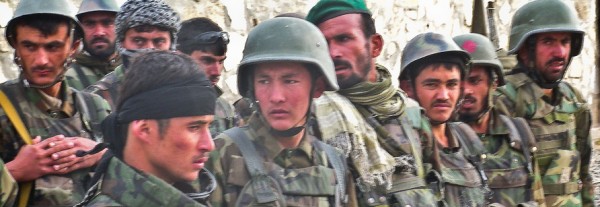
I’m reminded of that sorry-looking policeman when I look at this ragtag collection of Afghan National Army soldiers. It certainly doesn’t help that even when uniformed they are so visibly lacking in uniformity, but their collective look of bewilderment conveys better than any Congressional testimony that they are part of an ill-conceived enterprise.

President seeks clarity on turnover to Afghan government, official says

President Barack Obama does not plan to accept any of the Afghanistan war options presented by his national security team, pushing instead for revisions to clarify how and when U.S. troops would turn over responsibility to the Afghan government, a senior administration official said Wednesday.

Obama still is close to announcing his revamped war strategy, most likely shortly after he returns from a trip to Asia that ends on Nov. 19.

The president raised questions at a war council meeting on Wednesday, however, that could alter the dynamic of both how many additional troops are sent to Afghanistan and what the timeline would be for their presence in the war zone, according to the official, who spoke on condition of anonymity to discuss Obama’s thinking. [continued…]

In Afghanistan, Taliban surpasses al-Qaeda

This year, Omar’s military committee published a rule book for followers, calling on them to protect the population and avoid civilian casualties — much like U.S. counterinsurgency principles. He has railed against the corruption of President Hamid Karzai’s government, an issue that resonates with Afghans. He has also solicited support from other Muslim countries. But al-Qaeda’s agenda of global holy war and taste for mass-casualty attacks, no matter how many Muslim civilians are killed, complicate that goal.

In a February interview with al-Samoud magazine, Taliban political committee leader Agha Jan Mutassim praised the Saudi Arabian government, called for Muslim unity and said the Taliban “respects all different Islamic schools and branches without any discrimination” in Afghanistan.

Such positions may put Omar’s Taliban at odds with al-Qaeda’s extremist Sunni agenda of overthrowing what it sees as corrupt Muslim governments and targeting Shiites. Analysts said that Omar, who leads a council of Taliban commanders based in or around the Pakistani city of Quetta, wants such countries as Saudi Arabia, the United Arab Emirates and Pakistan to recognize the Taliban as a legitimate government if it regains power and that he has little interest in fomenting war elsewhere.

“We assure all countries that the Islamic Emirate of Afghanistan, as a responsible force, will not extend its hand to cause jeopardy to others,” Omar said in a written statement in September.

The messages from the Taliban leadership since the spring amount to something of a “revolution,” said Wahid Mujda, a political analyst who was a Foreign Ministry official under the Taliban government. “Al-Qaeda’s path is now different from the Taliban’s path, and they are growing more separated.” [continued…]

How the US funds the Taliban

Welcome to the wartime contracting bazaar in Afghanistan. It is a virtual carnival of improbable characters and shady connections, with former CIA officials and ex-military officers joining hands with former Taliban and mujahedeen to collect US government funds in the name of the war effort.

In this grotesque carnival, the US military’s contractors are forced to pay suspected insurgents to protect American supply routes. It is an accepted fact of the military logistics operation in Afghanistan that the US government funds the very forces American troops are fighting. And it is a deadly irony, because these funds add up to a huge amount of money for the Taliban. “It’s a big part of their income,” one of the top Afghan government security officials told The Nation in an interview. In fact, US military officials in Kabul estimate that a minimum of 10 percent of the Pentagon’s logistics contracts–hundreds of millions of dollars–consists of payments to insurgents. [continued…]

Afghanistan is neither Vietnam nor Iraq

As President Obama contemplates a new strategy in Afghanistan, Washington is obsessed with whether the best analogy to the conflict lies in Vietnam or Iraq, with attendant and obvious implications for policy. Of course, Afghanistan has little in common with either Vietnam or Iraq in terms of history, geography, culture, or politics. There is, however, a more apt analogy, and it involves the very area in dispute.

Driven by radical Islam, Pashtun nationalism, and armed opportunism, some of the clans in Waziristan — a pair of currently militant-ridden tribal regions in Pakistan and the site of the recent anti-Taliban Pakistani military offensive — rose against British rule in 1936. The rebels improvised roadside bombs, ambushed convoys, and launched hit and run attacks on isolated outposts to drive out alien forces. They kidnapped and beheaded British soldiers and civilians. In unprotected villages, they massacred civilians who did not support them. When troops chased the rebels, they crossed the border with Afghanistan to seek refuge. (Much of this is happening today on either side of Waziristan’s border with Afghanistan.)

Chasing down rebels, patrolling roads, and keeping supply lines open was — and remains — hazardous duty. Soldiers in Waziristan learned to vary their activities or paid with their lives. D. S. Richards in The Savage Frontier quotes a British soldier on “the cardinal Frontier principle of never doing the same thing in the same way twice running,” because “[s]omeone was always watching — someone with an inborn tactical sense, someone who missed nothing.” [continued…]

Facebooktwittermail

What Goldstone says about the US

What Goldstone says about the US

… if Israel is guilty of committing systematic war crimes across Gaza and the West Bank, then the US, which supported, funded and armed Israel during the war, is an accessory to those crimes.

Goldstone explains in no uncertain terms that Gaza was not an aberration in terms of Israel’s treatment of Palestinians.

Rather, it marked not only a continuation of Israel’s behaviour during the 2006 invasion of Lebanon, but “highlights a common thread of the interaction between Israeli soldiers and Palestinian civilians which emerged clearly also in many cases discussed in other parts of the report.

It referenced continuous and systematic abuse, outrages on personal dignity, humiliating and degrading treatment contrary to fundamental principles of international humanitarian law and human rights law”.

“The Mission concludes that the treatment of these civilians constitutes the infliction of a collective penalty on those persons and amounts to measures of intimidation and terror. Such acts are grave breaches of the Geneva Conventions and constitute a war crime,” the report says.

Put simply, if there is blood on Israel’s hands, than it is has dripped all over America’s shirt.

Israel could not and would not have engaged in the level of wholesale destruction of Gaza painstakingly catalogued in the report without the support of the outgoing Bush administration, and acquiescence of the incoming Obama administration. [continued…]

Facebooktwittermail

Obama hosts Netanyahu

Obama hosts Netanyahu

The prime minister’s visit comes as fears grow inside the Obama administration that its aggressive plans for promoting Mideast peace could be unraveling. Mr. Netanyahu hasn’t agreed to a complete freeze of settlements in the West Bank and Jerusalem as a precursor to talks, and Palestinian Authority President Mahmoud Abbas announced last week that he wouldn’t seek re-election in protest over the U.S. failure to deliver such a commitment.

Secretary of State Hillary Clinton fueled outrage in the Arab world when she visited Mr. Netanyahu just over a week ago in Jerusalem and praised the Israeli leader for his agreement to a partial freeze, rather than pushing him publicly for more.

Mrs. Clinton’s comments drew criticism in Arab capitals that Washington was tilting toward the Jewish state. U.S. officials briefed on the secretary’s visit said there also were tensions between Mrs. Clinton and her Israeli counterparts over the Israelis’ hard line. Mrs. Clinton, who is traveling in Germany, won’t be part of the White House meeting.

The brinksmanship over a one-on-one meeting between the two leaders represents a rare display of pique by the White House toward Israel. Mr. Netanyahu had long been scheduled to visit Washington to speak at the assembly of Jewish groups. While he had no confirmed plans to meet Mr. Obama, it would be rare, but not unprecedented, for an Israeli prime minister to visit Washington without meeting the U.S. president. [continued…]

Editor’s Comment — A few days ago, the Yedioth Ahronoth columnist Nahum Barnea wrote: “For days the White House has refused to set a date for a meeting. It was embarrassing and humiliating. Netanyahu was angry. Not mildly angry. He was incensed.”

Thank God President Obama has come to his senses and is ready to do whatever it takes to please America’s most important ally.

Facebooktwittermail

Is using aid to Israel as leverage becoming a mainstream idea?

Is using aid to Israel as leverage becoming a mainstream idea?

Tom Friedman today has some very harsh words for both the Israelis and Palestinians, both of whom — he claims — are not serious about reaching a peace agreement. As a result, these are the principles which Friedman — rather surprisingly — advocates the U.S. should follow:

Let’s just get out of the picture. Let all these leaders stand in front of their own people and tell them the truth: “My fellow citizens: Nothing is happening; nothing is going to happen. It’s just you and me and the problem we own.”

Indeed, it’s time for us to dust off James Baker’s line: “When you’re serious, give us a call: 202-456-1414. Ask for Barack. Otherwise, stay out of our lives. We have our own country to fix.” …

If the status quo is this tolerable for the parties, then I say, let them enjoy it. I just don’t want to subsidize it or anesthetize it anymore. We need to fix America. If and when they get serious, they’ll find us.

The only specific course of action Friedman explicitly advocates to fulfill those principles is that the U.S. cease its efforts to forge a resolution of the Israeli-Palestinian conflict and stop trying to pressure them into concessions, instead leaving each side to stew in the status quo — in other words, do exactly that which the Netanyahu government would like most. That would be a perfectly fine suggestion if not for the fact that the U.S. is heavily invested in the outcome of that process and its interests substantially and directly impacted by what happens. That’s because we single-handedly enable Israeli behavior with our massive amounts of military aid, diplomatic protection, and weapons supplying, which means Israeli behavior is rationally perceived by much of the Muslim world as being one and the same as American behavior. Muslim anger towards Israel will inevitably translate into Muslim anger towards the U.S. for as long as we continue to flood Israel with aid and cover. [continued…]

Israel’s apartheid is worse than South Africa’s

Regardless of whether there is a Democrat or a Republican in the White House, the United States became a distinctly pro-Israel world power after the 1967 war. It has no intention of being a “balanced mediator” when it comes to the conflict with the Palestinians.

Barack Obama’s public relations moves in the Arab world have frightened many average Israelis. But Netanyahu and Ehud Barak, allies of the final takeover of the West Bank, know very well that U.S. policy has not changed. It doesn’t take a genius to read the working papers of past prime ministers.

The prevailing attitude of all U.S. administrations was drafted by Henry Morgenthau, and was later updated by Kenneth Waltz. One line guided all of them – Dennis Ross, Martin Indyk, George Mitchell – essentially, that any possible settlement must match the positions of the stronger party. [continued…]

Abbas charts new course by abandoning faith in the US

‘Who lost China?” was the battle cry of a witch-hunt conducted in the US State Department following the 1949 victory of Mao Zedong’s communists. The department’s “China hands”, critics charged, had been woefully ignorant of the dynamics at work on the ground in China after the Second World War, and undermined the US ally Chiang Kai-shek. While the purge that followed is unlikely to be repeated, Washington may soon be asking itself, albeit quietly, “Who lost Fatah?”

Last week’s announcement by the Palestinian president Mahmoud Abbas that he would not seek re-election next January was a warning to the Obama administration, which had put Mr Abbas in an untenable position. Having retreated from its own demand that Israel halt all construction in East Jerusalem and the West Bank, Washington expected Mr Abbas to open talks with the Israeli prime minister Benjamin Netanyahu without conditions.

For the Palestinians, however, the settlement-freeze demand was a test of Mr Obama’s willingness to pressure the Israelis into taking steps they won’t take by choice. Mr Abbas knows that Mr Netanyahu, if it were up to him, would not yield to a viable, independent Palestinian state based on the 1967 borders. If the US is not prepared to pressure Israel, negotiations would not only be fruitless, they would actually help sustain a reality that is relatively comfortable for the Israelis but intolerable for the Palestinians. [continued…]

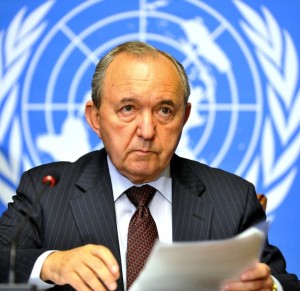
U.N.’s Goldstone criticizes U.S. reaction to Gaza report

The head of a U.N. investigation that accused Israel of war crimes in Gaza, Richard Goldstone, has said he is disappointed there has been such a “lukewarm” reaction to his findings in the United States.

The report by Goldstone, a South African jurist, lambasted both sides in the December-January war, which killed up to 1,387 Palestinians and 13 Israelis, but was harsher toward Israel.

It gave Israel and Palestinian Hamas militants six months to mount credible investigations or face possible prosecution in The Hague. Both Israel and Hamas denied committing war crimes. [continued…]

Facebooktwittermail

Obama leaning toward 34,000 more troops for Afghanistan

Obama leaning toward 34,000 more troops for Afghanistan

President Barack Obama is nearing a decision to send more than 30,000 additional U.S. troops to Afghanistan next year, but he may not announce it until after he consults with key allies and completes a trip to Asia later this month, administration and military officials have told McClatchy.

As it now stands, the administration’s plan calls for sending three Army brigades from the 101st Airborne Division at Fort Campbell, Ky. and the 10th Mountain Division at Fort Drum, N.Y. and a Marine brigade, for a total of as many as 23,000 additional combat and support troops.

Another 7,000 troops would man and support a new division headquarters for the international force’s Regional Command (RC) South in Kandahar, the Taliban birthplace where the U.S. is due to take command in 2010. Some 4,000 additional U.S. trainers are likely to be sent as well, the officials said. [continued…]

British army wants to retreat in Afghanistan

Army chiefs are drawing up plans to withdraw British troops from outlying bases in Afghanistan.

In what would be a significant change of strategy against the growing Taliban insurgency, they are considering abandoning several bases including Musa Qala, the scene of bloody battles that claimed 15 British lives. Army forces would attempt to hold only the larger towns in Helmand province.

It is understood the new “retrenchment” strategy is backed by the head of the army, General Sir David Richards. [continued…]

Is it time for Britain to pull out of Afghanistan?

In a week where one of the policemen being trained by British soldiers to protect his own country turned on his mentors and shot dead five in cold blood, an increasing number of people are asking what we are doing in Afghanistan and whether it is worth it.

Public opposition to the war has risen sharply: in a ComRes survey for the BBC published today, 64% said the war was “unwinnable” and 63% thought British troops should be withdrawn “as soon as possible”. In a YouGov poll last week for Channel 4, 35% of people thought all UK troops should be withdrawn immediately, up from 25% two weeks ago.

On radio phone-in and news programmes, discussion has been of little else. “There is a real chance we will lose this struggle in the bars and front rooms of Britain,” warned Lord Ashdown, the former leader of the Liberal Democrats.

Among those now calling for a “fundamental rethink” is Kim Howells, chairman of the parliamentary intelligence and security committee and a former Foreign Office minister.

Howells last week wrote an article questioning whether spending £2.6 billion a year keeping troops in Afghanistan was the best way to protect national security. He called for a phased withdrawal and more focus on domestic spying.

Nobody doubts the courage and skill of the armed forces, or seeks to betray the memory of the fallen by walking away. But is it right to keep sending more? Or is it time we changed strategy or even pulled out? [continued…]

Facebooktwittermail

Prospect of more U.S. troops worries Afghan public

Prospect of more U.S. troops worries Afghan public

As Americans, including President Obama’s top advisers, tensely debate whether to send more American troops to Afghanistan, Afghans themselves are having a similar discussion and voicing serious doubts.

In bazaars and university corridors across the country, eight years of war have left people exhausted and impatient. They are increasingly skeptical that the Taliban can be defeated. Nearly everyone agrees that the Afghan government must negotiate with the insurgents. If more American forces do arrive, many here say, they should come to train Afghans to take over the fight, so the foreigners can leave.

“What have the Americans done in eight years?” asked Abdullah Wasay, 60, a pharmacist in Charikar, a market town about 25 miles north of Kabul, expressing a view typical of many here. “Americans are saying that with their planes they can see an egg 18 kilometers away, so why can’t they see the Taliban?” [continued…]

The generals’ revolt

In early October, as President Obama huddled with top administration officials in the White House situation room to rethink America’s failing strategy in Afghanistan, the Pentagon and top military brass were trying to make the president an offer he couldn’t refuse. They wanted the president to escalate the war — go all in by committing 40,000 more troops and another trillion dollars to a Vietnam-like quagmire — or face a full-scale mutiny by his generals.

Obama knew that if he rebuffed the military’s pressure, several senior officers — including Gen. David Petraeus, the ambitious head of U.S. Central Command, who is rumored to be eyeing a presidential bid of his own in 2012 — could break ranks and join forces with hawks in the Republican Party. GOP leaders and conservative media outlets wasted no time in warning Obama that if he refused to back the troop escalation being demanded by Gen. Stanley McChrystal, the commander overseeing the eight-year-old war, he’d be putting U.S. soldiers’ lives at risk and inviting Al Qaeda to launch new assaults on the homeland. The president, it seems, is battling two insurgencies: one in Afghanistan and one cooked up by his own generals. [continued…]

The Pentagon’s building boom in Afghanistan indicates a long war ahead

In recent weeks, President Obama has been contemplating the future of U.S. military operations in Afghanistan. He has also been touting the effects of his policies at home, reporting that this year’s Recovery Act not only saved jobs, but also was “the largest investment in infrastructure since [President Dwight] Eisenhower built the Interstate Highway System in the 1950s.” At the same time, another much less publicized U.S.-taxpayer-funded infrastructure boom has been underway. This one in Afghanistan.

While Washington has put modest funding into civilian projects in Afghanistan this year — ranging from small-scale power plants to “public latrines” to a meat market — the real construction boom is military in nature. The Pentagon has been funneling stimulus-sized sums of money to defense contractors to markedly boost its military infrastructure in that country.

In fiscal year 2009, for example, the civilian U.S. Agency for International Development awarded $20 million in contracts for work in Afghanistan, while the U.S. Army alone awarded $2.2 billion — $834 million of it for construction projects. In fact, according to Walter Pincus of the Washington Post, the Pentagon has spent “roughly $2.7 billion on construction over the past three fiscal years” in that country and, “if its request is approved as part of the fiscal 2010 defense appropriations bill, it would spend another $1.3 billion on more than 100 projects at 40 sites across the country, according to a Senate report on the legislation.” [continued…]

Facebooktwittermail

Middle East peace process R.I.P.

Obama fails in Middle East

The announcement by Palestinian President Mahmoud Abbas that he will not run for reelection is the exclamation point on the utter collapse of the Obama adminstration’s Middle East policy. Launched to great expectations — the appointment of George Mitchell, Obama’s Cairo declaration that the plight of the Palestinians is intolerable — it is now in complete disarray. It is, without doubt, the first major defeat for Obama’s hope-and-change foreign policy.

Here’s how it unraveled. First, Obama began a test of strength with Israel over that country’s policy of illegal settlements, an expansion of its occupation of the West Bank driven by extremist, right-wing settlers who are fanatical, Bible-believing cultists who think that Israel has some God-given right to that territory. The settler-kooks — indeed, one of their past leaders was named Rabbi Kook — are supported by ultra-hardliners in Israel’s security establishment, who see the West Bank as strategic depth in Israel’s defense posture. What happened after Obama told Israel it had to stop settlements? Nothing. Score: Netanyahu 1, Obama 0. [continued…]

Editor’s Comment — In his somewhat hagiographic report on Clinton’s tour of the region, Joe Klein suggests that the Secretary of State’s “recklessness” in Jerusalem might coincide with her emergence as a single strong voice on foreign policy as the administration’s diplomatic efforts are increasingly in disarray.

“In the course of the trip, there were the first stray wisps of a hint that Clinton wanted to begin asserting her independence, as the Administration, facing roadblocks across the world, struggled for a firmer foreign policy tone after an opening nine months that might be called the Rodney King — ‘Can’t we all just get along?’ — phase,” Klein wrote.

Another way of putting this might be to say that in an administration that lacks leadership, there are likely to be an increasing number of freelancers as a power vacuum creates openings for political opportunists. The current trend is heading from bad to worse.

In a warning to Obama, Abbas quits election

“It’s time for you to find another donkey.” With those words, according to Palestinian sources, Palestinian Authority (PA) President Mahmoud Abbas told the Palestine Liberation Organziation (PLO) executive committee that he would not seek re-election in January. The 74-year-old leader, on whom U.S. peace efforts in the Middle East are heavily dependent, reiterated that message later on Thursday in a televised address from his home in Ramallah. “This decision does not at all amount to bargaining or political maneuvering. While I appreciate the views expressed by brothers [in the PLO, who rejected his move], I hope they will understand my wish.”

The prime audience for Abbas’ statement, of course, was not the PLO leadership but the Obama Administration. According to Palestinian sources who attended the meeting, Abbas told his PLO comrades that the U.S. had “cheated” him by retreating from its insistence that Israel end settlement construction in the West Bank and East Jerusalem. “We welcomed it, and were optimistic when President Obama announced the need for a complete halt to settlements, including natural growth,” Abbas said. “We were surprised by his support for the Israeli position.” [continued…]

Facebooktwittermail

Afghanistan’s civil war

No insurgency here

Two conclusions are inescapable from the fiasco of Afghanistan’s presidential elections and the McChrystal assessment: There is no electoral solution to Afghan government’s crisis of legitimacy, and there is no military solution to the challenge of the Taliban. And when observing the current Afghan conflict not from the perspective of America’s post-9/11 intervention, but from Afghanistan’s own quarter-century of warfare, a third conclusion becomes still more apparent: What we confront is not, in fact, an insurgency but rather a civil war — one whose resolution can only be found in a new decentralized Afghan politics based on the enduring, if ugly, realities of power there, and not through another decade of Western military intervention.

If there is one lesson to be drawn from the withdrawal of Hamid Karzai’s main rival from the second round of the elections — and his own subsequent appointment as president for another term — it is that the ability of outsiders to influence the existing politics of Afghanistan is now near zero, even when the object of our entreaties is a politician whose very existence has long depended entirely on Western support and funding. Like a patient rising from a hospital bed after a near-death experience only to rob his doctor blind on the way out the door, Karzai has conclusively demonstrated that his utility to Western interests — as well as to the Afghan people whom he’s grossly robbed of a chance for representative government — is over. [continued…]

UN relocates foreign staff in Afghanistan

The United Nations mission in Afghanistan announced plans on Thursday to relocate hundreds of foreign staff members, sending some out of the country, in the wake of a lethal attack on its workers at a guesthouse last week.

The relocation of its workers here, while temporary, is one more signal of mounting pressure on United Nations operations as security deteriorates around the region. The move comes four days after the United Nations announced that it was withdrawing its international workers from northwestern Pakistan, where insurgents are fighting Pakistani troops and have carried out a string of attacks.

In recent weeks, United Nations workers on both sides of the border have been singled out in deadly attacks, in what appears to be a deliberate campaign by insurgents to undercut international support for the embattled Afghan and Pakistani governments. [continued…]

Facebooktwittermail

Who wants to die for Obama?

One-term president?

I am told by people I respect that Barack Obama cannot pull out of both Iraq and Afghanistan without becoming a one-term president. I think that may be true. The charges from various quarters would be toxic—that he was weak, unpatriotic, sacrificing the sacrifices that have been made, betraying our dead, throwing away all former investments in lives and treasure. All that would indeed be brought against him, and he could have little defense in the quarters where such charges would originate.

These are the arguments that have kept us in losing efforts before. They are the ones that made presidents Kennedy, Johnson, and Nixon pass on to their successors in the presidency the draining and self-lacerating Vietnam War. They are the arguments that made President George W. Bush pass on two wars to his successor.

One of the strongest arguments for continued firing up of these wars is that none of these presidents wanted to serve only one term (even Lyndon Johnson, who chose not to run for a second full term). But what justification is there for buying a second presidential term with the lives of hundreds or thousands of young American men and women in the military? [continued…]

Hollow victory

The conventional wisdom among most Republicans is that while the United States had serious difficulty in Vietnam during the early years, by the early 1970s things were turning around, and victory was on the verge. Unfortunately, the craven Democrats in Congress bowed to widespread anti-war sentiment and forced the Ford administration to end almost all support to South Vietnam, allowing the North Vietnamese to win the war in 1975. In the GOP version of the story, this decision was a disastrous mistake.

There has been a lot of talk lately about what the Vietnam War tells us about Afghanistan. According to the Republicans, the United States is once again at the crossroads of losing another critical war because of feckless Democrats, only this time in Afghanistan. They contend that while, yes, the United States has mismanaged the war over the past eight years, Washington has now found a formidable military leader in General Stanley McChrystal. He knows how to defeat the Taliban and keep al Qaeda out of Afghanistan. However, the major obstacle he faces isn’t in Afghanistan, it’s here at home: the American public is war-weary and the Democrats — who control both Congress and the White House — have no enthusiasm for the greater sacrifices that General McChrystal recommends.

This narrative is unconvincing for at least two reasons. First, the United States was not close to victory in Vietnam by the early 1970s, because the South Vietnamese army could not stand on its own. This was manifestly apparent in 1971 when that army invaded Laos and was badly chewed up by North Vietnamese ground forces. To stand any chance of holding off Hanoi’s offensives, the South Vietnamese army needed massive amounts of American airpower, which effectively meant that the U.S. military would have to continue fighting in Vietnam indefinitely just to maintain a stalemate. That hardly qualifies as being on “the brink” of victory.

In Afghanistan, there is little reason to think that the United States can decisively defeat the Taliban, mainly because they can melt into the countryside or go to Pakistan whenever they are outgunned, returning to fight another day (just as they did after the initial U.S. victory in 2001). Furthermore, the Karzai regime, corrupt and incompetent, stands little chance of ever truly being able to rule the country and keep the Taliban at bay, which means that the American military will have to stay there to do the job for many years to come.

But even if success was at hand in Vietnam and the United States could in the near future win quickly in Afghanistan, there is a second and more important flaw in the Republican narrative: Victory is inconsequential. [continued…]

Facebooktwittermail

A stalemate looms in Obama’s Mideast peace effort

A stalemate looms in Obama’s Mideast peace effort

The Obama Administration’s bid to relaunch an Israeli-Palestinian peace process is falling apart faster than you can say settlement freeze — in no small part because President Obama began his effort by saying settlement freeze. On Monday, Secretary of State Hillary Clinton found herself struggling to persuade skeptical Arab foreign ministers to see the silver lining in Israel’s “No, but …” answer to the U.S. demand that Israel halt all construction in the occupied West Bank and East Jerusalem. At least Israeli Prime Minister Netanyahu was offering to restrain settlement activity, Clinton argued, but Arab leaders, whom Obama had hoped would make reciprocal gestures towards normalization of ties with Israel, were not buying. For Arab League secretary Amr Moussa, Clinton’s message offered a grim outlook for the Administration’s peace efforts: “I still wait until we have our meetings and decide what we are going to do,” Moussa reportedly said Monday in Morocco, where Clinton was meeting with Arab leaders. “But failure is in the atmosphere all over.”

Asking the Arab states to accept Israel’s offer to simply slow down construction in the West Bank and its refusal to stop building and demolishing Palestinian homes in East Jerusalem — after President Obama publicly and repeatedly demanded it — has battered the Administration’s credibility in Arab capitals. And Palestinian Authority President Mahmoud Abbas reiterated on Monday his refusal to heed Washington’s call to begin negotiating with Netanyahu in the absence of a settlement freeze. Abbas has promised his public and his own Fatah movement, which is deeply skeptical of the prospects for dealing with Israel’s current hawkish government, that he won’t return to the table until Netanyahu has signaled his bona fides by halting all construction in the West Bank and East Jerusalem. [continued…]

Pulling the plug on the two-state solution

The two-state solution was on life-support when Obama took office, and at first it appeared he might make a serious effort to nurse it back to health and make it a reality. At least, that’s what he said he was going to do. Instead, he and his Secretary of State are in the process of pulling out the plug. But what will they do when “two states for two peoples” isn’t an option and everybody finally admits it, and the Palestinians begin to demand equal rights in “greater Israel?” Will the United States support their claims for equality, democracy, and individual rights, or will it continue to defend and subsidize what will then be an apartheid state? Well, if it’s up to our courageous reps in Congress, you know what the answer will be. [continued…]

Facebooktwittermail

Fareed Zakaria interviews Matthew Hoh

Fareed Zakaria interviews Matthew Hoh

(The CNN embedded video above works in IE, Chrome but not Firefox.)

Matthew Hoh: The first place where I really had — where this was codified for me and where I started to understand what we were doing and how we were involved — the Korengal Valley, which I’m sure a lot of your viewers are familiar with. It’s been on the cover of TIME Magazine. The “New York Times” refers to it as the valley of death. Off the top of my head, unfortunately, I can’t remember how many American soldiers we have lost there, but it’s probably 30 or 40.

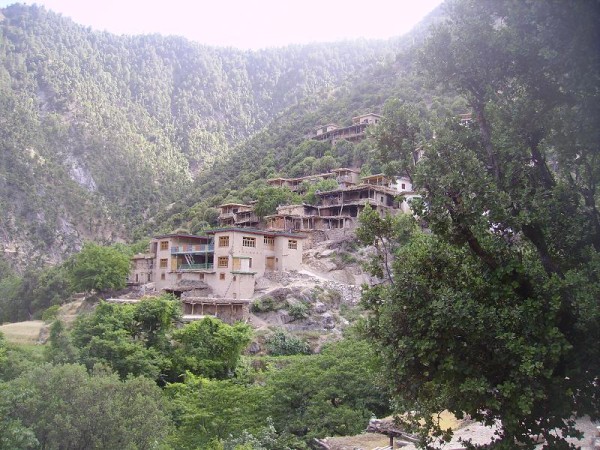
This is a valley, I don’t know, 15, 20 kilometers long. There’s only 10,000 people in it. They speak their own language. They speak Korengali. In the year 2009 we have a valley with people who speak their own language. Their only trade is the timber trade. And when they move their timber, they don’t even leave their valley. Most of the time, I believe, they just take it to the Mazar Valley, and a middleman picks it up and brings it to Pakistan for them.

We show up. We enter their valley. We occupy the richest man’s timber mill. And then we bring in Afghan army and Afghan police, who aren’t from there.

And then what do we do? Then we have the Afghan police and Afghan army. They say to the Korengalis, they say, “These mountains here that your families have been cutting trees down, sustaining yourselves for hundreds of years, you don’t own them. The central government does. And you have to pay tax on that.”

I’m not sure how many people anywhere else in the world wouldn’t take up arms against something like that.

And so, and for every Korengal we’re in, like I said before, there’s a hundred we’re not. And there’s like — and that would happen in those other valleys, the same thing, too, in the south. [Interview transcript]

Editor’s Comment — The “valleyism” that Hoh describes contains a crucial message for Americans considering the war in Afghanistan: this is a quagmire far more complex than Vietnam since America and its allies have sparked a thousand wars.

But perhaps more important than this military observation is the way the concept of valleyism should transform the value judgments outsiders make about Afghans and the land they inhabit.

What foreign armies and policymakers are up against is an incomparable level of adaptation where the non-transferable governing force is local knowledge — the means through which Afghans have made their homes in a land that others find utterly inhospitable.

In an analysis for the New York Times, David Sanger talks about Hamid Karzai as a flawed vessel in which the West had invested its hopes that Afghanistan could be saved and that Karzai could be re-legitimized through an election:

The question was whether that vote would demonstrate that a desolate nation that has always been at the mercy of larger powers would show it could find its own way.

In this image of a “desolate nation” that has yet to “find its own way,” there isn’t even an inkling that in many ways Afghanistan, as a patchwork of local communities, has found its own way admirably. Its greatest problem is that this is a way that few outsiders appreciate — especially those coming from a nation where human worth is so often measured by the size of someone’s bank balance.

As Rory Stewart says: “In every case, Afghans are more competent, more canny, more capable than we acknowledge, and we are less so.”

With Karzai, U.S. faces weak partner in time of war

With the White House’s reluctant embrace on Sunday of Hamid Karzai as the winner of Afghanistan’s suddenly moot presidential runoff, President Obama now faces a new complication: enabling a badly tarnished partner to regain enough legitimacy to help the United States find the way out of an eight-year-old war.

It will not be easy. As the evidence mounted in late summer that Mr. Karzai’s forces had sought to win re-election through widespread fraud to defeat his main challenger, Abdullah Abdullah, administration officials made no secret of their disgust. How do you consider sending tens of thousands of additional American troops, they asked in meetings in the White House, to prop up an Afghan government regarded as illegitimate by many of its own people?

The answer was supposed to be a runoff election. Now, administration officials argue that Mr. Karzai will have to regain that legitimacy by changing the way he governs, at a moment when he is politically weaker than at any time since 2001.

“We’re going to know in the next three to six months whether he’s doing anything differently — whether he can seriously address the corruption, whether he can raise an army that ultimately can take over from us and that doesn’t lose troops as fast as we train them,” one of Mr. Obama’s senior aides said. He insisted on anonymity because of the confidentiality surrounding the Obama administration’s own debate on a new strategy, and the request by Gen. Stanley A. McChrystal, the American military commander in Afghanistan, for upward of 44,000 more troops.

“Needless to say,” the senior aide added, “this is not where we wanted to be after nine months.”

That is a huge understatement. [continued…]

Why all the president’s Afghan options are bad ones

In the worst of times, my father always used to say, “A good gambler cuts his losses.” It’s a formulation imprinted on my brain forever. That no-nonsense piece of advice still seems reasonable to me, but it doesn’t apply to American war policy. Our leaders evidently never saw a war to which the word “more” didn’t apply. Hence the Afghan War, where impending disaster is just an invitation to fuel the flames of an already roaring fire.

Here’s a partial rundown of news from that devolving conflict: In the last week, Nuristan, a province on the Pakistani border, essentially fell to the Taliban after the U.S. withdrew its forces from four key bases. Similarly in Khost, another eastern province bordering Pakistan where U.S. forces once registered much-publicized gains (and which Richard Holbrooke, now President Obama’s special envoy to the region, termed “an American success story”), the Taliban is largely in control. It is, according to Yochi Dreazen and Anand Gopal of the Wall Street Journal, now “one of the most dangerous provinces” in the country. Similarly, the Taliban insurgency, once largely restricted to the Pashtun south, has recently spread fiercely to the west and north. At the same time, neighboring Pakistan is an increasingly destabilized country amid war in its tribal borderlands, a terror campaign spreading throughout the country, escalating American drone attacks, and increasingly testy relations between American officials and the Pakistani government and military. [continued…]

Facebooktwittermail