Category Archives: Obama administration

Obama’s bad influence

Obama’s bad influence

Now that Europe and the United States are officially reunited, it seems worth asking: is this necessarily a good thing? The Nobel Committee, which awarded the prize specifically for Obama’s embrace of “multilateral diplomacy,” is evidently convinced that US engagement on the world stage is a triumph for peace and justice. I’m not so sure. After nine months in office, Obama has a clear track record as a global player. Again and again, US negotiators have chosen not to strengthen international laws and protocols but rather to weaken them, often leading other rich countries in a race to the bottom.

Let’s start where the stakes are highest: climate change. During the Bush years, European politicians distinguished themselves from the United States by expressing their unshakable commitment to the Kyoto Protocol. So while the United States increased its carbon emissions by 20 percent from 1990 levels, the European Union countries reduced theirs by 2 percent. Not stellar, but clearly a case where the EU’s breakup with the United States carried tangible benefits for the planet.

Flash forward to the high-stakes climate negotiations that just wrapped up in Bangkok. The talks were supposed to lead to a deal in Copenhagen this December that significantly strengthens the Kyoto Protocol. Instead, the United States, the EU and the rest of the developed countries formed a unified bloc calling for Kyoto to be scrapped and replaced. Where Kyoto set clear and binding targets for emission reductions, the US plan would have each country decide how much to cut, then submit its plans to international monitoring (with nothing but wishful thinking to ensure that this all keeps the planet’s temperature below catastrophic levels). And where Kyoto put the burden of responsibility squarely on the rich countries that created the climate crisis, the new plan treats all countries the same. [continued…]

Facebooktwittermail

US: Security Council might not debate Goldstone Report

US: Security Council might not debate Goldstone Report

The endorsement of the Goldstone Report by the UN Human Rights Council (UNHRC) does not necessarily mean that it will be reviewed by the Security Council, US State Department spokesman Ian Kelly said Friday.

Earlier, the UNHRC voted to refer the report to the Security Council, possibly setting up international prosecution of Israelis and Palestinians accused of war crimes.

The report accused both Israel and the Palestinian terror group Hamas of committing war crimes in Gaza in their December-January conflict.

Kelly told reporters in Washington that the resolution had “an unbalanced focus and we’re concerned that it will exacerbate polarization and divisiveness.” [continued…]

Israel vents fury at ally Turkey over ‘barbaric’ TV drama

Israel’s increasingly troubled relations with its main ally in the Muslim world took a turn yesterday when it formally protested to Turkey over the “incitement” generated by a television series featuring fictional scenes of barbaric acts by Israeli soldiers.

The airing of the series, on Turkish
state television, coincides with tensions triggered by a decision last week by Ankara to exclude Israel – which it has severely criticised over last winter’s war in Gaza – from a planned Nato air exercise.

The acting Turkish ambassador, Ceylan Ozen, was summoned yesterday to the Israeli foreign ministry in protest at the drama series Ayrilik which shows soldiers brutalising Palestinians. In one abbreviated sequence shown on YouTube, a soldier is seen gratuitously shooting a girl at close range, killing her. In another, Palestinians are apparently about to be executed by a firing squad. [continued…]

An ordinary Israel

Is Israel just a nation among nations?

On one level, it is indeed an ordinary place. People curse the traffic, follow their stocks, Blackberry, go to the beach and pay their mortgages. Stroll around in the prosperous North Tel Aviv suburbs and you find yourself California dreaming.

On another, it’s not. More than 60 years after the creation of the modern state, Israel has no established borders, no constitution, no peace. Born from exceptional horror, the Holocaust, it has found normality elusive. [continued…]

Despite promises to Obama, construction continues in dozens of W. Bank settlements

Human rights activists monitoring the West Bank report that despite commitments Israel made to President Barack Obama’s administration last month, widespread building activity commenced three weeks ago in at least 12 settlements.

The work consists of ground preparation, pouring concrete and drilling construction foundations.

This work is not part of the projects that Israel and the United States had reached an understanding on. Prime Minister Benjamin Netanyahu and Defense Minister Ehud Barak had agreed with the administration to complete some 2,500 housing units that were already in various stages of construction at the time. The dozen sites do not appear on the list of 492 new housing units that the defense ministry issued after Barak approved their construction. Work on these units began after the list was released. [continued…]

ZOA praises Obama administration on Goldstone

The Zionist Organization of America is praising the Obama administration for “taking a principled stance” against the Goldstone Report.

The ZOA points to the remarks made at the UN Human Rights Council by U.S. Assistant Secretary of State for Democracy, Human Rights and Labor Michael Posner, in which he said that “we believe that the document is deeply flawed and disagree sharply with its methodology and many of its recommendations, including their extraordinarily broad scope.” [continued…]

Facebooktwittermail

U.S. considers a new assessment of Iran threat

U.S. considers a new assessment of Iran threat

U.S. spy agencies are considering whether to rewrite a controversial 2007 intelligence report that asserted Tehran halted its efforts to build nuclear weapons in 2003, current and former U.S. intelligence officials say.

The intelligence agencies’ rethink comes as pressure is mounting on Capitol Hill, and among U.S. allies, for the Obama administration to redo the 2007 assessment, after a string of recent revelations about Tehran’s nuclear program.

German, French and British intelligence agencies have all disputed the conclusions of the 2007 National Intelligence Estimate, or NIE, in recent months, according to European officials briefed on the exchanges. [continued…]

China’s links to Iran a snag for sanctions

Chinese Premier Wen Jiabao said Thursday that his nation was committed to deepening its ties with Iran, a declaration that underscores the difficulty the United States will face in seeking broad economic sanctions against Tehran in an effort to rein in its nuclear program.

“The Sino-Iranian relationship has witnessed rapid development, as the two countries’ leaders have had frequent exchanges, and cooperation in trade and energy has widened and deepened,” Wen said at a meeting in Beijing with visiting Iranian Vice President Mohammad Reza Rahimi, according to the official New China News Agency.

The U.S. and its allies are counting on China and Russia, veto-wielding members of the U.N. Security Council, for support in pressuring Iran to abandon activities the West fears could lead to the development of nuclear weapons. [continued…]

Facebooktwittermail

Has Obama’s foreign policy sacrificed human rights?

Has Obama’s foreign policy sacrificed human rights?

It is as hard as ever to know how much credence to give the report in today’s Kommersant newspaper that the Obama administration has done a backroom deal with Moscow in which it has agreed to self-censor on Russian human rights violations.

As The Guardian’s Moscow correspondent, Luke Harding, points out, Hillary Clinton took time out of her Moscow trip this afternoon to meet human rights activists, which knocks a bit of a hole in the story.

But the Obama White House has indisputably put the Bush democracy agenda on the back burner, if not taken it off the stove altogether. In his speech to the UN general assembly last month, the president spelled out the four pillars of his foreign policy which were non-proliferation, the pursuit of peace, combating climate change and the rebuilding of the global economy.

This is a long way from Bush’s second inaugural speech, which made America’s new manifest destiny the promotion of democracy across the world. In Obama’s UN address, human rights made an appearance principally as the right to life under the peace and security heading.

As for the rest, Obama’s message was: “America will live its values, and we will lead by example”. For example, by closing Guantanamo. [continued…]

Facebooktwittermail

Why Palestinians have lost faith in Obama

Why Palestinians have lost faith in Obama

For a man who is sometimes seen as the Palestinian politician that the Israelis and the Americans like best, Prime Minister Salaam Fayyad was in a strikingly robust mood during a two-hour press conference in Ramallah yesterday. While too polite to criticise the Obama administration, he nevertheless had a clear message in the wake of the failure by the US to persuade the Israeli government of Benjamin Netanyahu to grant a freeze on Jewish settlement construction in the West Bank as a precursor to serious negotiations.

He suggested that the Palestinian leadership no longer had much interest in a “process for the sake of a process” and he questioned what Mr Netanyahu’s “equivocal” endorsement of a Palestinian state really meant.

Mr Fayyad had been much struck by a report from the Jerusalem Centre for Public Affairs, arguing that the 60 per cent of the West Bank controlled by Israel and designated as Area C under the Oslo accords, including the Jordan Valley, should not be handed over in any peace deal. If the Israeli establishment was envisaging a “Mickey Mouse state” along these lines, he said, then “it looks like it would not come close to what we have in mind.” [continued…]

Yishai: Deporting foreign children preserves Israel’s Jewish identity

Interior Minister and Shas Party chairman Eli Yishai plans “to muster all of Shas’ political power on the issue of the foreign workers,” he told Haaretz on Tuesday.

During a conversation with Prime Minister Benjamin Netanyahu on Monday, Yishai warned that if the cabinet rejects his demand that children of foreign workers not be given residency or citizenship in Israel, he will abdicate responsibility for the Immigration Authority, which is currently in his ministry’s purview, to the Prime Minister’s Office, and foment a coalition crisis to boot. [continued…]

Facebooktwittermail

Experts say Iran may be ready for a nuclear deal

Experts say Iran may be ready for a nuclear deal

In contentious, high-stakes negotiations, deals are possible when both sides have a chance to declare victory, and that point may have been reached.

“If the Iranian endgame is to keep enrichment, and if the United States’ endgame is to make sure there are no nuclear weapons in Iran, then it can be a win-win,” said Trita Parsi, author of a book on Iran and president of the National Iranian American Council, an independent advocacy group in Washington. “Those who have been criticizing the administration for compromising or giving Iran a concession, they are wrong. It is not a concession to adjust to an unchanging reality.”

For Iran, this is not exactly about compromising — which it has shown little appetite for — as much as cooperating. For the West, it is not about winning concessions but about developing verifiable assurances that Iran is not producing weapons.

“I think the Iranians are simply in no mood to accept any serious limits on the expansion of their program,” said Flynt Leverett, director of the Iran Project at the New America Foundation. “From their point of view, they already suspended enrichment for almost two years, from 2003 to 2005, and from their perspective, they got nothing for that and they’re not going to do that again.”

But Mr. Leverett said Iran sees “that by expanding, they’ve gotten the attention of the international community and they have cards to play.”

And that may have been Iran’s primary goal from the start.

There are many analysts inside and outside Iran who say that Tehran’s objective has been to master — or at least appear to master — the process of preparing nuclear fuel, fashioning a warhead and providing the means to deliver that warhead, but not actually to build a weapon. [continued…]

‘Israel may attack Iran after December’

Israel is making preparations to carry out military attacks in Iran after December, a French magazine reported overnight Wednesday.

According to the report in Le Canard Enchainé quoted by Israel Radio, Jerusalem has already ordered high-quality combat rations from a French food manufacturer for soldiers serving in elite units and has also asked reservists of these units staying abroad to return to Israel.

The magazine further reported that in a recent visit to France, IDF Chief of General Staff Lt.-Gen. Gabi Ashkenazi told his French counterpart Jean-Louis Georgelin that Israel was not planning to bomb Iran, but might send elite troops to conduct activities on the ground there. [continued…]

Editor’s Comment — So, the bombing plans have now been shelved. Instead, Israel is going to send in commandos?

I kind of doubt it. The first problem is getting them in. I suppose the Kurds might oblige. But is Israel willing to risk seeing any of its soldiers taken prisoner and put on trial or used as human shields?

Facebooktwittermail

Stanley McChrystal’s long war

Stanley McChrystal’s long war

In his initial assessment of the country, sent to President Obama early last month, McChrystal described an Afghanistan on the brink of collapse and an America at the edge of defeat. To reverse the course of the war, McChrystal presented President Obama with what could be the most momentous foreign-policy decision of his presidency: escalate or fail. McChrystal has reportedly asked for 40,000 additional American troops — there are 65,000 already here — and an accelerated effort to train Afghan troops and police and build an Afghan state. If President Obama can’t bring himself to step up the fight, McChrystal suggested, then he might as well give up.

“Inadequate resources,” McChrystal wrote, “will likely result in failure.”

The magnitude of the choice presented by McChrystal, and now facing President Obama, is difficult to overstate. For what McChrystal is proposing is not a temporary, Iraq-style surge — a rapid influx of American troops followed by a withdrawal. McChrystal’s plan is a blueprint for an extensive American commitment to build a modern state in Afghanistan, where one has never existed, and to bring order to a place famous for the empires it has exhausted. Even under the best of circumstances, this effort would most likely last many more years, cost hundreds of billions of dollars and entail the deaths of many more American women and men.

And that’s if it succeeds. [continued…]

An inconvenient truth teller

Joe Biden had a question. During a long Sunday meeting with President Obama and top national-security advisers on Sept. 13, the VP interjected, “Can I just clarify a factual point? How much will we spend this year on Afghanistan?” Someone provided the figure: $65 billion. “And how much will we spend on Pakistan?” Another figure was supplied: $2.25 billion. “Well, by my calculations that’s a 30-to-1 ratio in favor of Afghanistan. So I have a question. Al Qaeda is almost all in Pakistan, and Pakistan has nuclear weapons. And yet for every dollar we’re spending in Pakistan, we’re spending $30 in Afghanistan. Does that make strategic sense?” The White House Situation Room fell silent. But the questions had their desired effect: those gathered began putting more thought into Pakistan as the key theater in the region. [continued…]

Why Joe Biden should resign

It’s been known for a while that Biden has been on the other side of McChrystal’s desire for a big escalation of our forces there — the New York Times reported last month that he has “deep reservations” about it. So if the president does decide to escalate, Biden, for the good of the country, should escalate his willingness to act on those reservations.

What he must not do is follow the same weak and worn-out pattern of “opposition” we’ve become all-too-accustomed to, first with Vietnam and then with Iraq. You know the drill: after the dust settles, and the country begins to look back and not-so-charitably wonder, “what were they thinking?” the mea-culpa-laden books start to come out. On page after regret-filled page, we suddenly hear how forceful this or that official was behind closed doors, arguing against the war, taking a principled stand, expressing “strong concern” and, yes, “deep reservations” to the president, and then going home each night distraught at the unnecessary loss of life.

Well, how about making the mea culpa unnecessary? Instead of saving it for the book, how about future author Biden unfetter his conscience in real time — when it can actually do some good? If Biden truly believes that what we’re doing in Afghanistan is not in the best interests of our national security — and what issue is more important than that? — it’s simply not enough to claim retroactive righteousness in his memoirs. [continued…]

Facebooktwittermail

Obama’s delusion

Obama’s delusion

Long before he became president, there were signs in Barack Obama of a tendency to promise things easily and compromise often. He broke a campaign vow to filibuster a bill that immunised telecom outfits against prosecution for the assistance they gave to domestic spying. He kept his promise from October 2007 until July 2008, then voted for the compromise that spared the telecoms. As president, he has continued to support their amnesty. It was always clear that Obama, a moderate by temperament, would move to the middle once elected. But there was something odd about the quickness with which his website mounted a slogan to the effect that his administration would look to the future and not the past. We all do. Then again, we don’t: the past is part of the present. Reduced to a practice, the slogan meant that Obama would rather not bring to light many illegal actions of the Bush administration. The value of conciliation outweighed the imperative of truth. He stood for ‘the things that unite not divide us’. An unpleasant righting of wrongs could be portrayed as retribution, and Obama would not allow such a misunderstanding to get in the way of his ecumenical goals. [continued…]

Facebooktwittermail

Jordanian frustration with U.S., Israel mounting

Jordanian frustration with U.S., Israel mounting

While I was in Jordan, King Abdullah gave a lengthy interview to Haaretz about the Israeli-Palestinian situation in which he warned that “We’re sliding back into the darkness.” My conversations with more than two dozen Jordanian officials, political activists, journalists and analysts suggest that on this, at least, the King reflects a widespread Jordanian consensus. Jordanians are growing increasingly frustrated with the Obama team’s approach, alarmed at Netanyahu’s unpunished intransigence, and downright frantic about the trend in Jerusalem. If we don’t start seeing progress soon, with stronger American leadership, then the “tinderbox” could explode.

It wasn’t always like this. When I was last in Jordan about six months ago, I found a great deal of optimism over the appointment of George Mitchell and the high profile Obama gave to the Israeli-Palestinian problem. But now those hopes seem to have largely evaporated. The launch of Israeli-Palestinian talks which they had expected by June continue to drift in limbo, while Obama’s failure to deliver on the settlement freeze has — just as so many predicted — eroded his credibility. How could the Americans have allowed Netanyahu to not only defy U.S. demands on settlements but to not even pay any significant price? Again and again, from all sectors of Jordanian political society, I heard the same refrain: Obama’s heart is in the right place and we want him to succeed, but he’s just not getting it done. [continued…]

‘Israel abuses detention without trial’

Twenty-eight Palestinians have been held in administrative detention for two to four years, and one has been held for four-and-a-half years, according to a report due to be released early Wednesday morning by two human rights organizations, B’Tselem and Hamoked.

The report, entitled “Without Trial,” found that more than 1,000 Palestinians had been held simultaneously in administrative detention during the second intifada.

At the end of September of this year, Israel was holding 335 administrative detainees, including three women and a minor. Thirty-seven percent of the detainees had been in jail for one to two years. [continued…]

Palestinian support wanes for American-trained forces

Commanders of the U.S.-trained Palestinian security forces who have been locking up criminals and battling Hamas militants here for nearly two years have maintained morale in the ranks with a single promise: They will one day be the anchor of security for an independent Palestinian state.

The lack of progress toward that goal is starting to sap Palestinian public support for the forces and erode morale among troops, even as they win praise and fresh funding from Washington for their accomplishments. [continued…]

After the bombing, drug addiction strikes Gaza

Mental health professionals say there has been a rise in the drug’s usage in Gaza since the war. The Hamas authorities have tried to crack down on it, but the drug’s severe withdrawal symptoms means it is a seriously hard habit to break. Hasan Shaban Zeyada, a senior psychologist at the Gaza Community Mental Health Programme (GCMHP) is convinced that many of the psychological problems underlying the addiction are “the consequence of living in this situation: the siege, internal division and the war”.

Abu Ahmed used to have a good job as a driver. But like an estimated 100,000 other Gazans he lost it when Israel imposed its blockade after Hamas seized control of the strip from Fatah in June 2007. “Before the war the situation was so hard. There was no work, plus I had to take care of 11 people, including my wife. All people could do was sit around in the street and drink tea or coffee.” [continued…]

Facebooktwittermail

Russia resists U.S. position on sanctions for Iran

Russia resists U.S. position on sanctions for Iran

Denting President Obama’s hopes for a powerful ally in his campaign to press Iran on its nuclear program, Russia’s foreign minister said Tuesday that threatening Tehran now with harsh new sanctions would be “counterproductive.”

The minister, Sergey V. Lavrov, said after meeting with Secretary of State Hillary Rodham Clinton here that diplomacy should be given a chance to work, particularly after a meeting in Geneva this month in which the Iranian government said it would allow United Nations inspectors to visit its clandestine nuclear enrichment site near the holy city of Qum.

“At the current stage, all forces should be thrown at supporting the negotiating process,” he said. “Threats, sanctions and threats of pressure in the current situation, we are convinced, would be counterproductive.” [continued…]

Iran investigating prominent opposition cleric

Iranian authorities launched a provocative attack on the opposition movement Tuesday by announcing a special investigation of prominent cleric Mehdi Karroubi over his accusations that security forces raped and tortured protesters after the disputed June reelection of President Mahmoud Ahmadinejad.

The move against Karroubi, a revered figure from Iran’s 1979 Islamic Revolution, is an attack on the heart of the opposition. It’s an indication that the government is increasing pressure on top dissenters, even clerics, and it follows death sentences handed to at least two anti-government protesters.

The investigation will test the resolve of the opposition and has the potential to unleash another round of street demonstrations, which recently have been largely thwarted by the Revolutionary Guard and the Basiji militia. At a rally in September, protesters shouted: “If Karroubi is arrested, there will be insurrections across Iran.” [continued…]

Facebooktwittermail

More US troops deployed overseas under Obama than Bush

More US troops deployed overseas under Obama than Bush

President Obama announced in March that he would be sending 21,000 additional troops to Afghanistan. But in an unannounced move, the White House has also authorized — and the Pentagon is deploying — at least 13,000 troops beyond that number, according to defense officials.

The additional troops are primarily support forces, including engineers, medical personnel, intelligence experts and military police. Their deployment has received little mention by officials at the Pentagon and the White House, who have spoken more publicly about the combat troops who have been sent to Afghanistan.

The deployment of the support troops to Afghanistan brings the total increase approved by Obama to 34,000. The buildup has raised the number of U.S. troops deployed to the war zones of Iraq and Afghanistan above the peak during the Iraq “surge” that President George W. Bush ordered, officials said. [continued…]

Rushed training ‘risks turning Afghan troops into cannon fodder’

Recruits to the Afghan Army are being rushed into combat with a barely acceptable level of training, according to senior British officers closely involved in the programme.

With US and Nato leaders pressing for a rapid expansion of the army to relieve pressure on their own forces and facilitate their eventual departure, the recruits are becoming “cannon fodder”, another coalition official said.

Courses are being shortened, class sizes are swelling and there is a serious shortage of Afghan instructors and Western mentors. [continued…]

Resignation of Afghan election official raises anxiety level

The disarray surrounding Afghanistan’s presidential election deepened Monday when an Afghan member of the vote-reviewing commission quit, citing “foreign interference.”

The resignation of Mustafa Barakzai from the Electoral Complaints Commission was not expected to affect the panel’s work of sifting through allegations of massive vote-rigging in the Aug. 20 balloting, officials said. But it added an acrimonious new element to a vote that has already become an exercise in recrimination — and has left Afghanistan in political limbo at a time when crucial decisions about the course of the conflict are being made in Washington. [continued…]

Facebooktwittermail

Obama floats like a butterfly – and stings like one as well

Obama floats like a butterfly – and stings like one as well

Just five years ago, Barack Obama was still a local politician in Illinois, preparing for a run for the US Senate. His office wall in Chicago at the time was decorated with the famous picture of Muhammad Ali standing over Sonny Liston, after knocking him out in a heavyweight title fight. Ali famously boasted that he could “float like a butterfly and sting like a bee.” But now that Mr Obama is president, he seems to float like a butterfly – and sting like one as well.

The notion that Mr Obama is a weak leader is now spreading in ways that are dangerous to his presidency. The fact that he won the Nobel Peace Prize last Friday will not change this impression. Peace is all very well. But Mr Obama now needs to pick a fight in public – and win it with a clean knock-out.

In truth, the Norwegians did the US president no favours by giving him the peace prize after less than a year in office. The award will only embellish a portrait of the president that has been painted in ever more vivid colours by his political enemies. The right argues that Mr Obama is a man who has been wildly applauded and promoted for not doing terribly much. Now the Nobel committee seems to be making their point for them. [continued…]

Whiner-in-Chief

The Obama administration really needs to get over itself.

First, the president and his aides go to war with Fox News because the network maintains a generally anti-Obama slant.

Then, an anonymous administration aide attacks bloggers for failing to maintain a sufficiently pro-Obama slant.

These are not disconnected developments.

An administration that won the White House with an almost always on-message campaign and generally friendly coverage from old and new media is now frustrated by its inability to control the debate and get the coverage it wants. [continued…]

Facebooktwittermail

U.S. to Egypt: Fatah-Hamas deal undermines Israel-PA talks

U.S. to Egypt: Fatah-Hamas deal undermines Israel-PA talks

The United States sent a message to Egypt stating it does not support the proposed reconciliation agreement between Fatah and Hamas as it would undermine negotiations with Israel, Haaretz has learned.

George Mitchell, the U.S. envoy to the Middle East, met on Saturday night in Cairo with the chief of Egyptian intelligence, Gen. Omar Suleiman, and told him the United States would not support an agreement not aligned with the principles of the Quartet.

According to the agreement, which was supposed to have been signed by Thursday, Abbas was to issue a presidential decree no later than October 25, scheduling both parliamentary and presidential elections for June 28. Eighty percent of the delegates to the Palestinian parliament were to be elected by party basis, and 20 percent by constituency.

A special committee with delegates from all factions was supposed to have assumed control of the Gaza Strip, reporting to Abbas. The Strip was also to see a new security force, staffed with members of all Palestinian factions.

Sources told Haaretz that Mitchell made clear to the Egyptians on Saturday the United States expects any Palestinian government to follow the conditions of the Quartet, which include recognition of the State of Israel, acknowledging earlier agreements and renouncing terrorism.

Mitchell also said certain aspects of current agreement were poorly timed as they would undermine relaunching negotiations between Israel and the Palestinians. [continued…]

Palestinian memo says hopes in Obama ‘evaporated’

An internal document circulated among members of Palestinian President Mahmoud Abbas’ political party says all hopes placed in the Obama administration “have evaporated” because of alleged White House backtracking on key issues to the Palestinians.

The Fatah Party memorandum, obtained Tuesday by The Associated Press, accuses the United States of backing off from its demands that Israel freeze settlement construction and failing to set a clear agenda for new Mideast peace talks.

It wasn’t immediately clear whether the Oct. 12 document reflected Abbas’ views or was intended to be leaked as Fatah’s attempt to pressure President Barack Obama to bear down harder on Israel.

The document said the Palestinians have lost hope in Obama and accused the American leader of caving in to pressure from pro-Israel lobbyists in Washington.

“All hopes placed in the new U.S. administration and President Obama have evaporated,” said the document issued by Fatah’s Office of Mobilization and Organization. The department is headed Fatah’s No. 2, Mohammed Ghneim. [continued…]

Turkey’s attitude toward Israel is changing

Turkey did not hide its deep opposition to Israel’s policies in the territories in general and to Operation Lead Cast in particular. Erdogan’s outburst against President Shimon Peres last January at the Davos gathering did not stem from Islamist or pro-Iranian objectives.

Erdogan’s support for a UN deliberation of the Goldstone Report and his declaration that “those responsible for war crimes must be identified and held accountable,” is not based on any wish to please Iran or Syria. Turkey has a steady and clear policy on this issue and it is not a proxy for any country.

Public opinion exists in Turkey too and it is influential, and when the prime minister sees thousands of Turks protesting against Israel’s policy in Jerusalem, he cannot remain indifferent. At the same time, Turkey continues and will continue to have normal ties with Israel because such a relationship is part of Turkey’s strategy, but today it finds itself in a different international status, of the sort that allows it to also take swipes at Israel. [continued…]

Facebooktwittermail

Russian FM: Threats of Iran sanctions won’t work

Russian FM: Threats of Iran sanctions won’t work

Russia pushed back Tuesday at U.S. efforts to threaten tough new sanctions if Iran fails to prove its nuclear program is peaceful, a setback to the Obama administration’s desire to present a united front with Moscow.

After meeting with U.S. Secretary of State Hillary Rodham Clinton, Russian Foreign Minister Sergey Lavrov said Moscow believed that such threats would not persuade Iran to comply and that negotiations should continue to be pursued.

“At the current stage, all forces should be thrown at supporting the negotiating process,” he told reporters at a joint news conference with Clinton. “Threats, sanctions and threats of pressure in the current situation, we are convinced, would be counterproductive.” [continued…]

Iranian journalists flee, fearing retribution for covering protests

For two months Ehsan Maleki traveled around Iran with a backpack containing his cameras, a few pieces of clothing and his laptop computer, taking pictures of the reformist candidate Mir Hussein Moussavi during the presidential campaign. He did not know that his backpack and his cameras would soon become his only possessions, or that he would be forced to crawl out of the country hiding in a herd of sheep.

Mr. Maleki, 29, is one of dozens of reporters, photographers and bloggers who have either fled Iran or are trying to flee in the aftermath of the disputed June presidential election. Reporters Without Borders, a Paris-based organization that promotes press freedom and monitors the safety of journalists, said the number of journalists leaving Iran was the largest since the years after the 1979 Islamic Revolution.

The wave of departures reflects the journalists’ anxiety over the retribution many of them have faced for reporting on the government’s violent suppression of the post-election protests. As bloody clashes unfolded in the streets of Tehran, the government went to great lengths to restrict the flow of information to the outside world. Foreign journalists were banned, and local reporters and photographers were warned to stay at home. [continued…]

Facebooktwittermail

Diplomacy in the lead on Iran nuclear issue — for now

Diplomacy in the lead on Iran nuclear issue — for now

Agreement to open Iran’s hidden nuclear complex to inspection has reduced talk of military action and put diplomacy back on track — at least for a while. But even as the U.S. tries to build international pressure, emerging details suggest it might already be too late for an armed strike.

Everything about Iran’s newly disclosed site near the holy city of Qom complicates the task for the two most likely attackers, the U.S. and Israel. Iranian officials say that’s precisely why they built the facility on an elite military base, fortified with steel and concrete, and buried under a mountain.

Less than a week after President Obama revealed that the U.S. knew about the site, Iran agreed to open it to inspectors from the International Atomic Energy Agency. In a subsequent visit to Tehran, IAEA Director-General Mohamed ElBaradei said inspectors would visit Oct. 25. [continued…]

Facebooktwittermail

Obama has betrayed mission to forge Mideast peace

Obama has betrayed mission to forge Mideast peace

What has the new Nobel laureate done so far in our region? Mitchell Shmitchell, a bitter and lost struggle over settlement expansion, a bizarre struggle against the Goldstone report, a disgraceful silence about the Gaza siege, and the ultimate proof that there’s nothing new under the Middle Eastern sun. It’s not Obama who “can,” it’s Israel. Israel can twist the arms of any president. You don’t want to freeze the settlements? Okay, never mind. You don’t want to take responsibility for the crimes in Gaza? Okay, never mind. You don’t want to end the occupation? Okay, never mind. This is not the conduct of a Nobel laureate and president.

A consolation prize: Perhaps the Nobel will serve as a catalyst, a kind of alarm clock ringing to wake the laureate in the final minute. Unlike in Afghanistan and Iraq, in this region he will not need to shed American blood to secure peace. It’s enough to show political determination, apply pressure and use Israel’s isolation and dependency for the cause of peace. Israel needs a friend to save it from itself.

Obama now needs to choose whether to join the laureates-in-vain – from Henry Kissinger to Yitzhak Rabin, Shimon Peres and Yasser Arafat – or join the great ones, like Martin Luther King, Jr., Nelson Mandela, Mikhail Gorbachev, Aung San Suu Kyi and Mother Teresa. It’s true, no one has ever won the prize twice (except the International Committee of the Red Cross), but no one has won it on a down payment, either. If Obama brings peace to the Middle East, perhaps Oslo will change its ways once more and grant him the Nobel again – once as a down payment, once by right. Congratulations, Mr. President, now it’s time to settle your debt. [continued…]

Obama, man of peace? No, just a Nobel prize of a mistake

Isn’t there anyone in the White House to remind Mr Obama that the Israelis have never obliged a US president who asked for an end to the building of colonies for Jews – and Jews only – on Arab land? Bill Clinton demanded this – it was written into the Oslo accords – and the Israelis ignored him. George W Bush demanded an end to the fighting in Jenin nine years ago. The Israelis ignored him. Mr Obama demands a total end to all settlement construction. “They just don’t get it, do they?” an Israeli minister – apparently Prime Minister Benjamin Netanyahu – was reported to have said when the US Secretary of State, Hillary Clinton, reiterated her president’s words. That’s what Avigdor Lieberman, Israel’s crackpot foreign minister – he’s not as much a crackpot as Mahmoud Ahmadinejad, but he’s getting close – said again on Thursday. “Whoever says it’s possible to reach in the coming years a comprehensive agreement,” he announced before meeting Mr Obama’s benighted and elderly envoy George Mitchell, “… simply doesn’t understand the reality.”

Across Arabia, needless to say, the Arab potentates continue to shake with fear in their golden minarets. That great Lebanese journalist Samir Kassir – murdered in 2005, quite possibly by Mr Obama’s new-found Syrian chums – put it well in one of his last essays. “Undeterred by Egypt since Sadat’s peace,” he wrote, “convinced of America’s unfailing support, guaranteed moral impunity by Europe’s bad conscience, and backed by a nuclear arsenal that was acquired with the help of Western powers, and that keeps growing without exciting any comment from the international community, Israel can literally do anything it wants, or is prompted to do by its leaders’ fantasies of domination.” [continued…]

Facebooktwittermail

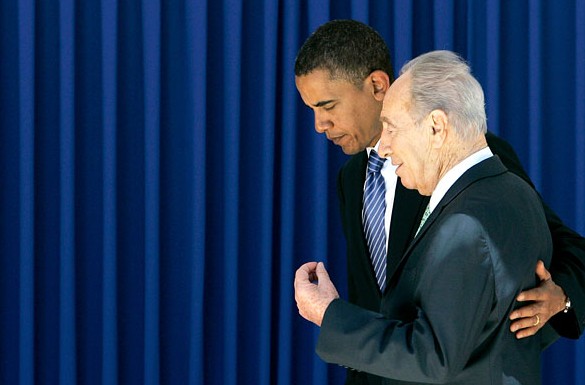
Barack Obama to follow in Shimon Peres’ footsteps

Barack Obama to follow in Shimon Peres’ footsteps

“Very few leaders if at all were able to change the mood of the entire world in such a short while with such profound impact. You provided the entire humanity with fresh hope, with intellectual determination, and a feeling that there is a lord in heaven and believers on earth.

“Under your leadership, peace became a real and original agenda. And from Jerusalem, I am sure all the bells of engagement and understanding will ring again. You gave us a license to dream and act in a noble direction.” Nobel Peace Prize laureate and President of Israel, Shimon Peres.

_____

It’s important not to rush to judgment on Obama — unless the judgment is glowing, then it’s full steam ahead.

If the so-called “reality-based community” still existed, then the very same people who have been suggesting that Obama critics hold their fire should now be insisting the Nobel committee jumped the gun.

Unfortunately that isn’t happening as much as it should. Why? Obama loyalists feel personally embattled. The impulse to grasp on to this fleeting object of relief is for some, irresistible. It’s a quick salve to those whose own unflinching loyalties portend humiliations that lurk down the road.

Realists can’t indefinitely remain true believers. True believers eventually abandon realism.

European Commission President Jose Manuel Barroso said: “The award of the prize to President Obama, leader of the most significant military power in the world, at the beginning of his mandate, is a reflection of the hopes he has raised globally with his vision of a world without nuclear weapons.”

There’s a note of realism there — this is about hopes raised, not accomplishments. The problem is, hope can only be raised so far and for so long. It’s power and durability depends on a strengthening conviction that hope is on a trajectory that leads to actuality. The longer that trajectory remains unclear, the more likely it will be that hope has instead provided the foundation for disappointment, cynicism and bitterness.

Obama traded on hope as a path to power but now he has the power he has to dispense with a large measure of hope. Governance is about deliverables.

It’s not surprising that the Nobel Peace Prize committee have chosen to endorse Obama’s nuclear disarmament initiative. But whether that goal has actually raised hopes globally is something I’m skeptical about. Disarmament is on Obama’s wish-list, but since — in the name of realism — he warned that this might not be accomplished in his lifetime, and since a goal is a dream with a deadline, thus far Obama has merely inspired hope in a dream. Ronald Reagan had that dream too.

Is there a sliver of a silver lining here? Maybe. It’s possible that the Nobel Peace-Prize winning president might feel inhibited from using the Pentagon’s newly-ordered 30,000lb Massive Ordnance Penetrator for destroying nuclear facilities in Iran. On the other hand, he might be persuaded that the destruction of Iran’s nuclear program is a necessary step on the path to nuclear disarmament.

* * *

A few other responses.

Mickey Kraus:

Turn it down! Politely decline. Say he’s honored but he hasn’t had the time yet to accomplish what he wants to accomplish. Result: He gets at least the same amount of glory–and helps solve his narcissism problem and his Fred Armisen (‘What’s he done?’) problem, demonstrating that he’s uncomfortable with his reputation as a man overcelebrated for his potential long before he’s started to realize it. … Plus he doesn’t have to waste time, during a fairly crucial period, working on yet another grand speech. … And the downside is … what? That the Nobel Committee feels dissed? … P.S.: It’s not as if Congress is going to think, well, he’s won the Nobel Peace Prize so let’s pass health care reform. But the possibility for a Nobel backlash seems non-farfetched.

The Taliban:

Taliban spokesman Zabihullah Mujahid said it was absurd to give a peace award to a man who had sent 21,000 extra troops to Afghanistan to escalate a war.

“The Nobel prize for peace? Obama should have won the ‘Nobel Prize for escalating violence and killing civilians’,” he told Reuters by telephone from an undisclosed location.

“When Obama replaced President Bush, the Afghan people thought that he would not follow in Bush’s footsteps. Unfortunately, Obama actually even went one step further.”

Gideon Rachman:

The prize is clearly an award of huge significance, awarded after only the deepest reflection, and won only by demi-Gods.

Maria Farrell:

President Obama has changed how the world feels about America. He’s lifted the planet’s mood. This guy is global Prozac.

Facebooktwittermail

Give peace a chance, says Mitchell. Fat chance, says Lieberman.

No chance of peace for years, says Israel’s Foreign Minister

There is no chance of an early solution to the Israeli-Palestinian conflict and people must “learn to live with it”, the Israeli Foreign Minister warned yesterday.

“Anyone who says that within the next few years an agreement can be reached ending the conflict… simply doesn’t understand the situation and spreads delusions, ultimately leading to disappointments and an all-out confrontation here,” Avigdor Lieberman said in a radio interview.

He added: “I am going to say very clearly: there are conflicts that have not been completely solved and people have learnt to live with it, like Cyprus.”

Mr Lieberman, the head of the far-right Yisrael Beitenu party, suggested that a long-term, interim deal with the Palestinians could ensure prosperity, security and stability, but tougher questions should be left until later.

“We have to be realistic,” he said. “We will not be able to reach agreement on core and emotional subjects like Jerusalem and the right of return of Palestinian refugees.” [continued…]

Palestinians change course on UN report

The Palestinian leadership has quickly backtracked in its approach to a U.N. report accusing Israel of possible war crimes in Gaza, in what its top diplomat acknowledged Thursday is erupting into a “clear crisis” for its people. [continued…]

UN Security Council to discuss Gaza report next week

A divided U.N. Security Council will meet next week at the request of Arab countries to discuss a U.N. report on war crimes committed by both Palestinian militants and Israel’s army during last December’s conflict in the Gaza Strip.

The Security Council’s monthly meeting on the Middle East was scheduled for October 20, but after a request from council member Libya that some western diplomat’s characterized as a bit of a “surprise”, the 15-member body agreed in closed consultations Wednesday to move up its session to October 14. [continued…]

After Goldstone, Hamas faces fateful choice

Naming collaboration — even treason — for what it is has always been a painful taboo among Palestinians, as for all occupied peoples. It took the French decades after World War II to begin to speak openly about the extent of collaboration that took place with the Nazi-backed Vichy government. Abbas and his militias — who for a long time have been armed and trained by Israel, the United States and so-called “moderate” Arab states to wage war against the Palestinian resistance — have relied on this taboo to carry out their activities with increasing brazenness and brutality. But the taboo no longer affords protection, as calls for Abbas’ removal and even trial issued from Palestinian organizations all over the world.

Hamas too seems to have been taken by surprise at the strength of reaction. Hamas leaders were critical of Abbas’ withdrawal of the Goldstone resolution, but initially this was notably muted. Early on, Khaled Meshal, the movement’s overall leader, insisted that despite the Goldstone fiasco, Hamas would proceed with Egyptian-mediated reconciliation talks with Fatah and smaller factions scheduled for later in the month, stating that reaching a power-sharing deal remained a “national interest.”

As the tremors continued, however, Hamas leaders escalated their rhetoric — seemingly following, not leading, public opinion. Mahmoud Zahar, a prominent Hamas leader in the Gaza Strip, labeled Abbas a “traitor” and urged that he be stripped of his Palestinian nationality. Prime Minister Ismail Haniyeh, speaking before a hastily convened session of the Palestinian Legislative Council, said Abbas was personally responsible for the “crime” committed in Geneva, and a senior officer from the Hamas-controlled Gaza police force held a press conference to announce that Abbas and his associates would be subject to arrest if they set foot in Gaza. [continued…]

Netanyahu, the tunnels opener

Last week, an incident that could have set the entire Middle East on fire was prevented. Netanyahu’s secret plan to visit a disputed tunnel in the East Jerusalem Palestinian neighborhood of Silwan, at the site known as Ir David (the City of David), was canceled, probably with some international intervention. Am I exaggerating the danger? No. Judging from past experience, provocations in Jerusalem never end well, and with the tensions in Jerusalem clearly rising in recent weeks, the potential for an explosion is very real. [continued…]

Israel considers recalling its ambassador to Sweden

Israel is considering recalling its ambassador to Stockholm in light of Swedish Foreign Minister Carl Bildt’s remarks in support of a UN report claiming war crimes were committed by both sides during the Israel-Hamas Gaza conflict.

Bildt told reporters in Stockholm Thursday that South African jurist Richard Goldstone, who headed the investigation into the war, is a person with “high credibility” and “high integrity” and that his report carries weight.

Deputy Foreign Minister Danny Ayalon called to re-examine Israel’s relations with Sweden. [continued…]

Facebooktwittermail