Category Archives: Obama administration

US intelligence – 7/18

House launches investigation into CIA program

The House Intelligence Committee said on Friday it was launching a formal investigation into the concealment of a secret CIA program from Congress that one senator said was withheld on orders from former Vice President Dick Cheney.

Immediately after the Democrats announced the investigation, Republicans cried foul and called it a partisan effort to protect the Democratic leader, House Speaker Nancy Pelosi. [continued…]

U.S. weighs special team of terrorism interrogators

The Obama administration is considering overhauling the way terror suspects are interrogated by creating a small team of professionals drawn from across the government, according to people familiar with a proposal that will be submitted to the White House.

The new unit, comprising members of spy services and law-enforcement agencies, would be used for so-called high-value detainees, they said. In a switch from Bush-era efforts, it wouldn’t be run by the Central Intelligence Agency, though who might be in charge isn’t specified.

One of the team’s tasks would likely be to devise a new set of interrogation methods, according to one person familiar with the proposal. Those techniques could be drawn from sources ranging from scientific studies to the psychology behind television ads. [continued…]

Facebooktwittermail

US-Middle East – 7/18

New Hope for Peace: What America Must Do to End the Israel-Palestine Conflict part 1

New Hope for Peace: What America Must Do to End the Israel-Palestine Conflict part 2

Revisiting Obama’s Riyadh meeting

US relations with Saudi Arabia are always something of a proverbial black box. And President Barack Obama’s meeting with Saudi King Abdullah last month was no exception. A late add-on to Obama’s planned June itinerary to Egypt, Germany, and France and conducted at King Abdullah’s horse ranch outside of Riyadh, the June 3 meeting was quickly overtaken by coverage of Obama’s high-profile June 4 speech to the Muslim world from Cairo.

But two sources, one a former U.S. official who recently traveled there and one a current official speaking anonymously, say the meeting did not go well from Obama’s perspective. What’s more, the former official says that Dennis Ross has told associates that part of what prompted Obama to bring him on as his special assistant and NSC senior director for the “Central Region” last month was the president’s feeling that the preparation for the trip was insufficient. The White House vigorously disputes all of that, some of which was previously reported by the New York Times.

Sources say Obama was hoping to persuade the king to be ready to show reciprocal gestures to Israel, which Washington has been pushing to halt settlements with the goal of advancing regional peace and the creation of a Palestinian state.

“The more time goes by, the more the Saudi meeting was a watershed event,” said the former U.S. official who recently traveled to Riyadh. “It was the first time that President Obama as a senator, candidate, or president was not able to get almost anything or any movement using his personal power of persuasion.” [continued…]

Report urges continued U.S. diplomatic push

The U.S. should proceed cautiously in its engagement strategy with Iran, while moving quickly toward final-status negotiations between Israelis and Palestinians, according to a new report by a team of veteran diplomats and Middle East policymakers.

The policy paper, released Wednesday by the Israel Policy Forum (IPF), an organisation that promotes U.S. diplomatic engagement in the Middle East, expresses support for President Barack Obama’s ambitious Middle East strategy.

Entitled “After Cairo and Iran: Next Steps for U.S. Diplomacy in the Middle East“, it recommends continuing attempts to engage Iran, but shifting primarily to back-channel rather than public talks in response to the recent political turmoil following June’s disputed presidential elections. [continued…]

Israel to drop Arabic names

Thousands of road signs are the latest front in Israel’s battle to erase the Arab heritage from much of the Holy Land, according to critics in both Israel and the wider Arab world.

Israel Katz, the transport minister, announced this week that signs on all major roads in Israel, East Jerusalem and possibly parts of the West Bank would be “standardised”, converting English and Arabic place names into straight transliterations of the Hebrew name.

Currently, road signs include the place name as it is traditionally rendered in all three languages.

Under the new scheme, the Arab identity of important Palestinian communities will be obscured: Jerusalem, or “al Quds” in Arabic, will be Hebraised to “Yerushalayim”; Nazareth, or “al Nasra” in Arabic, the city of Jesus’s childhood, will become “Natzrat”; and Jaffa, the port city after which Palestine’s oranges were named, will be “Yafo”. [continued…]

Facebooktwittermail

Afghanistan-Pakistan – 7/18

Obama’s war

June is never a good month on the plains. It was 46ºC in Fortress Islamabad a fortnight ago. The hundreds of security guards manning roadblocks and barriers were wilting, sweat pouring down their faces as they waved cars and motorbikes through. The evening breeze brought no respite. It, too, was unpleasantly warm, and it was difficult not to sympathise with those who, defying the law, jumped into the Rawal Lake, the city’s main reservoir, in an attempt to cool down. Further south in Lahore it was even hotter, and there were demonstrations when the generator at Mangla that sporadically supplies the city with electricity collapsed completely.

As far as the political temperature goes there is never a good month in Pakistan. This is a country whose fate is no longer in its own hands. I have never known things so bad. The chief problems are the United States and its requirements, the religious extremists, the military high command, and corruption, not just on the part of President Zardari and his main rivals, but spreading well beyond them.

This is now Obama’s war. He campaigned to send more troops into Afghanistan and to extend the war, if necessary, into Pakistan. These pledges are now being fulfilled. On the day he publicly expressed his sadness at the death of a young Iranian woman caught up in the repression in Tehran, US drones killed 60 people in Pakistan. The dead included women and children, whom even the BBC would find it difficult to describe as ‘militants’. Their names mean nothing to the world; their images will not be seen on TV networks. Their deaths are in a ‘good cause’. [continued…]

Afghanistan’s lost decade

The war in Afghanistan will move into its ninth year in under three months’ time, with the anniversary of the start of the United States bombing on 7 October 2001. This war is now beginning to approach the duration of the Soviet occupation. That started with the invasion by the Red Army on 24 December 1979 and ended with the United Nations-brokered ceasefire of 15 May 1988 and the final withdrawal of Soviet troops a year later.

That earlier conflict, which killed over a million Afghans and caused millions more refugees, was devastating. It was followed by a bitter and complex civil war in the early 1990s that led to a Taliban takeover of Kabul in 1996 and of most of the country by the end of the decade. For sheer civilian suffering, the Soviet occupation far exceeds the conflict of 2001-09 – but this ongoing war may still be in its early stages. Most military analysts believe that if present-day levels of western military involvement are maintained, then – whoever is in the White House – the war has at least a decade to go. [continued…]

Facebooktwittermail

US-Middle East – 7/17

Obama, Foxman and Israel’s purpose

Abe Foxman, President of the Anti-Defamation League and a stalwart cheerleader for Israel in Washington, has been worried about President Barack Obama ever since the new Administration took office. When Obama named Senator George Mitchell as his Mideast envoy, Foxman actually complained that the problem with Mitchell was “meticulously fair and even handed,” which he insisted was not a desirable approach for the U.S. to take to the Israeli-Palestinian conflict.

Ever since Obama’s Cairo speech, Foxman’s concerns have become more pronounced. It’s not that the Anti Defamation League president didn’t take heart from Obama’s insistence that Israel’s security is sacrosanct; or that “he made strong statements against anti-Semitism and Holocaust denial.” No, his concern — among others — was that Obama should have “made clear that Israel’s right to statehood is not a result of anti-Semitism and the Holocaust.”

He’s not the only one who argues this, of course; many on the Zionist right have long insisted that the movement claimed sovereignty in Palestine not on the basis of the Holocauast, but claiming to represent the continuity of the Hebrews of Judea thousands of years ago. [continued…]

Obama meets the Lobby

This past Monday, President Obama met with the heads of a number of prominent Jewish groups, to talk about the state of U.S.-Israeli relations and the future direction of U.S. Middle East policy. Virtually all the news reports I’ve seen suggest that the attendees had a cordial and candid discussion. After reading through various accounts, I have three comments.

First, although a few individuals in the Israel lobby continue to downplay its influence, the very fact that this meeting was held is additional testimony to its important role in shaping U.S. Middle East policy. Why was Barack Obama taking time from his busy schedule to meet with the heads of groups like AIPAC, the Anti-Defamation League, J Street, Hadassah, and the Conference of Presidents of Major American Jewish Organizations (among others)? Simple: he knows that these groups have a lot of political power. He also knows that the success of his Middle East policy depends in large part on getting significant support from them. In a political system like ours, where well-organized interest groups routinely wield disproportionate influence over the issues they care about, holding a White House sit-down with these key leaders was smart politics.

Second, the meeting also makes it clear that there have been significant changes within the lobby over the past several years, and that there is an evident rift between those who think the United States should continue to the same “special relationship” with Israel, and those who believe that it would be in Israel and America’s interest if Washington adopted a more candid and nuanced policy toward the Jewish state. It is noteworthy that the invitees included representatives from both J Street and Americans for Peace Now — groups that openly favor a two-state solution and have been backing Obama’s campaign to halt all construction in the settlements. Maybe even more noteworthy, the more hard-line groups were remarkably restrained in defending the settlement enterprise. [continued…]

Israeli author’s Zionist novel creates controversy

The idea for Israeli author Alon Hilu’s latest novel, “The House of Dajani,” came to him one day in a Tel Aviv cafe when he began mentally stripping the city to its roots.

Where he ended was with an Arab boy in the 1890s, at his family farm near what would become the Jewish metropolis, hallucinating about a future in which an army invades and builds skyscrapers over the land.

The novel based on Hilu’s ruminations has now embroiled him in an intense discussion of Israeli letters and the identity of the Jewish state. Critics have labeled the book anti-Semitic, lambasted what they call its loose use of historical details and branded Hilu’s unflattering portrayal of early Zionist immigrants as an effort to undermine the state. Admirers awarded the book Israel’s richest literary prize, only to have their decision reversed over conflict-of-interest allegations. [continued…]

Palestinian Authority closes down Al Jazeera offices

The other day I mentioned the explosive allegations made by PLO political section head Farouq Qaddoumi that Mahmoud Abbas and Mohammed Dahlan had conspired with Israel and the U.S. to have Yasir Arafat killed. Abbas has called Qaddoumi’s statement “lies” and threatened punishment, and rumors are that Qaddoumi will soon be expelled from his position in the PLO; Qaddoumi has presented documents that he claims prove his contention. His comments to a group of Jordanian journalists have led to a minor diplomatic crisis between the Palestinian Authority and Jordan. That will pass. But they have also led a defensive Mahmoud Abbas to order the closure of the Al Jazeera offices in the West Bank.

That’s a major mistake, and all too typical of the way the Palestinian Authority and most other Arab governments have approached critical media over the years. Shutting down critical media outlets represents the bad habit of the official Arab order, which has never adjusted to the contentious new media (whether Al Jazeera or political blogs). [continued…]

Facebooktwittermail

EDITORIAL: Does Joe Biden want Israel to attack Iran?

Does Joe Biden want Israel to attack Iran?

Or, let’s phrase the question another way: is Joe Biden stupid?

He might speak a bit more freely than politicians are supposed to in this day and age, but I don’t think Biden is stupid. And I don’t think he gave Israel a green light to attack Iran. This is the part of his interview with George Stephanopoulos aired yesterday where the issue came up:

George Stephanopoulos: [The Israeli] Prime Minister Netanyahu has made it pretty clear that he agreed with President Obama to give until the end of the year for this whole process of engagement to work. After that, he’s prepared to make matters into his own hands.

Is that the right approach?

Joe Biden: Look, Israel can determine for itself – it’s a sovereign nation – what’s in their interest and what they decide to do relative to Iran and anyone else.

Stephanopoulos: Whether we agree or not?

Biden: Whether we agree or not. They’re entitled to do that. Any sovereign nation is entitled to do that. But there is no pressure from any nation that’s going to alter our behaviour as to how to proceed.

What we believe is in the national interest of the United States, which we, coincidentally, believe is also in the interest of Israel and the whole world. And so there are separate issues.

If the Netanyahu government decides to take a course of action different than the one being pursued now, that is their sovereign right to do that. That is not our choice.

Stephanopoulos: But just to be clear here, if the Israelis decide Iran is an existential threat, they have to take out the nuclear programme, militarily the United States will not stand in the way?

Biden: Look, we cannot dictate to another sovereign nation what they can and cannot do when they make a determination, if they make a determination that they’re existentially threatened and their survival is threatened by another country.

Stephanopoulos: You say we can’t dictate, but we can, if we choose to, deny over-flight rights here in Iraq. We can stand in the way of a military strike.

Biden: I’m not going to speculate, George, on those issues, other than to say Israel has a right to determine what’s in its interests, and we have a right and we will determine what’s in our interests.

Earlier in the interview, Biden had reiterated that the US along with the other members of the permanent five plus one, Britain, China, France, and Russia, plus Germany, remain prepared to sit down and negotiate with Iran on its nuclear programme. Indeed, he went so far as to suggest that if Iran is willing to respond to the offer of engagement then this means that the regime has begun to change course and that “the protesters probably had some impact on the behavior of an administration that they don’t like at all.”

When pressed on whether the policy of engagement should now be put on hold, Biden insisted that the invitation was still out there and that “we have to wait to see how this sort of settles out.”

So what’s going on here? Biden wants to tell the Iranians we’re still ready to talk and at the same time he wants to tell the Israelis its OK if you go ahead and bomb Iran — we won’t get in your way?

Contrary to what the headlines suggest, the message I believe that Biden really wanted to drive home was that the administration remains committed to its policy of engagement.

When asked whether the US would modify its approach in response to choices Israel makes he said it would not. He said: “there is no pressure from any nation that’s going to alter our behavior as to how to proceed.”

By focusing on national sovereignty and Israel’s right to determine its own choices he was pointing to the fact that Israel and the US do not operate in tandem. And at a moment when Iran has been the focus of global condemnation he did not want it to appear that the US dictates what Israel can or cannot do.

If the Israeli government acts in a way that conflicts with America’s national interest then it should do so with the foreknowledge that this administration has already made it increasingly clear that it will not support Israel’s national interests at the expense of America’s national interest. Israel will no longer be treated like a rambunctious teenager that is given extra latitude by doting parents.

That’s a tough message — but it doesn’t readily reduce itself to a sensational headline.

Still skeptical about my interpretation? Well let’s consider another aspect of the conventional wisdom: Israel’s eagerness to strike Iran.

There has been no shortage of declarations by Israel’s hawkish leaders that would lead one to conclude that the only thing standing in the way of an attack was Washington. Hence, once provided with the requisite green light there would be nothing else holding Israel back. Indeed, with Obama’s policy of engagement now being viewed doubtfully by elements within most political camps, it might well appear that it’s no longer a question of if but simply when an attack will be launched.

But consider: isn’t this perception of Israeli-US power dynamics exactly the one that the Israelis would want sustained? On the one hand it perpetuates the image of Israel as lacking few internal inhibitions on its own use of military power. At the same time it maintains the expectation that whenever Israel launches an attack or starts a war it does so with American consent and collusion.

The one thing that Israel does not want unmasked is its own uncertainty: the fact that — all the bellicose rhetoric notwithstanding — it does not actually know whether it could effectively execute the military operation, nor is it confident that operational success would not also yield a strategic disaster.

John Bolton might be confident, but the confidence of a neocon sitting in Washington probably provides little comfort to anyone in Tel Aviv.

Facebooktwittermail

Hamas’ response to Obama’s speech

Hamas leader to Obama: deeds, not words

The head of Hamas’s political bureau, Khaled Meshaal, gave a qualified welcome here Thursday to the big speech that Pres. Barack Obama addressed to the Muslim world in Cairo.

“The speech was cleverly written in the way it addressed the Muslim world… and in the way it showed respect to the Muslim heritage,” Meshaal told IPS in an exclusive interview. “But I think it’s not enough. What’s needed are deeds, actions on the ground, and a change of policies.”

His remarks came just hours after the speech, in a wide-ranging interview in one of the Hamas leader’s offices here in the Syrian capital.

In the interview, Meshaal was friendly, quietly self-confident, and thoughtful. He was firm in describing his movement’s positions, including when he restated that he wants Hamas to be treated as “part of the solution and not part of the problem”. [continued…]

After the talk, can Obama walk the walk?

Most people across Muslim and Arab lands viewed President Obama’s speech in Cairo, Egypt, as “excellent,” a spokesman for the hard-line Palestinian movement Hamas said.

But the official, Ahmed Yousef, interviewed on CNN’s “American Morning” from Gaza City, said there’s a question on the street: Is the American president “ready to walk the way he talks?”

“This is the question,” said Yousef, the senior adviser for former Palestinian Prime Minister Ismail Haniya.

In his address to Muslims, Obama called for bridging gaps between Israelis and Palestinians and urged the establishment of a two-state solution to the conflict. He called for an end to Israeli settlement building, and he called for the Palestinians to end violence against the Jewish state. [continued…]

Facebooktwittermail

Cairo speech responses

Obama’s speech marks a strategic revolution for Israel

For Israel, Obama’s “Cairo speech” marks nothing less than a strategic revolution. During the Bush era, Israel was America’s friendliest partner in the war on terror, and enjoyed military freedom of operation against the Palestinians, Hezbollah and Syria, for which it in return withdrew from the Gaza settlements. With Obama, Israel has to undergo a re-education, and will have to once again pass a test of its dedication to U.S. interests in the Middle East.

Until yesterday, Obama discussed the Israeli-Arab conflict in terms of interests, and refrained from speaking about values and ethics. But in Cairo, he used the vocabulary and narrative of the American liberal left, whence he came. He spoke unwaveringly about “the occupation” and about the “Palestinians aspiration for dignity, opportunity, and a state of their own,” and promised that the United States would not turn its back on the Palestinians. He called on Hamas to show responsibility and to recognize Israel’s right to exist; he did not call it a terror organization, but a movement that enjoys some popular support.

In addressing the Palestinians, Obama urged that they wage their war without violence, and he compared it to the struggle of black slaves in America to be freed from white domination, to the struggle of the blacks in South Africa, and to the struggles of other nations in South Asia and Eastern Europe. This is not an easy comparison for Israeli ears: In Obama’s view, the Palestinians are waging a just struggle for national liberation, which reminds him of past efforts to break free of colonialism and Soviet tyranny. [continued…]

Reaction in Israel ranges from relief to outrage

“The government of Israel expresses its hope that this important speech in Cairo will indeed lead to a new period of reconciliation between the Arab and Muslim world and Israel,” said a statement released by the office of Israeli Prime Minister Benjamin Netanyahu.

His three-paragraph response to the speech made no mention of the two-state solution to the Israeli-Palestinian conflict – a formula Obama again championed in his address – or to the U.S. leader’s demand that Israel halt all construction activity on Palestinian lands, something Israel is refusing to do.

Politicians on the far right condemned Obama’s speech and reaffirmed their claim to all Palestinian lands.

“Obama’s words are not the solution to peace and security,” said Rabbi Dov Volpo, leader of the extremist Land of Israel party, who warned a “tragedy” could befall the United States if it threatens the land of Israel, a term used here to refer to a region that also includes the Palestinian territories. [continued…]

Facebooktwittermail

Obama in Cairo

Obama’s speech in Cairo

Now is the time for Palestinians to focus on what they can build. The Palestinian Authority must develop its capacity to govern, with institutions that serve the needs of its people. Hamas does have support among some Palestinians, but they also have responsibilities. To play a role in fulfilling Palestinian aspirations, and to unify the Palestinian people, Hamas must put an end to violence, recognize past agreements, and recognize Israel’s right to exist.

At the same time, Israelis must acknowledge that just as Israel’s right to exist cannot be denied, neither can Palestine’s. The United States does not accept the legitimacy of continued Israeli settlements. This construction violates previous agreements and undermines efforts to achieve peace. It is time for these settlements to stop.

Israel must also live up to its obligations to ensure that Palestinians can live, and work, and develop their society. And just as it devastates Palestinian families, the continuing humanitarian crisis in Gaza does not serve Israel’s security; neither does the continuing lack of opportunity in the West Bank. Progress in the daily lives of the Palestinian people must be part of a road to peace, and Israel must take concrete steps to enable such progress. [continued…]

Editor’s Comment — It’s easy enough to criticize Obama’s speech in terms of specifics – the fact that he denounced Palestinian violence at a time when Palestinians are overwhelmingly the victims of Israeli violence; the fact that he implied that Hamas merely has fringe support from “some Palestinians” rather than acknowledging that they won one election fair and square and will most likely win the next – but probably the most important thing about the speech is that the US president comes away having accrued political capital and in a better position to continue applying persistent pressure on the Israelis.

The glaring gap in the political equation is an effective process that will lead to Palestinian reconciliation. Sooner or later the US is going to have to involve itself. Egyptian mediators, fearful that empowering Hamas will empower their own Muslim Brotherhood, are not up to the task.

In characterizing Obama’s approach I would say we should expect incremental advances without high drama. He will pressure the Israelis through persistence — by convincing them of his seriousness and unwillingness to become distracted.

Israel baffled as no suddenly means no

It is true, the official said, that a succession of U.S. administrations has called on Israel to halt expansion of Jewish settlements in East Jerusalem and the West Bank, but he insisted those demands were designed for public consumption.

Privately, he said, the two countries have agreed for years that some new construction could go ahead, provided it met certain conditions worked out informally between the two governments.

Traditionally, the official explained, a “halt” to new settlement construction meant Israel could go ahead with building, provided such activity took place within existing settlement boundaries, did not include financial incentives for prospective settlers, and did not involve expropriation of private land.

These were the rules worked out privately with Washington, he said, and Israel has abided by them.

“Israel,” he said, “has not been hoodwinking anyone.”

In the past, rather than condemn Israel for such activity, Washington would instead react with muted dissent, using vapid adjectives such as “unhelpful” to describe the ongoing settlement construction.

Such words, the official said, were actually meant to signal Washington’s acceptance of Israel’s actions, not its disapproval.

Now, he complained, the administration of President Barack Obama is abandoning such unwritten “understandings” by insisting its demand for a halt to new construction means exactly what it says – no new construction.

In other words, “no” no longer means “yes.” [continued…]

US guest list includes Egypt regime’s critics

The US has invited leading critics of the Egyptian regime, including members of parliament from the Muslim Brotherhood, the Islamist group, to attend President Barack Obama’s much-awaited speech to the Muslim world in Cairo on Thursday.

The audience at Cairo University will include bloggers critical of the Egyptian government, Ayman Nour, the former presidential candidate whose imprisonment had strained relations between Cairo and the previous US administration, as well as independent deputies who belong to the banned Brotherhood, the country’s largest opposition group.

The guest list marks an apparent US attempt to balance closer relations with Arab leaders with an outreach to civil society and opposition groups. Mr Obama has carefully refrained from criticising the Egyptian authorities even when pressed on their human rights record. And he arrives in Cairo after lavishing praise on King Abdullah of Saudi Arabia during a visit to Riyadh. [continued…]

Facebooktwittermail

GUEST CONTRIBUTOR – John Robertson: Obama’s Cairo speech: a chance to make an historical difference?

Obama’s Cairo speech: a chance to make an historical difference?

President Obama is scheduled to make an address Thursday, in Cairo, directed at the “Muslim world” (as many have noted, a rather unfortunate locution, as it dismisses tremendous diversity under an all-encompassing umbrella). The site is both unfortunate and highly symbolic.

Unfortunate, in that Obama has selected as the venue for this address a country whose repressive leadership under President Hosni Mubarak epitomizes in the eyes of many across the Middle East one of the evils that have retarded the advance of democracy and human rights across the region. By making his address from there, Obama will be seen as at least implicitly sanctifying, rather than sanctioning, the US’s embrace of that regime. Many will be watching hopefully for any phraseology censuring that regime, but one of the central and most enduring values of traditional Arab society is hospitality: that it be offered to a guest, and that when it is offered, the guest accept it graciously and uncritically. Therefore, any criticism that Obama expresses will have to be sheathed in the most velvetized of gloves.

Symbolic, in that since the mid-10th century CE, Cairo has been one of the great political and cultural capitals of the Arab world (another umbrella concept, admittedly) – and the region of what became Cairo included the most ancient of Egyptian capitals, Memphis, founded around 3000 BCE by (according to ancient Egyptian legend) the unifier king known as Menes. The pyramids at Giza, which now lie within the confines of Cairo, were once one of several huge royal cemeteries devoted to Egypt’s earliest rulers. In 1798, on the eve of the Battle of the Pyramids, which ensured the French conquest (albeit a temporary one) of Egypt, Napoleon Bonaparte admonished his soldiers that thousands of years of history were looking down upon them.

Now, more than two centuries later, Mr. Obama would do well to take heed of Napoleon’s admonition. For, depending on what he says, his address may be about to assume for future generations the status of a major episode, even a turning point, in “histories” : the “(Middle) East” vs. the “West,” Israel vs. the Arab world, Jewish Israelis vs. Muslim and Christian Palestinian Arabs, and, within the United States, those who assume its prerogative of global hegemony as a righteous, militarized “Christian nation” vs. those who advocate its example of global leadership as a largely secular, tolerant democracy. These histories are, of course, hardly segregated from each other. Rather, they are intertwined – or perhaps, nestled within each other, like a series of Russian dolls. The scores of books and articles produced on each of them over just the last few years are too numerous to catalog here. But the vast majority of them show that those histories have been drenched in tension, conflict, and all too often, death, destruction, and the continual ramping-up of distrust and hatred.

Ever since his election – indeed, even during the months that led up to it – a mountain of expectation has been piled upon Mr. Obama’s shoulders by those who deeply hope that he might have an important impact on all these histories. Already, in some of his actions, he has moved to inaugurate a new era of US global outreach and partnership – specifically, in both improving international relations and combating global warming. It is perhaps too much to ask that Mr. Obama’s upcoming speech in Cairo will mark a turning point in each of the histories I’ve noted above. But seldom in recent memory has one man positioned himself so well to pull the planet away from the precipice at whose edge his predecessor’s policies poised it.

John Robertson is a professor of Middle East history at Central Michigan University and has his own blog, Chippshots.

Facebooktwittermail

EDITORIAL: Corruption: ‘the greatest single existential threat to Israel’

Corruption: ‘the greatest single existential threat to Israel’

At the web site of the neoconservative magazine, Commentary, Michael B Oren (who is in line to become Israel’s next ambassador to the United States) moves away from the standard position on existential threats to Israel. Seeing an array of existential threats, Oren says that among those, that posed by a nuclear-armed Iran would itself constitute “not one but several existential threats.” Even so, he does not see the risk of Israel being wiped off the map as preeminent among the dangers Israel faces.

This is where Oren locates the greatest threat to Israel’s survival:

Recent years have witnessed the indictment of major Israeli leaders on charges of embezzlement, taking bribes, money laundering, sexual harassment, and even rape. Young Israelis shun politics, which are widely perceived as cutthroat; the Knesset, according to annual surveys, commands the lowest level of respect of any state institution. Charges of corruption have spread to areas of Israeli society, such as the army, once considered inviolate.

The breakdown of public morality, in my view, poses the greatest single existential threat to Israel. It is this threat that undermines Israel’s ability to cope with other threats; that saps the willingness of Israelis to fight, to govern themselves, and even to continue living within a sovereign Jewish state. It emboldens Israel’s enemies and sullies Israel’s international reputation. The fact that Israel is a world leader in drug and human trafficking, in money laundering, and in illicit weapons sales is not only unconscionable for a Jewish state, it also substantively reduces that state’s ability to survive.

When it comes to Oren’s remedy, he sounds less than convincing:

…corruption must be rooted out through a revival of Zionist and Jewish values. These should be inculcated, first, in the schools, then through the media and popular culture. The most pressing need is for leadership.

Perhaps there’s another route — one that’s presumably compatible with Jewish values yet can make no claim to being specifically Judaic: the promotion of public integrity.

Corruption is the most glaring expression of a conflict between words and actions. The gap that separates what Israel’s leaders say from what they do is what renders their utterances worthless. But although such leaders are viewed with cynicism by those who have witnessed how deeply ingrained this lack of integrity has become, that cynicism can easily be washed away if promises are fulfilled through actions.

While Israel’s pathological political culture has been shaped by many powerful internal forces there has also been for many decades an external enabler: the United States.

Having previously given Israel’s leaders a free pass, the US could, if it chose, help break the cycle of corruption.

From an unexpected quarter an opportunity is now emerging through which Israel could reclaim some international faith in the value of its word.

Israel’s US-enabled policy of “nuclear ambiguity” has frayed beyond repair. A policy which was never anything more than a bargain of deceit does nothing more than give Israel an excuse for excluding itself from an international debate within which its unacknowledged nuclear arsenal is a central factor.

Now, the Obama administration’s top arms control negotiator, Assistant Secretary of State Rose Gottemoeller, has effectively declared that the era of nuclear ambiguity is over and that Israel’s nuclear arsenal cannot forever remain outside the regime of the nuclear non-proliferation treaty.

“Universal adherence to the NPT itself, including by India, Israel, Pakistan and North Korea … remains a fundamental objective of the United States,” Gottemoeller said at the UN on Tuesday.

The Jerusalem Post reported:

Former prime minister Ariel Sharon’s chief strategist, Dov Weisglass, said Gottemoeller’s comments were very alarming.

“If these statements indicate a change in American policy on this issue, I believe this may be the most worrisome development for Israel’s security in many years,” he told Army Radio.

The Washington Times reported:

Ms. Gottemoeller endorsed the concept of a nuclear-free Middle East in a 2005 paper that she co-authored, “Universal Compliance: A Strategy for Nuclear Security.”

“Instead of defensively trying to ignore Israels nuclear status, the United States and Israel should proactively call for regional dialogue to specify the conditions necessary to achieve a zone free of nuclear, chemical, and biological weapons,” she wrote.

The paper recommends that Israel take steps to disarm in exchange for its neighbors getting rid of chemical and biological weapons programs as well as Iran forgoing uranium enrichment.

If soon-to-be ambassador Oren is serious about reversing Israel’s problem with corruption, maybe he needs to put into practice the art of political leadership and press Prime Minister Netanyahu to take a bold political initiative by bringing Israel out of the nuclear closet.

Is this likely to happen? Hardly. Why? Because Israel does not perceive Iran so much as an existential threat as much as a strategic threat to its regional military dominance.

Entering the NPT and eventually disarming would not threaten Israel’s existence but would destroy its privileged status as a rogue nation able to resist international pressure.

If Obama really wants to sharpen his challenge to Netanyahu when they meet later this month, perhaps who can present him with this choice: keep your nuclear arsenal and learn how to live with a nuclear Iran, or, sign up for the creation of a non-nuclear Middle East. Nukes or no nukes. Which do you want?

Facebooktwittermail

EDITORIAL: Churchill’s “we don’t torture” — except they did

Churchill’s “we don’t torture” — except they did

During last night’s news conference, President Obama took a less than subtle jab at his predecessor by citing Winston Churchill’s statement: “We don’t torture.” Whether the exact words that we’re so familiar with coming from George Bush’s mouth were ever also uttered by his English hero, I don’t know, but even if they were, it’s unfortunate that Obama would cite Churchill’s as quite such a principled stance. The British war record actually reveals a dark side even more chilling than the one Dick Cheney inspired.

In 2005, The Guardian reported on then newly-revealed records of Britain’s brutal treatment of Nazi prisoners — treatment that led to Britain being accused of operating concentration camps after World War Two had ended. Citing the British example is useful, but not for the purpose of showing that those who espouse high principles necessarily have the integrity to match their words with their actions.

And herein lies the fatal flaw of the conceit: we’re better than that. We don’t torture because we’re Americans.

In truth there is no failing from which Americans are immune. On the contrary, as Americans we’re just like anyone else — just like the British and so many others who under the pressure of a perceived necessity think that torture can be justified even while its use must remain a closely guarded secret.

In other words, if we argue that we must not torture, it should be because we recognize that Americans are just as capable as anyone else of tumbling down a moral spiral in which conscience and individual responsibility make themselves subordinate to a collective imperative.

The reason we should not torture terrorists isn’t because we operate on a higher moral plane than them, but because we know that we too are capable of descending into barbarity and moral depravity. We should not torture because we want to protect ourselves from our own demons.

Consider then the chilling British record:

The interrogation camp that turned prisoners into living skeletons

Despite the six years of bitter fighting which lay behind him, James Morgan-Jones, a major in the Royal Artillery, could not have been more specific about the spectacle in front of him. “It was,” he reported, “one of the most disgusting sights of my life.”

Curled up on a bed in a hospital in Rotenburg, near Bremen, was a cadaverous shadow of a human being. “The man literally had no flesh on him, his state of emaciation was incredible,” wrote Morgan-Jones. This man had weighed a little over six stones (38kg) on admission five weeks earlier, and “was still a figure which may well have been one of the Belsen inmates”. At the base of his spine “was a huge festering sore”, and he was clearly terrified of returning to the prison where he had been brought so close to death. “If ever a man showed fear – he did,” Morgan-Jones declared.

Adolf Galla, 36, a dental technician, was not alone. A few beds away lay Robert Buttlar, 27, a journalist, who had been admitted after swallowing a spoon handle in a suicide attempt at the same prison. He too was emaciated and four of his toes had been lost to frostbite.

The previous month, January 1947, two other inmates, Walter Bergmann, 20, and Franz Osterreicher, 38, had died of malnutrition within hours of arriving at the hospital. Over the previous 13 months, Major Morgan-Jones learned, 45 inmates of this prison, including several women, had been dumped at Rotenburg. Each was severely starved, frostbitten, and caked in dirt. Some had been beaten or whipped.

The same week that Major Morgan-Jones was submitting his report, a British doctor called Jordan was raising similar concerns at an internment camp 130 miles away. Dr Jordan complained to his superiors that eight men who had been transferred from the same prison “were all suffering gross malnutrition … one in my opinion dying”.

They included Gerhard Menzel, 23, a 6ft German former soldier who weighed seven stones, and was described as a living skeleton. Another, admitted as Morice Marcellini, a 27-year-old Frenchman, later transpired to be Alexander Kalkowski, a captain in the Soviet secret police, the NKVD. He weighed a little over eight stones, and complained that he had been severely beaten and forced to spend eight hours a day in a cold bath.

Prisoners complained thumbscrews and “shin screws” were employed at the prison and Dr Jordan’s report highlighted the small, round scars that he had seen on the legs of two men, “which were said to be the result of the use of some instrument to facilitate questioning”. One of these men was Hans Habermann, a 43-year-old disabled German Jew who had survived three years in Buchenwald concentration camp.

All of these men had been held at Bad Nenndorf, a small, once-elegant spa resort near Hanover. Here, an organisation called the Combined Services Detailed Interrogation Centre (CSDIC) ran a secret prison following the British occupation of north-west Germany in 1945.

CSDIC, a division of the War Office, operated interrogation centres around the world, including one known as the London Cage, located in one of London’s most exclusive neighbourhoods. Official documents discovered last month at the National Archives at Kew, south-west London, show that the London Cage was a secret torture centre where German prisoners who had been concealed from the Red Cross were beaten, deprived of sleep, and threatened with execution or with unnecessary surgery.

As horrific as conditions were at the London Cage, Bad Nenndorf was far worse. Last week, Foreign Office files which have remained closed for almost 60 years were opened after a request by the Guardian under the Freedom of Information Act. These papers, and others declassified earlier, lay bare the appalling suffering of many of the 372 men and 44 women who passed through the centre during the 22 months it operated before its closure in July 1947.

They detail the investigation carried out by a Scotland Yard detective, Inspector Tom Hayward, following the complaints of Major Morgan-Jones and Dr Jordan. Despite the precise and formal prose of the detective’s report to the military government, anger and revulsion leap from every page as he turns his spotlight on a place where prisoners were systematically beaten and exposed to extreme cold, where some were starved to death and, allegedly, tortured with instruments that his fellow countrymen had recovered from a Gestapo prison in Hamburg. Even today, the Foreign Office is refusing to release photographs taken of some of the “living skeletons” on their release.

Initially, most of the detainees were Nazi party members or former members of the SS, rounded up in an attempt to thwart any Nazi insurgency. A significant number, however, were industrialists, tobacco importers, oil company bosses or forestry owners who had flourished under Hitler.

By late 1946, the papers show, an increasing number were suspected Soviet agents. Some were NKVD officers – Russians, Czechs and Hungarians – but many were simply German leftists. Others were Germans living in the Russian zone who had crossed the line, offered to spy on the Russians, and were tortured to establish whether they were genuine defectors.

One of the men who was starved to death, Walter Bergmann, had offered to spy for the British, and fell under suspicion because he spoke Russian. Hayward reported: “There seems little doubt that Bergmann, against whom no charge of any crime has ever been made, but on the contrary, who appears to be a man who has given every assistance, and that of considerable value, has lost his life through malnutrition and lack of medical care”.

The other man who starved to death, Franz Osterreicher, had been arrested with forged papers while attempting to enter the British zone in search of his gay lover. Hayward said that “in his struggle for existence or to get extra scraps of food he stood a very poor chance” at Bad Nenndorf.

Many of Bad Nenndorf’s inmates were there for no reason at all. One, a former diplomat, remained locked up because he had “learned too much about our interrogation methods”. Another arrived after a clerical error, and was incarcerated for eight months. As Inspector Hayward reported: “There are a number against whom no offence has been alleged, and the only authority for their detention would appear to be that they are citizens of a country still nominally at war with us.”

Today, the older people of Bad Nenndorf talk about August 1 1945, the day the British arrived, with undisguised bitterness. A convoy of trucks pulled into the village, and the Tommies took over from an easygoing US infantry division. Within hours, the British had ordered everybody in the centre of the village to pack their belongings and leave. Bad Nenndorf was heaving with refugees from the bomb-ravaged ruins of Hanover, 18 miles to the east: hundreds of people were given 90 minutes to pack some food and valuables, and get out.

“We thought everyone would be allowed back in a few days,” recalls Walter Münstermann, now a retired newspaperman, but then a 14-year-old. “Then the soldiers started putting barbed wire fences around the centre of the village, and slowly we began to realise that this was going to be no ordinary camp.”

Walter and his neighbours realised that the centre of their village was being transformed into a prison camp when they heard that the British were converting a large, 40-year-old bath-house, ripping out the baths and installing heavy steel doors to turn each cubicle into a cell. They saw the first batch of prisoners arrive in the back of a truck. Later groups arrived at the village railway station in cattle trucks.

Ingrid Groth, then a seven-year-old, said locals claimed that if you crept up to the barbed wire at night, you could hear the prisoners’ screams. Mr Münstermann, who passed the main gate on his way to school each day, insists that the opposite was true: that it was a sinister place precisely because “you never, ever saw anyone, and you never heard a sound”. Among the people of Lower Saxony, Bad Nenndorf became known as das verbotene dorf – the forbidden village.
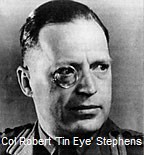
The commanding officer was Robin “Tin Eye” Stephens, 45, a monocled colonel of the Peshawar Division of the Indian Army who had been seconded to MI5 in 1939, and who had commanded Camp 020, a detention centre in Surrey where German spies had been interrogated during the war.

An authoritarian and a xenophobe with a legendary temper, Stephens boasted that interrogators who could “break” a man were born, and not made. Of the 20 interrogators ordered to break the inmates of Bad Nenndorf, 12 were British, a combination of officers from the three services and civilian linguists. The remaining eight included a Pole and a Dutchman, but were mostly German Jewish refugees who had enlisted on the outbreak of war, and who, Inspector Hayward suggested, “might not be expected to be wholly impartial”.

Most of the warders were soldiers barely out of their teens. Some had endured more than a year of combat, at the end of which they had liberated Belsen. Some represented the more unruly elements of the British Army of the Rhine, sent to Bad Nenndorf after receiving suspended sentences for assault or desertion. Often, Hayward said, they were the sort of individuals “likely to resort to violence on helpless men”.

The inmates were starved, woken during the night, and forced to walk up and down their cells from early morning until late at night. When moving about the prison they were expected to run, while soldiers kicked them. One warder, a soldier of the Welsh Regiment, told Hayward: “If a British soldier feels inclined to treat a prisoner decently he has every opportunity to do so; and he also has the opportunity to ill-treat a prisoner if he so desires”.

The Foreign Office briefed Clement Attlee, the prime minister, that “the guards had apparently been instructed to carry out physical assaults on certain prisoners with the object of reducing them to a state of physical collapse and of making them more amenable to interrogation”.

Former prisoners told Hayward that they had been whipped as well as beaten. This, the detective said, seemed unbelievable, until “our inquiries of warders and guards produced most unexpected corroboration”. Threats to execute prisoners, or to arrest, torture and murder their wives and children were considered “perfectly proper”, on the grounds that such threats were never carried out.

Moreover, any prisoner thought to be uncooperative during interrogation was taken to a punishment cell where they would be stripped and repeatedly doused in water. This punishment could continue for weeks, even in sub-zero temperatures.

Naked prisoners were handcuffed back-to-back and forced to stand before open windows in midwinter. Frostbite became common. One victim of the cold cell punishment was Buttlar, who swallowed the spoon handle to escape. An anti-Nazi, he had spent two years as a prisoner of the Gestapo. “I never in all those two years had undergone such treatments,” he said.

Kalkowski, the NKVD officer, claimed that toenails were ripped out and that he had been hung from his wrists during interrogation, with weights tied to his legs. British NCOs, he alleged, would beat him with rubber truncheons “while the interrogating officers went for lunch”. Hayward concluded, however, that “there was not a shred of evidence to support these allegations”.

Whatever was happening during the interrogations must have been widely known among many of the camp’s officers and men. In common with every CSDIC prison, each cell was bugged, so that the prisoners’ private utterances could be matched against their “confessions”.

Inspector Hayward’s investigation led to the courts martial of Stephens, Captain John Smith, Bad Nenndorf’s medical officer, and an interrogator, Lieutenant Richard Langham. The hearings were largely held behind closed doors. A number of sergeants – men who had carried out the beatings – were told they would be pardoned if they gave evidence against their officers. [continued…]

Facebooktwittermail

EDITORIAL: The scars of torture

The scars of torture

How much credit does President Obama deserve for releasing the torture memos?

Glenn Greenwald argues:

Other than mildly placating growing anger over his betrayals of his civil liberties commitments (which, by the way, is proof of the need to criticize Obama when he does the wrong thing), there wasn’t much political gain for Obama in releasing these documents. And he certainly knew that, by doing so, he would be subjected to an onslaught of accusations that he was helping Al Qaeda and endangering American National Security. And that’s exactly what happened, as in this cliché-filled tripe from Hayden and Michael Mukasey in today’s Wall St. Journal, and this from an anonymous, cowardly “top Bush official” smearing Obama while being allowed to hide behind the Jay Bybee of journalism, Politico‘s Mike Allen.

But Obama knowingly infuriated the CIA, including many of his own top intelligence advisers; purposely subjected himself to widespread attacks from the Right that he was giving Al Qaeda our “playbook”; and he released to the world documents that conclusively prove how that the U.S. Government, at the highest levels, purported to legalize torture and committed blatant war crimes. There’s just no denying that those actions are praiseworthy. I understand the argument that Obama only did what the law requires. That is absolutely true. We’re so trained to meekly accept that our Government has the right to do whatever it wants in secret — we accept that it’s best that most things be kept from us — that we forget that a core premise of our government is transparency; that the law permits secrecy only in the narrowest of cases; and that it’s certainly not legal to suppress evidence of government criminality on the grounds that it is classified.

Still, as a matter of political reality, Obama had to incur significant wrath from powerful factions by releasing these memos, and he did that. That’s an extremely unusual act for a politician, especially a President, and it deserves praise.

Really? I honestly don’t see it and I think that drawing a distinction between the act of releasing the memos and the act of throwing out a lifeline to those who might face prosecution is a way of decoupling what were actually interlocking actions.

The Obama administration had already stalled on releasing the memos. Had they continued to do so they would have put themselves in the position of appearing to be complicit in covering up a criminal conspiracy.

Central to that conspiracy was an effort to use evidence derived from observing the effects of the US military’s Survival, Evasion, Resistance and Escape (SERE) training.

In assessing the potential risk involved in the use of torture techniques such as waterboarding, the Department of Justice’s Office of Legal Council rested heavily on the proposition that if no lasting harm had been done to SERE trainees then neither would terrorist suspects be at risk.

In his memo to John Rizzo, Acting General Council of the CIA, Assistant Attorney General Jay Bybee wrote:

…the information derived from SERE training bears upon the impact of the use of the individual techniques and upon their use as a course of conduct. You have found that the use of these methods together or separately, including the use of the waterboard, has not resulted in any negative long-term mental health consequences. The continued use of these methods without mental health consequences to the trainees indicates that it is highly improbable that such consequences would result here. Because you conducted the due diligence to determine that these procedures, either alone or in combination, do not produce prolonged mental harm, we believe that you do not meet the specific intent requirement necessary to violate Section 2340A [the statute prohibiting the use of torture].

But the gaping hole in that argument was acknowledged by Steven Bradbury, a member of Bybee’s own staff, three years later:

Although we refer to the SERE experience below, we note at the outset an important limitation on reliance on that experience. Individuals undergoing SERE training are obviously in a very different situation from detainees undergoing interrogation; SERE trainees know it is part of a training program, not a real-life interrogation regime, they presumably know it will last only a short time, and they presumably have assurances that they will not be significantly harmed by the training.

What was obvious to Bradbury in 2005 somehow eluded Bybee’s grasp in 2002. Maybe it was because Bybee had spent too much time in the company of the likes of Dick Cheney, David Addington and Donald Rumsfeld.

It was Rumsfeld who had famously asserted that as someone who worked standing up, he couldn’t see the harm in forcing someone else to remain standing for many hours — as though it was neither here nor there whether the person standing was also naked, chained in position and being held in secret in a foreign country.

The point — and this is really the core issue in the whole torture debate — is that there is and always has been only one pressure point against which force is applied in the practice of torture, that being, the human mind. Its aim is to break the mind without breaking the body. Its successful practice requires that whatever scars are left behind are not clearly visible.

If its up to Obama, America will now “move forward” and the scars of torture will remain invisible.

The CIA however is bracing itself for examination.

The Washington Post reports:

For the first time, officials said yesterday that they would provide legal representation at no cost to CIA employees subjected to international tribunals or inquiries from Congress. They also said they would indemnify agency workers against any financial judgments.

The announcement appeared to be designed to soothe concerns expressed by top intelligence officials, who argued in recent weeks that the graphic detail in the memos could bring unwanted attention to interrogators and deter others from joining government service.

CIA Director Leon E. Panetta told employees that the interrogation practices won approval from the highest levels of the Bush administration and that they had nothing to fear if they followed the legal guidance from the Justice Department.

“You need to be fully confident that as you defend the nation, I will defend you,” Panetta said.

John Demjanjuk, the former Nazi death camp guard who is awaiting deportation from the United States before being sent to Germany to face trial for his part in the Holocaust, is being defended by lawyers who argue that putting the 89-year-old on trial would cause him pain amounting to torture.

If he does end up on trial, his defense may well suggest that we no longer live in a world where the Nuremberg defense is untenable.

As Barack Obama and Leon Panetta seem to be saying, “I was just following orders,” has now become an honorable American justification for torture.

Facebooktwittermail

Is Obama being blackmailed by the CIA?

Obama tilts to CIA on memos

The Obama administration is leaning toward keeping secret some graphic details of tactics allowed in Central Intelligence Agency interrogations, despite a push by some top officials to make the information public, according to people familiar with the discussions.

These people cautioned that President Barack Obama is still reviewing internal arguments over the release of Justice Department memorandums related to CIA interrogations, and how much information will be made public is in flux.

Among the details in the still-classified memos is approval for a technique in which a prisoner’s head could be struck against a wall as long as the head was being held and the force of the blow was controlled by the interrogator, according to people familiar with the memos. Another approved tactic was waterboarding, or simulated drowning. [continued…]

Editor’s Comment — No wonder there’s so much trepidation around releasing these memos. One can only imagine what kind of phrasing is involved in defining the “appropriate” amount of force with which someone’s head can be bashed against a wall.

Was it something specific like this: With less force than would be required to fracture the skull or spill blood? Or was it something more legalistic but vague, like this: With less force than could reasonably be expected to result in permanent brain damage?

The key issue here, the CIA would have us believe, is that revealing details on the torture techniques it has used would “undermine the agency’s credibility with foreign intelligence services.”

What this means, as far as I can tell from reading reports on the Binyam Mohamed case is this: When the CIA enlisted the support of MI5 (and other intelligence services) in the rendition and torture of suspected terrorists, the agreement was that information about the intelligence process would remain under the control of all participants. Another way of putting it would be to say that the co-conspirators agreed to cover each other’s backs so that they could collectively enjoy legal impunity.

Now that that impunity is in jeopardy, the lawbreakers are upping the ante by implying that exposing torture practices poses a national security threat. Ostensibly the threat comes from providing al Qaeda a propaganda coup, but the underlying threat is that the CIA will no longer get cooperation from foreign agencies and that intelligence gathering will therefore suffer. And what this boils down to is the crudest possible threat: if the administration doesn’t protect the agency, the agency won’t protect the administration. This is, in a word: blackmail.

At the White House, joking about a torture investigation?

I was asked to go on Hardball on Tuesday night to discuss the news that Spanish prosecutors are likely to recommend a full investigation be conducted to determine if six former Bush administration officials—including ex-Attorney General Alberto Gonzales—ought to be indicted for having sanctioned torture at Guantanamo. So I thought I’d ask White House press secretary Robert Gibbs about the matter.

This could become a true headache for the White House—a high-profile case in which Spanish prosecutors bring charges against Gonzales; Douglas Feith, former undersecretary of defense; David Addington, former counsel to Vice President Dick Cheney; William Haynes, a former Pentagon lawyer; and John Yoo and Jay Bybee, two former Justice Department officials. Several steps must occur before any prosecution proceeds. If the prosecutors determine a full criminal investigation is warranted–as is expected–it will be up to a Spanish judge to open a full-fledged inquiry that could produce indictments. He could decide not to accept the recommendation. And, of course, it’s possible that an investigation could end without indictments. The Spanish hook for the case is a simple one: Five Guantanamo detainees were either Spanish citizens or residents. And, by the way, Spanish courts claim jurisdiction that extends to other nations when it comes to torture and war crimes. [continued…]

Facebooktwittermail

Israeli war talk

Israel threatens military strike on Iran

President Shimon Peres has threatened that Israel will take military action against Iran if talks proposed by the US president Barack Obama fail to halt Iran’s nuclear programme. In an interview on the Israeli Kol Hai radio station on Sunday, Mr Peres warned that if the talks don’t soften the approach of the Iranian president, “we’ll strike him”.

Mr Peres ruled out the possibility of Israel engaging in a unilateral attack, and said: “We certainly cannot go it alone, without the US, and we definitely can’t go against the US. This would be unnecessary.”

The Israeli president’s statement comes just a few days after the US Vice President Joe Biden issued a high-level warning to Israel’s new government that it would be “ill advised” to launch a military strike against Iran.

Mr Peres also suggested that the arrest last week of 49 alleged agents of Hizbollah by Egyptian authorities was a blow to the Iranian president’s ambitions. [continued…]

Editor’s CommentIsrael threatens to attack Iran has become a dog-bites-man story. What’s significant here is that Peres went out of his way to say that Israel will not go it alone. An attack either gets US backing or it’s not going to happen.

The subtext here is that the Israelis are becoming genuinely afraid of a US-Israeli rift. And the driving force behind this rift is one that the Israel lobby is powerless to rein in: Avigdor Lieberman.

The diplomatic sleight of hand that the Israelis love to play is to gloss over disagreements and brush away criticisms by suggesting that the differences only exist in the eye of the beholder — that Israel and the US are of one heart, indivisible. But no one makes this posture more difficult than Lieberman, a man who is now too powerful to dismiss as a somewhat harmless embarrassment.

As Douglas Bloomfield wrote in the Jerusalem Post on Sunday, Lieberman “could do what the Arabs and their supporters could only dream of – drive a wedge between Americans and Israel.”

Netanyahu and threat of bombing Iran — the bluff that never stops giving?

Israel does not have the military capability to successfully eliminate Iran’s nuclear program. Even the most successful bombing campaign would only set back the known program for a few years — without affecting any potential clandestine program. This is not classified information. Military experts are well aware of Israel’s capabilities — and its limits.

Yet, the threat of military action, or rather the bluff, serves a purpose: Threats of military action militarizes the atmosphere. It creates an environment that renders diplomacy less likely to succeed — it may even prevent diplomacy from being pursued in the first place.

In the Iranian case, Netanyahu’s tough talk undermines the Obama administration’s prospects for diplomacy in the following ways.

Getting to the negotiating table has proven an arduous task for the US and Iran. Both sides are currently testing each other’s intentions, asking themselves if the other side is serious about diplomacy or if the perceived desire for talks is merely a tactical maneuver to either buy time or build greater international support for more confrontational policies down the road. From Tehran’s perspective, uncertainty about Washington’s intentions during the Bush administration was partly fueled by the insistence of the military option remaining on the table. Tehran seemed to fear entering negotiations that could have been designed to fail, since that could strengthen the case for military action against Iran. [continued…]

U.S. may drop key condition for talks with Iran

The Obama administration and its European allies are preparing proposals that would shift strategy toward Iran by dropping a longstanding American insistence that Tehran rapidly shut down nuclear facilities during the early phases of negotiations over its atomic program, according to officials involved in the discussions.

The proposals, exchanged in confidential strategy sessions with European allies, would press Tehran to open up its nuclear program gradually to wide-ranging inspection. But the proposals would also allow Iran to continue enriching uranium for some period during the talks. That would be a sharp break from the approach taken by the Bush administration, which had demanded that Iran halt its enrichment activities, at least briefly to initiate negotiations.

The proposals under consideration would go somewhat beyond President Obama’s promise, during the presidential campaign, to open negotiations with Iran “without preconditions.” Officials involved in the discussion said they were being fashioned to draw Iran into nuclear talks that it had so far shunned.

A review of Iran policy that Mr. Obama ordered after taking office is still under way, and aides say it is not clear how long he would be willing to allow Iran to continue its fuel production, and at what pace. But European officials said there was general agreement that Iran would not accept the kind of immediate shutdown of its facilities that the Bush administration had demanded. [continued…]

Iran says it controls entire nuclear fuel cycle

Iran now controls the entire cycle for producing nuclear fuel with the opening of a new facility to produce uranium fuel pellets, the Iranian president said Saturday.

Mahmoud Ahmadinejad made the speech two days after the inauguration of the facility which produces uranium oxide pellets for a planned 40-megawatt heavy-water nuclear reactor near the town of Arak, central Iran.

Production of nuclear fuel pellets is the final step in the long, complicated chain of nuclear fuel cycle. The U.S. and its allies have expressed concern over Iran’s developing nuclear program for fear it masks a nuclear weapons program — a charge Iran denies. [continued…]

Differences with US on Mideast ‘semantic’: Israel

Differences between Israel and the United States over the Middle East conflict are fundamentally semantic and will be harmonised within a few weeks, an Israeli minister said on Saturday.

“There are differences of approach toward the problems in the Middle East between our government and the administration of (US President Barack) Obama, but they point more to wording and semantics than to reality,” Transport Minister Israel Katz told public radio.

Israel’s hawkish new Prime Minister Benjamin Netanyahu “has already had meetings with American leaders, and our policies will converge,” he added. [continued…]

Israel lobbies Russia on Iranian arms sales

Israel has lobbied Russia to pull away from selling a strategic air-defense system to Iran but has received only vague assurances, Israeli defense sources said on Monday.

Last week Israel agreed to supply surveillance drones worth $50 million to Russia. The Israeli Haaretz newspaper said this followed a pledge by Moscow not to sell Iran the S-300, which could protect Iranian nuclear facilities against air strikes.

An Israeli defense official said he had no knowledge of such an undertaking by Russia in its talks with Israel on the matter. Moscow has given mixed messages on the prospects of Iran buying S-300s, a deal one Russian newspaper valued at $800 million. [continued…]

U.S. troops take part in Israel X-Band radar test

U.S. troops took part in a missile defense exercise in Israel last week that for the first time incorporated a U.S.-owned radar system deployed to the country in October.

About 100 Europe-based troops continue to operate the X-Band radar, which is intended to give Israel early warning in the event of a missile launch from Iran.

While it’s not a permanent assignment for U.S. troops, as long as the radar is in use, U.S. personnel will be there to operate it, U.S. European Command said. [continued…]

Facebooktwittermail

Turkey’s pivotal place

“Turkey’s greatness lies in your ability to be at the center of things. This is not where East and West divide — this is where they come together.” Barack Obama addressing the Turkish parliament, April 6, 2009.

Turkey wants U.S. ‘balance’

Prime Minister Recep Tayyip Erdogan of Turkey is a man of brisk, borderline brusque, manner and he does not mince his words: “Hamas must be represented at the negotiating table. Only then can you get a solution.”

We were seated in his suite at London’s Dorchester Hotel, where a Turkish flag had been hurriedly brought in as official backdrop. Referring to Mahmoud Abbas, the beleaguered Fatah leader and president of the Palestinian Authority, Erdogan said, “You will get nowhere by talking only to Abbas. This is what I tell our Western friends.”

In an interview on the eve of President Barack Obama’s visit to Turkey, his first to a Muslim country since taking office, Erdogan pressed for what he called “a new balance” in the U.S. approach to the Middle East. “Definitely U.S. policy has to change,” he said, if there is to be “a fair, just and all-encompassing solution.” [continued…]

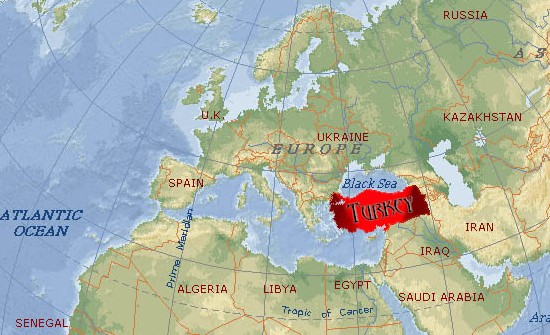
Editor’s Comment — Obama was well-advised in making Turkey one of his first foreign destinations. As a country that most Americans associate with a bird, its significance is not widely appreciated. But just look at a map. If any country can claim to be located at the strategic center of the world it is Turkey. No other country has as pivotal a position between multiple continents. It is no accident that Istanbul (or as it was, Constantinople) has been the capital of four successive empires. If the Turks now want to reclaim some of their former geopolitical power, the basis of that claim does not have to be imperial nostalgia. Turkey matters because this is where continents and cultures all converge.

Obama in Istanbul: Test for the West

“If we can show that a big Muslim nation can modernize itself with the help of friends,” former German Foreign Minister Joschka Fischer has argued on behalf of Turkey’s admission to the European Union, “it demonstrates that a strong civil society, equal rights for men and women, the rule of law, an independent judiciary, a modern administration and modern economy are not in contradiction to Islam. This would be the most powerful message against the jihadists and terrorists.”

That is certainly President Barack Obama’s hope when he attends the UN “Alliance for Civilizations” gathering in Istanbul this week after a pointed visit in Ankara to the grave of Ataturk, modern Turkey’s secular saint and founder. The meeting is of particular importance because Mohamed Khatami, the reformist former president of Iran is a key member of the group, as is Federico Mayor, the former secretary general of UNESCO who, long before 9/11, extolled the tolerant virtues of “La Convivencia” — the peaceful coexistence of Muslims, Jews and Christians in Andalusian Spain from 711-1492.

Whether Obama’s hope is justified is indeed the great test for the West in relations with the Muslim world. [continued…]

A Mideast play’s uncertain script

The Obama administration is preparing a broad stage for Middle East diplomacy stretching from the Palestinians to Syria to Iran. It’s a supremely ambitious agenda, and before the curtain goes up, Obama should explore his options and risks carefully.

By seeking to engage all the major actors in the Middle East at once, Obama is pursuing a general settlement of tensions in a dangerously unstable region. That’s intriguing and also worrying for countries in the Middle East. It makes Saudis and Israelis — not to mention Iranians and Syrians — nervous.

If you’re looking for a historical analogy for this scale of diplomacy, think of the Congress of Vienna of 1815. That gathering produced a new security architecture for a Europe that had been violently destabilized by revolutionary France — in something like the way the Middle East has been upset by the 1979 Iranian revolution. [continued…]

Facebooktwittermail

Nuclear disarmament: a dream or an imperative?

Obama outlines disarmament plan

Under a hazy spring sky, before a swelling Czech crowd, U.S. President Barack Obama called for an international effort to lock down nuclear weapons materials within four years, one of a host of steps he said would move the globe to nuclear disarmament.

Speaking just hours after North Korea launched a controversial multistage rocket, the U.S. president took to the stage in Castle Square here, testifying “clearly and with conviction” to an audience of at least 20,000 of “America’s commitment to seek the peace and security of a world without nuclear weapons.”

“We have to insist, ‘Yes, we can,'” he said, reprising a battle theme recognizable to a crowd a continent away from his campaign victory. [continued…]

Many obstacles to Obama nuclear dream

President Obama’s hopes for a world free of nuclear weapons may just be a dream.

Despite his rousing rhetoric in Prague that “we can do it”, huge obstacles are in the way and even he gave himself two escape clauses.

The first was that he did not necessarily expect this to happen in his lifetime. He is 47 years old, so, given that the life expectancy in the US is about 78, that means another thirty years or more in which the goal might not be realised. [continued…]

Editor’s Comment — A goal is just a dream unless there’s a deadline. When JFK announced his plan to send a man to the moon, he didn’t add the caveat, “but it might not happen in my lifetime.”

In a single breath, Obama inflated hopes and then let them drift away. To turn a dream into a reality will require a clearly defined strategy, a set of intermediary goals and deadlines, and genuine political commitment. If Obama becomes really serious, this could actually be the easy route for him to make history.

Gone are the days when nuclear disarmament could be dismissed as a lofty goal only entertained by dreamers. The CND marchers from the 50’s led by the likes of Bertrand Russell have been replaced an unlikely band of elder-statesman realists. Henry Kissinger, George Shultz, William Perry, and Sam Nunn made appeals for disarmament in 2007 and 2008 that drew a favorable response by pointing out that the risks in failing to disarm are now far greater than the challenge of taking on this goal.

But how can disarmament be easy? Of course it won’t be — but everything is relative. Placed alongside objectives such as tackling climate change, ending poverty or eradicating terrorism, nuclear disarmament is a much less complex undertaking. Whether Obama is ready to lead the way may come down to whether he has the courage to take on a bold political strategy that ties together nuclear disarmament with Middle East policy.

The effort to press Iran to abandon its uranium enrichment program would acquire a moral legitimacy that has so far been lacking if this particular objective was an integral part of a wider campaign for disarmament. At the same time, if Iran is to be persuaded then pressure must simultaneously be placed on Israel to both sign the non-proliferation treaty and commit to its own disarmament.

Benjamin Netanyahu says that stopping Iran becoming a nuclear power is a global imperative. Fair enough — but what is Israel willing to give up to make that happen?

If Obama wants to take a small but highly symbolic step in the right direction, he could tell the Israeli prime minister during his first trip to Washington, that the United States will no longer afford Israel the privelage of colluding in Israel’s policy of “nuclear ambiguity”. Robert Gates already chipped a crack in the foundations of that policy during his confirmation hearings. Now it’s time to drop the pretense altogether.

Challenging Iran’s nuclear aspirations requires acknowledging Israel’s nuclear realities.

US may cede to Iran’s nuclear ambition

US officials are considering whether to accept Iran’s pursuit of uranium enrichment, which has been outlawed by the United Nations and remains at the heart of fears that Iran is seeking nuclear weapons capability.

As part of a policy review commissioned by President Barack Obama, diplomats are discussing whether the US will eventually have to accept Iran’s insistence on carrying out the process, which can produce both nuclear fuel and weapons- grade material.

“There’s a fundamental impasse between the western demand for no enrichment and the Iranian dem­and to continue enrichment,” says Mark Fitzpat­rick, a former state depart­- ­­ment expert now at the International Institute for Strategic Studies. “There’s no obvious compromise bet­ween those two positions.” [continued…]

Facebooktwittermail

Israel’s threats

Israel expected to hold back on Iran

Robert Gates, US defence secretary, has said Israel is unlikely to attack Iran this year to prevent Tehran from developing a nuclear weapon.

In an interview with the Financial Times, Mr Gates said there was still enough time to persuade Iran to abandon what is widely perceived to be a nuclear weapons programme.

Mr Gates said he does not expect Israel – which believes the US estimate for when Iran could develop a nuclear weapon is too sanguine – to take military action this year.

“I guess I would say I would be surprised…if they did act this year,” said Mr Gates. [continued…]

Israel’s awful new government

Israeli leaders and their advocates have already promoted a full-court blitz demanding that the United States “stop” Iran, or Israel will be forced to do so on its own. In part, this is bluster, as few analysts believe Israel is able to attack Iran on its own, and no one believes that Iran wouldn’t retaliate, which would force the United States into the middle of the conflict. However, this emphasis on Iran serves another useful purpose for Netanyahu and Lieberman: Not only does it remove Palestinian independence and potential Israeli peace treaties with the Arab world from U.S. focus, but it sets the agenda for the U.S.-Israeli talks that are to take place this May.

So far, the Obama administration has kept its cards close to the vest — there’s little sign of how it will engage Israel’s new administration on such fundamental differences in policy. But one thing is certain. The longer the United States waits, the harder it will be for the Israeli government to back down from its positions. And it is clear, looking at the challenges facing the United States throughout the Middle East, that placing Israel’s occupation of the West Bank on the back burner is only going to add fuel to the many brush fires the United States is already fighting in the region. Dealing with a hostile and recalcitrant enemy in Afghanistan and Pakistan is hard enough, but the Obama administration may find that dealing with a hostile and recalcitrant ally brings its own set of challenges. [continued…]

Will Netanyahu attack Iran?

European governments are practicing evacuating their citizens from Iran in case a “third party” strikes the nuclear installations. Israel’s veiled threats “that no option should be lifted from the table,” which were meant to push the international community to intensify pressure and sanctions on Iran to prevent war, have had the opposite effect. The international community has become convinced that Israel will act on its own, so it does not need to do a thing. [continued…]

Editor’s Comment — Irrespective of whether Israel is ultimately a free agent, for Robert Gates to refer to Israeli intentions as though they are something about which Americans can only guess, does not seem to be in American interests. It burnishes Israel’s image of unpredictability and it implies that the US lacks the power to rein in its ally at a critical juncture.

It’s one thing for the Obama administration to want to show that Israeli interests and US interests don’t always coincide, but to suggest that the US has no leash strong enough to hold back the mad dog will merely have the effect of creating the appearance of complicity. If the US truly sees Israel as a maverick state that in the international arena is a law unto itself, then it’s time to question the basis of the US-Israeli alliance.

Facebooktwittermail

EDITORIAL: The missing Mandela

The missing Mandela

When the long sought solution to the Israeli-Palestinian conflict is being trumpeted from the cover of The Weekly Standard there’s every reason to scoff. Middle East peace has thus far not appeared high up on the neoconservative agenda and I really doubt that Bill Kristol and his cronies suddenly had some extraordinary change of heart.

What’s sad is that Gershom Gorenberg, who is clearly a man of integrity, chose to lend his support to the Israel apologists who happily massage their consciences by pretending that Palestinian violence is the one insurmountable obstacle to ending the conflict.

In a celebration of Israeli impotence we are presented with a mirage of peace in the form of an unfound Palestinian Mahatma. If only a Palestinian Gandhi emerged, anything would be possible.

It’s not that the appeal of a saintly leader of a non-violent resistance movement is lost on me, but the parallels between British India and Israel are beyond tenuous.

Gandhi’s resistance to British rule galvanized the support of a massive population governed by a tiny colonial elite who never had the pretense that Britain was reclaiming a long-lost homeland. To the British, India was a land brimming with resources that could be shipped back to the actual homeland and traded for handsome profits. By the end of World War Two, Britain was bankrupt and in a rush to free itself of what had become its colonial burdens. With or without a gentle shove from the Mahatma, the sun had already set on the British Empire.

As for Gandhi’s nominal success in non-violently waving goodbye to colonial rule, we should not forget that it was accompanied by the horrific failure of partition and a bloodbath in which as many as a million people died.

Another model of non-violent leadership that Gorenberg could have considered is that of the Dalai Lama.

After fifty years of principled resistance to Chinese rule, Tibetans are still no closer to winning autonomy. Thus far, the majority of the Dalai Lama’s followers remain loyal to the religious values that he practices and advocates, yet many are starting to wonder whether it is their pacifism that enables China to retain its firm grip on Tibet.

Of course the most obvious model of political leadership that Gorenberg should have mentioned is that of Nelson Mandela.

The problem is — at least from Gorenberg and The Weekly Standard‘s point of view — Mandela resolutely refused to renounce armed resistance. Apartheid didn’t end because its opponents adopted a spiritually enlightened non-violent perspective. It ended because white South Africans were forced to recognize they were clinging on to a politically unsustainable system.

Israelis still cling on to a politically unsustainable situation, but unlike white South Africans, they are still able to hold on to a security blanket stitched together by American military and economic aid and political protection.

President Obama might say that for Palestinians and Israelis “the status quo is unsustainable”, but unless the US takes away the security blanket, Israel will remain in its manipulatively infantile condition: vacillating between a manicured helplessness that occasionally gets punctuated by a violent tantrum.

Must Israel and its friends wait in frustration for an elusive Palestinian Mahatma or instead might an earnest search for an Israeli FW de Klerk be long overdue?

Facebooktwittermail