Category Archives: Obama administration

Israel sent aircraft into Iranian airspace in 2012, raising fears of regional war

The Wall Street Journal reports: The U.S. closely monitored Israel’s military bases and eavesdropped on secret communications in 2012, fearing its longtime ally might try to carry out a strike on Fordow, Iran’s most heavily fortified nuclear facility.

Nerves frayed at the White House after senior officials learned Israeli aircraft had flown in and out of Iran in what some believed was a dry run for a commando raid on the site. Worried that Israel might ignite a regional war, the White House sent a second aircraft carrier to the region and readied attack aircraft, a senior U.S. official said, “in case all hell broke loose.”

The two countries, nursing a mutual distrust, each had something to hide. U.S. officials hoped to restrain Israel long enough to advance negotiations on a nuclear deal with Iran that the U.S. had launched in secret. U.S. officials saw Israel’s strike preparations as an attempt to usurp American foreign policy.

Instead of talking to each other, the allies kept their intentions secret. To figure out what they weren’t being told, they turned to their spy agencies to fill gaps. They employed deception, not only against Iran, but against each other. After working in concert for nearly a decade to keep Iran from an atomic bomb, the U.S. and Israel split over the best means: diplomacy, covert action or military strikes.

Personal strains between President Barack Obama and Israeli Prime Minister Benjamin Netanyahu erupted at their first Oval Office meeting in 2009, and an accumulation of grievances in the years since plunged relations between the two countries into crisis.

This Wall Street Journal account of the souring of U.S.-Israel relations over Iran is based on interviews with nearly two dozen current and former senior U.S. and Israeli officials.

U.S. and Israeli officials say they want to rebuild trust but acknowledge it won’t be easy. Mr. Netanyahu reserves the right to continue covert action against Iran’s nuclear program, said current and former Israeli officials, which could put the spy services of the U.S. and Israel on a collision course.

In early 2012, U.S. spy agencies told the White House about a flurry of meetings that Mr. Netanyahu convened with top security advisers. The meetings covered everything from mission logistics to the political implications of a military strike, Israeli officials said.

U.S. spy agencies stepped up satellite surveillance of Israeli aircraft movements. They detected when Israeli pilots were put on alert and identified moonless nights, which would give the Israelis better cover for an attack. They watched the Israelis practice strike missions and learned they were probing Iran’s air defenses, looking for ways to fly in undetected, U.S. officials said.

New intelligence poured in every day, much of it fragmentary or so highly classified that few U.S. officials had a complete picture. Officials now say many jumped to the mistaken conclusion that the Israelis had made a dry run.

The U.S. Air Force analyzed the arms and aircraft needed to destroy Iran’s nuclear facilities and concluded Israel didn’t have the right equipment. The U.S. shared the findings, in part, to steer the Israelis from a military strike.

The Israelis weren’t persuaded and briefed the U.S. on an attack plan: Cargo planes would land in Iran with Israeli commandos on board who would “blow the doors, and go in through the porch entrance” of Fordow, a senior U.S. official said. The Israelis planned to sabotage the nuclear facility from inside.

Pentagon officials thought it was a suicide mission. They pressed the Israelis to give the U.S. advance warning. The Israelis were noncommittal.

Israeli officials approached their U.S. counterparts over the summer about obtaining military hardware useful for a strike, U.S. officials said.

At the top of the list were V-22 Ospreys, aircraft that take off and land like helicopters but fly like fixed-wing planes. Ospreys don’t need runways, making them ideal for dropping commandos behind enemy lines.

The Israelis also sounded out officials about obtaining the Massive Ordnance Penetrator, the U.S. military’s 30,000-pound bunker-busting bomb, which was designed to destroy Fordow.

White House officials decided not to provide the equipment.

Messrs. Obama and Netanyahu spoke in September 2012, and Mr. Obama emerged convinced Israel wouldn’t strike on the eve of the U.S. presidential election.

By the following spring, senior U.S. officials concluded the Israelis weren’t serious about a commando raid on Fordow and may have been bluffing. When the U.S. offered to sell the Ospreys, Israel said it didn’t have the money.

Former Israeli Defense Minister Ehud Barak, who championed a strike, said Mr. Netanyahu had come close to approving a military operation against Iran. But Israel’s military chiefs and cabinet members were reluctant, according to Israeli officials. [Continue reading…]


Facebooktwittermail

Putin’s partition plan for Syria

Hussein Ibish writes: Russia’s unspoken but unmistakable message is that Moscow is trying one — and perhaps the only — way of ending the conflict by means of a Lebanese-style segregation of Syria into zones controlled by rival militias. To Washington’s perennial concern in any Middle Eastern imbroglio, “Tell me how this ends,” Moscow responds: The Syrian conflict will be “resolved” on Russia’s terms, even if Mr. Assad proves dispensable to the Kremlin in the long run.

Meanwhile, the Obama administration’s desire to see the conflict end without actually doing anything itself means that, as Bloomberg View suggested recently, there is a group of senior American officials prepared to go along with the Russian plan. After all, America’s own policy in Syria has rapidly moved from tragedy to farce. The latest fiasco was the cancellation of the $500 million military training program for anti-Islamic State rebels that produced barely a handful of fighters on the ground.

So if Moscow has a policy, and Washington doesn’t, why not just support that?

Beyond the fact that it’s absurd to hope that Mr. Putin’s approach is likely to benefit American interests, giving way to Russia’s policy would, in effect, entail abandoning the fight against the Islamic State in Syria. And the militants cannot be effectively countered in Iraq alone. So what this final, ignominious capitulation would really mean is that not only would Mr. Assad (or some Russian-appointed successor) menace Syrians for the foreseeable future, but so too would the Islamic State. [Continue reading…]

Facebooktwittermail

We break it, you own it: Russia’s logic in Syria

Thomas Pierret writes: Some Western observers of Russia’s recent intervention in Syria are convinced President Vladimir Putin is making a mistake — and, following wisdom often attributed to Napoleon Bonaparte, one should never interrupt an enemy while they are making a mistake. By committing its own forces to the defense of beleaguered dictator Bashar al-Assad, some believe that Moscow is about to bog itself down in Syria the same way Washington got stuck in Iraq. However, proponents of this view should be wary the joke might well be on them.

First, although difficult times certainly lie ahead for Russia in Syria, Putin’s intervention will make the conflict more destructive, destabilizing, and intractable, hence more detrimental to all parties. Second, the way Moscow defines success in Syria is hardly comparable to the stabilization-oriented approach adopted by the United States-led coalition in Iraq. Instead, by trying to destroy mainstream insurgents, Putin aims to reshape the Syrian war in a way that would leave Western countries with no other option than to supplement Russia as the protector of Assad.

Russian intervention in Syria will make the war deadlier and heighten the refugee crisis spreading across the region into Europe and beyond. Although they have carried out some precision airstrikes against rebel headquarters, Russian forces have made a greater use of unguided ammunitions, including cluster bombs designed to wreak havoc over vast swaths of territory. As scores of these fail to explode, they will continue to kill civilians who will accidentally set them off years after the end of Russian operations. Russian attacks are not more discriminate than Assad’s, but they are far more powerful. Consequently, they have provoked new displacements of populations in regions whose inhabitants were already used to intensive shelling and bombing, such as the northern countryside of Hama province. [Continue reading…]

Facebooktwittermail

Canada to end airstrikes in Syria and Iraq, new prime minister Trudeau says

The Guardian reports: Canadian Liberal prime minister designate Justin Trudeau has confirmed that Canada will withdraw its fighter jets from the US-led mission against Islamic State in Iraq and Syria.

In his first news conference following the sweeping majority Liberal victory in Canada’s federal election, the visibly fatigued leader said he had spoken with US president Barack Obama in a phone call during which he discussed his intention to pull Canada’s fighter jets out of the anti-Isis campaign.

“I committed that we would continue to engage in a responsible way that understands how important Canada’s role is to play in the fight against Isil, but he understands the commitments I’ve made about ending the combat mission,” Trudeau said. [Continue reading…]

Facebooktwittermail

Could the Saudis be dragging the U.S. into a war crimes scandal?

PRI reports: Thirteen liberal legislators have put President Barack Obama on the spot for his support of Saudi Arabia’s unchecked war in Yemen. The Saudi-led coalition has been guided by US intelligence, flying American fighter jets and dropping US-made bombs.

A Human Rights Watch researcher has put the death toll from the incursion at 2,355 civilians since March.

Michigan Rep. Debbie Dingel and her colleagues reminded the president in a letter last week that Saudi Arabia, America’s strongest Arab ally and best weapons customer is behaving badly in Yemen, and could be dragging the US into a war crimes scandal. “With this level of active involvement in the campaign,” the letter reads, “we are concerned that some overseas may hold the United States responsible for any civilian casualties resulting from the bombing.”

Many Yemenis already hold America — and the UK — responsible for Saudi actions. [Continue reading…]

Facebooktwittermail

There’s just one problem with those Bin Laden conspiracy theories

Mark Bowden writes: Without a shred of evidence, without contradicting a word that I wrote, Jonathan Mahler in The New York Times Magazine this week suggests that the “irresistible story” that I told about the killing of Osama bin Laden in my 2012 book, The Finish (excerpted in Vanity Fair), might well have been a fabrication—“another example of American mythmaking.” He presents an alternative version of the story written by Seymour Hersh as, effectively, a rival account, one that raises serious doubts about mine, which is all but dubbed “the official version.” It’s not meant kindly.

Mahler’s think piece about the iffiness of reporting and the hazards of trying to shape history into a narrative is a great gift to conspiratorial thinkers everywhere. It’s not often that the most distinguished journalistic institution in America wades so fully into the crackpot world of Internet theorizing, where all information, no matter its source, is weightless and equal. Mahler is careful not to side with either Hersh or me, but allows that “Hersh’s version doesn’t require us to believe in the possibility of a government-wide conspiracy.”

In fact, that’s exactly what it does. [Continue reading…]

Facebooktwittermail

What do we really know about Osama bin Laden’s death?

Jonathan Mahler writes: It’s hard to overstate the degree to which the killing of Osama bin Laden transformed American politics. From a purely practical standpoint, it enabled Obama to recast himself as a bold leader, as opposed to an overly cautious one, in advance of his 2012 re-election campaign. This had an undeniable impact on the outcome of that election. (‘‘Osama bin Laden is dead and General Motors is alive,’’ Joe Biden was fond of boasting on the campaign trail.) Strategically, the death of bin Laden allowed Obama to declare victory over Al Qaeda, giving him the cover he needed to begin phasing U.S. troops out of Afghanistan. And it almost single-handedly redeemed the C.I.A., turning a decade-long failure of intelligence into one of the greatest triumphs in the history of the agency.

But bin Laden’s death had an even greater effect on the American psyche. Symbolically, it brought a badly wanted moment of moral clarity, of unambiguous American valor, to a murky war defined by ethical compromise and even at times by collective shame. It completed the historical arc of the 9/11 attacks. The ghastly image of collapsing towers that had been fixed in our collective minds for years was dislodged by one of Obama and his senior advisers huddled tensely around a table in the White House Situation Room, watching closely as justice was finally brought to the perpetrator.

The first dramatic reconstruction of the raid itself — “Getting bin Laden: What Happened That Night in Abbottabad” — was written by a freelancer named Nicholas Schmidle and published in The New Yorker just three months after the operation. The son of a Marine general, Schmidle spent a couple of years in Pakistan and has written on counterterrorism for many publications, including this magazine. His New Yorker story was a cinematic account of military daring, sweeping but also granular in its detail, from the ‘‘metallic cough of rounds being chambered’’ inside the two Black Hawks as the SEALs approached the compound, to the mud that ‘‘sucked at their boots’’ when they hit the ground. One of the SEALs who shot bin Laden, Matt Bissonnette, added a more personal dimension to the story a year later in a best-selling book, ‘‘No Easy Day.’’ [Mark] Bowden [in his book, “The Finish”] focused on Washington, taking readers inside the White House as the president navigated what would become a defining moment of his presidency. And then there was ‘‘Zero Dark Thirty,’’ which chronicled the often barbaric C.I.A. interrogations that the agency said helped lead the United States to bin Laden’s compound.

The official narrative of the hunt for and killing of bin Laden at first seemed like a clear portrait, but in effect it was more like a composite sketch from multiple perspectives: the Pentagon, the White House and the C.I.A. And when you studied that sketch a little more closely, not everything looked quite right. Almost immediately, the administration had to correct some of the most significant details of the raid. Bin Laden had not been ‘‘engaged in a firefight,’’ as the deputy national-security adviser, John Brennan, initially told reporters; he’d been unarmed. Nor had he used one of his wives as a human shield. The president and his senior advisers hadn’t been watching a ‘‘live feed’’ of the raid in the Situation Room; the operation had not been captured on helmet-cams. But there were also some more unsettling questions about how the whole story had been constructed. Schmidle acknowledged after his article was published that he had never actually spoken with any of the 23 SEALs. Some details of Bissonnette’s account of the raid contradicted those of another ex-SEAL, Robert O’Neill, who claimed in Esquire and on Fox News to have fired the fatal bullet. Public officials with security clearances told reporters that the torture scenes that were so realistically depicted in ‘‘Zero Dark Thirty’’ had not in fact played any role in helping us find bin Laden.

Then there was the sheer improbability of the story, which asked us to believe that Obama sent 23 SEALs on a seemingly suicidal mission, invading Pakistani air space without air or ground cover, fast-roping into a compound that, if it even contained bin Laden, by all rights should have been heavily guarded. And according to the official line, all of this was done without any sort of cooperation or even assurances from the Pakistani military or intelligence service. How likely was that? Abbottabad is basically a garrison town; the conspicuously large bin Laden compound — three stories, encircled by an 18-foot-high concrete wall topped with barbed wire — was less than two miles from Pakistan’s equivalent of West Point. And what about the local police? Were they really unaware that an enormous American helicopter had crash-landed in their neighborhood? And why were we learning so much about a covert raid by a secret special-operations unit in the first place?

American history is filled with war stories that subsequently unraveled. Consider the Bush administration’s false claims about Saddam Hussein’s supposed arsenal of weapons of mass destruction. Or the imagined attack on a U.S. vessel in the Gulf of Tonkin. During the Bay of Pigs, the government inflated the number of fighters it dispatched to Cuba in hopes of encouraging local citizens to rise up and join them. When the operation failed, the government quickly deflated the number, claiming that it hadn’t been an invasion at all but rather a modest attempt to deliver supplies to local guerrillas. More recently, the Army reported that the ex-N.F.L. safety Pat Tillman was killed by enemy fire, rather than acknowledging that he was accidentally shot in the head by a machine-gunner from his own unit.

These false stories couldn’t have reached the public without the help of the media. Reporters don’t just find facts; they look for narratives. And an appealing narrative can exert a powerful gravitational pull that winds up bending facts in its direction. [Continue reading…]

Facebooktwittermail

Frederic Hof: I got Syria so wrong

I did not think it inevitable that Assad — a computer-savvy individual who knew mass murder could not remain hidden from view in the 21st century — would react to peaceful protest as violently as he did, with no accompanying political outreach. And as Syria began to descend into the hell to which Assad was leading it, I did not realize that the White House would see the problem as essentially a communications challenge: getting Obama on “the right side of history” in terms of his public pronouncements. What the United States would do to try to influence Syria’s direction never enjoyed the same policy priority as what the United States would say.

Frederic C. Hof joined the State Department in 2009, where he advised Special Envoy George Mitchell on the full range of Arab-Israeli peace issues falling under his purview and focusing on Syria-Israel and Israel-Lebanon matters. Weeks before the popular uprising in Syria in 2011, Hof had won Bashir al-Assad’s provisional support for a peace deal with Israel which, if supported by Israel, would have resulted in the return of all Syrian territory lost in 1967.

Assad, told me in late February 2011 that he would sever all anti-Israel relationships with Iran, Hezbollah and Hamas and abstain from all behavior posing threats to the State of Israel, provided all land lost by Syria to Israel in the 1967 war — all of it — was returned. My conversation with him was detailed in terms of the relationships to be broken and the behavior to be changed. He did not equivocate. He said he had told the Iranians that the recovery of lost territory — the Golan Heights and pieces of the Jordan River Valley — was a matter of paramount Syrian national interest. He knew the price that would have to be paid to retrieve the real estate. He implied that Iran was OK with it. He said very directly he would pay the price in return for a treaty recovering everything.

Israeli Prime Minister Benjamin Netanyahu was interested. He was not at all eager to return real estate to Syria, but he found the idea of prying Syria out of Iran’s grip fascinating. And the negative implications for Hezbollah of Lebanon following Syria’s peace accord with Israel were not lost on him in the least. Although there were still details to define about the meaning of “all” in the context of the real estate to be returned, Netanyahu, too, knew the price that would ultimately have to be paid to achieve what he wanted. [Continue reading…]

Facebooktwittermail

Mother of Saudi man sentenced to crucifixion begs Obama to intervene

The Guardian reports: The mother of a Saudi protester sentenced to death by beheading and crucifixion has begged Barack Obama to intervene to save her son’s life.

In her first interview with foreign media, Nusra al-Ahmed, the mother of Ali Mohammed al-Nimr, whose case has made headlines around the world, described the intended punishment as savage and “backwards in the extreme”.

Human rights groups including Amnesty International and Reprieve, the US talkshow host Bill Maher and the British prime minister, David Cameron, have all weighed in with calls for clemency to stop Nimr, who was 17 at the time of his arrest, from being beheaded and then crucified. [Continue reading…]

Facebooktwittermail

Putin says U.S. fails to cooperate in Syria

The New York Times reports: President Vladimir V. Putin of Russia criticized the United States and others on Tuesday for what he said was their lack of cooperation with the Russian military campaign in Syria, suggesting that they had “mush for brains.”

Mr. Putin was responding to widespread accusations in the West that Russian warplanes were targeting practically every group opposed to the Syrian government except the Islamic State, also known as ISIS or ISIL. He complained that while the Russian government had asked for the coordinates of the groups that should or should not be attacked, the United States had not responded to either request.

“Recently, we have offered the Americans: ‘Give us objects that we shouldn’t target.’ Again, no answer,” he said. “It seems to me that some of our partners have mush for brains.” [Continue reading…]

Facebooktwittermail

A cyclone brews over Saudi Arabia

David Ignatius writes: An internal political storm is roiling Saudi Arabia, as the crown prince and his deputy jockey for power under an aging King Salman — while some other members of the royal family agitate on behalf of a third senior prince who they claim would have wider family support.

For the secretive oil kingdom, whose internal debates are usually opaque to outsiders, the recent strife has been unusually open. The tension between Crown Prince Mohammed bin Nayef and his deputy, Mohammed bin Salman (the king’s son), is gossiped about across the Arab world. Dissenters from the royal family have begun circulating open letters that have drawn tens of thousands of readers online.

Succession worries were in the background in early September when Salman, 79, visited Washington, accompanied by son Mohammed bin Salman, 30. U.S. officials were eager to meet the young deputy crown prince. But they were concerned that “MBS,” as he’s known, might be challenging Mohammed bin Nayef, who is viewed in Washington as a reliable ally against al-Qaeda. [Continue reading…]

Facebooktwittermail

Turkey warns U.S., Russia against backing Kurdish militia in Syria

Reuters reports: Turkey has warned the United States and Russia it will not tolerate Kurdish territorial gains by Kurdish militia close to its frontiers in north-western Syria, two senior officials said.

“This is clear cut for us and there is no joking about it,” one official said of the possibility of Syrian Kurdish militia crossing the Euphrates to extend control along Turkish borders from Iraq’s Kurdistan region towards the Mediterranean coast.

Turkey fears advances by Kurdish YPG militia, backed by its PYD political wing, on the Syrian side of its 900 km (560-mile) border will fuel separatist ambitions among Kurds in its own southeastern territories. But Washington has supported YPG fighters as an effective force in combating Islamic State.

“The PYD has been getting closer with both the United States and Russia of late. We view the PYD as a terrorist group and we want all countries to consider the consequences of their cooperation,” one of the Turkish officials said.

Turkey suspects Russia, which launched air strikes in Syria two weeks ago, has also been lending support to the YPG and PYD.

“With support from Russia, the PYD is trying to capture land between Jarablus and Azaz, going west of the Euphrates. We will never accept this,” the official said. [Continue reading…]

Facebooktwittermail

Iran lawmakers vote to implement nuclear deal

The New York Times reports: Iran’s parliament voted Tuesday to support implementing a landmark nuclear deal struck with world powers despite hard-line attempts to derail the bill, suggesting the historic accord will be carried out.

The bill will be reviewed by Iran’s 12-member Guardian Council, a group of senior clerics who could return it to lawmakers for further discussion. However, Iran’s Supreme Leader Ayatollah Ali Khamenei, who has the final say on key policies, has said it is up to the 290-seat parliament to approve or reject the deal.

Signaling the nuclear deal’s likely success, a spokesman for moderate President Hassan Rouhani’s administration welcomed the parliament’s vote and called it a “historic decision.”

“Members of parliament made a well-considered decision today showing they have a good understanding of the country’s situation,” Mohammad Bagher Nobakht said. “We hope to see acceleration in progress and development of the country from now on.”

The European Union’s foreign policy chief Federica Mogherini, who helped facilitate the nuclear talks, also praised the vote as “good news” in a message on Twitter.

In the parliamentary session carried live by state radio, 161 lawmakers voted for implementing the nuclear deal, while 59 voted against it and 13 abstained. Another 17 did not vote at all, while 40 lawmakers did not attend the session.

A preliminary parliamentary vote Sunday saw 139 lawmakers out of the 253 present support the outline of the bill. But despite getting more support Tuesday, hard-liners still tried to disrupt the parliament’s session, shouting that Khamenei himself did not support the bill while trying to raise numerous proposals on its details. [Continue reading…]

The Wall Street Journal reports: Tensions between the U.S. and Iran, rather than easing as a result of July’s nuclear accord, are increasing over a wide spectrum of issues tied to the broader Middle East security landscape and to domestic Iranian politics, current and former U.S. officials say.

Just in the past two days, Iran has test-fired a ballistic missile and announced the conviction of American journalist Jason Rezaian, fueling suspicions the historic nuclear agreement has allowed Tehran’s Islamist clerics to step up their long-held anti-U.S. agenda.

Washington’s closest Mideast allies, particularly Israel and Saudi Arabia, are more broadly concerned about Iran’s ability to use the diplomatic cover provided by the nuclear accord—and the promised release of tens of billions of dollars of frozen oil revenues—to strengthen its regional position and that of its allies. [Continue reading…]

Reuters reports: Iran’s Supreme Leader Ayatollah Ali Khamenei on Wednesday banned any further negotiations between Iran and the United States, putting the brakes on moderates hoping to end Iran’s isolation after reaching a nuclear deal with world powers in July.

Khamenei, the highest authority in the Islamic Republic, already said last month there would be no more talks with the United States after the nuclear deal, but has not previously declared an outright ban. [Continue reading…]

The New York Times reports: The Washington Post said on Monday that its correspondent Jason Rezaian, who has been jailed for 14 months in Iran on espionage charges, had been convicted after a trial that ended two months ago.

While the conviction could not be independently confirmed — a spokesman for the Iranian judiciary said on Sunday that a verdict had been handed down, but he did not disclose specifics — Iran appeared to be moving on Monday to position Mr. Rezaian’s case as part of a broader effort to get the release of Iranians detained in the United States.

On Monday, a state television news channel accused Mr. Rezaian, a dual American-Iranian citizen, of providing information to the United States about individuals and companies who were helping Iran circumvent international economic sanctions.

Iranian leaders, including President Hassan Rouhani, have raised the idea of a prisoner swap, suggesting that Mr. Rezaian, 39, could be exchanged for people who Tehran says are being held by or on the orders of the United States for violating sanctions. [Continue reading…]

Facebooktwittermail

Russia doubles number of daily airstrikes in Syria as rebels intensify their attacks

The New York Times reports: Russian warplanes are carrying out more airstrikes in support of Syrian government ground troops as rebels are firing more American antitank weapons, deepening the impression that a proxy war between the United States and Russia is joining the list of interlocking conflicts in Syria.

Russia doubled the number of its airstrikes over the weekend to more than 60 a day, Russian state news media said, helping government troops take two villages on Monday.

Videos posted online by pro-Russian outlets, from an area above the village of Tal Skayk, in Hama Province, showed Syrian troops and allied militias watching as heavy barrages sent smoke towering from clusters of houses, while a narrator enthusiastically described progress in fighting “terrorists.”

At the same time, the handful of insurgent groups that received covert assistance from the United States have intensified their use of TOW antitank guided missiles, posting more than two dozen videos in the past few days of the missiles weaving over open fields before hitting their targets. [Continue reading…]

The Washington Post reports: It is unclear whether the TOWs will be able to change the course of the war, as did the Stinger antiaircraft missiles introduced in the 1980s by the CIA in Afghanistan, where they were used by the mujahideen to shoot down Russian helicopters and paralyze the Soviet army.

Now that the Russians have introduced more intensive and heavier airstrikes and, for the first time, combat helicopters have been seen in videos strafing villages in the Hama area, the TOW missiles may only be able to slow, but not block, government advances.

The rebels have appealed for the delivery of Stinger missiles or their equivalents to counter the new threat from the air, but U.S. officials say that is unlikely. The Obama administration has repeatedly vetoed past requests from the rebels, as well as their Turkish and Saudi allies, for the delivery of antiaircraft missiles, out of concerns that they could fall into extremist hands.

But the TOW missile program is already in progress, and all the indications are that it will continue. Saudi Arabia, the chief supplier, has pledged a “military” response to the Russian incursion, and rebel commanders say they have been assured more will arrive imminently.

Under the terms of the program, the missiles are delivered in limited quantities, and the rebel groups must return the used canisters to secure more, to avoid stockpiling or resale.

The supplies of the missiles, manufactured by Raytheon, are sourced mainly from stocks owned by the Saudi government, which purchased 13,795 of them in 2013, for expected delivery this year, according to Defense Department documents informing Congress of the sale. Because end-user agreements require that the buyer inform the United States of their ultimate destination, U.S. approval is implicit, said [Oubai ] Shahbandar, a former Pentagon adviser. [Continue reading…]

Facebooktwittermail

New Syrian alliance unites Kurds, Arabs, and Assyrians

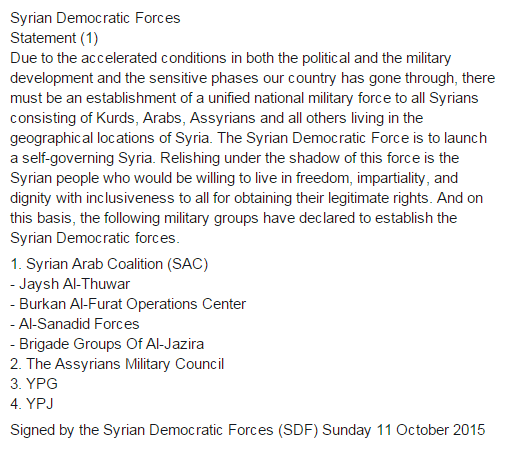
Reuters reports: A Kurdish militia that has been fighting Islamic State in Syria with help from U.S.-led air strikes has joined forces with Arab groups in an alliance announced on Monday that may be a prelude to an attack on the jihadists’ base of operations in Raqqa.

The alliance calling itself the Democratic Forces of Syria includes the Kurdish YPG militia and Syrian Arab groups, some of which fought alongside it in a campaign that drove Islamic State from wide areas of northern Syria earlier this year.

The Arab groups in the new alliance are operating under the name “The Syrian Arab Coalition” – a grouping which U.S. officials have said would receive support under a new U.S. strategy aimed at fighting Islamic State in Syria.

A U.S. military official has told Reuters that the Syrian Arab Coalition would push down towards Raqqa, Islamic State’s de facto capital, while staying east of the Euphrates river. [Continue reading…]

A statement issued yesterday by the Syrian Democratic Forces says:

sdfstatement

Facebooktwittermail

Syria: New Russian-made cluster munition reported

Human Rights Watch: An advanced type of Russian cluster munition was used in an airstrike southwest of Aleppo on October 4, 2015, Human Rights Watch said today. The use of the weapon near the village of Kafr Halab raises grave concerns that Russia is either using cluster munitions in Syria or providing the Syrian air force with new types of cluster munitions to use.

New photographs and videos also suggest renewed use of air-dropped cluster munitions as well as ground-fired Russian-made cluster munition rockets as part of the joint Russian-Syrian offensive in northern Syria.

“It’s disturbing that yet another type of cluster munition is being used in Syria given the harm they cause to civilians for years to come,” said Nadim Houry, deputy Middle East director at Human Rights Watch. “Neither Russia nor Syria should use cluster munitions, and both should join the international ban without delay.” [Continue reading…]

Last month, Human Rights Watch researcher, Ole Solvang, wrote about Saudi Arabia’s use of cluster bombs in Yemen: Cluster munitions were used in Yemen in past wars and now Saudi Arabia and members of its coalition are dropping bombs and launching rockets with this indiscriminate weapon on populated areas.

The U.S. is providing logistical and intelligence support for the coalition, and if it is providing targeting assistance for cluster munition strikes, it could be complicit in resulting laws-of-war violations. What’s more, the evidence we found of cluster rocket use just a few weeks ago showed that they were manufactured by U.S. companies. U.S. officials have expressed concern at the use of cluster munitions by Syria, South Sudan, Ukraine, and Sudan yet when it comes to the use of cluster munitions by the coalition in Yemen, the U.S. has been silent. [Continue reading…]

Facebooktwittermail

Obama’s legacy is tarnished as Putin fills the vacuum in Syria

Muhammad Idrees Ahmad writes: “Beware that, when fighting monsters, you yourself do not become a monster,” warned Nietzsche. “For when you gaze long into the abyss, the abyss gazes also into you.”

Russian tanks rolling into Hama, its air force bombing Idlib, its missiles flying from the Caspian, its fighter jets violating Turkish airspace – all of it backed by the familiar language of the “war on terror” – is the abyss staring back at an America that, in search of monsters to destroy, has helped legitimise monstrous deeds.

Vladimir Putin can face little resistance if he bombs an ambulance in Idlib when a US gunship incinerates a hospital in Kunduz. Bashar Al Assad can get away with murder because he has conveniently pronounced his opponents “terrorists”.

As long as the US carries the dead weight of the war on terror, it will have neither the agility to respond to crises nor the moral authority to restrain its wayward – or inadvertent – allies. When Mr Putin volunteered his forces to join a war on terror in Syria, Mr Obama had little choice but to assent. Russia, unlike the US, however has targeted mainly anti-Assad forces, some of them said to be US-backed. But Washington’s feeble complaints ring hollow when the US has itself set the precedent in targeting anti-ISIL groups.[Continue reading…]

Facebooktwittermail