Politico: A member of President Barack Obama’s hand-picked surveillance review group said Friday the White House was swayed by U.S. intelligence officials sympathetic to the National Security Agency and ultimately viewed the group’s findings “as a liberal report.”
University of Chicago law professor Geoffrey Stone said that, after receiving the surveillance group’s report, Obama spent a month meeting “with many of the same people we had met with at great length, members of the intelligence community, members of the intelligence committees from Congress largely on one side of the picture.”
“And instead of our report being truly understood as a middle ground, based upon taking into account all of those perspectives on both sides of the spectrum, I think the White House got moved by thinking of our report as a liberal report,” Stone said.
Stone, speaking during a panel discussion at the National Press Club in Washington, said intelligence officials were “pushing [Obama] and the White House generally more to what we can call the right.”
Category Archives: Obama administration
New York Times: End the phone data sweeps
In an editorial, the New York Times says: Once again, a thorough and independent analysis of the government’s dragnet surveillance of Americans’ phone records has found the bulk data collection to be illegal and probably unconstitutional. Just as troubling, the program was found to be virtually useless at stopping terrorism, raising the obvious question: Why does President Obama insist on continuing a costly, legally dubious program when his own appointees repeatedly find that it doesn’t work?
In a 238-page report issued Thursday afternoon, the Privacy and Civil Liberties Oversight Board, a five-member independent agency, called on the White House to end the phone-data collection program, for both constitutional and practical reasons. The board’s report follows a Dec. 16 ruling by Federal District Judge Richard Leon that the program was “almost certainly” unconstitutional and that the government had not identified “a single instance” in which it “actually stopped an imminent attack.”
Two days later, a panel of legal and intelligence experts convened by Mr. Obama after the disclosures by Edward Snowden echoed those conclusions in its own comprehensive report, which said the data sweep “was not essential to preventing attacks” and called for its end.
The growing agreement among those who have studied the program closely makes it imperative that the administration, along with the program’s defenders in Congress, explain why such intrusive mass surveillance is necessary at all. If Mr. Obama knows something that contradicts what he has now been told by two panels, a federal judge and multiple members of Congress, he should tell the American people now. Otherwise, he is in essence asking for their blind faith, which is precisely what he warned against during his speech last week on the future of government surveillance.
“Given the unique power of the state,” Mr. Obama said, “it is not enough for leaders to say: trust us, we won’t abuse the data we collect. For history has too many examples when that trust has been breached.”
The more likely reality is that the multiple analyses of recent weeks are correct, and that the phone-data sweeps have simply been ineffective. If they had assisted in the prevention of any terrorist attacks, it is safe to assume that we would know by now. Instead, despite repeated claims that the bulk-data collection programs had a hand in thwarting 54 terrorist plots, the privacy board members write, “we have not identified a single instance involving a threat to the United States in which the telephone records program made a concrete difference in the outcome of a counterterrorism investigation.”
That reiterates the findings of Judge Leon — who noted that even behind closed doors, the government provided “no proof” of the program’s efficacy — as well as the conclusion of a report released this month by the New America Foundation that the metadata program “had no discernible impact on preventing acts of terrorism and only the most marginal of impacts on preventing terrorist-related activity.”
No one disputes that the threat of terrorism is real and unrelenting, or that our intelligence techniques must adapt to a rapidly changing world. It is equally clear that the dragnet collection of Americans’ phone calls is not the answer.
The White House and the aristocratic institution of unpaid internships
Michael Lind writes: What do you call an employer that refuses to pay its workers any salary at all? Answer: The White House.
President Barack Obama has called for an increase in the U.S. minimum wage. And yet his administration expects hundreds of young people each year to work at the White House for an hourly wage of zero.
According to a White House website, White House interns are expected to work “at least Monday-Friday, 9 am-6pm.” Nice touch — “at least.”
In return for a full week’s worth of work and possible overtime, the White House provides its interns with no pay and no housing help. The latter is significant, because the Washington, D.C., metro area has among the highest costs in the U.S.
The problem with the unpaid internship program, which Obama inherited from previous Oval Officers and which has continued, is not sweatshop exploitation — it’s blatant class discrimination. [Continue reading…]
Video: James Bamford on surveillance policy
Note: This video runs for 1 hour 2 minutes.
U.S. says invitation to Iran to attend Syria talks should be withdrawn
Reuters reports: The United States insisted on Monday that a U.N. invitation to Iran to attend a January 22 peace conference on ending Syria’s war should be withdrawn unless Tehran fully supports a 2012 plan to establish a transitional government in Syria.
A senior State Department official, speaking on condition of anonymity, said chances of the conference going ahead were still “fluid” given that Iran has not fully endorsed the Geneva 1 agreement from 2012 to end the conflict.
The 2012 Geneva 1 plan agreed to establish “by mutual consent” a transitional body to govern Syria.
Syrian opposition groups, which voted on Saturday to attend the conference, have threatened to withdraw from the talks unless the invitation to Iran is withdrawn.
The official said Iran was providing substantial military and economic support for President Bashar al-Assad and Tehran’s participation in peace talks was not helpful.
“They are doing nothing to de-escalate tensions … and their actions have actually aggravated them, and so the idea that they would come to the conference refusing to acknowledge support for Geneva 1, we do not see how it could be helpful,” the official said.
No wonder this State Department official was speaking on condition of anonymity. He or she would hopefully be embarrassed to have their name attached to such nonsensical statements.
If this so-called peace conference was to require that all participants be committed to de-escalating tensions, then either there would be no participants who are qualified or no conference would be necessary.
The purpose of a peace conference is not to bring together peace lovers; it is to bring together adversaries in order to explore alternatives to the continuation of fighting. For any alternative to gain any traction it will need to offer each side the prospect of a better outcome than does the continuation of war.
How the U.S. turned the world into a war zone
Gregory D Johnsen writes: Sunrise was still nearly an hour off when Nazih al-Ruqai climbed into his black Hyundai SUV outside a mosque in northern Tripoli and turned the key. The lanky 49-year-old had left the house barely 30 minutes earlier for a quick trip to the mosque on a Saturday. It was Oct. 5, 2013, and after more than two decades in exile, he had settled into a predictable existence of prayer and worship.
The homecoming hadn’t always been so smooth. Ruqai, who is better known in the jihadi world as Abu Anas al-Libi, was still feeling the effects of the hepatitis C he had contracted years earlier during a stint in an underground prison in Iran. Following overtures from Muammar al-Qaddafi’s government, his wife and children had returned to Libya in 2010. But Libi stayed away, wary of the man he had once plotted to kill. Only when the Libyan uprisings started in early 2011 did he follow his family back to Libya. But by then it was already too late. His oldest son, Abd al-Rahman, the only one of his five children who had been born in Libya, was dead, shot while fighting for the capital.
After that, things moved in fits and starts. Qaddafi was killed weeks later in October 2011, and Libi eventually settled in Nufalayn, a leafy middle-class neighborhood in northeast Tripoli, alongside several members of his extended family. Life after Qaddafi was chaotic and messy — nothing really worked as the new government struggled to reboot after 42 years of dictatorship, often finding itself at the mercy of the heavily armed militias and tribes that had contributed to Qaddafi’s downfall.
Libi knew he was a wanted man. He had been on the FBI’s most wanted list for more than a decade, following an indictment in 2000 for his alleged role in al-Qaeda’s attacks on U.S. embassies in Kenya and Tanzania two years earlier. Along with Libi the indictment named 20 other individuals, including Osama bin Laden and Ayman al-Zawahiri, as defendants.
“He suspected that at any moment he would be killed,” his son later told The New York Times. Still, on that Saturday morning in early October, much of the danger seemed to have passed. Libi had been living in the open for nearly a year, attending prayers and settling local disputes, where his history as a fighter and knowledge of the Qur’an made him a respected arbiter. Neighbors called him simply “the shaykh,” a sign of respect in the conservative circles in which Libi still moved.
He had also taken steps to address his past. Three weeks earlier, on Sept. 15, Libi had sat down with Libya’s attorney general to discuss his indictment, according to one report. (The Libyan Embassy in Washington did not respond to repeated requests to confirm Libi’s meeting.) But mostly he just wanted to move on with his life. He had applied for his old job at the Ministry of Oil and Gas and he couldn’t stop talking about how much he was looking forward to becoming a grandfather for the first time.
A trio of cars around 6 a.m. ended all of that.
Inside the family’s apartment, Libi’s wife heard the commotion. From a window she looked out over the beige wall that surrounded their building and into the street where several men had surrounded her husband, who was still in the driver’s seat of his black Hyundai.
“Get out,” the men shouted in Arabic. “Get out.” Then they smashed the window. Most of the men were masked, but she could see a few faces, she said later in Arabic interviews. They looked Libyan; they sounded Libyan. Some of them had guns; some didn’t, but they all moved quickly.
By the time the rest of the family made it to the street, all that was left was a single sandal and a few drops of blood.
Early that same morning, nearly 3,000 miles away in the seaside city of Baraawe on Somalia’s eastern coast, U.S. Navy SEALs crept through the darkness toward their target, which a local resident later described to me as a walled compound more than 100 yards inland. The Americans had been here before. Four years earlier, in September 2009, a contingent of Navy SEALs had ambushed a two-car convoy just outside of town. Flying low in helicopter gunships, the SEALs quickly disabled the cars and then touched down to collect the bodies.
This time the target — Abd al-Qadir Muhammad Abd al-Qadir, a young Kenyan of Somali descent better known as Ikrima — was stationary. The SEALs would have to go in and get him. Pre-raid intelligence suggested that the compound housed mostly fighters with few or no civilians present. Only 130 miles south of Mogadishu and what passed for the Somali government, Baraawe had been under the control of al-Shabaab, a fragmentary militant group, since 2009. Fighters came and went freely, as al-Shabaab implemented its own narrow version of Islamic law in the city.
Moving up the beach and into enemy territory, the SEALs needed the element of surprise. Through the trees and scrub brush ahead of them, most of the city was dark. Baraawe had only a few hours of electricity each day, usually from evening prayers until midnight. But al-Shabaab’s members lived separately and, along with some of the city’s wealthier residents, got around the shortages by running private generators. The plan that night took this into account, calling for the SEALs to jam internet signals, apparently in an attempt to cut off communication once the raid began. That would prove to be a mistake.
Inside the compound, some of the al-Shabaab fighters were up late and online. And, according to a report in the Toronto Star, when the internet suddenly went out in the middle of the night, they went to look for the source of the problem. At least one fighter stepped outside, and as he moved around in the darkness he spotted some of the SEALs.
The plan to knock the internet offline and isolate the fighters in the villa had backfired, effectively giving al-Shabaab an early warning that the SEALs were on their way. (In the days after the raid, al-Shabaab would arrest a handful of local men who were known to visit Western websites, accusing them of spying and aiding U.S. efforts.)
The firefight lasted several minutes, although residents reported hearing gunfire throughout the night as members of al-Shabaab discharged their weapons into the dark for hours after the Americans had withdrawn, empty-handed.
In the span of a few hours, the U.S. had launched a pair of raids — one successful and one not — 3,000 miles apart, in countries with which the nation was not at war. Hardly anyone noticed.
More than a dozen years after the Sept. 11 attacks, this is what America’s war looks like, silent strikes and shadowy raids. The Congressional Research Service, an analytical branch of the Library of Congress, recently said that it had located at least 30 similar occurrences, although the number of covert actions is likely many times higher with drones strikes and other secret operations. The remarkable has become regular.
The White House said that the operations in both Libya and Somalia drew their authority from the Authorization for the Use of Military Force, a 12-year-old piece of legislation that was drafted in the hours after the Sept. 11 attacks. At the heart of the AUMF is a single 60-word sentence, which has formed the legal foundation for nearly every counterterrorism operation the U.S. has conducted since Sept. 11, from Guantanamo Bay and drone strikes to secret renditions and SEAL raids. Everything rests on those 60 words. [Continue reading…]

In keeping grip on data pipeline, Obama does little to reassure industry
The New York Times reports: Google, which briefly considered moving all of its computer servers out of the United States last year after learning how they had been penetrated by the National Security Agency, was looking for a public assurance from President Obama that the government would no longer secretly suck data from the company’s corner of the Internet cloud.
Microsoft was listening to see if Mr. Obama would adopt a recommendation from his advisers that the government stop routinely stockpiling flaws in its Windows operating system, then using them to penetrate some foreign computer systems and, in rare cases, launch cyberattacks.
Intel and computer security companies were eager to hear Mr. Obama embrace a commitment that the United States would never knowingly move to weaken encryption systems.
They got none of that. [Continue reading…]
Video: NSA whistleblowers point to Obama’s omissions in NSA speech
Tepid global reaction to Obama’s NSA vow
The Washington Post reports: After months of revelations that strained U.S. relations with allies and cast a harsh light on the National Security Agency’s global surveillance reach, President Obama’s speech Friday was aimed at least in part at reassuring the world of American intentions.
But the initial reaction overseas suggested he still has a significant way to go to heal the rifts, with many wondering why he didn’t offer more specific protections.
In Germany, where revelations that the NSA had been eavesdropping on the calls of Chancellor Angela Merkel stirred deep anger and unusually tough criticism of Washington, Obama’s promises to rein in the excesses of U.S. spying were met with a tepid welcome from the German government — and scorn from some analysts.
Government spokesman Steffen Seibert tweeted that the government would appreciate better safeguards of the rights of non-U.S. citizens but would need more time to review Obama’s words in detail. [Continue reading…]
Video: Obama NSA reforms are ‘a bouquet of roses’ to the intelligence agencies
Obama’s restrictions on NSA surveillance rely on narrow definition of ‘spying’
Barton Gellman reports: President Obama said Friday, in his first major speech on electronic surveillance, that “the United States is not spying on ordinary people who don’t threaten our national security.”
Obama placed restrictions on access to domestic phone records collected by the National Security Agency, but the changes he announced will allow it to continue — or expand — the collection of personal data from billions of people around the world, Americans and foreign citizens alike.
Obama squares that circle with an unusually narrow definition of “spying.” It does not include the ingestion of tens of trillions of records about the telephone calls, e-mails, locations and relationships of people for whom there is no suspicion of relevance to any threat.
In his speech, and an accompanying policy directive, Obama described principles for “restricting the use of this information” — but not for gathering less of it.
Alongside the invocation of privacy and restraint, Obama gave his plainest endorsement yet of “bulk collection,” a term he used more than once and authorized explicitly in Presidential Policy Directive 28. In a footnote, the directive defined the term to mean high-volume collection “without the use of discriminants.” [Continue reading…]
Obama’s (still) unanswered question on phone spying
National Journal reports: Ending bulk data collection, which the NSA claims is authorized under Section 215 of the Patriot Act, has been the top priority for civil liberties groups.
Obama announced on Friday that he will end the program “as it currently exists.”
Starting immediately, NSA analysts will need approval from the Foreign Intelligence Surveillance Court every time they want to access the phone database. Obama also said he plans to eventually move the database out of the government’s hands. The president directed Attorney General Eric Holder and top intelligence officials to come up with a plan by March 28 for turning over control of the database.
But no matter who stores the data, the NSA will want to ensure that its analysts can still access it when they want to map the connections of a potential terrorist group. That could mean the administration will ask Congress to enact a mandate requiring phone companies to store their customers’ data on behalf of the NSA.
Privacy advocates warn that a data retention mandate would turn phone companies into agents of the NSA.
“To the contrary, companies should be working on ways to store less user data for less time—decreasing the risks from data breaches and intrusions like the one that just happened to Target,” wrote Cindy Cohn and Rainey Reitman of the Electronic Frontier Foundation. “Data retention heads in the wrong direction for our security regardless of whether the government or private parties store the information.”
Kevin Bankston, a policy director for the New American Foundation, said that if the alternative to government storage is mandatory data retention or a requirement for phone companies to turn the data over to some other third party, “the President should be prepared for a major legislative battle with key members of Congress, the technology industry and the privacy community arrayed against him.” [Continue reading…]
Video: Julian Assange responds to Obama’s NSA reforms speech
A transcript of Obama’s full speech can be read here.
What happened to AIPAC’s seventy senators?

In 2005, AIPAC’s Steven Rosen when prompted by Jeffrey Goldberg to assess the level of the lobby’s influence famously said: “In twenty-four hours, we could have the signatures of seventy senators on this napkin.”
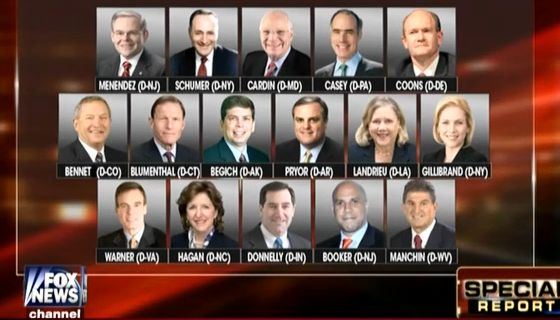
The “Nuclear Weapon Free Iran Act of 2013” sponsored by Democratic Senator Robert Menedez has the support of fifty-nine senators. That’s a dangerously large majority but just short of a veto-proof sixty-seven votes and well short of Rosen’s seventy.
Does that mean that AIPAC is refraining from pulling its weight or is it just not as powerful as Rosen declared?
I called my Democratic Senator Kay Hagan, one of the co-sponsors of the bill, to tell her that if she follows through and casts a vote in favor, she won’t have my vote in November. Interestingly, her staffer was at pains to underline the fact that this is still in process and hasn’t gone to a vote. I got a strong sense that Hagan, perhaps like many other senators both Democratic and Republican, would be content demonstrating her loyalty to AIPAC without actually casting a vote.
In the report below, Republican Senator Roy Blunt essentially says that every senator’s hands have been tied by Senate leader Harry Reid and far from striking a defiant tone, Blunt seems content to be rendered powerless.
If the bill got just one more supporter, would Reid bow to pressure and let it go to a vote? And can’t AIPAC with all its influence turn just one more senator in its favor?
I get the sense that for everyone involved — including AIPAC — this is all political theater. They want to act tough, but at the end of the day, they probably don’t want to be held responsible for sabotaging the most significant diplomatic opening in a decade.
National Journal reports: Senate Iran hawks have lots of votes to back their sanctions legislation. What they lack is a plan to get the bill to the floor.
Fifty-nine senators — including 16 Democrats — have signed onto sanctions legislation from Democratic Sen. Robert Menendez and Republican Sen. Mark Kirk. The measure would punish Iran with sanctions if it reneges on an interim nuclear agreement or if that agreement does not ultimately abolish any nuclear-weapons capabilities for Iran.
That count has climbed rapidly since the bipartisan pair introduced their legislation in late December. But now it’s unclear whether that support will be enough to clear the bill’s next major hurdle: Senate Majority Leader Harry Reid.
Reid is siding with the White House, which has put intense pressure on lawmakers not to act on sanctions, arguing it could result in both a nuclear-armed and hostile Iranian state. And without Reid’s backing, supporters of the Menendez-Kirk bill are unsure how to move the measure to the floor.
“I assume that if the Democrat senators put enough pressure on Senator Reid he might bring it to the floor,” said Missouri Republican Sen. Roy Blunt. “But, you know, we are at a moment in the Senate where nothing happens that Senator Reid doesn’t want to happen; and this is something at this moment that Senator Reid doesn’t want to happen.”
And for now, sanctions supporters are still mulling their strategy.
“We are talking amongst ourselves. There is a very active debate and discussion ongoing about how best to move forward,” said Democratic Sen. Richard Blumenthal of Connecticut, a cosponsor of the bill. “There are a number of alternative strategies, but we’re deliberating them.”
While Reid has, at least for now, foiled their policy plans, sanctions supporters are still scoring the desired political points on the issue. They can report their efforts to their constituents while blaming Reid for the inaction.
Jon Stewart, comparing these senators to egg-throwing Justin Bieber, is perfectly clear about which “constituents” they are trying to represent: AIPAC and Israel. (It’s a shame that Daily Show writers, having crafted a strong piece then felt compelled to add some “balance” by treating Rouhani’s tweet with scorn: “World powers surrendered to Iran’s national will.” If he can placate his hawkish critics just with a tweet, I’m sure Obama is envious.)
Video: Why Democrats may sabotage Obama’s Iran deal
Administration retreats on environmental protection in talks on Pacific trade
The New York Times reports: The Obama administration is retreating from previous demands of strong international environmental protections in order to reach agreement on a sweeping Pacific trade deal that is a pillar of President Obama’s strategic shift to Asia, according to documents obtained by WikiLeaks, environmentalists and people close to the contentious trade talks.
The negotiations over the Trans-Pacific Partnership, which would be one of the world’s biggest trade agreements, have exposed deep rifts over environmental policy between the United States and 11 other Pacific Rim nations. As it stands now, the documents, viewed by The New York Times, show that the disputes could undo key global environmental protections.
The environmental chapter of the trade deal has been among the most highly disputed elements of negotiations in the pact. Participants in the talks, which have dragged on for three years, had hoped to complete the deal by the end of 2013.
Environmentalists said that the draft appears to signal that the United States will retreat on a variety of environmental protections — including legally binding pollution control requirements and logging regulations and a ban on harvesting sharks’ fins — to advance a trade deal that is a top priority for Mr. Obama. [Continue reading…]
If you want Obama to rein in the NSA, you’re about to be disappointed
James Oliphant writes: President Obama has a rare opportunity this week to reshape the nation’s counterterrorism strategy. He won’t take it.
The White House has been trying to lower expectations for the president’s planned Friday speech for days now. He’ll outline a series of reforms to the National Security Agency’s surveillance programs in an address at the Justice Department, but Obama will do nothing to diminish the government’s capacity to root out terror networks, aides say.
Ever since the flood of disclosures regarding the NSA from former contractor Edward Snowden, Obama and his team have tried to walk a careful public line: appearing to cherish Americans’ privacy while defending the agency’s actions, particularly the bulk collection of telephone records, the so-called “metadata.”
But it’s been evident all along that the White House has more or less been dragged into the reform debate. At a press conference back in August, for example, the president maintained, amid heavy criticism, that the programs are valuable and that a public skeptical about their reach simply needs reassurance that they won’t be abused.
That’s still Obama’s view. And in the days leading to Friday’s speech, Jay Carney and others in the White House have referred to the issue as one of transparency and disclosure, not of reining in government power. “The president has been clear throughout this review process that we will not harm our national security or our ability to face global threats,” Obama’s press secretary said last week. “And our intelligence-gathering activities are directly related to our ability to face those global threats and protect our national security.”
To lay the groundwork for that position, aides to the president told the Los Angeles Times this weekend that the NSA’s metadata collection scheme could have prevented the Sept. 11 attacks. What’s more, Obama has adopted that “9/11 justification” for the NSA program, the paper reported.
That’s a blinking-red signal that the administration is not about to be accused of making the country more vulnerable by tampering with such a preventive weapon. [Continue reading…]
Edward Snowden isn’t the only truth teller who deserves clemency
Michael Ratner, the U.S. attorney for Julian Assange, writes: Last week, both the New York Times and the Guardian released editorials supporting clemency for NSA leaker Edward Snowden. Considering the important nature of Snowden’s revelations, clemency is definitely in order – and it’s about time that majorww outlets recognize that.
However, the focus on Snowden’s singular case seriously deflects from the fact that the Obama administration has been a nightmare for whistleblowers and truth tellers, and that several others currently in prison or in exile deserve the same clemency or clear assurances they will not be prosecuted.
So why is the media now calling for mercy for Edward Snowden, while other truth tellers including Chelsea Manning and Julian Assange, continue to face persecution (and prosecution)?
If you apply the criteria established by both the New York Times and the Guardian to Manning and Assange – as well as other truth tellers including Jeremy Hammond, currently in prison serving a 10-year sentence after exposing corporate spy networks – a clear double standard emerges. [Continue reading…]