Category Archives: Entities

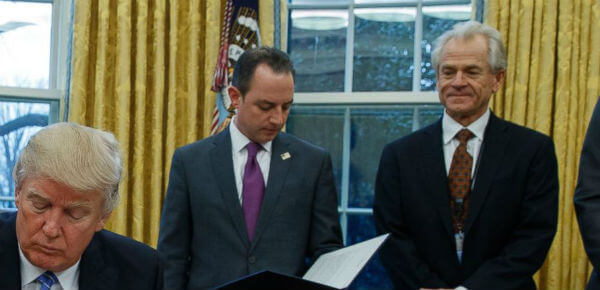
Is Peter Navarro the most dangerous man in Trump world?

While considering the danger posed by the head of Trump’s National Trade Council, Jacob Heilbrunn writes: To counter the manifold economic and military threats the United States faces, Navarro recommends a sweeping revision of U.S. foreign policy. He wants high tariffs, the repudiation of trade pacts and, above all, a massive military buildup against China. One of Navarro’s aspirations is to beef up military ties with Taiwan, which Beijing considers part of China. Calling the Obama administration’s treatment of Taipei “egregious,” Navarro declared in Foreign Policy that it has been “repeatedly denied the type of comprehensive arms deal it needs to deter China’s covetous gaze.” At the same time, Navarro wants to end sequestration on defense and go on an all-out shipbuilding binge for the U.S. Navy. Nor does Navarro seem to see a bomber that he would not like to build.

The hysterical economic warnings, the scary prescriptions and the self-defeating proposals would simply be fanciful nonsense if Navarro weren’t whispering in the ear of the most powerful man in the world. The fact that he is makes them dangerous. Of course, where Trump will actually head still remains an open question. After his initial questioning of a “one China” policy, Trump, in a phone call with Chinese President Xi Jinping on Thursday, seems to have endorsed it. But at the same time, Trump is clearly seeking to use Japan to balance Chinese power, which is why he is hosting Japanese Prime Minister Shinzo Abe this weekend. On Friday, Abe even promised to invest in America and joked that he would help build a Maglev train that would convey the president within an hour from Washington to his Manhattan aerie.

Like not a few presidential advisers in history, Navarro may not be able to enact everything he proposes. Perhaps he will breathe fire about the perfidy of China and other countries but not decisively influence economic policy. In this scenario, Navarro would serve as a convenient release valve for ventilating frustration about the further loss of manufacturing jobs that is likely to continue under Trump, thanks mostly to the inexorable rise of artificial intelligence and automation. In the Washington Post, Ed Hess, a professor of business administration at the University of Virginia, predicts that tens of millions of jobs will be destroyed in the next five to 15 years by emerging technologies, and 47 percent wiped out over the next 10 to 15 years.

Another possibility is that Navarro doesn’t get free rein but has to jockey for power with the other economic players in the administration, including Steven Mnuchin at Treasury, a former Goldman Sachs executive who has no history of China antagonism. In this scenario, Trump doesn’t jettison NAFTA but rather accedes to some cosmetic changes that don’t fundamentally alter the pact. At the same time, he retreats from his bogus charge that Beijing is depressing its currency — it isn’t — and initiates trade talks with the Chinese while also working with them to corral North Korean nuclear ambitions.

But there’s a third possibility — one that we shouldn’t dismiss. In this scenario, the Navarro line prevails. Trump unilaterally slaps draconian tariffs on Mexico and China. In turn, the World Trade Organization says they’re illegal. Trump, never one to defer to the courts, pulls the U.S. out of the WTO, and the international economic order is upended. With tariffs high and Trump bailing out of international institutions, it doesn’t take long before we end up in a global depression. The last time something like this occurred it led directly to the rise of fascist regimes in Germany, Italy and Japan, with nationalist leaders promising that domestic repression and external expansion were a quick and easy remedy to their nation’s woes. [Continue reading…]


Facebooktwittermail

Will Flynn go quietly?

The New York Times reports: These are chaotic and anxious days inside the National Security Council, the traditional center of management for a president’s dealings with an uncertain world.

Three weeks into the Trump administration, council staff members get up in the morning, read President Trump’s Twitter posts and struggle to make policy to fit them. Most are kept in the dark about what Mr. Trump tells foreign leaders in his phone calls. Some staff members have turned to encrypted communications to talk with their colleagues, after hearing that Mr. Trump’s top advisers are considering an “insider threat” program that could result in monitoring cellphones and emails for leaks.

The national security adviser, Michael T. Flynn, has hunkered down since investigators began looking into what, exactly, he told the Russian ambassador to the United States about the lifting of sanctions imposed in the last days of the Obama administration, and whether he misled Vice President Mike Pence about those conversations. His survival in the job may hang in the balance.

Although Mr. Trump suggested to reporters aboard Air Force One on Friday that he was unaware of the latest questions swirling around Mr. Flynn’s dealings with Russia, aides said over the weekend in Florida — where Mr. Flynn accompanied the president and Japan’s prime minister, Shinzo Abe — that Mr. Trump was closely monitoring the reaction to Mr. Flynn’s conversations. There are transcripts of a conversation in at least one phone call, recorded by American intelligence agencies that wiretap foreign diplomats, which may determine Mr. Flynn’s future. [Continue reading…]

Increasingly, the question seems not to be if Flynn will go, but how he will go?

As a top official dumped by two administrations, he’s quite likely to feel victimized and thus bitter — and perhaps therefore sooner or later willing to go public with a damning and detailed portrait of the dysfunctionality of the Trump administration.

Facebooktwittermail

‘The knives are out for Flynn,’ says Trump administration official

The Washington Post reports: White House national security adviser Michael Flynn is under increasing political pressure and risks losing the confidence of some colleagues following reports that he misled senior administration officials about his discussion of sanctions with a Russian envoy shortly before President Trump took office.

As White House aides scramble to get their stories straight about the exact nature of those communications and as Democrats call for Flynn’s security clearance to be suspended or revoked, neither Trump nor his advisers have publicly defended Flynn or stated unequivocally that he has the president’s confidence.

Privately, some administration officials said that Flynn’s position has weakened and support for him has eroded largely because of a belief that he was disingenuous about Russia and therefore could not be fully trusted going forward.

“The knives are out for Flynn,” said one administration official who, like others interviewed for this report, spoke on the condition of anonymity in order to speak candidly.

On Sunday, the top White House aide dispatched to represent the administration on the political talk shows pointedly declined to defend Flynn. [Continue reading…]

Facebooktwittermail

North Korean nuclear ambitions to be defining issue for Trump

Bloomberg reports: Trump will be forced to deal with ongoing threats from North Korea as that country gains the ability to threaten the continental U.S. with a nuclear strike, an official said on Sunday, hours after Pyongyang fired a ballistic missile into nearby seas.

North Korea will probably develop its ballistic missile technology enough to pair with its nuclear weapons to reach the U.S. during Trump’s tenure, said Richard Haass, president of the Council on Foreign Relations.

Either the U.S. gets the Chinese to help increase pressure on North Korea through sanctions, or Trump will have “a truly consequential decision,” Haass said on CNN’s “Fareed Zakaria GPS” on Sunday.

“Trump is going to have to face a truly fateful decision about whether we’re prepared to live with that, a North Korea that has that capability against us, or we are going to use military force one way or another to destroy their nuclear missile capability,” Haass said. [Continue reading…]

The New York Times reports: South Korea’s Foreign Ministry said the test, the first by the North this year, demonstrated the “maniacal obsession” of the North Korean leader, Kim Jong-un, with developing a nuclear-tipped ballistic missile.

The test came less than two days after Mr. Trump said on Friday that defending against the nuclear and missile threats from North Korea was a “very, very high priority.” Mr. Trump made the comment at a news conference with Mr. Abe at the White House. In their joint statement, the two leaders had urged North Korea “to abandon its nuclear and ballistic missile programs and not to take any further provocative actions.” [Continue reading…]

David Wright writes: The missile was apparently launched eastward from the Panghyon air base near Kusong, northwest of Pyongyang and traveled 500 km, splashing down in the Sea of Japan. According to the South Korean military, it flew on a lofted trajectory, reaching an apogee of about 550 km.

A missile flown on this trajectory would have a range of 1,200-1,250 km if flown on a standard trajectory with the same payload.

That range is similar to that of the North Korean Nodong missile, which was first tested in the early 1990s and has been launched repeatedly since then. Another launch of the Nodong would not be particularly useful for advancing Pyongyang’s missile program, so if that was what was launched it would have had a political motivation.

However, as Jeffrey Lewis points out, the trajectory is very similar to the trajectory the submarine-launched KN-11 missile flew in its first successful test last August. While similar in range to the Nodong, the KN-11 has the advantage that it uses solid rather than liquid fuel, which means it would take less preparation time before a launch. The North is likely to be interested in developing and testing a land-based version of the missile.

If this is what was launched, it would represent a useful developmental step for North Korea, no matter what may have driven the timing of the launch. [Continue reading…]

Facebooktwittermail

American husbands are incomparably more deadly than terrorists

Nicholas Kristof writes: It’s true that Muslim Americans — both born in the United States and immigrants from countries other than those subject to Trump’s restrictions — have carried out deadly terrorism in America. There have been 123 such murders since the 9/11 attacks — and 230,000 other murders.

Last year Americans were less likely to be killed by Muslim terrorists than for being Muslim, according to Charles Kurzman of the University of North Carolina. The former is a risk of approximately one in six million; the latter, one in one million.

The bottom line is that most years in the U.S., ladders kill far more Americans than Muslim terrorists do. Same with bathtubs. Ditto for stairs. And lightning.

Above all, fear spouses: Husbands are incomparably more deadly in America than jihadist terrorists.

And husbands are so deadly in part because in America they have ready access to firearms, even when they have a history of violence. In other countries, brutish husbands put wives in hospitals; in America, they put them in graves. [Continue reading…]

Facebooktwittermail

Germany picks anti-Trump president as trans-Atlantic bonds fray

The Washington Post reports: Frank-Walter Steinmeier, the former German foreign minister who was a vocal critic of Donald Trump during the U.S. campaign, was elected Sunday as the country’s 12th postwar president.

The Social Democrat, who served two stints as foreign minister under Chancellor Angela Merkel, emerged as her governing coalition’s candidate in November as their parties sought to avoid a political spat over the appointment in an election year. With the support of Merkel’s Christian Democratic-led bloc and the Social Democrats in a special assembly on Sunday, Steinmeier was elected in the first round to the mostly ceremonial post.

While Merkel steered clear of sharing her views on Trump before his election as president, her top diplomat vociferously derided what he saw as a campaign that broke taboos and threatened trans-Atlantic bonds. At one point, Steinmeier called Trump a “hate preacher.” As head of state, Steinmeier will be Trump’s counterpart, according to protocol, even though the German presidency lacks the political or policymaking power held by the chancellor.

The day after Trump’s surprise election victory, Merkel issued a couched warning that offered the new U.S. president German cooperation based on joint values, including democracy, respect for the rule of law and for human dignity “independent of origin, skin color, religion, gender, sexual orientation or political views.” Steinmeier was less diplomatic.

“The result is not what most Germans would have wished,” Steinmeier said Nov. 9. “I don’t want to sugarcoat anything. Nothing will be easier, many things will become more difficult.”

Steinmeier shunned political tension or any mention of Trump in an eight-minute speech after his election, though he cited Germany as an “anchor of hope” in an increasingly unsettled world. [Continue reading…]

Facebooktwittermail

How Trump may help Hezbollah

The Times of Israel reports: Hezbollah leader Hassan Nasrallah said he was “optimistic” now that the “fool” US President Donald Trump is in the White House, presenting what Nasrallah described as new opportunities for the Lebanon-based terror group.

Nasrallah made the comments during a televised speech broadcast on the Hezbollah terror group’s affiliate satellite channel, al-Manar.

“Neither Trump nor any other of these racists will damage the faith of children and our elders,” he said. “We are very optimistic that when a fool settles in the White House and boasts about his foolishness, this is the beginning of relief for the oppressed around the world.”

“Trump revealed the true face of the ugly, racist and unjust US administration, and we thank him for that,” Nasrallah added. [Continue reading…]

VOA reports: Hezbollah hopes that Trump is so busy pursuing his “America first” policy that he will leave a lighter U.S. footprint in the Middle East, perhaps even setting the stage for a withdrawal from the region.

“The more the U.S. policy turns toward isolationism, the more relieved the world would be from its troubles,” Nawwaf Moussawi, a member of Hezbollah in the Lebanese parliament, said last month.

Some analysts believe Hezbollah has reasons for optimism and that Trump’s possible policy in the region could, by default, strengthen the militant group.

“Trump’s reluctance toward the fight in Syria will practically provide more room for Hezbollah, a major player in Syria, to grow and flourish,” said U.K.-based Middle East scholar Scott Lucas, an editor at the EA Worldview research organization.

Others argue that Hezbollah doesn’t have the resources to create further instability in the region. [Continue reading…]

Facebooktwittermail

Tahrir al-Sham: Al-Qaeda’s latest incarnation in Syria

BBC News reports: The Syrian jihadist group Jabhat Fateh al-Sham (JFS), known as al-Nusra Front until it broke off formal ties with al-Qaeda last July, has merged with four smaller Syrian factions and rebranded itself as “Tahrir al-Sham”.

The new group’s leader has been named as Hashim al-Sheikh, who previously served as the head of the powerful Islamist rebel group, Ahrar al-Sham.

Ahrar al-Sham itself has refused to join the new body and has been at loggerheads with JFS in northern Syria.

On 9 February, al-Shaikh delivered the group’s first leadership message in which he insisted the new entity was independent and not an extension of former organisations and factions.

By reinventing itself again, JFS appears to be trying to distance itself from its al-Qaeda past and embed itself more deeply within the Syrian insurgency.

No mention has been made of JFS leader Abu Mohammed al-Julani in any of the new group’s communications. But he is widely believed to be serving as its military commander. [Continue reading…]

Facebooktwittermail

Michael Flynn’s deceptions present bigger problem than violation of the Logan Act

David Ignatius writes: Michael Flynn’s real problem isn’t the Logan Act, an obscure and probably unenforceable 1799 statute that bars private meddling in foreign policy disputes. It’s whether President Trump’s national security adviser sought to hide from his colleagues and the nation a pre-inauguration discussion with the Russian government about sanctions that the Obama administration was imposing.

“It’s far less significant if he violated the Logan Act and far more significant if he willfully misled this country,” said Rep. Adam B. Schiff (Calif.), the ranking Democrat on the House Intelligence Committee, in a telephone interview late Friday. “Why would he conceal the nature of the call unless he was conscious of wrongdoing?”

Schiff said the FBI and congressional intelligence committees should investigate whether Flynn discussed with Russian Ambassador Sergey Kislyak in late December the imminent imposition of sanctions, and whether he encrypted any of those communications in what might have been an effort to avoid monitoring. Schiff said that if some conversations were recorded by U.S. intelligence agencies, “we should be able to rapidly tell if Gen. Flynn was being truthful” when he told Vice President Pence and other colleagues that sanctions weren’t discussed. [Continue reading…]

Flynn’s ongoing obfuscation around the content of his conversations would appear to be a delaying tactic driven by the fact that he doesn’t know how much more detail in his exchanges might soon be leaked.

It’s also, no doubt, a product of the reliable expectation that in a political climate flooded with too many controversies for the media to closely track, the Flynn story is likely to get overshadowed by yet another drama.

The 24/7 Trump soap opera is effective in both sickening and exhausting an audience that will soon transition from interminable distraction to mass catatonia.

Facebooktwittermail

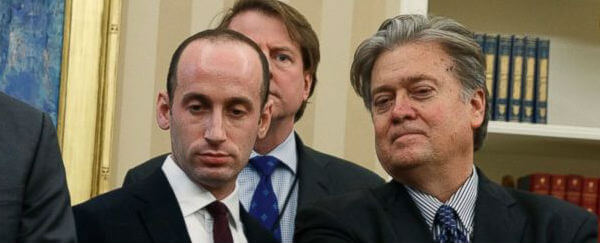
Stephen Miller — Trump’s devoted xenophobic ‘warrior’

The New York Times reports: Staff members on Capitol Hill recall Stephen Miller, the 31-year-old White House adviser behind many of President Trump’s most contentious executive orders, as the guy from Jeff Sessions’s office who made their inboxes cry for mercy.

As a top aide to Mr. Sessions, the conservative Alabama senator, Mr. Miller dispatched dozens and dozens of bombastic emails to congressional staff members and reporters in early 2013 when the Senate was considering a big bipartisan immigration overhaul. Mr. Miller slammed the evils of “foreign labor” and pushed around nasty news articles on proponents of compromise, like Senator Marco Rubio of Florida.

One exhausted Senate staff member, forwarding a Miller-gram to a reporter at the time, wrote: “His latest. And it’s only 11:45 a.m.”

The ascent of Mr. Miller from far-right gadfly with little policy experience to the president’s senior policy adviser came as a shock to many of the staff members who knew him from his seven years in the Senate. A man whose emails were, until recently, considered spam by many of his Republican peers is now shaping the Trump administration’s core domestic policies with his economic nationalism and hard-line positions on immigration. [Continue reading…]

Facebooktwittermail

FBI counter-terrorism taskforce investigating political activists; Army veterans return to defend protesters at Standing Rock

The Guardian reports: The FBI is investigating political activists campaigning against the Dakota Access pipeline, diverting agents charged with preventing terrorist attacks to instead focus their attention on indigenous activists and environmentalists.

The Guardian has established that multiple officers within the FBI’s joint terrorism taskforce have attempted to contact at least three people tied to the Standing Rock “water protector” movement in North Dakota.

The purpose of the officers’ inquiries into Standing Rock, and scope of the task force’s work, remains unknown. Agency officials declined to comment. But the fact that the officers have even tried to communicate with activists is alarming to free-speech experts who argue that anti-terrorism agents have no business scrutinizing protesters.

“The idea that the government would attempt to construe this indigenous-led non-violent movement into some kind of domestic terrorism investigation is unfathomable to me,” said Lauren Regan, a civil rights attorney who has provided legal support to demonstrators who were contacted by representatives of the FBI. “It’s outrageous, it’s unwarranted … and it’s unconstitutional.” [Continue reading…]

The Guardian reports: US veterans are returning to Standing Rock and pledging to shield indigenous activists from attacks by a militarized police force, another sign that the fight against the Dakota Access pipeline is far from over.

Army veterans from across the country have arrived in Cannon Ball, North Dakota, or are currently en route after the news that Donald Trump’s administration has allowed the oil corporation to finish drilling across the Missouri river.

The growing group of military veterans could make it harder for police and government officials to try to remove hundreds of activists who remain camped near the construction site and, some hope, could limit use of excessive force by law enforcement during demonstrations. [Continue reading…]

Facebooktwittermail

The fragile condition of Europe’s youngest democracies

Jan Kubik writes: On 31 January, during an evening session that was suspiciously secretive, the Romanian government adopted two ordinances changing the country’s penal code. The measures were immediately seen by many as a clumsy attempt to decriminalise certain corruption offences, with the main beneficiaries being the politicians of the ruling party. Street protests broke out during that night, culminating last Sunday in the biggest demonstration since the fall of communism.

These events bring into sharp relief the main features of a volatile situation in eastern Europe where three forces vie for dominance: disconnected and sometimes corrupt “traditional” politicians, increasingly impatient and angry publics and assertive demagogues.

The east central Europe that shed communism in 1989 is a convenient laboratory to observe the emergence of a new politics. It is not necessarily due to its politicians being more corrupt, its demagogues flashier (who can compete with Trump?) and its publics angrier. It is more because its democracies are still fresher, more “basic”, their institutions not yet wrapped in a resilient layer of protective pro-democratic cultures. The whole system is thus more exposed to pressure tests. [Continue reading…]

Facebooktwittermail

Trump is terrorizing America’s immigrant population

The New York Times reports: In Austin, Tex., undocumented women working in a laundromat cowered in the back of the room, petrified after seeing a video and a photograph of apprehensions outside a local grocery store and burger joint.

A day laborer and mechanic in Staten Island told his 17-year-old son where the list of emergency contacts were, including the name of the guardian who would take responsibility for him and his two younger siblings.

In Savannah, Ga., undocumented restaurant workers were asking for rides rather than walking home, afraid they might be stopped and questioned.

As reports of immigration raids and roundups have rocketed across Twitter, Facebook and texts around the country, undocumented immigrants, their lawyers and advocacy groups are bracing for the increased enforcement that President Trump has called for.

Susannah Volpe, a managing attorney at Ayuda, an immigrant legal services group in Washington, said she had noticed what seemed to be roundups of people, like those without criminal records, that the government had not previously paid much attention to.

“These are agents going into apartment buildings or agents going to worksites,” said Ms. Volpe, who had a client arrested, along with five others, at a construction site in Washington last week. “This is new.”

School principals in Los Angeles have been sent a checklist of things to do in case immigration agents turn up. The Mexican government even warned “the entire Mexican community” in the United States “to take precautions and to keep in touch with their nearest consulate,” after the deportation of a woman who had previously been allowed to remain in the United States. [Continue reading…]

Facebooktwittermail

Popular support for the rule of law and democracy has weakened across America

Austin Sarat writes: There is much to celebrate in the court decision against President Trump’s immigration ban. It was a stirring victory for the rule of law and reaffirmation of the independence of the judiciary. Yet America faces a serious problem which that decision did not address: the erosion of public faith in the rule of law and democratic governance.

While we have been focused on partisan divides over government policy and personnel, an almost invisible erosion of the foundations of our political system has been taking place. Public support for the rule of law and democracy can no longer be taken for granted.

In 2017, the rule of law and democracy itself are under attack by President Trump and his administration. This is as much a symptom as a cause of our current crisis. Public Policy Polling has released the startling results of a national survey taken this week. Those results show significant fissures in the public’s embrace of the rule of law and democracy.

Only 53% of those surveyed said that they “trust judges more than President Trump to make the right decisions for the United States.” In this cross-section of Americans, 38% said they trusted Donald Trump more than our country’s judges. 9% were undecided. Support for the rule of law seemed higher when respondents were asked whether they thought that President Trump should “be able to overturn decisions by judges” when he disagrees with those decisions. Here only 25% agreed, with 11% saying they were unsure. [Continue reading…]

Facebooktwittermail

‘A sense of dread’ for civil servants shaken by Trump transition

The New York Times reports: Across the vast federal bureaucracy, Donald J. Trump’s arrival in the White House has spread anxiety, frustration, fear and resistance among many of the two million nonpolitical civil servants who say they work for the public, not a particular president.

At the Environmental Protection Agency, a group of scientists strategized this past week about how to slow-walk President Trump’s environmental orders without being fired.

At the Treasury Department, civil servants are quietly gathering information about whistle-blower protections as they polish their résumés.

At the United States Digital Service — the youthful cadre of employees who left jobs at Google, Facebook or Microsoft to join the Obama administration — workers are debating how to stop Mr. Trump should he want to use the databases they made more efficient to target specific immigrant groups. [Continue reading…]

Facebooktwittermail

As ISIS is driven out of Anbar province, its cities now resemble bombed-out wastelands

BuzzFeed reports: Pandemonium erupted on the bridge that leads into the central Iraqi city of Fallujah. A woman in a black, all-covering niqab, sitting in a minibus with her six kids, screamed at the uniformed security forces at the checkpoint, trying to strike them through the window.

“The Islamic State lives!” she cried out, after exchanging insults with soldiers and police officers. “Iraq is gone! But the Islamic State lives. If I had weapons, I would kill you all!”

It was a sunny autumn day late last year, and the checkpoint was clogged with vehicles, each one from a different security force, vying for position and control of the crossing. We had been waiting for half an hour to get through when the row broke out, our police escorts struggling to convince the suspicious soldiers and intelligence officials to allow our car to cross into the city, the second largest in Iraq’s Anbar province, notorious as the center of insurgent activity during the US occupation.

The cops, soldiers, and spies fought to bring the angry woman and her family under control. “Stay in the car!” one officer ordered.

The source of her anger was a kangaroo court held a few hours earlier, when her husband had been found guilty of being a leading member of ISIS. Khalil Ibrahim Jumeili and his family had been attempting to return to Fallujah, a Sunni city around 45 miles west of Baghdad, when they were stopped at a checkpoint on the other side of town. Jumeili told authorities he was a guard at a school in the nearby town of Karma. He said his family had been living in a camp for displaced people north of Baghdad and were now trying to return to their home, among the hundreds of families trickling back into the largely destroyed city. [Continue reading…]

Facebooktwittermail

Should the Muslim Brotherhood be designated a terrorist organization?

William McCants and Benjamin Wittes write: Is the Muslim Brotherhood (1) a foreign organization that (2) engages in terrorist activity or retains the capability and intent to do so and (3) whose terrorism threatens the United States or its people?

The short answer is that the Brotherhood is not in a meaningful sense a single organization at all; elements of it can be designated and have been designated, and other elements certainly cannot be. As a whole, it is simply too diffuse and diverse to characterize. And it certainly cannot be said as a whole to engage in terrorism that threatens the United States.

The Muslim Brotherhood was founded in Egypt in 1928. Today, the group has chapters in dozens of countries that are nominally coordinated by an international organization helmed by the Supreme Guide of Egypt’s Brotherhood. It is difficult to assess the strength of the ties between the international organization and the various Brotherhood chapters, because of the organization’s penchant for secrecy. The Brotherhood in Egyptian is especially secretive because it operated underground for many years as a result of government suppression, which produced a cult-like organization. Where Brotherhood chapters have been allowed to operate more openly, there is more transparency.

From the available evidence, it seems the international organization (al-tanzim al-`alami or al-tanzim al-dawli) is unable to coerce its members or even set their agendas. Although every Brotherhood chapter wants their local governments to implement Islamic law, they have very different policies as to how that should be accomplished and they frequently disagree with one another. Sometimes these disagreements lead Brotherhood chapters to leave the international organization, as Kuwait’s Brotherhood did after the body supported Saddam’s occupation of their country. As one of America’s foremost scholars of the Muslim Brotherhood has written, the group’s international organization “most closely resembles today’s Socialist International: a tame framework for a group of loosely linked, ideologically similar movements that recognize each other, swap stories and experiences in occasional meetings, and happily subscribe to a formally international ideology without giving it much priority.” [Continue reading…]

Facebooktwittermail

Almost 90% of new power in Europe from renewable sources in 2016

The Guardian reports: Renewable energy sources made up nearly nine-tenths of new power added to Europe’s electricity grids last year, in a sign of the continent’s rapid shift away from fossil fuels.

But industry leaders said they were worried about the lack of political support beyond 2020, when binding EU renewable energy targets end.

Of the 24.5GW of new capacity built across the EU in 2016, 21.1GW – or 86% – was from wind, solar, biomass and hydro, eclipsing the previous high-water mark of 79% in 2014.

For the first time windfarms accounted for more than half of the capacity installed, the data from trade body WindEurope showed. Wind power overtook coal to become the EU’s second largest form of power capacity after gas, though due to the technology’s intermittent nature, coal still meets more of the bloc’s electricity demand.

Germany installed the most new wind capacity in 2016, while France, the Netherlands, Finland, Ireland and Lithuania all set new records for windfarm installations. [Continue reading…]

Facebooktwittermail