Category Archives: Donald Trump

Businesswoman who recently bought Trump penthouse is connected to Chinese intelligence front group

Mother Jones reports: When a Chinese American businesswoman who sells access to powerful people recently purchased a $15.8 million penthouse in a building owned by President Donald Trump, the deal raised a key question. Was this a straightforward real estate transaction, or was this an effort to win favor with the new administration? The woman, Angela Chen, refused to discuss the purchase with the media. The White House and the Trump Organization would not comment on it. Further investigation by Mother Jones has unearthed a new element to the story: Chen has ties to important members of the Chinese ruling elite and to an organization considered a front group for Chinese military intelligence.

Chen, who also goes by the names Xiao Yan Chen and Chen Yu, purchased the four-bedroom condo in the Trump Park Avenue building in New York City on February 21. As Mother Jones first reported, Chen runs a business consulting firm, Global Alliance Associates, which specializes in linking US businesses seeking deals in China with the country’s top power brokers. “As counselors in consummating the right relationships—quite simply—we provide access,” Chen’s firm boasts on its website. But Chen has another job: She chairs the US arm of a nonprofit called the China Arts Foundation, which was founded in 2006 and has links with Chinese elites and the country’s military intelligence service.

The China Arts Foundation was created by Deng Rong, the youngest daughter of Deng Xiaoping, the iconic revolutionary figure and Chinese leader. Deng Rong is what’s known in China as a princeling—a term used for the sons and daughters of former high-ranking officials or officers in the Chinese Communist Party who now hold significant sway in business and political circles. Since 1990, Deng has also served as a vice president of the China Association for International Friendly Contacts, which is an affiliate of the intelligence and foreign propaganda division of the People’s Liberation Army (PLA). China experts say CAIFC exists to cultivate relationships with former leaders and retired military officials and diplomats of various countries, including the United States and the United Kingdom, in order to influence foreign defense policies toward China and the Far East.

To sum up: An influence-peddler who works with a princeling tied to Chinese military intelligence placed $15.8 million in the pockets of the president of the United States. [Continue reading…]


Facebooktwittermail

Internal Trump administration data undercuts travel ban

The Washington Post reports: At least two sets of internal data that have been available to the Trump administration — but that have never been publicized — appear to undercut the government’s argument for a travel ban that it had hoped would take effect Thursday, according to several officials familiar with the documents.

One internal report, titled “Most Foreign-Born US-Based Violent Extremists Radicalized After Entering Homeland,” analyzed roughly 90 cases involving suspected or confirmed foreign-born terrorists, finding that most of them probably embraced extremist ideology after they arrived in the United States, not before.

Another report, drawn on classified FBI data, has been used by the Trump administration to bolster its claims that refugees pose a risk of terrorism. But the figures that are the basis for that report undermine a key premise of the travel ban, with most of the suspects cited in the report coming from countries unaffected by President Trump’s executive order, according to officials familiar with the report.

Taken together, the two reports show there is a significant amount of internal government data that suggests the travel ban Trump wants to implement is not likely to be effective in curbing the threat of terrorism in the United States, these people said. The officials spoke on the condition of anonymity because some of the data is classified and none of it has been approved for public dissemination. [Continue reading…]

Facebooktwittermail

Rex Tillerson’s dangerous silence

Stephen Krupin writes: Not long after President Obama’s second inauguration, I walked down 23rd Street in Foggy Bottom toward my new office in the State Department. I was a couple of days from starting as incoming Secretary of State John Kerry’s chief speechwriter, and was a couple of blocks from the building when I ran into two of the outgoing secretary’s writers.

In what felt like an informal, serendipitous changing-of-the-guard ceremony, my counterparts passed to their successor some well-earned wisdom: In diplomacy, every word matters. True, writers and pundits always feel this way, sometimes to a fault. But foreign policy amplifies the fussiness. One of Secretary Hillary Clinton’s speechwriters recalled the time when, in an otherwise innocuous list of countries, an ally took offense when its name came after another’s. The offended country had established diplomatic relations with the United States earlier; it just happened to come later in the alphabet.

Legislatures codify their policy in laws and amendments. Courts issue opinions that set judicial precedent. Foreign policy is a more subtle art. Outside of a major treaty, diplomacy is rarely dictated by anything resembling legislation, rulings, or executive orders. Instead, diplomats’ words are their policies. And when policy isn’t clearly defined by those speaking, it is divined, for better or worse, by those listening.

Secretary Rex Tillerson’s unnerving silence as America’s chief diplomat reveals a corollary to the rule I was reminded about on 23rd Street: Every word you don’t say speaks just as loudly as those you do. Tillerson has been less vocal and less forthcoming than his predecessors in his first weeks on the job — a defining period in any tenure, but especially in the tumultuous transition to Donald Trump’s America. At home and abroad, citizens and stakeholders are straining their ears for clues about what our “America First” conversion will look like: What tangible changes should we brace for as we regress from the indispensable nation to an insulated one? How will the muscular bluster of the campaign and nationalism of this new era be realized in bilateral and multilateral relationships? Which of our core interests, like standing with our NATO allies, standing up for universal human rights, or even standing firm on a two-state solution, are now obsolete? Yet in an administration that is so loud in so many ways, our top emissary to the world has been so quiet. [Continue reading…]

Facebooktwittermail

Trump’s plain words made clear his intention to ban Muslims

The New York Times reports: Rarely do a presidential candidate’s own words so dramatically haunt his presidency.

For the second time in two months, a federal judge on Wednesday refused to allow President Trump to impose a travel ban, citing his campaign rhetoric as evidence of an improper desire to prevent Muslims from entering the United States.

The judge’s stunning rebuke was a vivid example of how Mr. Trump’s angry, often xenophobic rallying cries during the 2016 campaign — which were so effective in helping to get him elected — have become legal and political liabilities now that he is in the Oval Office.

It is a lesson that presidents usually learn quickly: Difficult and controversial issues can easily be painted as black-and-white during a long campaign, but they are often more complicated for those who are in a position to govern.

That is especially true for Mr. Trump’s bellicose remarks about immigrants, which animated his upstart presidential campaign but now threaten to get in the way of his broader agenda for a health care overhaul, tax cuts and infrastructure spending.

It all seemed so simple before.

Five days after terrorists in California killed 14 people in December 2015, Mr. Trump whipped up his supporters at a rally by vowing to impose a complete ban on entry by Muslims “until our country’s representatives can figure out what the hell is going on.”

The crowd roared its approval.

Later in the campaign, Mr. Trump backed away from calling for a total Muslim ban. But the judge in Hawaii who ruled on Wednesday appears to have concluded that Mr. Trump’s true motivations could be found by looking at his earlier remarks.

“These plainly worded statements,” wrote Judge Derrick K. Watson of Federal District Court in Honolulu, “betray the executive order’s stated secular purpose.” [Continue reading…]

Facebooktwittermail

Trump federal budget 2018: An armed assault on the poor, the environment, and American culture

The Washington Post reports: President Trump on Thursday will unveil a budget plan that calls for a sharp increase in military spending and stark cuts across much of the rest of the government including the elimination of dozens of long-standing federal programs that assist the poor, fund scientific research and aid America’s allies abroad.

Trump’s first budget proposal, which he named “America First: A Budget Blueprint to Make America Great Again,” would increase defense spending by $54 billion and then offset that by stripping money from more than 18 other agencies. Some would be hit particularly hard, with reductions of more than 20 percent at the Agriculture, Labor and State departments and of more than 30 percent at the Environmental Protection Agency.

It would also propose eliminating future federal support for the National Endowment for the Arts, the National Endowment for the Humanities and the Corporation for Public Broadcasting. Within EPA alone, 50 programs and 3,200 positions would be eliminated.

The cuts could represent the widest swath of reductions in federal programs since the drawdown after World War II, probably leading to a sizable cutback in the federal non-military workforce, something White House officials said was one of their goals. [Continue reading…]

The New York Times reports: A deep fear came to pass for many artists, museums, and cultural organizations nationwide early Thursday morning when President Trump, in his first federal budget plan, proposed eliminating the National Endowment for the Arts and the National Endowment for the Humanities.

President Trump also proposed scrapping the Corporation for Public Broadcasting, a key revenue source for PBS and National Public Radio stations, as well as the Woodrow Wilson International Center for Scholars.

It was the first time a president has called for ending the endowments. They were created in 1965 when President Lyndon B. Johnson signed legislation declaring that any “advanced civilization” must fully value the arts, the humanities, and cultural activity.

While the combined annual budgets of both endowments — about $300 million — are a tiny fraction of the $1.1 trillion of total annual discretionary spending, grants from these agencies have been deeply valued financial lifelines and highly coveted honors for artists, musicians, writers and scholars for decades. [Continue reading…]

Facebooktwittermail

Republicans tell Trump to cut the BS with his ‘wiretap’ claims

The New York Times reports: In a striking repudiation, Republicans on Wednesday threatened subpoenas and vented openly about the lack of evidence behind President Trump’s tweet that President Barack Obama had wiretapped his phones in Trump Tower during the 2016 campaign.

The Republican chairman of the House Intelligence Committee, Representative Devin Nunes of California, told reporters on Capitol Hill that “I don’t think there was an actual tap of Trump Tower” and that Mr. Trump, if taken literally, is simply “wrong.”

Jeff Sessions, the attorney general, said he had provided no information to Mr. Trump that might have formed the basis for the president’s claim.

And two Republican senators threatened to block Mr. Trump’s nominee for deputy attorney general until they get clarity from the F.B.I. about the accuracy of the president’s assertions. One of them vowed to issue subpoenas, if needed.

But Mr. Trump appeared defiant. In a Fox News interview, he hinted at a broader meaning to his Twitter messages and suggested that his online assertions would eventually be vindicated, saying that “wiretap covers a lot of different things.”

Mr. Trump added, “I think you’re going to find some very interesting items coming to the forefront over the next two weeks.” [Continue reading…]

Facebooktwittermail

Paranoia seizes Trump’s White House

Politico reports: A culture of paranoia is consuming the Trump administration, with staffers increasingly preoccupied with perceived enemies — inside their own government.

In interviews, nearly a dozen White House aides and federal agency staffers described a litany of suspicions: that rival factions in the administration are trying to embarrass them, that civil servants opposed to President Donald Trump are trying to undermine him, and even that a “deep state” of career military and intelligence officials is out to destroy them.

Aides are going to great lengths to protect themselves. They’re turning off work-issued smartphones and putting them in drawers when they arrive home from work out of fear that they could be used to eavesdrop. They’re staying mum in meetings out of concern that their comments could be leaked to the press by foes.

Many are using encrypted apps that automatically delete messages once they’ve been read, or are leaving their personal cellphones at home in case their bosses initiate phone checks of the sort that press secretary Sean Spicer deployed last month to try to identify leakers on his team.

It’s an environment of fear that has hamstrung the routine functioning of the executive branch. Senior advisers are spending much of their time trying to protect turf, key positions have remained vacant due to a reluctance to hire people deemed insufficiently loyal, and Trump’s ambitious agenda has been eclipsed by headlines surrounding his unproven claim that former President Barack Obama tapped his phone lines at Trump Tower during the 2016 campaign.

One senior administration aide, who like most others interviewed for this story spoke on the condition of anonymity, said the degree of suspicion had created a toxicity that is unsustainable. [Continue reading…]

Facebooktwittermail

Why religiously unaffiliated Republicans flocked to Trump

Peter Beinart writes: When pundits describe the Americans who sleep in on Sundays, they often conjure left-leaning hipsters. But religious attendance is down among Republicans, too. According to data assembled for me by the Public Religion Research Institute (PRRI), the percentage of white Republicans with no religious affiliation has nearly tripled since 1990. This shift helped Trump win the GOP nomination. During the campaign, commentators had a hard time reconciling Trump’s apparent ignorance of Christianity and his history of pro-choice and pro-gay-rights statements with his support from evangelicals. But as Notre Dame’s Geoffrey Layman noted, “Trump does best among evangelicals with one key trait: They don’t really go to church.” A Pew Research Center poll last March found that Trump trailed Ted Cruz by 15 points among Republicans who attended religious services every week. But he led Cruz by a whopping 27 points among those who did not.

Why did these religiously unaffiliated Republicans embrace Trump’s bleak view of America more readily than their churchgoing peers? Has the absence of church made their lives worse? Or are people with troubled lives more likely to stop attending services in the first place? Establishing causation is difficult, but we know that culturally conservative white Americans who are disengaged from church experience less economic success and more family breakdown than those who remain connected, and they grow more pessimistic and resentful. Since the early 1970s, according to W. Bradford Wilcox, a sociologist at the University of Virginia, rates of religious attendance have fallen more than twice as much among whites without a college degree as among those who graduated college. And even within the white working class, those who don’t regularly attend church are more likely to suffer from divorce, addiction, and financial distress. As Wilcox explains, “Many conservative, Protestant white men who are only nominally attached to a church struggle in today’s world. They have traditional aspirations but often have difficulty holding down a job, getting and staying married, and otherwise forging real and abiding ties in their community. The culture and economy have shifted in ways that have marooned them with traditional aspirations unrealized in their real-world lives.”

The worse Americans fare in their own lives, the darker their view of the country. According to PRRI, white Republicans who seldom or never attend religious services are 19 points less likely than white Republicans who attend at least once a week to say that the American dream “still holds true.”

But non-churchgoing conservatives didn’t flock to Trump only because he articulated their despair. He also articulated their resentments. For decades, liberals have called the Christian right intolerant. When conservatives disengage from organized religion, however, they don’t become more tolerant. They become intolerant in different ways. Research shows that evangelicals who don’t regularly attend church are less hostile to gay people than those who do. But they’re more hostile to African Americans, Latinos, and Muslims. In 2008, the University of Iowa’s Benjamin Knoll noted that among Catholics, mainline Protestants, and born-again Protestants, the less you attended church, the more anti-immigration you were. (This may be true in Europe as well. A recent thesis at Sweden’s Uppsala University, by an undergraduate named Ludvig Bromé, compared supporters of the far-right Swedish Democrats with people who voted for mainstream candidates. The former were less likely to attend church, or belong to any other community organization.)

How might religious nonattendance lead to intolerance? Although American churches are heavily segregated, it’s possible that the modest level of integration they provide promotes cross-racial bonds. In their book, Religion and Politics in the United States, Kenneth D. Wald and Allison Calhoun-Brown reference a different theory: that the most-committed members of a church are more likely than those who are casually involved to let its message of universal love erode their prejudices.

Whatever the reason, when cultural conservatives disengage from organized religion, they tend to redraw the boundaries of identity, de-emphasizing morality and religion and emphasizing race and nation. Trump is both a beneficiary and a driver of that shift. [Continue reading…]

Facebooktwittermail

Yes, Trump is being held accountable

Jack Goldsmith writes: In the second month of a new presidency, several bodies in a Congress controlled by the president’s party are conducting high-profile, politically fraught and hard-to-control investigations that potentially implicate current and former administration officials and former campaign officials.

All of these actors and institutions are holding the Trump presidency to account. They are endeavoring to uncover the truth about the manifold Russian mysteries. And they can, if they see fit, take action with effects ranging from publicity and embarrassment to political damage with electoral consequences to criminal prosecution to impeachment if appropriate.

It’s true that the process of accountability is halting and frustratingly slow. But this is as it should be. The stakes could not be higher for our democracy. Ascertaining the truth is vital, and respect for the innocent is as important as identification of wrongdoing. It is thus crucial that the complex and elusive facts be sorted out in a fair and procedurally rigorous manner, and that the law be applied with deliberation and good judgment.

Justice seems elusive here because it is so plodding. But plodding justice is our best chance for a legitimate resolution to this mess. [Continue reading…]

Facebooktwittermail

Sen. Grassley accuses Justice Department officials of lying about Trump-Russia investigation

The Washington Post reports: Tensions between congressional Republicans and the Trump administration are rising over Russia, as lawmakers probing alleged ties between the president’s team and the Kremlin accuse officials of trying to stymie their efforts.

Senate Judiciary Committee Chairman Charles E. Grassley (R-Iowa), whose committee is one of several whose investigations are now fully underway, accused Justice Department officials Wednesday of lying outright when they promised to share information about ongoing department probes with lawmakers conducting oversight.

“Every time they come up here for their nomination hearing . . . I ask them: ‘Are you going to answer phone calls and our letters, and are you going to give us the documents we want?’ And every time we get a real positive ‘yes!’ And then they end up being liars!” Grassley said, screaming into the phone during an interview with The Washington Post. “It’s not if they’re treating us differently than another committee. It’s if they’re responding at all.”

Grassley, who spoke as he awaited a meeting with FBI Director James B. Comey to determine whether the bureau is investigating alleged Russia interference in last year’s presidential elections, threatened this week to block the nomination of Rod J. Rosenstein as the No. 2 man at the Justice Department until his full committee received an FBI briefing.

And he is not alone in voicing frustrations at how the administration is interacting with members trying to investigate allegations of links between the Trump team and Russia. [Continue reading…]

Facebooktwittermail

Scandal fatigue and the Trump ethical swamp

Timothy L. O’Brien writes: Thanks to some fine work by two Bloomberg news reporters, David Kocieniewski and Caleb Melby, we now know that a major Chinese financial services firm may invest $4 billion in a Manhattan skyscraper owned by the family of President Donald Trump’s son-in-law, Jared Kushner. And that Kushner’s family stands to take home about $500 million for itself from the transaction.

All sorts of goodies are sprinkled around this potential deal, which is being circulated to attract additional investment. It would be the biggest investment — ever — in a single Manhattan building. Some of the Kushner family’s debt on the property would get erased for about a fifth of its value. The Kushners would become equity partners with the Chinese firm, Anbang Insurance Group.

Best of all for the Kushners, the deal would rescue the family company from the consequences of overpaying for the building, 666 Fifth Avenue, which it purchased in 2007 for $1.8 billion. It would also buy out another prominent Trump political backer who invested in the building, Steve Roth of Vornado Realty, for 10 times his original investment.

“It would make business partners of Kushner Cos. and Anbang, whose murky links to the Chinese power structure have raised national security concerns over its U.S. investments,” Kocieniewski and Melby wrote.

That observation is made all the more pungent by the fact that Trump and China’s president, Xi Jinping, have been discussing the terms of a possible diplomatic summit meeting that may take place as early as next month. [Continue reading…]

Facebooktwittermail

Jared Kushner heavily involved in planning Xi Jinping’s visit to Trump’s Mar-a-Lago resort

The New York Times reports: When President Trump and President Xi Jinping of China sit down for their first meeting next month in Palm Beach, Fla., they could use the balmy breezes and tranquil views at the Mar-a-Lago resort: Relations between the United States and China are as complex and chilly as they have been since the early days of the Reagan administration.

The list of issues that could open a new rift between these two men is long, such as the deployment of American antimissile batteries in South Korea, Mr. Trump’s campaign threats of a trade war or escalating tensions over the South China Sea and Taiwan.

The debate over where to hold Mr. Trump’s meeting with Mr. Xi captures the underlying angst. Chinese officials pushed for an invitation to Mr. Trump’s private resort, American officials said, because it would be more relaxed and informal than a summit meeting at the White House. Equally important, it would reduce the pressure on the two leaders to produce any agreements, which in the current environment is viewed as unrealistic.

Inside the Trump administration, the visit lays bare the unsettled nature of policy toward China. The White House is divided into camps, with a fiercely ideological, anti-China faction vying against more pragmatic elements. Mr. Trump’s son-in-law, Jared Kushner, has emerged as an influential, moderating voice. He is heavily involved in planning the presidential visit, a senior official said, and took part in a National Security Council meeting on Monday at which North Korea and China were discussed. [Continue reading…]

Facebooktwittermail

Republicans are threatening to expose Trump as the emperor with no clothes

Aaron Blake writes: It’s almost as though Republicans are tired of having President Trump’s evidence-free allegations laid at their feet. Almost.

Late Monday, a spokesman for House Intelligence Committee Chairman Devin Nunes (R-Calif.) threatened to subpoena the Trump administration to produce evidence of Trump’s claim that President Barack Obama wiretapped Trump Tower during the campaign. The White House has declined to produce this evidence publicly, offering various excuses, including the Constitution’s separation of powers and — most recently on Monday — arguing that Trump wasn’t speaking literally when he made the claim.

The Justice Department missed Nunes’s deadline to provide evidence Monday, which drew Nunes’s subpoena threat.

“If the committee does not receive a response, the committee will ask for this information during the March 20 hearing and may resort to a compulsory process if our questions continue to go unanswered,” Nunes spokesman Jack Langer said.

Then, on Tuesday, Sen. Lindsey O. Graham (R-S.C.) made his own threat. Last week, Graham — who is clearly skeptical of the wiretapping claim and chairs a subcommittee looking into it — asked the Justice Department and the FBI to provide copies of any warrants or court orders related to the alleged wiretapping. Having not received anything, Graham said Tuesday that he would announce his next steps Wednesday and may push for a special committee. [Continue reading…]

Reuters reports: A UK spy agency did not eavesdrop on Donald Trump during and after last year’s U.S. presidential election, a British security official said on Tuesday, denying an allegation by a U.S. television analyst.

The official, who is familiar with British government policy and security operations, told Reuters that the charge made on Tuesday by Fox News analyst Andrew Napolitano, was “totally untrue and quite frankly absurd.” [Continue reading…]

Facebooktwittermail

Did Trump have his own tax return leaked? That was the big question after Maddow

The Washington Post reports: It wasn’t the smoking gun President Trump’s critics had hoped for. Far from it.

Some even thought MSNBC host Rachel Maddow’s apparent scoop on Trump’s leaked 2005 tax return made him look good. After all, the New York Times had once suggested that he had avoided taxes, and others that he was faking the extent of his wealth.

The White House circulated a response before the segment aired, complete with its go-to “dishonest media” broadside.

“You know you are desperate for ratings when you are willing to violate the law to push a story about two pages of tax returns from over a decade ago,” a White House spokesperson said anonymously in a statement.

Donald Trump Jr. seized on the report minutes after the show ended, tweeting, “Thank you Rachel Maddow for proving to your #Trump hating followers how successful @realDonaldTrump is $ that he paid $44mm in taxes!”

The documents revealed nothing about the president’s financial ties, the subject of intense scrutiny from Democrats and others who think Trump may have concealed business relationships in Russia.

All told, Trump seemed to make it through the segment in pretty good shape — so good that a cyberspace chorus wondered for hours after the fact: Did Trump leak his own tax return? [Continue reading…]

Facebooktwittermail

Neil Gorsuch has web of ties to secretive billionaire, Philip Anschutz

The New York Times reports: The publicity-shy billionaire Philip F. Anschutz inherited an oil and gas firm and built it into an empire that has sprawled into telecommunications, railroads, real estate, resorts, sports teams, stadiums, movies and conservative publications like The Weekly Standard and The Washington Examiner.

Mr. Anschutz’s influence is especially felt in his home state of Colorado, where years ago Judge Neil M. Gorsuch, a Denver native, the son of a well-known Colorado Republican and now President Trump’s nominee for the Supreme Court, was drawn into his orbit.

As a lawyer at a Washington law firm in the early 2000s, Judge Gorsuch represented Mr. Anschutz, his companies and lower-ranking business executives as an outside counsel. In 2006, Mr. Anschutz successfully lobbied Colorado’s lone Republican senator and the Bush administration to nominate Judge Gorsuch to the federal appeals court. And since joining the court, Judge Gorsuch has been a semiregular speaker at the mogul’s annual dove-hunting retreats for the wealthy and politically prominent at his 60-square-mile Eagles Nest Ranch.

“They say a country’s prosperity depends on three things: sound money, private property and the rule of law,” Judge Gorsuch said at the 2010 retreat, according to his speaker notes from that year. “This crowd hardly needs to hear from me about the first two of the problems we face on those scores.”

With the Senate Judiciary Committee set to take up Judge Gorsuch’s nomination next week, Democrats have based much of their criticism of him on the argument that his judicial and economic philosophy unduly favors corporations and the wealthy. But his relationship with Mr. Anschutz, 77, whose fortune is estimated by Forbes to be $12.6 billion, has received scant attention.

The Federalist Society and the Heritage Foundation, which developed the list of potential Supreme Court nominees from which Mr. Trump selected Judge Gorsuch, receive funding from Mr. Anschutz. But it is not clear how well the two know each other, in part because the mogul and those around him keep a low profile. [Continue reading…]

Facebooktwittermail

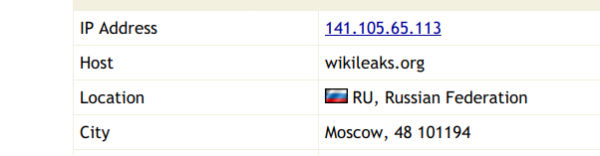
Wikileaks-Russia link revealed: site hosted in Russia, hacking suspect named

Inquisitr reports: The Wikileaks site is at least partly hosted on servers based in Russia — servers that it added just one week before the site released thousands of hacked emails from the account of John Podesta, chairman of the Hillary Clinton presidential campaign, in October of last year according to findings published in an online report on Sunday.

The Podesta emails, while containing no major revelations, revealed members of Clinton’s campaign speaking privately, in frank terms that proved embarrassing and likely damaging to her campaign for president against Donald Trump. United States intelligence agencies, according to a report issued by the Director of National Intelligence in January, concluded that a Russian government-sponsored hacking effort was behind the Podesta leak and other cyber-attacks — which were designed to help throw the election to Donald Trump.

Sunday’s online report, authored by freelance journalist Laurelai Bailey, examined a list of internet IP addresses used by Wikileaks to host its site, which houses numerous large troves of leaked and hacked documents, and found two addresses of servers in Russia and hosted by a company run by an individual named Peter Chayanov.

“Now the actual owner of the IP addresses is a man by the name of Peter Chayanov, whose IP addresses have hosted spammers and hackers, according to my sources, who work in internet backbone companies,” Bailey wrote. “Chayanov’s IP space is a virtual equivalent of a bad neighborhood that makes you lock your car doors when you drive through it. So this further implies a connection to Wikileaks and Russian hackers.”

To read the full report by Bailey, click on this link. [Continue reading…]

Patribotics reports: The internet is tightly controlled in Russia. Cyber criminals have to answer to Putin. Mr. Chayanov is the head of a firm called Hostkey, which hosts mail spammers and other malware and hacking tools, despite offering web space to Wikileaks. Wikileaks chose to use a Russian hacker to host their site – and they knew that he was connected to Vladimir Putin and operated with the blessing of Putin’s government.

Putin and Assange are thus already linked.

But it is much worse for Wikileaks – and the internet in general – even than it looks. In order not to bury the lede, I will report what appear to be the conclusions of the web developers and hackers on Twitter discussing Laurelai’s story, and then report on how they appeared to have arrived there.

* Wikileaks has handed Chayanov access to everything stored on its site and servers

* The Russian hacker and spammer can ‘monitor traffic

* He can tell who is reading anything on the Wikileaks site anywhere in the world

* The Russian hacker has access to all documents that have been sent to Wikileaks

* He can probably bust the anonymity of any computer or user who thought they were anonymously donating to Wikileaks

* It is not reasonable to suggest that this hacker is other than linked with Russia’s GRU – if he has it, they have it

* Through Julian Assange and his website, it appears that the Russian hacker and his government can track any readers of the Wikileaks site and any donors of material to it, thus allowing Russia to ‘blackmail’ anyone who ‘sent secrets’ to Wikileaks as a ‘whistleblower’. [Continue reading…]

Facebooktwittermail

The Trump-Putin honeymoon is over, but the marriage was a sham

James Miller writes: The Russian government’s love affair with Trump had more to do with fostering anti-Americanism than with seeking rapprochement. Russian media coverage reflects this. A careful study of the Kremlin-controlled media, working in both English and Russian, shows that the Russian media was never pro-Trump, but it was anti-Clinton. Trump received mostly neutral treatment, mixed with positive and negative coverage, while the Kremlin spread conspiracy theories and attacked Clinton’s policies. Russian articles about Trump tended to spread the narrative that the United States is a failing democracy and the game was rigged against any politician, like Trump, who did not view Russia as the enemy. They even warned that the establishment would likely find a way to sabotage Trump’s success. In this way, many articles that were “pro-Trump” were really just anti-Clinton, as Clinton was painted as a member of the establishment by both the Russian media and the Trump campaign.

But the Kremlin’s narrative about Trump was formed when Clinton had a commanding lead in the polls. In all likelihood, they never expected him to win. This means that the Kremlin has to find a new narrative to attack the United States. The anti-Americanism that is resurfacing in the Russian media now is just a return to form.

In an interesting twist, the Russian media is now warning that American society is fraying and a constitutional crisis may be brewing. Kiselyov used his TV show on March 5 to voice concern about what is happening in America. Partisanship and controversy are tearing the country apart, he said. “America is in the grips of hatred,” he warned viewers, a situation made more worrisome because of its culture of “free-flowing firearms.” [Continue reading…]

Facebooktwittermail

Trump to drop climate change from environmental reviews, source says

Bloomberg reports: President Donald Trump is set to sign a sweeping directive to dramatically shrink the role climate change plays in decisions across the government, ranging from appliance standards to pipeline approvals, according to a person familiar with the administration’s plan.

The order, which could be signed this week, goes far beyond a targeted assault on Obama-era measures blocking coal leasing and throttling greenhouse gas emissions from power plants that has been discussed for weeks. Some of the changes could happen immediately; others could take years to implement.

It aims to reverse President Barack Obama’s broad approach for addressing climate change. One Obama-era policy instructed government agencies to factor climate change into formal environmental reviews, such as that for the Keystone XL pipeline. Trump’s order also will compel a reconsideration of the government’s use of a metric known as the “social cost of carbon” that reflects the potential economic damage from climate change. It was used by the Obama administration to justify a suite of regulations. [Continue reading…]

Facebooktwittermail