Category Archives: Donald Trump

The best legal arguments against Trump’s immigration ban

By Steven Mulroy, University of Memphis

Is President Trump’s recent executive order on immigrants and refugees legal?

It’s a surprisingly tricky question.

The order arguably violates both a federal statute and one or more sections of the Constitution – depending on whether the immigrant is already in the U.S. In the end, opponents’ best hope for undoing the order might rest on the separation of church and state.

Trump’s order bars the entry of any refugee for 120 days, and Syrian refugees indefinitely. It also bans citizens of Iraq, Iran, Syria, Somalia, Sudan, Libya and Yemen from entering the U.S. for 90 days. This order potentially affects more than 20,000 refugees, along with thousands of students nationwide. Depending on how it is enforced, it could also impact as many as hundreds of thousands of green card holders, or immigrants with permanent residency.

Many opponents have challenged the order in court.

A U.S. District Court judge in Brooklyn, New York, issued a ruling that halted the enforcement of Trump’s executive order the day after he signed it. Judges in at least four other states followed suit.

Trump’s supporters defend the order’s legality based on a federal immigration statute passed in 1952 that allows the president to suspend the U.S. entry of “any class of aliens.” But, as a former U.S. Justice Department lawyer and a law professor, I believe there are at least four possible arguments challenging the legality of the order.

Continue reading

Facebooktwittermail

Why liberals should back Neil Gorsuch

Neal K. Katyal writes: I am hard-pressed to think of one thing President Trump has done right in the last 11 days since his inauguration. Until Tuesday, when he nominated an extraordinary judge and man, Neil Gorsuch, to be a justice on the Supreme Court.

The nomination comes at a fraught moment. The new administration’s executive actions on immigration have led to chaos everywhere from the nation’s airports to the Department of Justice. They have raised justified concern about whether the new administration will follow the law. More than ever, public confidence in our system of government depends on the impartiality and independence of the courts.

There is a very difficult question about whether there should be a vote on President Trump’s nominee at all, given the Republican Senate’s history-breaking record of obstruction on Judge Merrick B. Garland — perhaps the most qualified nominee ever for the high court. But if the Senate is to confirm anyone, Judge Gorsuch, who sits on the United States Court of Appeals for the 10th Circuit in Denver, should be at the top of the list.

I believe this, even though we come from different sides of the political spectrum. I was an acting solicitor general for President Barack Obama; Judge Gorsuch has strong conservative bona fides and was appointed to the 10th Circuit by President George W. Bush. But I have seen him up close and in action, both in court and on the Federal Appellate Rules Committee (where both of us serve); he brings a sense of fairness and decency to the job, and a temperament that suits the nation’s highest court.

Considerable doubts about the direction of the Supreme Court have emerged among Democrats in recent weeks, particularly given some of the names that have been floated by the administration for possible nomination. With environmental protection, reproductive rights, privacy, executive power and the rights of criminal defendants (including the death penalty) on the court’s docket, the stakes are tremendous. I, for one, wish it were a Democrat choosing the next justice. But since that is not to be, one basic criterion should be paramount: Is the nominee someone who will stand up for the rule of law and say no to a president or Congress that strays beyond the Constitution and laws?

I have no doubt that if confirmed, Judge Gorsuch would help to restore confidence in the rule of law. His years on the bench reveal a commitment to judicial independence — a record that should give the American people confidence that he will not compromise principle to favor the president who appointed him. Judge Gorsuch’s record suggests that he would follow in the tradition of Justice Elena Kagan, who voted against President Obama when she felt a part of the Affordable Care Act went too far. In particular, he has written opinions vigorously defending the paramount duty of the courts to say what the law is, without deferring to the executive branch’s interpretations of federal statutes, including our immigration laws. [Continue reading…]

Of this much we can be close to certain: Donald Trump did not give deep thought to his choice.

How can we be so sure?

There is an overwhelming body of evidence that Trump is incapable of deep thought. If evidence to the contrary exists, I have yet to see it.

Trump’s decision was most likely strongly influenced by pieces of information such as this: that when possible new members of the court were ranked in terms of which was most like Justice Scalia, Gorsuch ranked highest. For Trump, the idea that he could replace Scalia with a close match would seem to make the selection process a no-brainer.

Where least thought is required, there Trump reliably goes.

If Katyal is correct in his assessment of Gorsuch’s commitment to judicial independence, this is indeed the most important factor at play at a time when the rule of law is in question.

Facebooktwittermail

Only a third of Americans think Trump’s travel ban will make them safer

Reuters reports: Imposing a temporary travel ban on citizens from seven Muslim countries, President Donald Trump said the move would help protect the United States from terrorism. But less than one-third of Americans believe the move makes them “more safe,” according to a Reuters/Ipsos opinion poll released on Tuesday.

The Jan. 30-31 poll found roughly one in two Americans backed the ban, which also suspends admission of all refugees for 120 days, although there were sharp divisions along party lines.

Trump has pushed back against critics who say the travel ban targets Muslims. He says the “extreme vetting” is necessary to protect the country and its borders.

“This is not about religion,” Trump said in a statement after announcing the travel ban on Friday. “This is about terror and keeping our country safe.”

In the Reuters/Ipsos poll some 31 percent of people said the ban made them feel “more safe,” while 26 percent said it made them feel “less safe.” Another 33 percent said it would not make any difference and the rest said they don’t know. [Continue reading…]

As usual, the unimaginative pollsters sliced the pie in a predictable way by identifying Democrats and Republicans. What would perhaps have been more enlightening would have been to differentiate between those who do or do not possess passports.

The implications of border regulations are significantly different for people who never venture overseas.


Facebooktwittermail

Trump has not yet chosen a science advisor

Time reports: President Trump has issued a series of executive actions linked to a range of scientific issues since taking office earlier this month, but he has yet to name a science advisor.

Formally known as the Director of the Office of Science and Technology Policy, the science advisor is responsible for consulting with scientists inside and outside of government to ensure the President has the best available information on any policy issue related to science.

OSTP and the science advisor role have not been a priority for the Trump White House with the position still open and no indications that a nomination is coming soon. The transition team only held one meeting with the office before Trump became president, according to John Holdren, Obama’s OSTP director. That meeting—attended by a single transition staffer—lasted one hour and took place a week prior to inauguration, Holdren said.

“He seemed positive and enthusiastic about the mission of OSTP as we explained it,” Holdren said of the meeting with the transition team. “But I have not had any further contact.” The White House did not reply to a request for comment Monday, and the presidential transition team did not reply to a request on the same topic in December.

Several controversial names have appeared as potential science advisors including Yale University computer scientist David Gelernter and Princeton University physicist William Happer. Both are respected in their fields, but deny the science of climate change. [Continue reading…]

Facebooktwittermail

Moscow spy scandal snowballs: What we know

RFE/RL reports: The murky investigation of Russian intelligence officers reportedly facing treason charges has taken a fresh turn, with the Interfax news agency quoting unnamed sources as saying that two suspects are accused of collaborating with the U.S. Central Intelligence Agency (CIA).

The news, unverified and uncorroborated, is the latest in a growing number of remarkable leaks that hint at possible struggles and hidden agendas inside Russia’s formidable security apparatus.

To date, not a single Russian official or law enforcement agency has commented on the record about the reported case against the Federal Security Service (FSB) officers, identified as Sergei Mikhailov and Dmitry Dokuchayev, and other alleged accomplices.

Instead, numerous Russian media citing anonymous sources have reported the suspects may be tied to hackers targeting the Russian elite and may have disclosed information related to cyberattacks targeting the U.S. election system.

These reports come on the heels of an assessment by U.S. intelligence agencies in early January concluding that Russia orchestrated a hacking campaign aimed at helping President Donald Trump defeat his Democratic rival, Hillary Clinton, in the election.

The anonymous sources have not expressly linked the reported accusations against Mikhailov and Dokuchayev to the breaches of Democratic Party servers, though the Novaya Gazeta newspaper has reported there may be links to attacks on U.S. state-electoral systems. [Continue reading…]

Facebooktwittermail

Bannon is not Trump’s servant. The president is his tool

Lawrence Douglas writes: That didn’t take long. From no-drama Obama to all-trauma Trump: the shift has been seismic, leaving millions in this country and abroad frightened and struggling to make sense of America’s new political landscape.

Some of the upheaval appears to be the consequence of incompetence, the predictable result of an under-qualified real estate mogul struggling to master the most powerful and demanding job on the planet.

But not so with the travel ban. In this case, upheaval was the intent – not to the degree we have seen; that clearly caught the administration off guard. But it was upheaval nonetheless.

As we now know, the drafting and rollout of the travel ban was largely the work of Steve Bannon, the president’s chief political strategist. It was Bannon who reportedly overruled the proposal to exempt green card holders from the ban. And it was Bannon who pushed the order through without consulting experts at the Department of Homeland Security or at the state department.

The Nacht und Nebel quality of the ban’s announcement makes clear that the president’s chief strategist wanted to send tremors through the world. Here was bold proof that the portentous accents of Trump’s inaugural address, also Bannon’s work, was not mere rhetoric. [Continue reading…]

Facebooktwittermail

Did Trump just appoint John Miller as his new White House spokesman?

Donald Trump has a history of posing as a fictitious spokesman for the Trump Organization who would variously call himself “John Miller,” John Barron,” and “John Baron,” while showering “his” boss with praise.

Since Trump has never explained why he has posed as his own publicist, his motives remain a matter of speculation. In a court hearing he did admit to using the name John Miller, so this suggests he may not have been driven by a need to later cover his tracks by disowning his own statements.

On the contrary, a more plausible explanation might be that Trump trusts no one to speak on his behalf and thus sometimes on occasions where he feels obliged to create the appearance of a some distance between himself and what is supposedly being said about him, he resolves his own fear of misrepresentation by playing the role of his own spokesman.

The problem Trump has consistently had in pulling off this stunt is that he’s a lousy actor. Trump playing the role of John Miller sounds indistinguishable from Trump. Trump is always Trump.

Last night the “Office of the Press Secretary” at the White House released a statement explaining why Trump had just fired Acting Attorney General Sally Yates. It refers to Trump in the third person: “Tonight, President Trump relieved Ms. Yates of her duties…” and yet the language and tone of the statement is from beginning to end, pure Trump — from his histrionic declaration that he has been “betrayed” to his signature put down, “weak” on this and “very weak” on that. In Trump’s impoverished lexicon his critics invariably get cast down as “weak” the purpose being, presumably, that they can then be seen in contrast to Mighty Trump — the undefeated heavy champion of the world.

Does it really matter whether the words come directly from Trump or from the office of his press secretary? One way or another this is the voice of the president.

Well actually, it really does matter that we know without doubt whether these are Trump’s words.

Why?

Because deciphering the political machinations going on inside the White House has increasingly become a question of trying to determine the extent to which the guiding hand behind what are ostensibly presidential actions belongs not to Trump but to Steve Bannon.

Knowing when Trump is or is not speaking may be critical when assessing how much power is now being wielded by the man who was dubbed as “the Most Dangerous Political Operative in America” long before he entered the White House and swiftly claimed a permanent seat on the National Security Council.

Facebooktwittermail

What connects attacks in Québec and Charleston? Trump needs to know

Richard Wolffe writes: One of them shot and stabbed to death Jo Cox. Another massacred nine churchgoers in Charleston. Then six Canadians were gunned down at evening prayers in Québec City.

It’s long past time to recognize the mortal threats within our own borders. Donald Trump can ban all the Muslims he wants; Justin Trudeau can welcome all the refugees he likes.

But the truth is that white nationalist terrorists are as much of a threat to civilized society as their radical Islamist counterparts.

Thomas Mair murdered Cox as she was campaigning to stay inside the European Union. “Britain first,” said the Nazi-loving white supremacist, as he brutally attacked the British MP and mother of two.

Dylann Roof hoped to incite a race war when he fired more than 70 bullets into a Bible study group that had welcomed him into the fellowship hall of Emanuel AME Church.

Alexandre Bissonnette, charged with six counts of murder in a Québec City mosque, is said to be well known to refugee groups for his frequent online insults about immigration and his admiration for Marine Le Pen, the leader of France’s far-right Front National.

Mair and Roof both found their sick inspiration in online communities of hatred and violence. It may be that Bissonnette did too.

The great Primo Levi would recognize what connects these men and what is happening to our culture. “The plague is over but the infection spreads: it would be foolish to deny it,” he wrote, more than two decades after he left the Nazi concentration camps.

The scientist survivor was clear about the source of the infection he observed in such clinical detail: “Mainly, at the root of it all, a tide of cowardice, an abysmal cowardice, masked as warrior virtue, love of country, and loyalty to an idea.” [Continue reading…]

The Intercept reports: White supremacists and other domestic extremists maintain an active presence in U.S. police departments and other law enforcement agencies. A striking reference to that conclusion, notable for its confidence and the policy prescriptions that accompany it, appears in a classified FBI Counterterrorism Policy Guide from April 2015, obtained by The Intercept. The guide, which details the process by which the FBI enters individuals on a terrorism watchlist, the Known or Suspected Terrorist File, notes that “domestic terrorism investigations focused on militia extremists, white supremacist extremists, and sovereign citizen extremists often have identified active links to law enforcement officers,” and explains in some detail how bureau policies have been crafted to take this infiltration into account.

Although these right-wing extremists have posed a growing threat for years, federal investigators have been reluctant to publicly address that threat or to point out the movement’s longstanding strategy of infiltrating the law enforcement community.

No centralized recruitment process or set of national standards exists for the 18,000 law enforcement agencies in the United States, many of which have deep historical connections to racist ideologies. As a result, state and local police as well as sheriff’s departments present ample opportunities for white supremacists and other right-wing extremists looking to expand their power base. [Continue reading…]

Facebooktwittermail

Trump’s plan for refugee zones in and around Syria will not materialize

Yezid Sayigh writes: U.S. President Donald Trump appeared to fulfill one of his many campaign promises last week. A draft of his executive order on immigration appeared on January 25 and raised the possibility of U.S. action to set up safe zones for displaced Syrians. Trump confirmed this in a television interview the same day, saying “I’ll absolutely do safe zones in Syria for the people.”

Reactions varied. Members of the Syrian opposition cautiously welcomed anything that would reduce the bloodshed in their country, while in Moscow a Kremlin spokesperson warned the proposal might “further aggravate the situation with refugees.”

The flurry of excitement was cut short, however, as the final version of the executive order published on January 27 dropped all mention of safe zones. And yet Trump returned to the theme two days later during phone calls to Saudi Arabia’s King Salman and Abu Dhabi’s Crown Prince Mohammad bin Zayed, in which he requested their support for safe zones in Syria (and Yemen) according to an official White House statement.

What are Trump’s real intentions? More importantly, who will police a safe zone if one is established?

The initial draft of the executive order gave some clues. Most significant was the proposal “to provide safe areas in Syria and in the surrounding region.” This suggested a rebranding exercise, in which refugee concentrations in countries such as Jordan and Lebanon or their absorption in Gulf states would be labeled “safe zones.” Expediently for Trump, this would remove the burden of financial outlay from U.S. shoulders, while precluding any need for military action to protect refugees inside Syria.

Furthermore, even if the original draft of the executive order had been preserved, it only directed the secretaries of state and defense to “produce a plan.” But contingency planning does not commit the U.S. administration to any course of action, nor does it make action probable. [Continue reading…]

Middle East Eye reports: Lebanon’s president has insisted that President Bashar al-Assad of Syria will remain in office, saying he wants Syrian refugees currently in his country to go home.

“President Assad will stay, and those who are asking for his departure are ignoring Syria,” newly elected Lebanese President Michel Aoun told French TV channel LCI on Monday.

Aoun, a former army general during the country’s civil war, was elected president in October, ending a 29-month presidential vacuum as part of a political deal that made Sunni leader Saad al-Hariri prime minister.

“We were facing the prospect of a second Libya here, but for the Assad regime that represents the only power that through its capacities restored the regime, a restoration that has united everyone and the government,” Aoun said.

Aoun is an ally of Hezbollah, Lebanon’s Iran-backed party, which is fighting in Syria on Assad’s behalf.

The Lebanese militia and political party were critical to Aoun’s ascendancy to the presidency.

“Lebanon cannot take in Syrian refugees indefinitely on its territory,” the 81-year-old said. “We hosted them for humanitarian reasons, and they must return to their country.” [Continue reading…]

Facebooktwittermail

U.S. allies draw close to Trump at their peril

The New York Times reports: A close relationship with any American president is regarded as crucial by allies and foes alike, but especially by intimates like Britain, Canada, Japan and Mexico. Yet like moths to the flame, the leaders of those nations are finding that they draw close at their peril.

While [Britain’s Prime Minister Theresa] May is the latest prominent figure to suffer repercussions for her handling of Mr. Trump, the leaders of those other three close allies have also felt the sting of public anger soon after what seemed to be friendly telephone calls or encounters. They then find themselves facing a no-win situation, either openly criticizing the leader of their superpower ally or pulling their punches and risking severe criticism at home.

One Western leader to escape this fate so far is the German chancellor, Angela Merkel, who has kept a cool distance from Mr. Trump. In a telephone call on Saturday, she reminded him of Washington’s obligations under the Geneva Conventions to accept refugees fleeing war, a view underlined by her official spokesman.

The danger of playing nice with Mr. Trump should come as little surprise to his country’s allies. Besides campaigning on an “America First” platform, he has regularly argued that allies have been taking the United States for a ride, in trade, security and financial terms.

While he has been cordial in public settings with the leaders of those allied nations, Mr. Trump has turned on them soon afterward.

“The problem for May is that Trump doesn’t value relationships. He values strength and winning,” said Jeremy Shapiro, the director of research at the European Council on Foreign Relations and a former senior State Department official. “If you rush to the White House to offer a weak hand of friendship, you guarantee exploitation.” [Continue reading…]

Paul Mason writes: We have two choices: we can acquiesce and let this sociopathic sex pest grab our collective hand amid the scary world he has created. We can abase ourselves for special favours – such as exemption for British dual nationals. Or we can reject Trump in his entirety.

Just as Trump is meddling – via Ukip – in the racial politics of Britain, British liberalism and socialism has the duty now to intervene in the social politics of the US. We must bet on Trump’s defeat in 2020, help train and fund lawyers and journalists to hold him in check, and – once he is gone – attempt to rebuild the multilateral order. Yes, and ruin his state visit: through all forms of protest legally possible.

The shape of a Dump Trump foreign policy is clear: Britain must strengthen its alliance with countries whose governments and peoples share our values: France, the Netherlands, Germany, Canada and Greece. Although we are headed out of the EU, the case for the softest possible form of Brexit is only strengthened by the US’s descent into arbitrary government. [Continue reading…]

Facebooktwittermail

Trump’s talk about Muslims led acting attorney general to follow the law and defy the president


The New York Times reports: As Republicans seethed over President Barack Obama’s executive order on immigration in early 2015, Senator Jeff Sessions sharply questioned Sally Q. Yates about whether she had the independent streak needed to be the Justice Department’s second in command.

Mr. Sessions, Republican of Alabama, wanted to know whether Ms. Yates, a federal prosecutor from Georgia who made her career charging domestic terrorists and white-collar criminals, would be willing to stand up to the president.

“If the views the president wants to execute are unlawful, should the attorney general or the deputy attorney general say ‘No?’ ” Mr. Sessions asked during a confirmation hearing for Ms. Yates.

“I believe the attorney general or deputy attorney general has an obligation to follow the law and Constitution and give their independent legal advice to the president,” Ms. Yates replied.

As acting attorney general on Monday, Ms. Yates faced what she believed to be the realization of that hypothetical.

President Trump’s own words convinced her that his executive order on immigration was intended to single out Muslims, senior officials said. Hours after she refused to defend that order, Mr. Trump fired her.

Ms. Yates, 56, a relative newcomer to Washington, has become a hero to many on the left and the face of a simmering resistance inside the government to Mr. Trump’s administration.

After receiving a hand-delivered dismissal letter, she packed up her office around midnight and left the department, a politically divisive moment in a career that until now had earned her bipartisan praise.

“She will be a hero of the American people, a hero of what’s right,” Senator Johnny Isakson, Republican of Georgia, said in 2015 at her confirmation hearing. “She’ll call them like she sees them, and she will be fair, and she will be just.” [Continue reading…]

Facebooktwittermail

Donald Trump’s role in the Quebec City massacre

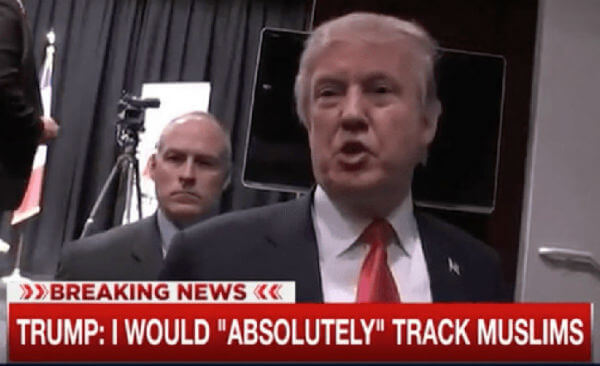
Donald Trump has consistently identified Muslims as perpetrators of terrorism rather than victims of terrorism — despite the fact that by vast numbers the victims of terrorism are indeed overwhelmingly Muslims.

Trump has relentlessly fueled Islamophobia and insisted that the key to combating terrorism is to label it Islamic.

Trump chose as his closest national security adviser, Michael Flynn, who has described Islam as a cancer.

Trump just signed an executive order that singles out 200,000 Muslims as a potential threat to America.

Shortly after Trump signed this order, Alexandre Bissonnette, a vocal Trump supporter, known for his online attacks on refugees, went to a Quebec City mosque and carried out a mass shooting, killing six people and injuring 19 others.

As The Globe and Mail reports:

The suspect in the deadly attack on a Quebec City mosque was known in the city’s activist circles as an online troll who was inspired by extreme right-wing French nationalists, stood up for U.S. President Donald Trump and was against immigration to Quebec – especially by Muslims.

To fail to draw a connection between Trump’s campaign rhetoric, his choice of advisers, his executive order targeting Muslims and Bissonnette’s murderous rampage would be absurd.

In the hostile climate Trump has helped cultivate, there have been anti-mosque incidents in at least 41 states.

Within hours of Trump signing the executive order a mosque in Texas went up in flames.

The massacre in Canada could just as easily have happened in the United States. Indeed, the risk of a similar attack is so great that it seems less a case of if than when.

Donald Trump has promised to make America safe and yet through his words and actions has already done enough to suggest that the stable of Trump brands will sooner or later acquire one that he will vociferously disavow as a slur on his name: Trump terrorism.

That is not to suggest that Trump actually wants anyone to engage in acts of terrorism.

At the same time and for the same reasons as Alex Massie spelled out after Jo Cox’s murder in Britain last June, those who fuel anger cannot absolves themselves of responsibility for what follows:

When you encourage rage you cannot then feign surprise when people become enraged. You cannot turn around and say, ‘Mate, you weren’t supposed to take it so seriously. It’s just a game, just a ploy, a strategy for winning votes.’

When you shout BREAKING POINT over and over again, you don’t get to be surprised when someone breaks. When you present politics as a matter of life and death, as a question of national survival, don’t be surprised if someone takes you at your word. You didn’t make them do it, no, but you didn’t do much to stop it either.

Sometimes rhetoric has consequences. If you spend days, weeks, months, years telling people they are under threat, that their country has been stolen from them, that they have been betrayed and sold down the river, that their birthright has been pilfered, that their problem is they’re too slow to realise any of this is happening, that their problem is they’re not sufficiently mad as hell, then at some point, in some place, something or someone is going to snap. And then something terrible is going to happen.

Trump’s biggest lie is to promote the myth that the greatest threats to American lives reside outside this country’s borders.

Right now the very opposite is true as the most incendiary catalyst of violence sits in the Oval Office.

Facebooktwittermail

How to build an autocracy

David Frum writes: No society, not even one as rich and fortunate as the United States has been, is guaranteed a successful future. When early Americans wrote things like “Eternal vigilance is the price of liberty,” they did not do so to provide bromides for future bumper stickers. They lived in a world in which authoritarian rule was the norm, in which rulers habitually claimed the powers and assets of the state as their own personal property.

The exercise of political power is different today than it was then — but perhaps not so different as we might imagine. Larry Diamond, a sociologist at Stanford, has described the past decade as a period of “democratic recession.” Worldwide, the number of democratic states has diminished. Within many of the remaining democracies, the quality of governance has deteriorated.

What has happened in Hungary since 2010 offers an example — and a blueprint for would-be strongmen. Hungary is a member state of the European Union and a signatory of the European Convention on Human Rights. It has elections and uncensored internet. Yet Hungary is ceasing to be a free country.

The transition has been nonviolent, often not even very dramatic. Opponents of the regime are not murdered or imprisoned, although many are harassed with building inspections and tax audits. If they work for the government, or for a company susceptible to government pressure, they risk their jobs by speaking out. Nonetheless, they are free to emigrate anytime they like. Those with money can even take it with them. Day in and day out, the regime works more through inducements than through intimidation. The courts are packed, and forgiving of the regime’s allies. Friends of the government win state contracts at high prices and borrow on easy terms from the central bank. Those on the inside grow rich by favoritism; those on the outside suffer from the general deterioration of the economy. As one shrewd observer told me on a recent visit, “The benefit of controlling a modern state is less the power to persecute the innocent, more the power to protect the guilty.”

Prime Minister Viktor Orbán’s rule over Hungary does depend on elections. These remain open and more or less free — at least in the sense that ballots are counted accurately. Yet they are not quite fair. Electoral rules favor incumbent power-holders in ways both obvious and subtle. Independent media lose advertising under government pressure; government allies own more and more media outlets each year. The government sustains support even in the face of bad news by artfully generating an endless sequence of controversies that leave culturally conservative Hungarians feeling misunderstood and victimized by liberals, foreigners, and Jews.

You could tell a similar story of the slide away from democracy in South Africa under Nelson Mandela’s successors, in Venezuela under the thug-thief Hugo Chávez, or in the Philippines under the murderous Rodrigo Duterte. A comparable transformation has recently begun in Poland, and could come to France should Marine Le Pen, the National Front’s candidate, win the presidency.

Outside the Islamic world, the 21st century is not an era of ideology. The grand utopian visions of the 19th century have passed out of fashion. The nightmare totalitarian projects of the 20th have been overthrown or have disintegrated, leaving behind only outdated remnants: North Korea, Cuba. What is spreading today is repressive kleptocracy, led by rulers motivated by greed rather than by the deranged idealism of Hitler or Stalin or Mao. Such rulers rely less on terror and more on rule-twisting, the manipulation of information, and the co-optation of elites.

The United States is of course a very robust democracy. Yet no human contrivance is tamper-proof, a constitutional democracy least of all. Some features of the American system hugely inhibit the abuse of office: the separation of powers within the federal government; the division of responsibilities between the federal government and the states. Federal agencies pride themselves on their independence; the court system is huge, complex, and resistant to improper influence.

Yet the American system is also perforated by vulnerabilities no less dangerous for being so familiar. Supreme among those vulnerabilities is reliance on the personal qualities of the man or woman who wields the awesome powers of the presidency. A British prime minister can lose power in minutes if he or she forfeits the confidence of the majority in Parliament. The president of the United States, on the other hand, is restrained first and foremost by his own ethics and public spirit. What happens if somebody comes to the high office lacking those qualities?

Over the past generation, we have seen ominous indicators of a breakdown of the American political system: the willingness of congressional Republicans to push the United States to the brink of a default on its national obligations in 2013 in order to score a point in budget negotiations; Barack Obama’s assertion of a unilateral executive power to confer legal status upon millions of people illegally present in the United States — despite his own prior acknowledgment that no such power existed.

Donald Trump, however, represents something much more radical. A president who plausibly owes his office at least in part to a clandestine intervention by a hostile foreign intelligence service? Who uses the bully pulpit to target individual critics? Who creates blind trusts that are not blind, invites his children to commingle private and public business, and somehow gets the unhappy members of his own political party either to endorse his choices or shrug them off? If this were happening in Honduras, we’d know what to call it. It’s happening here instead, and so we are baffled. [Continue reading…]

Facebooktwittermail

This Trump petition shows UK citizens will not bend a knee to hate

Suzanne Moore writes: If you had told me a few months back I would be encouraging people to sign a petition to prevent embarrassment being caused to the Queen, I would have laughed. Petitions are so overused these days that they can seem meaningless – and surely there are bigger issues at stake than the feelings of the monarch. But that was before Donald Trump and his decency-shredding goons were in power, before this shameful Muslim ban. These are not normal times – despite our government and much of our press pretending that they are. It is good to see that Trump is being fought on every level from huge marches, to spontaneous demonstrations to legal challenges. This petition is another small front. It is not an attempt to ban Trump, it simply asks that he does not make a state visit, that the red carpet is not rolled out for him. It says a state visit could cause the Queen “embarrassment”.

This is a smart move because Trump does care about pomp, ceremony and hierarchy. Symbolism matters more to him than reality. Never accepted socially in the upper echelons of American society, it matters hugely that he is now seen with those his supporters recognise as important. He kept the menu from his dinner with Theresa May remember, as a reminder that he’d “had lunch with the British prime minister”.

Embracing him with the royal flummery would signal to his base that this country held him in high regard, that he was head of a respected government. Both these things are untrue. May’s embarrassing renewal of the vows of the special relationship didn’t even amount to a one-night stand. As soon as she had got on the plane he was signing this vile executive order. The ban on people from seven Muslim-majority countries is a domestic policy to play to his racist base. It has nothing to do with terrorism, but some of those who would support it would also enjoy seeing him all puffed up hanging out with the Queen. [Continue reading…]

Facebooktwittermail

Trump’s ban could kneecap the war on ISIS

Kimberly Dozier writes: Team Trump’s travel ban, or pause, or whatever reverse politically correct term you want to call it, has sparked simmering fury among America’s Muslim allies. The media splash meant to show that President Donald Trump means business about keeping America safe, and keeping his campaign promises, is ironically damaging the very campaign against terrorism he wants to put into overdrive.

Key allies in the fight against the so-called Islamic State are dumbfounded, but few are making official statements, unwilling to pick a fight with the pugnacious new White House.

Iraqi parliamentarians have called for similar bans against U.S. citizens, and Iranian-backed militia groups have called for American troops to be ejected from their country.

But the Iraqi government, managing a fragile and fractious multi-ethnic coalition against ISIS, is treading carefully. Government spokesman Saad al-Hadithi told the AP that Iraqis are hoping the “measures will be temporary and for regulatory reasons and not permanent at least for Iraq.”

Other allies? Not so diplomatic.

“This is an insult to us all,” said one Afghan official reached Sunday. “To treat all as terrorists is not what inspires support and confidence among friends.” [Continue reading…]

Facebooktwittermail

Steve Bannon is making sure there’s no White House paper trail, says intel source

Kate Brannen writes: If there was any question about who is largely in charge of national security behind the scenes at the White House, the answer is becoming increasingly clear: Steve Bannon, the former head of Breitbart News, a far-right media outlet, and now White House advisor.

Even before he was given a formal seat on the National Security Council’s “principals committee” this weekend by President Donald Trump, Bannon was calling the shots and doing so with little to no input from the National Security Council staff, according to an intelligence official who asked not to be named out of fear of retribution.

“He is running a cabal, almost like a shadow NSC,” the official said. He described a work environment where there is little appetite for dissenting opinions, shockingly no paper trail of what’s being discussed and agreed upon at meetings, and no guidance or encouragement so far from above about how the National Security Council staff should be organized.

The intelligence official, who said he was willing to give the Trump administration the benefit of the doubt when it took office, is now deeply troubled by how things are being run.

“They ran all of these executive orders outside of the normal construct,” he said, referring to last week’s flurry of draft executive orders on everything from immigration to the return of CIA “black sites.”

After the controversial draft orders were written, the Trump team was very selective in how they routed them through the internal White House review process, the official said.

Under previous administrations, if someone thought another person or directorate had a stake in the issue at hand or expertise in a subject area, he or she was free to share the papers as long as the recipient had proper clearance.

With that standard in mind, when some officials saw Trump’s draft executive orders, they felt they had broad impact and shared them more widely for staffing and comments.

That did not sit well with Bannon or his staff, according to the official. More stringent guidelines for handling and routing were then instituted, and the National Security Council staff was largely cut out of the process. [Continue reading…]

Facebooktwittermail

Obama supports protests: ‘American values are at stake’

Politico reports: Barack Obama spoke out Monday afternoon against his successor — and in support of the protests opposing President Donald Trump — with a spokesman saying the former president thinks they’re “citizens exercising their Constitutional right to assemble, organize and have their voices heard by their elected officials is exactly what we expect to see when American values are at stake.”

Obama, who left office vowing to uphold the presidential tradition of not criticizing his successor but also promising to speak out when he saw core values under threat by Trump, made it all of 10 days before releasing a statement following Friday’s executive order that temporarily halted the nation’s refugee program and severely restricted immigration from seven predominantly Muslim countries.

Obama flew to California immediately after the inauguration and a farewell speech to staff at Andrews Air Force Base, where he called Trump’s presidency “not a period,” but “a comma in the continuing story of building America.” He later flew to the Caribbean. He has still not returned to Washington, where he is expected to live for at least the next year and a half.

When a reporter at the daily press briefing on Monday raised the existence of the statement without providing detail, White House press secretary Sean Spicer’s response was only “Okay, thank you.”

The statement from Obama’s office (notably not in his voice directly) is extraordinary compared to the usual deference between presidents, but reflects both the existential threat that Obama truly believes Trump poses to the country and a Democratic Party brimming with anti-Trump energy but lacking any clear leaders. [Continue reading…]

Facebooktwittermail

Quebec City mosque attack suspect known for right-wing online posts and support of Trump

The Globe and Mail reports: The suspect in the deadly attack on a Quebec City mosque was known in the city’s activist circles as a right-wing troll who frequently took anti-foreigner and anti-feminist positions and stood up for U.S. President Donald Trump.

Alexandre Bissonnette, 27, a student at Laval University who lived on a quiet crescent in the Cap-Rouge suburb of Quebec City, faces six counts of first-degree murder for a shooting that killed six people and wounded 19 others. Police initially arrested a person they considered a second suspect but they later backtracked, saying he was a witness.

Mr. Bissonnette’s online profile and school friendships revealed little interest in extremist politics until last March when French nationalist leader Marine Le Pen visited Quebec City and inspired Mr. Bissonnette to vocal extreme online activism, according to people who clashed with him.

Vincent Boissoneault, a student in international relations at Laval University, grew up with Mr. Bissonnette and was friends with him on Facebook. He said they frequently clashed on politics when Mr. Bissonnette attacked refugees or expressed support for Ms. Le Pen or Mr. Trump. [Continue reading…]

Facebooktwittermail
