Category Archives: Donald Trump

Putin’s puppet: Trump says NATO is ‘obsolete,’ doesn’t care if EU breaks up, calls refugees ‘illegals,’ and wants ‘good deals with Russia’

Bloomberg reports: Donald Trump called NATO obsolete, predicted that other European Union members would follow the U.K. in leaving the bloc, and threatened BMW with import duties over a planned plant in Mexico, according to two European newspapers which conducted a joint interview with the president-elect.

Trump, in an hourlong discussion with Germany’s Bild and the Times of London published on Sunday, signaled a major shift in trans-Atlantic relations, including an interest in lifting U.S. sanctions on Russia as part of a nuclear weapons reduction deal.

Quoted in German by Bild from a conversation held in English, Trump predicted that Britain’s exit from the EU will be a success and portrayed the EU as an instrument of German domination designed with the purpose of beating the U.S. in international trade. For that reason, Trump said, he’s fairly indifferent to whether the EU stays together, according to Bild.

The Times quoted Trump as saying he was interested in making “good deals with Russia,” floating the idea of lifting sanctions that were imposed as the U.S. has sought to punish the Kremlin for its annexation of Crimea in 2014 and military support of the Syrian government.

“They have sanctions on Russia — let’s see if we can make some good deals with Russia,’’ Trump said, according to the Times. “For one thing, I think nuclear weapons should be way down and reduced very substantially, that’s part of it.’’

Trump’s reported comments leave little doubt that he’ll stick to campaign positions and may in some cases upend decades of U.S. foreign policy, putting him fundamentally at odds with German Chancellor Angela Merkel on issues from free trade and refugees to security and the EU’s role in the world. [Continue reading…]


Facebooktwittermail

Germany hits back at Trump criticism of refugee policy and BMW tariff threat

The Guardian reports: Berlin has mounted a staunch defence of its policies after Donald Trump criticised the German chancellor, Angela Merkel, for her stance during the refugee crisis and threatened a 35% tariff on BMW cars imported into the US.

Germany’s deputy chancellor and minister for the economy, Sigmar Gabriel, said on Monday morning that a tax on German imports would lead to a “bad awakening” among US carmakers since they were reliant on transatlantic supply chains.

“I believe BMW’s biggest factory is already in the US, in Spartanburg [South Carolina],” Gabriel, leader of the centre-left Social Democratic party, told the Bild newspaper in a video interview.

“The US car industry would have a bad awakening if all the supply parts that aren’t being built in the US were to suddenly come with a 35% tariff. I believe it would make the US car industry weaker, worse and above all more expensive. I would wait and see what the Congress has to say about that, which is mostly full of people who want the opposite of Trump.” [Continue reading…]

In 2014, Automotive News reported from Spartanburg: BMW will invest $1 billion in its factory here by 2016 to expand capacity by 100,000 units and add production of a fifth crossover, the X7 — making the plant its biggest worldwide.

Norbert Reithofer, CEO of BMW AG, said Spartanburg’s annual production will top that of BMW’s Dingolfing, Germany, plant, which can build 350,000 vehicles a year.

BMW’s current capacity has just been boosted to 350,000 units. Last year, the plant produced 297,326 vehicles.

Reithofer said building 450,000 vehicles a year will mean the equivalent of “a whole new plant” of output beyond last year’s total.

“This is the fifth expansion since production began 20 years ago and represents another major investment,” said Manfred Erlacher, president of BMW Manufacturing Co.

The plant has begun building the new X4 crossover, which is to go on sale in June in the United States. Spartanburg also produces the X3, X5 and X6.

Harald Krueger, BMW board member for production, said the group has 28 factories in 13 countries. More than 70 percent of the plant’s production is exported to more than 140 countries worldwide, he said.

“And we are really proud that this plant annually exports vehicles valuing over $7.5 billion — which, according to the U.S. Department of Commerce, makes BMW the largest U.S. vehicle exporter by value to non-NAFTA countries. ‘Freude am Fahren’ — made in America,” Krueger said. [Continue reading…]

Facebooktwittermail

The Republican in charge of government oversight wants to prohibit criticism of Trump’s ethical violations

Dahlia Lithwick writes: It is going to be practically impossible for Donald Trump to take office next Friday and stay on the right side of the Constitution’s Emoluments Clause without divesting and placing his businesses in a blind trust. This fact is — with a clutch of dissenters — not in dispute. Ethics experts across the political spectrum have explained carefully what needed to be done to avoid the appearance that the president was benefiting financially from foreign gifts, payments, or favors. But Trump announced this week that he has no intention of creating a blind trust, arguing that voters don’t care about the issue and declaring that he would donate any hotel profits from foreign governments to the Treasury and let his sons manage his business for the duration of his presidency.

At his Wednesday announcement, Trump’s lawyer, Sheri Dillon, disputed claims that he even has any such constitutional obligations: “These people are wrong. This is not what the Constitution says, paying for a hotel is not a gift or present and has nothing to do with an office. It is not an emolument,” she said. She added that “President-elect Trump should not be expected to destroy the company he built,” meaning, I suppose, that the normal rules don’t apply to rich presidents. (Mitt Romney was willing to divest in 2012, so maybe it’s just that the normal rules don’t apply to Trump).

The director of the nonpartisan Office of Government Ethics, Walter Shaub, immediately dismissed the president-elect’s dramatic nonplan as “meaningless.” He was quoted this week as saying at an unprecedented press conference at the Brookings Institution, “It’s important to understand that the president is now entering the world of public service. He’s going to be asking our men and women in uniform to risk their lives in conflicts around the world. So, no, I don’t think divestiture is too high a price to pay to be the president.”

Most ethics experts have agreed with Shaub that the arrangement announced Wednesday is inadequate to address the conflict rules. Trump’s expectation and hope seems to be that — since the only fix for an Emoluments Clause violation is impeachment — Republicans will do as Trump has instructed and stop caring and that Democrats won’t have the nerve to raise the point that the president will — every day after next Friday — be violating the Constitution in a way that risks putting him in thrall to foreign powers. Republicans seem happy to oblige. [Continue reading…]

The Washington Post reports: Donald Trump’s incoming White House chief of staff warned the director of the Office of Government Ethics on Sunday to “be careful” about criticizing Trump’s handling of his business conflicts.

“The head of the government ethics ought to be careful because that person is becoming extremely political,” Priebus said on ABC News’s “This Week with George Stephanopoulos.”

Priebus suggested that Shaub, who was appointed by President Obama, was supportive of Hillary Clinton during the campaign.
[Continue reading…]

Facebooktwittermail

Democrats should follow John Lewis’ lead


Michelle Goldberg writes: A new conventional wisdom is emerging among Very Serious People in Washington, D.C. It essentially holds that while Russia intervened on Donald Trump’s behalf in America’s election, questioning Trump’s legitimacy only plays into Russian hands. Marco Rubio articulated the new line in his questioning of Mike Pompeo, Trump’s choice for CIA chief, on Thursday. Rubio began with a series of false equivalences: “A president-elect who has questioned at times the judgment of our intelligence agencies. Opponents to our president-elect who continuously question the legitimacy of his election. The shameful leak in the media regarding unsubstantiated, unsourced information designed to smear the president-elect.” Given all that, he asked, “Is Vladimir Putin looking at all this and saying, ‘We’ve done a really good job of creating chaos?’ ” With this, Rubio conflated the behavior of Putin and Trump, which raises questions about Trump’s legitimacy, with the act of merely asking those questions. It’s a way to shut down attempts to reckon with the existential crisis Trump’s elevation poses to our faltering democracy while maintaining a centrist, Trump-skeptical pose.

Democrats should be pushing against this conventional wisdom, hard. So far only a few have stepped forward. In an interview to air on Meet the Press Sunday, U.S. Rep John Lewis, legend of the civil rights movement, told Chuck Todd that he does not consider Trump a legitimate president. “I think there was a conspiracy on the part of the Russians and others to help him get elected,” Lewis said. “That’s not right. That’s not fair.” For the first time in his 30 years in Congress, Lewis said he would not be attending the inauguration. “You cannot be at home with something that you feel that is wrong,” he said.

Lewis was speaking for many of us who are aghast at the way Trump benefited from Russian hacking and now appears to be returning the favor by taking a fawning stance toward Putin. He spoke for those of us who are shocked by the role of the FBI, which improperly publicized the reopening of its investigation into Hillary Clinton’s emails but refuses to say whether it is investigating Trump’s ties with Russia. Trump lost the popular vote; he is president-elect only because the country values fidelity to the democratic process over popular democracy itself. (The Constitution, it turns out, may in fact be a suicide pact.) If the process itself was crooked — if Trump’s campaign colluded in any way with Russia — his legitimacy disappears. If he scorns the Constitution by, say, violating the Emoluments Clause, it disappears as well. A president who lost the popular vote, who may have cheated to win the Electoral College, and who will be contravening the Constitution the second he’s sworn in is due neither respect nor deference. [Continue reading…]

Facebooktwittermail

Ignoring any ‘secrets,’ what we already know about Trump and Russia is bad enough

Anne Applebaum writes: Here, for the record, once again, are things we already know about Trump and Russia, and they aren’t remotely secret:

  • Trump’s real estate empire relies, though we don’t know how much, on Russian money. Trump says he never invested in Russia or got loans from Russia. But he did get investment from Russia. In 2008, his son said that Russian investment was “pouring in” to Trump properties. Even before that, Trump had a whole series of partners and investors linked to post-Soviet oligarchs and even Russian organized crime. Has Trump concealed his tax returns for this reason?
  • Paul Manafort, Trump’s former campaign manager, spent many years working on behalf of the thuggish Russian-backed Ukrainian president, Viktor Yanukovych, who eventually fled his own country. Manafort maintains links to pro-Russian groups in Ukraine. His name appeared on a list of people who took large chunks of cash from Yanukovych. He hasn’t gone away — in fact, he has lived in Trump Tower. There is no secret about his Russian connections. On the contrary, they define him.
  • Last summer, Trump operatives at the convention changed the Republican Party platform to soften the language on Ukraine. There was no explanation for this change, one of the few substantive changes made to the entire party platform. Was this a signal, from Manafort or Trump, that the candidate was on Vladi­mir Putin’s side?
  • Throughout the campaign, Trump repeated slogans and conspiracy theories — “Obama invented ISIS,” “Hillary will start World War III” — lifted from Sputnik, the Russian propaganda website. Was this just Trump campaign chief Stephen K. Bannon borrowing ideas, or Manafort using tactics he perfected in Ukraine? Or was there deliberate linkage?
  • Finally, and most important: Trump is willing to risk serious conflict with China, to destroy U.S. relations with Mexico, to dismiss America’s closest allies in Europe and to downgrade NATO, our most important military alliance. But he has repeated many times his admiration for Russia and its president. In 2013 he told MSNBC, “I do have a relationship” with Putin, who is “probably very interested in what you and I are saying today” and will “be seeing it in some form.” In 2014 he bragged that Putin had sent him a “beautiful present” and claimed — apparently untruthfully — to have spoken to him as well. Nothing that Putin has done since — invade Ukraine, murder journalists, jail opponents — has induced Trump to change his mind.

To that list, we can now add the fact that Russia hacked material from the Clinton campaign, fed it to WikiLeaks and passed it on through their bot and troll network, which transformed it into hysterical slogans. Eventually, our intelligence agencies may learn more about that process, but at this point it doesn’t matter.

Information doesn’t have to be secret to be shocking. Trump doesn’t have to be a Manchurian candidate who has been hypnotized or recruited by foreign intelligence. It’s enough that he has direct and indirect links to a profoundly corrupt and violent foreign dictator, whose policies he admires, whose advisers he shares and whose slogans he uses. That’s kompromat enough for me. [Continue reading…]

Facebooktwittermail

Human Rights Watch: Trump, European populists foster bigotry, discrimination

Human Rights Watch: The rise of populist leaders in the United States and Europe poses a dangerous threat to basic rights protections while encouraging abuse by autocrats around the world, Human Rights Watch said today in launching its World Report 2017. Donald Trump’s election as US president after a campaign fomenting hatred and intolerance, and the rising influence of political parties in Europe that reject universal rights, have put the postwar human rights system at risk.

Meanwhile, strongman leaders in Russia, Turkey, the Philippines, and China have substituted their own authority, rather than accountable government and the rule of law, as a guarantor of prosperity and security. These converging trends, bolstered by propaganda operations that denigrate legal standards and disdain factual analysis, directly challenge the laws and institutions that promote dignity, tolerance, and equality, Human Rights Watch said.

In the 687-page World Report, its 27th edition, Human Rights Watch reviews human rights practices in more than 90 countries. In his introductory essay, Executive Director Kenneth Roth writes that a new generation of authoritarian populists seeks to overturn the concept of human rights protections, treating rights not as an essential check on official power but as an impediment to the majority will.

“The rise of populism poses a profound threat to human rights,” Roth said. “Trump and various politicians in Europe seek power through appeals to racism, xenophobia, misogyny, and nativism. They all claim that the public accepts violations of human rights as supposedly necessary to secure jobs, avoid cultural change, or prevent terrorist attacks. In fact, disregard for human rights offers the likeliest route to tyranny.”

Roth cited Trump’s presidential campaign in the US as a vivid illustration of the politics of intolerance. He said that Trump responded to those discontented with their economic situation and an increasingly multicultural society with rhetoric that rejected basic principles of dignity and equality. His campaign floated proposals that would harm millions of people, including plans to engage in massive deportations of immigrants, to curtail women’s rights and media freedoms, and to use torture. Unless Trump repudiates these proposals, his administration risks committing massive rights violations in the US and shirking a longstanding, bipartisan belief, however imperfectly applied, in a rights-based foreign policy agenda. [Continue reading…]

Facebooktwittermail

Spy agencies around the world are digging into Trump’s Moscow ties

BuzzFeed reports: The dossier alleging that the Russian government has compromised President-elect Donald Trump has not only been circulating at the highest levels of the US government, but also among the intelligence agencies of other countries, two Israeli intelligence officers told BuzzFeed News. And while the dossier’s claims haven’t been verified, the officers said that intelligence services from other countries have been doing their own digging into Trump’s connections to Moscow.

“You can trust me that many intelligence agencies are trying to evaluate the extent to which Trump might have ties, or a weakness of some type, to Russia,” one of the intelligence officers said.

Part of Israel’s interest, he said, came from wanting to know how much of the intelligence it routinely shares with the Unites States might be fed to Russia.

The document published by BuzzFeed News “had been circulating for some months” among intelligence officers from various governments, one of the officers said. Both asked to speak on condition of anonymity, citing the sensitive nature of the claims in the dossier, a 35-page collection of memos commissioned by political opponents of Trump and written by a former British intelligence agent, identified in news reports as Christopher Steele.

Besides the Steele dossier, several unconfirmed reports of ties between Moscow and Trump are being circulated among Western intelligence agencies, said one of the Israeli officials familiar with the reports.

“There have been various reports about Trump’s ties to Russia,” the officer said in reference to other unpublished reports. “The dossier is one of them, but there are others, they make other allegations. Some are more specific, and some are less. You can trust me that many intelligence agencies are trying to evaluate the extent to which Trump might have ties, or a weakness of some type, to Russia.” [Continue reading…]

Facebooktwittermail

How Russian ‘kompromat’ destroys political opponents, no facts required

Sarah Oates writes: The 2016 presidential election and Donald Trump have given Russia a wonderful opportunity to showcase one of its best national products: a particularly effective type of media manipulation called “kompromat.”

Short for “compromising material” in Russian, kompromat is all about the intersection of news and blackmail. It’s the ability to sully the reputations of political opponents or pressure allies through hints, images, videos, promises of disclosures, perhaps even some high-quality faked documentation. Sex or pornography often figures prominently. The beauty of kompromat is that it has to create only a sense of doubt, not prove its case conclusively. This sounds a bit like “fake news,” but in a classic kompromat operation, real Russian state media organizations work in tandem with the Kremlin to find appealing and effective ways to discredit the target. Often, that means in the most visceral and personal ways possible.

Now kompromat may have come to the United States.

This past week, news broke that U.S. intelligence officials had briefed Trump on unsubstantiated allegations that Russian operatives had gathered scandalous information on him or had had contacts with his advisers. But kompromat was a constant undercurrent in the campaign, too: National security officials say hackers linked to Russian intelligence got into the Democratic National Committee’s servers and the Gmail account of Hillary Clinton’s campaign chairman in order to leak damaging information about her. And Trump’s love of conspiracy theories and baseless accusations isn’t so far from the Russian concept, either — which may be why the idea that he might have been a target of kompromat himself is resonating so clearly with his political opponents. [Continue reading…]

Facebooktwittermail

At Paris meeting, major powers to warn Trump over Middle East peace

Reuters reports: Major powers will send a message to U.S. President-elect Donald Trump on Sunday that a two-state solution between Israelis and Palestinians is the only way forward, and warn that his plan to move the U.S. Embassy to Jerusalem could derail peace efforts.

Some 70 countries, including key European and Arab states as well as the permanent members of the U.N. Security Council, are due in Paris for a meeting that Israeli Prime Minister Benjamin Netanyahu has rejected as “futile” and “rigged”. Neither the Israelis nor the Palestinians will be represented.

But, just five days before Trump is sworn in, the conference provides a platform for countries to send a strong signal to the future American leader. [Continue reading…]

Facebooktwittermail

Did the Trump transition team conspire with Russia to undermine U.S. sanctions?

As the primary beneficiary of Russian interference in the U.S. presidential election, it stands to reason that Donald Trump would not want to punish his benefactor, Vladimir Putin. For that reason, we might expect that when President Obama imposed the most recent round of sanctions on Russia in retaliation for the attack on American democracy, Trump would want to reassure his patron that sanctions relief is close at hand. Moreover, for this reassurance to have the greatest value it would need to be conveyed before Russia gave the standard tit-for-tat response to having dozens of diplomats expelled.

That’s probably why David Ignatius raised these questions on Thursday:

According to a senior U.S. government official, [Retired Lt. Gen. Michael T.] Flynn [Trump’s choice for national security adviser] phoned Russian Ambassador Sergey Kislyak several times on Dec. 29, the day the Obama administration announced the expulsion of 35 Russian officials as well as other measures in retaliation for the hacking. What did Flynn say, and did it undercut the U.S. sanctions? The Logan Act (though never enforced) bars U.S. citizens from correspondence intending to influence a foreign government about “disputes” with the United States. Was its spirit violated?

The Associated Press now reports: President-elect Donald Trump’s national security adviser and Russia’s ambassador to the U.S. have been in frequent contact in recent weeks, including on the day the Obama administration hit Moscow with sanctions in retaliation for election-related hacking, a senior U.S. official says.

After initially denying that Michael Flynn and Ambassador Sergey Kislyak spoke Dec. 29, a Trump official said late Friday that the transition team was aware of one call on the day President Barack Obama imposed sanctions.

It’s not unusual for incoming administrations to have discussions with foreign governments before taking office. But repeated contacts just as Obama imposed sanctions would raise questions about whether Trump’s team discussed — or even helped shape — Russia’s response.

Russian President Vladimir Putin unexpectedly did not retaliate against the U.S. for the move, a decision Trump quickly praised.

More broadly, Flynn’s contact with the Russian ambassador suggests the incoming administration has already begun to lay the groundwork for its promised closer relationship with Moscow. That effort appears to be moving ahead, even as many in Washington, including Republicans, have expressed outrage over intelligence officials’ assessment that Putin launched a hacking operation aimed at meddling in the U.S. election to benefit Trump.

In an interview published Friday evening by The Wall Street Journal, Trump said he might do away with Obama’s sanctions if Russia works with the U.S. on battling terrorists and achieving other goals.

“If Russia is really helping us, why would anybody have sanctions?” he asked. [Continue reading…]

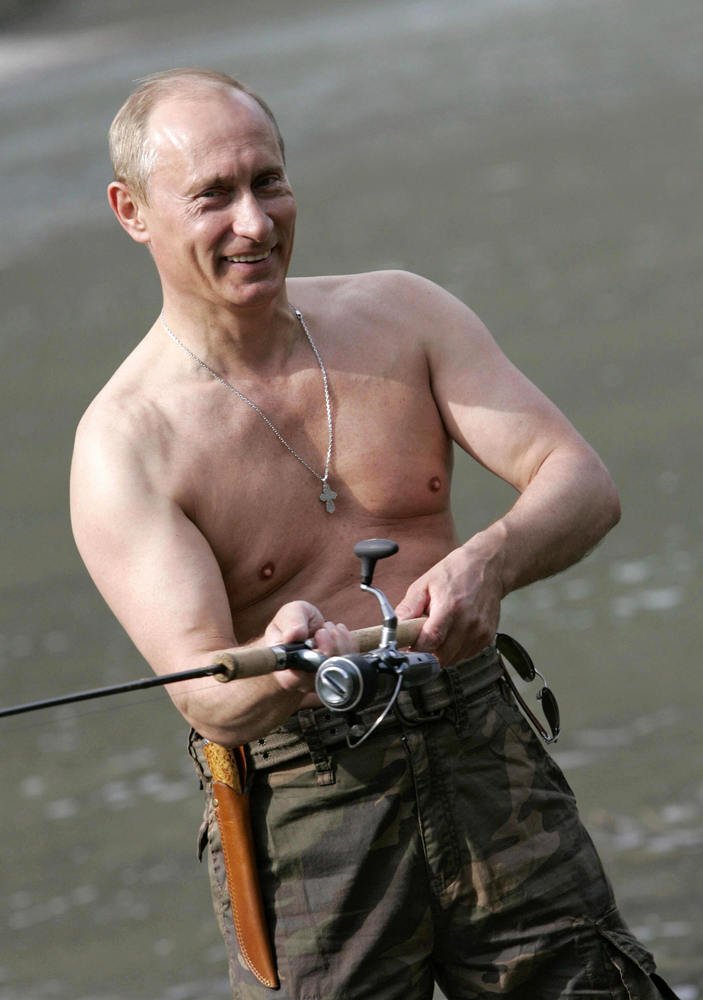
Putin helps Trump and Trump helps Putin — but no one should be in any doubt about who is the dominant partner in this bromance: it’s the one who’s rather proud of showing off his body; not the one who lives in fear of the day he might show up naked on the nightly news.

Facebooktwittermail

The Trump dossier and the FBI cover-up

The Independent reports: Christopher Steele, the former MI6 agent who investigated Donald Trump’s alleged Kremlin links, was so worried by what he was discovering that at the end he was working without pay, The Independent has learned.

Mr Steele also decided to pass on information to both British and American intelligence officials after concluding that such material should not just be in the hands of political opponents of Mr Trump, who had hired his services, but was a matter of national security for both countries.

However, say security sources, Mr Steele became increasingly frustrated that the FBI was failing to take action on the intelligence from others as well as him. He came to believe there was a cover-up, that a cabal within the Bureau blocked a thorough inquiry into Mr Trump, focusing instead on the investigation into Hillary Clinton’s emails. [Continue reading…]

The Guardian reports: Embattled FBI director James Comey has refused to clarify whether his organization is investigating Donald Trump’s ties to Russia in a closed briefing on Friday for members of Congress, angering legislators who recall his high-profile interjections about Hillary Clinton during the 2016 presidential campaign, the Guardian has learned.

Comey’s lack of candor in a classified setting, intended to brief members on the intelligence agencies’ assessment that Russia interfered in the election to benefit Trump, follows a public rebuff this week to senators seeking clarification.

In that earlier hearing, Comey said he would “never comment” on a potential FBI investigation “in an open forum like this”, raising expectations among some attendees of Friday’s briefing that Comey would put the issue to rest in a classified setting.

But according to sources attending the closed-door Friday morning meeting, that was not the case. As such, frustration with Comey was bipartisan and heated, adding to intense pressure on the director of the FBI, whose conduct in the 2016 election itself is now being investigated by an independent US justice department watchdog.

One source in the meeting said Comey would not answer “basic questions” about the FBI’s current investigative activities. The FBI chief was grilled “over and over again”, according to the source, about his standards for acknowledging FBI investigations, with legislators repeatedly bringing up Comey’s dramatic public confirmation that the bureau was revisiting classification issues with Hillary Clinton’s private email server days before the election, as well as his summer press conference announcing that he would not seek indictment. [Continue reading…]

Facebooktwittermail

Intelligence Committee will investigate possible Russia-Trump links

Politico reports: Senate Intelligence Chairman Richard Burr (R-N.C.) said late Friday that his committee will investigate possible contacts between Donald Trump’s campaign and Russia, reversing himself one day after telling reporters that the issue would be outside of his panel’s ongoing probe into Moscow’s election-disruption efforts.

Burr and the intelligence panel’s top Democrat, Virginia Sen. Mark Warner, said in a joint statement that the committee’s probe would touch on “intelligence regarding links between Russia and individuals associated with political campaigns” as well as Russian cyberattacks and other election meddling outlined in an intelligence report released last week.

The committee will use “subpoenas if necessary” to secure testimony from Obama administration officials as well as Trump’s team, Burr and Warner said.

The bipartisan Senate announcement came hours after several House Democrats aired their frustrations with FBI Director James Comey following a classified briefing on Russian election disruption. The Democrats were livid that Comey refused to confirm whether he is conducting an inquiry into potential Trump ties to Russia — a question that he publicly declined to answer earlier this week. [Continue reading…]

Facebooktwittermail

Trump’s Cabinet nominees keep contradicting him

The Washington Post reports: Donald Trump’s Cabinet nominees, in their first round of confirmation hearings on Capitol Hill, have one after another contradicted the president-elect on key issues, promising to trim back or disregard some of the signature promises on which he campaigned.

A fresh set of examples came Thursday, the third day of hearings.

Retired Marine Corps Gen. James Mattis, Trump’s nominee to be defense secretary, told the Senate Armed Services Committee that the United States must honor the “imperfect ­arms-control agreement” with Iran that Trump has vowed to dismantle because “when America gives her word, we have to live up to it and work with our allies.”

He also took a more adversarial stance than Trump has toward Russian President Vladi­mir Putin and cited Moscow as one of the nation’s top threats.

“I’ve never found a better guide for the way ahead than studying the histories. Since [the 1945 meeting of world powers at] Yalta, we have a long list of times we’ve tried to engage positively with Russia. We have a relatively short list of successes in that regard,” Mattis said. “I think right now, the most important thing is that we recognize the reality of what we deal with [in] Mr. Putin and we recognize that he is trying to break the North Atlantic alliance.”

At a witness table in another Senate hearing room, Rep. Mike Pompeo (R-Kan.), whom Trump picked to head the CIA, assured the Intelligence Committee that he would “absolutely not” use brutal interrogation tactics on terrorism suspects in contravention of the law, even if ordered to do so by a president who campaigned on a promise to reinstate the use of such measures.

Trump indicated in a tweet Friday morning that he is unconcerned about the contradictions. “All of my Cabinet nominee are looking good and doing a great job,” Trump wrote. “I want them to be themselves and express their own thoughts, not mine!”

The discordant notes that Cabinet nominees have struck as they have been questioned by senators suggest that a reality check may lie ahead for Trump.

It may be that the grandiosity and disregard for convention that got Trump elected were inevitably bound for a collision with the practical and legal limitations of governing. [Continue reading…]

Facebooktwittermail

U.S. intel sources warn Israel against sharing secrets with Trump administration

Ynet reports: Donald Trump’s upcoming inauguration as the next president of the United States is causing Israeli intelligence officials to lose sleep as well. Discussions held in closed forums recently raised fears of a leakage of Israeli intelligence top-classified information, clandestine modus oprandi and sources, which have been exposed to the American intelligence community over the past 15 years, to Russia – and from there to Iran.

The cause of concern are the suspicions of unreported ties between the president-elect or his associates and the Kremlin, whose agents are also associated with intelligence officials in Tehran.

These fears, which began upon Trump’s election, grew stronger following a meeting held recently between Israeli and American intelligence officials (the date of the meeting is not mentioned to protect the sources of the report). During the meeting, according to the Israelis who participated in it, their American colleagues voiced despair over Trump’s election, as he often lashes out at the American intelligence community. The American officials also told the Israelis that the National Security Agency (NSA) had “highly credible information” that Russia’s intelligence agencies, the FSB and GRU, were responsible for hacking the Democratic Party (DNC) servers during the elections and leaking sensitive information to WikiLeaks, which hurt Democratic presidential candidate Hillary Clinton.

The American officials further added that they believed Russia President Vladimir Putin had “leverages of pressure” over Trump – but did not elaborate. They were apparently referring to what was published Wednesday about embarrassing information collected by the Russian intelligence in a bid to blackmail the president-elect.

The Americans implied that their Israeli colleagues should “be careful” as of January 20, Trump’s inauguration date, when transferring intelligence information to the White House and to the National Security Council (NSC), which is subject to the president. According to the Israelis who were present in the meeting, the Americans recommended that until it is made clear that Trump is not inappropriately connected to Russia and is not being extorted – Israel should avoid revealing sensitive sources to administration officials for fear the information would reach the Iranians. [Continue reading…]

Facebooktwittermail

Frank Rich on BuzzFeed’s decision to publish the Trump dossier

In an interview with Alex Carp, Frank Rich said: Next to the staggering list of press failures that have marked Trump’s rise to the presidency, this seems small potatoes. BuzzFeed did frame what it published as being both unconfirmed and redolent with errors. The “dossier” may well prove to be utter trash (if entertaining trash), and the only slender justification for publishing it is that it fleshes out a true news break by CNN, that both Obama and Trump had been told of this salacious report’s existence by American intelligence agencies, who also have not verified it. But is BuzzFeed’s sin worse than CNN having put Trump henchman Corey Lewandowski on its election-year payroll? Or than the Times repeatedly giving major home-page play to data suggesting that Hillary Clinton had a close to 100 percent chance of victory right up to Election Day? You could argue that that latter stunt actually suppressed Democratic turnout in the presidential race; the BuzzFeed stunt changed nothing unless you count the impressive number of jokes it has prompted, on Twitter and beyond, around the phenomenon of #GoldenShower. It is not a bright spot in BuzzFeed’s history, but the ruckus it has generated seems disproportionate, a reflection of how much Trump has put the press on the defensive over a bruising 18 months.

What most seems to upset press critics about BuzzFeed’s action — understandably — is that Trump seized on it to paint the entire press Establishment, including CNN, as purveyors of “fake news.” That is an outrage, but if Trump hadn’t found this pretext, he would have found another opening soon enough. There is, of course, no bigger purveyor of fake news than Trump himself, unless it’s his comrade in alt-right propaganda, Stephen Bannon. Trump’s entire campaign was spawned by trafficking in conspiracy theories, whether about President Obama or Mexican immigrants or imaginary Muslims cheering 9/11 in New Jersey. His effort to play the virtuous defender of journalistic ethics is as ludicrous as his presenting himself as the greatest, most respectful champion of America’s women. He is determined to bully, destabilize, and discredit the press. But those who buy his preposterous self-righteous pose are so imprisoned by the alternative reality of Trump anyway that they might as well be Scientologists — nothing short of an intervention will return them to the real world. These are the same people who think that Trump’s display of piles of manila envelopes at his press conference actually told us something about his business ethics. If I may briefly embrace Trumpism by being both vulgar and politically incorrect, let me say that people who fall for his bullshit are idiots. Even if the dossier BuzzFeed published is found to be mostly true, they’ll still believe it’s fake news because it doesn’t match the fake news they are imbibing every day. [Continue reading…]

The strange thing about all this soul searching on whether BuzzFeed stepped over some sacred line is the demonstrable fact that the press is and never has confined itself to publishing verified facts. It is wholly legitimate to publish information which might turn out to be untrue or inaccurate if the reporting is done in good faith. Journalists repeatedly lean on “analysts” as sources of conjecture and opinion and they do so — hopefully — on the basis that facts so often call out for interpretation and the interpretations provided are credible.

The decision to publish the Trump dossier seems — at least to me — to be no different from the intelligence community’s decision to summarize its contents for briefings given to Obama and Trump: it merits attention, both presidential and public, because of its credibility.

If the strongest arguments that Donald Trump can make to challenge the dossier’s credibility are his claims to be a man who exercises great caution when out in the world and who is also a self-described germophobe, I’d say we have even more reason to wonder what kinds of recordings the Kremlin might have with which it can blackmail the next president.

“You better be careful, or you’ll be watching yourself on nightly television,” Trump warned on Wednesday — to which he should have added, “or listening to yourself bragging about grabbing pussy.”

We know what Trump says and we also know some of what he’s done. As yet, we don’t know what he did in Russia — but it’s way too soon to dismiss stories of golden showers and videotapes as fake news.

Facebooktwittermail

Trump dossier: The more that is revealed about the source, the more his credibility grows

The Guardian reports: At his press briefing on Wednesday, the president-elect dared the world’s media to scrutinise the 35 pages of claims, before throwing down a challenge – where’s the proof? Nobody had any. Case closed.

But in the rush to trample all over the dossier and its contents, one key question remained. Why had America’s intelligence agencies felt it necessary to provide a compendium of the claims to Barack Obama and Trump himself?

And the answer to that lies in the credibility of its apparent author, the ex-MI6 officer Christopher Steele, the quality of the sources he has, and the quality of the people who were prepared to vouch for him. In all these respects, the 53-year-old is in credit.

On Thursday night, as the former spy was in hiding, having fled his home in the south-east of England, former colleagues rallied to defend him. One described him as “very credible” – a sober, cautious and meticulous professional with a formidable record.

The former Foreign Office official, who has known Steele for 25 years and considers him a friend, said: “The idea his work is fake or a cowboy operation is false – completely untrue. Chris is an experienced and highly regarded professional. He’s not the sort of person who will simply pass on gossip.”

The official added: “If he puts something in a report, he believes there’s sufficient credibility in it for it to be worth considering. Chris is a very straight guy. He could not have survived in the job he was in if he had been prone to flights of fancy or doing things in an ill-considered way.”

That is the way the CIA and the FBI, not to mention the British government, regarded him, too. It’s not hard to see why.

A Cambridge graduate, Steele was one of the more eminent Russia specialists for the Secret Intelligence Service (MI6). The Guardian understands that he focused on Soviet affairs after joining the agency, and spent two years living in Moscow in the early 1990s.

This was a period when Russia and the breakup of the eastern bloc were still the prime focus for Britain’s intelligence agencies, and a successful spell in the region was a good way to get on.

By all accounts, that’s exactly what Steele did. And his interest in Russia did not diminish as he continued to rise up the ranks, a friend and contemporary of Alex Younger – now head of MI6.

Over a career that spanned more than 20 years, Steele performed a series of roles, but always appeared to be drawn back to Russia; he was, sources say, head of MI6’s Russia desk. When the agency was plunged into panic over the poisoning of its agent Alexander Litvinenko in 2006, the then chief, Sir John Scarlett, needed a trusted senior officer to plot a way through the minefield ahead – so he turned to Steele. It was Steele, sources say, who correctly and quickly realised that Litvinenko’s death was a Russian state “hit”. [Continue reading…]

The Independent adds: The official’s work had involved the former Soviet Union and Warsaw Pact countries during the Cold War and he had maintained contacts since in Russia and eastern Europe while working as a security consultant. Importantly, he is well known to the American agencies and, according to senior sources, they felt the official had enough credibility to be taken seriously.

One matter that appear to buttress this credibility was a report he supplied five months ago claiming that figures in Mr Trump’s campaign team had agreed to a Russian request to try and dilute election focus on its intervention in Ukraine. Four days later Mr Trump stated that he would recognise Moscow’s annexation of Crimea. A month later officials involved in his campaign asked the Republican Party’s election platform to remove a pledge for military assistance to the Ukrainian government against separatist rebels in the east of the country. [Continue reading…]

Facebooktwittermail

How Putin played the far left

Casey Michel writes: In the aftermath of the U.S. intelligence community’s recent report on the Russian-directed hacking of the Democratic National Committee, it’s easy but misleading to conclude that the Russian government’s propaganda strategy lies solely in advancing the careers of conservative Republicans in the United States. Backing Donald Trump’s candidacy, via steady leaks of stolen communiques to organizations like WikiLeaks, was but one prong of the Kremlin’s assault on American liberal democracy. Part of its campaign to vilify Hillary Clinton involved catering to her rivals on the far-left and pushing any number of crankish conspiracy theories that appeal as much to “anti-imperialists” as to neo-Nazis.

There’s nothing new in that, really.

Moscow’s attempts to cultivate America’s far-left long predate the presidency of Vladimir Putin. The Kremlin, according to available evidence, donated more funds per capita to the U.S. Communist Party than any other communist claque during the Soviet period, when Moscow’s intelligence operations against the “main adversary” involved recruiting agents of influence and spies of a progressive background who were sympathetic to the Soviet cause. But the past 18 months have seen a noted spike in information warfare aimed at gulling the Bernie Bros and Occupy-besotted alternative media set, which saw Clinton as more of a political danger than it did Trump.

Perhaps the starkest case in point is Green Party presidential candidate Jill Stein and her constituency. In December 2015, the Kremlin feted Stein by inviting her to the gala celebrating the 10-year anniversary of Kremlin-funded propaganda network RT. Over a year later, it remains unclear who paid for Stein’s trip to Moscow and her accommodations there. Her campaign ignored multiple questions on this score. We do know, however, that Stein sat at the same table as both Putin and Lt. Gen. Mike Flynn, Trump’s soon-to-be national security adviser. She further spoke at an RT-sponsored panel, using her presence to criticize the U.S.’s “disastrous militarism.” Afterward, straddling Moscow’s Red Square, Stein described the panel as “inspiring,” going on to claim that Putin, whom she painted as a political novice, told her he “agree[d]” with her “on many issues.”

Stein presents herself as a champion of the underclass and the environment, and an opponent of the surveillance state and corporate media, and yet she seemed to take pleasure in her marriage of true minds with a kleptocratic intelligence officer who levels forests and arrests or kills critical journalists and invades foreign countries. Their true commonality, of course, is that both Putin and Stein are dogged opponents of U.S. foreign policy. [Continue reading…]

Facebooktwittermail

Trump lies about phone conversation with Clapper

On Wednesday evening Director of National Intelligence James Clapper issued a statement saying:

This evening, I had the opportunity to speak with President-elect Donald Trump to discuss recent media reports about our briefing last Friday. I expressed my profound dismay at the leaks that have been appearing in the press, and we both agreed that they are extremely corrosive and damaging to our national security.

We also discussed the private security company document, which was widely circulated in recent months among the media, members of Congress and Congressional staff even before the IC became aware of it. I emphasized that this document is not a U.S. Intelligence Community product and that I do not believe the leaks came from within the IC. The IC has not made any judgment that the information in this document is reliable, and we did not rely upon it in any way for our conclusions. However, part of our obligation is to ensure that policymakers are provided with the fullest possible picture of any matters that might affect national security.

The following morning, Trump tweeted:


When I say Trump lied about the conversation, I’m giving him the benefit of the doubt.

The alternative is that the next president has such an impaired capacity to take in information that conflicts with his presuppostions/prejudices/agenda that he is functionally deaf — that he literally only hears what he wants to hear.

As I said, I’ll give him the benefit of the doubt — I think he’s just a liar.

Facebooktwittermail