



Glenn Greenwald writes: Anonymous U.S. officials this morning are announcing in The Washington Post that they have effectively defeated what they call “the organization that brought us 9/11″ — Al Qaeda — by rendering it “operationally ineffective.” Specifically, “the leadership ranks of the main al-Qaeda terrorist network have been reduced to just two figures whose demise would mean the group’s defeat, U.S. counterterrorism and intelligence officials said.” And: “asked what exists of al-Qaeda’s leadership group beyond the top two positions, the official said: ‘Not very much’.”
You might think this means that the vastly expanded National Security and Surveillance States justified in the name of 9/11, as well as the slew of wars and other aggressive deployments which it spawned, can now be reversed and wound down. After all, the stated purpose of the 2001 Authorization to Use Military Force (AUMF) which provided legal cover to all of this was expressed in the very first line: “To authorize the use of United States Armed Forces against those responsible for the recent attacks launched against the United States.” The purpose of this authorized force was equally clear and limited: “to use all necessary and appropriate force against those nations, organizations, or persons [the President] determines planned, authorized, committed, or aided the terrorist attacks that occurred on September 11, 2001, or harbored such organizations or persons.”
Now, the group which the U.S. government has always said was the one that “planned, authorized, committed, or aided the terrorist attacks that occurred on September 11, 2001″ is, according to this same government, “operationally ineffective.” So what does that mean in terms of policy? Absolutely nothing:
U.S. officials stressed that al-Qaeda’s influence extends far beyond its operational reach, meaning that the terrorist group will remain a major security threat for years.
Not just a threat — but a major security threat — “for years” to come. In fact, it turns out that the version of Al Qaeda that the U.S. just spent the last decade “defeating” on the ground that it perpetrated 9/11 does not even really matter: “U.S. counterterrorism officials now assess al-Qaeda’s offshoot in Yemen as a significantly greater threat.” Even in Pakistan, where the “effectively inoperable” group is based, the CIA refuses even to reduce its activities: “letting up now could allow them to regenerate,” an anonymous official decreed. And if that’s not enough to keep your fear levels sufficiently high to support (or at least acquiesce to) more militarism, there is always this: “The arrest this week of an alleged al-Qaeda sympathizer in New York underscored the group’s ability to inspire ‘lone wolf’ attacks.”
Eric Lewis writes: As a candidate in 2008, President Obama stated categorically, “We’ll reject torture — without exception or equivocation.” During his first month in office, he made good on his pledge, signing an executive order prohibiting torture or inhumane treatment. There is no reason to doubt that the order has been followed. This was a huge step forward for the United States.
But if he loses the presidency next year, Obama’s failure to deal with the legacy of torture that he inherited may turn out to be a huge problem. He has left the door open for state-sanctioned torture to be part of the next administration’s tool kit for dealing with the “global war on terror.” The leading Republican candidates understand that in many circles advocating torture is good politics. In their debates and in their foreign policy pronouncements, they are effectively capitalizing on a series of decisions that the Obama administration made as it failed to enshrine its own ban on torture as an absolute legal norm. Torture remains on the table as a future policy choice.
So what happened? The president has rejected three clear opportunities to erect a high legal wall against the return of torture: he has made it clear that criminal prosecutions for torture will not go forward; he has opposed the creation of a truth commission to examine events comprehensively; and he has affirmatively intervened to stop civil litigation by detainees against their torturers.
When President Obama took office, I was in the midst of litigating a civil case against former Secretary of Defense Donald Rumsfeld and the military chain of command for torture. A panel of judges from the United States Court of Appeals for the District of Columbia Circuit had found that as “aliens without presence or property in the United States,” Guantánamo detainees had no right not to be tortured under the Constitution and, in any event, even if there were such rights, there was no reason that Rumsfeld and other military leaders should have been aware that the right to be free from torture was “clearly established.” Accordingly they were immune from suit. In 2009, the Supreme Court directed that the Court of Appeals reconsider its decision in light of its recent finding in Boumediene v. Bush of a constitutional right to habeas corpus for detainees at Guantánamo.
Surely, I thought, the new administration would weigh in and support the argument that there was an inarguable and fundamental right not to be tortured by the government of the United States. What’s more, supporting civil actions for damages would have allowed the facts of torture to emerge through judicial proceedings, avoiding the political conflict of direct executive involvement.
Instead, the Obama administration slammed the door on constitutional challenges to torture. It reiterated the Bush administration’s position, arguing that “aliens held at Guantánamo do not have due process rights,” limiting the Supreme Court’s decision in Boumediene to habeas corpus only. In other words, it was the position of the Obama administration that even though the Supreme Court had found a constitutional right for detainees to challenge their confinement, detainees had no constitutional right not to be tortured while in confinement. The Obama administration also insisted that it was not sufficiently clear that the Constitution prohibited torture of aliens, and so “a reasonable officer would not have concluded that plaintiffs here possessed Fifth and Eighth Amendment rights while they were detained at Guantánamo.”
Yet reasonable officers have known since the founding of the republic that military law prohibits torturing prisoners and, since the 1930s, that it was cruel and unusual punishment and a violation of due process to torture prisoners in the custody of the United States. What these officers apparently could not have been expected to figure out was whether by bringing prisoners to Guantánamo, they could evade the Constitutional ban on torture or prisoners. Finally, the Obama administration warned that civil remedies for torture would “enmesh the courts in military, national security, and foreign affairs matters that are the exclusive province of the political branches.” In plain English, it is up to us — the executive — and not you — the courts — to decide whether detainees can be tortured or not.
Adam Weinstein reports: With time fast running out for the so-called deficit supercommittee, the mammoth amount of government money spent on the military has become a prime target in Washington. But the main focus isn’t on big-ticket weapons projects or expensive wars—it’s on retirement benefits for the roughly 17 percent of soldiers, Marines, sailors, and airmen who have served 20 years or more in uniform. Currently the total cost of their benefits is about $50 billion a year.
Cuts to military pensions are “the kind of thing you have to consider,” Defense Secretary Leon Panetta said in September. When President Obama unveiled his $3 trillion debt reduction plan the same month, it called GIs’ benefits “out of line” with private employee retirement plans, saying the system was “designed for a different era of work.” When Congress held a hearing on military retirements in October, Rep. Austin Scott (R-Ga.) promoted a cheaper 401(k)-style plan that would slash existing benefits for many troops. “I see nothing wrong with them being able to choose a different retirement plan,” he said.
These ideas may sound like a bold new approach in an urgent moment—but in fact, the push for pension cuts and other corporate “reforms” at the Pentagon originates from an obscure advisory panel that has existed for a decade: the Defense Business Board. Its 21 members know little about military affairs, but they are rich in Wall Street experience, including with some of the biggest companies implicated in the 2008 financial meltdown. They are investment bank CEOs and CFOs, outsourcing experts, and layoff specialists who promote a corporate agenda of “behavior change” and “business solutions” [PDF] in the military bureaucracy. The board proposes not only to slash and privatize military pensions, but also to have the Pentagon invest in oil futures, boost pay for its executives and political appointees, and make it easier for them to fire rank-and-file employees while scaling back those workers’ collective-bargaining rights.
Indeed, “this sounds like what’s being done now around the country with the public unions,” affirms Charles Tiefer, a University of Baltimore law professor and defense contracting watchdog who’s testified to Congress about the board’s recommendations. The board was launched in 2001 by then Defense Secretary Donald Rumsfeld, who famously wanted to downsize the military and corporatize its management system. The essential reason it exists, Tiefer says, is so that “a pro-business attitude—especially on personnel issues—remains intact” inside the Pentagon.
Visit msnbc.com for breaking news, world news, and news about the economy
MSNBC reports: A well-known Washington lobbying firm with links to the financial industry has proposed an $850,000 plan to take on Occupy Wall Street and politicians who might express sympathy for the protests, according to a memo obtained by the MSNBC program “Up w/ Chris Hayes.”
The proposal was written on the letterhead of the lobbying firm Clark Lytle Geduldig & Cranford and addressed to one of CLGC’s clients, the American Bankers Association.
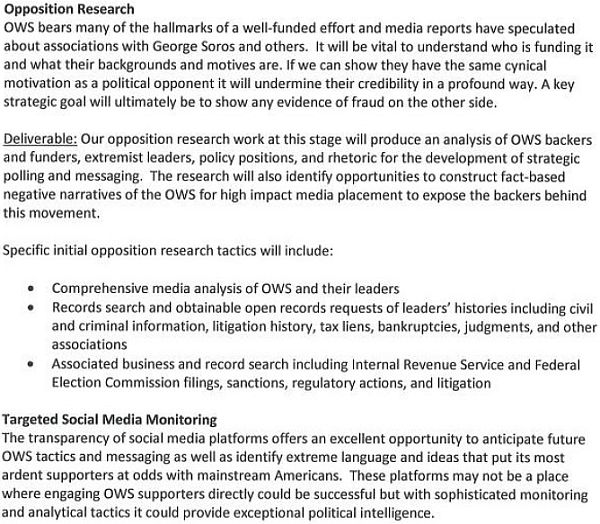
CLGC’s memo [PDF] proposes that the ABA pay CLGC $850,000 to conduct “opposition research” on Occupy Wall Street in order to construct “negative narratives” about the protests and allied politicians. The memo also asserts that Democratic victories in 2012 would be detrimental for Wall Street and targets specific races in which it says Wall Street would benefit by electing Republicans instead.
According to the memo, if Democrats embrace OWS, “This would mean more than just short-term political discomfort for Wall Street. … It has the potential to have very long-lasting political, policy and financial impacts on the companies in the center of the bullseye.”
Here’s an extract from the memo:

The New York Times reports: The warning has ricocheted around the financial world in recent weeks, in conversations at Midtown restaurants and Washington fund-raisers, carrying urgent appeals for money from financial executives around the Northeast: The battle to re-elect Senator Scott P. Brown, the Republican from Massachusetts, just got a little more interesting.
“Senator Brown is a free-market advocate who believes that our strength as a nation comes from the ingenuity and hard work of its people,” read an invitation to a fund-raiser at a New Canaan, Conn., country club last week, that circulated among hedge fund and private equity executives. His Democratic opponent, the invitation noted, was all but certain to be the financial industry’s most prominent foe: “big government liberal Elizabeth Warren.”
Mr. Brown, a freshman who harnessed populist Tea Party anger to win the seat once held by Edward M. Kennedy, has taken more money from the financial industry than almost any other senator: all told, more than $1 million during the last two years, according to data from the Center for Responsive Politics.
Of the 20 companies that accounted for the most campaign donations to Mr. Brown, about half were prominent investment or securities firms like Morgan Stanley, Fidelity Investments and Bain Capital. His donors include such blue-chip names as Gary Cohn, the president of Goldman Sachs, and the hedge fund kings John Paulson and Kenneth Griffin.
Mr. Brown, in turn, has been an important ally at critical moments, using his swing vote in the Senate to wring significant concessions out of Democrats on last year’s financial regulation bill, including helping strip out a proposed $19 billion bank tax and weakening a proposal to stop commercial banks from holding large interests in hedge funds and private equity funds.
But the intensity of his relationship with Wall Street was altered in September, when Mr. Brown got a new opponent: Ms. Warren, a law professor and consumer advocate who has described herself as an intellectual godmother of the Occupy Wall Street movement.
Ms. Warren’s relentless manner and withering attacks on predatory lenders have won her enemies from Wall Street to Washington, where as a member of an oversight panel she helped usher in the largest expansion in decades of federal oversight of the financial industry. Now Mr. Brown’s support for the industry — and Ms. Warren’s battles with it — are becoming a defining issue in one of the most hotly contested Senate races and a magnet for special interest money.
Zaid Jilani reports: In one of the greatest signs yet that the 99 Percenters are having an impact, Rep. Ted Deutch (D-FL), a member of the House Judiciary Committee, today introduced an amendment that would ban corporate money in politics and end corporate personhood once and for all.
Deutch’s amendment, called the Outlawing Corporate Cash Undermining the Public Interest in our Elections and Democracy (OCCUPIED) [PDF] Amendment, would overturn the Citizens United decision, re-establishing the right of Congress and the states to regulate campaign finance laws, and to effectively outlaw the ability of for-profit corporations to contribute to campaign spending.
“No matter how long protesters camp out across America, big banks will continue to pour money into shadow groups promoting candidates more likely to slash Medicaid for poor children than help families facing foreclosure,” said Deutch in a statement provided to ThinkProgress. “No matter how strongly Ohio families fight for basic fairness for workers, the Koch Brothers will continue to pour millions into campaigns aimed at protecting the wealthiest 1%. No matter how fed up seniors in South Florida are with an agenda that puts oil subsidies ahead of Social Security and Medicare, corporations will continue to fund massive publicity campaigns and malicious attack ads against the public interest. Americans of all stripes agree that for far too long, corporations have occupied Washington and drowned out the voices of the people. I introduced the OCCUPIED Amendment because the days of corporate control of our democracy. It is time to return the nation’s capital and our democracy to the people.”
Reuters reports: The number of children in the United States considered poor rose by 1 million in 2010, the U.S. Census said Thursday, with more than one in five of the youngest Americans now living in poverty.
“Children who live in poverty, especially young children, are more likely than their peers to have cognitive and behavioral difficulties, to complete fewer years of education, and, as they grow up, to experience more years of unemployment,” the Census said.
In 2010, when the Census survey was conducted, 21.6 percent of children across the country were poor, compared to 20 percent in 2009.
That was mainly due to a rise in the number of children living below the federal poverty threshold, defined as an annual income of $22,314 for a family of four, to 15.7 million from 14.7 million in 2009.
The figures reflect the overall state of the economy. The national poverty rate stands at 15.3 percent and the unemployment rate is at 9 percent some two years after the recession that began in 2007 officially ended.
The Guardian reports: David Williams did not have an easy life. He moved to Newburgh, a gritty, impoverished town on the banks of the Hudson an hour or so north of New York, at just 10 years old. For a young, black American boy with a father in jail, trouble was everywhere.
Williams also made bad choices. He ended up going to jail for dealing drugs. When he came out in 2007 he tried to go straight, but money was tight and his brother, Lord, needed cash for a liver transplant. Life is hard in Newburgh if you are poor, have a drug rap and need cash quickly.
His aunt, Alicia McWilliams, was honest about the tough streets her nephew was dealing with. “Newburgh is a hard place,” she said. So it was perhaps no surprise that in May, 2009, David Williams was arrested again and hit with a 25-year jail sentence. But it was not for drugs offences. Or any other common crime. Instead Williams and three other struggling local men beset by drug, criminal and mental health issues were convicted of an Islamic terrorist plot to blow up Jewish synagogues and shoot down military jets with missiles.
Even more shocking was that the organisation, money, weapons and motivation for this plot did not come from real Islamic terrorists. It came from the FBI, and an informant paid to pose as a terrorist mastermind paying big bucks for help in carrying out an attack. For McWilliams, her own government had actually cajoled and paid her beloved nephew into being a terrorist, created a fake plot and then jailed him for it. “I feel like I am in the Twilight Zone,” she told the Guardian.
Lawyers for the so-called Newburgh Four have now launched an appeal that will be held early next year. Advocates hope the case offers the best chance of exposing the issue of FBI “entrapment” in terror cases. “We have as close to a legal entrapment case as I have ever seen,” said Susanne Brody, who represents another Newburgh defendant, Onta Williams.
Some experts agree. “The target, the motive, the ideology and the plot were all led by the FBI,” said Karen Greenberg, a law professor at Fordham University in New York, who specialises in studying the new FBI tactics.
But the issue is one that stretches far beyond Newburgh. Critics say the FBI is running a sting operation across America, targeting – to a large extent – the Muslim community by luring people into fake terror plots. FBI bureaux send informants to trawl through Muslim communities, hang out in mosques and community centres, and talk of radical Islam in order to identify possible targets sympathetic to such ideals. Or they will respond to the most bizarre of tip-offs, including, in one case, a man who claimed to have seen terror chief Ayman al-Zawahiri living in northern California in the late 1990s.
That tipster was quickly hired as a well-paid informant. If suitable suspects are identified, FBI agents then run a sting, often creating a fake terror plot in which it helps supply weapons and targets. Then, dramatic arrests are made, press conferences held and lengthy convictions secured.
But what is not clear is if many real, actual terrorists are involved.
MJ Rosenberg writes: The Republican candidates for president are not the only politicians who use Iran and its nuclear program as a magnet for campaign dollars. The same dynamic is at play in Los Angeles, where two Democratic House members, Howard Berman and Brad Sherman, are trying to out-hawk each other on Iran in preparation for a June 2012 primary. (Their districts are being merged.)
To be fair, both Sherman and Berman, who is a former chair of the House Foreign Affairs Committee and now its ranking Democrat, are AIPAC stalwarts and were hardliners on Iran long before being pitted against each other in a primary.
They have both promoted “crippling” sanctions bills, which supporters argue are specifically targeted at Iranians involved in the country’s nuclear program and not at Iranians in general.
But that claim cannot be made for Brad Sherman’s latest AIPAC-inspired legislation, which would prevent the president from permitting the inspection and repair of U.S.-manufactured engines on Iranian civilian aircraft.
The planes in question were sold to the Iranians back in the 1970s (when the Shah was in power) and are now dangerously out of date. Current sanctions laws ban the sale of new planes and parts to Iran, but a humanitarian exception in the law permits repairs and the replacement of parts necessary to prevent civilian air crashes. It is that exception that Sherman is hell-bent on removing.
On March 16, President Obama informed Congress that he would use his authority under the law to allow Iran to repair fifteen General Motors engines used in civilian planes that were recently deemed a safety risk by the Federal Aviation Administration.
Sherman went ballistic, immediately firing off a letter to the president demanding that he not permit the planes to be repaired. He wrote:
There is no reason we should be helping the Iranians keep these planes in the air. … Fixing these aircraft is in 180 degree opposition to our sanctions policy, which if properly implemented, would provide for Iran’s increased economic and political isolation.
Sherman either overlooks or doesn’t care about the one reason the United States should permit the repair of those planes: saving lives.
Most Americans vastly overestimate how much the U.S. government spends on foreign aid. In a recent poll, the median answer was that 25% of the federal budget goes to foreign aid. In reality it is about 1%. Along with the idea that the U.S. spends massively overseas is the idea that America gives and the rest of the world takes, but in its most recent rankings, the Centre for Global Development places the U.S. #17.
Click on the image below to explore the CGD’s 2011 Commitment to Development Index.
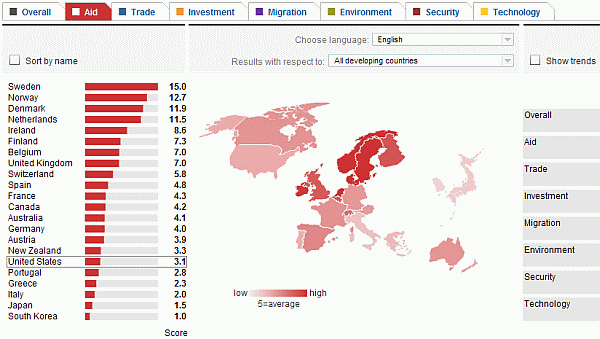
David Roodman, senior fellow at the Center for Global Development in Washington, DC, introduces the Commitment to Development Index, which ranks wealthy nations by how much they help poorer ones.
The index is not without flaws in some of the reasoning it applies. For instance, in arriving at its overall rankings (which aggregate aid and other components such as security) the position of the U.S. was boosted this year thanks to Obama’s troop surge in Afghanistan. Because the war in Afghanistan has a UN mandate, the CGD dubs it a “peacekeeping” operation!

Glenn Greenwald writes: Slightly more than two months after he was awarded the 2009 Nobel Peace Prize, President Obama secretly ordered a cruise missile attack on Yemen, using cluster bombs, which killed 44 innocent civilians, including 14 women and 21 children, as well as 14 people alleged to be “militants.” It goes without saying that — unless you want Rick Perry to win in 2012 — this act should in no way be seen as marring Obama’s presidency or his character: what’s a couple dozen children blown up as a part of a covert, undeclared air war? If anything, as numerous Democrats have ecstatically celebrated, such acts show how Tough and Strong the Democrats are: after all, ponder the massive amounts of nobility and courage it takes to sit in the Oval Office and order this type of aggression on defenseless tribal regions in Yemen. As R.W. Appel put it on the front page of The New York Times back in 1989 when glorifying George H.W. Bush’s equally courageous invasion of Panama: “most American leaders since World War II have felt a need to demonstrate their willingness to shed blood” and doing so has become “a Presidential initiation rite.”
But one aspect of the December, 2009, attack that perhaps did merit some more critical scrutiny was the use of cluster bombs, weapons which “scatter hundreds of bomblets over a large area but with limited accuracy and high failure rates.” The inevitability of “duds” — “unexploded ordnance” — poses a great risk to civilians, often well after the conflict has ended, since — like land mines — they often detonate when stumbled into by children and other innocents long after they disperse. According to the Cluster Munitions Coalition, cluster bombs “caused more civilian casualties in Iraq in 2003 and Kosovo in 1999 than any other weapon system.” As Wired pointed out, while the U.S. used these weapons in both Iraq and Afghanistan, “neither the Taliban nor Saddam used cluster bombs against U.S. troops.
The Washington Post reports: The Dover Air Force Base mortuary for years disposed of portions of troops’ remains by cremating them and dumping the ashes in a Virginia landfill, a practice that officials have since abandoned in favor of burial at sea.
The mortuary in Delaware, the main point of entry for the nation’s war dead and the target of federal investigations of alleged mishandling of remains, engaged in the practice from 2003 to 2008, according to Air Force officials. The manner of disposal was not disclosed to relatives of fallen service members.
Air Force officials acknowledged the practice Wednesday in response to inquiries from The Washington Post. They said the procedure was limited to fragments or portions of body parts that were unable to be identified at first or were later recovered from the battlefield, and which family members had said could be disposed of by the military.
Lt. Gen. Darrell G. Jones, the Air Force’s deputy chief for personnel, said the body parts were cremated, then incinerated, and then taken to a landfill by a military contractor. He likened the procedure to the disposal of medical waste.
Jones also could not estimate how many body parts were handled in this way. “That was the common practice at the time, and since then our practices have improved,” he said.
Gari-Lynn Smith, portions of whose husband’s remains were disposed of in the landfill after his 2006 death in Iraq, said she was “appalled and disgusted” by the way the Air Force had acted. She learned of the landfill disposal earlier this spring in a letter from a senior official at the Dover mortuary.
“My only peace of mind in losing my husband was that he was taken to Dover and that he was handled with dignity, love, respect and honor,” Smith said. “That was completely shattered for me when I was told that he was thrown in the trash.”
Foreign Policy reports: The secret is out: America’s war on drugs is now more like a real war than ever before. This week, the New York Times reported that the U.S. Drug Enforcement Administration’s paramilitary capabilities include "five commando-style squads," mixing law enforcement and armed conflict across Latin America.
It’s an operation that hasn’t spread to Mexico — yet. But as the expense of the status quo in that country mounts, with no end in sight to what over the past five years has become the world’s most disastrous narco-conflict, U.S. policymakers are feeling growing pressure to take the fight south of the border. Mexico’s pivotal position in the drug trade has grown so vexing — despite unprecedented international cooperation — that national political figures in the United States are pushing publicly to make Mexico the next step in indulging the military temptation.
The paramount concern is that Mexico will become a magnet for America’s enemies abroad. In October, the U.S. Justice Department alleged that Iranian operatives — one a U.S. citizen — had plotted to work with a Mexican drug cartel to assassinate the Saudi ambassador by bombing a Washington restaurant. Texas Republican Rep. Michael McCaul, chairman of Congress’s Homeland Security Oversight, Investigations, and Management Subcommittee, urged in response that "every tool available" must be used "to stop the advancement of Mexican drug cartels inside the U.S."
What, specifically, does that mean? Fresh light has been shed by eye-opening developments elsewhere in politics. As Paul McLeary of Defense Technology International reported in October, Republican Rep. Connie Mack of Florida used an Oct. 4 hearing on the Merida Initiative — the security agreement between the United States, Mexico, and other Latin American countries on combating the drug trade — to promote an "ink spot" counterinsurgency campaign in Mexico. On the presidential campaign trail, Texas Gov. Rick Perry, who had previously called for deploying drone aircraft to patrol the U.S.-Mexico border, opined on Oct. 1, "It may require our military in Mexico working in concert" with Mexican troops "to kill these drug cartels and to keep them off of our border and to destroy their networks." U.S. defense secretary and former CIA chief Leon Panetta recently announced that President Barack Obama has nominated Lt. Gen. William B. Caldwell IV to be commanding general of U.S. Army North, headquartered at Fort Sam Houston, Texas. Caldwell’s current assignment? Combined Security Transition Command, Afghanistan.
The Miami Herald reports: Guards get combat pay, just like troops in Afghanistan, without the risk of being blown up. Some commanders get to bring their families to this war-on-terror deployment. And each captive gets $38.45 worth of food a day.
The Pentagon detention center that started out in January 2002 as a collection of crude open-air cells guarded by Marines in a muddy tent city is today arguably the most expensive prison on earth, costing taxpayers $800,000 annually for each of the 171 captives by Obama administration reckoning.
That’s more than 30 times the cost of keeping a captive on U.S. soil.
It’s still funded as an open-ended battlefield necessity, although the last prisoner arrived in March 2008. But it functions more like a gated community in an American suburb than a forward-operating base in one of Afghanistan’s violent provinces.
Congress, charged now with cutting $1.5 trillion from the budget by Christmas, provided $139 million to operate the center last year, and has made every effort to keep it open — even as a former deputy commander of the detention center calls it “expensive” and “inefficient.”
“It’s a slow-motion Berlin Airlift — that’s been going on for 10 years,” says retired Army Brig. Gen. Greg Zanetti, a West Point graduate who in 2008 was deputy commander at the detention center.
Both its location and temporary nature drive up costs, says Zanetti. While there, he wrote a secret study that compared the operation to Alcatraz, noting that Attorney General Robert F. Kennedy had closed it in 1963 because it was too expensive.
Reza Marashi writes: After weeks of hyping intelligence on the military aspects of Iran’s nuclear program, the Obama administration’s public statements on the recently released International Atomic Energy Agency report are curiously moderate. Off the record, U.S. officials say that not all of America’s intelligence findings were included in the I.A.E.A. report — which aims to reflect international consensus. This fact speaks to a larger challenge — that the United States faces a credibility problem. Key countries do not share Washington’s assessment of Iran, and thus it’s unlikely that the U.S. will disclose more substantial information.
Some administration officials would like to see harder evidence made public — if for no other reason than supporting calls for more “crippling” sanctions on Iran. But U.S. intelligence agencies reportedly oppose more detailed disclosures for fear of jeopardizing intelligence-gathering and sources. The U.S. is therefore unlikely to secure more robust U.N. sanctions when it makes its case to the Security Council.
More important but less understood, however, are two longstanding and increasingly dangerous institutional problems within the U.S. government that this case has brought to the fore: an overreliance on intelligence and under-utilization of diplomatic resources when formulating Iran policy. By treating diplomacy with Iran as a reward to be earned rather than the vital national security tool that it is, American politicians have been administering a self-inflicted wound.
The recent allegations against Iran show the critical role that intelligence can play in helping policymakers gather information and make decisions on the most challenging issues. However, intelligence is not meant to be taken in isolation — and when it comes to America’s Iran policy, it almost always is.
While serving in the State Department’s Office of Iranian Affairs, I learned the 10 percent rule: intelligence is meant to make up approximately 10 percent of the overall information used to analyze strategic issues. The remaining 90 percent consists of embassy reporting and unclassified, open-source information.
As a whole, this symbiotic process is meant to provide a balanced, broader context to policymakers. Intelligence is supposed to be the missing piece of the puzzle — not the only piece. Overreliance on intelligence to support key policy decisions results in skewed or incomplete analysis that lacks the fuller context needed for sound decision-making. As this information vacuum grows over time, so too does the likelihood of misperceptions, miscalculations and dangerous mistakes.
Intelligence is not a substitute for the critical work of diplomats on the ground — and perhaps no foreign policy issue demonstrates this more forcefully than Iran. Simply put, a vital national security process has been broken for over three decades, and American politicians are exacerbating rather than repairing it.