Category Archives: US government

GUEST CONTRIBUTOR – Roger Morris: America’s shadow in the Middle East

roger-morris.jpgA death in Damascus
By Roger Morris, War in Context, February 24, 2008

It was another car bomb in the Middle East, the victim this time one of those “notorious terrorists” seemingly generic to the landscape. Hezbollah’s Imad Mughniyeh died February 12 in Damascus as he lived most of his forty-five years, in that world of searing blast, mutilation, mayhem, and aftershock of cold fear.

Yet behind fleeting, often hackneyed reports of his death, he was no ordinary figure in the long blood-red line of killers and killed. Given a murderer’s good-riddance by Washington and Jerusalem while a martyr’s memorial from Gaza and Beirut to Baghdad and Tehran, Mughniyeh was emblematic of the gulf between worlds—of atrocities and abject failure of statesmanship on all sides, in which American policy has its own half-century share.
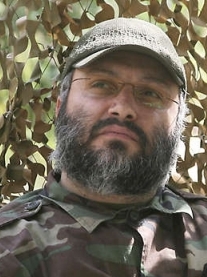
mughniyeh.jpgMillions on his head, Mughniyeh led a largely unseen life. But some of its milestones can be glimpsed from the archive of the past fifty years in the Middle East. It is in part the story of a man, a country, a region pitted against the United States in a shadow war of intervention and resistance, attack and reprisal, most Americans never saw.

No outrage or theology of the oppressed can rationalize the savagery of a Mughniyeh, spiraling vengeance that leaves the non-state terrorist—or the government practicing its own version in the guise of “special operations” or covert action—no better than the evil they claim as justification, and their cause ultimately no less betrayed. But there will be no end to reciprocal brutality and defeat in the Middle East until the history Mughniyeh embodies is understood.

Born in 1963 to Shiite peasant parents in Tayr Dibba, a village in impoverished southern Lebanon, he grew up in a cinder block house with no running water in a Levant of vast inequity, where pre-World War II French colonialism and then postwar U.S. support heedlessly fastened Western control with the proxy political-economic repression by the Maronite Christian minority with its avowedly fascist Phalangist party and militia. That client tyranny, masked by Beirut’s cosmopolitan façade, was perpetuated by the 1958 military intervention of US Marines and the ensuing CIA corruption of Lebanese politics through the 1970s, including millions in covert subsidies to the Phalange and numerous Lebanese politicians.

He was nine in July 1972 when near where he lived in south Beirut’s Shiite slums the city’s first car bomb, planted by the Israelis in retaliation for the recent Lod Airport massacre, blew up the spokesman of the group behind the Lod attack, Palestinian poet Ghassan Kanafani, along with his 17-year-old niece Lamees with him for a shopping trip.

Mughniyeh was thirteen in 1976 when the CIA and Israel covertly backed the invasion of Lebanon by Syria to thwart the emergence of a broad nationalist coalition representing the country’s Islamic majority and supported by the Palestinian Liberation Organization.

He was an eighteen-year-old engineering student at the American University of Beirut in 1981 when the U.S. gave a “green light” to the Israeli invasion of Lebanon in pursuit of the PLO.

He was nineteen in the summer of 1982 when the Israeli Army, with covert U.S. aid, laid siege to Beirut, raking the city with artillery, devastating Shiite neighborhoods. (Osama bin Laden would say later it was the attacks on Beirut’s high-rise apartment buildings that prompted him to retaliate against New York skyscrapers.)

By 1982, like several of his boyhood soccer team, teenage Mughniyeh joined the combined PLO and Lebanese nationalist resistance to the invasion, becoming a sniper along the Green Line. He watched that September as the West negotiated the PLO’s exit from Lebanon with guarantees that U.S. and other peacekeeping troops would protect Palestinian refugee camps from reprisal by hostile Lebanese factions—only to see the US Marine force swiftly withdrawn, leaving Lebanese militias to massacre helpless hundreds at the Shatila and Sabra camps as Israeli forces looked on. Even US officials, Secretary of State George Shultz and National Security Advisor Robert McFarlane, would call the episode “treacherous” and “criminal.”

In April 1983, a bombing of the US Embassy in Beirut killed several CIA agents pivotal in past covert actions in Lebanon, an attack Mughniyeh was later accused of “masterminding.” But there would be no real evidence of his role—only that the bombing was in retaliation for the Marine withdrawal allowing the Shatila and Sabra slaughter as well as earlier interventions.

He was twenty in September 1983 when the U.S. Sixth Fleet intervened in the Lebanese Civil War by firing on rebel forces fighting the reactionary Phalangist regime, the USS Virginia and John Rodgers pounding hills above Beirut with 24,000 pounds of ordnance, soon followed by the battleship New Jersey’s small car-size 2,000-pound shells inflicting untold civilian as well as combatant casualties.

On October 23, 1983, a truck bomb with 12,000 pounds of explosives killed 241 Marines quartered at the Beirut Airport after being sent back to Lebanon. U.S. officials later accused Mughniyeh in the attack, though again there would be no evidence—only that the assault on the Marines was in retaliation for the U.S. naval shelling and other interference in Lebanon’s civil war. “We still do not have the actual knowledge of who did the bombing of the Marine barracks at the Beirut Airport,” Caspar Weinberger, the Secretary of Defense at the time, told PBS in 2001, “and we certainly didn’t then.”

A turning point came for Mughniyeh came in 1985 when he was a twenty-two-year-old bodyguard to Sheikh Mohammad Hussein Fadlallah. A fiery preacher, spiritual mentor to many in the rising political consciousness of Lebanon’s Shiite community, Fadlallah took no political role, opposed violence and sectarian division, and defied growing Iranian influence in Lebanon. But on March 8, 1985—in reprisal for the Marine barracks bombing, and in an operation goaded by the Israelis and funded by the Saudis, both of whom saw Fadlallah as a threat to their own interests in Lebanon—the CIA tried to car-bomb Fadlallah. By chance the cleric escaped harm, but the huge explosion ravaged the poor Shiite area where he lived, wounding 200 and killing 80, among them Fadlallah’s bodyguards and Mughniyeh’s close friends. The next day, a banner hung over the smoking ruins—“Made in the USA.”

With the Fadlallah bombing, Mughniyeh joined the terrorist arm of the increasingly militant political impulse among Lebanon’s Shiites from which Hezbollah soon emerged, and as the resistance movement’s chief of security and intelligence, he joined one of history’s more vicious chain reactions.

Later in 1985 he reportedly interrogated kidnapped CIA agent William Buckley who soon died in captivity, and whose abduction set in motion the Washington sequel of trading arms for hostages that led to the Iran-Contra scandal.

In July 1985 he was involved in the hijacking of TWA Flight 847 with the brutal killing of U.S. Navy diver Robert Stethem, for which Mughniyeh and others were indicted by an American court.

In 1988, he was implicated in the kidnapping and murder of Marine Colonel William Higgins serving with UN peacekeeping forces in Lebanon, a crime a U.S. official would describe as a “blood debt” driving Washington’s further intervention in Lebanon and the region.

Over the 1980s, Mughniyeh conducted much of the Middle East’s shadowy minuet with Washington in which dozens of Western hostages were taken and traded for American arms for the Palestinians and Iranians as well as Hezbollah—the U.S. feeding Iran weapons in its 1980s war with Iraq while supplying the Iraqis intelligence on Iran in a ruthless policy of bleeding both.

Mughniyeh evaded numerous U.S. and Israeli attempts to assassinate him, including a 1994 car bomb that killed his brother. Become mythic, in the West a faceless monster, in the Middle East a tall, handsome, well-dressed hero fluent in English and French, he was widely credited with historic feats, including the deployment of armor-piercing roadside bombs driving Israeli forces from Lebanon in 2000 and 2006, and plaguing the U.S. occupation of Iraq. “When in doubt, and we are always in doubt about this,’ said an ex-CIA official, “blame Mughniyeh.”

His death, predictably, was shrouded in intrigue and menace. As Hezbollah threatened revenge, there were reports that he had been planning some retaliation for the recent Israeli bombing of Syria, that the headrest explosive in his SUV was triggered by satellite as only the U.S. or Israel could have managed, that some of his Syrian hosts may have conspired with the CIA in some new cabal, or even that the killing was faked so that he could go still deeper underground. In the old ceaseless, senseless cycle, reprisals were in the offing.

About his life, as Churchill said of historical tragedy, the terrible ifs accumulate. If in a Lebanon free of any real cold war Russian threat the West had not so reflexively and so long colluded with the colonial oligarchs against a political-economic democracy bringing long-term stability. If there had been from any side an equitable peace between Palestinians and Israelis. And perhaps most decisively, if the U.S. had not continuously thrown its vast weight into the scales—furtively if not always openly—with so little knowledge and sensibility that it ended with enemies America and its Israeli client need never have made.

How history will see Mughniyeh—vicious killer, fierce patriot, or both—will depend, of course, on who writes it in the era’s clashing dogmas. If only his death could teach, this figure who killed so many might yet save lives. But so long as the world’s greatest power lacks the wisdom and courage to face its past culpability and change its course in the Middle East, the key to so much else in its policies at home as well as abroad, one outcome seems sure. In some cinder block hovel in south Beirut, the rubble of Gaza, or the walled-in ghettos of the West Bank, some young man, or woman, is waiting to take his place.

© Roger Morris

(A shorter version of this article ran in Canada’s Globe and Mail February 23.)

Roger Morris, who served on the Senior Staff of the National Security Council under Presidents Johnson and Nixon before resigning over the invasion of Cambodia, is an award-winning historian and author of several books, including Shadows of the Eagle a history of US policy and covert action in the Middle East and South Asia, forthcoming from Knopf in 2008.


Facebooktwittermail

NEWS: American lessons on torture

Justice official defends rough CIA interrogations

The Bush administration allowed CIA interrogators to use tactics that were “quite distressing, uncomfortable, even frightening,” as long as they did not cause enough severe and lasting pain to constitute illegal torture, a senior Justice Department official said last week.

In testimony before a House subcommittee, Steven G. Bradbury, the acting chief of the Justice Department’s Office of Legal Counsel, spelled out how the administration regulated the CIA’s use of rough tactics and offered new details of how simulated drowning was used to compel disclosures by prisoners suspected of being al-Qaeda members.

The method was not, he said, like the “water torture” used during the Spanish Inquisition and by autocratic governments into the 20th century, but was subject to “strict time limits, safeguards, restrictions.” He added, “The only thing in common is, I think, the use of water.”

Bradbury indicated that no water entered the lungs of the three prisoners who were subjected to the practice, lending credence to previous accounts that the noses and mouths of CIA captives were covered in cloth or cellophane. Cellophane could pose a serious asphyxiation risk, torture experts said.

Bradbury’s unusually frank testimony Thursday before the House Judiciary Committee subcommittee stunned many civil liberties advocates and outside legal scholars who have long criticized the Bush administration’s secretive and aggressive interrogation policies.

Martin S. Lederman, a former Office of Legal Counsel official who teaches law at Georgetown University, called Bradbury’s testimony “chilling.” In an online posting, Lederman said that “to say that this is not severe physical suffering — is not torture — is absurd. And to invoke the defense that what the Spanish Inquisition did was worse and that we use a more benign, non-torture form of waterboarding . . . is obscene.” [complete article]

Facebooktwittermail

NEWS: CIA’s ambitious post-9/11 spy plan crumbles

CIA’s ambitious post-9/11 spy plan crumbles

The CIA set up a network of front companies in Europe and elsewhere after the Sept. 11 attacks as part of a constellation of “black stations” for a new generation of spies, according to current and former agency officials.

But after spending hundreds of millions of dollars setting up as many as 12 of the companies, the agency shut down all but two after concluding they were ill-conceived and poorly positioned for gathering intelligence on the CIA’s principal targets: terrorist groups and unconventional weapons proliferation networks.

The closures were a blow to two of the CIA’s most pressing priorities after the 2001 terrorist attacks: expanding its overseas presence and changing the way it deploys spies.

The companies were the centerpiece of an ambitious plan to increase the number of case officers sent overseas under what is known as “nonofficial cover,” meaning they would pose as employees of investment banks, consulting firms or other fictitious enterprises with no apparent ties to the U.S. government. [complete article]

Facebooktwittermail

NEWS, OPINION & EDITOR’S COMMENT: The atrophy of conscience

Anybody’s guess

It’s been a banner week for water-boarding. This centuries-old practice of simulated drowning to extract false confessions and false testimony has really benefited of late from a good old legal reassessment and a smoking-hot PR campaign. In the course of a few short years, water-boarding has morphed from torture that unquestionably violates both federal and international law to an indispensable tool in the fight against terror. [complete article]

Waterboarding should be prosecuted as torture: U.N.

The controversial interrogation technique known as waterboarding and used by the United States qualifies as torture, the U.N. human rights chief said on Friday.

“I would have no problems with describing this practice as falling under the prohibition of torture,” the U.N. High Commissioner for Human Rights, Louise Arbour, told a news conference in Mexico City. [complete article]

Cheney defends U.S. use of waterboarding

The debate over waterboarding flared Thursday on Capitol Hill, with the CIA director raising doubts about whether it’s currently legal and the attorney general refusing to investigate U.S. interrogators who have used the technique on terror detainees.

Vice President Dick Cheney, meanwhile, said “it’s a good thing” that top al Qaeda figures underwent the harsh interrogation tactic in 2002 and 2003, claiming they were forced to give up information that helped protect the country and saved “thousands” of American lives. [complete article]

Justice Dept. ‘cannot’ probe waterboarding, Mukasey says

The attorney general yesterday rejected growing congressional calls for a criminal investigation of the CIA’s use of simulated drownings to extract information from its detainees, as Vice President Cheney called it a “good thing” that the CIA was able to learn what it did from those subjected to the practice.

The remarks reflected a renewed effort by the Bush administration to defend its past approval of the interrogation tactic known as waterboarding, which some lawmakers, human rights experts and international lawyers have described as illegal torture. [complete article]

CIA chief doubts tactic to interrogate is still legal

Gen. Michael V. Hayden, the director of the Central Intelligence Agency, told a Congressional committee on Thursday that waterboarding may be illegal under current law, despite assertions this week from the director of national intelligence and the White House that the harsh interrogation method may be used in the future.

General Hayden said that while “all the techniques we’ve used have been deemed to be lawful,” laws have changed since waterboarding was last used nearly five years ago.

“It is not included in the current program, and in my own view, the view of my lawyers and the Department of Justice, it is not certain that the technique would be considered to be lawful under current statute,” General Hayden said before the House Intelligence Committee. [complete article]

Waterboarding: Two questions for Michael Hayden

My questions for Mr. Hayden are simple. Firstly, if it’s true that only three detainees were subjected to waterboarding, then why did a number of “former and current intelligence officers and supervisors” tell ABC News in November 2005 that “a dozen top al-Qaeda targets incarcerated in isolation at secret locations on military bases in regions from Asia to Eastern Europe” were subjected to six “Enhanced Interrogation Techniques,” instituted in mid-March 2002?

According to the ABC News account, the six techniques used by the CIA on the “dozen top al-Qaeda targets” were “The Attention Grab,” “Attention Slap,” “The Belly Slap” and three other techniques that are particularly worrying: “Long Time Standing,” “The Cold Cell,” and, of course, “Waterboarding.”

“Long Time Standing” was described as “among the most effective [techniques],” in which prisoners “are forced to stand, handcuffed and with their feet shackled to an eye bolt in the floor for more than 40 hours.” The ABC News report added, “Exhaustion and sleep deprivation are effective in yielding confessions.” In “The Cold Cell,” the prisoner “is left to stand naked in a cell kept near 50 degrees. Throughout the time in the cell the prisoner is doused with cold water.”

The description of “Waterboarding” was as follows: “The prisoner is bound to an inclined board, feet raised and head slightly below the feet. Cellophane is wrapped over the prisoner’s face and water is poured over him. Unavoidably, the gag reflex kicks in and a terrifying fear of drowning leads to almost instant pleas to bring the treatment to a halt.” [complete article]

Editor’s Comment — There’s a simple reason why the simple-minded don’t think that waterboarding is torture. In “real” torture, the person being tortured is the innocent victim; the torturer is the evil party. When Cheney ventured over to the dark side it was in order to give good people the freedom to do bad things to bad people. If the person being tortured is bad, then it can’t be torture. It’s perverse logic but it explains how a vice president with a twisted mind can have a “clean” conscience.

Facebooktwittermail

ANALYSIS: The Pentagon’s $713 billion budget

What’s really in the U.S. military budget?

… as the Pentagon’s budget documents note up front, in the “Summary Justification,” Congress has yet to approve $102 billion left over from the supplemental for FY 2008. And so—in terms of how much Congress is being asked to authorize this year—that brings us to $713 billion.

But let’s delve into the Pentagon’s base line figure—the $515.4 billion that has nothing directly to do with the wars in Iraq and Afghanistan. What’s in there? Do the U.S. armed forces really need that much for the everyday maintenance of national security?

About a quarter of that sum—$125.2 billion—is for personnel costs: understandable. Another third—$180 billion—is for operations and maintenance of equipment (a bit more mysterious, since this is apart from the O&M costs brought on by the war). But a larger sum still—$184 billion—is for what the Pentagon calls “major weapons systems.”

This includes $45.6 billion for military aircraft, including $6.7 billion to buy 16 more F-35 stealth planes. The F-35 is still in its early stages; the Pentagon has, to date, spent only about one-tenth of what it estimates to be a $300 billion program. It’s not too late to ask if we need such a costly, sophisticated fighter jet, given that air-to-air combat is not likely to be a major element of future wars and, to the extent that it might be, we’re way ahead—in numbers and technology—of any prospective foe. Or let’s accept the proposition that China’s air force is going to be a formidable rival by the year 2020: Do we need to tear full-speed ahead on the F-35 now? Could we slow the program down and see how things shape up? [complete article]

Facebooktwittermail

NEWS, CAMPAIGN 08 & OPINION: The bankruptcy of American military power

Pentagon seeks record level in 2009 budget

As Congress and the public focus on more than $600 billion already approved in supplemental budgets to pay for the wars in Iraq and Afghanistan and for counterterrorism operations, the Bush administration has with little notice reached a landmark in military spending.

When the Pentagon on Monday unveils its proposed 2009 budget of $515.4 billion, annual military spending, when adjusted for inflation, will have reached its highest level since World War II.

That new Defense Department budget proposal, which is to pay for the standard operations of the Pentagon and the military but does not include supplemental spending on the war efforts or on nuclear weapons, is an increase in real terms of about 5 percent over last year.

Since coming to office, the administration has increased baseline military spending by 30 percent over all, a figure sure to be noted in the coming budget battles as the American economy seems headed downward and government social spending is strained, especially by health-care costs. [complete article]

Downsizing our dominance

It should be no surprise that the presidential campaigns have barely touched on foreign policy. One reason is that no candidate of either party has a solution to the nation’s most pressing foreign problem, the war in Iraq (perhaps because there are no good solutions).

A larger reason, however, may be that no ambitious politician is willing to mention the discomfiting reality about America’s place in the world — that we are weaker today than we were a decade or two ago, and that we need a new foreign policy that acknowledges and builds on that fact.

President Bush’s follies have accelerated the decline of U.S. influence, but he can’t be blamed for its onset. It started, ironically, at the moment of our late-century triumph, when the Soviet Union imploded and the Cold War victory was ours. Some proclaimed that the United States was now “the sole superpower.” But, in fact, the end of the Cold War left the very concept of a “superpower” in tatters. [complete article]

Facebooktwittermail

OPINION: The false dichotomy of security versus privacy

What our top spy doesn’t get: Security and privacy aren’t opposites

We’ve been told we have to trade off security and privacy so often — in debates on security versus privacy, writing contests, polls, reasoned essays and political rhetoric — that most of us don’t even question the fundamental dichotomy.

But it’s a false one.

Security and privacy are not opposite ends of a seesaw; you don’t have to accept less of one to get more of the other. Think of a door lock, a burglar alarm and a tall fence. Think of guns, anti-counterfeiting measures on currency and that dumb liquid ban at airports. Security affects privacy only when it’s based on identity, and there are limitations to that sort of approach.

Since 9/11, two — or maybe three — things have potentially improved airline security: reinforcing the cockpit doors, passengers realizing they have to fight back and — possibly — sky marshals. Everything else — all the security measures that affect privacy — is just security theater and a waste of effort. [complete article]

Facebooktwittermail

INTERVIEW: Sibel Edmonds

Sibel Edmonds: ‘Buckle up, there’s much more coming.’

In the last few weeks, London Times has run a series of articles about the so-called ‘Sibel Edmonds case’: (For sale: West’s deadly nuclear secrets,’ FBI denies file exposing nuclear secrets theft‘ and ‘Tip-off thwarted nuclear spy ring probe‘)

Former FBI translator Sibel Edmonds stumbled into a world of espionage, nuclear black market, narcotics trafficking, money laundering, and corruption at the highest levels of the US government.

I interviewed Sibel on Sunday regarding the current investigation and reporting by the Times, the failures of the US media, and last week’s decision by the Bush administration to legalize the sale of nuclear technology to Turkey, in an apparent effort to exonerate prior criminal activity by officials in his administration. [complete article]

Facebooktwittermail

NEWS & OPINION: The Bush administration’s dirty bomb

Tip-off thwarted nuclear spy ring probe

Ainvestigation into the illicit sale of American nuclear secrets was compromised by a senior official in the State Department, a former FBI employee has claimed.

The official is said to have tipped off a foreign contact about a bogus CIA company used to investigate the sale of nuclear secrets.

The firm, Brewster Jennings & Associates, was a front for Valerie Plame, the former CIA agent. Her public outing two years later in 2003 by White House officials became a cause célèbre.

The claims that a State Department official blew the investigation into a nuclear smuggling ring have been made by Sibel Edmonds, 38, a former Turkish language translator in the FBI’s Washington field office.

Edmonds had been employed to translate hundreds of hours of intercepted recordings made during a six-year FBI inquiry into the nuclear smuggling ring. [complete article]

Why Bush wants to legalize the nuke trade with Turkey

According to FBI whistleblower Sibel Edmonds, there is a vast black market for nukes, and certain U.S. officials have been supplying sensitive nuclear technology information to Turkish and Israeli interests through its conduits. It’s a scathing allegation which was first published by the London Times two weeks ago, and Edmonds’ charge seems to be on the verge of vindication.

In likely reaction to the London Times report, the Bush Administration quietly announced on January 22 that the president would like Congress to approve the sale of nuclear secrets to Turkey. As with most stories of this magnitude, the U.S. media has put on blinders, opting to not report either Edmonds’ story or Bush’s recent announcement. [complete article]

Facebooktwittermail

NEWS: Pakistan’s nukes safe in military “middle-class” hands; Americans should back off

Pakistan shuns CIA buildup sought by U.S.

The top two American intelligence officials traveled secretly to Pakistan early this month to press President Pervez Musharraf to allow the Central Intelligence Agency greater latitude to operate in the tribal territories where Al Qaeda, the Taliban and other militant groups are all active, according to several officials who have been briefed on the visit.

But in the unannounced meetings on Jan. 9 with the two American officials — Mike McConnell, the director of national intelligence, and Gen. Michael V. Hayden, the C.I.A. director — Mr. Musharraf rebuffed proposals to expand any American combat presence in Pakistan, either through unilateral covert C.I.A. missions or by joint operations with Pakistani security forces. [complete article]

Pakistan says its nukes are safe from terrorists

The nation’s nuclear chief Saturday dismissed concerns that Pakistan’s nuclear weapons might go astray, saying that crack squads have a foolproof grip that would never allow bombs to fall into the hands of Islamic militants or rogue military officers.

“Pakistan’s nuclear weapons … are absolutely safe and secure,” said Lt. Gen. Khalid Kidwai, chief of the nation’s nuclear programs.

Kidwai offered an unprecedented briefing for foreign journalists following months of political turmoil here that have raised global fears over the safety of its nuclear weapons, even elevating the issue into the U.S. presidential campaign. [complete article]

Facebooktwittermail

FEATURE: Sibel Edmonds’ claims demand investigation

FBI whistleblower Sibel Edmonds spills her secrets

Most Americans have never heard of Sibel Edmonds, and if the U.S. government has its way, they never will. The former FBI translator turned whistleblower tells a chilling story of corruption at Washington’s highest levels—sale of nuclear secrets, shielding of terrorist suspects, illegal arms transfers, narcotics trafficking, money laundering, espionage. She may be a first-rate fabulist, but Edmonds’s account is full of dates, places, and names. And if she is to be believed, a treasonous plot to embed moles in American military and nuclear installations and pass sensitive intelligence to Israeli, Pakistani, and Turkish sources was facilitated by figures in the upper echelons of the State and Defense Departments. Her charges could be easily confirmed or dismissed if classified government documents were made available to investigators.

But Congress has refused to act, and the Justice Department has shrouded Edmonds’s case in the state-secrets privilege, a rarely used measure so sweeping that it precludes even a closed hearing attended only by officials with top-secret security clearances. According to the Department of Justice, such an investigation “could reasonably be expected to cause serious damage to the foreign policy and national security of the United States.” [complete article]

Facebooktwittermail

FEATURE: U.S. military breaks ranks – part one

A salvo at the White House

The fact that the Iraq war has been pushed off the front pages of America’s newspapers has given the US military a seeming respite from the almost endless spate of disastrous stories coming out of the Middle East, as well as the almost endless round of embarrassing questions from the press about what they intend to do about it.

But military officers say that the American public should not be fooled: the relative quiet in Iraq – and it is, after all, only a “relative quiet” – does not mean the “surge” has worked, or that the problems facing the US military have somehow magically gone away. Quite the opposite. For while the American public is consumed by the campaign for the presidency, the American military is not. Instead, they are as obsessed now, in January of 2008, with the war in Iraq as they were then, in 2003 – except that now, many military officers admit, the host of problems they face may, in fact, be much more intractable.

“Don’t let the quiet fool you,” a senior defense official says. “There’s still a huge chasm between how the White House views Iraq and how we [in the Pentagon] view Iraq. The White House would like to have you believe the ‘surge’ has worked, that we somehow defeated the insurgency. That’s just ludicrous. There’s increasing quiet in Iraq, but that’s happened because of our shift in strategy – the ‘surge’ had nothing to do with it.” [complete article]

Facebooktwittermail

NEWS: Turkish-Israeli network sold nuclear secrets

FBI denies file exposing nuclear secrets theft

The FBI has been accused of covering up a key case file detailing evidence against corrupt government officials and their dealings with a network stealing nuclear secrets.

The assertion follows allegations made in The Sunday Times two weeks ago by Sibel Edmonds, an FBI whistleblower, who worked on the agency’s investigation of the network.

Edmonds, a 37-year-old former Turkish language translator, listened into hundreds of sensitive intercepted conversations while based at the agency’s Washington field office.

She says the FBI was investigating a Turkish and Israeli-run network that paid high-ranking American officials to steal nuclear weapons secrets. These were then sold on the international black market to countries such as Pakistan and Saudi Arabia.

One of the documents relating to the case was marked 203A-WF-210023. Last week, however, the FBI responded to a freedom of information request for a file of exactly the same number by claiming that it did not exist. But The Sunday Times has obtained a document signed by an FBI official showing the existence of the file. [complete article]

Facebooktwittermail

EDITORIAL: Having reason to doubt the CIA

Having reason to doubt the CIA

On the basis of an interview with CIA director Michael V. Hayden, the Washington Post reports that “The CIA has concluded that members of al-Qaeda and allies of Pakistani tribal leader Baitullah Mehsud were responsible for last month’s assassination of former Pakistani prime minister Benazir Bhutto, and that they also stand behind a new wave of violence threatening that country’s stability.” Describing this as the “most definitive public assessment by a U.S. intelligence official,” the Post says that Hayden’s “view mirrors the Pakistani government’s assertions.” The New York Times cites an anonymous American intelligence official who “said that ‘different pieces of information‘ had pointed toward Mr. Mehsud’s responsibility, but he would not provide any details.” The Los Angeles Times says that, “The CIA assessment concurred with that of Pakistani officials.” Washington and Musharraf see eye to eye when it comes to the Bhutto assassination.

What the leading American newspaper’s have done is to gently massage a story in such a way that they avoid pointing out that either the director of the CIA is a fool or that he regards the reporters he talks to as suckers. Hayden told the Post that the assassination “was done by that network around Baitullah Mehsud. We have no reason to question that.” An intelligence official told the New York Times that there were “powerful reasons” for believing this, and the Los Angeles Times was told that “There is certainly no reason to doubt that Mahsud was behind this.”

This is the epitome of faith-based intelligence. It is no more conclusive than any other expression of faith. To report Hayden’s statement as a “definitive public assessment,” is to dress up an opinion with the trappings of authority for no other reason than that it came out of the mouth of the director of the CIA. Hayden said it. It is therefore a definitive statement. He’s bald and appears to have a big brain. It must be true.

In response to demands for an international inquiry into Bhutto’s assassination, President Musharraf acquiesed by allowing investigators from Scotland Yard to visit Pakistan. In the parts of the Hayden interview that were reported, he made no reference to that inquiry. That should perhaps come as no surprise, since according to Raw Story‘s Larisa Alexandrovna, “British investigators are not examining the question of who killed Benazir Bhutto. They were only charged with identifying the cause of her death.” She cites both Scotland Yard and an MI6 spokesman as her sources.

There seems little reason to doubt that the CIA and the White House think that their interests are not going to be served by efforts to unravel the mystery around this event. But even if that is the case, General Hayden could boost his own credibility and that of the Agency by avoiding treating conjecture as conclusive. Intelligence might be described as a craft of informed conjecture, but speculation is only as good as the information on which it is based. If Hayden can only say that he has no reason to doubt that Meshud was behind the killing, it seems reasonable to infer that he has yet to be shown any compelling evidence for reaching that conclusion.

Facebooktwittermail

NEWS & OPINION: New torture tapes?

Lawyers for detainee refer in filing to more CIA tapes

Attorneys for a former detainee at a secret CIA prison said in a court filing this week that intelligence officials had falsely claimed in public statements that his interrogations were not videotaped, that all videotaped interrogations stopped in 2002 and that only a small number of CIA detainees were subjected to unusually harsh interrogation techniques.

The basis of the assertions was redacted from the filing by the Bush administration, under an unusually stringent security order that blocks the attorneys for Majid Khan from disclosing evidence of the alleged falsehoods or detailing how Khan was treated while in CIA custody.

Khan, one of 14 detainees whom the CIA secretly imprisoned before transferring them last year to the U.S. military prison at Guantanamo Bay, Cuba, has said he was systematically tortured. His attorneys at the New York-based Center for Constitutional Rights have been pressing for a court order to prevent the government from destroying evidence of his treatment. [complete article]

The official story unfolds

The destruction of the CIA torture tapes is still a fairly young scandal as Washington scandals go. It hasn’t even acquired a “gate” suffix. But the Administration is already busily choreographing it, with the dozens of shiny metal parts clicking away in synchronicity, like a finely designed mechanical watch. There is an admirable efficiency to the political process. If only these people were a fraction as good at the work of government as they are at political shenanigans, I keep thinking. The Bush Administration plan is simple: let’s think of this as a movie–Abu Ghraib, The Sequel. Instead of offering up a group of young grunts for the sacrifice, this time it will be a retired senior management figure at the CIA and some of his subordinates. And this sacrifice will, in the White House’s view, divert attention from the real source of both scandals, which is high in the upper reaches of the Executive Branch. Inside the White House, in fact. [complete article]

Facebooktwittermail

FEATURE: The war on diplomacy

Off target

Linda Gallini, one of the State Department’s leading experts on nuclear nonproliferation, stepped into an empty room at the International Atomic Energy Agency’s headquarters in Vienna, Austria, and placed a call to Washington. A senior delegate to the iaea, she’d spent the past week strategizing how to keep dangerous materials out of the hands of rogue states and terrorists. But as dusk settled over the Danube that evening in September 2005, Gallini was more worried about what was brewing back home.

When she got her boss, deputy assistant secretary for nuclear nonproliferation Andrew Semmel, on the phone, he confirmed her worst fears. Carrying out a plan announced two months earlier by Secretary of State Condoleezza Rice, neoconservative political appointees were about to replace some of State’s most knowledgeable wmd experts with Republican loyalists. Gallini’s heart sank. “If that’s what they’re going to do, pretty much everyone else is going to leave,” she said. “Yeah,” she recalls Semmel telling her. “That’s what they want.”

As she resigned a year later, Gallini gave a series of interviews to Mother Jones, providing an insider’s view of how the Bush administration has gutted the nation’s expertise on wmd. Presidents come and go, but State Department staff like Gallini have long been the backbone of U.S. foreign policy—the “ballast,” as she puts it—that keeps political appointees grounded in reality. “Our job is to be the informed, helpful, supportive folks who guide them when they arrive clueless to the issues,” she explains. [complete article]

See also, Burns’ departure muddles nuclear deal (AP).

Facebooktwittermail

GUEST CONTRIBUTOR – Roger Morris: Burials in the Sind

roger-morris.jpgPakistan has paid dearly for America’s most generous and tragic patronage
By Roger Morris, War in Context, January 17, 2008

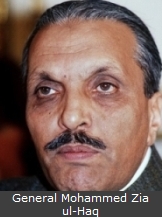
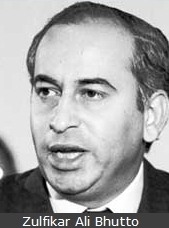
Benazir Bhutto was a precocious 23-year-old in 1976 when she noticed Army Chief of Staff Mohammed Zia ul-Haq come and go at the office of her father, Pakistani prime minister Zulfikar Ali Bhutto. “A short, nervous, ineffectual-looking man,” she remembered the general, “whose pomaded hair was parted in the middle and lacquered to his head.” Along with the hair, Gen. Zia’s thick mustache and diffident manner seemed to Islamabad politicians a Punjabi version of English comedian Terry Thomas. “Bhutto’s butler” they called him.

General Muhammad Zia-Ul-HaqThen, suddenly, in July 1977, Gen. Zia was no longer amusing when his junta arrested Mr. Bhutto and his cabinet, and imposed martial law. There followed more than a decade of military tyranny as Pakistan became, in Salman Rushdie’s phrase, “a nightmarish land.” That era and its sequels would be the setting of Benazir Bhutto’s political career, climaxing in her assassination Dec. 27. She was emblematic of her country’s nightmare, and of the tortuous role the United States played in it. It is a history – forgotten, denied – that haunts us all.
Benazir was a year old in 1954 as Washington adopted Pakistan as its Cold War client, lavishing the first of what would be billions of dollars on a military that by the end of the 1950s seized power amid the country’s chronic poverty and hostility with India. It was cozy, enduring patronage. Pentagon and CIA men shared with their Pakistani peers an occupational contempt for non-alignment and the hindrance of democratic politics.

By 1959, the CIA had stationed an agent in Karachi to advise Pakistani generals on public relations practices that would be enabling military dictatorships to claim legitimacy nearly a half-century later.

Zulfikar Ali BhuttoCanny, charismatic, irrepressibly ambitious, U.S.- and Oxford-educated Zulfikar Ali Bhutto was a young civilian minister for the junta in the 1960s, veering between complicity and enmity with the generals in the tangled pattern of Pakistan’s civilian-military politics. He then was an occasional nemesis of Washington, courting Communist China, fiercely bellicose on Kashmir and India. Breaking with the junta and founding his Pakistan Peoples Party in 1967, he inherited power in the 1971 breakaway of Bangladesh, when not even the U.S. could save the generals from the toll of secession, genocide, and another lost war with India.

While Benazir was driving her yellow MG at Radcliffe and Oxford, her father moved to restore his truncated nation and, in the process, seeded much of the 21st century predicament in South Asia – often in collusion with a heedless Washington. Grateful for Pakistan’s role as go-between in their 1971 opening to China, U.S. president Richard Nixon and secretary of state Henry Kissinger joined and financed Mr. Bhutto in his covert intervention against an Afghan regime he claimed was a pawn for Soviet expansion to the Arabian Sea and a menace to Pakistan’s ever-unruly northwest with its Afghan-kindred tribes. In 1973-75 they secretly mounted attacks in the Hindu Kush by radical Islamic Afghan exiles – whose anti-Western politics, terrorist tactics, and control by Pakistan prefigured the mujahedeen and Taliban years before the 1979 Russian invasion, the Afghan civil war, al-Qaeda and 9/11.

Meanwhile, in January 1972, under an awning on the broad lawn of an estate in Multan – an ancient city of Sufi shrines known as Pakistan’s “second heart” – Mr. Bhutto secretly gathered 70 of the country’s finest scientists and asked them to build a nuclear bomb. “They responded,” said one, “enthusiastically.” For years, Washington would look the other way. His foes sneered at Mr. Bhutto as the “Raja of Larkana,” after his estate in the Sind where he and his daughter would be buried. Both were seigniorial in their politics, the PPP family chattel, inherited now by Benazir’s son, Bilawal Bhutto Zardari. “Our feudals,” a CIA agent called them. But unlike Benazir, her father was a reformer as well as demagogue, nationalizing exploitative industries, insurance companies, and exclusive private schools, giving the poorest farmers tax relief and fixing ceilings on land ownership.

Despite periodic repression and no little corruption in his ranks, his constitution in 1973 recognized Islam as the national religion while establishing a parliamentary system to evolve into a secular democracy. He freed Pakistan from the fine-print fetters of the Commonwealth, negotiated the Simla Agreement with India accepting the line of control in Kashmir, recognized Bangladesh and, by 1977, was making peace with Afghanistan. It all won popular support – but challenged the oligarchy, religious right, and allies of both in the military, Pakistan’s ruling triad. Gen. Zia’s coup came with sanction from those forces – and, ultimately, Washington.

After a show trial, they hanged Mr. Bhutto at dawn at the old Rawalpindi prison, not far from where his daughter was murdered three decades later. The U.S. embassy referred to it delicately as “resolving the Bhutto problem,” and the American media made its peace with the winner; Newsweek taken with Gen. Zia’s “brooding eyes,” the Los Angeles Times finding him “low-key, direct, and polite,” an “incredibly canny man” who “talks with quiet sincerity about his country’s problems” – the latter the Times and others didn’t bother to explore. Gen. Zia was no stranger to the Pentagon and CIA, files plump with his 1950s study in the U.S. as a young officer, at the Command and General Staff School at Fort Leavenworth in 1964, and in highly secret Pentagon “command courses” not long before he seized power. Like most of his predecessors and successors, the pomaded general was, to some, Washington’s creature.

Two days after the April 1979 Bhutto hanging, U.S. president Jimmy Carter’s advisers formally approved a major covert intervention using the client Afghan religious radicals against the new Communist regime in Afghanistan – this, eight months before the Soviet invasion that the U.S.-armed and Pakistani-controlled insurgency was designed, in part, to provoke. The ensuing enormity came to seem familiar, though distorted to parody by versions like Charlie Wilson’s War and its Hollywood gloss. Hundreds of millions, ultimately billions, poured into the mujahedeen with their rampant drug trade and fulmination of al-Qaeda; Washington’s unstinting support of Gen. Zia, with more winking at his nuclear arsenal, and with as much as half the U.S. money siphoned off by Pakistan’s Inter-Services Intelligence, the notorious ISI already a state-within-a-state and now dominant in a black economy that eclipsed the open one. When he was assassinated in 1988 in the crash of Pak One, Gen. Zia was returning from a demonstration of a faulty tank the Pentagon was typically keen to sell him, and in tête-à-tête with a U.S. ambassador who knew him when he was still “Bhutto’s butler.”

Benazir BhuttoBenazir Bhutto now joined the story, though in ugly anticlimax. While the CIA-Zia combine conducted its Afghan war and associated trade over the 1980s, she worked tirelessly as her father’s chosen successor. This included building furtive ties to the Americans, the CIA covering its bets with subsidies to Ms. Bhutto, some no doubt recycled in paying for her Washington lobbyists.

With Gen. Zia’s murder, she was ready and, like her father, inherited power in a moment of the military’s division. But her tenures as prime minister in 1988-90 and again in 1993-96 were hobbled by the massive power of the ISI, old habits of repression, including the murder of her own dissident brother, and blatant looting by her circle, not least by her husband Asif Zardari. Failure and corruption went unrelieved by any reforms approaching her father’s. It stood to be repeated had Ms. Bhutto held power again – the ISI manacling along with her own corruption – and is in the wings now with Mr. Zardari’s regency over the PPP.

Like her father, like Gen. Zia her nemesis, she was partly America’s creature as well, inserted by the Bush administration, with the blessing of congressional Democrats, to shore up Pakistani President Pervez Musharraf with some coalition manqué appeasing enough of the crowd as well as the triad. As always, there was even an underside to Ms. Bhutto’s vaunted defiance of the Islamic radicals; her own regimes had been instrumental in the rise of the Afghan Taliban and given to quiet accommodation and sharing of spoils with the internal Pakistani zealots.

She was dead only days when it became clear that the tragedy of her last 30 years would continue. In a U.S. presidential campaign that, otherwise, blares change, no candidate dares to change this most disastrous, most bipartisan, most bigoted of foreign policies, in which America’s meddling was so malignant and its ultimate control so illusory. In Pakistan, the old politics go on, including the security of the nuclear arms. None of the ruling triad wants that horror unleashed. The losers, as always, will be the more than hundred million Pakistanis in abject want or on the edge – the historic disgrace of the world’s longest running military despotism, and of America’s most generous and tragic patronage.

If only they buried in the Sind, along with Zulfikar Ali Bhutto and his beloved daughter, that sordid past. For now, we can only follow the poet Faiz Ahmed Faiz: “We will inter hope with appropriate mourning … Every gate of prayer throughout heaven is slammed shut today.”

© Roger Morris

Roger Morris, who served on the National Security Council staff under Lyndon Johnson and Richard Nixon, is the author of Shadows of the Eagle, a history of U.S. covert intervention and policy in the Middle East and South Asia, to be published this year.
This article first appeared in the Globe and Mail and is reprinted here with the author’s permission.

Facebooktwittermail

ANALYSIS: Pentagon’s Whitman spins a good yarn

How the Pentagon planted a false story

Senior Pentagon officials, evidently reflecting a broader administration policy decision, used an off-the-record Pentagon briefing to turn the Jan. 6 U.S.-Iranian incident in the Strait of Hormuz into a sensational story demonstrating Iran’s military aggressiveness, a reconstruction of the events following the incident shows.

The initial press stories on the incident, all of which can be traced to a briefing by deputy assistant secretary of defense for public affairs in charge of media operations Bryan Whitman, contained similar information that has since been repudiated by the Navy itself.

Then the Navy disseminated a short video into which was spliced the audio of a phone call warning that U.S. warships would “explode” in “a few seconds.” Although it was ostensibly a Navy production, IPS has learned that the ultimate decision on its content was made by top officials of the Defense Department. [complete article]

Facebooktwittermail