Category Archives: US government

NEWS & EDITOR’S COMMENT: The torture cover-up

Station chief made appeal to destroy CIA tapes

Those known to have counseled against the tapes’ destruction include John B. Bellinger III, while serving as the National Security Council’s top legal adviser; Harriet E. Miers, while serving as the top White House counsel; George J. Tenet, while serving as CIA director; [Scott W.] Muller, while serving as the CIA’s general counsel; and John D. Negroponte, while serving as director of national intelligence.

Hayden, in an interview, said the advice expressed by administration lawyers was consistent. “To the degree this was discussed outside the agency, everyone counseled caution,” he said. But he said that, in 2005, it was “the agency’s view that there were no legal impediments” to the tapes’ destruction. There also was “genuine concern about agency people being identified,” were the tapes ever to be made public.

Hayden, who became CIA director last year, acknowledged that the questions raised about the tapes’ destruction, then and now, are legitimate. “One can ask if it was a good idea, or if there was a better way to do it,” he said. “We are very happy to let the facts take us where they will.” [complete article]

Editor’s Comment — The top officials here were either duplicitous or incompetant or both. The decision-making process carries the signature of the Bush-Cheney administration. It’s all about being able to act and evade responsibility. Under the leadership of a frat boy president, no one wants to carry the accountability that Bush himself refuses to bear.

Special counsel sought in CIA tapes case

The chairman of the House Judiciary Committee and 18 other House Democrats on Tuesday asked the attorney general to replace a government prosecutor with an outside lawyer to investigate the CIA’s destruction of interrogation videotapes. [complete article]

Facebooktwittermail

NEWS: Bagram – the other Gitmo

Bagram: The other Gitmo

As last week marked the sixth anniversary of the arrival of the first orange-jumpsuit-clad prisoners at the US naval base at Guantanamo Bay, Cuba, human-rights organizations are attempting to focus public and congressional scrutiny on what some are calling “the other Gitmo”.

This is a prison located on the US military base in the ancient city of Bagram near Charikar in Parvan, Afghanistan. The detention center was set up by the US military as a temporary screening site after the 2001 invasion of Afghanistan overthrew the Taliban. It currently houses about 630 prisoners – close to three times as many as are still held at Guantanamo.

In 2005, following well-documented accounts of detainee deaths, torture and “disappeared” prisoners, the US undertook efforts to turn the facility over to the Afghan government. But, thanks to a series of legal, bureaucratic and administrative missteps, the prison is still under American military control. And a recent confidential report from the International Committee of the Red Cross (ICRC) has reportedly complained about the continued mistreatment of prisoners.

The ICRC report is said to cite massive overcrowding, “harsh” conditions, lack of clarity about the legal basis for detention, prisoners held “incommunicado” in “a previously undisclosed warren of isolation cells”, and “sometimes subjected to cruel treatment in violation of the Geneva Conventions”. Some prisoners have been held without charges or lawyers for more than five years. The Red Cross said dozens of prisoners have been held incommunicado for weeks or even months, hidden from prison inspectors. [complete article]

Facebooktwittermail

NEWS & OPINION: Bush’s effort to undermine the NIE

Artificial intelligence

President George W. Bush hasn’t accomplished much on his voyage to the Middle East, but he did take the time to inflict another wound on the entire U.S. intelligence community—and on the credibility of anything he might ever again say about the world.

In the latest Newsweek, Michael Hirsh reports that, during a private conversation with Israeli Prime Minister Ehud Olmert, Bush “all but disowned” the agencies’ Dec. 3 National Intelligence Estimate on Iran. A “senior administration official who accompanied Bush” on the trip confided to Hirsh that Bush “told the Israelis that he can’t control what the intelligence community says, but that [the NIE’s] conclusions don’t reflect his own views.” [complete article]

In Iran reversal, bureaucrats
triumphed over Cheney team

Senior officials at the Office of the Director of National Intelligence, the umbrella organization that coordinates the U.S.’s 16 spy agencies and that oversaw the report, say payback wasn’t a factor. They defend the report as a righting of the ship after the Iraq intelligence failures.

Hundreds of officials were involved and thousands of documents were drawn upon in this report, according to the DNI, making it impossible for any official to overly sway it. Intelligence sources were vetted and questioned in ways they weren’t ahead of the 2003 U.S. invasion of Iraq.

Thomas Fingar, 62 years old, is one of the lead architects of the Iran report. A veteran State Department official, Mr. Fingar helped lead the office that argued in 2002 that evidence of Iraq’s nuclear program was faulty. He is now a senior official at the DNI.

Of the backlash against the report, Mr. Fingar says, “A lot of it is just nonsense. The idea that this thing was written by a bunch of nonprofessional renegades or refugees is just silly.” [complete article]

Facebooktwittermail

OPINION: Less than human

Less than human

Friday marked the sixth anniversary of the arrival of the first detainees at the American GULAG constructed to house prisoners taken in the Bush Administration’s War on Terror in Guantánamo. Around the world, thousands gathered in public commemorations in London, Stockholm, Dublin, Brussels and Bahrain. More than twelve hundred parliamentarians signed a formal plea calling for the immediate closing of the base. The same plea had previously been issued by Pope Benedict, Chancellor Angela Merkel and more than two dozen other world leaders. Indeed, quite remarkably, on Sunday Admiral Mike Mullen, chairman of the Joint Chiefs of Staff essentially joined in with the protestors.

“More than anything else it’s been the image — how Gitmo has become around the world, in terms of representing the United States. … I believe that from the standpoint of how it reflects on us that it’s been pretty damaging.”

Mullen went on to say that he wanted the facility shut down. Sources inside the Pentagon say that has been the view of the Joint Chiefs of Staff for several years now. [complete article]

Facebooktwittermail

FEATURE: Can Mike McConnell fix America’s intelligence community?

The spymaster [PDF]

I asked how he [Mike McConnell, the US Director of National Intelligence,] defined torture.

“There’s a history of people making claims that it’s not torture if you don’t force the failure of a major organ,” McConnell said, referring to the infamous 2002 memo by John Yoo, a Justice Department lawyer, who argued that an interrogation technique was torture only when it was as painful as organ failure or death. “My view is, that’s kind of absurd. It’s pretty simple. Is it excruciatingly painful to the point of forcing someone to say something because of the pain?” McConnell leaned forward confidentially. “Now, how descriptive do I want to be with you? I don’t want to tell you everything, and why is that? Look, these guys talk because, among other things, they’re scared.”

McConnell asserted that it was not difficult to evaluate the truthfulness of a confession, even a coerced one. “And as soon as they start to talk we can tell in minutes if they are lying,” he said. “One, you know a lot. And you know when someone is giving you information that is not connecting up to what you know. You also know when to use a polygraph.”

McConnell refused to specify what new methods had been approved for the C.I.A. “There are techniques to get the information, and when they get the information it has saved lives,” he said vaguely. “We have people walking around in this country that are alive today because this process happened.”

Couldn’t the information be obtained through other means?

“No,” McConnell said. “You can say that absolutely.” He again cited the case of Khalid Sheikh Mohammed. “He would not have talked to us in a hundred years. Tough guy. Absolutely committed. He had this mental image of himself as a warrior and a martyr. No way he would talk to us.” Among the things that Mohammed confessed to was the murder of Daniel Pearl. And yet few people involved in the investigation of Pearl’s death believe that Mohammed had anything to do with the crime; another man, Ahmed Omar Saeed Sheikh, was convicted of killing Pearl. I mentioned McConnell’s hero, General Powell, whose disastrous speech to the United Nations, in February, 2003, made the case to the world for invading Iraq—a case founded on faulty intelligence. Part of Powell’s presentation was based on the testimony of Ibn al-Sheikh al-Libi, an Al Qaeda operative who was captured by Pakistani forces in December, 2001. The Pakistanis turned him over to the Americans. According to Jack Cloonan, a former F.B.I. agent involved in the interrogation, Libi was providing useful and accurate intelligence until the C.I.A. took custody of him and placed him inside a plywood box for transport. He was reportedly sent to Egypt and tortured. (An agency spokesman said, “The C.I.A. does not transport individuals anywhere to be tortured.”) Libi allegedly told his interrogators that the Iraqi military had trained two Al Qaeda associates in chemical and biological warfare. This was the essence of Colin Powell’s claim: Saddam had weapons of mass destruction and was working with Al Qaeda. Neither assertion was true. How could we ever trust information obtained under torture when such methods had already led us into a catastrophic war?

“Now, wait a minute,” McConnell said. “You allege torture. I don’t know. Maybe it was. I don’t know.” He wasn’t in office at the time.

I asked what personal experiences informed his views.

McConnell recalled that before going to Vietnam he had participated in the military’s Survival, Evasion, Resistance and Escape program. “You had to go through jungle training, get slapped around, knocked down, put in a box, physically abused,” he said. “That’s to prepare you for what the enemy might do to you.” McConnell was thrown into a covered pit with a snake. There was no room to stand or move around. “They would open up the thing and whack you a few times and close it down,” he said. “They beat us up reasonably well.” However, he knew that he was not going to die.

Waterboarding was not a part of the training when McConnell went through SERE, although it sometimes has been. “You know what waterboarding is?” he asked. “You lay somebody on this table, or put them in an inclined position, and put a washcloth over their face, and you just drip water right here”—he pointed to his nostrils. “Try it! What happens is, water will go up your nose. And so you will get the sensation of potentially drowning. That’s all waterboarding is.”

I asked if he considered that torture.

McConnell refused to answer directly, but he said, “My own definition of torture is something that would cause excruciating pain.”

Did waterboarding fit that description?

Referring to his teen-age days as a lifeguard, he said, “I know one thing. I’m a water-safety instructor, but I cannot swim without covering my nose. I don’t know if it’s some deviated septum or mucus membrane, but water just rushes in.” For him, he said, “waterboarding would be excruciating. If I had water draining into my nose, oh God, I just can’t imagine how painful! Whether it’s torture by anybody else’s definition, for me it would be torture.”

I queried McConnell again, later, about his views on waterboarding, since this exchange seemed to suggest that he personally condemned it. He rejected that interpretation. “You can do waterboarding lots of different ways,” he said. “I assume you can get to the point that a person is actually drowning.” That would certainly be torture, he said. The definition didn’t seem very different from John Yoo’s. The reason that he couldn’t be more specific, McConnell said, is that “if it ever is determined to be torture, there will be a huge penalty to be paid for anyone engaging in it.” [complete article – PDF]

Facebooktwittermail

EDITORIAL: It’s not the end of times – just the end of Bush

It’s too late, baby

Yesterday, in an address to government and business leaders in Abu Dhabi, President Bush said, “Iran’s actions threaten the security of nations everywhere. So the United States is strengthening our longstanding security commitments with our friends in the Gulf — and rallying friends around the world to confront this danger before it is too late.”

Bush may take comfort in the knowledge that, according to Prime Minister Ehud Olmert’s spokesman Mark Regev and as the Jerusalem Post reports, “Israel and the US are ‘on the same page‘ regarding the gravity of the Iranian nuclear threat and their commitment to thwart it.” Even so, when Bush says “before its too late” to his Arab friends, most of them are probably taking comfort in completing that line with, “before its too late… for Bush to do anything about it.” He frets about only twelve months left on the clock — the rest of the world can’t wait for his term to end.

Witness the spectacle of an international “incident” that after a few days has devolved into a debate about a Filipino Monkey. The only comfort the White House can take from this drama is that the press never even noticed when the stage upon which it was set, came into question.

Iranian speedboats threatened US warships in international waters in the Straits of Hormuz. So far only one analyst — Kaveh L Afrasiabi, writing in Asia Times — has pointed out the most basic factual error in this account: there are no international waters in the Straits of Hormuz.

Let’s repeat that: there are no international waters in the Straits of Hormuz. The U.S. ships were in Iranian territorial waters exercising the “right of transit passage” afforded to them in international law by the UN Convention on the Law of the Sea (UNCLOS) which the United States has signed but which Congress has yet to ratify. This is why in the video of the incident, a U.S. naval officer can be heard saying, “I am engaged in transit passage in accordance with international law.”

However provocatively the Iranian speedboats might have been behaving, if from the outset, this incident had been reported as occurring inside Iranian territorial waters, the Pentagon’s first task would have been to educate the press and the public about some of the technicalities of international law as it applies to the Straits of Hormuz. That lesson would have sucked the air out of the story and Bush would have landed in Tel Aviv deprived of what he was clearly eager to employ in his latest round of fear-mongering rhetoric. Absent this rallying cry, there might have been a tiny possibility that he pay a bit of attention to the real concerns that resonate across the region.

Facebooktwittermail

FEATURE: Fighting over there, then killing back here

Across America, deadly echoes of foreign battles

Town by town across the country, headlines have been telling similar stories. Lakewood, Wash.: “Family Blames Iraq After Son Kills Wife.” Pierre, S.D.: “Soldier Charged With Murder Testifies About Postwar Stress.” Colorado Springs: “Iraq War Vets Suspected in Two Slayings, Crime Ring.”

Individually, these are stories of local crimes, gut-wrenching postscripts to the war for the military men, their victims and their communities. Taken together, they paint the patchwork picture of a quiet phenomenon, tracing a cross-country trail of death and heartbreak.

The New York Times found 121 cases in which veterans of Iraq and Afghanistan committed a killing in this country, or were charged with one, after their return from war. In many of those cases, combat trauma and the stress of deployment — along with alcohol abuse, family discord and other attendant problems — appear to have set the stage for a tragedy that was part destruction, part self-destruction. [complete article]

Facebooktwittermail

NEWS & ANALYSIS: The Iranian threat

Saudi cannot be launchpad for Iran attack: report

A leading Saudi newspaper on Saturday ruled out any attempt by the United States to use the oil-rich Gulf kingdom as a launchpad for a possible war on Iran over Tehran’s disputed nuclear programme.

Two days before a visit to Saudi Arabia by US President George W. Bush, the pro-government daily Al-Riyadh said: “We refuse to be used to launch wars or tensions with Iran. [complete article]

Iran’s Revolutionary Guard in secret Iraq talks with US

The head of the Iranian Revolutionary Guard Corps slipped into the green zone of Baghdad last month to press Tehran’s hardline position over the terms of the current talks with American officials, it was claimed last week.

Iraqi government sources say that Major-General Mohammed Ali Jafari, 50, travelled secretly from Tehran. Jafari appears to have passed through checkpoints on his way into the fortified enclave that contains the American embassy and Iraqi ministries, even though he is on Washington’s “most wanted” list. [complete article]

Iran encounter grimly echoes ’02 war game

There is a reason American military officers express grim concern over the tactics used by Iranian sailors last weekend: a classified, $250 million war game in which small, agile speedboats swarmed a naval convoy to inflict devastating damage on more powerful warships.

In the days since the encounter with five Iranian patrol boats in the Strait of Hormuz, American officers have acknowledged that they have been studying anew the lessons from a startling simulation conducted in August 2002. In that war game, the Blue Team navy, representing the United States, lost 16 major warships — an aircraft carrier, cruisers and amphibious vessels — when they were sunk to the bottom of the Persian Gulf in an attack that included swarming tactics by enemy speedboats. [complete article]

Iran urges agency to settle atomic case

Iran’s supreme leader, Ayatollah Ali Khamenei, told the visiting chief of the International Atomic Energy Agency on Saturday that Iran’s nuclear case should be handled by the I.A.E.A. and not the United Nations Security Council, which has imposed two rounds of sanctions on Tehran. [complete article]

Israel stressed to Bush that Iran is a nuclear ‘threat’: general

Iran poses a real nuclear threat and Israel made that point clear to US President George W. Bush during his visit this week, an Israeli defence official said Saturday. [complete article]

Facebooktwittermail

NEWS, OPINION & EDITOR’S COMMENT: Unscrambling Iranian-U.S. communications

What to make of the Iranian videotape

Iran has now aired a video of the incident in the Straits of Hormuz on Sunday, and according to the wire services (AP, AFP, Reuters) the video stresses routine and not confrontation.

As I said yesterday, the Iranians on Sunday wanted to send a not-so-subtle message to their Persian Gulf neighbors that they could disrupt the flow of oil and that any U.S.-Iranian confrontation would hurt the pocketbooks of the ruling sheiks. Now, by issuing a video that seems to call into question the authenticity of the Pentagon videotape, Iran seeks a bigger victory with international public opinion.

At this point, Washington has two choices: It can release every shred of intelligence and information it has in an attempt to show how the Iranians are lying. Or it can let the matter drop and focus instead averting these types of incidents in the future. If it chooses the latter, it may find that Iran is a more willing partner than it appears. What Tehran is saying, after all, is quite similar to what the U.S. Navy is saying. [complete article]

Editor’s Comment — Let’s suppose that the Pentagon had never released its own video (the one to which it added an audio track) — that it had simply issued a statement describing the Hormuz incident — and that the Iranian video that has now been broadcast came under critical scrutiny. Suppose the Pentagon then announced that after having analysed the Iranian videotape, they had determined that the audio came from a different source than the images. Would the Pentagon refrain from describing this as a “fabrication”? Almost certainly not — and neither would many news editors in the U.S. media be reluctant to run headlines referring to the “Fabricated Iranian Video.”

Official version of naval incident starts to unravel

Despite the official and media portrayal of the incident in the Strait of Hormuz early Monday morning as a serious threat to US ships from Iranian speedboats that nearly resulted in a “battle at sea,” new information over the past three days suggests that the incident did not involve such a threat and that no US commander was on the verge of firing at the Iranian boats.

The new information that appears to contradict the original version of the incident includes the revelation that US officials spliced the audio recording of an alleged Iranian threat onto to a videotape of the incident. That suggests that the threatening message may not have come in immediately after the initial warning to Iranian boats from a US warship, as it appears to do on the video. [complete article]

Forging ties with Iran

There is widespread feeling overseas that the consequences of the judgment that Tehran has suspended its nuclear weapons program should be positive, not punitive. To be sure, the Islamic Republic still has nuclear ambitions, and its expanded uranium enrichment capacity is certainly worrisome. Nonetheless, dialogue and diplomacy are still the best means of mitigating the Iranian challenge. And despite President Mahmoud Ahmadinejad’s odious rhetoric and the reckless behavior of Iranian speedboats, there is reason to believe that Tehran may be open to such an approach.

While some have depicted Iran as a rash, militant state imbued with messianic fervor, the clerical state today is an unexceptional opportunistic power seeking to exert preponderance in its immediate neighborhood. Gone are the heady revolutionary days when Iran viewed projection of influence as necessitating the subversion of the incumbent Arab regimes. [complete article]

See also, Iran shows its own video of vessels’ encounter in Gulf (NYT) and US protests Iran harassment of US ships (AP).

Facebooktwittermail

NEWS: The torture tapes cover-up

Ex-CIA aide won’t testify on tapes without immunity

A lawyer for Jose A. Rodriguez Jr., the former Central Intelligence Agency official who in 2005 ordered the destruction of videotapes of harsh interrogations of prisoners at a secret site overseas, has told Congress that Mr. Rodriguez will not testify about the tapes without a grant of immunity, a person familiar with the discussions said Wednesday.

The House Intelligence Committee has scheduled a closed hearing on the tapes’ destruction for next Wednesday, and John A. Rizzo, the C.I.A.’s acting general counsel, has agreed to testify.

The committee issued a subpoena last month for Mr. Rodriguez’s testimony. Since then, the Justice Department has opened a criminal investigation into the tapes’ destruction. Mr. Rodriguez’s lawyer, Robert S. Bennett, wrote to the committee last week, saying that in light of the investigation he would not allow Mr. Rodriguez to offer testimony that might subsequently be used against him, according to the person familiar with the discussions, who would not speak for attribution because of their confidential nature.

The immunity demand creates a quandary for the House committee, which rejected a request from Attorney General Michael B. Mukasey to postpone the Congressional inquiry. An offer of immunity for Mr. Rodriguez’s testimony could make prosecuting him difficult or impossible, legal experts say. [complete article]

Facebooktwittermail

NEWS: Iranians grab attention; Hormuz incident produces brief blip in the markets

U.S. describes confrontation with Iranian boats

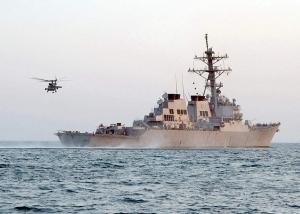
uss-hopper.jpgOne Defense Department official, who spoke on the condition of anonymity to describe early reports from the Navy’s regional headquarters in Bahrain, said that the Iranian boats made a radio threat that the American ships would explode.

“The five Iranian fast boats essentially came in and charged the ships,” the Defense Department official said. The verbal warnings heard in English over the internationally recognized bridge-to-bridge radio channel said, “I am coming at you, and you will explode in a few minutes,” the official said.

A few minutes later, one of the Iranian boats placed two white boxes, possibly meant to be taken for mines, in the wake of one of the Navy ships, which caused another of the American vessels to take evasive action.

“Whether they’re just testing us to learn about our procedures, or actually trying to initiate an incident, we don’t know,” the official said.

The five fast boats were identified by Defense Department officials as belonging to Iran’s Islamic Revolutionary Guards Corps. Traditionally, the Revolutionary Guards’ maritime forces have operated in a far more hostile manner than the regular Iranian Navy.

“We have found in the past that the regular Iranian Navy was a courteous and professional organization, and our relations are as we would have with any other navy in the world,” said one Pentagon official who has studied the issue. “The I.R.G.C. Navy has a tendency to act in these unprofessional ways, and to be very provocative at times.”

Last March, Revolutionary Guards sailors captured 15 British sailors in waters the British insisted were international, and held them for nearly two weeks. [complete article]

Hotdogs and brinkmanship

There’s a fair bit of speculation on Iranian motives today, from Blake Hounsell wondering if the IRGC commanders are doing some oil-market speculating to talk of a “Gulf of Tonkin” exersize and the inevitable Rightwing calls to bomb, bomb, bomb Iran. Others see this incident as being connected to the US nomination races (no, really – everything is about the races for some folk) or to Bush’s Mid-East visit.

While the latter is the most likely if this event – not unusual except for one Iranian redneck on a radio – was deliberately singled out for orders to that effect by some senior commander, I’m going with Dave Schuler’s take – dumb hotdogs playing brinkmanship games.

I think it’s more likely that it’s just a bunch of IRG’s horsing around, taunting the Great Satan. You can’t peddle that sort of stuff for a generation or more without it having some effects.

On both sides, Dave. [complete article]

Diplomatic two-step in Iran

Tehran in recent days reshuffled its diplomatic team in key Middle East posts. It has cut short the tenure of its ambassador to Syria after just a two-year stint, replacing him with another hard-core loyalist of President Mahmoud Ahmadinejad. The Tehran government has also announced the departure of its point man on Iraq to a post in far-flung Japan.

The moves have sparked speculation that Ahmadinejad wants more control over the country’s foreign policy on Iraq and Lebanon.

But they could also just be complicated maneuvers to consolidate power within the ruling elite’s treacherous factional politics. [complete article]

Oil shrugs off Iran-US bounce, falls below $97

Oil fell more than $1 to below $97 a barrel on Monday, handing back gains triggered by reports of fresh tensions between Iran and the United States. [complete article]

Facebooktwittermail

OPINION: Second thoughts on Charlie Wilson’s War

Second thoughts on Charlie Wilson’s War

I have some personal knowledge of Congressmen like Charlie Wilson (D-2nd District, Texas, 1973-1996) because, for close to twenty years, my representative in the 50th Congressional District of California was Republican Randy “Duke” Cunningham, now serving an eight-and-a-half year prison sentence for soliciting and receiving bribes from defense contractors. Wilson and Cunningham held exactly the same plummy committee assignments in the House of Representatives — the Defense Appropriations Subcommittee plus the Intelligence Oversight Committee — from which they could dole out large sums of public money with little or no input from their colleagues or constituents.

Both men flagrantly abused their positions — but with radically different consequences. Cunningham went to jail because he was too stupid to know how to game the system — retire and become a lobbyist — whereas Wilson received the Central Intelligence Agency Clandestine Service’s first “honored colleague” award ever given to an outsider and went on to become a $360,000 per annum lobbyist for Pakistan. [complete article]

Facebooktwittermail

NEWS & REVIEW: Taxi to the Dark Side

The power of authority: a dark tale

Frank Gibney was old and sick and a little more than a month away from dying. But he was filled with righteous anger, and he had some things to say. He told his son, the documentary filmmaker Alex Gibney, to unplug a noisy oxygen machine and to grab a video camera.

The older Mr. Gibney, a journalist and scholar who died in April, had served as a naval interrogator in World War II. In a moving statement that serves as a sort of coda to “Taxi to the Dark Side,” a new documentary about the Bush administration’s interrogation policies in the post-9/11 world, he said it had never occurred to him to use brutal techniques on the Japanese prisoners in his custody.

“We had the sense that we were on the side of the good guys,” Frank Gibney said, seething. “People would get decent treatment. And there was the rule of law.”

There would seem to be an enormous distance between the Bagram Air Base in Afghanistan, where the central events in “Taxi to the Dark Side” take place, and Enron’s headquarters in Houston, where the machinations of white-collar criminals brought down the giant energy company and became the backdrop for Mr. Gibney’s entertaining 2005 documentary, “Enron: The Smartest Guys in the Room.” But Mr. Gibney said the two projects have common themes.

“The subject of corruption unites my films,” he said. “‘Enron’ was about economic corruption, and ‘Taxi’ is about the corruption of the rule of law.” [complete article]

Padilla sues John Yoo over detention

Jose Padilla, the American citizen who was held in military detention for more than three years as an enemy combatant, filed a lawsuit Friday against a former Justice Department lawyer who helped provide the legal justifications for what the suit says was Mr. Padilla’s unconstitutional confinement and “gross physical and psychological abuse.”

The lawyer, John C. Yoo, now a law professor at the University of California, Berkeley, wrote or helped prepare a series of legal memorandums on interrogations and the treatment of detainees after the Sept. 11 attacks. [complete article]

Foiling U.S. plan, prison expands in Afghanistan

As the Bush administration struggles for a way to close the military prison at Guantanamo Bay, Cuba, a similar effort to scale down a larger and more secretive American detention center in Afghanistan has been beset by political, legal and security problems, officials say.

The American detention center, established at the Bagram military base as a temporary screening site after the invasion of Afghanistan in 2001, is now teeming with some 630 prisoners — more than twice the 275 being held at Guantanamo. [complete article]

Facebooktwittermail

NEWS & EDITOR’S COMMENT: The new Cambodia?

U.S. considers new covert push within Pakistan

President Bush’s senior national security advisers are debating whether to expand the authority of the Central Intelligence Agency and the military to conduct far more aggressive covert operations in the tribal areas of Pakistan.

The debate is a response to intelligence reports that Al Qaeda and the Taliban are intensifying efforts there to destabilize the Pakistani government, several senior administration officials said.

Vice President Dick Cheney, Secretary of State Condoleezza Rice and a number of President Bush’s top national security advisers met Friday at the White House to discuss the proposal, which is part of a broad reassessment of American strategy after the assassination 10 days ago of the Pakistani opposition leader Benazir Bhutto. There was also talk of how to handle the period from now to the Feb. 18 elections, and the aftermath of those elections. [complete article]

Editor’s Comment — It’s never enough just to know what was said; we need to know who was talking.

This is a report that illustrates well the need for newspapers to limit their use of anonymous sources. The key to unlocking the article’s significance is knowing who was talking to the New York Times. On that basis we could attempt to understand the sources’ motives for making this information public. For instance, if the sources are intelligence officials we’d have reason to think they might be talking to the press in an effort to kill a harebrained plan before it gains momentum. If on the other hand the sources are inside the White House, then we’d have to wonder whether a political agenda was trumping the need for operational security. Myers, Sanger, and Schmitt should know the answer, but of course their sacred duty to protect the confidentiality of their sources prevents them from adding meaning that currently only they are in a position to discern. Still, why call it reporting if the reporter is only willing to tell part of the story?

What’s more important? That the New York Times is able to protect the privilege of its access to those in power, or that it uses all its means to hold those in power accountable to the people they represent?

Since the Grey Lady is so firmly wedded to its institutional authority, what can we do but go back to parsing the Times as though we were reading Pravda.

This is what I’m able to glean. President Bush, who was in the White House on Friday, did not attend the meeting. The key players at the meeting are named in the article and since they didn’t include Bush, it seems reasonable to infer he wasn’t there. Too busy? We do know for sure that Defense Secretary Gates wasn’t there, so it looks like this was Cheney’s meeting.

Midway through the article, our steely reporters toss in an idle piece of speculation about why the discussions in the White House were taking place: “In part, the White House discussions may be driven by a desire for another effort to capture or kill Osama bin Laden and his deputy, Ayman al-Zawahri.” Does this mean that the Times was told by its sources, this was the main reason for the discussions, but you can’t attribute that to your sources, or was this just some journalistic day-dreaming? Let’s assume the former. And if that’s the case, this discussion may have more to do with domestic American politics than a desire to bring stability to Pakistan.

Perhaps the most revealing lines in the report are these: “The Bush administration has not formally presented any new proposals to Mr. Musharraf, who gave up his military role last month, or to his successor as the army chief, Gen. Ashfaq Parvez Kayani, who the White House thinks will be more sympathetic to the American position than Mr. Musharraf…. But at the White House and the Pentagon, officials see an opportunity in the changing power structure for the Americans to advocate for the expanded authority [of the CIA] in Pakistan, a nuclear-armed country.” In this changing power structure, the administration’s focus remains unchanged: its interest in working more closely with Pakistan’s military than with its civilians. At the same time, the administration appears to want to communicate indirectly with Pakistan’s military by getting its ideas floated in the press. Is this a case of putting the word out to see if it provokes civil unrest?

It’s starting to sound like Cheney might be on the war path again. Iran is off the table, but maybe Pakistan will provide the CIA with an opportunity to help the administration pull its chestnuts out of the fire before November ’08. If they haul in or kill America’s most-wanted men, the presidential race might be nudged back onto national security, and maybe Bush and Cheney won’t go down in history as the men who destroyed the Republican Party.

Could Pakistan go up in flames in the process, al Qaeda’s leaders elude capture and the war in Afghanistan expand into a full-fledged regional war? These are all risks the vice president might be willing to take.

But I digress. The reporters at Pravda — I mean the Times — could do a bit more to enlighten us, couldn’t they?

Facebooktwittermail

NEWS: Investigation into the destruction of the torture tapes

Justice Dept. sets criminal inquiry on CIA tapes

Attorney General Michael B. Mukasey said Wednesday that the Justice Department had elevated its inquiry into the destruction of Central Intelligence Agency interrogation videotapes to a formal criminal investigation headed by a career federal prosecutor.

The announcement is the first indication that investigators have concluded on a preliminary basis that C.I.A. officers, possibly along with other government officials, may have committed criminal acts in their handling of the tapes, which recorded the interrogations in 2002 of two operatives with Al Qaeda and were destroyed in 2005.

C.I.A. officials have for years feared becoming entangled in a criminal investigation involving alleged improprieties in secret counterterrorism programs. Now, the investigation and a probable grand jury inquiry will scrutinize the actions of some of the highest-ranking current and former officials at the agency.

The tapes were never provided to the courts or to the Sept. 11 commission, which had requested all C.I.A. documents related to Qaeda prisoners. The question of whether to destroy the tapes was for nearly three years the subject of deliberations among lawyers at the highest levels of the Bush administration. [complete article]

Lawmaker told CIA not to destroy tapes

The top Democrat on the House Intelligence Committee warned in a 2003 letter that destroying videotapes of terrorist interrogations would put the CIA under a cloud of suspicion, according to a newly declassified copy of the letter.

“Even if the videotape does not constitute an official record that must be preserved under the law, the videotape would be the best proof that the written record is accurate, if such record is called into question in the future,” Rep. Jane Harman, D-Calif., wrote in a Feb. 10, 2003 letter to then-CIA general counsel Scott Muller. “The fact of destruction would reflect badly on the agency.”

Harman’s office released the declassified letter on Thursday, a day after the Justice Department announced it had opened a criminal investigation into the destruction of the tapes. The letter notes that a copy also went to then-CIA Director George Tenet. [complete article]

Probe leader called a tough prosecutor

John H. Durham, who was appointed yesterday to lead a criminal probe into the destruction of the CIA’s interrogation tapes, oversaw corruption charges against a Republican governor in Connecticut, put away FBI agents in Boston and prosecuted many of New England’s Mafia bosses.

Former colleagues said the deputy U.S. attorney is known for seeking maximum sentences, shunning plea bargains and avoiding the spotlight. Four friends said they could not recall him losing a case in more than 30 years as a prosecutor, almost all of it spent fighting organized crime and gang violence in Connecticut. [complete article]

Editor’s Comment — I surely won’t be the first to make this observation, but Durham’s experience in investigating the Mafia should serve him well when it comes to uncovering the workings of the Bush adminstration.

Facebooktwittermail

OPINION: The presidency of outlaws

Looking at America

In the years since 9/11, we have seen American soldiers abuse, sexually humiliate, torment and murder prisoners in Afghanistan and Iraq. A few have been punished, but their leaders have never been called to account. We have seen mercenaries gun down Iraqi civilians with no fear of prosecution. We have seen the president, sworn to defend the Constitution, turn his powers on his own citizens, authorizing the intelligence agencies to spy on Americans, wiretapping phones and intercepting international e-mail messages without a warrant.

We have read accounts of how the government’s top lawyers huddled in secret after the attacks in New York and Washington and plotted ways to circumvent the Geneva Conventions — and both American and international law — to hold anyone the president chose indefinitely without charges or judicial review.

Those same lawyers then twisted other laws beyond recognition to allow Mr. Bush to turn intelligence agents into torturers, to force doctors to abdicate their professional oaths and responsibilities to prepare prisoners for abuse, and then to monitor the torment to make sure it didn’t go just a bit too far and actually kill them.

The White House used the fear of terrorism and the sense of national unity to ram laws through Congress that gave law-enforcement agencies far more power than they truly needed to respond to the threat — and at the same time fulfilled the imperial fantasies of Vice President Dick Cheney and others determined to use the tragedy of 9/11 to arrogate as much power as they could. [complete article]

Stonewalled by the CIA

More than five years ago, Congress and President Bush created the 9/11 commission. The goal was to provide the American people with the fullest possible account of the “facts and circumstances relating to the terrorist attacks of Sept. 11, 2001” — and to offer recommendations to prevent future attacks. Soon after its creation, the president’s chief of staff directed all executive branch agencies to cooperate with the commission.

The commission’s mandate was sweeping and it explicitly included the intelligence agencies. But the recent revelations that the C.I.A. destroyed videotaped interrogations of Qaeda operatives leads us to conclude that the agency failed to respond to our lawful requests for information about the 9/11 plot. Those who knew about those videotapes — and did not tell us about them — obstructed our investigation.

There could have been absolutely no doubt in the mind of anyone at the C.I.A. — or the White House — of the commission’s interest in any and all information related to Qaeda detainees involved in the 9/11 plot. Yet no one in the administration ever told the commission of the existence of videotapes of detainee interrogations. [complete article]

Judgement and torture

The Administration has launched what Laura Rozen recently termed “Operation Stop Talking,” a program designed to insure that all intelligence officers and former officers maintain complete silence about what transpired with these tapes. This has included some very heavy handed measures, including an FBI investigation targeting John Kiriakou. My own sources tell me that Rozen’s reporting is right on the money about this—the word has been put out that any one allowing further information to slip out, or corroborating Kiriakou’s account, can expect severe retribution. And what is the objective of this extraordinary public relations project? Again, the aspect of Kiriakou’s remarks that gave rise to it was his detailed depiction of the Justice Department’s and the White House’s role in the entire process.

The Bush Administration’s containment strategy for this matter is very clear: it was a CIA affair, start to finish. The decision to make and destroy the tapes came down in the ranks of the CIA. Other agencies and particularly the White House were uninvolved. Yes, there will be a scapegoat offered up. [complete article]

Facebooktwittermail

NEWS: The CIA’s tireless effort to protect itself — and others

Tapes by CIA lived and died to save image

If Abu Zubaydah, a senior operative of Al Qaeda, died in American hands, Central Intelligence Agency officers pursuing the terrorist group knew that much of the world would believe they had killed him.

So in the spring of 2002, even as the intelligence officers flew in a surgeon from Johns Hopkins Hospital to treat Abu Zubaydah, who had been shot three times during his capture in Pakistan, they set up video cameras to record his every moment: asleep in his cell, having his bandages changed, being interrogated.

In fact, current and former intelligence officials say, the agency’s every action in the prolonged drama of the interrogation videotapes was prompted in part by worry about how its conduct might be perceived — by Congress, by prosecutors, by the American public and by Muslims worldwide.

That worry drove the decision to begin taping interrogations — and to stop taping just months later, after the treatment of prisoners began to include waterboarding. And it fueled the nearly three-year campaign by the agency’s clandestine service for permission to destroy the tapes, culminating in a November 2005 destruction order from the service’s director, Jose A. Rodriguez Jr. [complete article]

Facebooktwittermail

ANALYSIS: The realist resurgence

Gates led realist resurgence in 2007

2007 will likely go down in US history as the year in which the balance of power in the long-running struggle between hawks and realists in the administration of President George W. Bush shifted decisively in favor of the latter.

That shift, which could still be reversed by events or actors not subject to Washington’s direct control, can be credited in part to the manifest failures of policies – particularly in Iraq, elsewhere in the Middle East, and in North Korea – promoted by the coalition of aggressive nationalists, neoconservatives, and Christian Zionists who were empowered by the Sep. 11, 2001 terrorist attacks on New York and the Pentagon.

The realist resurgence can also be traced to the rise of specific individuals, who took the place of their discredited predecessors in posts between the beginning of Bush’s second term and the end of 2006 when the most important realist of all – Defense Secretary Robert Gates – replaced Donald Rumsfeld at the Pentagon. [complete article]

Facebooktwittermail