Category Archives: US government

Deadly clash underscores rift over interpretation of U.S.-Iraq deal

Deadly clash underscores rift over interpretation of U.S.-Iraq deal

When insurgents attacked an American convoy with AK-47 rounds and a couple of grenades on a dusty highway in a Baghdad suburb this week, U.S. soldiers returned fire, chased the suspects through narrow alleyways and raided houses.

Tuesday’s clash killed two Iraqi adults and a 14-year-old and wounded four people, including two children.

When the shooting subsided, another confrontation began. A senior Iraqi army commander who arrived at the scene concluded that the Americans had fired indiscriminately at civilians and ordered his men to take the U.S. soldiers into custody. The U.S. military said the soldiers had acted in self-defense and had sought to avoid civilian casualties; U.S. commanders at the scene persuaded the Iraqis to back down.

The incident, apparently the first time a senior Iraqi commander has sought to detain U.S. soldiers, signals a potential escalation of tensions between U.S. and Iraqi forces trying to find a new equilibrium as Iraq assumes more responsibility for its security. [continued…]

Iraq presses U.S. on pact with Sunnis in Turkey

Iraq’s government said Thursday that it was demanding explanations from the United States and Turkey about a protocol signed this year between an American official and a representative of a group of Iraqi Sunni insurgents in Istanbul as a precursor to negotiations between the two sides.

The Iraqi government said in a statement that the protocol amounts to “an interference in Iraq’s internal political affairs” and that it was expecting “clear explanations” from American and Turkish officials at the embassies in Baghdad.

Contacts between the American government and Iraqi insurgent groups are nothing new, and the most recent ones have occurred with the coordination of an Iraqi government reconciliation unit attached to Prime Minister Nuri Kamal al-Maliki’s office. The goal is to get insurgents to renounce violence and embrace the political process.

But the release of the document of the protocol appears to be an attempt to embarrass the United States and show how deeply involved it remains in Iraq’s affairs. It also underscores just how hostile Mr. Maliki’s Shiite-led government remains to any serious engagement with Sunni insurgents, especially those suspected of having links to Saddam Hussein’s former ruling Baath Party. [continued…]

Facebooktwittermail

How the Bush administration tried to cover up mass murder

How the Bush administration tried to cover up mass murder


AfghanMassGrave.org

Dr. Jennifer Leaning, Nathaniel Raymond and Dr. Nizam Peerwani of Physicians for Human Rights discuss with Terry Gross their investigation of the alleged massacre of hundreds or possibly thousands of Taliban and Al Qaeda prisoners at Dasht-i-Leili in Afghanistan in December 2001.

Nathaniel Raymond [Physicians for Human Rights]: Our consuming fear from day one, Terry, was that any evidence there was going to be removed and/or destroyed. We were also deeply concerned about witnesses who had spoken to journalists such as Newsweek, to the United Nations and to others and now sadly we know two things: One, we know that there is clear evidence — our forensic team documented [this] in 2008 — of tampering at the site. And we also have satellite imagery which shows that in 2006, less than a month approximately after we filed a Freedom of Information Act request in US federal court, there is one large hole present at the site and what appears to be a hydrolic excavator and a truck digging what becomes the second large trench that our forensic team found in 2008. But for me, and I want to make this very clear, the great tragedy in this case has been the loss of the witnesses.

We now know through State Department documents we received through Freedom of Information Act request that at least four witnesses — innocent men who were bulldozer drivers and truck drivers — have been tortured, killed and disappeared.

Terry Gross: Nathaniel, your Freedom of Information Act files related to the mass grave — your request was made in June of 2006 — and I know you had a lot of trouble getting the Freedom of Information files, although you finally got them. What kind of trouble did you have?

NR: Well, the trouble that Physicians for Human Rights had was the Bush administration did not want to release any documents and so with the help of Ropes and Gray, a law firm in Washington, we were able to pressure them to release the documents and we started receiving them in 2008 and what we found was frankly jaw dropping.

In a November 2002 State Department intelligence report there was a body count and it was from a three-letter redacted intelligence source, which means we couldn’t see who was reporting it, but whoever was reporting it was identified by three letters [editor’s wild guess: possibly a combination of the letters “C”, “I” and “A”]. And this three-letter source said at least 1,500 to as many as 2,000 had died as part of the massacre.

And what we also learned, which was very hard for us at Physicians for Human Rights to see, is that the US government had confirmation that at least four witnesses had been tortured, killed and/or disappeared.

TG: What does it say to you that within these Freedom of Information Act files there was a source, whose name was redacted, who actually gave an estimated body count in this mass grave?

NR: Speaking with former Bush administration officials, that source was an agency. And we still do not have confirmation about what US intelligence agency that was, but it was absolutely outrageous. The fact that the US government would be saying there was no grounds for a US investigation, no grounds for security of the site, no grounds for protection of witnesses, but they had a body count for years, and they had clear evidence that people — innocent bystanders in this case — were being killed and they did nothing. [continued…]

Afghan massacre: the convoy of death (video)

Facebooktwittermail

Group plans lawsuit to unveil the CIA’s ‘Pentagon Papers’

Group plans lawsuit to unveil the CIA’s ‘Pentagon Papers’

The CIA and other agencies are sitting on a trove of documentary evidence of actual and suspected wrongdoing under the Bush administration, and the Electronic Frontier Foundation plans to file a lawsuit Wednesday to force the intelligence community to come clean, the group says.

At issue are the misconduct reports the spy agencies are required to file with the Intelligence Oversight Board, a board of private citizens with security clearances who oversee the spy agencies and report to the president. The board is tasked with evaluating the self-reported malfeasances of intelligence agencies, looking at the agencies’ responses, and forwarding on the worst to the attorney general when it believes criminal prosecution is called for.

The CIA is among the agencies that failed to respond to the EFF’s Freedom of Information Act (FOIA) requests for copies of the reports. Given the unfolding controversy over the CIA’s apparent failure to notify Congress of a secret agency assassination program, the withholding of these documents takes on even greater importance, according to EFF lawyer Nate Cardozo. [continued…]

Facebooktwittermail

Pentagon seeks to overhaul prisons in Afghanistan

Pentagon seeks to overhaul prisons in Afghanistan

A sweeping United States military review calls for overhauling the troubled American-run prison here as well as the entire Afghan jail and judicial systems, a reaction to worries that abuses and militant recruiting within the prisons are helping to strengthen the Taliban.

In a further sign of high-level concern over detention practices, Adm. Mike Mullen, the chairman of the Joint Chiefs of Staff, sent a confidential message last week to all of the military service chiefs and senior field commanders asking them to redouble their efforts to alert troops to the importance of treating detainees properly.

The prison at this air base north of Kabul has become an ominous symbol for Afghans — a place where harsh interrogation methods and sleep deprivation were used routinely in its early years, and where two Afghan detainees died in 2002 after being beaten by American soldiers and hung by their arms from the ceiling of isolation cells. [continued…]

Facebooktwittermail

US intelligence – 7/18

House launches investigation into CIA program

The House Intelligence Committee said on Friday it was launching a formal investigation into the concealment of a secret CIA program from Congress that one senator said was withheld on orders from former Vice President Dick Cheney.

Immediately after the Democrats announced the investigation, Republicans cried foul and called it a partisan effort to protect the Democratic leader, House Speaker Nancy Pelosi. [continued…]

U.S. weighs special team of terrorism interrogators

The Obama administration is considering overhauling the way terror suspects are interrogated by creating a small team of professionals drawn from across the government, according to people familiar with a proposal that will be submitted to the White House.

The new unit, comprising members of spy services and law-enforcement agencies, would be used for so-called high-value detainees, they said. In a switch from Bush-era efforts, it wouldn’t be run by the Central Intelligence Agency, though who might be in charge isn’t specified.

One of the team’s tasks would likely be to devise a new set of interrogation methods, according to one person familiar with the proposal. Those techniques could be drawn from sources ranging from scientific studies to the psychology behind television ads. [continued…]

Facebooktwittermail

EDITORIAL: The scapegoat with a savage bite

The scapegoat with a savage bite

Everyone’s afraid of the CIA.

On PBS’s Washington Week last night, in a roundtable discussion on the Pelosi-CIA joust, there was a clear consensus among the assembled reporters: anyone who dares pick a fight with the CIA does so at their own peril and is almost certain to lose.

As is always the case, the only thing the press is interested in here is the fight — who, if anyone, is telling the truth is apparently of no consequence. It also appears that journalists — just as much as the White House and Congress — are afraid of challenging the agency. No one’s at risk of ending up with a bullet in the back of their head, but that isn’t because the CIA is benign — it just means it can exploit much subtler but equally effective methods for accomplishing its aims.

Consider for a moment that we supposedly live in a democracy. How can it be that the head of state, the executive and legislative branches of government and the erstwhile Fourth Estate should all be afraid of a single government agency?

Why is it that an agency that enjoys the medieval privilege of operating with a “black budget” in the ostensible interests of national security, nevertheless always seems able to lift the umbrella of secrecy as and when it serves its own interests?

After Nancy Pelosi accused the CIA of lying about briefing Congressional leaders on waterboarding, CIA Director Leon Panetta’s response was to publicly issue a statement to CIA employees. This was a multi-layered message.

Top layer: The agency didn’t lie. He said: “…our contemporaneous records from September 2002 indicate that CIA officers briefed truthfully on the interrogation of Abu Zubaydah, describing ‘the enhanced techniques that had been employed.’ ” (This isn’t a particularly solid statement. “Contemporaneous records” — so might there be other records that tell a different story? “CIA officers briefed truthfully” — briefed who truthfully? “Describing ‘the enhanced techniques that had been employed'” — why didn’t he put it in black and white: Nancy Pelosi was told by CIA officers that Abu Zubaydah was waterboarded?)

Next layer: I’m defending you guys (and want to be seen defending you — hence, he didn’t just send out the memo but also put it on the CIA web site). He said: “We are an Agency of high integrity, professionalism, and dedication. Our task is to tell it like it is — even if that’s not what people always want to hear. Keep it up. Our national security depends on it.”

Next layer: But I do have to cover my own ass: “Let me be clear: It is not our policy or practice to mislead Congress.”

Why should the employees of the CIA need reminding that they shouldn’t mislead — which is to say, lie to or deceive — Congress? Oh yes, because it’s already public knowledge that in 2005, even after having been requested by Rep. Jane Harman not to do so, they destroyed video tapes of the torture of Abu Zubaydah and Abd al-Rahim al-Nashiri — tapes that would almost certainly have been used as evidence if anyone is ever prosecuted for torture.

For the last seven years, the CIA has been playing what probably ranks as the most masterful political game in its history. When 9/11 should have posed an existential threat to the agency, instead it was able to distance itself from the Bush administration to such a degree that it ended up being perceived as the victim of a neocon vendetta. Former agents became honorary members of the anti-Bush movement with Valerie Plame as their poster child.

Even now, as the agency fends off demands for investigations into its use of torture, a defense narrative has already being wheeled into service. We were just honest government employers doing what we were asked to do. The real offenders were in Cheney’s office.

I have no problem with the idea that it is the decision-makers and architects of the torture program who should be held responsible. But that doesn’t mean that torturers and murderers get off the hook. Indeed, an agency that goes to such lengths to protect its own doesn’t just need reform; it needs breaking up.

Facebooktwittermail

Is Obama being blackmailed by the CIA?

Obama tilts to CIA on memos

The Obama administration is leaning toward keeping secret some graphic details of tactics allowed in Central Intelligence Agency interrogations, despite a push by some top officials to make the information public, according to people familiar with the discussions.

These people cautioned that President Barack Obama is still reviewing internal arguments over the release of Justice Department memorandums related to CIA interrogations, and how much information will be made public is in flux.

Among the details in the still-classified memos is approval for a technique in which a prisoner’s head could be struck against a wall as long as the head was being held and the force of the blow was controlled by the interrogator, according to people familiar with the memos. Another approved tactic was waterboarding, or simulated drowning. [continued…]

Editor’s Comment — No wonder there’s so much trepidation around releasing these memos. One can only imagine what kind of phrasing is involved in defining the “appropriate” amount of force with which someone’s head can be bashed against a wall.

Was it something specific like this: With less force than would be required to fracture the skull or spill blood? Or was it something more legalistic but vague, like this: With less force than could reasonably be expected to result in permanent brain damage?

The key issue here, the CIA would have us believe, is that revealing details on the torture techniques it has used would “undermine the agency’s credibility with foreign intelligence services.”

What this means, as far as I can tell from reading reports on the Binyam Mohamed case is this: When the CIA enlisted the support of MI5 (and other intelligence services) in the rendition and torture of suspected terrorists, the agreement was that information about the intelligence process would remain under the control of all participants. Another way of putting it would be to say that the co-conspirators agreed to cover each other’s backs so that they could collectively enjoy legal impunity.

Now that that impunity is in jeopardy, the lawbreakers are upping the ante by implying that exposing torture practices poses a national security threat. Ostensibly the threat comes from providing al Qaeda a propaganda coup, but the underlying threat is that the CIA will no longer get cooperation from foreign agencies and that intelligence gathering will therefore suffer. And what this boils down to is the crudest possible threat: if the administration doesn’t protect the agency, the agency won’t protect the administration. This is, in a word: blackmail.

At the White House, joking about a torture investigation?

I was asked to go on Hardball on Tuesday night to discuss the news that Spanish prosecutors are likely to recommend a full investigation be conducted to determine if six former Bush administration officials—including ex-Attorney General Alberto Gonzales—ought to be indicted for having sanctioned torture at Guantanamo. So I thought I’d ask White House press secretary Robert Gibbs about the matter.

This could become a true headache for the White House—a high-profile case in which Spanish prosecutors bring charges against Gonzales; Douglas Feith, former undersecretary of defense; David Addington, former counsel to Vice President Dick Cheney; William Haynes, a former Pentagon lawyer; and John Yoo and Jay Bybee, two former Justice Department officials. Several steps must occur before any prosecution proceeds. If the prosecutors determine a full criminal investigation is warranted–as is expected–it will be up to a Spanish judge to open a full-fledged inquiry that could produce indictments. He could decide not to accept the recommendation. And, of course, it’s possible that an investigation could end without indictments. The Spanish hook for the case is a simple one: Five Guantanamo detainees were either Spanish citizens or residents. And, by the way, Spanish courts claim jurisdiction that extends to other nations when it comes to torture and war crimes. [continued…]

Facebooktwittermail

ANALYSIS & EDITOR’S COMMENT: Inbedded reporting

Israel is a long way from attacking Iran

Israeli leaders and officials have recently intensified their campaign against nuclearIran. The messages from Prime Minister Ehud Olmert to Ambassador to Washington Salai Meridor and Transportation Minister Shaul Mofaz is clear: Israel will not tolerate a nuclear Iran. Indeed Israel is very concerned by the likelihood that Iran, whose leadership has called for the Jewish state’s destruction, will be able to produce nuclear weapons.

These public statements, as well as closed talks between Israel’s leadership and leaders around the world, can be interpreted as “preparing the ground” for the possibility that Israel will attack Iran. It is also correct that all the bodies dealing with the “Iran case,” including the Mossad, Military Intelligence, Operations Directorate of the Israel Defense Forces, Israel Air Force and the Israeli Atomic Energy Commission, are planning for the worst-case scenario. This is their professional duty. But one cannot conclude, as many have following a report in The New York Times (June 19) that an Israeli attack is certainly around the corner. Not only has such a decision not been made in any relevant forum in Israel – the question has not even been discussed. [complete article]

Editor’s Comment — When an “inbedded” reporter like Michael Gordon not only performs a service for his government, but is internationally seen to be acting as a stooge, I wonder how he feels?

Last Friday, no-questions-asked, he got the Israeli-attack-on-Iran-rehearsal story out and it provoked lots of reaction. A bump in oil prices (yet another little windfall for Iran), a rebuke from the Iranian government, a threat that Mohamed ElBaradei would resign as director of the IAEA in such an event, and a carefully studied no-comment from the Israeli government. Even if this was an Israeli Air Force exercse, the consensus among Israeli commentators was that the story — courtesy of Pentagon-mouthpiece Michael Gordon — was an expression of American pressure.

The fact is, a military exercise of this nature is not really newsworthy. As Amos Harel noted in Haaretz: “There is little new in the fact that the IAF is preparing for the Iranian challenge. About six months ago, Channel 2 reported a similar exercise covering a radius that an operation against Iran would require. At the time the report received little attention.” Indeed, assuming that the IAF as an active and well-trained air force will periodically engage in major exercises, what would we expect them to be training to do? Attack France?

So why did the Pentagon/New York Times need to get the story out? The Iranians know that the Bush administration is a spent force and the antics of attention-seeking neocons are becoming increasingly easy to ignore, but mad-dog Israel — that’s always the wild card. Less than a year ago it burnished its image of unpredictability by bombing Syria. The idea that Israel is unpredictable is at this point the only thing that has any chance of keeping the Iranians on their toes.

Facebooktwittermail

NEWS & EDITOR’S COMMENT: New York Times sends signal to Iran

U.S. says exercise by Israel seemed directed at Iran

Israel carried out a major military exercise earlier this month that American officials say appeared to be a rehearsal for a potential bombing attack on Iran’s nuclear facilities.

Several American officials said the Israeli exercise appeared to be an effort to develop the military’s capacity to carry out long-range strikes and to demonstrate the seriousness with which Israel views Iran’s nuclear program.

More than 100 Israeli F-16 and F-15 fighters participated in the maneuvers, which were carried out over the eastern Mediterranean and over Greece during the first week of June, American officials said. [complete article]

Editor’s Comment — Does the New York Times have a vital role to play in defending Israel from an Iranian nuclear threat? If the answer is ‘yes’, then I can understand why the paper would run a report like this. But if the paper’s primary responsibility is to report, then it has no business turning itself into an adjunct of either the US government or the Israeli government as it is doing so in this case. Performing government service here means disseminating information that no government official is willing to disseminate openly.

A senior Pentagon official who has been briefed on the exercise, and who spoke on condition of anonymity because of the political delicacy of the matter, said the exercise appeared to serve multiple purposes.

One Israeli goal, the Pentagon official said, was to practice flight tactics, aerial refueling and all other details of a possible strike against Iran’s nuclear installations and its long-range conventional missiles.

A second, the official said, was to send a clear message to the United States and other countries that Israel was prepared to act militarily if diplomatic efforts to stop Iran from producing bomb-grade uranium continued to falter.

“They wanted us to know, they wanted the Europeans to know, and they wanted the Iranians to know,” the Pentagon official said. “There’s a lot of signaling going on at different levels.”

But the NYT isn’t just describing the signaling — it’s part of the signaling loop. It thereby in the most insidious way inserts itself into a political process wherein it serves a role in applying pressure on all the parties involved.

Anonymous sourcing is required in a story like this, not because of — as the NYT puts it — “the political delicacy of the matter.” It’s used because journalists willing to prostitute themselves to their sources give those sources complete freedom to pick and choose which questions they want to answer. Indeed, they hand the reporter the story on a plate and then the newspaper happily gets the message out.

How would this story be approached if it was real journalism? It would dig into some of the key political question here: To what degree are the United States and Israel pursuing a coordinated political and military strategy in confronting Iran? Is the Pentagon — with a nod and a wink — helping relay Israel’s signal to Iran, or is it signaling to all concerned that Israel is a free agent whose actions might conflict with American interests?

These are the kinds of questions that don’t get answered when journalists turn themselves into the mouthpieces of anonymous sources.

How Iran would retaliate if it comes to war

Pressure is building on Iran. This week Europe agreed to new sanctions and President Bush again suggested something more serious – possible military strikes – if the Islamic Republic doesn’t bend to the will of the international community on its nuclear program.

But increasingly military analysts are warning of severe consequences if the US begins a shooting war with Iran. While Iranian forces are no match for American technology on a conventional battlefield, Iran has shown that it can bite back in unconventional ways.

Iranian networks in Iraq and Afghanistan could imperil US interests there; American forces throughout the Gulf region could be targeted by asymmetric methods and lethal rocket barrages; and Iranian partners across the region – such as Hezbollah in Lebanon – could be mobilized to engage in an anti-US fight. [complete article]

Facebooktwittermail

NEWS & EDITOR’S COMMENT: Iran’s plausible denials

Doubting the evidence against Iran

American circles in Baghdad and Washington are probably not pleased with Iraqi Prime Minister Nouri al-Maliki’s plan for a special panel to investigate allegations of Iranian interference in Iraq. Many U.S. officials are already convinced of the worst and, for years, U.S. officials have now aired accusations against Iran, insisting that Tehran is stoking Iraq’s violence by keeping up a flow of money, weapons and trained fighters into the country. The Iraqi government, however, remains unconvinced — with good reason.

“We want to find really good evidence and not evidence made on speculations,” Ali al-Dabbagh, a spokesman for the Iraqi government, told reporters in Baghdad on Sunday. Last week an Iraqi government delegation went to Tehran to discuss the allegations of Iranian involvement in the Iraqi militias, the government said. Details of the evidence presented in Tehran remains hazy, but at the same time American officials in Baghdad and Washington have never offered a convincing case publicly to support their allegations. [complete article]

Iraqi government caught in the middle as US directs new accusations at Iran

In line with the American accusations, the Iraqi government has confirmed that it has “concrete evidence” that Iranian weapons are flowing into Iraq. Even so, Iraqi officials have been at pains to draw a distinction between saying that these weapons were produced in Iran without necessarily concluding that they were supplied by Iran.

In an interview with The Washington Post, the Iraqi government spokesman Ali al Dabbagh said: “The truth came out; there is evidence of Iranian weapons in Iraq. Now we need to document who sent them.”

The Christian Science Monitor noted that the Iraqi delegation’s visit to Tehran “coincided with the release of the annual US terrorism report, which declared Iran, as in years past, to be the ‘most significant’ state sponsor of terrorism.” The report added: “It also quietly raised the official number of US and Iraqi soldiers allegedly ‘killed’ by Iranian actions in Iraq from ‘hundreds’ to ‘thousands’ – a surprise to analysts sceptical even of the lower figure.” [complete article]

Editor’s Comment — If the Iranians are guilty as charged, there does seem to be something thoroughly American in their approach — the training and arming of a proxy force and studious application of the principle of “plausible deniability.” It has more than the aroma of Reagan-era support for the Contras. Shouldn’t Elliot Abrams, John Negroponte, Oliver North et al feel flattered?

Facebooktwittermail

NEWS, ANALYSIS, INTERVIEW & EDITOR’S COMMENT: Foreign interference

Hezbollah trains Iraqis in Iran, Pentagon’s New York Times spokesman says

Militants from the Lebanese group Hezbollah have been training Iraqi militia fighters at a camp near Tehran, according to American interrogation reports that the United States has supplied to the Iraqi government.

An American official said the account of Hezbollah’s role was provided by four Shiite militia members who were captured in Iraq late last year and questioned separately.

The United States has long charged that the Iranians were training Iraqi militia fighters in Iran, which Iran has consistently denied, and there have been previous reports about Hezbollah operatives in Iraq.

But the Americans say the reports of Hezbollah’s role at the Iranian camp offer important details about Iranian assistance to the militias, including efforts Iran appears to be making to train the fighters in unobtrusive ways. [complete article]

Iraq: Al-Sadr refuses to meet Baghdad delegation In Iran

Prime Minister Nuri al-Maliki dispatched a delegation of leading Shi’ite figures to Iran last week in order to present Tehran with mounting evidence of Iran’s support for rogue militias in Iraq. But Shi’ite cleric Muqtada al-Sadr, whose militia continues to battle Iraqi and U.S. forces in Baghdad and other areas and who has been in Iran for months, refused to meet with the delegation.

The Iraqi delegation reportedly met with Qasim Suleimani, the head of Iran’s Islamic Revolution Guard Corps’ Qods Force, on May 1, and was expected to meet again with him on May 2. The force is suspected of being the main supplier of Iranian-made weapons to Iraq. It has also been linked to the training of Iraqi militiamen. The delegation was also slated to meet with Iran’s supreme leader, Ayatollah Ali Khamenei.

On May 2, Iranian Foreign Ministry spokesman Mohammad Ali Hosseini downplayed the delegation’s visit, saying, “Iranian officials will hold talks with this delegation in line with helping settle differences and ongoing clashes in Iraq.” [complete article]

Interview with Mohsen Hakim

Mohsen Hakim is the Tehran representative of the Supreme Iraqi Islamic Council, and a son of the SIIC leader, Abdelaziz Hakim.

LAT: So why is there postponement of the next round of talks between Iran and the U.S.?
HAKIM: There are technical problems.

LAT: What do you mean by “technical”?
HAKIM: I mean, anything that happens in the negotiations has an impact on Lebanon, Palestine and Afghanistan. Look, Iraqi security issue is not separated from other issues in the Middle East. On the whole, security in the region is not divisible. If there is no security in Iraq, there is no security anywhere in the region. We look at the security of Iraq as a organic security package for the whole region.

LAT: In fact, you want Iran and U.S. negotiations in Iraq to be all-encompassing negotiations?
HAKIM: Look, we as Iraqis care most now about our own problems. But we look at the security of Iraq as a common case between Iran and the U.S. I tell you with 100% certainty that if the security of Iraq is settled, the region will be affected positively. Iraq is not an isolated issue. Remember that. [complete article]

Editor’s Comment — “Unobtrusive ways” — now Michael Gordon could have chose an equally suitable phrase: plausible deniability.

The fact that the US military keeps pushing the story that Hezbollah is training Shia militia fighters in Iran raises a question that, as far as I know, still remains unanswered: Did the US have a role in the assassination of top Hezbollah commander Imad Mughniyeh on February 12 in Damascus? At the time it was assumed that Mossad was behind the killing, but last month M K Bhadrakumar wrote in >Asia Times:

Fars [the Iranian news agency, which is close to the Iranian Revolutionary Guards Corps] named Saudi Prince Banda al-Sultan, formerly Saudi ambassador in Washington, as responsible and that the Saudis were retaliating for the 1996 car bomb attack at the Abdul Aziz airbase in Khobar near Dahran in Saudi Arabia, which was allegedly planned and executed by Mughniyeh. The Fars report would have brought a welcome relief to Israeli intelligence, since the prevailing impression in the region was that Syria would accuse Israel of involvement in Mughniyeh’s assassination, which in turn would be the signal for Hezbollah to retaliate and for Israel to hit at Lebanon and possibly even Syria.

The fact that Iran would push a story blaming the Saudis may imply that they were willing to disown Mughniyeh and also that he wasn’t the strategic asset that the US imagined him to be.

If there is a consistent failing in American analysis it seems to be in, 1. over emphasizing the significance of individuals — we have a fascination with the acquisition of personal power and thus find it difficult to discern networks and social trends whose existence doesn’t depend on kingpins, and 2. in the homogenization of diversity — we see entities instead of seeing complexity. Any time anyone says “the Iranians”, one has to wonder, who are they talking about?

It’s not hard to understand why the US government has always found foreign relations easier when it can work with dictators. If you can cut deals with The Man, you don’t have to worry about the people.

Facebooktwittermail

EDITORIAL: Syria’s nuclear reactor

The Al Kibar nuclear reactor in Syria

As someone who voiced great skepticism about the initial claims that Israel destroyed a nuclear facility in the Syrian desert on September 6, 2007, I’ll be the first to admit that the evidence provided in the DNI background briefing presents proof that Syria was in fact close to completing the construction of a Calder-Hall type of nuclear reactor producing plutonium. The evidence of North Korean involvement is not quite as compelling but there doesn’t seem much reason to doubt it. (Nearly all the information that follows comes courtesy of Arms Control Wonk.)

Here’s the video:

All in all, in terms of intelligence, this looks like an open and shut case — with one noteworthy exception: In the intelligence briefing a senior intelligence officer when asked about evidence of a Syrian nuclear weapons development program said this:

To go with the question you’re asking – weapons – we said, we believe it. There’s no other reason for it. But our confidence level that it’s weapons is low at this point. We believe it, but it’s low based on the physical evidence.

In other words, the physical evidence gathered indicated that Syria had built a nuclear reactor that, once operational, would have been capable of producing plutonium. There was no evidence that the reactor had been built to produce electricity and neither was it deemed suitable to be a research facility. The production of plutonium for use in nuclear weapons was thus inferred in the absence of any other plausible explanation.

The next point worth noting is that the decision to bomb the facility was Israel’s:

Q: Would the U.S. have considered any kind of activity had the Israelis not?

SENIOR ADMINISTRATION OFFICIAL: We obviously were looking very closely at options, and we had looked at some approaches that involved a mix of diplomacy and the threat of military force with the goal of trying to ensure that the reactor was either dismantled or permanently disabled, and therefore never became operational.

We looked at those options. There were, as I mentioned to you, conversations with the Israelis. Israel felt that this reactor posed such an existential threat that a different approach was required. And as a sovereign country, Israel had to make its own evaluation of the threat and the immediacy of the threat, and what actions it should take. And it did so.

The unanswered questions at this point nearly all seem to be political. Such as:

1. Why did the US government back Israel in a military action that totally undermines the authority and value of the IAEA?

2. Why has the intelligence been released now?

3. What impact should this have on any agreement reached with North Korea?

Facebooktwittermail

ANALYSIS & EDITOR’S COMMENT: The Petraeus promotion

Petraeus promotion frees Cheney to threaten Iran

The nomination of Gen. David Petraeus to be the new head of the Central Command not only ensures that he will be available to defend the George W. Bush administration’s policies toward Iran and Iraq at least through the end of Bush’s term and possibly even beyond.

It also gives Vice President Dick Cheney greater freedom of action to exploit the option of an air attack against Iran during the administration’s final months. [complete article]

Petraeus’ ascension

Reaffirming his status as his generation’s most respected general officer, David H. Petraeus was nominated today to head U.S. Central Command (Centcom), the command responsible for all U.S. military operations in the Middle East. The move puts the U.S. military’s premier advocate, theorist and practitioner of counterinsurgency operations — once shunned by a Vietnam-stung military — at the helm of the military’s most important regional command.

But many military analysts — even those closely associated with the counterinsurgency theories that Petraeus has long championed — viewed the move as a mixed blessing. [complete article]

Editor’s Comment — Time is running out! There’s only six months left to keeping pushing the argument that Dick Cheney is going to start another war. After that, the only hope for the war-fearmongers is a McCain or Clinton presidency… Pardon the sarcasm.

So why do I question the idea that Petraeus’ promotion lets Cheney off the leash? Firstly, I doubt that Gates had his arm twisted into doing this. Indeed, to the extent that Petraeus was guilty of promoting operations in Iraq at the expense of meeting needs in Afghanistan, this seems to present quite a strong argument in favor of his being moved to CentCom. As commander in Iraq, it wasn’t his job to be an advocate for meeting pressing needs in any other arena. But as head of CentCom, Petraeus will become answerable for both Iraq and Afghanistan. And this time around The White House is hardly likely to go around the CentCom commander and deal directly with the commander in Iraq. By appointing U.S. Army Gen. Raymond Odierno to that position, Gates has ensured that Petraeus retains control in both commands. And Petraeus’ own ambitions surely stretch beyond 2008. He won’t merely want to please this president, but he also knows he’s going to be answerable to the next.

And as William Arkin argued last month, beyond the occasional bellicose piece of rhetoric (and there really hasn’t even been much of that in recent months), there is no practical evidence that the US military is readying itself or capable of starting another war. Blaming Iran for problems in Iraq seems to have less to do with making a case for attacking Iran than it does with resisting pressure to withdraw troops.

Facebooktwittermail

FEATURES & EDITOR’S COMMENT: Torture and propaganda

Behind TV analysts, Pentagon’s hidden hand

In the summer of 2005, the Bush administration confronted a fresh wave of criticism over Guantánamo Bay. The detention center had just been branded “the gulag of our times” by Amnesty International, there were new allegations of abuse from United Nations human rights experts and calls were mounting for its closure.

The administration’s communications experts responded swiftly. Early one Friday morning, they put a group of retired military officers on one of the jets normally used by Vice President Dick Cheney and flew them to Cuba for a carefully orchestrated tour of Guantánamo.

To the public, these men are members of a familiar fraternity, presented tens of thousands of times on television and radio as “military analysts” whose long service has equipped them to give authoritative and unfettered judgments about the most pressing issues of the post-Sept. 11 world.

Hidden behind that appearance of objectivity, though, is a Pentagon information apparatus that has used those analysts in a campaign to generate favorable news coverage of the administration’s wartime performance, an examination by The New York Times has found.

The effort, which began with the buildup to the Iraq war and continues to this day, has sought to exploit ideological and military allegiances, and also a powerful financial dynamic: Most of the analysts have ties to military contractors vested in the very war policies they are asked to assess on air. [complete article]

Editor’s Comment — This article describes a triangle of complicity comprising Pentagon officials, retired military leaders, and television news networks. The New York Times essentially gives the networks a free pass. The final paragraphs of the article summarize the perfunctory answers the paper received in response to questions about conflicts of interest, yet the mere fact that the networks might have been unaware about the Pentagon briefings their analysts were receiving or the way these generals were cashing in on their connections, does not explain away what was always glaringly obvious: the chasm separating war news reporting on the one hand, and the military analysis being presented by the networks’ prize generals on the other hand. The networks had no interest in closing this gap. That fact in and of itself merits another investigative report but that will only happen if mainstream journalism opens itself up to some critical self-examination — and what are the chances of that happening?!

Stress hooding noise nudity dogs

When the Haynes memo reached Guantánamo on December 2 [2002], Detainee 063 was in an isolated, plywood interrogation booth at Camp X-Ray. He was bolted to the floor and secured to a chair, his hands and legs cuffed. He had been held in isolation since August 8, nearly four months earlier. He was dehydrated and in need of regular hook-ups to an intravenous drip. His feet were swollen. He was urinating on himself.
amazon-tortureteam.jpgDuring Detainee 063’s first few months at Guantánamo, the interrogators had followed established practices for military and law enforcement interrogations. Building rapport is the overriding aim of the US Army Field Manual 34-52, the rule book for military interrogators, colloquially referred to as “FM 34-52”. Legality was also essential, which meant operating in accordance with the rules set out in the US military’s Uniform Code of Military Justice and international law, in particular the four Geneva conventions.

At the heart of them lies “Common Article 3”, which expressly prohibits cruel treatment and torture, as well as “outrages upon personal dignity, in particular, humiliating and degrading treatment”. Tactics that had conformed to these principles changed dramatically. The interrogation log describes what happened immediately after Rumsfeld signed the Haynes memo.

The pattern was always the same: 20-hour interrogation sessions, followed by four hours of sleep. Sleep deprivation appears as a central theme, along with stress positions and constant humiliation, including sexual humiliation. These techniques were supplemented by the use of water, regular bouts of dehydration, the use of IV tubes, loud noise (the music of Christina Aguilera was blasted out in the first days of the new regime), nudity, female contact, pin-ups. An interrogator even tied a leash to him, led him around the room and forced him to perform a series of dog tricks. He was forced to wear a woman’s bra and a thong was placed on his head.

Rumsfeld led the charge for war in Iraq; in part he did so because of Saddam Hussein’s contempt for human life. “Torture is systematic in Iraq, and the most senior officials in the regime are involved,” Rumsfeld said, a few months before Saddam was overthrown. “Electric shock, eye gouging, acid baths, lengthy confinement in small metal boxes are only some of the crimes committed by this regime.” He spoke those words one day after secretly signing the Haynes memo and approving his own techniques of aggressive interrogation at Guantánamo.

Ironically, it was the Iraq war – in particular, events at Abu Ghraib prison – that brought the Haynes memo into the open two years later. By the autumn of 2003, Abu Ghraib was being run by the US as a detention facility. On April 28 2004, a CBS television report revealed the nature and scale of abuse being inflicted upon Iraqi prisoners. Photographs taken by US military participants were published, including one, now notorious, showing a prisoner standing on a box with his head covered and wires attached to his fingers. Another showed Private Lynndie England holding a leash tied to the neck of a naked man on the floor.

Was there a connection between the abuses at Abu Ghraib and the Bush administration’s secret interrogation policies at other places, including Guantánamo? In June 2004, President Bush, hosting the G8 summit in Savannah, Georgia, was asked by the media if he had authorised any kind of interrogation techniques necessary to pursue the “war on terror”? No, he said, his authorisation was that anything the US did would conform to US law and be consistent with international treaty obligations. “We’re a nation of law. We adhere to laws. We have laws on the books.”

Four days later, the administration unexpectedly declassified and released a number of documents relating to interrogation in the belief that this would reflect the thorough process of deliberation that, it was claimed, took place, and demonstrate a commitment to the rule of law. At the briefing, conducted by three lawyers from Bush’s inner circle, Alberto Gonzales, the president’s counsel, Jim Haynes from the Defence Department, and his deputy, Dan Dell’Orto, it was made clear that particular documents were crucial: the Haynes memo, and a decision taken a few months previously by the president, on February 7 2002, that none of the detainees at Guantánamo, whether Taliban or al-Qaida, could rely on any of the protections granted by the Geneva conventions, not even Common Article 3.

The second set of documents were legal opinions issued on August 1 2002. One of these, by two senior lawyers at the Justice Department, concluded that physical torture occurred only when the pain was “equivalent in intensity to the pain accompanying serious physical injury, such as organ failure, impairment of bodily functions, or even death”. Mental torture required “lasting psychological harm”. The memo concluded that torture of suspected terrorists under interrogation would not be unlawful if it could be justified on grounds of necessity or self-defence.

On October 11 2002, Guantánamo had request that additional techniques beyond those in FM 34-52 be approved for use against high-value detainees, in particular a Saudi Arabian, Mohammed al-Qahtani – otherwise known as Detainee 063. The underlying message of the briefing was spelled out: Rumsfeld had merely responded to a request from Guantánamo, and in doing so had acted reasonably. By contrast, the abuses at Abu Ghraib were unauthorised and unconnected to actual policies.

Much later, in March 2006, Time magazine published on its website the interrogation log of Detainee 063. Some of the Abu Ghraib images bore a resemblance to what Detainee 063 had been through: humiliation, stress, hooding, nudity, female interrogators, shackles, dogs. Was this just a coincidence? [complete article]

Facebooktwittermail

NEWS, OPINION & ANALYSIS: Global food crisis

A ‘revolutionary’ moment in Egypt?

The idea of the starving masses driven onto the streets to demand bread, and then being forced by the violent response of the state to seek its overthrow, had seemed impossibly quaint for decades — the stuff of a distant epoch, kept alive in Broadway musicals and Warren Beatty vehicles in a world where the masses were acquiring cell phones. Bread? Who needs bread? Let them eat arugula at globalization’s ever-expanding buffet table.

But a cursory look at the headlines of the past month — a general strike and mass protests in Egypt, the storming of the presidential palace in Haiti, violent protests in Cote D’Ivoire and Cameroon, demonstrations in Uzbekistan, Yemen and Indonesia, among others, suggests that the proverbial “wretched of the Earth” are arising, all over again, this time in response to skyrocketing food prices.

Turns out the Malthusians, and even — gasp! — their Marxist progeny, were not entirely wrong, after all: Spread capitalism to every corner of the globe (a planet already blighted by a century of industrialism with its attendant sometimes catastrophic climate) and the rich do, indeed, get richer, while the poor do get poorer, although not necessarily more numerous. The patterns are uneven, but basic laws of scarcity still prevail. Global food prices have risen 80% over the past three years, and the primary reason may be the success of capitalism in China and India over the past two decades: Their industrialization has spurred demand for energy beyond the capacity of supply, which has pushed oil prices to levels five times what they were in the mid 1990s. That, in turn, has raised pressure on food prices by making agricultural inputs more expensive, and by prompting the substitution of biofuel crops for edible ones on scarce farmland. And, of course, capitalism has indeed raised the living standards of hundreds of millions of people in those countries — they’re eating more, and better, particularly more meat. The fact that it takes some eight calories of grain to produce a single calorie of beef means that the expansion of meat protein in the diet of previously poor Chinese workers also creates a massive increase in global demand for grains. Throw in climate disasters such as the Australian drought, and you have food inflation spiraling so fast that even the U.N. agency created to feed people in emergencies is unable to keep pace. [complete article]

Food price rises threaten global security – UN

Rising food prices could spark worldwide unrest and threaten political stability, the UN’s top humanitarian official warned yesterday after two days of rioting in Egypt over the doubling of prices of basic foods in a year and protests in other parts of the world.

Sir John Holmes, undersecretary general for humanitarian affairs and the UN’s emergency relief coordinator, told a conference in Dubai that escalating prices would trigger protests and riots in vulnerable nations. He said food scarcity and soaring fuel prices would compound the damaging effects of global warming. Prices have risen 40% on average globally since last summer.

“The security implications [of the food crisis] should also not be underestimated as food riots are already being reported across the globe,” Holmes said. “Current food price trends are likely to increase sharply both the incidence and depth of food insecurity.” [complete article]

Food riots grip Haiti

United Nations peacekeepers fired rubber bullets and used tear gas to control mobs rioting over rising food prices in Haiti yesterday.

Angry protesters tried to break into the presidential palace in the capital, Port au Prince, and demanded that President Rene Preval step down.

Preval was inside the palace at the time, aides said. The president has made no public statements since riots broke out on the island last week. Five people have died in a week of protests, Reuters reported. [complete article]

Map of food riots
Where food riots have taken place around the world since January 2007. Map compiled by Allegra Stratton, The Guardian. Click on blue pointers for information on locality. Click on “minus” button for wider view.


View Larger Map

Facebooktwittermail

OPINION & EDITOR’S COMMENT: The slow rise and meteoric fall of Admiral “Fox” Fallon

American Icarus

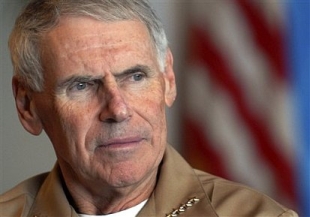
fallon.jpgThere is a view abroad, commonly held, that Admiral William “Fox” Fallon has been sacrificed, has been gotten out of the way, by the Bush Administration because he disagreed with its policies on Iran. That Fallon stood in the way of the neo-Conservative cabal who is bent on expanding the Middle East conflict and that, when given the order for the attack (at some point in the future), Fallon would have courageously refused the order and reversed the tide of history.
What bunk.

William Fox Fallon was and is a Navy officer and a patriot. As such, if given a legitimate order from the President of the United States, as passed through the legally constituted chain-of-command, he would have obeyed the order. Of this we can have absolutely no doubt. To do otherwise is treason and to believe otherwise is to believe that Fallon would have rejected every moment of training, every tradition of his service, every law and custom that has governed U.S. civilian-military relations. The problem is not that Fox Fallon disagreed with George Bush.

The problem is that he talked to Thomas Barnett. [complete article]

See also, The man between war and peace (Thomas Barnett) and Commander rejects article of praise (WP).

Editor’s Comment — Sometimes it’s better to get out sooner than later.

As much as I respect the knowledge and views of my friend and colleague Mark Perry, it’s hard for me to believe that Fallon didn’t know exactly what he was in for when agreed to spend several days with Thomas Barnett. Indeed, in addition to spending four-and-a-half days with him, Fallon later welcomed Barnett as a speaker at an event the admiral was hosting.

Barnett blogs: “… since I’d offered him a speech in return for the favor of letting me on the tour, and since his staff took that offer up by asking me to address the Bright Star post-exercise gathering of senior Mideast military leaders (which Fallon was hosting) in Cairo the weekend after the trip, I figured I’d get some chance for F2F [face-to-face] follow-up if required.”

Far from thinking that Fallon took a calculated risk in responding to Esquire’s invitation, I’m more inclined to think that on some level he got what he was asking for.

Barnett is upfront in spelling out his own motives where — in a comment on his blog — he refers to “outing” Fallon:

It’s the secrecy by which decisions are made that has poisoned the well. If “outing” any opposition to the administration’s line puts that person at risk, then is the journalist’s choice simply to ignore the internal debate to spare the public such knowledge?

Cause if it is, then we’re offering descriptions of our own government that historically are better leveled at authoritarian regimes, where America constantly needs to be careful shining a light on dissidents lest they fall under attack by authorities.

If we place our military leadership in that category, then this country is in a world of trouble.

The public’s right to know of internal debates on matters as crucial as to whether or not we go to war with Iran is sacrosanct in my mind. Wars of choice have to be national choices, not just leadership choices.

Fallon is now a free agent. Will he use his influence to more effect outside than he did inside the Pentagon? The answer to that may depend on who wins the Democratic presidential nomination, but if after a diplomatic silence of a few weeks, Ret Adm Fallon lends some solid military credibility to the campaign of the young senator from Illinois, I wouldn’t be surprised. And then, speculating even further over the horizon, why should we not ask: Which position offers the greater potential for Fallon to fulfill his stated mission?

He said, “I’d like to continue to do things that will be useful to the world and its inhabitants.”

Was he seeing himself as head of CENTCOM when he said that, or might he have had had some inkling that a larger brief lay ahead? Secretary of Defense, or Secretary of State, perhaps….

Facebooktwittermail

NEWS & FEATURE: Fallon quits

Top U.S. commander in Mideast to retire early

Adm. William J. Fallon, the top American commander in the Middle East whose views on Iran and other issues have seemed to put him at odds with the Bush administration, is retiring early, the Pentagon said Tuesday afternoon.

The retirement of Admiral Fallon, 63, who only a year ago became the first Navy man to be named the commander of the United States Central Command, was announced by his civilian boss, Defense Secretary Robert M. Gates, who said that he accepted the admiral’s request to retire “with reluctance and regret.”

President Bush said Admiral Fallon had served his country with “honor, determination and commitment” and deserved “considerable credit” for the progress in Afghanistan and Iraq.

But despite the warm words from Mr. Bush and Mr. Gates, there was no question that the admiral’s premature departure stemmed from a public appearance of policy differences with the administration, and with Gen. David H. Petraeus, the American commander in Iraq. [complete article]

The man between war and peace

If, in the dying light of the Bush administration, we go to war with Iran, it’ll all come down to one man. If we do not go to war with Iran, it’ll come down to the same man. He is that rarest of creatures in the Bush universe: the good cop on Iran, and a man of strategic brilliance. His name is William Fallon, although all of his friends call him “Fox,” which was his fighter-pilot call sign decades ago. Forty years into a military career that has seen this admiral rule over America’s two most important combatant commands, Pacific Command and now United States Central Command, it’s impossible to make this guy–as he likes to say–“nervous in the service.” Past American governments have used saber rattling as a useful tactic to get some bad actor on the world stage to fall in line. This government hasn’t mastered that kind of subtlety. When Dick Cheney has rattled his saber, it has generally meant that he intends to use it. And in spite of recent war spasms aimed at Iran from this sclerotic administration, Fallon is in no hurry to pick up any campaign medals for Iran. And therein lies the rub for the hard-liners led by Cheney. Army General David Petraeus, commanding America’s forces in Iraq, may say, “You cannot win in Iraq solely in Iraq,” but Fox Fallon is Petraeus’s boss, and he is the commander of United States Central Command, and Fallon doesn’t extend Petraeus’s logic to mean war against Iran. [complete article]

Commander rejects article of praise

The top U.S. commander in the Middle East is the subject of a glowing magazine article describing him as the only person who might stop the Bush administration from going to war against Iran.

Esquire magazine’s forthcoming profile of Adm. William “Fox” Fallon portrays the chief of the U.S. Central Command as “brazenly challenging” President Bush on Iran, pushing back “against what he saw as an ill-advised action.”

Written by Thomas P.M. Barnett, a former professor at the Naval War College, the article in the magazine’s April issue predicts that if Fallon leaves his position at Central Command, “it may well mean that the president and vice president intend to take military action against Iran before the end of this year and don’t want a commander standing in their way.”

The article is written in an admiring fashion, praising Fallon as “a man of strategic brilliance” whose understanding of the tumultuous situation in Pakistan “is far more complex than anyone else’s.”

Asked about the article yesterday, Fallon called it “poison pen stuff” that is “really disrespectful and ugly.” He did not cite specific objections. [complete article]

Facebooktwittermail

GUEST CONTRIBUTOR – John Robertson: The bullies converge

The bullies converge
By John Robertson, War in Context, March 3, 2008

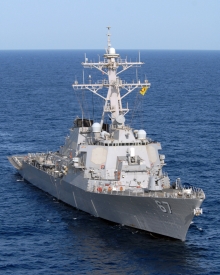
uss-cole.jpg28 and 29 February: the US parks the USS Cole off the shore of Lebanon. Uh-oh.

1 March: Israeli forces launch a major operation into Gaza, killing as many as 60 Palestinians, many of them civilians and children.

Senators Clinton, McCain, and Obama daily wage verbal slugfests on national security, the US’s proper role in the Middle East, and which of them will be best prepared to defend “our strong ally” Israel. OK, business as usual in an election year?

Er, . . . wait a minute.

The timing here ought to be raising antennae here in the US. You can bet that the Arab and Iranian “street” will be taking due note.

The arrival of a US Navy vessel off the coast of Lebanon had to send chills up the spines of many Lebanese. As Roger Morris recently reminded us in his chronicle of the life of Hezbollah “engineer” Imad Mugnieh, the US Navy has pumped shells into Lebanese villages on several occasions (even rolling out a World War II era battleship, the USS New Jersey, on one occasion to use its huge shells to get maximum killing and intimidation effect on the unfortunate villagers on whom they rained down ). That was in the context of the Lebanese civil war of 1975-1990, which featured ongoing deadly scrums involving the IDF, the PLO, and various Lebanese militias – Christian and Muslim, including the newly established Hezbollah. In the summer of 2006, Israel and Hezbollah got into it again, with horrific toll in life and infrastructure (especially on the Lebanese side) while US Secretary of State Condoleeza Rice, as a rather ghoulish birthing coach, urged on the IDF during what she then called the “birth pangs of a new Middle East.” Now, in March 2008, the Lebanese government is mired in a parliamentary impasse, unable to elect a new president. Not yet a full-fledged civil war in Lebanon, but the US Navy lies offshore again, this time, we’re told, to signal to Hezbollah (which is now a legitimately constituted, democratically elected political party in Lebanon’s political structure) that the US will tolerate no stronger interference from them (or from Syria or Hezbollah’s ally and patron, Iran) as Lebanon’s struggles continue.

Yet the very next day, the IDF launched its deadly raid into Gaza, knowing that Hamas forces would resist with whatever means they could muster but would be ultimately powerless to change the outcome. Might they assume (dare we say, hope?) that Hezbollah and Iran might find this an unacceptable provocation and wish to retaliate against Israel? Except that – gosh, wouldn’t you know it? – the US Navy is parked right offshore. And wouldn’t you know it? It’s the USS Cole, the same USS Cole in whose side an al-Qaeda suicide boat blew a hole in those distant days before 9-11. The irony is palpable – indeed, dare we say, intended? Certainly, from the US perspective, delicious.

So, with the US looming in the wings, Israel can do what it wants to in Gaza. And if Hezbollah (and, by implication, Iran) decide not to respond to Israel’s wanton holocaust of innocent Palestinians in Gaza (whose lives had already been made miserable by Israel’s US-approved blockade), they run the risk of accusations of cowardice in the face of the Zionist bullies. If they were to rise to the bait and retaliate, they run the risk of the bullies turning against them and trying to flatten them. Israeli prime minister Olmert will jump at the chance to atone for the disaster of the summer 2006 war, and George Bush may get the military confrontation with Iran that he well may have been hoping for all along.

And all the while, our senator-candidates must intone their often rehearsed mantra, “Israel has the right to defend itself against the terrorists.” The US Navy offshore, the US presidential candidates cowed by political realities in an election season — how much better cover could the bully have?

John Robertson is a professor of Middle East history at Central Michigan University and has his own blog, Chippshots.

Editor’s Comment — It’s worth recalling that less than two weeks before the beginning of the 2006 Lebanon War, Israel was in the middle of pounding Gaza in what Mahmoud Abbas described as an “unacceptable and barbaric collective punishment of civilians, including women, children and old people.”

Facebooktwittermail