John R. Schindler writes: It would be terrible for the United States if the Trump administration convinces citizens that any sort of derin devlet [Deep State] in Turkish fashion exists in our country. Since it certainly does not. In the first place, American spies exhibit no political unity. There are Republicans, there are Democrats, there are Independents. Nearly every political viewpoint under the sun is represented in the IC, and while generalizations can be made — e.g. FBI agents are mostly conservatives while CIA analysts are largely liberals — they are so broad, and so marred by exceptions, as to be almost useless.
When spies in Washington leak to the media, they do so not out of any ideology, much less overt partisanship, but to protect bureaucratic turf and to settle personal scores. Mark Felt, the senior FBI official whose leaks to The Washington Post as the infamous Deep Throat made Watergate a national scandal, spilled the beans on the Nixon White House for entirely personal reasons. President Nixon repeatedly refused to appoint Felt — who was no liberal — the Bureau’s director, the top post that the bitter leaker felt he deserved. Exposing the Watergate scandal was Felt’s careerist vendetta.
Today, the Intelligence Community is deeply unhappy with President Trump. They dislike his repeated public insults and impugning of their professional integrity — something no president has ever done before. Many spies distrust the commander-in-chief, which is why some of our secret agencies are withholding highly classified intelligence from a White House they think is penetrated by Russian intelligence.
The Russia angle is most troubling to the IC. Behind closed doors, plenty of American intelligence experts believe that President Trump is the pawn of the Kremlin, wittingly or not, and assess that it’s only a matter of time before unseemly Moscow ties are exposed and the White House enters unsurvivable political crisis. [Continue reading…]
Category Archives: US government
A nation of immigrants enters dark chapter
Raul A. Reyes writes: The deportation force is here. According to new Department of Homeland Security (DHS) memos, the Trump administration plans to vastly expand the pool of undocumented immigrants in the United States who will be targeted for removal.
Virtually everyone who is in the country without documentation is now eligible for deportation, and some in an expedited fashion. These memos, signed by DHS Secretary John Kelly, were rolled out on Tuesday.
There are two memos at issue here; one dealing with interior immigration enforcement, and the other with border security. They provide a scary picture of what life will soon look like for the estimated 11 million undocumented men, women, and children who live among us. But President Donald Trump’s deportations won’t necessarily make us safer, let alone “great again.” Instead they are a mixture of harsh new policies and questionable ideas from the past.
The most important thing to know about Trump’s deportation force is that they will be going after everyone they can. [Continue reading…]
New Trump deportation rules allow far more expulsions
The New York Times reports: President Trump has directed his administration to more aggressively enforce the nation’s immigration laws, unleashing the full force of the federal government to find, arrest and deport those in the country illegally, regardless of whether they have committed serious crimes.
Documents released on Tuesday by the Department of Homeland Security revealed the broad scope of the president’s ambitions: to publicize crimes by immigrants; enlist local police officers as enforcers; strip immigrants of privacy rights; erect new detention facilities; discourage asylum seekers; and, ultimately, speed up deportations.
The new enforcement policies put into practice the fearful speech that Mr. Trump offered on the campaign trail, vastly expanding the definition of “criminal aliens” and warning that such unauthorized immigrants “routinely victimize Americans,” disregard the “rule of law and pose a threat” to people in communities across the United States.
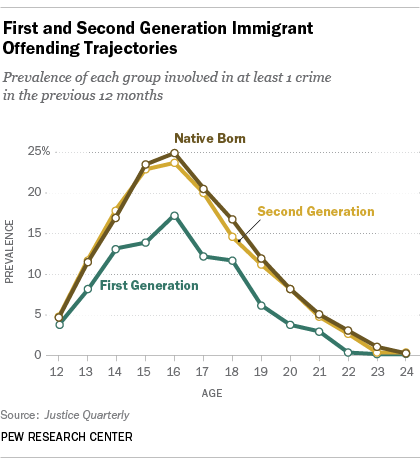
Despite Mr. Trump’s talk, research shows lower levels of crime among immigrants than among native-born Americans. [Continue reading…]
A report published by Pew Research Center in 2013 states: The crime rate among first-generation immigrants—those who came to this country from somewhere else—is significantly lower than the overall crime rate and that of the second generation. It’s even lower for those in their teens and early 20s, the age range when criminal involvement peaks. [Continue reading…]

Jim Mattis to Baghdad: ‘We’re not in Iraq to seize anybody’s oil’
The New York Times reports: Defense Secretary Jim Mattis, on the first visit by a senior Trump administration official to Iraq, worked on Monday to repair breaches of trust with Iraq’s leaders caused by his boss just as the two sides began a major offensive to oust the Islamic State from its last stronghold in the country.
Mr. Mattis found himself in nearly the same position he was in during his just-finished trip to Europe, where much of his time was spent reassuring wary allies that the United States was still committed to NATO after statements and actions by President Trump seemed to call old alliances into question.
Before arriving in Baghdad, Mr. Mattis was asked by reporters about Mr. Trump’s remarks during a visit to C.I.A. headquarters last month that the United States should have “kept” Iraq’s oil after the American-led invasion, and might still have a chance to do so.
“We’re not in Iraq to seize anybody’s oil,” Mr. Mattis said during a stop in Abu Dhabi, in the United Arab Emirates.
Mr. Mattis also found himself allaying concerns that the administration would exclude from the United States Iraqis who have worked and fought side by side with American troops. [Continue reading…]
I didn’t think I’d ever leave the CIA. But because of Trump, I quit
Edward Price worked at the CIA from 2006 until this month, most recently as the spokesman for the National Security Council. He writes: Nearly 15 years ago, I informed my skeptical father that I was pursuing a job with the Central Intelligence Agency. Among his many concerns was that others would never believe I had resigned from the agency when I sought my next job. “Once CIA, always CIA,” he said. But that didn’t give me pause. This wouldn’t be just my first real job, I thought then; it would be my career.
That changed when I formally resigned last week. Despite working proudly for Republican and Democratic presidents, I reluctantly concluded that I cannot in good faith serve this administration as an intelligence professional.
This was not a decision I made lightly. I sought out the CIA as a college student, convinced that it was the ideal place to serve my country and put an otherwise abstract international-relations degree to use. I wasn’t disappointed. [Continue reading…]
British Muslim teacher denied entry to U.S. on school trip
The Guardian reports: A British Muslim schoolteacher travelling to New York last week as a member of a school party from south Wales was denied entry to the United States.
Juhel Miah and a group of children and other teachers were about to take off from Iceland on 16 February on their way to the US when he was removed from the plane at Reykjavik. The previous week, on the 10 February, a US appeals court had upheld a decision to suspend Donald Trump’s executive order that temporarily banned entry to the country from seven Muslim-majority countries.
The trip proceeded as planned but pupils and colleagues from Llangatwg comprehensive in Aberdulais were left shocked and distressed after the maths teacher, who had valid visa documentation, was escorted from the aircraft by security personnel.
The teacher’s employer, Neath Port Talbot council, has written to the US embassy in London demanding an explanation and the issue is being taken up by Welsh politicians.
A council spokesman said Miah was left feeling belittled at what it described as “an unjustified act of discrimination”. The council said the teacher is a British citizen and does not have dual nationality. [Continue reading…]
Will Republicans break with Trump over Russia?
Susan B Glasser writes: President Donald Trump is “dangerously naïve.”
He has a “pathological unwillingness to criticize anything the Kremlin does.” He is discrediting U.S. intelligence agencies and “telling the world they can’t be believed.”
As for Trump’s refusal to disavow Russian President Vladimir Putin and the murders and poisonings of Putin critics in recent years because, as Trump put it, America has “killers” too? “I don’t think we’ve ever had a more harmful statement come out of the Oval Office than that one,” says Rep. Adam Schiff, ranking member of the House intelligence committee, in an extensive interview for our new podcast, The Global Politico.
Schiff, a Harvard-trained lawyer who made his career by prosecuting an FBI agent caught in a sex-for-secrets trap by the Soviet Union, has been one of the leading Democrats calling for a more serious investigation of Trump’s mysterious ties to Russia. Last week, when national security adviser Michael Flynn was forced to resign after misleading the vice president about his December phone call with the Russian ambassador, Schiff quickly demanded an expansion of the House intel panel’s probe of the 2016 election hacking to include the Flynn matter, an expansion Chairman Devin Nunes reluctantly agreed to late last week. [Continue reading…]
Bloomberg reports: U.S. Senator Lindsey Graham promised that Congress will press ahead with a bill to sanction Russia for interfering in the U.S. presidential election, and investigate the methods it used, to make sure other countries don’t fall victim to similar hacking attacks.
Graham, a Republican from South Carolina, called on President Donald Trump to make a clear statement that Russia must pay a price for interfering with the election even though Democrats suffered most from the hacking. A Senate bill to sanction Russia is likely to get more than 75 votes and Trump should sign it, he told the Munich Security Conference on Sunday. [Continue reading…]
Trump’s plan to eviscerate the State Department
The Associated Press reports: In his first weeks as America’s top diplomat, [Secretary of State Rex] Tillerson has gone to great lengths to avoid attracting attention, despite a growing perception in Washington that the State Department is being sidelined by a power-centric White House.
Some State Department officials have been told by the White House to expect drastic budget cuts, with much of the reduction potentially coming out of U.S. foreign aid money. Trump and his team have also told those interviewing for top State Department jobs that significant staffing cuts will come. Some appear to have started already.
While Tillerson was in Germany, several senior management and advisory positions were eliminated. The staffers were reassigned. Some other top posts are vacant, and there are no signs they’ll be quickly filled.
While Tillerson has met or spoken with dozens of foreign counterparts in his first weeks, the White House is driving the front-page diplomacy. The lack of State Department involvement has flustered many long-time diplomats.
When Trump met Israeli Prime Minister Benjamin Netanyahu last week, acting Deputy Secretary Tom Shannon was assigned to represent the agency in the meeting because Tillerson was flying to Germany. At the last minute, Shannon was blocked from participating in the meeting. The meeting went on without State Department representation. [Continue reading…]
Defense Secretary Mattis disagrees with Trump, says he does not see media as the enemy
The Washington Post reports: Defense Secretary Jim Mattis said Sunday that he does not see the media as the enemy of the American people, disagreeing with a claim made Friday by President Trump about numerous outlets.
Mattis, asked directly about Trump’s criticism of the media, said he has had “some rather contentious times with the press” but considers the institution “a constituency that we deal with.” The defense secretary added: “I don’t have any issues with the press myself.”
The comments came during a trip to Europe and the Middle East intended to reassure allies and gather information about ongoing operations. Mattis, a retired Marine general, also acknowledged concerns about the administration raised by Army Gen. Raymond “Tony” Thomas, the chief of U.S. Special Operations Command. Thomas said at a conference Tuesday that “our government continues to be in unbelievable turmoil” and that he hopes “they sort it out soon because we’re a nation at war.”
Mattis said Sunday that he has been talking with a “fair number of military commanders around the world” and believes Thomas was “probably taken a bit out of context because we all want to see everything moving smoothly.” But Mattis also acknowledged the chaotic nature of Trump’s administration so far.
“Welcome to democracy,” Mattis said. “It’s at times wildly contentious. It’s at times quite sporting. But the bottom line is this is the best form of government that we can come up with. So, the military’s job is to hold the line, and to hold the line, and to hold the line while our government sorts out the way ahead and our people speak. We don’t have any disarray inside the military, and that’s where my responsibility resides.” [Continue reading…]
Robin Wright writes: Trump’s baffling foreign policy is a central focus of the annual Munich Security Conference this weekend. Top officials from almost fifty countries — including Mattis and Vice-President Mike Pence — are attending the three-day event, which is the premier global forum on security policy. The preparatory report — written by an international team as the official “conversation starter” — uses stark language about the new American President. “The worries are that Trump will embark on a foreign policy based on superficial quick wins, zero-sum games, and mostly bilateral transactions — and that he may ignore the value of international order building, steady alliances, and strategic thinking,” it says. “Or, maybe worse, that he sees foreign and security policy as a game to be used whenever he needs distractions for domestic political purposes.” The report, “Post-Truth, Post-West, Post-Order?” adds candidly, “What is uncertain is how Trump’s core beliefs will translate into policy (and whether policies will be coherent).”
In an ominous introductory note, the conference’s chairman, Wolfgang Ischinger, a widely respected former German Ambassador to Washington, warns of the dangers to global order if the United States reneges on international commitments and pursues a more unilateralist and nationalistic agenda. He writes, “We may, then, be on the brink of a post-Western age, one in which non-Western actors are shaping international affairs, often in parallel or even to the detriment of precisely those multilateral frameworks that have formed the bedrock of the liberal international order since 1945. Are we entering a post-order world?” [Continue reading…]
Why the U.S. should rethink its anti-ISIS Syria strategy
Hassan Hassan writes: The imminent battle to dislodge ISIL from Raqqa can deliver many things. It can be a deadly blow to ISIL in a country where it has little experience – relative to Iraq where it originated. It can be the beginning of a process to steer much of the country in a new direction. Or it can merely reset the conditions for a more chaotic north where ISIL will still be a player and other jihadist organisations will return.
The most significant battle against ISIL in Syria is muddled by the conflict between Turkey and the Kurdish militias in northern Syria. Both the United States and Turkey exerted little effort over the past two and a half years to adequately prepare for this battle. As the battle approaches, the two find themselves stuck with the forces they perceive as better positioned to do the job, when neither choice is appropriate for such an important battle.
The US had an Iraq-first strategy for the best part of the Operation Inherent Resolve, while it relied on the YPG, the Kurdish People’s Protection Units, to fight in Syria. Whereas the international coalition prepared well for Mosul and ensured that Kurdish and Shia militias do not fight in the city, the same has not been done in Syria. Kurdish militias appear primed to spearhead the fight in Raqqa. [Continue reading…]
‘Psychological warfare’: Immigrants in America held hostage by fear of raids
The Guardian reports: Immigrant communities across the United States are in a state of fear and uncertainty after a week of immigration raids and leaks from the Trump administration that have raised the specter of a mass deportations.
The White House denied the most alarming leak – a draft memo suggesting it considered mobilising 100,000 national guard troops to round up and deport unauthorised immigrants, including millions living nowhere near the Mexico border – was current administration policy.
However the 11-page memo has compounded fears among immigrant communities that Trump’s campaign promise of a hardline clampdown on immigration, dismissed by some at the time as little more than heated rhetoric, is about to be realized.
“It’s almost like it’s psychological warfare that’s being waged against people of color to create a constant feeling of fear and uncertainty,” said Juanita Molina, the executive director of Border Action Network, a human rights organization in Tucson, Arizona. [Continue reading…]
The Washington Post reports: Homeland Security Secretary John F. Kelly has signed sweeping new guidelines that empower federal authorities to more aggressively detain and deport illegal immigrants inside the United States and at the border.
In a pair of memos, Kelly offered more detail on plans for the agency to hire thousands of additional enforcement agents, expand the pool of immigrants who are prioritized for removal, speed up deportation hearings and enlist local law enforcement to help make arrests.
The new directives would supersede nearly all of those issued under previous administrations, Kelly said, including measures from President Barack Obama aimed at focusing deportations exclusively on hardened criminals and those with terrorist ties.
“The surge of immigration at the southern border has overwhelmed federal agencies and resources and has created a significant national security vulnerability to the United States,” Kelly stated in the guidelines. [Continue reading…]
Republicans are failing to protect the nation
.@Evan_McMullin: President Trump’s Russian connections present an acute danger to American national security https://t.co/Sr1VIVFTV3
— New Day (@NewDay) February 17, 2017
Evan McMullin, a former CIA officer and chief policy director of the House Republican Conference from January 2015 until August 2016, when he left to run as an independent candidate in the presidential election, writes: President Trump’s disturbing Russian connections present an acute danger to American national security. According to reports this week, Mr. Trump’s team maintained frequent contact with Russian officials, including senior intelligence officers, during the campaign. This led to concerns about possible collusion with one of America’s principal strategic adversaries as it tried to influence the election in Mr. Trump’s favor. On Monday, Mr. Trump’s national security adviser, Michael T. Flynn, was forced to resign after details of his communications with the Russian ambassador emerged.
Republican leaders in Congress now bear the most responsibility for holding the president accountable and protecting the nation. They can’t say they didn’t see the Russian interference coming. They knew all along.
Early in 2015, senior Republican congressional leaders visited Ukraine and returned full of praise for its fight for independence in spite of Russia’s efforts to destabilize the country and annex some of its regions. And in June, coincidentally just before Mr. Trump announced his campaign for the Republican nomination, they met with Ukraine’s prime minister in Washington — one of many meetings I attended as a senior aide to the House Republican Conference.
As the presidential race wore on, some of those leaders began to see parallels between Russia’s disinformation operations in Ukraine and Europe and its activities in the United States. They were alarmed by the Kremlin-backed cable network RT America, which was running stories intended, they judged, to undermine Americans’ trust in democratic institutions and promote Mr. Trump’s candidacy. Deeply unsettled, the leaders discussed these concerns privately on several occasions I witnessed. [Continue reading…]
A suspicious pattern is emerging for how the White House handles its most controversial plans
Business Insider reports: The White House quickly denied an explosive Associated Press report published Friday morning that said the Department of Homeland Security (DHS) was seeking to mobilize 100,000 National Guard troops to round up and deport immigrants living in the US illegally.
“It is false,” the White House press secretary, Sean Spicer, said, according to a pool report. “It is irresponsible to be saying this. There is no effort at all to round up, to utilize the National Guard to round up illegal immigrants.”
“I wish you guys had asked before you tweeted,” Spicer added.
An AP reporter, however, replied that the wire service had asked the White House for comment multiple times before publishing the report, which was based off of a leaked DHS draft memo. The original AP story notes that neither the White House nor the Department of Homeland Security responded to requests for comment.
“AP reached out to the White House repeatedly beginning 24 hours before publishing this story and also asked the Department of Homeland Security for comment prior to publication,” the AP’s director of media relations told Business Insider. “We stand by our reporting.”
The incident reflects an emerging pattern noted by several top political reporters in how the Trump administration handles its most controversial policy proposals, and undermines the press in the process: [Continue reading…]
Feinstein: Trump trademark in China may violate Constitution
Politico reports: A decision by the Chinese government to grant President Donald Trump a trademark for his brand could be a breach of the U.S. Constitution, a senior Democratic senator warned Friday.
“China’s decision to award President Trump with a new trademark allowing him to profit from the use of his name is a clear conflict of interest and deeply troubling,” said Sen. Dianne Feinstein (D-Calif.) in a statement. “If this isn’t a violation of the Emoluments Clause, I don’t know what is.”
The Emoluments Clause of the Constitution prohibits federal officials — including the president — from accepting payments from foreign governments. Trump’s critics have argued that Trump’s opaque and byzantine business network could run afoul of this principle. [Continue reading…]
Flynn apparently lied to the FBI about discussions on sanctions with Russian ambassador
The Washington Post reports: Former national security adviser Michael Flynn denied to FBI agents in an interview last month that he had discussed U.S. sanctions against Russia with that country’s ambassador to the United States before President Trump took office, contradicting the contents of intercepted communications collected by intelligence agencies, current and former U.S. officials said.
The Jan. 24 interview potentially puts Flynn in legal jeopardy. Lying to the FBI is a felony offense. But several officials said it is unclear whether prosecutors would attempt to bring a case, in part because Flynn may parse the definition of the word “sanctions.” He also followed his denial to the FBI by saying he couldn’t recall all of the conversation, officials said.
Any decision to prosecute would ultimately lie with the Justice Department. [Continue reading…]
Pentagon: No records of Flynn’s 2015 Russia trip
Politico reports: The Pentagon has informed lawmakers that there are no records of former national security adviser Michael Flynn’s 2015 trip to Moscow, when he dined with Russian President Vladimir Putin and may have accepted unconstitutional payments from a foreign government for his attendance.
In a letter to the Republican and Democratic leaders of the House oversight committee delivered Tuesday, acting Army Secretary Robert Speer confirmed that Flynn — a retired lieutenant general — filed no documentation of his trip.
In response, House oversight committee Chairman Jason Chaffetz and Elijah Cummings, ranking Democrat on the committee, sent a letter that suggests Flynn may have inappropriately accepted payments from the Russian government or its agents in exchange for his attendance. Scrutiny is growing on Flynn’s trip and whether his payment violated the Constitution’s Emolument’s Clause, which prohibits any person holding an “office of profit or trust” in the federal government from accepting foreign payment. The prohibition has long been considered to apply for retired military officials. [Continue reading…]
How Trump is undermining public trust in the military
Benjamin Haas writes: After his inauguration, President Donald Trump didn’t take long to boast of his purported political support from the military. In his speech to the CIA – given in front of the Memorial Wall that honors CIA employees who have died in the line of duty – he claimed that “the military gave us tremendous percentages of votes. We were unbelievably successful in the election with getting the vote of the military.”
As a former Army officer, I know that new officers and enlistees take an oath to “support and defend the Constitution,” not a particular president or party. Therefore, Trump’s comments struck me as jarringly improper. So when I learned that Trump would speak to soldiers at U.S. Central Command (CENTCOM) in Florida last week, I wondered whether he would echo the claim he’d made at the CIA or demonstrate that he’d learned his lesson.
Just a few lines into his speech, Trump answered my question: “We had a wonderful election, didn’t we? And I saw those numbers, and you liked me, and I liked you. That’s the way it worked,” Trump declared.
There are two problems with Trump’s statements. First, they are misleading at best, false at worst. Second – and more importantly – politicizing the military risks undermining the public’s trust in the armed forces, an institution that enjoys greater public confidence than any other in the country. [Continue reading…]
Out of the loop: Rex Tillerson finds State Department sidelined by White House
The Guardian reports: Given the time vetting and congressional confirmation takes, Tillerson is now facing many months of working with a severely depleted team of senior staff.
“What concerns me is that in the absence of any confirmed officials other than the secretary, they will not have the weight to make those educated voices heard as the White House makes policy,” said Thomas Countryman, former assistant secretary of state for international security and nonproliferation and one of the senior staff who was suddenly sacked before Tillerson’s arrival.
“My nagging suspicion is that the White House is very happy to have a vacuum in the under-secretary and assistant secretary levels, not only at state but across government agencies, because it relieves them of even feeling an obligation to consult with experts before they take a new direction.”
In normal times, the state department is a constant part of an inter-agency policymaking process coordinated by the national security council. But the NSC is in crisis and not just because its leader, Michael Flynn, was forced to resign after details of his discussions with the Russian ambassador were revealed.
The NSC itself is being bypassed on key decisions by a small group of highly ideological advisers around Trump led by his chief strategist, Steve Bannon, a former Breitbart News executive with ties to the far right. Bannon has presented his role as one of a deliberate disruptor of the Washington establishment and its normal ways of functioning. [Continue reading…]