The Jerusalem Post reports: The European Union’s guidelines on consumer labels for Israeli products produced over the pre-1967 lines is not tantamount to a boycott of Israel, Edgar Vasquez, a State Department spokesman, told The Jerusalem Post.
“We do not believe that labeling the origin of products is equivalent to a boycott. And as you know, we do not consider settlements to be part of Israel. We do not view labeling the origin of products being from the settlements as a boycott of Israel,” Vasquez said.
The EU has also insisted that the measure is not a boycott of Israel and that their concern is the consumer’s right to know as well as compliance with EU legislation. [Continue reading…]
Category Archives: US government
How policing in the U.S. is relentlessly being militarized
GQ reports: Last month, the local press in New York confirmed what civil rights advocates had been saying for years: the NYPD has been driving around in unmarked vans chock full of X-ray equipment and scanning for… something.
It was a major story, mostly because not much is known about “Z Backscatter” vans other than that they cost somewhere between $729,000 and $825,000. Yet, there’s no way to know for sure what they’re capable of because the NYPD refuses to talk about them, even though the ACLU won a lawsuit that required the department to reveal records about the vans (including their potential health impacts on people who might be exposed to X-rays without knowing it). “The devices we have, the vehicles if you will, are all used lawfully and if the ACLU and others don’t think that’s the case, we’ll see them in court — where they’ll lose!” Commissioner Bill Bratton told the New York Post.
The X-ray vans bring up all kinds of concerns about privacy, health, and general ickiness — no one wants to walk around New York wondering whether some bored cop in a van is checking out your skivvies — but by today’s police tech standards, the vans are actually relatively low-tech and benign. Departments large and small are using a host of new gadgets — from laser light weapons that can induce vomiting to surveillance systems that can predict crimes before they happen.
And what’s scariest of all is the majority of these technologies are being funneled down from the U.S. Military, down into neighborhoods that are most definitely not war zones. “After 15 years of war, there’s a demand for all these companies to find new markets for all these technologies,” said Joel Pruce a professor of human rights at the University of Dayton who studies police technology. “So it trickles down from the military to police.” The revelations about the backscatter vans were just one more sign that the future of policing is here, and it’s terrifying. [Continue reading…]
Tom Engelhardt: Roads to nowhere, ghost soldiers, and a $43 million gas station in Afghanistan
It’s a $cam!
The American way of war in the twenty-first century
By Tom Engelhardt
Let’s begin with the $12 billion in shrink-wrapped $100 bills, Iraqi oil money held in the U.S. The Bush administration began flying it into Baghdad on C-130s soon after U.S. troops entered that city in April 2003. Essentially dumped into the void that had once been the Iraqi state, at least $1.2 to $1.6 billion of it was stolen and ended up years later in a mysterious bunker in Lebanon. And that’s just what happened as the starting gun went off.
It’s never ended. In 2011, the final report of the congressionally mandated Commission on Wartime Contracting estimated that somewhere between $31 billion and $60 billion taxpayer dollars had been lost to fraud and waste in the American “reconstruction” of Iraq and Afghanistan. In Iraq, for instance, there was that $75 million police academy, initially hailed “as crucial to U.S. efforts to prepare Iraqis to take control of the country’s security.” It was, however, so poorly constructed that it proved a health hazard. In 2006, “feces and urine rained from the ceilings in [its] student barracks” and that was only the beginning of its problems.
When the bad press started, Parsons Corporation, the private contractor that built it, agreed to fix it for nothing more than the princely sum already paid. A year later, a New York Times reporter visited and found that “the ceilings are still stained with excrement, parts of the structures are crumbling, and sections of the buildings are unusable because the toilets are filthy and nonfunctioning.” This seems to have been par for the course. Typically enough, the Khan Bani Saad Correctional Facility, a $40 million prison Parsons also contracted to build, was never even finished.
And these were hardly isolated cases or problems specific to Iraq. Consider, for instance, those police stations in Afghanistan believed to be crucial to “standing up” a new security force in that country. Despite the money poured into them and endless cost overruns, many were either never completed or never built, leaving new Afghan police recruits camping out. And the police were hardly alone. Take the $3.4 million unfinished teacher-training center in Sheberghan, Afghanistan, that an Iraqi company was contracted to build (using, of course, American dollars) and from which it walked away, money in hand.
And why stick to buildings, when there were those Iraqi roads to nowhere paid for by American dollars? At least one of them did at least prove useful to insurgent groups moving their guerrillas around (like the $37 million bridge the U.S. Army Corps of Engineers built between Afghanistan and Tajikistan that helped facilitate the region’s booming drug trade in opium and heroin). In Afghanistan, Highway 1 between the capital Kabul and the southern city of Kandahar, unofficially dubbed the “highway to nowhere,” was so poorly constructed that it began crumbling in its first Afghan winter.
And don’t think that this was an aberration. The U.S. Agency for International Development (USAID) hired an American nonprofit, International Relief and Development (IRD), to oversee an ambitious road-building program meant to gain the support of rural villagers. Almost $300 million later, it could point to “less than 100 miles of gravel road completed.” Each mile of road had, by then, cost U.S. taxpayers $2.8 million, instead of the expected $290,000, while a quarter of the road-building funds reportedly went directly to IRD for administrative and staff costs. Needless to say, as the road program failed, USAID hired IRD to oversee other non-transportation projects.
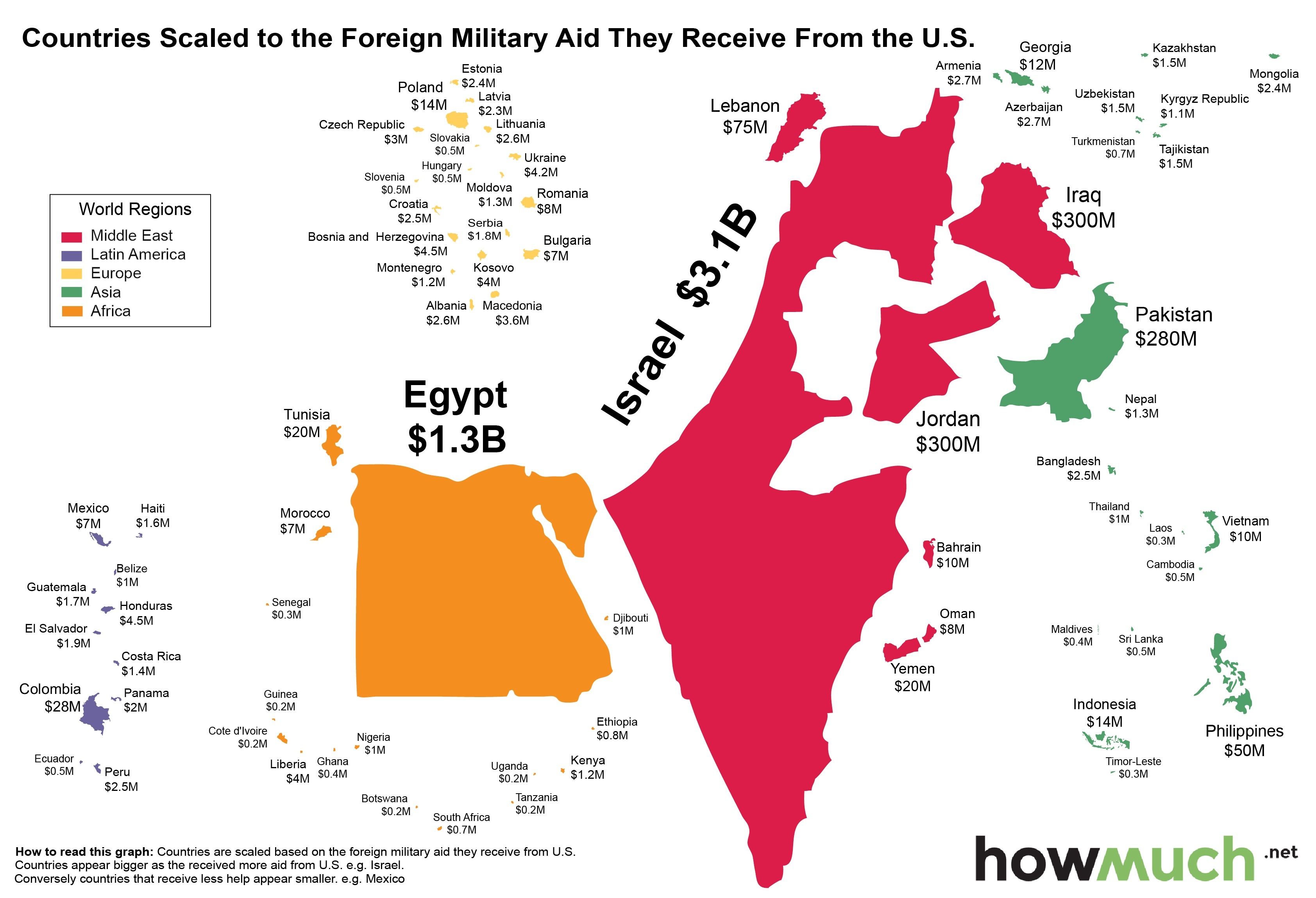
Map: As a recipient of U.S. military aid, Israel dwarfs the rest of the world
Is the Iraqi army a lost cause?
By Jon Moran, University of Leicester
Building an army in a short space of time is a very difficult task. To be sure, there are some impressive examples. Cromwell’s republican New Model Army was put together while the English Civil War was already underway; Washington’s army of US Independence quickly wore down and beat the British in the 18th century; Napoleon’s revolutionary army was born from the French Revolution and swept all Europe before it; the Red Army of the Soviet Union was forged from the chaos of its defeat in World War I.
But the list of failures is just as spectacular. The South Vietnamese Army boasted billions of dollars, up-to-date equipment and state-of-the-art training, but couldn’t control even South Vietnam itself. It ultimately surprised observers only by holding on as long as it did after the Americans left.
The Soviet Union similarly built up the communist army in Afghanistan but always distrusted it as a fighting force; it ultimately suffered mass desertions.
And the latest ignominious addition to the list seems to be the Iraqi Army. Despite being nourished, trained and supplied by the US, it seems to be perpetually in trouble, whether failing to fend off terrorist groups or all but collapsing in the face of a stunning advance by Islamic State (IS).
Senior U.S. intelligence official says escalation of Russian bombing in Syria ‘should be fun’
When journalists grant government sources anonymity, the proforma explanation for doing so is the following line (or one of its common variants): officials spoke on the condition of anonymity because they’re not authorized to comment publicly.
That claim is almost always false. Authorization is besides the point. The primary reason for an official wanting anonymity is so that his or her remarks will have no return address. No one other than the journalist offering their source camouflage will be in a position to come back with a follow-up question. When there is no risk of any comeback, assertions can be made and opinions expressed in the knowledge that they will escape critical scrutiny. Likewise, propositions can be floated and later easily abandoned.
Another reason sources want anonymity is for the same reason that internet trolls conceal their identities: they don’t want to be held responsible for the language they use. They imagine that invisibility creates space for unvarnished honesty — even though the evidence more often shows that this kind of freedom from social inhibitions has a habit of releasing the inner jerk.
The Daily Beast reports: [S]ix U.S. intelligence and military officials told The Daily Beast that they hoped an ISIS attack on Russian civilians would force Putin to finally take the gloves off and attack the group, which the U.S. has been trying to dislodge from Iraq and Syria for more than a year, without success.
“Now maybe they will start attacking [ISIS],” one senior defense official smugly wondered last week. “And stop helping them,” referring to ISIS gains in Aleppo that came, in part, because the group took advantage of Russian strikes on other rebels and militant outfits.
Since the plane crashed, Russia has struck two ISIS-controlled areas in Syria: Raqqa and Palmyra.
“I suppose now he’ll really let ISIS have it. This should be fun,” one senior intelligence official told The Daily Beast. [Continue reading…]
Fun, perhaps, if you’re an intelligence analyst with a 9-5 job in Langley, Virginia, or the Pentagon. But although Raqqa and Palmyra are under the control of ISIS, they still have civilian populations. And bombing isn’t fun for anyone on the receiving end.
It is already clear that in its bombing operations in Syria, Russia is not greatly concerned about the precision of its targeting. It’s definition of inefficiency is for a jet to return to its base without releasing its bombs.
Those U.S. officials who now relish the prospect of Russia “finally take the gloves off” against ISIS are conjuring images of what are euphemistically described as “robust kinetic operations” — the type that ISIS apparently deserves. Implicit in this characterization is the assumption that restraint is an expression of timidity, the antidote to which is unrestrained force.
In reality, the effect of indiscriminate bombing will be to tell local populations that there are no outside forces working for their liberation.
If the enemies of ISIS pose a greater threat than ISIS itself, the logic for joining ISIS only becomes more compelling.
Two foreign coalitions take turns bombing areas under ISIS control and civilians are expected to tell the difference https://t.co/odQSXp6jsO
— Hassan Hassan (@hxhassan) November 9, 2015
Classified report on the CIA’s secret prisons is caught in limbo
The New York Times reports: A Senate security officer stepped out of the December chill last year and delivered envelopes marked “Top Secret” to the Pentagon, the C.I.A., the State Department and the Justice Department. Inside each packet was a disc containing a 6,700-page classified report on the C.I.A.’s secret prison program and a letter from Senator Dianne Feinstein, urging officials to read the report to ensure that the lessons were not lost to time.
Today, those discs sit untouched in vaults across Washington, still in their original envelopes. The F.B.I. has not retrieved a copy held for it in the Justice Department’s safe. State Department officials, who locked up their copy and marked it “Congressional Record — Do Not Open, Do Not Access” as soon as it arrived, have not read it either.
Nearly a year after the Senate released a declassified 500-page summary of the report, the fate of the entire document remains in limbo, the subject of battles in the courts and in Congress. Until those disputes are resolved, the Justice Department has prohibited officials from the government agencies that possess it from even opening the report, effectively keeping the people in charge of America’s counterterrorism future from reading about its past. There is also the possibility that the documents could remain locked in a Senate vault for good. [Continue reading…]
U.S.-led air war on ISIS in Syria has little allied support
The New York Times reports: As the United States prepares to intensify airstrikes against the Islamic State in Syria, the Arab allies who with great fanfare sent warplanes on the initial missions there a year ago have largely vanished from the campaign.
The Obama administration heralded the Arab air forces flying side by side with American fighter jets in the campaign’s early days as an important show of solidarity against the Islamic State, also known as ISIS or Daesh. Top commanders like Gen. Lloyd J. Austin III, who oversees operations in Syria and Iraq, still laud the Arab countries’ contributions to the fight. But as the United States enters a critical phase of the war in Syria, ordering Special Operations troops to support rebel forces and sending two dozen attack planes to Turkey, the air campaign has evolved into a largely American effort.
Administration officials had sought to avoid the appearance of another American-dominated war, even as most leaders in the Persian Gulf seem more preoccupied with supporting rebels fighting the government of President Bashar al-Assad of Syria. Now, some of those officials note with resignation, the Arab partners have quietly left the United States to run the bulk of the air war in Syria — not the first time Washington has found allies wanting.
Saudi Arabia and the United Arab Emirates have shifted most of their aircraft to their fight against Iranian-backed Houthi rebels in Yemen. Jordan, reacting to the grisly execution of one of its pilots by the Islamic State, and in a show of solidarity with the Saudis, has also diverted combat flights to Yemen. Jets from Bahrain last struck targets in Syria in February, coalition officials said. Qatar is flying patrols over Syria, but its role has been modest. [Continue reading…]
FBI to help Russia investigate plane crash in Egypt
The New York Times reports: The F.B.I. has agreed to help the Russian government with its investigation into the deadly crash of a Russian charter plane in the Sinai Peninsula in Egypt, senior American officials said on Saturday.
Some American officials said that the Russians want help doing a forensic analysis to determine what brought down the Airbus A321-200, while other officials said that the request from the Russians was more general. Although most of the debris is scattered over nearly eight square miles in the desert, some parts of the plane were taken to Russia for analysis.
It is rare for the Russians to make such a request, which was first reported on Friday by CBS News, and some American officials interpreted it as a sign of the challenges facing investigators. [Continue reading…]
The New York Times reports: Russian officials said Saturday that more than 70,000 of their citizens were in Egypt awaiting the arrival of jets being sent to carry them home. British officials said on Saturday that there were about 19,000 Britons at Sharm el Sheikh and that it would take 10 days to get them all home.
The exodus from Sharm el Sheikh has dealt a devastating blow to Egypt’s already sputtering tourism industry. The loss of foreign currency from tourists is likely to greatly increase downward pressure on the value of the Egyptian pound, compounding the damage to the broader economy.
Only a small number of Western European airlines operated direct flights to Sharm el Sheikh before the crash, flying from Britain, Belgium, Germany, Italy and Switzerland. Airlines from some countries, including France and the Netherlands, stopped offering direct service in recent years, in part out of security concerns, European officials said. [Continue reading…]
Global reaction to Egyptian plane crash a real test for Sisi – he received no such censure over Rabaa massacre, which killed 1000+ people.
— Louisa Loveluck (@leloveluck) November 6, 2015
The New York Times reports: Six days after the crash of a Russian charter flight from the Egyptian resort area of Sharm el Sheikh, the government of Egypt is finding itself increasingly isolated in its resistance to the possibility that a terrorist’s bomb brought down the plane.
Britain has concluded the cause was most likely a bomb. President Obama has said pointedly that he takes the possibility “very seriously.” After standing arm in arm with Egypt for six days in discouraging any such discussion of terrorism, even President Vladimir V. Putin on Friday suspended Russia’s flights to Egypt for fear of another attack, stranding tens of thousands of tourists at the resort.
But the government of Egypt, critically dependent on the money tourists bring to Sharm el Sheikh’s resorts, has dismissed any suggestion that a bombing killed the 224 people aboard as “premature,” “surprising” and “unwarranted.”
The widening chasm between Egypt and the world, some say, recalls an earlier crash, in 1999, when EgyptAir Flight 990 plunged into the ocean off the coast of Nantucket Island. Although American investigators said flight records pointed to the decisions of an Egyptian pilot, the Egyptian government blamed a malfunction in the Boeing airplane, and 17 years later the Egyptian-American dispute over the cause is still unresolved.
In that case, the Egyptian investigation was cloaked in mystery and, critics say, politicized from that start.
“I don’t anticipate the Egyptian investigation here to be any more transparent than their work on EgyptAir 990,” James E. Hall, the former head of the National Transportation Safety Board who oversaw that investigation, said in an interview. [Continue reading…]
Médecins Sans Frontières releases internal review of Kunduz hospital attack
Médecins Sans Frontières reports: The international medical humanitarian organization Doctors Without Borders/Médecins Sans Frontières (MSF) today released an internal document reviewing the October 3 airstrikes by US forces on its hospital in northern Afghanistan. The chronological review of the events leading up to, during, and immediately following the airstrikes reveal no reason why the hospital should have come under attack. There were no armed combatants or fighting within or from the hospital grounds.
The document, part of an ongoing review of events undertaken by MSF, is based upon sixty debriefings of MSF national and international employees who worked at the 140-bed trauma center, internal and public information, before and after photographs of the hospital, email correspondence, and telephone call records. At least thirty people were killed in the airstrikes, including 13 staff members, 10 patients and 7 unrecognizable bodies yet to be identified.
“The view from inside the hospital is that this attack was conducted with a purpose to kill and destroy,” said Christopher Stokes, MSF general director. “But we don’t know why. We neither have the view from the cockpit, nor the knowledge of what happened within the US and Afghan military chains of command.”
The initial findings of the MSF review firmly establish the facts from inside the hospital in the days leading up to and during the attack. The review includes the details of the provision of the GPS coordinates and the log of phone calls from MSF to military authorities in attempt to stop the airstrikes. MSF had reached an agreement with all parties to the conflict to respect the neutrality of the hospital, based on international humanitarian law.
“We held up our end of the agreement — the MSF trauma center in Kunduz was fully functioning as a hospital with surgeries ongoing at the time of the US airstrikes,” said Dr. Joanne Liu, international president of MSF. “MSF’s no-weapons policy was respected and hospital staff were in full control of the facility prior to and at the time of the airstrikes.”
Among the 105 patients at the time of the airstrikes, MSF was treating wounded combatants from both sides of the conflict in Kunduz, as well as women and children.
“Some public reports are circulating that the attack on our hospital could be justified because we were treating Taliban,” said Stokes. “Wounded combatants are patients under international law, and must be free from attack and treated without discrimination. Medical staff should never be punished or attacked for providing treatment to wounded combatants.”
The MSF internal review describes patients burning in their beds, medical staff that were decapitated and had lost limbs, and others who were shot from the air while they fled the burning building.
“The attack destroyed our ability to treat patients at a time of their greatest need,” said Dr. Joanne Liu, international president of MSF. “A functioning hospital caring for patients cannot simply lose its protected status and be attacked.”
Ann Jones: The never-ending war
In an effort to attack Taliban fighters, an air strike by a U.S. plane killed dozens of civilians in Kunduz, Afghanistan. In the wake of the attack, an American general responded in unequivocal fashion. “I take this possible loss of life or injury to innocent Afghans very seriously,” he said. “I have ordered a complete investigation into the reasons and results of this attack, which I will share with the Afghan people.”
In an effort to attack Taliban fighters, an air strike by a U.S. plane killed dozens of civilians in Kunduz, Afghanistan. In the wake of the attack, an American general responded in unequivocal fashion. “I want to offer my deepest condolences to those innocent civilians who were harmed and killed on Saturday,” he said. “I’ve ordered a thorough investigation into this tragic incident… we will share the results of the investigation once it is complete.”
The first of those air strikes took place in 2009 and targeted fuel tankers hijacked by the Taliban. The second took place last month and targeted a hospital that Afghan officials say was used as a safe haven by the Taliban. The striking similarities between the two attacks are rooted not in uncanny coincidence but in the law of averages. Bomb a country long enough and such echoes are bound to occur.
Of course, U.S. planes have been carrying out attacks and terrorizing innocent Afghans in and around Kunduz (and elsewhere in the country) since 2001. This is, after all, America’s war in Afghanistan, which has produced eerily repetitive tragedies; a war that’s also seen almost endless announcements of achievements, improvements, and progress; a war that seems to regularly circle back on itself.
“The Taliban is gone,” Army General Tommy Franks, the chief of U.S. Central Command, announced in 2002. “Afghanistan is rising from the oppression of the Taliban into an independent, democratic nation.” Six years later, the Taliban was, oddly enough, still around. But things were still going well. “We’re clearly not done… But I do know that we’re making good progress, and each and every day we’re making a difference in the Afghan people’s lives,” said Army Major General Jeffrey Schloesser. In 2010, Army General David Petraeus offered his unique assessment of the war. “We’re making progress, and progress is winning, if you will,” he insisted. This summer, another five years having passed, Army General John Campbell weighed in: “We have done a great job, both from both a conventional perspective and our special operating forces, and from the Afghan security forces… I see [the Afghans] continue to progress and continue to be very resilient.”
There have been so many claims of “progress” these last 14 years (and so many air strike apologies as well) and yet each announcement of further success seems to signal the very opposite. Days after Campbell spoke, for instance, Brigadier General Wilson Shoffner, the U.S. deputy chief of staff for communications in Afghanistan, told reporters, “Kunduz is — is not now, and has not been in danger of being overrun by the Taliban… that’s sort of how we see it.” Just over a month later, Kunduz fell to the Taliban.
This is the war that TomDispatch regular Ann Jones has monitored, analyzed, and covered since its opening stages, first as a humanitarian worker and then as a reporter. While the military was spinning tales of progress, Jones had a far more realistic assessment. “The story of success in Afghanistan was always more fairy tale than fact — one scam used to sell another,” she wrote at this site in 2006, drawing attention to “a threefold failure: no peace, no democracy, and no reconstruction.” After embedding with U.S. troops in 2010 she said all the things America’s generals never did. “I’d been ‘on the front’ of this war for less than two weeks, and I already needed a vacation,” she wrote. “Being outside the wire had filled me with sorrow as I watched earnest, heavily armed and armored boys try to win over white-bearded Afghans — men of extraordinary dignity — who have seen all this before and know the outcome.”
All this is to say Jones has been remarkably, consistently, undeniably ahead of the curve on the conflict, a reality reflected in her revelatory look at the deeply personal costs of America’s second Afghan War in her now-classic book, They Were Soldiers: How the Wounded Return from America’s Wars — The Untold Story. She’s done what billions of U.S. taxpayer dollars, 17 U.S. intelligence agencies, the finest officers produced by America’s premier military academies, and untold numbers of analysts with access to highly classified information, have failed to do: accurately assess the situation in a country the U.S. has been intimately enmeshed in, on and off now, for the better part of four decades. With that in mind, let Jones give you the lowdown on the current state of “progress” there. When you’re through, chances are — even if you lack a top-secret clearance and have never set foot in the Greater Middle East — you’ll have a better grasp of the reality of the war than either the Pentagon or the president has ever had. Nick Turse
Afghanistan “after” the American war
Once more down the rabbit hole
By Ann JonesTen months ago, on December 28, 2014, a ceremony in Kabul officially marked the conclusion of America’s very long war in Afghanistan. President Obama called that day “a milestone for our country.” After more than 13 years, he said, “our combat mission in Afghanistan is ending, and the longest war in American history is coming to a responsible conclusion.”
That was then. This is now. In between, on September 28, 2015, came another milestone: the Taliban takeover of Kunduz, the capital of the province of the same name in northern Afghanistan, and with a population of about 270,000, the country’s fifth-largest city.
Lawmakers get $83,000 from pipeline company, then rush a bill favoring pipeline construction
David Sirota writes: The fossil fuel industry had already managed to shape a bill moving rapidly through Congress last summer, gaining provisions to ease its ability to export natural gas. But one key objective remained elusive: a measure limiting the authority of local communities to slow the construction of pipelines because of environmental concerns.
Then, U.S. Rep. Fred Upton, a Michigan Republican who chaired the House Energy Committee, gave the industry an opportunity to amplify its influence. Joining forces with Sen. Lisa Murkowski, the Alaska Republican who chaired the Senate Energy Committee, he launched a so-called joint fundraising committee, a campaign war chest that would accept donations from a range of contributors, with the proceeds divided between the two lawmakers.
Executives at one of the nation’s largest natural gas pipeline companies soon deposited more than $83,000 into the joint fund’s coffers. The very next day, Upton delivered on the industry’s aspirations: He rushed a bill through his legislative panel that would not only streamline the approval process for new pipelines but also empower federal officials to impose tight deadlines on state and local governments seeking to review their potential environmental impacts. [Continue reading…]
U.S.-backed offensive against ISIS in northern Syria suffers devastating setback
McClatchy reports: The newest U.S.-backed offensive against the Islamic State in northern Syria suffered a devastating setback when the extremist group detonated an explosive-laden vehicle near a Kurdish-led column of armored vehicles, an Arab militia commander said Monday.
The Islamic State said the suicide bomber, with five tons of explosives, attacked a convoy of 70 vehicles Sunday, including tanks and armored personnel carriers, killed dozens of Arabs and members of the Kurdish People’s Protection Units, or YPG.
Such vehicles are a favorite tactic of the Islamic State in northeastern Syria, according to another commander in the region, Abu Issa, of the Liwa Thurwar Al-Raqqa, or Raqqa Revolutionaries. He said between mid-July and mid-October, the Islamic State had sent 45 such vehicle bombs against his force, which is based north of Raqqa, the Islamic State’s self-styled capital. Among those killed were five of the 20 men who had been trained by the U.S. in the use of TOW anti-tank missiles.
“They empty out a 10-ton armored personnel carrier. They remove the seats and everything. There’s one driver, and he comes really fast,” Abu Issa told McClatchy in an interview last month. He said a TOW missile can stop the vehicle, but he said the U.S. had not supplied his forces with those missiles.
Abu Issa’s is not the only group hoping for U.S. arms in order to take on the Islamic State. Even the Sanadid militia, which took part in the fighting near al Hawl, has yet to receive U.S. ammunition, Bandar told McClatchy on Monday.
“We got nothing yet from the Americans,” he said. [Continue reading…]
How U.S. officials can kidnap and threaten American citizens without legal risk
Patrick G. Eddington writes: At exactly 5 p.m. on March 13, 2007, just as I was preparing to leave my cubicle in Washington for the day, I got a phone call from the journalist Jonathan Landay of McClatchy Newspapers. To this day, I remember his exact words.
“One of your congressman’s constituents is being held in an Ethiopian intelligence service prison, and I think your former employer is neck-deep in this.”
The congressman was Rush Holt, then a Democratic representative from New Jersey, for whom I worked for 10 years starting in 2004. The constituent was Amir Mohamed Meshal of Tinton Falls, N.J., who alleges that he was illegally taken to Ethiopia, where he was threatened with torture by American officials. My “former employer” was the Central Intelligence Agency, but it soon became apparent that the agency “neck-deep in this” was the Federal Bureau of Investigation.
Eight years after Mr. Meshal’s rendition, his case ended up before a three-judge panel of the United States Court of Appeals for the District of Columbia. The questions hanging over the proceeding were: can the United States government allow, or even facilitate, the rendition of an American citizen to another country for interrogation? And can United States officials themselves conduct rendition and interrogations of American citizens, including threats of torture, on foreign soil?
According to a decision handed down last week, the answers appear to be yes. [Continue reading…]
Flash was detected as Russian jet broke apart, U.S. military officials say
The New York Times reports: American military officials said Tuesday that satellite surveillance had detected a large flash of light just as a Russian chartered jet broke apart and fell from the sky over the Sinai Peninsula on Saturday, killing all 224 people aboard.
The United States military is not part of the multinational investigation into the crash, but officials said the satellite images were the first indication that the plane had exploded, because of either a bomb or the ignition of a fuel tank. But it will probably take several more days for the authorities to better understand what occurred.
The disaster has set off waves of hand-wringing in Egypt, Russia and elsewhere about whether mechanical failure, human error or terrorism was the cause. But here in the resort area where the plane took off minutes before the crash, thousands of sun-seekers from Russia and other European countries arriving daily say they are undeterred. Most have already written off the possibility that the crash was terrorism. [Continue reading…]
U.S.-backed ‘Syrian Democratic Forces’ created to fight ISIS, exist only as a name
The New York Times reports: A newly appointed spokesman for the alliance briefed reporters in Syria beneath a yellow banner bearing its name in Kurdish, Arabic and Assyrian. But the meeting took place inside a Kurdish militia facility because the alliance does not have its own bases yet, nor flags to put on its cars or a defined command structure, said the spokesman, Talal Sillu.
The combined force is to be commanded by a six-person military council, Mr. Sillu said. But he acknowledged that only one member had been selected so far — Mr. Sillu himself.
Last week, President Obama announced plans to deploy dozens of Special Operations troops to support the new alliance. And before that, American officials said 50 tons of ammunition had been airdropped for Arab fighters with the new group.
But already, things have not always gone as planned. Since the ammunition airdrop, American officials have privately acknowledged that the Arab units it was intended for did not have the logistical capability to move it. So, again, the Kurds were called to help.
An array of smaller groups have allied with the Kurds, including Arab and Turkmen rebels, Christian militias and Bedouin fighters loyal to a sheikh who considered the Libyan leader Col. Muammar el-Qaddafi a friend.
While these groups hate the Islamic State, most are small, and some have been repeatedly routed by the very jihadists the United States now hopes they will defeat.
While the Kurds have become used to securing territory, with uniformed forces and a clear chain of command, their Arab allies often leave teenagers with Kalashnikovs at checkpoints who stop and release cars at random, scaring drivers.
A commander of one Arab group lamented that while Kurdish commanders could simply order their fighters to move, he could only make suggestions and hope his men complied. [Continue reading…]
U.S. brings F-15C dogfighters to counter Russians over Syria
The Daily Beast reports: The U.S. Air Force is deploying to Turkey up to a dozen jet fighters specializing in air-to-air combat—apparently to help protect other U.S. and allied jets from Russia’s own warplanes flying over Syria.
Officially, the deployment of F-15C Eagle twin-engine fighters to Incirlik, Turkey—which the Pentagon announced late last week—is meant to “ensure the safety” of America’s NATO allies, Laura Seal, a Defense Department spokesperson, told The Daily Beast.
That could mean that the single-seat F-15s and the eight air-to-air missiles they routinely carry will help the Turkish air force patrol Turkey’s border with Syria, intercepting Syrian planes and helicopters that periodically stray into Turkish territory.
But more likely, the F-15s will be escorting attack planes and bombers as they strike ISIS militants in close proximity to Syrian regime forces and the Russian warplanes that, since early October, have bombed ISIS and U.S.-backed rebels fighting the Syrian troops.
Seal declined to discuss the deployment in detail, but hinted at its true purpose. “I didn’t say it wasn’t about Russia,” she said.
Russia’s air wing in western Syria is notable for including several Su-30 fighters that are primarily air-to-air fighters. The Su-30s’ arrival in Syria raised eyebrows, as Moscow insists its forces are only fighting ISIS, but ISIS has no aircraft of its own for the Su-30s to engage.
The F-15s the U.S. Air Force is sending to Turkey will be the first American warplanes in the region that are strictly aerial fighters. The other fighters, attack planes and bombers the Pentagon has deployed — including F-22s, F-16s, A-10s and B-1s—carry bombs and air-to-ground missiles and have focused on striking militants on the ground.
In stark contrast, the F-15s only carry air-to-air weaponry, and their pilots train exclusively for shooting down enemy warplanes. It’s worth noting that F-15Cs have never deployed to Afghanistan, nor did they participate in the U.S.-led occupation of Iraq. The war in Syria is different. [Continue reading…]
Watchdog accuses Pentagon of evading questions on $800 million Afghanistan program
By Megan McCloskey, ProPublica, November 2, 2015
This story has been updated.
The watchdog charged with overseeing U.S. spending in Afghanistan says the Pentagon is dodging his inquiries about an $800 million program that was supposed to energize the Afghan economy.
John Sopko, the Special Inspector General for Afghanistan Reconstruction, said the military is restricting access to some documents in violation of law and has claimed there are no Defense Department personnel who can answer questions about the Task Force for Business Stability Operations, or TFBSO, which operated for five years.
“Frankly, I find it both shocking and incredible that DOD asserts that it no longer has any knowledge about TFBSO, an $800 million program that reported directly to the Office of the Secretary of Defense and only shut down a little over six months ago,” Sopko wrote in a letter to Secretary of Defense Ash Carter released today.
The Pentagon’s claims are particularly surprising since Joseph Catalino, the former acting director of the task force who was with the program for two years, is still employed by the Pentagon as Senior Advisor for Special Operations and Combating Terrorism.