Category Archives: 2016 President Election

Bill Clinton recalls killing himself for the Palestinians

Politico reports: Bill Clinton went on the defensive over his record on the Israeli-Palestinian conflict, as well as his wife’s, after a spectator at a Friday afternoon campaign event repeatedly pressed the former president on the issue.

Clinton was explaining his wife’s policy positions in Ewing Township, New Jersey, when a spectator yelled, “What about Gaza?”

“She and the Muslim Brotherhood president of Egypt stopped the shooting war between Israel and Hamas in Gaza,” Clinton responded.

“She said neutrality is not an option,” the spectator said, prompting boos from the audience, but Clinton told them to stop.

“Depends on whether you care what happens to the Palestinians as opposed to the Hamas government and the people with guided missiles,” the former president answered.

“They were human beings in Gaza,” the audience member said.

“Yes, they were,” Clinton said. “And Hamas is really smart. When they decide to rocket Israel, they insinuate themselves in the hospitals, in the schools, in the highly populous areas, and they are smart.”

The line prompted applause, and he continued: “They said they try to put the Israelis in a position of either not defending themselves or killing innocents. They’re good at it. They’re smart. They’ve been doing this a long time.”

“I killed myself to give the Palestinians a state. I had a deal they turned down that would have given them all of Gaza,” Clinton said. [Continue reading…]

When Bill Clinton supposedly “killed himself” in his efforts at Camp David, one of his principle aides was Robert Malley, Special Assistant to President Clinton for Arab-Israeli Affairs. After Clinton and others blamed Yasser Arafat for refusing to accept a “generous” offer from Israel’s prime minister, Ehud Barak, Malley set the record straight in the New York Review of Books in 2001:

Robert Malley and Hussein Agha wrote: In accounts of what happened at the July 2000 Camp David summit and the following months of Israeli-Palestinian negotiations, we often hear about Ehud Barak’s unprecedented offer and Yasser Arafat’s uncompromising no. Israel is said to have made a historic, generous proposal, which the Palestinians, once again seizing the opportunity to miss an opportunity, turned down. In short, the failure to reach a final agreement is attributed, without notable dissent, to Yasser Arafat.

As orthodoxies go, this is a dangerous one. For it has larger ripple effects. Broader conclusions take hold. That there is no peace partner is one. That there is no possible end to the conflict with Arafat is another.

For a process of such complexity, the diagnosis is remarkably shallow. It ignores history, the dynamics of the negotiations, and the relationships among the three parties. In so doing, it fails to capture why what so many viewed as a generous Israeli offer, the Palestinians viewed as neither generous, nor Israeli, nor, indeed, as an offer. Worse, it acts as a harmful constraint on American policy by offering up a single, convenient culprit—Arafat—rather than a more nuanced and realistic analysis. [Continue reading…]


Facebooktwittermail

Sheldon Adelson is poised to give Donald Trump a $100 million donation boost

The New York Times reports: The casino magnate Sheldon G. Adelson told Donald J. Trump in a private meeting last week that he was willing to contribute more to help elect him than he has to any previous campaign, a sum that could exceed $100 million, according to two Republicans with direct knowledge of Mr. Adelson’s commitment.

As significant, Mr. Adelson, a billionaire based in Las Vegas, has decided that he will significantly scale back his giving to congressional Republicans and direct most of his contributions to groups dedicated to Mr. Trump’s campaign. The two Republicans familiar with Mr. Adelson’s plans spoke anonymously because they were not authorized to discuss the matter publicly.

Mr. Adelson’s pledge to Mr. Trump, the presumptive Republican presidential nominee, comes at an opportune time. Mr. Trump has relied on a mix of his own wealth and small-dollar contributions to finance his primary effort and lacks the sort of major donor network needed to sustain him in the general election. Mr. Trump has said that he may need $1 billion for the campaign but has only recently begun scheduling fund-raisers and hiring finance staff members. Many of the Republican Party’s wealthiest contributors, including the billionaire brothers Charles G. and David H. Koch, have indicated they are unlikely to give to his candidacy. [Continue reading…]

Chas Danner writes: Trump has often boasted about how he was self-funding his campaign and thus wasn’t beholden to special interest groups or wealthy donors like, well, Sheldon Adelson:


[Continue reading…]

Facebooktwittermail

Four ideas about the crisis of the Arab world that need to be repudiated

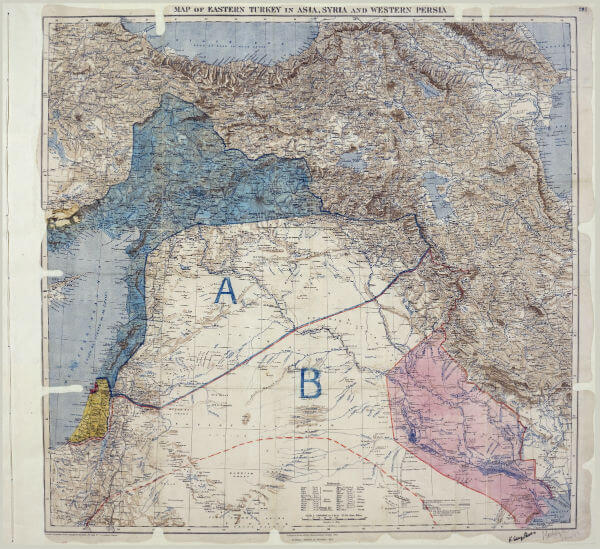
sykes-picot

An editorial in The Economist says: Arab states are suffering a crisis of legitimacy. In a way, they have never got over the fall of the Ottoman empire. The prominent ideologies — Arabism, Islamism and now jihadism — have all sought some greater statehood beyond the frontiers left by the colonisers. Now that states are collapsing, Arabs are reverting to ethnic and religious identities. To some the bloodletting resembles the wars of the former Yugoslavia in the 1990s. Others find parallels with the religious strife of Europe’s Thirty Years War in the 17th century. Whatever the comparison, the crisis of the Arab world is deep and complex. Facile solutions are dangerous. Four ideas, in particular, need to be repudiated.

First, many blame the mayhem on Western powers — from Sykes-Picot to the creation of Israel, the Franco-British takeover of the Suez Canal in 1956 and repeated American interventions. Foreigners have often made things worse; America’s invasion of Iraq in 2003 released its sectarian demons. But the idea that America should turn away from the region — which Barack Obama seems to embrace — can be as destabilising as intervention, as the catastrophe in Syria shows.

Lots of countries have blossomed despite traumatic histories: South Korea and Poland — not to mention Israel. As our special report (see article) sets out, the Arab world has suffered from many failures of its own making. Many leaders were despots who masked their autocracy with the rhetoric of Arab unity and the liberation of Palestine (and realised neither). Oil money and other rents allowed rulers to buy loyalty, pay for oppressive security agencies and preserve failing state-led economic models long abandoned by the rest of the world.

A second wrong-headed notion is that redrawing the borders of Arab countries will create more stable states that match the ethnic and religious contours of the population. Not so: there are no neat lines in a region where ethnic groups and sects can change from one village or one street to the next. A new Sykes-Picot risks creating as many injustices as it resolves, and may provoke more bloodshed as all try to grab land and expel rivals. Perhaps the Kurds in Iraq and Syria will go their own way: denied statehood by the colonisers and oppressed by later regimes, they have proved doughty fighters against IS. For the most part, though, decentralisation and federalism offer better answers, and might convince the Kurds to remain within the Arab system. Reducing the powers of the central government should not be seen as further dividing a land that has been unjustly divided. It should instead be seen as the means to reunite states that have already been splintered; the alternative to a looser structure is permanent break-up.

A third ill-advised idea is that Arab autocracy is the way to hold back extremism and chaos. In Egypt Mr Sisi’s rule is proving as oppressive as it is arbitrary and economically incompetent. Popular discontent is growing. In Syria Bashar al-Assad and his allies would like to portray his regime as the only force that can control disorder. The contrary is true: Mr Assad’s violence is the primary cause of the turmoil. Arab authoritarianism is no basis for stability. That much, at least, should have become clear from the uprisings of 2011.

The fourth bad argument is that the disarray is the fault of Islam. Naming the problem as Islam, as Donald Trump and some American conservatives seek to do, is akin to naming Christianity as the cause of Europe’s wars and murderous anti-Semitism: partly true, but of little practical help. Which Islam would that be? The head-chopping sort espoused by IS, the revolutionary-state variety that is decaying in Iran or the political version advocated by the besuited leaders of Ennahda in Tunisia, who now call themselves “Muslim democrats”? To demonise Islam is to strengthen the Manichean vision of IS. The world should instead recognise the variety of thought within Islam, support moderate trends and challenge extremists. Without Islam, no solution is likely to endure. [Continue reading…]

Facebooktwittermail

No, Donald Trump has not softened his stance on banning Muslims

The Washington Post reports: As headlines popped up this week declaring that Donald Trump had softened his position on banning most foreign Muslims from entering the United States, some Republicans celebrated the news.

“Glad he’s walking it back,” Sen. Jeff Flake (R-Ariz.) tweeted on Thursday.

Except that Trump has not actually walked anything back. The presumptive Republican nominee still wants to ban nearly all members of the world’s fastest-growing religion from entering the United States in an effort to prevent terrorist attacks. [Continue reading…]

Facebooktwittermail

Facebook news selection is in hands of editors not algorithms, documents show

The Guardian reports: Leaked documents show how Facebook, now the biggest news distributor on the planet, relies on old-fashioned news values on top of its algorithms to determine what the hottest stories will be for the 1 billion people who visit the social network every day.

The documents, given to the Guardian, come amid growing concerns over how Facebook decides what is news for its users. This week the company was accused of an editorial bias against conservative news organizations, prompting calls for a congressional inquiry from the US Senate commerce committee chair, John Thune.

The boilerplate about its news operations provided to customers by the company suggests that much of its news gathering is determined by machines: “The topics you see are based on a number of factors including engagement, timeliness, Pages you’ve liked and your location,” says a page devoted to the question “How does Facebook determine what topics are trending?”

But the documents show that the company relies heavily on the intervention of a small editorial team to determine what makes its “trending module” headlines – the list of news topics that shows up on the side of the browser window on Facebook’s desktop version. The company backed away from a pure-algorithm approach in 2014 after criticism that it had not included enough coverage of unrest in Ferguson, Missouri, in users’ feeds. [Continue reading…]

Facebooktwittermail

Bernie Sanders could still win the Democratic nomination — no, seriously

Seth Abramson writes: Last night on CNN, while discussing Bernie Sanders’ landslide victory over Hillary Clinton in West Virginia — which followed a 5-point Sanders win in Indiana last week — Michael Smerconish said that “Democratic super-delegates might have to rethink” their support of Hillary Clinton given how dramatically better Sanders fares in head-to-head match-ups against Donald Trump.

After Clinton’s Indiana loss, John King had told CNN viewers that “if Sanders were to win nine out of ten of the remaining contests, there’s no doubt that some of the super-delegates would panic. There’s no doubt some of them would switch to Sanders. What he has to do is win the bulk of the remaining contests. Would that send jitters, if not panic, through the Democratic Party? Yes. Yes it would.”

So what gives? Isn’t this thing over?

Almost, but not quite.

What Smerconish (and Wolf Blitzer) were discussing last night, and John King was discussing last week, is a very simple theory — call it “run-the-table” — which is easy enough to understand if you simply know the history of Democratic super-delegates and what’s happened in the 2016 Democratic primary since Super Tuesday.

So here it is — both a brief history of the “super-delegate” and an explanation of the “run-the-table” scenario that increasingly is making it into the mainstream media. [Continue reading…]

Facebooktwittermail

Why many of Iran’s ‘moderates’ say they prefer Trump to Clinton

Jeremy Shapiro and Ellie Geranmayeh write: Much of the world seems fairly put off by Donald Trump. Europeans are annoyed that he has threatened to withdraw from NATO. The Japanese and South Koreans seem upset about his intention to withdraw US troops from their shores. Mexicans dislike him so much they are selling Donald Trump piñatas like hotcakes. Even the Chinese seem worried about his idea to slap them with a 45 percent tariff and his support for a nuclear-armed Japan.

So does anyone outside of America like Trump? Many people point to Russian President Vladimir Putin. He and Trump have expressed admiration for each other’s leadership qualities. But beyond Putin, there is (unsurprisingly) little foreign support for Trump’s trademark blend of American nationalism and xenophobia.

Recent conversations, however, have led us to suspect that there might be another country of potential Trump supporters out there: Iran. [Continue reading…]

Facebooktwittermail

Trump’s empty administration

trump-bw

Politico reports: Top Republican political leaders aren’t the only ones shunning their party’s presidential nominee — a vast number of highly skilled managers and policy experts, veterans of recent GOP administrations who would normally be expected to fill key positions for a new White House, are also vowing to sit out a Donald Trump presidency.

And while the failure of the two Presidents Bush or House Speaker Paul Ryan to endorse the presumptive nominee carries political consequences, the absence of policy veterans in a new administration would have a substantive effect on the running of government.

POLITICO interviewed nearly five dozen Republicans over the past two weeks — people with experience working in government and who understand how Congress can enact, or shred, a new president’s agenda — and heard the same sentiment expressed repeatedly. If Trump doesn’t change his tune or extend much longer olive branches, many of these government veterans say they intend to cede highly coveted administration posts to less-experienced competitors.

“I would never serve in a Trump administration,” said James Capretta, a former Office of Management and Budget official under George W. Bush. “The person at the top is unfit for the presidency. He’s made that very clear with his behavior.” [Continue reading…]

Facebooktwittermail

Released emails show use of unclassified systems was routine

The New York Times reports: On the morning of March 13, 2011, the assistant secretary of state for Near Eastern affairs, Jeffrey D. Feltman, wrote an urgent email to more than two dozen colleagues informing them that Saudi Arabia and the United Arab Emirates were sending troops into Bahrain to put down antigovernment protests there.

Mr. Feltman’s email prompted a string of 10 replies and forwards over the next 24 hours, including to Secretary of State Hillary Clinton, as the Obama administration debated what was happening and how to respond.

The chain contained information now declared classified, including portions of messages written by Mr. Feltman; the former ambassador in Kuwait, Deborah K. Jones; and the current director of the Central Intelligence Agency, John O. Brennan.

The top administration officials discussed the Bahrain situation on unclassified government computer networks, except for Mrs. Clinton, who used a private email server while serving as secretary of state.

Her server is now the subject of an F.B.I. investigation, which is likely to conclude in the next month, about whether classified information was mishandled.

Whatever the disposition of the investigation, the discussion of troops to Bahrain reveals how routinely sensitive information is emailed on unclassified government servers, reflecting what many officials describe as diplomacy in the age of the Internet, especially in urgent, fast-developing situations. [Continue reading…]

Facebooktwittermail

Sadiq Khan vs. Donald Trump

Roger Cohen writes: The most important political event of recent weeks was not the emergence of Donald J. Trump as the presumptive presidential nominee of the Republican Party but the election of Sadiq Khan, the Muslim son of a London bus driver, as mayor of London.

Trump has not won any kind of political office yet, but Khan, the Labour Party candidate, crushed Zac Goldsmith, a Conservative, to take charge of one of the world’s great cities, a vibrant metropolis where every tongue is heard. In his victory, a triumph over the slurs that tried to tie him to Islamist extremism, Khan stood up for openness against isolationism, integration against confrontation, opportunity for all against racism and misogyny. He was the anti-Trump.

Before the election, Khan told my colleague Stephen Castle, “I’m a Londoner, I’m a European, I’m British, I’m English, I’m of Islamic faith, of Asian origin, of Pakistani heritage, a dad, a husband.”

The world of the 21st century is going to be shaped by such elided, many-faceted identities and by the booming cities that celebrate diversity, not by some bullying, brash, bigoted, “America first” white dude who wants to build walls. [Continue reading…]

Time interviewed Khan and asked:

You’re the first Muslim mayor of a major western city. Do you feel an extra responsibility to tackle religious extremism?

One of the things that’s important to me as a Londoner is making sure my family, people I care about, are safe. But clearly, being someone who is a Muslim brings with it experiences that I can use in relation to dealing with extremists and those who want to blow us up. And so it’s really important that I use my experiences to defeat radicalization and extremism. What I think the election showed was that actually there is no clash of civilization between Islam and the West. I am the West, I am a Londoner, I’m British, I’m of Islamic faith, Asian origin, Pakistan heritage, so whether it’s [ISIS] or these others who want to destroy our way of life and talk about the West, they’re talking about me. What better antidote to the hatred they spew than someone like me being in this position? [Continue reading…]

The Independent reports: Sadiq Khan has criticised Donald Trump for suggesting he would exempt him from his proposed temporary ban on Muslims entering the US, adding his comments play “into the hands of extremists”.

It comes after Mr Trump, the presumptive Republican presidential candidate, said he was happy to see London’s new Muslim mayor elected, saying it could be “very, very good”.

The billionaire property mogul caused international outrage when he called for the temporary ban after the November 2015 Paris attacks. David Cameron labelled the idea “stupid” and calls to ban Mr Trump from entering Britain were raised in Parliament after a petition attracted nearly 600,000 signatures.

“This isn’t just about me – it’s about my friends, my family and everyone who comes from a background similar to mine, anywhere in the world,” Mr Khan said.

“Donald Trump’s ignorant view of Islam could make both our countries less safe – it risks alienating mainstream Muslims around the world and plays into the hands of the extremists.

“Donald Trump and those around him think that western liberal values are incompatible with mainstream Islam – London has proved him wrong.” [Continue reading…]

Facebooktwittermail

The rise of militias: Patriot candidates are now getting elected in Oregon

The Guardian reports: Joseph Rice’s manner is a long way from militia stereotypes. The Patriot Movement leader does not present as a crazed gun nut, nor as a blowhard white supremacist. He’s genial, folksy, and matter-of-fact in laying out his views. But talk to him for long enough, and time and again the Patriot Movement leader returns to what really drives him: land.

Rice is running for Josephine county commissioner in south-west Oregon, and believes that the federal government’s current role in land management is illegitimate and even tyrannical.

His campaign is well-advertised around the county and appears well-organised. His growing experience in organising Patriot groups and community watch organisations has polished his skills in retail politics. He’s clearly done a lot of work to make himself politically palatable to conservative rural voters.

He has positions on education (kids should finish high school), legalised marijuana (it presents an economic opportunity) and Donald Trump (“people are tired of career politicians, and they know the country’s in trouble”).

But county supremacy is what really drives him.

It’s this notion that is once again becoming central to local politics in the Pacific north-west. Throughout the region, people whose ideas about land management broadly align with Rice and the now infamous Bundy clan are aiming for elected office in cities, counties and even the state houses.

Taking notice of the trend, progressive watchdog group Political Research Associates even pointed to “a wave of Patriot-affiliated candidates in Oregon”. [Continue reading…]

Facebooktwittermail

Why Sadiq Khan’s victory matters

Muddassar Ahmed writes: the type of aggressive, populist campaign that has so far been successful for Donald Trump in the United States will not necessarily be a blueprint for success elsewhere. Although many on the right in Britain apparently believed that capitalizing on anti-Muslim sentiment is not just acceptable, but a sure ticket to victory, the strategy was found wanting. In short, there is a limit to the ability of bigotry to capture elections.

And it is not just Britain that has demonstrated that resorting to anti-Muslim language can backfire. Take the example of former Canadian Prime Minister Stephen Harper. Last year, he resorted to crude anti-Muslim language as he sought re-election. In contrast, Harper’s opponent, Justin Trudeau, went out of his way to embrace Muslims (and other minorities). Harper didn’t just lose — he was trounced.

Why?

Many non-Muslim Canadians were repelled by seeing this faith-based bigotry in their secular politics. Just as importantly, the Muslim-bashing had another effect that Harper apparently did not seem to see coming — it prompted Canadian Muslims to vote in record numbers. You can bet that these new voters will continue and extend their political involvement, meaning that in a well deserved bit of irony, Harper’s Islamophobic campaign may have created a Canadian Muslim political consciousness where none existed before.

With this in mind, it is likely for good reason that in the United Kingdom, the Conservative group leader of the Greater London assembly, Andrew Boff, criticized Goldsmith’s divisive campaign for damaging his party’s relations with the Muslim community, something that could further hurt it down the road.

In fact, the same thing could happen in America. After all, not only is Donald Trump now a widely detested politician (polls suggest that more Americans disapprove of him than are worried about Muslims), but American Muslims are becoming more politically engaged. And although the American Muslim population is relatively small, it may hold the key to swing states like Virginia, Florida and Ohio. [Continue reading…]

Facebooktwittermail

The rest of the world has no Trump contingency plan

The New York Times reports: Alarmed by Donald J. Trump’s grip on the Republican presidential nomination, world leaders are wrestling with the possibility that, even if he loses the general election, his ascent reflects a strain of American public opinion that could profoundly reshape the way the United States addresses security alliances and trade.

From Beijing, Tokyo and Seoul to the headquarters of NATO in Brussels and the vulnerable Baltic nations along Russia’s western border, officials and analysts said in interviews that they saw the success of Mr. Trump’s “America first” platform as a harbinger of pressure for allies to pay up or make trade concessions in return for military protection.

In many capitals, Mr. Trump’s formal and off-the-cuff foreign policy proposals — his threat to pull out of NATO; his musings about removing the United States’ nuclear umbrella over Japan and South Korea; his pledge to slap huge trade tariffs on China — are regarded with a mix of alarm and confusion. Asked on Thursday if Beijing was concerned about the prospect of a Trump presidency, the Chinese Foreign Ministry spokesman, Hong Lei, replied, “We hope the U.S. people from all walks of life would view bilateral relations from a reasonable and objective perspective.”

Stefano Stefanini, a former representative of Italy to NATO and former diplomatic adviser to the Italian president, put it this way: “There is no Donald Trump contingency plan.” [Continue reading…]

Facebooktwittermail

How ‘America First’ got its nationalistic edge

Eric Rauchway writes: When Donald Trump declared,⁠ “‘America First’ will be the overriding theme of my administration,” he invoked the America First Committee, which opposed U.S. aid to the opponents of Nazi Germany before December 1941. This legacy sparked critiques⁠ and defenses⁠ alike of Trump’s appeal to nationalism. Nervous⁠ U.S. allies even worried the phrase heralded a new isolationism. One of Trump’s advisers, however, insisted the phrase was a coincidental echo that didn’t “go back to negative aspects at all.” Apparently, it was merely quaint⁠ in today’s relatively Nazi-free era. But the slogan actually predates the anti-interventionist committee, and it has a lot more to do with the proto-fascist politics of the publishing magnate and sometime politician William Randolph Hearst.

Hearst did not invent the slogan “America First”; he borrowed it from Woodrow Wilson — so he could hurl it back at the president. After World War I broke out, Wilson used the “motto” of “America First” to define his version of neutrality: The United States should bide its time and husband its resources until the warring powers had “carried the thing so far” that they “must be disposed of” — then America would wade in and sort Europe out. In keeping with this view, after the Germans declared unrestricted submarine warfare against transatlantic shipping, Wilson asked Congress for a declaration of war in April 1917.

Before the United States entered World War I, Hearst’s sympathies lay with Germany. He used his publishing empire to gather pro-German editors and writers around him, did a deal with a German agent for newsreel footage, and used a paid agent of the German government as his newspaper correspondent for German matters. But once the United States declared war on Germany, Hearst could no longer maintain this stance, so he took up a new one. With American flags decorating his newspapers’ masthead, he declared that the freshly belligerent Americans should tender no aid to the Allies also fighting Germany: “[K]eep every dollar and every man and every weapon and all our supplies and stores AT HOME, for the defense of our own land, our own people, our own freedom, until that defense has been made ABSOLUTELY secure. After that we can think of other nations’ troubles. But till then, America first!” [Continue reading…]

Facebooktwittermail

Racism by any other name

Vann R. Newkirk II writes: Stop me if you’ve heard this one before: Barack Obama’s election as the first black president was supposed to usher in a golden “post-racial” age but instead was met with racial conflict, a battle Obama failed, in his role as conciliator-in-chief, to either predict or control. The conflict has blossomed into a war, producing Donald Trump’s racial-angst-fueled campaign and the anger of Black Lives Matter protesters. At the heart of this racial conflict is Obama’s divisive presidency.

If that storyline sounds familiar, it’s the tack that many analyses have taken as they try to tease apart the interconnected issues of race and politics. It’s an exercise––an important one––that writers attempt every few months. Two years ago, commentators chronicled “unrest over race” in Obama’s legacy, and even before that speculated at racial tensions or unrest that might ensue should he ever lose an election. One recent column by Peniel Joseph in the Washington Post chronicles Obama’s failure to stop the “open warfare” of racial conflict during his term in office.

One reason these attempts to grapple with race and Obama’s presidency recur so often is that they usually can’t quite pull together a unified theory. Perhaps the moving pieces are just too complicated to analyze while they are still moving; perhaps they appear deceptively simple. But maybe some of the difficulty in talking about race today is attributable to the unhelpful euphemisms of “racial conflict,” “racial tension,” and other phrases that suggest an equal amount of instigation across racial groups, if not a perfectly balanced battle. But not all “racial conflicts” or “racially fraught” sentiments are the same. Equating them even via casual euphemism dilutes the potency of a truth that has undergirded every aspect of American society for as long as American society has existed.

It is tempting to try to conceptualize American culture as a theater of war, with battles fought between well-equipped factions over the future of the dominant identity. This conceptualization of political conflict animates arguments about everything from political correctness on college campuses to the tensions at the heart of Bernie Sanders’s political revolution. And at some level, especially when discussing differing factions of white men, it works. But the idea of political conflict as a pitched battle proves inadequate when it fails to take into account the power gradients that have been woven into the fabric of the country. That is especially true of race. [Continue reading…]

Facebooktwittermail

Hillary Clinton and the engine of war-making

Given the ubiquity of the phrase, perpetual war, it’s clear that many Americans believe that a powerful faction at the heart of government has such an insatiable appetite for war that if all the conflicts the U.S. is currently entangled in were to unexpectedly find peaceful resolution, then Washington would seek out, engineer, or in some other way precipitate new wars, because this has become America’s core business: war-making.

Among those who subscribe to this view are at one extreme the Truthers who believe 9/11 was an “inside job” carried out as a pretext for a never-ending war on terrorism. At the other end of the spectrum are those with a less conspiratorial perspective who simply observe that the military–industrial complex generates its own political and commercial momentum which fosters geopolitical conditions that make wars more rather than less likely.

The decisive factor seen as most likely to tip the balance in the future is the hawkishness of the president.

Hillary Clinton is constantly being branded as a hawk, but most of these assessments of her appetite for war-making seem to be based on judgments about her character and her track record rather than on plausible predictions of the actual scenarios in which this destructive appetite will continue to be satisfied.

Aaron David Miller writes:

Mrs. Clinton may have more hawkish instincts than President Obama, but there is little reason to doubt that her preference for U.S. engagement in the world is through diplomacy, political and cultural soft power, and economic strength. She led the “reset” with Russia (though later soured on it), advocated using negotiations to address North Korea, campaigned for a nuclear agreement with Iran, and preferred regional diplomacy to counter Beijing’s military moves in the South China Sea. She also supported the President’s Cuba initiative. Mrs. Clinton has long championed negotiating an end to the Israeli-Palestinian issue. Unlike many of her Republican rivals, who bluster against engagement in favor of force and tough responses, Mrs. Clinton has been a cheerleader for negotiations on the campaign trail, a predisposition likely to follow her into the White House.

“There’s no doubt that Hillary Clinton’s more muscular brand of American foreign policy is better matched to 2016 than it was to 2008,” her close aide, Jake Sullivan, told Mr. Landler. The rise of Islamic State and the attacks in Paris and San Bernardino last year bolster that argument, certainly when it comes to protecting the homeland. Shortly after the attacks in Paris, a CNN/ORC poll found that 53% of Americans supported sending ground to Syria or Iraq to fight ISIS. But as time passes after attacks, support for deployments falls. Gallup polling in February found that Americans were divided on U.S. military involvement in Syria, with 34% saying more involvement is needed, 29% saying the current level of engagement is about right, and 30% saying that the U.S. should be less involved. Should a Brussels-style attack be carried out in the U.S., support for a large military response would grow, as would any president’s options to authorize it.

What is perhaps the greatest constraint on a putative President Clinton’s hawkishness? The bad options that exist for projecting military force, particularly in the Middle East. Mrs. Clinton’s strategy toward ISIS doesn’t differ much from President Obama’s: She has talked about creating a partial “no-fly” zone, though it’s hard to see how this would improve the situation, and it risks conflict with Russia. It’s likely that as president Mrs. Clinton would try to work with Moscow to deescalate the situation in Syria through diplomacy. She is highly unlikely to deploy thousands of additional ground troops to Iraq or Syria, though she talks about using special forces more–something President Obama is already doing. Meanwhile, as a staunch defender of the international agreement over Iran’s nuclear program, she is not looking for a fight with Tehran.

Hillary Clinton knows the consequences of using force in Iraq and Libya absent a political strategy, and she knows that the Middle East won’t be “fixed” by U.S. military power alone. She may have hawkish instincts, but if she is in the Oval Office next year, she may be as reluctant to use force as Barack Obama has been.

Facebooktwittermail

How Donald Trump won the GOP nomination

John Cassidy writes: Despite the best efforts of the Never Trump movement, it has been clear for some time that Donald Trump is destined to be the Republican candidate for President in 2016. His sweeping victory in New York, a couple of weeks ago, confirmed his popularity among the white suburban voters who make up the key voting bloc in the G.O.P. And his decisive win in Indiana, on Tuesday, more or less settled things. Ted Cruz, in suspending his candidacy, was only accepting the inevitable.

I noted a couple of months ago that one of the big problems with the Never Trump movement was that it didn’t have a credible candidate. Once Marco Rubio flamed out, its only options were John Kasich, who had won but a single state (his own), and the stridently reactionary Cruz. Republican primary voters have their idiosyncrasies and prejudices, but in one respect they are just like other Americans. Presented with a choice of voting for Cruz or A.N. Other, a majority of them opted for the latter — a fact that played greatly to Trump’s advantage.

Still, even Trump appeared to be surprised by his sixteen-point margin of victory in the Hoosier State. In a speech at Trump Tower, Trump said that he hadn’t expected Cruz to drop out just yet. The Texas Senator’s decision occasioned a rhetorical flip-flop on Trump’s part. Earlier in the day he had suggested that Cruz’s father, Rafael, who is now an evangelical preacher, had aided and abetted Lee Harvey Oswald, a claim arising from an article that had appeared in the National Enquirer. In his speech, Trump now paid tribute to Cruz’s “whole beautiful family.”

It has been evident ever since Trump announced his candidacy, eleven months ago, that there was virtually nothing he wouldn’t say to tar his rivals or anyone else who dared to challenge him. This is the candidate who referred to Rick Perry as a dimwit; criticized Carly Fiorina’s appearance; claimed that John McCain wasn’t a war hero; appeared to suggest, during a televised debate, that Megyn Kelly was menstruating; and compared Ben Carson to a child molester. Ultimately, none of these statements did much damage to Trump’s campaign. Arguably, they enhanced it.

Historians and political scientists will be debating for decades how Trump got to this point, but any convincing explanation must acknowledge his talents as a demagogue and pugilist. Speaking on CNN last night, David Axelrod, one of the many commentators who initially dismissed Trump’s candidacy, said, “He’s proven himself to be very resourceful and very skilled.” Axelrod pointed, in particular, to Trump’s mastery of television and social media. On Fox, Rich Lowry, the editor of the National Review, which has been in the vanguard of the Never Trump movement, said, “I have to tip my hat to what Trump has achieved.” Citing the fact that Trump didn’t have any pollsters or, until recently, any political organization to speak of, Lowry added, “It is completely incredible.”

That it is. But there are two factors in Trump’s rise that help to account for it: the febrile environment he has been operating in, and the potency of his message. [Continue reading…]

Facebooktwittermail

Why a British fight over Israel and anti-Semitism matters to the rest of us

Robert Mackey writes: At first glance, the heated argument two members of the British Labour Party conducted in front of reporters’ iPhones on Thursday, sparked by accusations that one of their colleagues posted anti-Semitic comments on Facebook, seems like a story of interest mainly to political junkies in London.


When the debate is unpacked, however, it becomes clear that what’s at stake is something much broader: whether critics of Israel, who question its government’s policies or its right to exist as a Jewish state, are engaged in a form of coded anti-Semitism. That matters because attempts to disqualify all critics of Israel as racists are widespread across the globe.

In the United States, for instance, supporters of a movement to boycott Israel until it grants Palestinians full civil rights have recently been condemned as anti-Semites by Hillary Clinton; last month, the University of California adopted a policy on discrimination that implies anti-Semitism is behind opposition to Zionism, the political ideology asserting that the Jewish people have a right to a nation-state in historic Palestine.

But how did this issue come to dominate the political debate in Britain, a week before important local elections? [Continue reading…]

Facebooktwittermail