Category Archives: Arab Spring

Egypt’s Israel problem

Yasmine El Rashidi writes:

The Israeli embassy in Cairo is tucked away on the top two levels of a twenty-one-floor residential tower ten minutes from Tahrir. It is flanked by graying buildings and a usually traffic-clogged bridge. Nearby are Cairo University and the National Zoo. In the past, its busy location served it well; it was inconspicuous, and under Mubarak, the security around the building was so tight that even reaching the barricades surrounding it felt like a feat. In one of the more revealing signs of change in the New Egypt, however, it has now become the focus of the public’s attention and the site of unobstructed demonstrations.

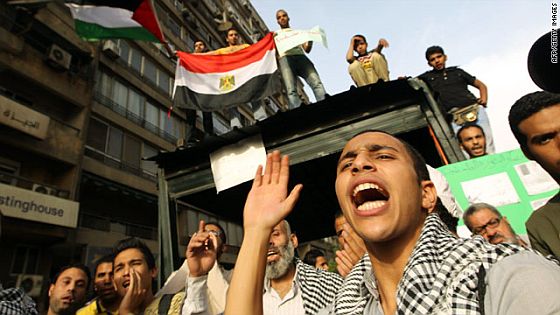
On August 18, when Israeli forces opened fire in the direction of Egypt’s border, killing five conscripts, hundreds of angered Egyptians spontaneously marched to the embassy in protest. The Israeli shooting had been triggered by an attack on two buses heading from Bersheeba to Eilat; Israeli authorities alleged that the fleeing assailants were Palestinians who had taken advantage of the security vacuum that has emerged in Egypt since the revolution to infiltrate Israeli territory from Gaza via the Sinai. The protesters were outraged; both at the “accidental” killing of the soldiers, and at the implication that it was Egypt’s fault. The army was swift to deploy additional force to protect the already high-security embassy when the news broke, and alongside the usual concrete barricades and corrugated metal shields, there were now tanks, riot police, and rows of armed soldiers. “Give us your guns and send us to Sinai,” the protesters shouted at them. “The blood of our soldiers will not be in vain. Egyptian blood is not cheap.” The soldiers simply stood by.

With Mubarak now gone, many of his business cronies (including his close friend Hussein Salem, who orchestrated the gas deal) behind bars, and the nation in the grips of a new kind of nationalism, the question of what will become of relations with Israel has become critical. For the ruling Military Council, adhering to Camp David comes at a cost, but until it finds a better alternative—one that includes strategic training, resources, and intelligence support, as well as regional security guarantees—it is worth the price.

But for all the major contenders for Egypt’s new civilian leadership—including both secular and Islamist candidates—the status quo is as intolerable as Mubarak himself. Indeed, since the fall of Mubarak, almost every political question—from the referendum and the rules for forming parties to the new constitution—has been controversial and divisive. Yet on the Israel issue there has been a wide consensus. In front of the Israeli embassy last week, westernized, English-speaking activists stood side-by-side with Salafis, Muslim Brothers, working class Egyptians, and educated elite. As someone pointed out, this was a “mini-Tahrir.”

On August 20, even as the government was figuring out its own response to the killings, a group of political parties and presidential hopefuls met at the headquarters of the Islamist Al-Wasat party to discuss “how to handle the Israeli question.” The coalition was not only Islamist: it included Amr Moussa, Ayman Nour, Hisham Al-Bastawisi, George Ishaq, and representatives of the Al-Wafd, Al-Ghad, El-Hadara, El-Asala and El-Nahda Parties. After the meeting, the group announced that the Mubarak regime, which was a “strategic treasure” to Israel, is gone forever. “It has been replaced by a strong nation that doesn’t know weakness and knows how to get justice for the blood of its martyrs. In the face of this crime, the Egyptians have united across ideologies, political parties, police and army and put aside their differences for the sake of the nation.” The coalition announced a list of eight demands to be handed to SCAF. They include banning Israeli naval forces from passing through the Suez Canal, raising Egyptian armed forces presence in Sinai, and reconsidering the gas deal.

Government sources have since told me that SCAF and the interim cabinet are being “forced to seriously consider” public demands to reset its Israel policies and that “discussions are taking place.” Troop allowances in the Sinai are likely to be where the interim government presses for change, as well as re-examining the controversial gas deal. “What the Egyptian public wants is important, but many of the demands are too drastic—they would escalate a situation in ways nobody would want,” Major-General Badin told me by phone last week.

The Israeli embassy sit-in was suspended on August 27, one day after a “million man march” in which 8,000-odd protesters demonstrated in Cairo, Alexandria, and governorates across Egypt. Although the Israeli ambassador was not asked to leave and the Egyptian envoy to Israeli was not recalled, the protesters could claim a few successes. The Israelis had issued several statements of apology and regret, a joint investigation had reportedly begun, more Egyptian troops would be allowed into the Sinai’s Zone C (an area on the eastern border of Sinai where only limited and light-armed Egyptian police presence is allowed according to Camp David).

Perhaps most significantly (and despite general Badin’s insistence that it wouldn’t) the flag over the Israeli embassy had in fact been removed: a young Egyptian, Ahmad El-Shahat scaled the 21-story building and brought it down on the night of August 21, replacing it with an Egyptian one. The “Flagman,” as he came to be known, instantly became a national hero. Hamdeen Sabahi, the presidential hopeful and head of the Karama party, sent “a salute of pride to Ahmad El-Shahat, the public hero who burned the Zionist flag that spoiled the Egyptian air for 30 years.” The governor of Sharqiya, just east of Cairo, honored Shahat with an apartment and job. Across the Arab world too, he was hailed. For seven days, the army left the Egyptian flag on the building, but foreign ministry officials were quick to tell me that “it won’t last. The army is letting the protesters vent steam. Give it a week, the [Israeli] flag will be up again.”

On August 29, at 2:37 PM, it happened. A middle-aged man stuck his head out of the window of the Israeli embassy building’s twentieth floor, scanned the streets and bridge and horizon for possible protesters, and when the coast seemed clear replaced the by-then tattered Egyptian flag with a crisp new Israeli one. A security guard at a building next door who witnessed it said it took about seven minutes. It took about half that time for the news to spread. On Twitter and Facebook, Egyptians quickly started calling for El-Shahat to return to the embassy. “Get that damn flag down,” someone tweeted.


Facebooktwittermail

Libyan rebel military chief says he was tortured by CIA

Patrick Cockburn writes:

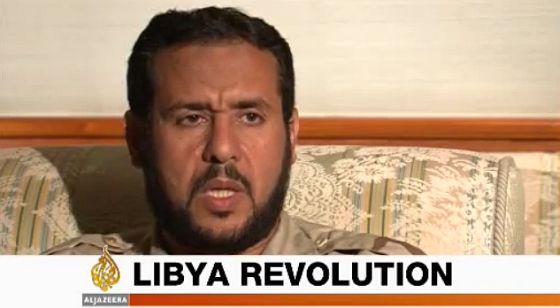
The overthrow of Gaddafi has brought together strange allies, but few stranger than Abdulhakim Belhaj, the military commander of all rebel military forces in Tripoli, and Nato. An Islamist whom Gaddafi tried to have the US list as a terrorist, Mr Belhaj says he was tortured by CIA agents after being arrested in the Far East in 2004 and later handed over by them to Colonel Gaddafi for further torture and imprisonment in Libya.

Mr Belhaj, the head of the military council for Tripoli, who led an Islamist guerrilla organisation fighting the Gaddafi regime in the 1990s, told The Independent in an interview that he had been directly “tortured by CIA agents” in Thailand after being first arrested in Malaysia.

If true, his story is evidence of the close co-operation between the CIA and Colonel Gaddafi’s security services after the Libyan leader denounced the 9/11 attacks. After his stint in the hands of the CIA, Mr Belhaj was kept in Abu Salim prison in Tripoli. He says: “I was in prison for seven years during which I was subjected to torture as well as solitary confinement. I was even denied a shower for three years.” Other Libyan Islamist prisoners have related how they were sometimes taken from Abu Salim to be questioned by US officials in Tripoli.

Released from prison in 2010, Mr Belhaj, who had military experience from fighting in Afghanistan against the Russians in the 1980s, became one of the most effective rebel military commanders. He is said by diplomats to have played a crucial role in the capture of Tripoli at the end of last month, and is highly regarded by the chairman of the Transitional National Council (TNC), Mustafa Abdul Jalil.

Ironically, given his claims of previous mistreatment at US hands, Mr Belhaj has emerged as one of Nato’s most important allies during their air campaign in support of the rebels over the last six months. Speaking in his headquarters in the Mitiga military airbase on the eastern outskirts of Tripoli, he forcefully denied that he and the Libyan Islamic Fighting Group (LIFG), which he helped found in 1995, had ever been allied to al-Qa’ida.

“We never had any link to al-Qa’ida,” said Mr Belhaj, a short, soft-spoken, bearded man, who does not use a military title. “We never took part in global jihad. The fact that we were in the same country, Afghanistan, [as al-Qa’ida] does not mean we had the same goal.” He stresses that the sole aim of the LIFG was always to overthrow Gaddafi.

Despite his current close co-operation with Nato, Mr Belhaj says he finds it difficult to forgive his treatment by the CIA in the past.

When first detained at an airport in Malaysia in 2004 he says he was with his wife: “She was six months pregnant and she suffered a lot.”

After a few days, CIA agents took him to Thailand as part of the notorious rendition process by which the agency transferred prisoners to countries where security forces were known to use torture. He says that in Thailand CIA agents took a direct part in his torture, though he did not give details. He says that “if I ever have the chance I will take legal action” against those responsible.

The disclosure of Libya’s intelligence files may reveal embarrassing details of co-operation between the CIA and other Western intelligence agencies with Gaddafi’s brutal and ruthless security services in pursuit of Islamist opponents. Mr Belhaj says that in the wake of 9/11, the US administration reacted by pursuing “any organisation with an Islamic agenda”.

Mr Belhaj spent seven years in Abu Salim prison which was the site of the Gaddafi regime’s most infamous atrocity, the massacre of some 1,200 prisoners in 1999, almost all of them Islamists, who had protested against conditions. The first protests which ushered in the uprising in Benghazi this February was by lawyers representing the families of the dead Abu Salim prisoners.

The Libyan prison was run with great savagery even against those whose offences were minor. Students accused of being excessively religious were stripped naked and attacked by dogs. Prisoners who survived might spend decades without seeing their families. In Abu Salim, Mr Belhaj helped write a 419-page document, published in 2009, which repudiated the Jihadi doctrine of holy war and the use of violence to change regimes. The name of the LIFG was changed to the Libyan Islamic Movement for Change. The ideological change, spurred by the failure of radical Islamic groups fighting on their own to overthrow governments, led to Islamists seeking the co-operation of more secular and liberal groups also opposed to Arab police states. It is these popular front coalitions that have won victories in Tunisia, Egypt and now Libya.

The New York Times reports on evidence gathered from the bombed ruins of Gaddafi’s intelligence headquarters in Tripoli that corroborates Belhaj’s account.

When Libyans asked to be sent Abu Abdullah al-Sadiq, another member of the [Libyan Islamic Fighting G]roup, a [CIA] case officer wrote back on March 4, 2004, that “we are committed to developing this relationship for the benefit of both our services,” and promised to do their best to locate him.

Two days later, an officer faxed the Libyans to say that Mr. Sadiq and his pregnant wife were planning to fly into Malaysia, and the authorities there agreed to put them on a British Airways flight to London that would stop in Bangkok. “We are planning to take control of the pair in Bangkok and place them on our aircraft for a flight to your country,” the case officer wrote.

Mr. Bouckaert of Human Rights Watch said he had learned from the documents that Sadiq was a nom de guerre for Abdel Hakim Belhaj, who is now a military leader for the rebels.

In an interview [with The Independent — see above] on Wednesday, Mr. Belhaj gave a detailed description of his incarceration that matched many of those in the documents. He also said that when he was held in Bangkok he was tortured by two people from the C.I.A.

Facebooktwittermail

Women celebrate in Tripoli’s Martyrs’ square

Farah Abushwesha writes:

At this week’s conference on Libya in Paris, the Libyan National Transitional Council (NTC) and the international community talk about “inclusiveness” in the new country’s future. It seems strange, then, that half of the population – women – seem to be excluded from the discussions on the future of their country.

It is not commonly known, but Libyan women started the revolution when the mothers, sisters and widows of prisoners killed in the 1996 Abu Salim massacre took to the streets in Benghazi on 15 February to protest outside the courthouse after their lawyer was arrested.

Since then Libyan women at home and abroad have protested, smuggled arms beneath their clothing, founded countless civil society groups, tweeted, blogged, fed, nursed, mourned, mothered, raised funds and awareness, and sent in humanitarian aid and medical staff for the cause. Women have taken a central role alongside men and it has united us.

Libyan women may not have been visible on the streets with guns, but they have played an equally important role, displaying courage and strength that has been invaluable to the success of the country’s revolution. Only now are some of the harrowing stories starting to emerge. We have seen the iconic images of Iman al-Obeidi, who spoke out about the sexual violence inflicted on so many who have otherwise suffered in silence; the elderly lady praising rebels at a lay-by and giving them her blessing; and Malak, the five-year-old amputee from Misrata – to name a few.

Libyan women will no doubt continue to play a vital part in the national reconciliation and rebuilding process, but the time has come for this role to be fully recognised, encouraging them to step forward. The Women for Libya campaign aims to mobilise and encourage Libyan women to take their rightful place and be included as equals for the purpose of shaping a better Libya. We do not want tokenistic representation.

Facebooktwittermail

The problem with Palestinian political leadership

Ben White writes:

For a few months now, discussion of Palestine/Israel has focused on the looming UN vote on Palestinian statehood, but this is obscuring more fundamental problems in the Palestinian political arena – of which the forthcoming UN vote is a symptom.

In three critical areas, there are significant flaws hampering Palestinian political leadership.

The first is a legitimacy deficit. Both the Fatah-dominated Palestinian Authority and Hamas have, with the most generous interpretation, a minority mandate from the Palestinian people. The last elections of any sort took place in 2005-2006, and overdue local elections have been indefinitely postponed. And even if presidential or parliamentary elections in the West Bank and Gaza were to take place tomorrow, they would still exclude Palestinian refugees. The Palestine Liberation Organisation (PLO) remains a potential vehicle for democratic decision-making, but serious reform is still not on the horizon.

The second critical problem is a lack of creativity and strategic thinking when it comes to tactics. This has a number of root causes which are beyond the scope of this article but the main point is a marked inability to adapt to circumstances with regard to the kind of smart resistance most appropriate for confronting Israeli colonisation. This is more than simply an issue of “violent” versus “nonviolent” (a discussion often plagued by patronising western double standards).

Fear of losing control over the course of events can be one factor inhibiting an openness to change – which brings us to the third problematic area: a focus on power for its own sake rather than for the achievement of a specific goal.

This criticism applies to both Fatah and Hamas, though the former has been guilty of it for a longer period of time and with more devastating consequences. Over the past five years or so, the conflict between these two factions has frequently resembled a fight for who can occupy the Bantustan palace, rather than who can serve most effectively the unfinished Palestinian revolution.

This fight for fake authority has resulted in a dangerous phenomenon: the harassment of youth activists (such as the 15 March movement) and dissidents in the West Bank and Gaza. The growing expressions of dissatisfaction, particularly from young Palestinians, have contributed to a hardening grip on power by two regimes that fear they stand to lose from an overhauled democratic system.

Facebooktwittermail

Oil firms bet on survival of Syria’s Assad

Reuters reports:

Oil companies in Europe are betting on the survival of President Bashar al-Assad in Syria, in sharp contrast to their support for Libya’s opposition six months ago, even while the European Union is expected to soon slap oil sanctions on Damascus.

Several tankers are sailing to Syria this week to either deliver fuel or pick up crude, which may suggest that oil companies believe the rebellion in Syria will fail to overthrow Assad’s government.

The same companies, including Swiss-based trader Vitol, made the opposite bet when it came to trade in Libya. They agreed to supply opponents of Muammar Gaddafi with fuel in the hope their support would be rewarded at the end of the war.

“What oil firms are currently doing does really look like they believe Assad will win, and they will have to deal with him again,” said a Western diplomatic source.

“The big difference that they all see with Libya is that in Syria you don’t even have a location where the opposition can get together like Benghazi,” he added.

Facebooktwittermail

Syrians must contemplate foreign help – if not the West’s

Abdur Rahman al Shami” writes:

On 22 August an interview with Bashar Al-Assad was aired on Syrian TV. He assumed the people were following his every word. But they were not in the least concerned with his interview; instead, many stayed up the whole night watching the battle to liberate Tripoli. It had huge symbolism, especially for the people of Damascus. With the fall of Tripoli and the departure of Gaddafi and his family, it became clear to the people that despite the severity of losses, the fight in Libya was worth the price.

The decision by the Syrian people to march in protest was taken on the night of 17 March, the day the UN passed resolution 1973, imposing a no-fly zone over Libya. The following day there were demonstrations in Damascus, Dara’a, Banias and Homs. Two people were killed, and this effectively lit the flames of the Syrian revolution.

But our peaceful revolution received no official support from the Islamic and Arab countries. All we got were hesitant platitudes from our neighbours. Likewise, the west called only for reform, or at most economic sanctions. This encouraged Assad to increase his repression in the hope that he would be able to quell the revolution quickly.

But our revolution gathered momentum. Always peaceful, and without any external intervention it spread, with more and more protesters, cities and villages taking part. Syrian opposition figures inside and abroad worked to support the revolution through a series of initiatives, culminating in the formation of national councils earlier this month.

The revolutionaries on the ground now find themselves confronting a new reality. On the one hand we are faced with Arab silence, an ongoing regional indecision – especially from neighbouring Turkey – and the west as passive spectators to Assad’s violations. On the other, Tripoli and Libya are liberated. While Nato support was helpful, credit must be given to the determination of the Libyan people and their tactics, including armed struggle.

There is no doubt that the Syrian revolutionaries will now carry out a reappraisal of their own position; especially as we witness the daily bombardment of Homs, Latakia and Deir al-Zour; while Hama is attacked, the plains of Houran bleed, Aleppo is terrorised and Damascus repressed. The revolutionaries are now questioning the peaceful nature of the Syrian revolution – we have not until now used arms against the regime – and also re-evaluting our position on foreign intervention.

Meanwhile, Amnesty International says:

At least 88 people are believed to have died in detention in Syria during five months of bloody repression of pro-reform protests, a new Amnesty International report reveals today.

Deadly detention: Deaths in custody amid popular protest in Syria documents reported deaths in custody between April and mid-August in the wake of sweeping arrests.

The 88 deaths represented a significant escalation in the number of deaths following arrest in Syria. In recent years Amnesty International has typically recorded around five deaths in custody per year in Syria.

“These deaths behind bars are reaching massive proportions, and appear to be an extension of the same brutal disdain for life that we are seeing daily on the streets of Syria,” said Neil Sammonds, Amnesty International’s researcher on Syria.

Facebooktwittermail

Algeria’s regime: out on a limb that looks set to fall

Brian Whitaker writes:

With three out of five countries now under new management along the north African coast, the spotlight is turning towards the remaining two: Algeria and Morocco.

In Morocco, where a new constitution was approved in July, the king’s promises of reform may succeed in staving off a mass revolt – at least for the time being. Morocco also recognised the national transitional council (NTC) in Libya with deft timing a week ago, declaring its support for “the legitimate aspirations of the brotherly Libyan people”.

That leaves Algeria out on a limb, increasingly identified with the forces of counter-revolution. Not only has it so far failed to recognise the Libyan NTC, but it is now openly providing refuge for members of the Gaddafi family.

Welcoming the Gaddafis, according to Algeria’s ambassador at the UN, was nothing more than a humanitarian gesture, in line with the traditions of desert hospitality – but we don’t have to look very far to see the politics behind it.

What happened to the Tunisian, Egyptian and Libyan regimes could easily have been the fate of the Algerian regime, too. In January, as the Tunisian uprising gathered pace, Algeria also experienced widespread disturbances – and for very similar reasons. Regular protests were still continuing on a smaller scale at the end of March.

Facebooktwittermail

Libya’s rebels achieved what many thought would be impossible

George Joffe writes:

Given Libya’s dramatic lack of political and administrative experience (the legacy of the baleful perfection of the Jamahiriyah, which punished dissent with death or imprisonment), and the parallel lack of civil society (eliminated over the years for identical reasons), it is almost impossible for Libya to ignore the accumulated experience of the previous regime.

Indeed, Mr Abdel Jalil himself, as president of the Council, is Libya’s former minister of justice and the commander of the East’s military forces. General Younis, who was killed at the end of July, had been the interior minister. Yet General Younis’ death was almost certainly a consequence of a widespread dislike and suspicion of former members of the Gaddafi regime within the insurgent movement.

The issue also highlights the tensions within the Council between different groups: Exiles against former members of the regime, Islamist militias suspicious of the military command, and tensions between the armed forces of the East and those of the West of the country. Mr Abdel Jalil has battled against these trends, it is true, but it is not clear how successful he has been and how coherent and competent the Council will be in handling its new responsibilities. Nonetheless, there are still many question marks about the immediate future that pro-Gaddafi forces may seek to exploit if they manage to regroup.

Yet against these concerns must be set the single staggering fact that, admittedly with NATO’s help but essentially with their own resources, Libya’s people have overthrown the regime that had oppressed them for decades. Unlike Tunisia, the regime was not capable of understanding its own loss of legitimacy and fought unsuccessfully to retain control. Unlike Egypt, there was no army as a national institution which, in the end, was prepared to force the regime to go. NATO’s help was vital in evening out the odds that the insurgents faced, but they were the ones who actually achieved what many thought at the beginning would be impossible.

It could be argued, therefore, that Libya, the country upon which its regional neighbors used to look with a pitying regret, perhaps even contempt, may turn out to be a paradigm of how liberty can and should be won against corrupting and violent dictatorship. In that respect, it finds its place alongside Tunisia as the unexpected and unanticipated examples of radical political change in the Arab world, in which it is North Africa that offers lessons to a Middle East that has been used to precisely the reverse!

Given that achievement, perhaps, the problems faced by the National Transitional Council can now be seen in a proper perspective.

Facebooktwittermail

Military council fails to defuse mounting tales of torture in Egypt

Ahram Online reports:

Soldiers arrive one mid-afternoon to break off a peaceful gathering in Tahrir Square. Days later, several young people recount scary ordeals and horror stories they claim they endured.

Amr, for example, a young Egyptian man who works in the TV and Radio Corporation, entered the Metro Station in Tahrir Square to take the train home around 2pm.

“On the stairs going into the station, three men in civilian clothes arrested me. They took my ID card and broke it into two pieces. They kicked and punched me around and then led me to a personnel carrier nearby,” Amr told El Nadeem Centre for the psychological rehabilitation of victims of violence and torture.

“In the crowded vehicle, soldiers cursed me and hit me all over my body repeatedly until I almost fainted. I found a few young men in the car who were also apparently beaten and we all had trouble breathing because it was inhumanely hot and stuffy in there. They drove us around for two hours until we arrived at the prison,” Amr continued, recounting his story as it appears on the Centre’s website.

“Soldiers welcomed us at the prison gate by hitting us with electric shock batons in sensitive parts of our bodies. They made us crawl on our stomachs into the jail yard while stepping down on us with their boots and lashing at us with their whips,” Amr recalled to El Nadeem.

Ahmed, a journalist, said that soldiers arrested him that same day as he headed towards a mosque near the square to perform his afternoon prayers.

“I told them that I am a journalist. They said they did not give a damn. They took us to a prison. They stripped us and made us crawl naked on the jail’s asphalt. My back is swollen and I might need surgery on my leg,” goes Ahmed’s account to El Nadeem Centre.

Zeinab, a young woman, said that soldiers abused her as she tried to help an elderly woman whom soldiers knocked down after she shouted at soldiers in defence of those being beaten.

“Some soldiers grabbed me, lifted my blouse and started slapping me straight on the flesh. They said that I was more or less a whore,” Zeinab told El Nadeem.

These stories are not of the horror and torture that Egyptians endured in the long years under the draconian rule of ousted president Hosni Mubarak. The peaceful gathering in question did not take place against one of the many facets of Mubarak’s repressive rule.

Moreover, the soldiers accused of brutality and torture were not members of the notorious State Security Intelligence core, which haunted and abused endless numbers of protesters and other ordinary citizens for decades to keep Mubarak safely in power.

The demonstration in question took place on 1 August 2011; seven months after Egyptians ousted Mubarak in a spectacular popular revolution.

Facebooktwittermail

Pro-Assad militia threatens to go on strike

Asharq Al-Awsat reports:

The state of unity exhibited by the Syrian regime since the outbreak of protests more than 5 months may have finally come to an end. Over this period of time, the al-Assad regime has relied on Syrian military forces and the pro-regime “Shabiha” militia to suppress the protests taking place across the country, but both forces have now begun slowly to move out of the Damascus regime’s control. This is a state of affairs that could significantly change the equation on the ground and may lead to a scenario that will result in a quick and indeed surprising end to the Syrian crisis, which has so far claimed 2,200 lives, according to Human Rights groups’ estimates.

The “Shabiha” militia has played a prominent role in silencing the demonstrations taking place in Syria. The Syrian security apparatus hired the “Shabiha” militia to suppress anti-regime protests, and eyewitness reports indicate that “Shabiha” militants have beaten and killed unnamed Syrian demonstrators, as part of the al-Assad regime’s campaign to quell the popular uprising against it.

However the Syrian regime is now running out of funds, particularly after the protests and demonstrations have continued for more than 4 months. This has led to a situation where the al-Assad regime is no longer able to continue paying the “Shabiha” militia. This has reportedly angered members of the pro-regime militia and may even lead to them electing to withdraw from the picture.

The Syrian regime’s trouble finding funds to pay the pro-regime “Shabiha” militia, who have been instrumental in the al-Assad regime’s campaign to quell the popular uprising, represents the first overt indication that the economic sanctions imposed on the Syrian regime by the international community is having an effect. Earlier this week, Syrian Central Bank Governor Adib Mayaleh acknowledged that “we [the people of Syria] will have to tighten our belts” adding that “all [Syrians] will be increasingly affected [by the economic sanctions], and this will create unemployment and poverty.”

This confirms information reported to Asharq Al-Awsat by a well-informed source that the “Shabiha” militia has threatened to go on strike if the Syrian government continues to fail to pay up. The source stressed that this is an extremely urgent issue, particularly as many members of the “Shabiha” militia in Damascus left the capital for Latakia and other Syrian provinces, after the Syrian regime stopped paying them.

Facebooktwittermail

Syrian protesters ‘killed’ after Eid prayers

Al Jazeera reports:

Syrian security forces have shot dead at least seven protesters on the first day of the Muslim Eid al-Fitr holiday, activists say.

Protests erupted in many towns and cities on Tuesday morning, after Muslims performed morning prayers marking the end of Ramadan.

The Local Co-ordination Committees (LCC) activist network said six of the deaths occurred in the southern province of Deraa and one in Homs.

Syrian security forces reportedly also opened fire on protesters in the town of Deir ez-Zor.

LCC said a “huge” protest was formed as worshippers emerged from the al-Omari mosque in Daraa and marched to the town’s cemetery. Muslims traditionally visit graves on the first day of Eid.

Large demonstrations were also reported in cities including Deraa, Idlib, Hama and Homs, and in Damascus suburbs.

A day earlier, security forces killed at least eight people and wounded dozens in raids across the country, according to opposition activists.

Facebooktwittermail

‘Defections’ in Syrian army reported

Reuters reports:

An armored Syrian force surrounded a town near the city of Homs Monday and fired heavy machineguns after the defection of tens of soldiers in the area, activists and residents said.

One woman, 45 year-old Amal Qoraman, was killed and five other people were injured, they said, adding that tens of people were arrested in house to house raids in the town of 40,0000.

Since the demise of Muammar Gaddafi’s rule in Libya, activists and residents have reported increasing defections among Syrian troops, as well as more intense street protests in a five-month-old uprising against President Bashar al Assad.

Syrian authorities have repeatedly denied army defections have been taking place. They have expelled independent media since the uprising began in March.

Activists say there have been desertions in eastern Deir al-Zor province, northwestern Idlib province, the Homs countryside and the outskirts of Damascus, where security forces fought gunbattles with defectors Sunday.

At least 40 light tanks and armored vehicles, and 20 buses of troops and military intelligence members deployed at dawn at the entrance of Rastan, 20 km (12 miles) north of Homs and began firing heavy machineguns at the town, two residents said.

“The tanks deployed at both banks of the highway, which remained open, and fired long bursts from their machineguns at Rastan,” one of the residents, who gave his name as Raed, told Reuters by phone.

He said defections began in the town when it was stormed by tanks three months ago to crush large street protests against Assad in an assault that killed dozens of civilians.

Security forces killed Monday a former officer who had played a key role in coordinating army defections, activists said.

Mostapha Selim Hezbollah, a former air force officer in his 40s’, was shot dead when his car was ambushed near the town of Kfar Nubul in Idlib province, which borders Turkey, they said.

“It was a targeted assassination. A companion who was with him in the car was badly wounded but we managed to get him to a hospital. The attack happened just before ‘iftar’ (breaking of fast). We don’t know yet if it was security police or troops who fired at them,” one of the activists told Reuters by phone.

The Syrian Observatory for Human Rights, which is based in Britain, said five other people were killed earlier in military assaults on several towns in Idlib.

Rastan is traditionally a reservoir of recruits for the mostly Sunni rank-and-file army that is dominated by officers from the Alawite minority sect to which Assad belongs, and effectively commanded by his younger brother Maher.

Troops backed by tanks also entered the town of Qara on the same highway south of the city of Homs, which has been scene of daily protests, killing one resident and arresting tens of people in house to house raids, activists said.

“These armored assaults on outlying areas are designed to crush protests and to contain any defections in the army,” said a Syrian political analyst in Damascus, who did not want to be named because of fear for his safety.

“The regime’s political control on the army had seemed unbreakable, but that is no longer the case, after soldiers saw mosques being stormed, worshippers attacked and minarets shelled,” he said.

Facebooktwittermail

Libya: Evidence suggests Khamis Brigade killed 45 detainees

Members of the Khamis Brigade, a powerful Gaddafi military force run by Muammar Gaddafi’s son Khamis, appear to have summarily executed detainees in a warehouse near Tripoli on August 23, 2011, Human Rights Watch said today. Within three days the same warehouse was set on fire but the cause is unknown, Human Rights Watch said.

Human Rights Watch inspected the charred skeletal remains of approximately 45 bodies, still smoldering, on August 27. The remains were spread throughout a warehouse in the Khalida Ferjan neighborhood in Salahaddin, south of Tripoli, adjoining the Yarmouk Military Base. At least two additional corpses were seen lying outside, unburned.

“Sadly this is not the first gruesome report of what appears to be the summary execution of detainees in the final days of the Gaddafi government’s control of Tripoli,” said Sarah Leah Whitson, Middle East and North Africa director at Human Rights Watch. “These merciless murders took place in the midst of Ramadan and those responsible should be brought to justice and punished.”

Facebooktwittermail

Gaddafi wanted to be Libya’s only hero

Luke Harding visits Tripoli’s museum, now guarded by two friendly rebels, Naiem and Islam.

Naiem told me how he and other locals liberated the museum on Sunday 21 August – the day the rebels surged into western Tripoli, and a popular insurrection erupted inside it. The Gaddafi soldiers were armed; the locals had no weapons other than a small harpoon used for fishing trips. “Gaddafi was mad. He had hid soldiers in hospitals, museums and schools,” Naiem said. “They left their clothes here and ran away.”

Not all escaped: the rebels captured two of Gaddafi’s soldiers trying to flee. One, Naiem said, admitted he genuinely liked Gaddafi. The other, however, explained that his officers had told him he wasn’t fighting fellow Libyans but was going to war against France, Britain and Nato. “He didn’t know the truth,” Islam said. Both soldiers were now in a rebel prison, their fate unclear in a city without a justice system.

In a room devoted to Sabratha – Libya’s other stunning Roman city – I found a bust of Marcus Aurelius. He had been taken out of his niche and propped carefully against a wall. Nearby was a female bust from a Roman necropolis, her expression dignified and mournful. I discovered more soldiers’ mattresses in a room of Neolithic grinding stones and panels of early Saharan rock art – their primitive strokes recognisable as palm trees.

Upstairs, an entire room had been devoted to the Green Book, Gaddafi’s balmy political treatise. The inscription in English was, predictably, glowing in its praise of Libya’s mysterious and vanished leader. The “charming” Gaddafi led an audacious coup against the “medieval monarchy” of King Idris, it said, and took the bold step in 1973 of nationalising Libya’s oil industry. Gaddafi’s Third Universal Theory was a philosophy superior to both western capitalism and Soviet communism, I learned.

The most intriguing discovery lay in the basement. Here, I found exhibits from the pre-Gaddafi era, carefully stored away, as well as King Idris’s palace furniture, smelling strongly of mothballs. There was a gilded Buddha, water pitchers, and a series of framed prints — a 19th-century French lithograph of the Bosporus, and portraits of Libyan nationalists who fought a century ago against Italian colonial rule. All had been hidden. “We have many heroes in Libya. But Gaddafi wanted to be the only one,” Naiem observed.

Facebooktwittermail

Syrian businessmen signal revulsion with President Assad’s regime

The Guardian reports:

Syrian businessmen are reaching out to western diplomats, expressing revulsion for the Assad regime but also concern at the crippling effect of sanctions.

Diplomats say several businessmen from the merchant elite have approached western embassies to register their unease. “There are many businessmen coming to us to tell us how much they hate the regime,” said one senior western diplomat, speaking on condition of anonymity.

Protesters continue to take to the streets in large numbers but have so far been unable to dislodge those in power, prompting them to look for any splits within the regime’s political, military and economic base. While the international community has targeted the economy with sanctions, protesters have circulated lists of companies to boycott. The US and EU have accompanied their calls for President Basher al-Assad to resign with economic sanctions.

“Business leaders are definitely moving because they are realising the regime may not be around forever,” said Adib Shishakly, a Saudi-based businessman.

Almost six months of protests against Assad have all but wiped out the tourist industry, which accounts for 12% of GDP, while the International Institute of Finance forecasts that the economy will shrink by 3% this year.

Neighbouring countries, including Turkey, have until now called on Bashar al-Assad to reform rather than resign. But in a sign of rising tensions, Turkey’s president, Abdullah Gül, told Anatolia news agency on Sunday that Turkey has lost confidence. His comments came a day after Iran warned the regime to heed protesters’ demands and the Arab League said it would send its leader to Damascus.

Facebooktwittermail

Syrian opposition decides to take up arms against Assad regime

Deutsche Presse-Agentur reports:

The leader of the Revolutionary Council of the Syrian Coordination Committees, Mohammad Rahhal, said in remarks published Sunday that the council took the decision to arm the Syrian revolution.

Since mid-March pro-democracy protests have engulfed most of Syria calling for political and economic reforms as well as for the ousting of Syrian president Bashar Assad.

“We made our decision to arm the revolution which will turn violent very soon because what we are being subjected to today is a global conspiracy that can only be faced by an armed uprising,” he told the London-based As-Sharq al-Awsat newspaper. Circumstances no longer allow dealing peacefully with the regime’s “crimes,” he added. “We will use whatever arms and rocks … We will respond to the people’s calls to arm the revolution,” he said.

“Confronting this monster (the Syrian regime) now requires arms, especially after it has become clear to everyone that the world only supports the Syrian uprising through speeches,” he added. Rahal lashed out some Arab regimes and described them as “cowards.”

Haaretz reports:

Turkish President Abdullah Gul said he has lost confidence in Syria, and that the situation has reached a point where changes would be too little too late, Turkish state-run news agency Anatolian reported on Sunday.

Commenting on the situation in Turkey’s neighbor, Gul told Anatolian in an interview: “We are really very sad. Incidents are said to be ‘finished’ and then another 17 people are dead.”

He continued, asking, “how many will it be today? Clearly we have reached a point where anything would be too little too late. We have lost our confidence.”

Earlier this month Gul, who like other Turkish leaders has piled pressure on Syria to end a violent crackdown on protests, appealed to Syrian President Bashar Assad not to leave reforms until it was too late.

Hürriyet Daily News reports:

Turkey would side with the Syrian people if it has to make a choice between the neighboring country’s government and its citizens, Foreign Minister Ahmet Davutoğlu said late Thursday.

“We would choose the people, because what is permanent for us is the brotherhood of the Syrian and Turkish people. Our side is certain. We are with the Syrian people and we will continue to be,” Davutoğlu said in an interview with the private news channel NTV.

Davutoğlu earlier this month traveled to Damascus to convey a “last warning” to Syrian leader Bashar al-Assad to end the bloodshed. The neglect of this advice by the Syrian regime and its continued military operations against the Syrian people during the holy month of Ramadan have caused deep frustration and anger in Ankara, whose ties with Damascus had flourished in recent years. Turkey has repeatedly called on al-Assad to initiate reforms but has stopped short of calling for his departure.

“There is a vicious cycle, we want Syria to immediately break this cycle,” Davutoğlu told NTV, adding that Turkey was ready for any scenario.

Though he ruled out a foreign military intervention, the minister said Turkey “cannot accept human-rights violations either. Our ‘zero problems with neighbors’ policy does not mean we’ll turn our back to such violations.”

When asked what message he conveyed to al-Assad in Damascus, Davutoğlu said: “[I said] we stood by you against possible interventions by other countries. But now if we have to make a choice between you and [your] people in this current problem of yours, we’ll side with the people. Because what is lasting and what will endure until eternity is the brotherhood of the people of Turkey and Syria.”

Tom Rogan writes:

External pressure is building on President Bashar al-Assad. Along with the EU and US, key regional actors including Jordan, Saudi Arabia and Turkey have taken steps to distance themselves from the faltering Syrian regime. Further, as Meir Javedanfar argues on this site, the Iranian clerical leadership will only support Assad to the degree that this support serves their on-going Islamic revolution.

These states are calibrating their policies towards Syria with an eye on Assad’s potential fall from power and the consequences likely to follow. Hezbollah’s approach under leader Hassan Nasrallah is no different. As David Hirst notes, Nasrallah has made Hezbollah “the most influential political player in Lebanon and probably the most proficient guerrilla organisation in the world”. Nasrallah does not risk jeopardising these successes lightly.

Clearly, because of the major forms of support that Assad provides, Hezbollah has a vested interest in his political survival. This Syrian support includes the provision of material supplies and a relatively safe haven for Hezbollah leaders. Syria also acts as a reliable ally through which supplies of money and weapons can transit from Iran to Lebanon. And, as Randa Slim explains, Assad’s regime provides a legitimating and supportive Arab state to balance Iran. This complements Hezbollah’s intended appearance as a cross-sectarian liberation force, a force struggling not just for Shia Islam but for the subjugated “oppressed” in general.

However, as important as Assad’s support is to Hezbollah, the survival of his regime does not take precedence over Hezbollah’s objectives: the defeat of Israel, the marginalisation of American influence and the creation of a regional arc of Shia theocracies.

Accordingly, Hezbollah’s support for Assad is predicated on its perception of his political survival as both realistically possible and compatible with Hezbollah’s objectives. Hezbollah thus must consider the impact of its stance regarding Assad in the context of political environments in Syria, Lebanon and beyond.

Facebooktwittermail

Syrian security forces storm Damascus mosque

Al Jazeera reports:

Syrian security forces have reportedly killed one person and wounded several others protesting at a mosque in the capital, Damascus.

Activists said “thousands” of people took to the streets in Kafarsouseh, a western suburb, to protest against President Bashar al-Assad’s rule after early morning prayers on Saturday.

A witness told Al Jazeera that security forces and shabiha [regime thugs] arrived at the scene, using sound bombs and tear gas in an attempt to stop the demonstration.

Protesters threw rocks and the tear gas canisters back at the security forces, the witness said, and security forces responded with gun fire, injuring eight people.

The witness said protesters were then pushed back into the mosque, which was surrounded by shabiha and security forces.

Activists said security forces stormed the mosque, attacking the 80-year-old imam who was later taken to a Damascus hospital. Parts of the interiors was damaged and about 150 people arrested, according to activists.

While the mosque was besieged, crowds gathered to protest in a square adjacent to the mosque. Activists said five people were injured when security forces opened fire and used teargas to disperse the protesters.

Facebooktwittermail