The American and French ambassadors to Damascus now have some company as occasional human shields for the Syrian protest movement. At the vigil on Sunday of Giyath Matar, a human rights activist tortured and killed in custody, Robert Ford and Eric Chevallier were joined by other western envoys, including the UK’s Simon Collis, and representatives from Germany, Canada, Japan, Netherlands and the EU.
British diplomats said that if Collis had been in the country at the time he would have joined Ford and Chevalier on their celebrated trips to Hama in July, which drew attention to the threat of a bloodbath in the opposition stronghold. Ford’s high-profile role in particular led to violent pro-government protests outside the US embassy and a ban on diplomats travelling without specific permission.
The measure of protection provided by the coordinated diplomatic presence is limited. The Washington Post’s Liz Sly tweeted that the funeral tent at the Matar wake was trashed by security forces an hour later. And the risk to the diplomats is real. It is an uncomfortable and somewhat bizarre position to be in being the diplomatic representative of a country openly calling for the toppling of the host regime. Ford has noted on his Facebook page that he has received death threats, but British diplomats say there will be more such public appearances at opposition events.
“We have said we will stand with the Syrian people, whether that means grieving with them or talking to the opposition,” a diplomat said. He added that it was critical that the Syrian protesters should not feel forgotten by the world while the focus is on Libya and the Palestinian resolution next week at the UN.
After entering Libya four days after the fall of Tripoli, Rory Stewart wrote:
There were many reasons to fear that the aftermath of the fall of Tripoli would resemble the first days after the fall of Baghdad. For decades, Libya had been controlled by Gaddafi and his secret police. His sons, allies and a few tribal chiefs had grown fat on largesse, oil, sanctions-busting and the remnants of a state-owned economy. When these men fell, others would scramble to seize what they could. Gaddafi’s civil servants would spend their last moments burning documents and trashing desks, and leave with televisions and armchairs. Their successors would steal the ministry cars. Gaddafi’s cronies would flee for the border with cousins and jewels; and militia groups would squat in their marble-floored villas (with squalid bathrooms because there was no water supply). Gangsters would seize petrol stations; and opportunists would strip the computers from schools and perhaps the beds from hospitals. Garbage and sewage would fill the once tidy streets.
Meanwhile, Islamist brigades might challenge the religious values of the new government. The militias might ask for money to protect businesses. Fights might break out between teenagers with mortars looted from the state arsenals and those with foreign-supplied, truck-mounted anti-aircraft guns. Minor fissures, in the past often irrelevant, between Benghazi and Tripoli, Berber and Arab, desert and coast, Salafi and Brotherhood, tribe and tribe, could suddenly become decisive splits. The villas and the farms, the banks and the hotels of Gaddafi’s children would be up for grabs; so too would be the land transferred illegally by Gaddafi to tribes now out of favour. Others might well fight to gain control of state monopolies; the commissions, agents’ fees and franchises from foreign companies; the contracts from international donors; and $120 billion of overseas Libyan assets. The new self-appointed transitional government, with its expatriate professors, mid-level businessmen and aged dissidents, would struggle. Gaddafi himself predicted much of this.
And it was easy in my first few hours in Libya to find evidence for this way of thinking. Within ten miles of the border, I was stopped at six different checkpoints, manned by teenagers with new-model Kalashnikovs and American rifles. In Bir-al-Ghanam, five pick-up trucks roared into the square and men in clean blue jeans and tight T-shirts leaped out, firing round after round into the air. Who was in control of them? Who could control them? Weapons were everywhere: on the outskirts of Tripoli, I saw, lying on the grass, a gleaming, finned, three-foot live rocket, and nearby, still in its packing case, a seven-foot-long surface-to-air missile.
The militias that clearly were under someone’s control were even more troubling. The man with the long grey beard, combat trousers, aviator shades and quiet voice who told me to get out of my car had the manner of an intelligence officer. The very tall young man in flowing robes with a soft curly beard – whose limousine was waved through the checkpoint with such deference – looked like a Saudi. Mahdi al-Harati, the commander of the Tripoli brigade, who wore his military beret for the Eid prayers, had been the only member of his family not to be imprisoned as an Islamist; he had lived in Dublin, run Islamic relief organisations, sailed on the Gaza flotilla and been shot by Israeli special forces. What were his views? And what of Abdul Hakim Belhadj, who was on the military council and was detained by the CIA in 2004 because of his links to al-Qaida?
The interior minister, in his grey suit and grey tie, held a press conference flanked by overweight mustachioed men in police uniform with colonels’ tabs. One of them told me he had worked in the ‘interrogation’ department under the old regime. ‘When I went to Martyrs’ Square and said I was the interior minister,’ the minister boasted, ‘there was far more shooting in the air than normal – it was to greet me. If you don’t believe me, come with me to the square, I will show you.’ I was not confident of his ability to keep order.
Yet so far Libya has proved, not unpredictably awful but unpredictably good. After 15 years working around interventions, I was watching for any hint of disaster. I noted, for example, that a Berber militia had occupied a prime hotel beside the arch of Marcus Aurelius on the grounds that the owner ‘was a Gaddafi sympathiser’. But even after 24 hours, I couldn’t escape the sense that things were not that bad: that Libyans were delighted and confident, and with justification.
The celebration in the central square that night was far happier, more joyful than any I’d seen in Bosnia, Iraq or Afghanistan. Hundreds of young men in jeans and T-shirts were hanging off cranes, 50 feet in the air. Five-year-olds in bright pink dresses were lining up at popcorn stands. A 50-year-old director of the audit department of the national airline had brought his mother and teenage daughters to see the crowds at midnight. ‘No one in the world has ever seen anything like Gaddafi,’ he said to me. ‘You cannot imagine what it was like. We are just so happy he is gone.’ Like everyone else, he joined in the revolutionary songs, and seemed to know the words. As a mullah tried to make a ponderous statement about God and the martyrs of the revolution, the crowd clapped and chanted: ‘Poor old Gaddafi – it’s time to move on.’
When my new friend the interior minister appeared on stage at two in the morning, in front of the crowd of ten thousand, he had lost his grey tie and his police escort and gained a smile. ‘Young people,’ he began, ‘please, one minute, please – do not fire your weapons in the air – it gives a bad image to the foreigners.’ The crowd continued to fire (one man was hit, it seemed fatally, by a falling bullet) and some teenagers continued to chant. But the minister slowly got the measure of his laughing audience: pausing for long stretches and luring the crowd into moments of silence. Eventually, they even cheered him. And everyone sang the national anthem.
Libya did not look as shabby or dangerous as Iraq. Despite six months of fighting and uncertainty, the lawns in Tripoli were mown, the bougainvillea bushes were bright, and the rubbish was still in garbage bags, not strewn, as in Basra, in suppurating ditches. The shops and petrol stations were reopening, the water supply was beginning to return. The armed 15-year-olds were polite. No one at any of the checkpoints asked for a bribe, or our satellite phones. The Misrata militia in their jeeps were as friendly as the Knights of Zintan in their pick-up trucks. There was little talk of revenge. No one was shooting anyone else.
And to my surprise, there was little looting. In the executive offices, it was not just the furniture and the televisions that were untouched: even the silver ashtrays and gold paperknives were still on the desks. It seemed that no one had slipped even a fountain-pen into their pocket when the government left and the rebels came in. At night, the streets of Tripoli were so jammed with honking cars, waving flags, boys wearing the national colours, that one might imagine Libya had just won the World Cup. The government and the police were not in any position to prevent disorder, but it seemed that the Libyans were not drawn to looting or violence. And no one I spoke to, from expatriate engineers to young gunmen, expected that.
In the fight against Gaddafi’s forces, the Islamist militants played an important role among the rebels’ rag-tag forces because of their experience in battles abroad. With a place in the new Libya, most have said that their days as militants are over. The largest of the organizations, the Libyan Islamic Fighting Group, has re-branded itself as the Libyan Islamic Movement for Change.
Some Islamists are blunt in expressing resentment about fellow rebels.
“Secularists don’t like Islamists,” said Ismail Sallabi, an influential cleric who is among nine leaders commanding rebel forces in eastern Libya. Before the revolution, he said, he had never held a weapon. “They want to use Islamists in the fighting stage and then take control.”
“I’m proud to be an Islamist, and this is a historic chance for the West to understand Islamists up close,” Sallabi said.
Libya is a conservative Muslim nation, and its future government will probably reflect that; the governments of Egypt and Iraq are among Arab states that base their governance on Islamic law. While Gaddafi’s government tolerated little in the way of activism, Libya’s Islamist groups appear to have emerged from his reign as the best-organized among political groups, and secularists among Libya’s new leaders appear determined not to alienate them.
One early step intended to rein in Islamists is the creation of a Supreme Security Committee, which has put the most powerful rebel commander, former militant Abdelhakim Belhadj, under civilian control. But in an interview, Ali Tarhouni, a liberal who heads the committee, also sounded a conciliatory note.
The Libyan Islamic Fighting Group is “not al-Qaeda. They don’t have any intention of fighting the West or Europe. This is a group that basically carried arms to topple Gaddafi’s regime,” Tarhouni said. “Their brand of thinking is not geared towards the instability of the rest of the world.”
Even before Gaddafi was ousted from power last month, Islamists and secularists on the Transitional National Council had clashed this summer on whether Islamic law should be the primary source for legislation. Initially, secularists prevailed, winning approval of a provision that established Islamic law as one guidepost for a future Libya, but not the dominant one.
Days later, however, Islamists led by the Libyan Muslim Brotherhood took advantage of the absence of secularists from Benghazi to win passage of a revised provision that made Islamic law the principal law of the land, said a council member involved in the process. He spoke on the condition of anonymity to discuss the fraught subject.
One prominent Islamist, Abdul Razag el-Aradi, a nationalist who is close to the Muslim Brotherhood, described that approach as a compromise intended to appease more conservative Islamists while stopping well short of an approach that would transform Libya into an Islamic country.
“There are two kinds of people we in Libya will completely reject: extremist Islamists and extremist secularists,” Aradi said.
Turkish Prime Minister Recep Tayyip Erdogan on Monday called on Egyptians to adopt a secular constitution, noting that secularism does not mean renouncing religion.
A secular state respects all religions, Erdogan said in an interview with the private satellite TV channel Dream before heading to Egypt for a two-day visit.
“Do not be wary of secularism. I hope there will be a secular state in Egypt,” Erdogan said.
He stressed that people have the right to choose whether or not to be religious, adding that he is a Muslim prime minister for a secular state.
Erdogan said Egypt needs to meet some requirements for establishing a modern state, including better management of human resources, more attention to education, improved management of financial resources and eliminating corruption.
Erdoğan, visiting Egypt at the start of a North Africa tour, said Israel continued taking steps that undermine its own legitimacy, noting that it killed nine Turks on an aid ship trying to break the blockade of Gaza last year and more recently shot dead five Egyptian soldiers.
He reiterated that a UN report defending the Israeli blockade of Gaza as legal was “null and void” for Turkey and insisted that Turkey’s relations with Israel will not return to normal unless Israel apologizes for the 2010 raid, pay compensation for families of the victims and lifts the blockade of Gaza.
“Turkey does not recognize the Gaza blockade,” Erdoğan said, reiterating that Turkey will take measures to ensure freedom of navigation in the eastern Mediterranean and vowed that Turkey will press for an International Court of Justice review of the blockade.
“States, just like individuals, have to pay the price for murders, for acts of terrorism they committed so that we can live in a more just world,” he said.
The Turkish prime minister also said the Israeli-Palestinian conflict was a “matter of humanity” and added that the current status quo can no longer be maintained. He vowed support for Palestinian efforts for recognition at the UN General Assembly. “Our Palestinian brothers should be able to have their own state. It is time for the flag of Palestine to fly at the UN,” he said, calling on the Arab League countries to support the Palestinian bid.
Turkey’s Military Electronics Industry (ASELSAN) has produced a new identification friend or foe (IFF) system for Turkish jet fighters, warships and submarines and the new software, contrary to the older, US-made version, does not automatically identify Israeli planes and ships as friends, a news report said on Tuesday.
The new IFF has already been installed in Turkish F-16s and is expected to be installed in all Navy ships and submarines, the report, published in Turkish daily Star, said. It will be fully operational when it is installed in all military planes, warships and submarines.
The F-16 jet fighters, purchased from the US, came with pre-installed IFF software that automatically identifies Israeli fighters and warships as friends, disabling Turkish F-16s from targeting Israeli planes or ships. ASELSAN-made IFF will allow Turkish military commanders to identify friends and foes on the basis of national considerations.
Turkey was unable to make modifications to the friend or foe identification codes in US-made F-16s, while Israel was given a different version of the software allowing Israeli authorities to make modifications. Israel was also authorized to view the version given to Turkey, according to Star.
Jordanian King Abdullah II said Monday that Israel’s position in the Middle East has deteriorated in the wake of the recent wave of Arab uprisings, telling a group of intellectuals that the Palestinians now have a “more secure future” than Israel.
Israel’s position is “more problematic than it has been in the past”, Abdullah told the group of authors and academics gathered at the royal palace in Amman, according to Army Radio.
The Jordanian king told the group that he had expressed these views on a recent visit to the United States. An Israeli intellectual told the king that he believed that the Arab Spring would serve Israeli interests, whereupon Abdullah answered he felt that the opposite would be true.
King Abdallah also related to proposals advocated by some Israeli rightists that his country fulfill the national aspirations of the Palestinian people. Abdallah called this so-called “Jordanian option” an unacceptable fantasy plan. He said that Jordan can never take the place of a substitute Palestinian homeland.
The king added that no American or European official has ever pressured him to support a solution to the Palestinian refugee problem that would come at the expense of the kingdom, according to Israel Radio.
Egyptian activists and politicians accused the ruling military leaders of breaking a promise to end emergency law, after authorities said they would reintroduce special security courts following an attack on the Israeli embassy.
Eight months after protesters toppled President Hosni Mubarak and the military took power on an interim basis, many supporters of the protest movement say they are concerned that the military rulers are backsliding on reform pledges.
Ending emergency law, seen as a tool of Mubarak’s repression, has long been a key demand.
Israel pulled its ambassador out of Egypt after protesters stormed the building housing Israel’s embassy on Friday night.
Egypt’s military rulers said they would try suspects in emergency state security courts. Emergency law would now apply in cases such as blocking of roads, publishing false information and weapons possession, they said.
The measures add to a list of developments that activists say worry them, including the banning of cameras from important trials including that of Mubarak himself, and the army’s failure so far to set a firm date for a parliamentary election.
“The new procedure violate the constitutional decree that the military council issued after Mubarak, in which it pledged to end the state of emergency within six months and said a public referendum had to take place for it to be extended,” Mohamed Adel, leader of the April 6 youth group, told Reuters.
“Egyptian law has many rules against thugs and terrorism, so I still don’t see a reason to extend emergency law,” he added.
Presidential candidate Mohamed ElBaradei said: “It is the normal right of every Egyptian to be tried in front of an ordinary judge, but it is unfortunately not what we see as we are relying more on military and extraordinary courts.”
Emergency law was widely applied under Mubarak’s rule to stifle opposition. The law, in place for decades, gives the state ultimate powers to question or detain citizens.
It was due to be lifted before the parliamentary election which is expected anytime starting November. No poll date has yet been set, although the army has said procedures for a vote, such as voter registration, will start in September.
The Muslim Brotherhood, one of Egypt’s most organised political groups, condemned the use of emergency courts in one of its strongest statements against the military to date. The group, expected to benefit from an early vote, has tended to take a softer line than other activists in the past.
“We confirm our rejection of any attempt to abuse the events to issue martial laws or decrease the margin of freedoms,” the group’s political wing, the Freedom and Justice party, said.
The Islamist group condemned violence by protesters targeting the embassy and other police sites, but also blamed the army for not taking a tough enough stance against Israel.
Presidential hopeful and former Brotherhood leader Abdel Moneim Abul Futuh said he feared the new security measures were “part of a pre-prepared scenario to take over the revolution.”
“I warn the governing power in Egypt against moving forward in this path. And I hope everyone knows the Egyptian people will not allow such scenarios and will not allow their revolution to be aborted.”
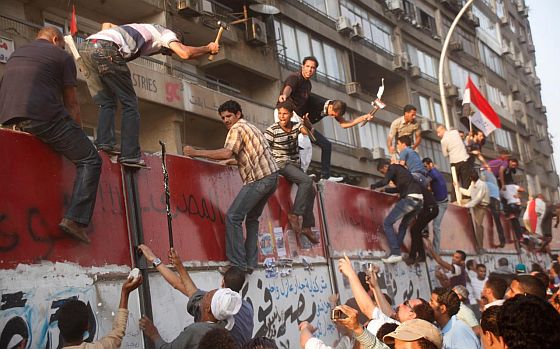
Egyptians marched on the Israeli embassy in Cairo on Friday, demolished a wall built around the embassy building to protect it and stormed the Nile tower block that houses the mission.
Egyptian security forces raided the offices of an Egyptian affiliate of the Al Jazeera news network known for attentive coverage of street protests, eliciting allegations on Sunday of a crackdown on the news media as the military-led transitional government seeks to ensure law and order after allowing an angry mob to invade the Israeli Embassy over the weekend.
The raid on the television network came as both the Egyptian and Israeli governments began tentative steps to repair the diplomatic breach between the awkward allies after the embassy attack on Friday night.
The raid also came after a warning last week by Egypt’s minister of media, Osama Heikal, that the government would take legal action against stations that “endanger the stability and security” of the nation, and some analysts said they feared the raid could signal a broader effort to curtail the new freedoms of expression experienced since the uprising that ousted former President Hosni Mubarak this year.
The network, Al Jazeera Live Egypt, was founded in the aftermath of the uprising and has become known for its attentive, if not sensational, coverage of street protests, including the Israeli Embassy attack on Friday. The raid forced the network to halt its programming for a period before it resumed broadcasting from Al Jazeera’s headquarters in Doha, Qatar.
Officials of the Interior Ministry said they had raided the network because it lacked a license, and that neighbors had complained about noise. Numerous satellite channels have sprung up since the revolution, and Mr. Heikal, the media minister, said in his statement last week that the government would stop issuing new permits because of concerns about broadcasts that endangered stability.
But Islam Lotfy, a lawyer for the channel, said the channel had applied for a license in March without a response.
According to identical accounts offered by Egyptian officials and foreign diplomats in Cairo, Egypt had asked Israel before the developments of last Friday to keep the Israeli ambassador in Tel Aviv and to reduce the volume of its staff to the minimum, but Netanyahu insisted on sending the ambassador back only a few days before the latest protest.
“We are not expelling him, but we thought a long holiday for the Israeli ambassador in Egypt would be useful for all of us now; unfortunately, Israel thought otherwise and when anger erupted on Friday evening they had to solicit the intervention of the Americans who sent a plane to carry him and the rest of the staff out of Egypt,” said one official.
Today, there is a tacit agreement between Egypt and Israel that the long holiday for the ambassador is in place and there are guarantees offered by Cairo to both Washington and Tel Aviv that stepped up security measures will be in place to prevent another attack on the embassy.
In the Islamist Al-Dawa Al-Salafiya (Salafist Call) reaction statement to the protesters’ storming of the Israeli embassy in Cairo on 9 September, they slammed the attack as “not thought-out,” which will work in the favour of Israel.
The Salafist movement claims that the 9 September mobbing of the embassy “will work in favour of Israel and will transform them from perpetrators to victims and the focus will shift from our demands to amend the Camp David agreement to Israel’s calls for help to protect their embassy in Egypt.”
The movement also pointed out that the “Egyptians are united in their hate for Israel (thank God). We must fight cultural normalisation [with Israel] and we should push for the international isolation of Israel.”
The group also condemned the statement released by President Obama in which he told Egypt to “honour its international obligations to safeguard the security of the Israeli embassy,” and reminded the US president that Egypt has changed after the January 25 Revolution.
The statement also claimed that most of the calls for violence are actually from a US-backed ex-police officer, Omar Afifi, who resides in the US and uses the internet to incite divisions in Egypt.
The Israeli government must be exhilarated that it is no longer being held responsible for the chaotic events taking place in Egypt. Instead they are now being portrayed as victims of a different “foreign hand,” which sponsored the storming of their embassy in Cairo.
Friday’s incident at the Israeli Embassy, in which thousands of angry protestors – surprisingly – managed to storm the embassy, is being portrayed by Egypt’s flagship newspaper Al-Ahram as fueled by elements of the “counter-revolution” that seeks the fall of the Egyptian state.
In its main headline, the paper speaks of “the involvement of a number of neighboring countries in providing ‘huge beyond imagination’ funds to Egyptian NGOs.”
Justice Minister Abdel Aziz al-Guindi told Al-Ahram that a country from the Gulf gave LE181 million to a small Egyptian NGO.
Guindi added that he has received a report that shows that several neighboring countries have offered million of pounds to Egyptian human rights and civil society organizations, some of which are not registered.
He also said that he has submitted a report to the head of the Supreme Council of the Armed Forces (SCAF) and the prime minister to take appropriate action against the inflow of funds, adding that the cabinet will announce the report’s findings within the next few days.
Guindi added that these “foreign hands” – and local ones – have been behind other incidents of violence in Egypt, seeking to sabotage state institutions, undermine national security, and intimidate citizens.
One might cast doubt over the relationship between the demonstrations in front of the Israeli Embassy and a small NGO receiving millions of pounds, but Al-Ahram doesn’t address such logical inconsistencies.
An editorial in the same paper echoes the article’s sinister tone, with a lead blaring, “The secrets of the plot facing Egypt.”
It reads, “Today, the details of the plot facing Egypt are appearing. The plot doesn’t challenge the Egyptian revolution only; more dangerously, it aims to make Egypt reel in chaos.”
Following the events at the Israeli Embassy, the Egyptian government announced its intent to fully implement the decades-old Emergency Law.
It’s easy to forget that the repeal of the state of emergency was a top demand of protesters who took the streets against former President Hosni Mubarak in January and February. That mood has clearly changed now, although the SCAF declared last month that they had begun the process of ending the state of emergency before parliamentary elections that are expected to be held in November.
Despite this very fact, state-run Al-Gomhurriya praised the move of fully implementing the exceptional measures enshrined in the widely-reviled law. The newspaper runs a lengthy feature quoting “legal experts” defending the re-implementation of the law, saying that such a move would restore the prestige of the state and its stability.
At some point, will it dawn on the Israelis that constructing walls is not the magic solution to all their security problems?
After Israel enraged many Egyptians by killing five border guards on August 18 (a sixth who was shot in the same incident died today), the Israeli government thought it would be prudent to install a 15-foot concrete barrier around its embassy in Cairo.
The construction of a wall outside the embassy was almost a provocation to people to come and bring it down. The symbolism of a wall was not lost on any one and merely angered people.
After protesters stormed the embassy on Friday night, Egyptian authorities only moved in to protect the Israeli staff after the Obama administration interceded on Israel’s behalf. Even then, it took two hours before U.S. Secretary of Defense Leon Panetta was able to speak to Supreme Military Council head Mohamed Hussein Tantawi.
“There’s no time to waste,” Panetta reportedly told Tantawi in the 1 A.M. call, warning of a tragic outcome that “would have very severe consequences.”
The U.S. source also said that Tantawi failed to answer incoming calls from U.S. officials throughout the evening, finally answering after more than two hours of attempts.
Nominally, Egypt is one of Israel’s only allies in the Middle East, but as Israelis are now acutely aware, there’s a big difference between an alliance with Hosni Mubarak and cordial relations with the Egyptian people.
Israel has now pulled out all its embassy staff and their families leaving behind just one diplomat, its deputy ambassador who has taken refuge at the US embassy.
The flight of the Israelis from Egypt comes just a few days before Turkish Prime Minister Recep Tayyep Erdogan is about to arrive in Cairo where he will address a meeting of Arab foreign ministers on Tuesday. Some reports say that he might travel from Cairo for a brief visit to Gaza.
The Arab awakening is a tale of three battles rolled into one: people against regimes; people against people; and regimes against other regimes. The first involves the tug-of-war between regimes and spontaneous protesters. The demonstrators, most of them political only in the broadest sense of the term, are stirred by visceral, nebulous emotions—paramount among them the basic feeling of being fed up. Many don’t know what they want or who they support but are confident of what they refuse—daily indignities, privations, and the stifling of basic freedoms—and who they reject, which makes them formidable adversaries. Neither of the instruments used by rulers to maintain control, repression and co-optation, can easily succeed: repression because it further solidifies the image of the state as hostile; co-optation because there are no clearly empowered leaders to win over and attempts to seduce convey a message of weakness, which further emboldens the demonstrators.
The second struggle involves a focused fight among more organized political groups. Some are associated with the old order; they include the military, social and economic elites, local chieftains, as well as a coterie of ersatz traditional parties. Others are the outlawed or semitolerated opposition, including exiled personalities, parties, and, most importantly, Islamists. In Libya and Syria, armed groups with various leanings and motivations have emerged. Little of the enthusiasm or innocence of the protest movements survives here; this is the province of unsentimental dealings and raw power politics.
Relations between young protesters and more traditional opposition parties can be tenuous and it is not always clear how representative either are. In Egypt, where the street battle against the regime was quickly won and Mubarak rapidly resigned, organized opposition groups—from the Muslim Brotherhood to long-established parties—subsequently stepped in and sought to muscle the disorganized protesters out. In Yemen, street demonstrators coexist uneasily with organized opposition parties and defectors from the regime. In Libya, rivalry among strands of the opposition has led to bloodshed and could portend a chaotic future. Some of the local popular committees that spontaneously emerged in Syria warily eye and distrust the exiled opposition.
The third struggle is a regional and international competition for influence. It has become an important part of the picture and assumes an increasingly prominent role. The region’s strategic balance is at stake: whether Syria will remain in alliance with Iran; whether Bahrain will drift from Saudi Arabia’s influence; whether Turkey will emerge bolstered or battered; whether stability in Iraq will suffer. One suspects more than faithfulness to reforms and infatuation with democratic principles when Saudi Arabia and Bahrain, which both ruthlessly suppress dissent at home, urge Syria to allow peaceful protesters; when Iran, which backs the regime in Damascus, castigates the oppression in Bahrain; and when Ankara hedges its bets between the Syrian regime and its foes.
Interlopers are legion. The sense grows that what happens anywhere will have a profound impact everywhere. NATO fought in Libya and helped oust Qaddafi. Iran and Saudi Arabia play out their rivalry in Yemen, Bahrain, and Syria; Qatar hopes to elevate its standing by propelling the Libyan and Syrian opposition to power; in Syria, Turkey sees an opportunity to side with the majority Sunnis yet simultaneously fears what Damascus and Tehran might do in return: could they rekindle Kurdish separatism or jeopardize Ankara’s delicate modus vivendi in Iraq? Iran will invest more in Iraq if it feels Syria slipping away. As they become buoyed by advances in Libya and Syria, how long before Iraqi Islamists and their regional allies rekindle a struggle they fear was prematurely aborted?
The US has not been the last to get involved, but it has done so without a clear sense of purpose, wishing to side with the protesters but unsure it can live with the consequences. The least visible, curiously yet wisely, has been Israel. It knows how much its interests are in the balance but also how little it can do to protect them. Silence has been the more judicious choice.
Any number of outcomes could emerge from this complex brew. Regional equilibriums could be profoundly unsettled, with Iran losing its Syrian ally; the US, its Egyptian partner; Saudi Arabia, stability in the Gulf; Turkey, its newly acquired prestige; Iraq, its budding but fragile democracy. A wider Middle Eastern conflict could ensue. At the domestic level, some uprisings could result in a mere reshuffling of cards as new configurations of old elites keep control. There could be prolonged chaos, instability, and the targeting of minority groups.
The uprisings, partly motivated by economic hardship, ironically make those hardships still more severe. Where elections take place, they likely will prompt confusion, as groups with uncertain political experience compete. As with all upheavals, there will be a messy chapter before clarity sets in and the actual balance of power becomes evident. Increasing numbers could well question whether emerging regimes are improvements. Nostalgia for the past cannot lag far behind.
Some states might fragment because of ethnic, sectarian, or tribal divides. Civil war, a variant of which has broken out in Yemen and is deeply feared in Syria, may emerge. The region is ripe for breakdown. Sudan is partitioned; Yemen is torn between a Houthi rebellion in the north and secessionists in the south; Iraqi Kurdistan teeters on the edge of separation; in Palestine, Gaza and the West Bank each goes its own way; in Syria, Sunnis, Alawites, Kurds, Druze, and Bedouin tribes might push for greater self-rule. The upheaval could accelerate the drift. The uprisings revitalized symbols of unity—the national flag and anthem—yet simultaneously loosened the state’s hold and facilitated displays of subnational identity. Even the often ignored Berbers of North Africa have become more assertive.
For all this uncertainty, there seems little doubt—as protesters tire and as the general public tires of them—in what direction the balance will tilt. After the dictator falls, incessant political upheaval carries inordinate economic and security costs and most people long for order and safety. The young street demonstrators challenge the status quo, ignite a revolutionary spirit, and point the way for a redistribution of power. But what they possess in enthusiasm they lack in organization and political experience. What gives them strength during the uprising—their amorphous character and impulsiveness—leads to their subsequent undoing. Their domain is the more visible and publicized. The real action, much to their chagrin, takes place elsewhere.
The outcome of the Arab awakening will not be determined by those who launched it. The popular uprisings were broadly welcomed, but they do not neatly fit the social and political makeup of traditional communities often organized along tribal and kinship ties, where religion has a central part and foreign meddling is the norm. The result will be decided by other, more calculating and hard-nosed forces.
[…]
Of all the features of the initial Arab uprisings, the more notable relate to what they were not. They were not spearheaded by the military, engineered from outside, backed by a powerful organization, or equipped with a clear vision and leadership. Nor, remarkably, were they violent. The excitement generated by these early revolutionary moments owed as much to what they lacked as to what they possessed. The absence of those attributes is what allowed so many, especially in the West, to believe that the spontaneous celebrations they were witnessing would translate into open, liberal, democratic societies.
Revolutions devour their children. The spoils go to the resolute, the patient, who know what they are pursuing and how to achieve it. Revolutions almost invariably are short-lived affairs, bursts of energy that destroy much on their pathway, including the people and ideas that inspired them. So it is with the Arab uprising. It will bring about radical changes. It will empower new forces and marginalize others. But the young activists who first rush onto the streets tend to lose out in the skirmishes that follow. Members of the general public might be grateful for what they have done. They often admire them and hold them in high esteem. But they do not feel they are part of them. The usual condition of a revolutionary is to be tossed aside.
The only surprising thing about the breach of the Israeli embassy in Cairo is that it never happened any time before in the past 30 years. In a city that abounds in isolated walled desert compounds, someone decided to put the most often marched-upon facility in Egypt in a quite ordinary apartment building in the heart of the city, whose defenses basically consist of however much force the security services/army choose to deploy on the street that particular day. Throughout the 1990s, at least once a year, students from nearby Cairo University staged a half-hearted attempt to storm the place. The hardcore “Ultra” football club fans who seemed to be a major contingent of yesterday’s crowd may simply have been more persistant than your usual Cairo demonstrators — partially because the self-styled “commandos of the revolution” (whose subculture is described by Ursula below) are used to fighting with police, and partially because they claimed to have one of their own dead to avenge, supposedly killed on Tuesday night post-match battle between Ahly club fans and police on Saleh Salem Road that started when police charged the stands in response to taunting chants.
So, rather than being satisfied with a few hours of melee with the police and military, they kept up the battle until late into the night, until eventually some got inside the building and up to the reception area. Meanwhile, other protesters tried to storm the Giza security directorate, reportedly after a police car leaving the scene ran down two demonstrators. The deaths were a tragedy, but I don’t think that this quite constitutes an international crisis.
I was at the Tahrir demo earlier in the day, and although the Ultras were a heavy presence, and although small groups approached the nearby Interior Ministry from time to time, most of them responded pretty quickly to the “Peacefully! Peacefully!” chants from the crowd. In fact, part of the reason that the Ultras were there seemed to be that they wanted to be taken seriously as an aggrieved constituency — a huge banner reading “Ultras are not criminals!” hung in the square. Ultras in the crowd said that while they were used to demonstrating, today they came specifically on account of their own grievances: specifically, police brutality, and the referral of civilians to military trials. (Activists following the military trials says that military prosecutors tend to pick on working class kids who aren’t connected to one of the mainstream movement, so I’m guessing that includes a lot of Ultras.). “I used to come to Tahrir for the sake of the nation, but now for the first time I’m here as an Ultra,” one Ahli fan said.
A group of about 30 protesters broke into the Israeli Embassy in Cairo Friday and dumped hundreds of documents out of the windows after a day of demonstrations outside the building in which crowds swinging sledge hammers and using their bare hands tore apart the embassy’s security wall.
Israel’s ambassador, Yitzhak Levanon, his family and other embassy staff rushed to Cairo airport and left on a military plane for Israel, said airport officials who spoke on condition of anonymity because they were not authorized to speak to the media.
Israeli officials refused to comment on the ambassador’s departure.
Hundreds of protesters converged on the embassy throughout the afternoon and into the night, tearing down large sections of the graffiti-covered security wall outside the 21-story building housing the embassy. Egyptian security forces made no attempt for hours to intervene.
Just before midnight, a group of protesters reached a room on one of the embassy’s lower floors at the top of the building and began dumping Hebrew-language documents from the windows, said an Egyptian security official who spoke on condition of anonymity because he was not authorized to speak to the media.
In Jerusalem, an Israeli official confirmed the embassy had been broken into, saying it appeared the group reached a waiting room on the lower floor. He spoke on condition of anonymity because he was not permitted to release the information.
No one answered the phone at the embassy late Friday.
Meanwhile, U.S. President Barak Obama spoke with Prime Minister Benjamin Netanyahu about the situation at the Israeli Embassy in Cairo.
The President’s office said in a statement that Obama expressed great concern about the situation at the Embassy, and the security of the Israelis serving there.
The statement said Obama “reviewed the steps that the United States is taking at all levels to help resolve the situation without further violence, and to call on the Government of Egypt to honor its international obligations to safeguard the security of the Israeli Embassy.”
Obama and Netanyahu agreed to stay in close touch until the situation is resolved.
Turkish President Abdullah Gül has called on European leaders to stick to values such as democracy, the rule of law and respect for human rights, which originated from the continent of Europe, as he warned that populist tendencies among European leaders towards migration triggered the radicalization of immigrant societies.
Delivering a speech at the third Global Policy Forum held in the central Russian city of Yaroslavl, Gül said the values of democracy, the rule of law and respect for human rights, although having originated in Europe, had a global impact.
“The Arab Spring that began with the demand of the people for democratic transformation is the latest manifestation of this impact. One expects a decline in discriminatory treatment as the world experiences these developments and the emergence of a common cultural understanding for mankind, but we unfortunately continue to witness the strengthening of extremist views that consider differences as a reason for conflict in various parts of the world,” Gül said at the forum, to which he had been invited as guest of honor. The forum was held under the auspices of Russian President Dmitry Medvedev. This year’s forum, titled “The Modern State in the Age of Social Diversity,” focused on issues democracies face in the present-day social diversity such as the correlation of economic efficiency and social equality, the balance between innovation and tradition, maintaining global security and personal freedoms.
“The existence of these movements on the European continent, which presented the world with the notions of democracy and the modern state, is food for thought. Racism, Islamophobia and xenophobia that fester contemporaneously with the economic crisis affecting Europe give rise to serious concern. Parties that point at migrants as the source of problems such as security, crime, poverty and other social difficulties gain more votes.
“The reaction by governments and main political parties that introduce stricter measures on migration in order to counter this fear by the people is also worrying. Rising intolerance and discrimination becomes a trigger for radicalization,” Gül said.
The July 22 terrorist attacks in which a right-wing extremist killed 77 people and rocked the foundations of Norway’s democratic society, which places high value on openness and civil rights, was one example used by Gül to better explain his point.
Libya’s interim prime minister arrived in Tripoli on Thursday for his first public appearance in the capital since Muammar Gaddafi was overthrown more than two weeks ago, to face criticism that the country is experiencing a power vacuum.
Mahmoud Jibril’s debut press conference coincided with a meeting of revolutionary activists from across Libya who called on the National Transitional Council to show leadership or face potential revolt.
Saoud Elhafi, co-founder of the February 17 Coalition – a reference to the date of the first uprising – told the Guardian that there had been frustration over Jibril’s long diplomatic missions abroad.
“There is definitely a vacuum,” he said. “He needs to fill this vacuum as soon as possible. He was assigned to form a new government but we are yet to see it. Part of stability is to provide services to the people – otherwise, they will revolt.”
Elhafi added: “In the next few weeks you will see change with Mr Jibril. There’s a lot of pressure on him now. The honeymoon period for him now is gone. People are coming together to say enough is enough.”
He said of Jibril, head of the NTC’s executive office: “We notice he is not available. He is mostly outside Libya; you can count on your hands the days he is here. It is not acceptable. He needs to be in touch with the people.”
Brigadier-General Michael Edelstein, the officer crafting Israel’s counter-demonstration doctrines, said troops were now better equipped and trained to police the occupied West Bank and the boundaries with Gaza, Lebanon and Syria.
“The balance has changed. We have more means that we can use, therefore the use of lethal weapons will decrease,” he told foreign reporters in a briefing.
He said there was no plan to reinforce military garrisons, which had been practicing non-lethal riot control techniques.
Israel has also invested heavily in riot-dispersal gear including accurate tear-gas launchers, high-powered loudspeakers that emit an intolerable buzzing noise, and cannons for dousing crowds with water or a foul-smelling liquid known as “skunk.”
The objective, Edelstein said, was “to be able to handle riots while diminishing casualties on both sides.”
Asked if this meant that Israeli forces, accused in the past of shoot-on-sight policies against Palestinians, would now show more tolerance, he said: “Much more tolerance.”
While Israel’s ability to develop internally as a democracy is shackled by the undemocratic nature of Zionism, it’s hardly surprising that the growth of democracy outside Israel — notably in Turkey and Egypt — presents a conundrum for the Jewish state: how can harmonious relations be maintained with historically friendly governments without also attempting to cultivate friendly relations with the people that those governments represent?
Democracy is a simple idea: people matter. And if Israel doesn’t get this, it doesn’t get democracy.
Public opinion has had an increasing impact on Turkey’s foreign policy-making in recent years. Democratization and a growing participation in civil society, due to economic development and the EU accession process, have empowered public opinion to assert itself on the matter of foreign affairs, which was not the case a decade ago. Thus Turkey’s relationship with Israel was questioned whenever Israel engaged in violent policies in the region, like the war in Lebanon and the attacks on Gaza. Public reaction to Israeli aggression in the region is bound to be taken into consideration by a government that is accountable to its people.
Especially after the killing of eight Turks and one Turkish-American aboard the Mavi Marmara by Israeli soldiers, public opinion is ever more important. It will be very difficult to win the people over to a rapprochement with Israel, without at least an official apology and compensation.
It is therefore a mistake to assume that the Erdoğan government is the source of the problem, and to claim that Turkish-Israeli relations would return to normal under a non-AK Party government. To refute this I will say two things: First, the AK Party government is only responding to the public mood and demands. Second, the AK Party is very unlikely to disappear from the political scene in Turkey. That is to say that both the current public mood and the AK Party’s rule appear as though they will be around for a while. So instead of sitting and waiting in vain for them to disappear, Israel and its friends should try to not lose Turkey’s support permanently.
My advice to the Israeli government is that it should get used to living and working with the AK Party government, and to try to understand the “new Turkey” because even in a future post-AK Party period things will never be the same as in days past.
Traveling from safe house to safe house, Anthony Shadid meets Syria’s young revolutionaries, one of whom declares: “We’ve already won. We’re victorious now. I lived a life of terror, fear and killing, and now I’m free.”
It was past 11 a.m., and Abdullah was finally waking up. The night before had gone late, he and his friends challenging and daring and fleeing from the feared mukhabarat, Syria’s secret police, who for the past five months have been bent on crushing dissent here in Homs. With a few hours of sleep behind him, Abdullah rolled off his mattress and began tapping out details of their exploits on his laptop. The clashes had been fierce and lasted hours, past the muezzin’s call to prayer at dawn. “We won’t bow to anyone but God,” the protesters declared. The mukhabarat replied with tear gas, buckshot and bullets. “Hot” was how Abdullah described it as he typed.
As safe houses go, the room he slept in was lavish. A wide-screen television shared space on the wall with framed Koranic verses, rendered in sloping gold script. The hot wind of the Syrian summer billowed the thick drapes like sails in a storm. There was a mattress for each of the four men, all in their 20s, who slept surrounded by their smartphones and laptops and satellite phones and speakers.
Abdullah, a 26-year-old computer engineer and pious Muslim, is a wanted man. He joined the first protest in Homs in March, and since then he has emerged as one of the dozen or so leaders of the youth resistance. His savvy with technology has made him a target for the police, and this was the fifth place he had slept in in less than a week. He hadn’t been to his family’s home in two months. Around his neck he wore a tiny toy penguin that was actually a thumb drive, which he treated like a talisman, occasionally squeezing it to make sure it was still there. I sat next to him on the mattress and watched as he traded messages with other activists on Skype, then updated a Facebook page that serves as an underground newspaper, then marked a Google Earth map of Homs with the spots of the latest unrest. “If there’s no Internet,” Abdullah said, “there’s no life.”
The other young men in the room began to stir. Abdullah’s friend Iyad (last names of the activists will not be used, in order to protect their identities), brought in tea and emptied ashtrays. They all soon started talking with an excitement that belied the danger to which they have grown accustomed. By day, a measure of normal life unfolds in Homs: stores and government offices are open, and people go about their business. Checkpoints have proliferated, though, and the most active youth try to stay off the streets, worrying that they are easier to identity in the daylight. By night, they gather in scores, sometimes in the hundreds, in open defiance of the regime. In Iyad’s living room, they bragged about spreading nails in the streets to flatten the tires of security-force vehicles and described to me how they load onions into plastic pipes and fire them by igniting hair spray. When security forces surged toward one of their comrades, they shouted to him: “You’ve got 20 guys around you! Blow yourself up!”
“They just fled,” Abdullah said, smiling as he recalled the security forces retreating in fear from the imaginary explosives.
One night late last month, in a sweltering apartment deep in the heart of Tripoli, a group of men gathered around the television to watch the evening news. The program was carried on Libya al-Ahrar, a Doha-based news channel beaming into Libya in support of the revolution. At precisely 8:30 p.m., after the breaking of the Ramadan fast and as locals were streaming to the mosques, the message these men were waiting for came: “Truly, we have granted you a clear victory,” the newscaster said, before signing off for the night.
It was a verse from the Quran, but to the men in this room, in the tightly packed neighborhood of Souq al-Juma, it was so much more — a code that signaled that their uprising was to begin. Over the next 48 hours, the people of Tripoli pushed Libya’s six-month revolution to its staggering denouement, ensuring their country would never again be the same and reinvigorating the Arab awakening — and it all began in this neighborhood.
The men watching the television were part of a group of 62 underground revolutionaries who had been preparing for this day for weeks. Malik Jamal Abargo, a 20-something port worker, was one of them. He grabbed his Kalashnikov and rushed into the streets with his comrades. “My heart was pounding,” he says. “I thought that I might become a martyr.”
The sight of the small crowd chanting slogans against Muammar al-Qaddafi in the street prompted shouts from the mosque. Soon its speakers issued forth a thunderous chant: Allahu akbar! Out came Khalid Abu Humeida, a customs worker. “I was standing in line for vegetables when I heard it,” he says. “It had more force to me than any bomb or jet. I knew what to do.” He was joined by Salem El Burai, a restaurant owner who came rushing out with a bag of rocks. Abdul, who would not give his last name and has no job at all, emerged with a Molotov cocktail.
The crowd grew to hundreds — the first large open protests against the government in any part of Tripoli since February, when demonstrations were drowned in blood. Almost immediately, truckloads of state security forces began to arrive. They pointed their weapons at the demonstrators. “We inched forward, step by step, trying not to waver,” says Abdul.
This website or its third-party tools use cookies, which are necessary to its functioning. By closing this banner, you agree to the use of cookies.