The U.S. and Israel are closely monitoring Syria’s suspected cache of weapons of mass destruction, fearing that terror groups could take advantage of the revolt against President Bashar al-Assad to obtain blistering agents, nerve gas and long-range missiles, according to officials from both countries.
U.S intelligence services believe Syria’s nonconventional weapons programs include significant stockpiles of mustard gas, VX and Sarin gas and the missile and artillery systems to deliver them.
United Nations investigators also recently concluded that Damascus had been secretly constructing a nuclear reactor with North Korean help before Israeli jets destroyed the site in late 2007. U.S. and U.N. nonproliferation officials continue to worry that Pyongyang may have provided Syria with additional nuclear-related equipment.
“We are very concerned about the status of Syria’s WMD, including chemical weapons,” Israel’s ambassador to the U.S., Michael Oren, said in an interview. “Together with the U.S. administration, we are watching this situation very carefully.”
Israel has historically held concerns about the fall of the Assad regime, which has largely kept the Syria-Israel border quiet for the past 40 years. Still, Prime Minister Benjamin Netanyahu’s government has increasingly voiced support for democratic change in Damascus.
“We see a lot of opportunity emerging from the end of the Assad regime,” Mr. Oren said.
A senior U.S. official said Syria’s suspected chemical weapons arsenal “is of great importance and…under intense study.”
U.S. and Israeli officials won’t disclose exactly how they are keeping tabs on Syrian weaponry. But in the past, the U.S. and Israel have tracked activities at Syrian military installations using satellites and human spies. In 2008, the George W. Bush administration released detailed photographs and other intelligence of a reactor allegedly set to produce weapons-grade plutonium on the Euphrates River in eastern Syria.
Washington’s concerns about Syria mirror in some ways those held about Libya, where U.S. intelligence agencies are trying to help rebels secure mustard gas, shoulder-fired missiles and light arms amassed by Col. Moammar Gadhafi’s regime in recent decades. The Obama administration is concerned these weapons could fall into the hands of militant groups and terrorist organizations operating across North Africa and the Middle East.
As the fighting died down in Tripoli on Friday, the scope and savagery of the violence during the nearly weeklong battle for control of the capital began to come into sharper focus.
Amnesty International said Friday that it had evidence that forces loyal to Col. Muammar el-Qaddafi had killed rebels who had been held in custody in two camps. In one camp, it said, guards killed five detainees held in solitary confinement, and in another they opened the gates, telling the rebels they were free to go, then tossed grenades and fired on the men as they tried to run for freedom.
The report, based on accounts from escaped prisoners, cited no death toll, but said that of the 160 detainees attacked, only 23 were known to have escaped.
On Thursday, there were reports that the bullet-riddled bodies of more than 30 pro-Qaddafi fighters had been found at a military encampment in central Tripoli. At least two were bound with plastic handcuffs, suggesting that they had been executed, and five of the dead were found at a field hospital.
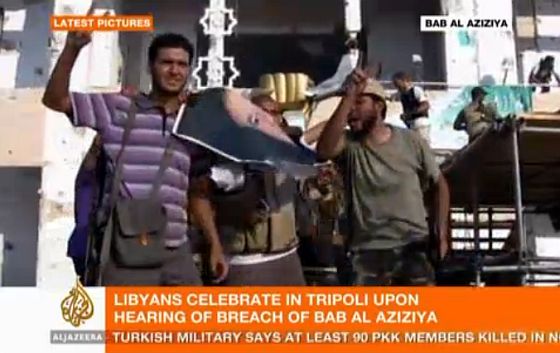
More bodies turned up in the streets on Friday, where occasional volleys of gunfire were heard. Near Colonel Qaddafi’s abandoned citadel, Bab al-Aziziya, rebels began hauling away nine bloated bodies. The face of one was so badly decayed it appeared charred.
Maggots crawled over the torso of another.
“Only a butcher could commit a massacre like this,” said Sami Omar, a rebel.
Six were dumped near a trash receptacle, two left under a stairwell and one thrown in a large ditch, his hands apparently cuffed.
Rebels said Qaddafi loyalists had killed them as they celebrated his fall. But one resident said they were his fighters, slain by rebels.
As he spoke, a rebel approached him, saying he was not authorized to speak.
In a sign of the intensity of the fighting this week in the capital, 40 bodies, many in advanced states of decomposition, were piled up in an abandoned hospital in the Abu Salim neighborhood, until Friday the preserve of the Qaddafi forces. Most of the fighters were darker skinned than most Libyans, a sign, rebels there said, that they may have been recruited from sub-Saharan Africa. The rebels have frequently accused the Qaddafi government of using mercenaries but have not offered convincing proof.
The halls of the hospital were a chaos of beds and unplugged machines, and its floors were painted with blood. A medical technician said that three doctors had been on duty during the fighting in recent days, and that they had been unable to cope.
It was difficult to ascertain the fates of the dead men, who were lying on gurneys nested by maggots in a hospital room and the morgue. The relatives of one victim, Abdul Raouf Al Rashdi, a 33-year-old police officer, said he had been killed by a sniper several days earlier in the Hay Andalus neighborhood.
Libyan rebels pushed Col. Moammar Gadhafi’s forces out of the last residential neighborhood in Tripoli overnight Friday, but the rebel military gains were overshadowed by rapidly deteriorating living conditions in the capital of about two million people.
The challenges of restoring life to Tripoli grow more daunting by the day. Streets are buried under a mix of trash, waste and, in several places, corpses. Water and electricity have been cut throughout much of the city.
But the rebels’ victory in the Abu Salim neighborhood has made the area safe enough for city residents and journalists to visit its notorious Abu Salim prison for the first time.
A 1996 inmate massacre at the prison has fired up Libya’s opposition for years. A protest on Feb. 15 in Benghazi by families of victims of that massacre, and their lawyers, kicked off the countrywide protests that launched six months of fighting that this week unseated Col. Gadhafi.
The rebels’ national governing body, the National Transitional Council, is just beginning to relocate from its eastern base in Benghazi to Tripoli. Opposition leader Mustafa Abdul Jalil will remain in Benghazi until the capital is deemed secure.
Tripoli was cloaked in darkness Friday night, the first time it has been largely without power since rebels stormed into the capital Sunday. City faucets were dry for a second straight day.
In hospital morgues, bodies are piled on top of each other on available floor space. As rebels claim corpses of their own ranks, bodies of what appear to be pro-Gadhafi fighters are left on the streets in the summer heat. In some places, the smell suffocates whole blocks.
Libya’s opposition National Transitional Council (NTC) gave its first press conference in Tripoli on Thursday evening. It was a chaotic late-night affair; so far nobody has had much of a chance to sketch out a new political system. On Friday, however, the marchers [in new Libya’s first political march] agreed that after 42 years of dictatorship and iron-fisted personalist rule the country should become a European-style democracy.
“I want to live in a democratic country. It’s the most important thing for me and my children,” Naser al-Shahawi said, emerging from the [Jamal Abdul Nasser] mosque. “This is what the people want. We also want an Islamic country. But I don’t think that democracy is an enemy of Islam.”
The 48-year-old international lawyer said he wasn’t greatly impressed by the NTC – pointing out that several of its leaders “had been with Gaddafi”.
Who, then, did he think could be Libya’s new prime minister? “Maybe me,” he replied. “Now is the first time that anybody can be prime minister, or president.” Then he admitted: “I have never voted in my life.”
Shahawi, who had spent a year and half living in Cardiff, said he was studying for a PhD in international law. Asked what should happen to Gaddafi when justice eventually caught up with him, he was brutally succinct.
“He should die,” he said, then insisted that the former dictator should be tried inside the country, rather than extradited to the international criminal court, where a heap of indictments await.
A group of fighters then expressed their feelings in verbal form: “Fuck you Gaddafi,” they shouted.
Rebel units were massing for an attack on Sirte, Muammar Gaddafi’s birthplace, on Friday after Nato warplanes conducted intensive bombing raids to weaken one of the last major redoubts controlled by the ousted regime.
On the road to Sirte from Misrata, tanks, heavy artillery and rocket launchers abandoned by fleeing government forces were being assembled for the attack.
Rebels said a British and French special forces team was helping co-ordinate the assault, in which Misrata-based units will push eastwards to meet forces from Benghazi fighting their way westwards.
Israel’s July 14 social justice movement is really like a campaign in support of sunshine. Who’s going to oppose it? The supporters of social injustice?
To the extent that Israelis were inspired by the example of the Egyptian revolution, this seems to have gone no further than sharing in the empowering experience of being among thousands of people who have taken to the streets, joined by a sense of solidarity. But solidarity around what?
The difference between J14 and the Egyptian revolution is the difference between asking for a pay raise or telling your boss, “You’re fired!”
As Ami Kaufman wrote recently, “Although the protesters are demanding ‘social justice,’ what they’re really asking for is ‘more money!’”
Joseph Dana and Max Blumenthal explain how easy it has been for Israelis to call for social justice while ignoring the occupation.
The decision to exclude the occupation from the grievances of the July 14 movement was entirely organic. No hired gun consultant advised movement activists to avoid the hot button issue in order to broaden the appeal of the demonstrations. The mainstream of the Jewish public decided on its own, and without much internal reflection, that social justice could exist alongside a system of ethnic exclusivism. Thus, while the July 14 movement proceeded through cities across Israel bellowing out cries for dignity and rights, Palestinians remained safely tucked away behind an elaborate matrix of control — the Iron Wall. Ten years of separation had not only rendered the Palestinians invisible in a physical sense. It had erased them from the Israeli conscience.
“It’s very strange to see a social justice protest without mentioning occupation,” Gidi Grinstein, a confidant of Defense Minister Ehud Barak, who heads the Reut Institute, a government-linked Israeli think tank remarked. “But most people in Israel don’t even believe there is an occupation anymore. They see the Palestinian Authority in the West Bank, and think there is a functioning government. They hear about the Palestinian statehood resolution at the UN in September, and they think Palestine is a real state. So there is this cognitive dissonance among Israelis.”
For years Israel’s tiny but intensely motivated left-wing tried to mobilize mass protests against the occupation, hoping they could shake Israeli society out of its slumber. But the settlements grew, and the occupation became more and more entrenched. Suddenly, with hundreds of thousands of their compatriots in the streets demonstrating against the most right-wing government in their country’s history, some leftists began conjuring visions of a revolution.
“We have failed to end the occupation by confronting it head on but the boundary-breaking, de-segregating movement could, conceivably, undermine it,” wrote Dimi Reider. Reider claimed the demonstrations could achieve dramatic change because they “may challenge something even deeper than the occupation.” Hagai Mattar, a veteran anti-occupation activist and widely read journalist, echoed Reider’s unbridled enthusiasm. “For the first time in decades, perhaps, we are witnessing the impossible becoming possible,” Mattar wrote on the popular Hebrew website MySay. “What appeared to be a mere fantasy half a year ago… has become a vivid reality.”
Many members of the Israeli left have suffered for their activism. Some have been injured by Israeli soldiers during protests in the West Bank, where they routinely dodge rubber bullets and high-velocity teargas projectiles. Others have served months in prison for refusing to serve in the Israeli Army. With a suite of anti-democratic laws passed by the Knesset, they fear a coming crackdown. But perhaps the greatest source of suffering for Israeli leftists is having been cast out of one of the most tribalistic societies in the world. Many are turned down for housing and employment on the grounds that they refused military service. The very word “leftist,” or smolini, has become an insult in the Hebrew language. Hoping to replace the communal bond their society had denied them, the radical leftists who have not escaped to the squats of Berlin or Barcelona formed a tribe within the tribe.
As the July 14 protests gathered momentum and manpower, members of the radical left bolstered the movement with their tactical experience and fearlessness in the face of police intimidation. On July 23, when hundreds of thousands of protesters took to the streets of Tel Aviv, Israeli police forces arrested 43 demonstrators. Most of them were leftists who attempted to block a major intersection. The most prominent among them was Matar. Normally, the arrests of left-wingers at anti-occupation protests go unreported. In this instance, however, the arrests were broadcast to a national audience during the prime time news. After being released from their jail cells, the demonstrators were greeted by their fellow Israelis not as traitors but as heroic leaders.
“The radical left is no longer an outsider, but forms an important part of the mainstream,” Matar wrote recently in an article celebrating the protests. If this new movement welcomed leftists, and upheld them as its vanguard, how could it not be revolutionary?
After decades of near-hegemonic Israeli strategic supremacy in the Middle East, the ground is shifting. For Israel’s leaders, the Arab Awakening and the removal of Mubarak represents the collapse of a key support structure in the edifice that maintains Israel’s regional posture. That edifice had been fraying for some time. Yet with Israel unwilling or unable to relinquish its control over and occupation of Palestine, it was a system of conflict management that had proven to be remarkably resilient. Undemocratic Egypt was that system’s linchpin. In fact, only an undemocratic Egypt could play this role, indifferent and dismissive as the regime was toward public opinion and able to pursue policies, both at home and abroad, widely perceived as being an affront to Egyptian dignity.
Every country needs a strategy for managing its external relations, especially in the near abroad. Israel’s predicament in this respect is especially challenging. Born as an unusual movement combining religious and historical claims to land with modern aspirations of state-building and communal preservation, Zionism was initially branded by most in the region as a colonial project, a sense that Israel has fed with its expansionist and expulsionist approach to the indigenous population. Unfortunately for Israel, that indigenous population has ethnic and religious ties to a large population throughout the surrounding region. Nevertheless, Israel managed to adapt, pursuing whatever great power or regional alliances were available, making itself useful to the United States as a cold war ally.
Long after it became clear that the Oslo peace process would not deliver Palestinian freedom, rights or sovereignty, the structures established by it and the opportunities they have forged for Israel have endured. They were kept afloat by donor assistance, by the difficulties entailed in dismantling the Palestinian Authority and, crucially, by the stamp of legitimacy that only Egypt could confer. The impact of the Arab Awakening on Israel’s leaders must be understood first and foremost against this backdrop.
But here’s the key statement Levy makes which defined Israel’s view of the region well before the Arab Awakening erupted:
Israel has erected a separation barrier between itself and the Palestinians in the West Bank and Gaza, is proceeding to do the same on the Egyptian border and has long had closed and militarily fortified borders with Lebanon and Syria. Trade with all of its Middle East neighbors, in fact, amounts to less than 5 percent of its total. Israelis rarely visit even those Arab countries it is possible to enter, and the Arab community inside Israel is treated as a fifth column rather than as a bridge to regional relations. Of course, this is a two-way street. Yet when the physical barriers are combined with what is often a striking lack of intellectual, cultural and social curiosity, Israel is in danger of being fundamentally incapable of interpreting developments in its immediate surroundings.
This incapacity is not just an impediment — it actually defines the core of Zionism.
Israel defines itself as a state by its desire to underline the otherness of the non-Jew and emphasize the necessity for Jewish solidarity and self-reliance. On this basis, how would it be possible to foster dynamic and creative relations between Jews and Arabs when the prevailing attitude among Israeli Jews is that they have little or no interest in having any relations with Arabs?
Repetition, according to Hegel, plays a crucial role in history: when something happens just once, it may be dismissed as an accident, something that might have been avoided if the situation had been handled differently; but when the same event repeats itself, it is a sign that a deeper historical process is unfolding. When Napoleon lost at Leipzig in 1813, it looked like bad luck; when he lost again at Waterloo, it was clear that his time was over. The same holds for the continuing financial crisis. In September 2008, it was presented by some as an anomaly that could be corrected through better regulations etc; now that signs of a repeated financial meltdown are gathering it is clear that we are dealing with a structural phenomenon.
We are told again and again that we are living through a debt crisis, and that we all have to share the burden and tighten our belts. All, that is, except the (very) rich. The idea of taxing them more is taboo: if we did, the argument runs, the rich would have no incentive to invest, fewer jobs would be created and we would all suffer. The only way to save ourselves from hard times is for the poor to get poorer and the rich to get richer. What should the poor do? What can they do?
Although the riots in the UK were triggered by the suspicious shooting of Mark Duggan, everyone agrees that they express a deeper unease – but of what kind? As with the car burnings in the Paris banlieues in 2005, the UK rioters had no message to deliver. (There is a clear contrast with the massive student demonstrations in November 2010, which also turned to violence. The students were making clear that they rejected the proposed reforms to higher education.) This is why it is difficult to conceive of the UK rioters in Marxist terms, as an instance of the emergence of the revolutionary subject; they fit much better the Hegelian notion of the ‘rabble’, those outside organised social space, who can express their discontent only through ‘irrational’ outbursts of destructive violence – what Hegel called ‘abstract negativity’.
There is an old story about a worker suspected of stealing: every evening, as he leaves the factory, the wheelbarrow he pushes in front of him is carefully inspected. The guards find nothing; it is always empty. Finally, the penny drops: what the worker is stealing are the wheelbarrows themselves. The guards were missing the obvious truth, just as the commentators on the riots have done. We are told that the disintegration of the Communist regimes in the early 1990s signalled the end of ideology: the time of large-scale ideological projects culminating in totalitarian catastrophe was over; we had entered a new era of rational, pragmatic politics. If the commonplace that we live in a post-ideological era is true in any sense, it can be seen in this recent outburst of violence. This was zero-degree protest, a violent action demanding nothing. In their desperate attempt to find meaning in the riots, the sociologists and editorial-writers obfuscated the enigma the riots presented.
The protesters, though underprivileged and de facto socially excluded, weren’t living on the edge of starvation. People in much worse material straits, let alone conditions of physical and ideological oppression, have been able to organise themselves into political forces with clear agendas. The fact that the rioters have no programme is therefore itself a fact to be interpreted: it tells us a great deal about our ideological-political predicament and about the kind of society we inhabit, a society which celebrates choice but in which the only available alternative to enforced democratic consensus is a blind acting out. Opposition to the system can no longer articulate itself in the form of a realistic alternative, or even as a utopian project, but can only take the shape of a meaningless outburst. What is the point of our celebrated freedom of choice when the only choice is between playing by the rules and (self-)destructive violence?
When Mohamed Bouazizi set himself on fire in rural Tunisia on December 17, 2010, he set in motion a dynamic that goes far beyond the overthrow of individual dictators. We are witnessing nothing less than the awakening, throughout the Arab world, of several phenomena that are critical for stable statehood: the citizen, the citizenry, legitimacy of authority, a commitment to social justice, genuine politics, national self-determination and, ultimately, true sovereignty. It took hundreds of years for the United States and Western Europe to develop governance and civil society systems that affirmed those principles, even if incompletely or erratically, so we should be realistic in our expectations of how long it will take Arab societies to do so.
The countries where citizens are more actively agitating or fighting for their rights—Libya, Tunisia, Egypt, Syria, Bahrain and Yemen are the most advanced to date—have very different local conditions and forms of governance, with ruling elites displaying a wide range of legitimacy in the eyes of their people. Governments have responded to the challenge in a variety of ways, from the flight of the Tunisian and Egyptian leaderships to violent military repression in Syria, Libya and Bahrain, to the attempt to negotiate limited constitutional transformations in Jordan, Morocco and Oman. A few countries that have not experienced major demonstrations—Algeria and Sudan are the most significant—are likely to experience domestic effervescence in due course. Only the handful of wealthy oil producers (like Saudi Arabia, Kuwait, Qatar and the United Arab Emirates) seem largely exempt, for now, from this wave of citizen demands.
Two words capture every important dimension of the Arab Awakening: “humiliation” and “legitimacy.” They explain why the Arab region is erupting, and what needs to be done to satisfy popular demands. The typical Arab citizen, with few exceptions, has felt humiliated in recent decades by his or her government. Hundreds of millions of Arabs feel they have been denied both their human rights and their citizenship rights, the result of decades of socioeconomic stresses and political deprivations. These include petty and large-scale corruption; police brutality; abuse of power; favoritism; unemployment; poor wages; unequal opportunities; inefficient or nonexistent public services; lack of freedom of expression and association; state control of media, culture and education; and many other dimensions of the modern Arab security state. At the same time, ordinary men and women in countries across the region have seen small groups of families in the ruling elite grow fabulously rich simply because of their connections.
The governor of Zagazig on Tuesday honored Ahmed al-Shahat, the young man who pulled down the Israeli flag from the Israel Embassy and replaced it with the Egyptian flag during anti-Israel protests on Saturday.
Protesters have been staging demonstrations before the Israeli Embassy in Giza since last week, following the death of five Egyptian soldiers at the hands of Israeli forces.
Residents of the city cheered Shahat upon his arrival and held a big celebration for him.
“I did it to please millions of Egyptians and Arabs,” Shahat said.
This week, in Libya, thousands of people celebrated carrying posters of “The Fantastic Four”: Obama, Rice, French President Nicolas Sarkozy and UK Prime Minister David Cameron. All four played a leading role in supporting the people of Libya in their overthrow of a tyrant. But it was America that played the crucial role. It was America that decided at a key moment to “invest in protecting the lives of others” and to join with NATO not to overthrow a regime, but to help the people of Libya make the regime change that only they could effect.
That is leadership. That is smart. And this is what victory feels like.
President Obama’s critics are on the verge of witnessing a third major Obama success in the Arab world in 2011.
First, longtime Egyptian strongman Hosni Mubarak was deposed after Obama refused to support him against the Egyptian people at the moment of truth. Second, Osama bin Laden, America’s archenemy #1, was killed by Navy SEALS on direct orders from Obama in a risky cross-border raid into Pakistan. And now, Muammar Gaddafi — a man whose presence on the international stage has mocked any reasonable definition of sanity for more than four decades — is about to be knocked out of power by an international coalition in which Obama ensured that the U.S. played a leading team role.
Fareed Zacharia, heralding a new era in U.S. foreign policy, writes:
The United States decided that it was only going to intervene in Libya if it could establish several conditions:
1) A local group that was willing to fight and die for change; in other words, “indigenous capacity”.
2) Locally recognized legitimacy in the form of the Arab League’s request for intervention.
3) International legitimacy in the form of United Nations Security Council Resolution 1973.
4) Genuine burden sharing with the British and French spelling out precisely how many sorties they would be willing to man and precisely what level of commitment they would be willing to provide.
It was only when all those conditions were fulfilled that the Obama Administration agreed to play a pivotal but supporting role in the Libya operation.
Perhaps if Obama gets re-elected (though I wouldn’t place large bets on that yet), he’ll invite a few Libyans to Washington so that they can celebrate the pivotal role they played in securing his second term.
Needless to say, I jest. Even Obama’s most loyal boosters would be forced to concede that hardly any votes in the 2012 presidential election will end up being swayed by the outcome of the Libyan revolution.
So let’s assume that Zacharia and Rubin and Cirincione are simply celebrating what they regard as a foreign policy success (and are not driven just by some idea that the outcome in Libya is good for Obama), what should we make of their analysis?
As usual it comes weighted down by the conceit that Washington is the center of the world.
Libyans who spent the last six months fighting for their country — they are just supporting actors with the honor of rolling out a red carpet along which America can now stride on its way to glory.
Has everyone forgotten? The idea that on Libya, Obama “led from behind” was a facetious way of spinning the fact that in this intervention, he really was the reluctant partner. US involvement was agreed to on the strict condition that American soldiers could maintain a comfortable distance from Libya, while their commander in chief kept his distance from Congress and the media.
America’s arm-length involvement in Libya was indeed a success, but not in the sense that success is now being paraded. It was a success in as much as it is clear to most people (at least outside Washington) that victory in Libya belongs to the people of Libya. They know they couldn’t have succeeded without Western support, but it is Libyans who died in their thousands while their allies shed not a single drop of blood.
Sarkozy, Cameron, Obama, and Rice — these were the supporting actors. NATO’s involvement was much more reluctant than it was opportunistic and it was driven by fears about the potential price of non-involvement.
Those who now want to construct out of this a model for other interventions seem to have no more imagination than those who not long ago employed the simplistic argument that what “worked” in Iraq should work in Afghanistan.
Washington was able to help out a bunch of Arabs in Libya when they got in trouble — should be able to do the same in Syria. Right?
The lesson to take away from Libya is that in the Arab Awakening no two uprisings are the same and no idea is more dangerous than that a successful intervention can be replicated.
Muammar Gaddafi and his sons are now on the run, fleeing from the Libyan people, yet already the doomsayers and prophets of disaster have lined up to tell the world it isn’t worth it, that Libya is destined to go down the route of chaos and fragmentation. Libya will be another Iraq and Afghanistan, we are told.
They are wrong, because the post-conflict scenario in Libya differs from those two examples of failed western intervention in several crucial aspects. Indeed if you study the indicators, Libya is poised to be the most complete and potentially most successful of any the Arab uprisings so far.
The roots of Iraq and Afghanistan’s tragedy lie in the abrupt and imposed nature of change. It’s easy to forget that Libya’s organic and intense popular uprising preceded any international intervention. UN security council resolution 1973, which authorised the use of force to protect civilians, was only passed when it became clear that a massacre in the east was imminent. This is not Nato’s revolution, not by a long way. The Libyan revolution remains very much the real deal.
The reason this matters is because it means no foreign power can now assert a moral right to meddle in Libya’s future. Libya’s destiny is now rightfully in the hands of its people, having been hijacked by Gaddafi and his cronies for almost 42 years. It also means the west must to a degree absolve itself of direct responsibility for what happens next in Libya and leave the planning to Libyans themselves.
The worst idea of all would be to send in foreign ground troops now, even under the peacekeeping banner. Not only would this be met with fierce opposition by the Libyan people, it would send the message that the west still feels that Arabs cannot be trusted to look after themselves.
The events of the last week or so in Sinai have been overshadowed by the current diplomatic rift and public outrage over Israel’s shooting of at least three Egyptian border guards a few days ago. The question of security and state legitimacy in the Sinai, the attack that killed 17 Israelis in Eilat, Israel’s latest bombing campaign in Gaza (and the Palestinian rocket fire that came in response), the border incident and the future of the the Egyptian-Israel relationship has interwoven in complex ways. But there are also distinct issues worth separating to get a better understanding of the whole.
The situation in Sinai: The raid on July 29 by some 100 gunmen of the al-Arish police station was a wake-up signal to the Egyptian government about how dire the situation is in North and Central Sinai. So were media reports and calls for a “Islamic Republic of Sinai” that Salafist Jihadist organizations — most notably Takfir wal Hijra, a group calling itself after the more famous group of the 1970s but that had hitherto been a low-intensity nuisance for the authorities. The security situation in Sinai is a mixture of tribal grievances and score-settling, banditry and violent ideological activity by Jihadists. Sometimes the interaction between these is uncertain. The military’s unleashing of Operation Eagle, aimed at breaking up violent groups, confiscating weapons and pacifying the region, is absolutely necessary. The Egyptian state has too long tolerated tribal bending of the law in Sinai, an ambiguity it used to replace legitimacy. The price it is paying is the current chaos. The question now is how to forcefully intervene (as it should, at times using force when necessary to disarm armeg groups) while repairing relations with locals. That Sami Enan, the chief of staff of the Armed Forces, is holding meetings with tribal leaders is a good first step, as is the creation of a new law for Sinai and an administrative body that will focus on its development. For a thorough look at this complicated situation in Sinai, including the presence of Palestinians affiliated with Muhammad Dahlan’s factions and the possibility of armed groups being manipulated by regional powers, you could do no better than to read this investigation by Lina Attalah in al-Masri al-Youm.
The Eilat attack: Israel both immediately claimed that the perpetrators of the Eilat had come in from Gaza through Egypt and that Hamas were responsible for them, although Hamas denies this and Israel presented scant evidence. The Netanyahu government also used them as a diversion from protests against their economic policy, and used them to justify a new bombing campaign in Gaza that has already killed at least 15. It might very well be the case that the Eilat attackers came from Gaza into Egypt and then into Israel — but much of the coverageoftheissuesuggests this is a new phenomenon due to the situation in Sinai post-revolution. In fact, previous attacks in Israel’s south-west were probably also conducted via Sinai. So unlike Barry Rubin1argues, this is not just “the bitter fruit of the U.S-backed downfall of the government of President Husni Mubarak in Egypt, opening the Egypt-Israel border as a new front in the war.” Of course, that it’s not the first time is little consolation to Israelis. But it means that has relatively little to do with the post-revolutionary situation. Egypt has a long border with Israel that has been porous to human and drug trafficking for a long time. It has a limited ability to deploy military personnel and helicopters. And it has a situation with smuggling and other illegal activities in Eastern Sinai that has been exarcebated by the blockade on Gaza. In other words, the core problem is not a temporary reduction in Egyptian control of Sinai. It’s the Israeli-Palestinian conflict, the pressures on neighbors created by the blockade on Gaza, and the international community’s endorsement of of it.
The bombing campaign in Gaza: This brings us the point that, although it has scant evidence of who was behind the Eilat attacks, Israel bombarded Gaza, killing 15 so far, including at least five civilians, three of them children. In retaliation, Hamas fired rockets into southern Israel. But the truth is there would have probably been more rockets were it not for Israeli concern over the public mood in Egypt. This is one of the positive outcomes of the revolution: Israel will think twice about whether antagonizing Egyptian public opinion is worth it now that Mubarak is no longer around to deflect it.
On Sunday night, Binyamin Netanyahu and Ehud Barak called a cabinet meeting to argue against going to war in Gaza. The meeting lasted four hours, as these unlikely doves made the case for ‘restraint’. They were, in a sense, arguing against themselves. After the attack in Eilat last Thursday, in which eight Israelis, five of them civilians, were killed, Netanyahu and Barak had immediately blamed the Popular Resistance Committee in Gaza, an armed movement of militants from different factions. If they had any evidence of PRC involvement, they didn’t share it: the best an IDF spokeswoman interviewed on the Real News could manage was that the attackers used Kalashnikovs. The PRC denied responsibility; Hamas was even more sheepish: the last thing it needed was another Operation Cast Lead.
A more likely story was that the attacks were carried out by Islamic militants in the Sinai, where relations between Bedouins and the Egyptian government have deteriorated, and where the pipeline that carries natural gas to Israel and Jordan has been blown up five times since February (as it happens, one of the charges against Mubarak is that he sold gas to Israel at below market prices). Earlier this month, more than a thousand Egyptian troops launched a ‘pacification’ campaign in the Sinai after Islamist insurgents attacked a police station, killing five people.
But Israel insisted that Gazan militants were to blame for Eilat, and carried out air strikes in Gaza that killed at least 14 people, including two children. The usual round of rocket attacks by armed groups in Gaza (though not by Hamas) followed, and the usual calls inside Israel for more blood. War looked imminent. As some left-wing Israelis noted, it looked like just what Netanyahu needed to distract attention from – and perhaps even crush – the tent protests against his economic policies. Who would dare to demonstrate against the government – or raise inconvenient questions about the recent announcement to build 1600 new homes in occupied East Jerusalem – if the nation went to war?
Yet here were Netanyahu and Barak, pleading with their cabinet for ‘restraint’ until the early hours of Monday morning. They were joined by defence officials who pointed out that Hamas hadn’t joined in the rocket attacks but had imposed a ceasefire on other militant groups. According to Haaretz, Netanyahu and Barak argued that Israel was too isolated internationally to go to war, and that its rocket interception system wasn’t fully prepared. But the decisive argument was that the price of war in Gaza could be the peace treaty with Egypt. Relations had already been jeopardised by Israel’s killing of at least three Egyptian security officers (five, according to Egypt) during its cross-border raid in search of the attackers in Eilat. The Egyptians were furious, and grew even more so when Israel chastised them for losing control of the Sinai.
Chief of Staff Benny Gantz ordered on Wednesday that the Israel Defense Forces increase defensive measures along Israel’s border with Egypt due to intelligence that terrorist groups are planning attacks similar to the ones last Thursday in which eight Israelis were killed.
The new measures include putting in place additional means of electronic and visual intelligence gathering as well bolstering the Navy Command Center in the southern city of Eilat.
Also on Wednesday, security officials said that the Islamic Jihad operative who was killed in an IAF airstrike early Wednesday morning was responsible for transfer of funds used in last Thursday’s attacks.
The operative was identified as 34-year-old Ismael al-Asmar.
Security officials said that the decision was made to target al-Asmar due to intelligence that he was planning to initiate another attack from Sinai in the coming days.
The creation of a Jewish state, right from the moment of its conception, was never compatible with the development of democracy.
Democracy rests on the recognition of the political rights and power of dēmos, the people, and in as much as it allows for any kind of discrimination it does so by empowering the under-privileged. The idea that there could be such as thing as a Jewish democracy which helps preserve the Jewish character of the state at the expense of the interests of non-Jewish minorities is an insult to the idea of democracy.
Even so, since this is a contradiction that doesn’t seem to trouble most Jewish Israelis the most immediate democratic threat to Israel does not come from inside its borders — it comes from Egypt.
A year ago, if in response to an attack emanating from inside Egypt’s borders Israel had “retaliated” by launching attacks on Gaza, it would have been confident that it’s military action would have received a fairly muted response from the Mubarak regime. Demonstrations on the streets of Cairo would have done little to damage Egypt’s cordial relations with Israel.
Now everything has changed. Thus on Monday, even while rockets were still be fired at Israel from Gaza the Netanyahu cabinet voted to refrain from any action that could lead to an all-out war against Hamas. Gone is some of the hubris that fueled Israel’s 2009 war on Gaza, Operation Cast Lead.
Why? Israel can no longer be guided by its confidence that it can punish the population of Gaza with total impunity. Now its calculus must take into consideration the mood of 80 million Egyptians who can do much more than just shout on the streets — they can influence the policies of their own government. That power is still muted by military rule, but everything Israel does to alienate Egypt now has much greater potential to define and sour future Israeli-Egyptian relations.
After the Eilat attacks last week, Israel was swift to launch what Netanyahu described as retaliatory air strikes against the leaders of the Popular Resistance Committees in Gaza, even though the Israeli Defense Forces’ spokesperson later denied that the IDF believes the PRC was responsible.
At the same time, Netanyahu’s choice to hit Gaza may have had as much to do with Israel’s wariness about challenging Egypt.
One of the assumptions enshrined in the Camp David Accords was that the demilitarization of Sinai was in Israel’s security interests, but that is no longer the case. Since the fall of Mubarak, militants in the peninsula have taken advantage of the security vacuum, launching multiple rocket attacks, and now, evidence suggests, attacking Israelis outside Eilat.
Before he then pointed the finger at Gaza, Israeli minister of defense Ehud Barak last week acknowledged: “The attacks demonstrate the weakening of Egypt’s control over the Sinai peninsula and the expansion of terrorist activity there.”
Even so, Israel’s political leaders share the same fear of acts of terrorism that politicians do everywhere — that such acts risk making the state look impotent. To have responded to the attacks by saying that Israel would engage in intense diplomatic dialogue with Egypt in order to improve security would not have been enough, yet neither could Israel afford to disregard Egyptian sovereignty by pursuing militants across the border.
The only muscle-flexing alternative was to strike Gaza. But even with its show of force, Israel now feels constrained.
What emerged most clearly from Netanyahu’s and Barak’s statements to the cabinet was that Israel lacks the international legitimacy needed for a large-scale operation in Gaza. The diplomatic crisis with Egypt [following the deaths of three Egyptian policemen killed by Israelis during the Eilat attacks] further constrains Israel’s freedom of action.
“The prime minister thinks it would be wrong to race into a total war in Gaza right now,” one of Netanyahu’s advisors said. “We are preparing to respond if the fire continues, but Israel will not be dragged into places it doesn’t want to be.”
Several Netanyahu aides detailed the constraints on Israeli military action, most of which are diplomatic.
“There’s a sensitive situation in the Middle East, which is one big boiling pot; there’s the international arena; there’s the Palestinian move in the Untied Nations in September,” when the Palestinians hope to obtain UN recognition as a state, one advisor enumerated. “We have to pick our way carefully.”
For Israel, the regional expansion of democracy is clearly problematic. No longer can it take comfort in the deals it once made with a small handful of autocratic allies. Arab populations whose views could all too easily be ignored in the past, now have new power to make themselves heard and the voice of democracy frightens Israel.
The Arab Street has a new hero. Dubbed Flagman or the Egyptian Spiderman on Facebook and Twitter, young Ahmad Ash-Shahat scaled Israel‘s embassy in Cairo and replaced its flag with Egypt‘s.
This was in response to the death of three Egyptian policemen last week during clashes that followed a series of attacks by gunmen who killed eight Israelis near the Israeli resort city of Eilat. Egypt blames the Israeli military for killing the policemen in its pursuit of the gunmen, who fled into Egypt’s Sinai peninsula. Israel says the gunmen infiltrated Israel from the Sinai. Israel has expressed regret for the death of the policemen and has said it is investigating whether its forces may have been inadvertently to blame.
For most of the commentators who took up the matter in the Arabic media, Israel’s culpability is a given, the issue of whether the deaths were accidental an irrelevance. For them, Ahmad Ash-Shahat’s mounting of the Israeli embassy, during mass protests after the death of the Egyptian policemen, was an expression of triumph over a country that is a source of resentment. Wrote Abdel-Beri Atwan, the editor in chief of the Palestinian owned, London-based Al-Quds al-Arabi:
This young Egyptian man embodies the strong patriotic feelings of the Egyptians. This young man represents more than 80 million Egyptians, the Egyptian revolution at its best and even one and a half billion Arabs and Muslims spread throughout the five continents, since he conveyed the anger felt toward this violating state.
Under the rule of former Egyptian president Hosni Mubarak, a close ally of the U.S., popular criticism of Israel was muted in Egypt. But those days are over, as Makram Mohammad Ahmad noted in his column in the semi-official Egyptian daily Al-Ahram. Israelis, he wrote, have “failed to understand that Egypt has changed and that, in spite of its current keenness on preserving the peace in the region, it is now even keener on preserving the dignity of the nation.”
Euphoria, as it almost always is, is premature, fleeting, or both. This was the case on Feb. 11, when Egyptians celebrated after President Hosni Mubarak stepped down. They soon realized, however, that democratic transitions, even in the best of times, are messy, uncertain and occasionally bloody. As Adam Michnik memorably said: “The worst thing about Communism is what comes after.”
Unlike Egypt, Libya doesn’t have the benefit of established political parties, a largely independent judiciary, and a whole host of other weak but intermittently vibrant institutions. But, for these same reasons, Libya isn’t as weighed down by the past. The Transitional National Council does not have to contend with an old constitution or worry about hundreds of thousands of ruling party members. This, then, is the Arab world’s first true revolution; the old regime will soon find itself erased.
Libyans will go about creating a state more or less from scratch. Quite a lot is at stake. The T.N.C., a capable, impressive body, is neither cohesive nor unified. Qaddafi, as hated as he was, succeeded in uniting his own opposition. Without Qaddafi, though, the various elements within the T.N.C. will turn its attention elsewhere, and perhaps toward each other. The council includes every faction imaginable – liberals, mild-mannered technocrats, socialists, salafis and, of course, the Muslim Brotherhood. Islamists, a relatively unknown quantity in Libya but by all accounts strong and well organized, will make their real presence known for the first time. The potential for factionalization is compounded by the fact that each of these groups have guns.
Libyans will have to decide what role they want religion to play in public life. They will have to decide how much retribution to inflict on their former tormenters. Considering the thorniness of such questions, the international community’s role will be critical. This does not mean boots on the ground or a stabilization force, as some have prematurely suggested. But it can, and should, mean funding, consensus-building, technical assistance and help in organizing free elections, most likely within a year.
Unlike nearly everywhere else in the region, Libyans are grateful to the West for intervening when it did. Aug. 21 would not have happened otherwise. Accordingly, the United States and Europe can play a more constructive, less contentious role in Libya than they have in, say, Egypt, where anti-Americanism is at an all-time high. According to Steve Negus, at least one Libyan rebel is hoping to slaughter a sheep in Sarkozy’s honor. This is inconceivable anywhere else. But so many things about Libya are inconceivable anywhere else. And herein lies both the promise and peril of what is to come.
Taking inspiration from the rapid unraveling of the regime in Libya, thousands of Syrians poured into the streets Monday and taunted President Bashar Assad with shouts that his family’s 40-year dynasty will be the next dictatorship to crumble.
Mr. Assad, who has tried in vain to crush the 5-month-old revolt, appears increasingly out of touch as he refuses to acknowledge the hundreds of thousands of people demanding his ouster, analysts say. Instead, he blames the unrest on Islamic extremists and thugs.
But many observers say Mr. Assad should heed the lessons of Libya.
“Gadhafi is gone; now it’s your turn, Bashar!” protesters shouted in several cities across the country hours after Assad dismissed calls to step down during an interview on state TV. Security forces opened fire in the central city of Homs, killing at least one person.
We got rid of Muammar Gaddafi. I never thought I would be able to write these words. I thought it might have to be something like: “Gaddafi has died of old age”; a terrible sentence, not only because of what it means but also the sort of bleak and passive future it promises. Now rebel forces have reached Tripoli, we can say we have snatched freedom with our own hands, paid for it with blood. No one now will be more eager to guard it than us.
This is a tremendously important victory for Libyans and for any nation wanting to control its future. Gaddafi tried to give a masterclass to men like the Syrian dictator, Bashar al-Assad, on how to crush a civilian uprising. Assad’s violent crimes in recent days show not only the stupidity of that regime but also how it was darkly inspired by the Libyan example. Just as the people of the Arab world have gained strength and confidence from one another’s victories, Arabic dictatorships too have been looking to each other.
Libya is critical because it is where the Tunisian and Egyptian domino effect might have stopped. The Syrian people are now stronger, and although I hope they will not need to sacrifice what we have had to sacrifice, I know that their hearts are bolder today than they were yesterday. There are moments in history when brotherhood between people no longer seems an abstract idea. Libya’s revolution has undermined every totalitarian rule and every oppressive individual. It has inspired that most profound ingredient in any uprising – a nation’s ability to imagine a better reality.
Just a few days before completing his 42nd year in power, Muammar Gaddafi appears to have become the third Arab dictator to fall in the past eight months.
Tunisian president Zine el Abidine Ben Ali was the first to go, hounded out of the country in January after 23 years in power. In February it was the turn of Hosni Mubarak, when a popular uprising by the Egyptian masses ended his 29-year rule.
In the wake of that, hopes of political change swept across the region as protests broke out in Yemen, Bahrain and Syria, plus others on a smaller scale in Morocco, Jordan, Algeria and Oman.
But then came a hiatus, prompting speculation that the Arab spring was running out of steam. The opposition in Bahrain was brutally crushed, the Yemeni youth movement was sidelined by tribal warlords and military chiefs jockeying for position, while protests in Syria brought deadly reprisals and failed to make much of a dent on the Ba’athist regime.
The question now is whether the events in Tripoli will change the picture once again. While they may prove inspirational to opposition activists across the region, the Libyans’ own achievements in battling against Gaddafi are also overshadowed by their dependence on Nato support.
As for Arab leaders, it is unlikely they will lose much sleep. In Syria, President Bashar al-Assad may reasonably conclude he is safe so long as Nato does not intervene and the Libyan experience has little relevance to Yemen where President Ali Abdullah Saleh, still recovering in Saudi Arabia after being injured in a bomb attack on his own palace last June, flatly refuses to resign.
Arab rulers in the Gulf are also unlikely to draw lessons from Gaddafi’s fall, viewing him as an ill-behaved and troublesome eccentric who insulted almost all of them at some point, and whose comeuppance is no less than he deserved.
In terms of Arab geopolitics, Libya – unlike Iraq or Egypt, for example – is one of the less important states, and perhaps even more inconsequential in the future without Gaddafi’s unpredictable antics to place it in the spotlight.
It is in north Africa, rather than the wider Middle East, that the effects of the Libyan revolution will mostly be felt. Together, Egypt, Libya and Tunisia form a contiguous bloc of post-revolutionary states, which ought to prompt some soul-searching further west, in Algeria and Morocco. Algeria’s government faced riots earlier this year and fended them off by spending money, a palliative that cannot work indefinitely.
In Morocco too, where King Mohammed recently introduced a mildly reformist constitution in response to demonstrations, events in Libya can be expected to maintain or increase the pressure for more comprehensive change.
As recently as last Friday, Kathleen McFarland, a security analyst at Fox News, was lecturing President Obama on America’s “missteps” in Libya.
“Libya and Syria are the textbook examples of why it’s important to pick your battles, and then make sure you win the one you pick,” she wrote. “President Obama picked the wrong fight by going to war against Libya, and so far is not succeeding.”
Just three days later, the Gaddafi regime is almost gone and it’s looking as if Obama picked the right battle after all. The real test, though, is further down the line. One year from now, will Libyans be living under a government that is significantly better than the one that tyrannised them for almost 42 years? Will they be able to speak their minds freely and engage in the country’s politics without fearing the consequences?
The next few months in Libya are not going to be easy – only a fool would imagine that – but nor are the grimmest predictions likely to be fulfilled. Libya is unlikely to turn into another Iraq, let alone another Afghanistan.
The first encouraging sign is that the National Transitional Council – a diverse alliance forged out of necessity – has begun making the right noises. Its interim constitution, published last week, acknowledges the need for give and take. It recognises the rights of the Berber minority and, while accepting a role for Islamic law, also sets some limits to it.
As far as retribution is concerned, initial indications are that it intends to go by the book. Gaddafi’s most prominent son, Saif al-Islam, has reportedly been captured alive so that he can be put on trial.
Like Iraq (and many other Arab countries, for that matter), Libya has its social faultlines. Tribal, ethnic and religious rivalries that were swept under the carpet by the Gaddafi regime will now emerge into the open. Allowing them to do so is the only way to address them in the long term, though in the short term they could easily become an obstacle to democratic processes.
On the plus side, however, many Libyans insist that the social divisions are nowhere near as deep as in Iraq (we shall soon know if they are right) but, perhaps more importantly, in Libya they are less likely to become a proxy battleground for foreign powers.
This website or its third-party tools use cookies, which are necessary to its functioning. By closing this banner, you agree to the use of cookies.