Category Archives: Arab Spring

Egypt’s military censors critics as it faces more scrutiny

The New York Times reports:

Even the mildest criticism of the Egyptian military was too much for Mahmoud Saad, a television host on the newly founded, independent Tahrir television network.

“Any institution of the country that takes taxes from us should be open to question,” Hossam el-Hamalawy, a blogger, said in an interview with Mr. Saad.

“No, no, no,” Mr. Saad interrupted. “I will not allow you to say those things on this network.”

“Thank you, Mr. Hossam,” he declared, hanging up.

The next day Mr. Hamalawy and two other liberal television journalists, but not Mr. Saad, were summoned to a military headquarters for questioning about their remarks.

The Egyptian military — facing public criticism for torturing demonstrators and admitting that it forced some female detainees to undergo “virginity tests” — is pressing the Egyptian news media to censor harsh criticism of it and protect its image. The military’s intervention concerns some human rights advocates who say they are worried that such efforts could make it harder for politicians to scrutinize the military and could possibly undermine attempts to bring it under civilian control or investigate charges of corruption.

“Nobody believes corruption was limited to the civilian government,” said a prominent liberal politician, speaking on the condition of anonymity out of fear of reprisal by the military.

In recent weeks military authorities have sent letters warning news organizations to review any discussion of the military before publication or broadcast. A military court has also sentenced a blogger to three years in prison for what it called persistent attacks, and it has charged an outspoken liberal presidential candidate with libeling a general and insulting the military. Military authorities have summoned many journalists and bloggers to headquarters for questioning about their reports and sources.

Facebooktwittermail

UK training Saudi forces used to crush Arab spring

The Guardian reports:

Britain is training Saudi Arabia’s national guard – the elite security force deployed during the recent protests in Bahrain – in public order enforcement measures and the use of sniper rifles. The revelation has outraged human rights groups, which point out that the Foreign Office recognises that the kingdom’s human rights record is “a major concern”.

In response to questions made under the Freedom of Information Act, the Ministry of Defence has confirmed that British personnel regularly run courses for the national guard in “weapons, fieldcraft and general military skills training, as well as incident handling, bomb disposal, search, public order and sniper training”. The courses are organised through the British Military Mission to the Saudi Arabian National Guard, an obscure unit that consists of 11 British army personnel under the command of a brigadier.

The MoD response, obtained yesterday by the Observer, reveals that Britain sends up to 20 training teams to the kingdom a year. Saudi Arabia pays for “all BMM personnel, as well as support costs such as accommodation and transport”.

Bahrain’s royal family used 1,200 Saudi troops to help put down demonstrations in March. At the time the British government said it was “deeply concerned” about reports of human rights abuses being perpetrated by the troops.

Facebooktwittermail

U.S. yanks diplomat from Bahrain after he’s threatened

McClatchy reports:

The United States pulled its human rights officer from Bahrain last week after he’d become the subject of a weeks-long campaign of ethnic slurs and thinly veiled threats on a pro-government website and in officially sanctioned newspapers.

Ludovic Hood left the island nation on Thursday. During his final days in Bahrain, Hood was given security protection equal to that of an ambassador, U.S. officials said.

“The safety and security of our diplomatic personnel is our highest priority,” the State Department in Washington said in a statement in response to inquiries from McClatchy. “It is unacceptable that elements within Bahrain would target an individual for carrying out his professional duties.”

Hood’s early departure from Bahrain — five human rights and U.S. officials confirmed that he had not been scheduled to leave Bahrain last week — underscores the serious tensions that have arisen between the U.S. government and Bahrain, the home port of the U.S. Navy’s 5th Fleet.

Facebooktwittermail

Egyptian general admits ‘virginity checks’ conducted on protesters

CNN reports:

A senior Egyptian general admits that “virginity checks” were performed on women arrested at a demonstration this spring, the first such admission after previous denials by military authorities.

The allegations arose in an Amnesty International report, published weeks after the March 9 protest. It claimed female demonstrators were beaten, given electric shocks, strip-searched, threatened with prostitution charges and forced to submit to virginity checks.

At that time, Maj. Amr Imam said 17 women had been arrested but denied allegations of torture or “virginity tests.”

But now a senior general who asked not to be identified said the virginity tests were conducted and defended the practice.

Facebooktwittermail

Yemeni military battles opponents on two fronts

The New York Times reports:

The government pounded a major coastal city on Monday with airstrikes to dislodge Islamic militants and, to the west, smashed the country’s largest antigovernment demonstration in overnight clashes that killed at least 20 protesters, according to witnesses reached by phone.

In Zinjibar, along the country’s southern coast, residents said warplanes attacked militant positions with repeated bombing runs beginning early Monday afternoon, a day after Islamists of uncertain affiliation took control, seizing banks and a central government compound. The compound was hit in the airstrikes and also shelled by the army, witnesses said.

It is unclear how many people have died in the Zinjibar fighting, which began Friday. The city has few medical services left, and no electricity or water, people there say. Hundreds have fled; others have taken refuge in local mosques, residents said.

In the city of Taiz, west of Zinjibar, security forces and plainclothes gunmen swept through a main square, driving out the thousands of protesters seeking the ouster of President Ali Abdullah Saleh. Witnesses said that security forces descended from three directions in a thick cloud of tear gas late Sunday afternoon, and that the clashes continued until after midnight with security forces firing water cannons and setting the protesters’ tents ablaze with Molotov cocktails. Video posted on social networking sites by opposition groups showed protesters scattering as plainclothes gunmen fired from doorways and from rooftops. Bulldozers and tractors demolished remnants of the sit-in. Sporadic gunfire echoed through the city on Monday, witnesses said.

Facebooktwittermail

Egypt-Gaza border opening turns out to be less than billed

McClatchy reports:

Mufid al Masry, 46, was so excited about his first trip to Egypt that he couldn’t sleep the night before he set out for the Rafah border crossing, which Egypt’s ruling military council ordered opened Saturday under new hours and fewer restrictions for Palestinian travelers.

So when Egyptian border guards rejected him, citing security concerns, Masry grew belligerent as other Palestinians at the terminal watched in sympathetic silence. An officer ordered him to stop shouting, which only made Masry angrier.

“I’ve been locked in Gaza for the past seven years and just wanted a breath of fresh air!” he said. “If you were locked up for seven years, wouldn’t you be yelling like me?”

The Egyptian government’s decision to permanently open its border with Hamas-controlled territory was heralded — or feared — as a sign of a new Egypt, one willing to risk U.S. and Israeli rebukes to provide a lifeline to Gaza’s 1.5 million residents and to break from the policies of toppled President Hosni Mubarak.

But Saturday’s landmark opening of the Rafah crossing ended with a fizzle.

By dusk, just 400 Palestinians had crossed into Egypt, and another 30 were turned back because their names appeared on a security “blacklist,” according to a senior Egyptian border officer who spoke on condition of anonymity because he wasn’t authorized to make public statements. About 150 Palestinians returned to Gaza from Egypt.

Facebooktwittermail

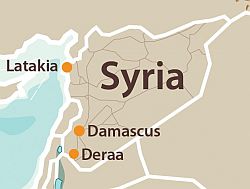
Syria in fragments: divided minds, divided lives

At Syria Comment, Joshua Landis has posted an article written by a contributor from Damascus — “the best piece of writing on Syria since the uprising began,” says Landis. The author requested that his identity not be disclosed and that the piece simply be given the byline “From Damascus.” He writes:

About a week ago I sat with a good friend from the muhafiza (governorate or county) of Dera’a. The raw account of events in Dera’a that he presented to me bore striking contrast to the opinions of people outside that area, people of Damascus, confused people trying to weigh the injustices vs. necessity of the military action in Dera’a.

Details of our conversation that might have been news at the time I spoke with him are now known by most readers at this late date: electricity, water, mobile phone service, land line telephone service, all cut off; rooftop water tanks, common in this area, are shot by military personnel; anyone who moves in the streets is shot. Furthermore, people who have used their own generators to provide power to their homes are visited by the military and the generators are promptly confiscated.

This friend (let’s call him Adham) has a sister and brother who both live in the city of Dera’a with their families. For weeks, they have had no word from them. They don’t even know if they or their children are alive. Adham’s brother was working in Damascus when the occupation of Dera’a began. He was unable to return home to his family. He cannot communicate with or receive any news from his wife or children. He has traveled recently to the city, hoping that after these weeks he would finally be allowed to reunite with his family, but has been prevented from doing so by the military that is keeping the city sealed off.

News that does trickle out of Dera’a seems to be coming from people who have Jordanian cell phones that sometimes find coverage in the area. People are using their car batteries to charge their cell phones, among other devices.

Many Damascenes continue to look me in the eye and tell me that “There’s nothing happening in Syria! Everything is fine!” Consider that Adham’s village in the muhafiza of Dera’a is closer to Damascus than it is to the city of Dera’a, and yet his family is without cell phone service, or even land-line service. Phone service of all types has been cut off from the entire muhafiza. When he comes to work in Damascus, he and his family have no way of checking on each other. This treatment is having the effect of galvanizing oppositional sentiment in the muhafiza and the growing sense of Dera’an separateness.

Adham is an atheist whose family is of Shia background. Being an atheist and coming from a Shia family, he is in no way sympathetic to Sunni Islamism. Therefore, it’s telling when he affirms that “there are no Salafiin in Dera’a. I can say for sure that any group of such people that exists is very, very small.”

Rather, he explains that the government’s siege has been effective in unifying the muhafiza of Dera’a against it. By treating the entire muhafiza as criminal, the sentiments of most of its inhabitants (not just those inside the city of Dera’a) have turned against the regime. It’s interesting that identity runs not only along religious, ethnic, and tribal lines, but also along geographical lines, in that the people of Dera’a—not only the city, but the entire muhafiza—are viewing themselves as a unit, separate from those who comprise the leadership of Syria. “I can say that 90% of people in the entire muhafiza are against the government,” Adham says. Rather than viewing the uprising as one of sectarian character, he explains that “my brother’s family in the city of Dera’a has Christian neighbors. There are many Christians in the city of Dera’a and in other villages who have joined in the protests.”

Dera’a is becoming a unit—I hesitate to say almost separate from Syria—not only in how people there are beginning to view themselves as separate from the state (an understandable effect after feeling attacked by the state), but in the way many other Syrians are reacting to Dera’ans. Adham tells me that in the hospital where he works in Damascus, he is experiencing a new, unmistakable resentment and coldness from his coworkers. “They say nothing, but I can see in their faces that they blame us for the current situation in Syria.” He says that he doesn’t feel safe responding to the opinions voiced by people in his workplace. He believes that people’s opinions are misled and mistaken, but if he defends “his own” Dera’ans, he fears reprisal.

“One Alawi girl who works in the hospital was very happy about the army entering the city. She said, ‘They must destroy the entire city and should kill everyone demonstrating.’” Her comments reflect the result of the government’s successful campaign to demonize the protesters; many people simply believe that there is an insidious cancer of extremism growing inside Syria, that threatens all life, security, and humane values, and that drastic measures are needed to thoroughly wipe it out.

In stark contrast to Adham’s understanding of the situation, I witnessed unreserved approval for the government crack down on a Thursday a week after the siege on Dera’a began. I visited some close Christian friends in Damascus who we can call Samer and Najwah. It was impossible not to broach the subject of the situation in Dera’a, knowing that the next day, Friday, would likely produce significant casualties. This household however, grimly viewed the army’s cordoning off and occupation of the city as necessity. I couldn’t help but begin to argue with them that even if there was a poisonous “Salafi” threat in the town, the siege and suppression would mean the suffering, trauma, and even killing of many innocent people as well. If some people from that area had indeed called for the establishment of an Islamic emirate (and it’s no surprise that some there would be oriented this way), I was just not convinced that the entire city, the many thousands protesting there, were all seeking such a goal.

For Najwah, however, the city of Dera’a has become a single entity containing one kind of people: bad. For her, the terrorist persuasion of the people in that community now justifies virtually any action against them. From her attitude, I felt that if the city was to be wiped off the map, she wouldn’t mind. I began to mention reports of the more grisly examples of violent killings there. “Good!” was her angry response.

I tried to think back and remember if I’d ever been in a country where serious atrocities were taking place and had looked in the eye of someone who rejoiced in them. I couldn’t, and I realized that I was witnessing the kind of passive approval for massacre that one reads about in history books, when individuals or groups become convinced of the evil of another and of the necessity of wiping them out. Najwah is not an evil woman, but the people of Dera’a have become completely vilified in her mind, and she fears them. [Continue reading…]

(H/t Helena Cobban.)

Facebooktwittermail

Apparent torture of boy reinvigorates Syria’s protest movement

The Washington Post reports:

The boy’s head was swollen, purple and disfigured. His body was a mess of welts, cigarette burns and wounds from bullets fired to injure, not kill. His kneecaps had been smashed, his neck broken, his jaw shattered and his penis cut off.

What finally killed him was not clear, but it appeared painfully, shockingly clear that he had suffered terribly during the month he spent in Syrian custody.

Hamza Ali al-Khateeb was 13 years old.

And since a video portraying the torture inflicted upon him was broadcast on the al-Jazeera television network Friday, he has rapidly emerged as the new symbol of the protest movement in Syria. His childish features have put a face to the largely faceless and leaderless opposition to President Bashar al-Assad’s regime that has roiled the country for nine weeks, reinvigorating a movement that had seemed in danger of drifting.

Facebooktwittermail

Gaddafi snatch squads took hundreds of men and boys from Misrata

The Independent reports:

The lifting of the siege of the embattled Libyan city of Misrata has revealed the disappearance of hundreds of people with many of them suspected victims of snatch squads loyal to the Gaddafi regime, relatives and rights workers said yesterday.

A desperate search has begun for “the disappeared”, many of whom were reported to have been taken away to regime prisons or killed during some of the fiercest fighting of a three-month rebel uprising that has reduced parts of the city to rubble.

Witness accounts gathered by The Independent and rights groups indicate that there was a systematic attempt to kidnap men from parts of the city.

Facebooktwittermail

Hundreds of women report rapes by Gaddafi forces

The Associated Press reports:

At first, the responses to the questionnaire about the trauma of the war in Libya were predictable, if tragic: 10,000 people suffering post-traumatic stress, 4,000 children with psychological problems. Then came the unexpected: 259 women said they had been raped by militiamen loyal to Moammar Gadhafi.

Dr. Seham Sergewa had been working with children traumatized by the fighting in Libya but soon found herself being approached by troubled mothers who felt they could trust her with their dark secret.

The first victim came forward two months ago, followed by two more. All were mothers of children the London-trained child psychologist was treating, and all described how they were raped by militiamen fighting to keep Gadhafi in power.

Sergewa decided to add a question about rape to the survey she was distributing to Libyans living in refugee camps after being driven from their homes. The main purpose was to try to determine how children were faring in the war; she suspected many were suffering from PTSD.

To her surprise, 259 women came forward with accounts of rape. They all said the same thing.

“I was really surprised when I started visiting these areas, first by the number of people suffering from PTSD, including the large number of children among them, and then by the number of women who had been raped from both the east and west of the country,” Sergewa said in an interview with The Associated Press.

Facebooktwittermail

Remember Srebrenica? The west’s intervention in Libya is a no-brainer

Peter Preston at The Guardian writes:

It’s fashionable already to cluck apprehensively over Libya. Another botched adventure, another unwanted war. Look how much it’s costing – at this rate, more or less your standard Ministry of Defence project overrun before 2011’s out. Why isn’t it over long since? Why, for all his soaring rhetoric, has Barack Obama decided to rest on his oars? David Cameron broods over sending in four Apache helicopters while the BBC lugubriously reminds us that helicopters can get shot down. If you want to confect a stew of gloom, then any old ingredients will do.

But mix a pinch of foresight with your hindsight, and sprinkle lightly with added realism. Libya isn’t Afghanistan or Iraq. It isn’t even a proper war, more a series of skirmishes strung out along a long coastal strip. Oh! TV reporters talk excitedly as though this was some mighty contest between opposing armies, but they don’t even seem to look at their own pictures. In fact, it’s rag-tag stuff on both sides. There are casualties, of course; but the numbers involved seem relatively small. The colonel’s mercenary regiments are brutal, but militarily feeble. Take away air cover and they’re going nowhere. Will four British Apaches – count them again, yes just four! – make a big difference this week? Merely posing the question helps define this mini-conflict. Its costs and its risks aren’t worth so much rumbling angst.

Recent history tells us Muammar Gaddafi is a menace (especially if you’re in a jumbo jet over Scotland). When he vowed to take revenge on the insurgents, these were no idle threats. His first reaction when the citizens of his second city marched for change was to shoot them down. The chief prosecutor in The Hague already thinks that, just like Ratko Mladic, Gaddafi has a case to answer. On 18 March, as the allies finally prepared to move, his troops were driving into the outer suburbs of Benghazi. No hindsight necessary: it was five minutes to midnight. And no shucking off our own leaders’ responsibility, either.

After Tunisia, after Egypt, the word was the same from Obama to Nicolas Sarkozy to Cameron. The US Senate, the European parliament, the Arab League and the UN security council all knew what had to be done. So did Gaddafi’s man at the UN. There was massacre pending. All the usual recourses had been duly employed: sanctions, seizing overseas assets and the rest. But it wasn’t enough. Hundreds – probably thousands – of Libyan protesters we’d directly encouraged were about to get shot. Do nothing? Then or now, with or without hindsight, it’s a no-brainer.

Facebooktwittermail

Where Egypt is at

Issandr El Amrani writes:

The #May 27 “Second Revolution” came and went this weekend without the drama that many had expected. Turnout was pretty good — good enough to show that the ranks of those unsatisfied with the current state of affairs is plenty big, and big enough to show that the Muslim Brothers’ participation is not essential to getting a decent number of people protesting. Impressive also was that the protests took place across the country, as Zeinobia points out with her gallery of videos. Get more videos and an account at Jadaliyya. It may not be a second revolution but it’s enough to keep the SCAF [Supreme Council of the Armed Forces] on its toes and give media traction to multiple grievances: high-ranking corruption, insecurity, slow justice, heavy-handedness of the military, etc.

Although many of these grievances are indeed worthwhile, this opposition movement should start coalescing over one or two core demands with regards to the transition. It has already been a tragedy of Egypt’s revolution that the revolutionaries did not have a clear aim beyond the removal of Mubarak and that the post-Mubarak transition has been handled poorly, to say the least, by a SCAF that is guilty of bumbling incompetence perhaps more than malice. In particular, the transition process could have been more along the lines of Tunisia’s, with an elected constituent assembly rather than one appointed by parliament and independent commissions to investigate corruption as well as violence. The real drama, it seems to me, is that right now transitional justice consists of immediately going after certain persons (those close to Gamal Mubarak) yet only going after older apparatchiks (NDP apparatchiks, etc.) after popular pressure forced the SCAF to. And, most of all, a piecemeal approach to trying former officials: consider that Hosni Mubarak has just been fined for cutting off the internet, and may only be tried for the violence during the revolution, while not being held accountable for 30 years of autocracy.

To me, this should be the focus of the opposition: obtaining a real truth and reconciliation process that holds the regime, as a system, accountable and features the televised testimony of both its victims and participants. If Egyptians try to gloss over the Mubarak era as a question of a few bad apples and then quickly move on, they risk losing a more important understanding of what was the Mubarak regime (and institutions like State Security) and lose the chance of making a clean break. The other demand may be about postponement of elections, but then it has to make on sound grounds (as I discussed a few days ago) with concrete proposals on who will rule in the meantime — including explaining what would make a transitional presidential council more legitimate than the SCAF.

Facebooktwittermail

Libya: Britain prepares ‘bunker buster’ bombs for assaults

The Guardian reports:

Britain has ratcheted up the pressure on Colonel Muammar Gaddafi by preparing to load heavy “bunker buster” bombs on RAF jets ready to attack his compounds in and around Tripoli.

Paveway bombs, weighing 2,000lbs, the largest in the RAF’s arsenal, have been dispatched to Gioia del Colle in southern Italy where RAF Tornado and Typhoon jets are based. While the Apache’s cannon and Hellfire missiles are used against small or moving targets, the Paveway bombs are expected to be used against bunkers underneath the Gaddafi regime’s Bab al-Azizia compound in Tripoli and elsewhere.

The MoD said on Sunday the enhanced Paveway III bombs, are designed “to punch through the roof or wall of a hardened building”. The bombs join smaller laser or satellite-guided Paveway bombs, Brimstone missiles and Tomahawk submarine-launched cruise missiles, with which the army and navy have been attacking targets in Libya for more than two months.

Facebooktwittermail

In Benghazi, shouts of thanks to America and the West

Rod Nordland reports:

Frustrated by the gridlocked traffic, the young man in fatigues was leaning on the horn of his old Chevrolet Impala, the one with the front and rear windshields shot out. The shrillness of the pointless noise made a foreigner in the car next to him wince.

Then came one of those Free Libya moments.

“Sorry, sorry,” the horn-blower called apologetically, in English. The young man riding shotgun, also in fatigues and carrying a Kalashnikov, grinned sheepishly and apologized as well. Then he saluted, bringing his wounded right hand into view, a giant mitten of a bandage on it, blood soaking through in places.

“Thank you, thank you,” he said. “America No. 1.”

Americans and, for that matter, all Westerners are treated hereabouts with a warmth and gratitude rarely seen in any Muslim country — even those with 100,000 American troops — in probably half a century or more. People smile and go out of their way to say hello to them, and are almost shockingly courteous. It is that oddest of oddities, an Arab war zone where foreign joggers are regarded, not with hostility or even that sympathetic puzzlement reserved for the insane, but with a friendly wave or a toot on the horn.

Here, even taxi drivers do not rip off foreign visitors, and when a taxi cannot be found, some passing driver will soon volunteer a ride, and will be likely to refuse any offer of payment. A big problem for non-Arabic speaking journalists who visit is trying to find a translator who will accept payment for his or her services. The rebels’ press office has signed up all the English translators it could find, and ordered them to work for free.

In some restaurants, they seem almost reluctant to accept a foreigner’s money. It is a society chronically short of change, so a lot of the coffee bars will just say skip it, and serve up an espresso for whatever loose change is handy, if any. Espresso is one of the welcome surprises of Libya, and while no one would confuse it with Tre Scalini, it is pretty good for a region where the standard stuff is either instant Nescafe or Turkish coffee so thick that a toothpick is needed afterwards.

The pizza, too, is respectable, especially at Pisa Pizza in Benghazi, where the pies are about a yard in diameter. Proof that Italian colonialism accomplished something after all.

In other parts of the Mideast, one refrains from advertising American nationality, if only just in case. This is a part of the world where, other than outside American embassies, the Stars and Stripes are most often spotted ablaze and stomped upon.

Here, crowds of chanting youth fly it proudly, alongside their own new flag, a tricolor with red, black and green horizontal stripes and a crescent and star in the center. (It was widely and quickly adopted by the rebels to replace the Qaddafi government’s hated green flag, an unadorned panel so plain that it has been derided as a putting green.) What popular Arab street movement has ever flown the flags of not only the United States, but the European Union, NATO, Italy, France and Qatar, all at once?

Facebooktwittermail

Libyan tribal leaders call for united front

Al Jazeera reports:

More than 100 community and tribal leaders from Libya have met with members of the opposition National Transitional Council at a conference in Turkey, in a bid to show a united front against Muammar Gaddafi.

Most of the tribal leaders who gathered in Istanbul on Saturday and Sunday, were from the powerful Warfalla clan based in Baniwalid, a city in western Libya.

The delegates were calling for an end to the violence in Libya and the departure of Libyan leader Gaddafi and his sons.

An organiser of the conference told Al Jazeera that Gaddafi and his forces became aware of the conference yesterday and then moved in to seize control of Baniwalid.

“Fierce clashes broke out between Gaddafi’s forces and Warfalla members in Baniwalid, and at least 11 people died, including the brother of a conference delegate,” the source said.

Al Jazeera’s Anita McNaught, reporting from Istanbul, said that the delegates were mostly senior professionals from both inside Libya as well as those who have been in exile for the last few years.

“They all stood up together and presented their declaration and sang the old Libyan national anthem – I watched grown men break down in tears and sob all their way through this,” our correspondent said.

Facebooktwittermail

The psychology of dictatorship: Why Gaddafi clings to power

John Cloud writes:

Muammar Gaddafi continues to hold tightly to power even as NATO bombs rain down on Tripoli. Syrian autocrat Bashar al-Assad has killed more than 1,000 of his own people in an effort to quash protests. In Yemen, President Ali Abdullah Saleh has refused to step down despite months of unrest that has intensified into near civil war this week. The question is, why do all these guys fight so hard to keep power? Why not decamp to Saudi Arabia or Venezuela and live out their lives in luxury before being killed or held for trial like Hosni Mubarak?

Any attempt to diagnose a defining psychological feature of dictatorship would be facile. But in the public record available on many of them — Stalin and Mao, Saddam Hussein and Gaddafi himself — one can begin to see patterns that shape a dictatorial personality. At least since the Office of Strategic Services (now known as the Central Intelligence Agency) commissioned a secret profile called “A Psychological Analysis of Adolf Hitler,” which was issued in 1943, psychologists have sought an explanation for the authoritarian mind. New research has brought us closer than ever to understanding how leaders become despots.

There are at least three explanations for dictatorial behavior:

Facebooktwittermail