Category Archives: Arab Spring

Russia agrees to try to talk Gaddafi into stepping down

The New York Times reports:

President Dmitri A. Medvedev on Friday offered to leverage Russia’s relationships in Libya to try to persuade Col. Muammar el-Qaddafi to leave power, an act of long-shot diplomacy that for the first time casts Russia as a central player in events unfolding in North Africa.

Mr. Medvedev’s announcement, which came a day after a 90-minute bilateral meeting with President Obama at the Group of 8 meeting in France, represents a pronounced shift in Russia’s tone on Libya. Russia’s criticism of NATO attacks had become increasingly tough over the last months, reviving a longstanding critique of American unilateralism that had quieted since Mr. Obama took office.

By signing on to the effort, Mr. Medvedev is taking a gamble. If Colonel Qaddafi could be persuaded to leave, Russia would win international plaudits but would also bear some responsibility for guaranteeing his safety. If he cannot, Mr. Medvedev might find it more difficult to keep his distance from the military campaign, which is not popular in Russia.

But all those risks may be mitigated by the prestige of being asked to defuse a violent standoff on behalf of world powers.

“Russia in the post-Soviet era has all these ideas about its influence and consequence in the world, and it is very sad for Russian politicians if it does not exist,” said Dmitri Oreshkin, an analyst with the Mercator Group, a Moscow-based advisory group. “In this case, it seems like it exists. This is a reason to feel strong and respected.”

Mikhail V. Margelov, Russia’s special envoy to the Middle East and Africa, said he had been ordered to fly to Benghazi, the rebel stronghold, to conduct negotiations with the Libyan opposition, with an eye to assessing their vision of a post-Qaddafi government. He has mentioned Qatar and Saudi Arabia as countries that might possibly offer Colonel Qaddafi asylum, and said Group of 8 allies have proposed a variety possibilities for his future, “from a quiet life as a simple Bedouin in the Libyan desert, to the fate of Milosevic in the Hague.”

Reuters reports:

NATO aircraft destroyed the guard towers at Muammar Gaddafi’s compound in Tripoli, a NATO official said on Saturday, then staged a rare daytime air strike on the Libyan capital, heightening pressure on him to quit.

“RAF Typhoons, along with other NATO aircraft, last night used precision-guided weapons to bring down guard towers along the walls of Colonel Gaddafi’s Bab al-Aziziyah complex in the center of Tripoli,” Major General John Lorimer, chief British military spokesman, said in a statement.

“Last night’s action sends a powerful message to the regime’s leadership and to those involved in delivering Colonel Gaddafi’s attacks on civilians that that they are no longer hidden away from the Libyan people behind high walls,” he said.

On Thursday, the New York Times reported:

President Obama has subtly shifted Washington’s public explanation of its goals in Libya, declaring now that he wants to assure the Libyan people are “finally free of 40 years of tyranny” at the hands of Col. Muammar el-Qaddafi, after first stating he wanted to protect civilians from massacres.

But if toppling Colonel Qaddafi is now the more explicit goal, Mr. Obama’s European trip this week has highlighted significant tensions over how much time the NATO allies have to finish a job that is now in its third month.

Mr. Obama has urged strategic patience, expressing confidence that over time the combination of bombing, sanctions and import cutoffs will force Colonel Qaddafi from power. “Time is working against Qaddafi,” Mr. Obama said on Wednesday at a news conference in London with Prime Minister David Cameron of Britain.

But in Europe and in Libya, patience is calculated differently. Many countries are struggling with the rapid pace of operations. Some, like Norway, have already said they will sharply reduce their forces beginning next month. According to NATO officials, Colonel Qaddafi has a calculation of his own: facing a possible indictment by the International Criminal Court, he may soon have few places to go and little to lose by waiting out NATO and betting that European public opinion will tire of the bombing campaign and its costs.

In interviews in Washington, at NATO headquarters in Brussels and in the alliance’s southern command center in Naples, Italy, officials have described a new strategy to intensify the pressure — and drive out Colonel Qaddafi, a goal that officials now privately acknowledge extends beyond the boundaries of the United Nations mandate to protect civilians.

The Associated Press reports:

The deputy leader of Libya’s rebel administration said it could take up to two years to organize elections, backtracking on promises of a six-month transition to democracy and adding to internal dissent already brewing within the movement seeking to topple Moammar Gadhafi.

Criticism of the rebel leadership’s National Transitional Council has been growing in its stronghold city of Benghazi, in the mostly rebel-held east of Libya. Deeper splits within the rebel movement could further hamper its faltering drive to remove Gadhafi, who has been in power for more than 40 years and is continuing to hold on despite NATO airstrikes in support of his opponents.

The announcement on Wednesday of a longer transition period has raised suspicions that some council members are intent on prolonging their power.

The council’s vice chairman, Abdel-Hafidh Ghoga, said a news conference that a one- to two-year transition period would be needed after the hoped-for ouster of Gadhafi. In that time, he said, the opposition would form a transitional legislative body tasked with writing a constitution, hold a referendum on the charter, form political parties and then hold elections.


Facebooktwittermail

Saudis try to shield fragile Arab thrones

The New York Times reports:

Saudi Arabia is flexing its financial and diplomatic might across the Middle East in a wide-ranging bid to contain the tide of change, shield fellow monarchs from popular discontent and avert the overthrow of any more leaders struggling to calm turbulent republics.

From Egypt, where the Saudis dispensed $4 billion in aid last week to shore up the ruling military council, to Yemen, where it is trying to ease out the president, to the kingdoms of Jordan and Morocco, which it has invited to join a union of Gulf monarchies, Saudi Arabia is scrambling to forestall more radical change and block Iran’s influence.

The kingdom is aggressively emphasizing the relative stability of monarchies, part of an effort to avert any dramatic shift from the authoritarian model, which would generate uncomfortable questions about the glacial pace of political and social change at home.

Saudi Arabia’s proposal to include Jordan and Morocco in the six-member Gulf Cooperation Council — which authorized the Saudis to send in troops to quell a largely Shiite Muslim rebellion in the Sunni Muslim monarchy of Bahrain — is intended to create a kind of “Club of Kings.” The idea is to signal Shiite Iran that the Sunni Arab monarchs will defend their interests, analysts said.

“We’re sending a message that monarchies are not where this is happening,” Prince Waleed bin Talal al-Saud, a businessman and high-profile member of the habitually reticent royal family, told The New York Times’s editorial board, referring to the unrest. “We are not trying to get our way by force, but to safeguard our interests.”

The range of the Saudi intervention is extraordinary as the unrest pushes Riyadh’s hand to forge what some commentators, in Egypt and elsewhere, brand a “counterrevolution.” Some Saudi and foreign analysts find the term too sweeping for the steps the Saudis have actually taken, though it appears unparalleled in the region and beyond as the kingdom reaches out to ally with non-Arab Muslim states as well.

Facebooktwittermail

A Palestinian revolt in the making?

Jesse Rosenfeld and Joseph Dana write:

At 10:30 on May 15, two battalions of Israeli combat soldiers opened fire with tear gas and rubber bullets on hundreds of unarmed Palestinian demonstrators at the Qalandia checkpoint dividing Ramallah from Jerusalem, sending people scrambling into the adjacent refugee camp. These were the opening shots of Israel’s response to protests commemorating the Nakba, the Arabic word for catastrophe, used to define Israel’s creation of 750,000 Palestinian refugees in 1948. By nightfall Israeli soldiers had killed thirteen Palestinian refugees and wounded hundreds with live fire on its borders with Lebanon, Syria, Gaza and inside the West Bank.

The May 15 demonstrations reinvigorated the long-alienated Palestinian refugee community; although it is 70 percent of the Palestinian population, it has been largely shut out of the negotiations process with Israel. The emerging unity was on display at Qalandia, where youth trying to symbolically march from Ramallah to Jerusalem wore black T-shirts with the slogan “Direct Elections for the Palestine National Council, a Vote for Every Palestinian, Everywhere.” The PNC is the legislative body of the Palestine Liberation organization and is responsible for electing its executive committee. Traditionally, seat allocation in the PNC has been divided to represent the influence factions within the PLO, of which Hamas is not a member.

The Nakba protests have been the largest so far of a growing Palestinian youth revolt. The protests—launched with unity protests on March 15 in the Palestinian Authority–controlled West Bank and Hamas-governed Gaza Strip—are the Palestinian response to the outbreak of revolutions in Egypt and Tunisia. While it is a new development, this manifestation of popular anger against Palestinian Authority concessions in the failed negotiations process—shockingly revealed with Al Jazeera’s January release of top-secret negotiation minutes, known as the Palestine Papers—and Israel’s practice of divide and rule has been simmering under the surface for the past three years.

“The unity agreement between Fatah and Hamas gave people hope to be here today and continue with this new phase of struggle,” said Fadi Quran, a founding organizer of the March 15 movement, amid the clashes with Israeli soldiers at the Qalandia checkpoint. “It showed us that something was possible and we must continue,” he added, coughing from tear gas.

Peter Beinart adds:

I watched Benjamin Netanyahu’s speech to Congress with a guy named Fadi Quran. He recently graduated from Stanford, where he double-majored in physics and international relations. He lives in Ramallah, where he’s starting an alternative energy company. And he just might rock our world.

Quran is helping to coordinate a raft of Palestinian youth organizations—located in the West Bank, Gaza Strip, Jordan, Lebanon and Syria—all united around one goal: to create a Palestinian Tahrir Square. They organized the unity march that helped pressure Fatah and Hamas to reconcile. Ten days ago, they organized the Nakba Day protests in which refugees marched on Israel’s borders.

What they’re doing isn’t exactly new. Palestinians in the West Bank have been conducting regular nonviolent protests for many years now, often against the separation barrier that stands between them and their fields. But Egypt and Tunisia made Quran and his colleagues realize that nonviolence was possible on a much larger scale. Not everyone in his movement believes in peaceful resistance as a matter of principle, he admitted sheepishly. But they all believe it represents the right strategy. They’ve been studying the civil rights movement and Gandhi’s struggle against the British and the movement that peacefully brought down Slobodan Milosevic in Serbia. No one wants a second intifada, he insisted. “It hurt us much more than the Israelis.”

When I asked Quran what his movement believes, I expected to hear about borders and refugees and Jerusalem. Instead, he began talking about John Rawls and John Locke, a social contract between the government and the governed. A Palestinian government that denies his rights, he insisted, is as offensive as an Israeli one. When I pressed him on whether his colleagues want two states—one Palestinian, one Jewish—or a secular binational one, he seemed strangely agnostic. He said that in an ideal world one democratic state would be better, before adding that of course such a state would have to guarantee the safety and cultural autonomy of Jews. (One of his inspirations, he said, was Martin Buber, the Jewish philosopher who advocated a binational state in the 1920s and 1930s). When I said I didn’t consider a binational state very realistic, he conceded the point, before noting that in the age of Netanyahu and Lieberman, most Palestinians don’t consider a two-state solution very realistic either.

Facebooktwittermail

Shattered humanity inside Syria’s security apparatus

Reuters journalist Suleiman al-Khalidi, a Jordanian citizen, was arrested by Syrian security police when covering the uprising against Syrian President Bashar al-Assad. In the following story, he recounts his treatment at the hands of the Syrian intelligence services and the scenes of torture he witnessed around him during four days of confinement.
Like other foreign correspondents, he was subsequently expelled from Syria. He now reports on the continuing unrest from Amman.

Suleiman al-Khalidi writes:

The young man was dangling upside down, white, foaming saliva dripping from his mouth. His groans sounded more bestial than human.

It was one of many fleeting images of human degradation I witnessed during four days as an unwilling guest of Syrian intelligence, when I was detained in Damascus after reporting on protests in the southern Syrian city of Deraa.

Within minutes of my arrest I was inside a building of the intelligence services — known, as elsewhere in the Arab world, simply as the “Mukhabarat.” I was still in the heart of bustling Damascus, but had been transported into a macabre parallel world of darkness, beatings and intimidation.

I caught sight of the man hanging by his feet as one of the jailers escorted me to the interrogation room for questioning.

“Look down,” the jailer shouted as I took in the scene.

Inside an interrogation room, they made me kneel and pulled what I could just make out as a car tyre over my arms.

My reporting from Deraa, where protests against President Bashar al-Assad had broken out in March, had apparently not endeared me to my hosts, who accused me of being a spy.

The formal reason Syrian authorities gave Reuters for my detention was that I lacked the proper work permits.

That I was an established journalist working for Reuters, going about my professional business, was not an argument to men whose livelihood depends on breaking human dignity.

“So, you cheap American agent!,” the interrogator shouted.

“You have come to report destruction and mayhem. You animal, you are coming to insult Syria, you dog.”

From outside the room I could hear the rattling of chains and hysterical cries that echo in my mind to this day. My interrogators worked professionally and tirelessly to keep me on edge at every step of the questioning process over several days.

“Shut up, you bastard. You and your types are vultures who want to turn Syria into another Libya,” said another interrogator, who kept yelling: “Confess, liar!”

Facebooktwittermail

Interview with Sinan Antoon: Literature and the Arab spring

Sinan Antoon, an Iraqi-born poet, novelist, and translator, interviewed by The Kenyon Review:

How do you think literature may or should respond to this spring’s events? What role (or roles) would you say literature has played, and how might those roles change?

Literature always responds to history, of course, but works hastily written under the pressure of responding often risk being pedestrian, but there are exceptions! The revolts are still ongoing and unfolding and we are all still processing their effects, but they have definitely energized all citizens, including writers. The challenge is how to represent these moments in their complexity and in beautiful forms.

Contrary to all the brouhaha about Twitter and Facebook, what energized people in Tunisia and Egypt and elsewhere, aside from sociopolitical grievances and an accumulation of pain and anger, was a famous line of poetry by a Tunisian poet, al-Shabbi. Poetry, novels, and popular culture have chronicled and encapsulated the struggle of peoples against colonial rule and later, against postcolonial monarchies and dictatorships, so the poems, vignettes, and quotes from novels were all there in the collective unconscious. Verses were spontaneously deployed in chants and slogans and disseminated in clips. The revolution introduced new songs, chants, and tropes, but it refocused attention on an already existing, rich and living archive.

Institutionally and structurally, the revolts further exposed how the state had neutralized certain intellectuals and writers and used them to legitimate its projects. The revolts reignited debates about the relationship between cultural production and state power. The revolts have already debunked the old cultural discourse and are threatening the dominant cultural elite, many of whose figures were at the service of state culture for a variety of reasons.

Facebooktwittermail

The IMF versus the Arab spring

Austin Mackell writes:

In the midst of the media storm surrounding IMF chief Dominique Strauss-Kahn last week, my feelings were perfectly expressed in a tweet by Paul Kingsnorth: “Could someone please arrest the head of the IMF for screwing the poor for 60 years?”

Without diminishing the seriousness of the sexual allegations against Strauss-Kahn, the role of the IMF, over past decades and at present, is a far bigger story. Of particular importance is its role at this crucial moment in the Middle East.

The new loans being negotiated for Egypt and Tunisia will lock both countries into long-term economic strategies even before the first post-revolution elections have been held. Given the IMF’s history, we should expect these to have devastating consequences on the Egyptian and Tunisian people. You wouldn’t guess it though, from the scant and largely fawning coverage the negotiations have so far received.

The pattern is to depict the IMF like a rich uncle showing up to save the day for some wayward child. This Dickensian scene is completed with the IMF adding the sage words that this time it hopes to see growth on the “streets” not just the “spreadsheets”. It’s almost as if the problem had been caused by these regimes failing to follow the IMF’s teachings.

Such portrayals are credulous to the point of being ahistorical. They do not even mention, for example, the very positive reports the IMF had issued about both Tunisia and Egypt (along with Libya and others) in the months, weeks, and even days before the uprisings.

To some extent, though, the IMF is aware that its policies contributed to the desperation that so many Egyptians and Tunisians currently face, and is keen to distance itself from its past. Indeed, as IMF watchers will know, this is part of a new image that the IMF, along with its sister organisation the World Bank, has been working on for a while. The changes, so far, do not go beyond spin. You can’t, as they say, polish a turd – but you can roll it in glitter.

Facebooktwittermail

The fight for Libya

The New York Times reports:

In the heaviest attack yet on the capital since the start of the two-month-old NATO bombing campaign, alliance aircraft struck at least 15 targets in central Tripoli early Tuesday, with most of the airstrikes concentrated on an area around Col. Muammar el-Qaddafi’s command compound.

The strikes, within a 30-minute period around 1 a.m., caused thunderous explosions and fireballs that leapt high into the night sky, causing people in neighborhoods a mile or more away to cry out in alarm.

Just as one strike ended, the sound of jet engines from low-flying aircraft in the stormy skies above the capital signaled the imminence of another. Huge plumes of black smoke rose and converged over the darkened cityscape.

“We thought it was the day of judgment,” one enraged Libyan said.

The intensity of the attacks, and their focus on the area of the Bab al-Aziziya command compound in central Tripoli, appeared to reflect a NATO decision to step up the tempo of the air war over the Libyan capital, perhaps with a view to breaking the stalemate that has threatened to settle over the three-month-old Libyan conflict.

As NATO intensified its airstrikes, the American State Department’s highest-ranking Middle East official, Jeffrey D. Feltman, was in Benghazi on Tuesday on a visit aimed at providing fresh impetus to the rebel cause. Speaking at a news conference, Mr. Feltman said that the Obama administration had invited the Libyan opposition to open an office in Washington, but stopped short of offering the formal recognition the rebels have been seeking.

From an Awac flying over the Mediterranean, the New York Times reports:

Just after midnight on Sunday, an allied Mirage 2000 fighter jet prowling the Libyan coastline attacked a Libyan missile patrol boat that military officials said threatened NATO and humanitarian aid vessels in nearby waters.

The strike on the Libyan warship in the harbor at Sirt came at the end of a convoluted chain that started with political orders from Brussels, passed through two military command centers in Italy and concluded with controllers aboard this Awacs command-and-control plane 50 miles off the Libyan coast authorizing the Mirage to bomb the boat.

Two months into the Libya air campaign, allied officers insist they have worked out the kinks in an operation initially plagued by NATO’s inexperience in waging a complex air war against moving targets and botched communications with the ragtag rebel army. The confusion resulted in at least two accidental bombings that killed over a dozen rebel fighters.

As Tuesday’s heavy airstrikes in the Libyan capital, Tripoli, underscored, NATO is escalating the pace and intensity of attacks on Col. Muammar el-Qaddafi’s forces, trying to break an apparent stalemate in the three-month-old conflict. Yet the alliance is still short on reconnaissance planes to identify hostile targets and refueling planes to allow fighter-bombers to conduct longer missions, a senior NATO diplomat said.

French and British officials said this week that they were sending more than a dozen attack helicopters to allow for more precise ground attacks, particularly around Misurata, where loyalist forces continue to fire mortars and artillery despite rebel gains and heavy air attacks.

With no troops on the ground, NATO planners and pilots acknowledge that they often cannot pinpoint the shifting battle lines in cities like Misurata. “The front lines are more scattered,” said Col. L. S. Kjoeller, who commands four Danish F-16s flying eight daily strike missions from Sigonella air base in Sicily.

Information on Libyan forces filters up from Central Intelligence Agency officers and allied special operations troops working with the rebels on the ground, as well as from the rebels themselves. But NATO planners say they have no direct contact with anyone on the ground to help coordinate the roughly 50 allied attack missions every night.

Instead, they rely on an array of imagery and electronic intercepts collected by drones, spy planes and satellites, as well as news media reports and other whispers of intelligence. These are used to build a round-the-clock campaign that allied officers say is preventing Colonel Qaddafi from making sustained attacks on rebel fighters and driving him deeper into hiding.

Reuters reports:

African migrants, captured and jailed by the rebels they were fighting in Libya’s Western Mountains, say they were tricked or coerced into the army of Muammar Gaddafi in the belief they faced an al Qaeda invasion.

In rare first-hand accounts from a group branded “mercenaries” by the rebels, five men from Sudan’s western Darfur region and Chad told Reuters how they were working in Libya as builders and decorators when they became embroiled in the conflict unleashed by an uprising to end Gaddafi’s four-decade rule.

They spoke last week at a makeshift jail in a secondary school in the rebel-held town of Zintan. They have had no contact with their families or aid groups, and medical workers in the town say they have had only limited access to the men.

Some of what they said about their treatment in the prison appeared aimed at pleasing their captors. At one point, a guard outside the cell loaded two cartridges into a double-barrelled shotgun and motioned as if to shoot the prisoners.

Mohammed, who said he was a decorator from Darfur, said he enlisted in April in the capital, Tripoli.

“In Tripoli I went to military camp 77. They trained me in how to use weapons and told us we were only going to guard checkpoints. They told us there were Algerians, French and al Qaeda in Maghreb fighting in Libya,” he said.

Al Qaeda in the Islamic Maghreb (AQIB) is al Qaeda’s north African branch.

“We found nothing like that,” he said. “We’ve been tricked. It wasn’t true.”

Facebooktwittermail

Mubarak to face trial for killing of protesters

The New York Times reports:

Former President Hosni Mubarak will be put on trial for conspiring to kill unarmed protesters, Egypt’s top prosecutor announced Tuesday, yielding to public demands for accountability and setting an example that could rattle autocrats around the region.

The charge could incur the death penalty. Mr. Mubarak was also accused of obtaining his seaside mansion in Sharm el Sheik as a kickback from a friend for a corrupt land deal, and prosecutors accused his two sons, Gamal and Alaa, of receiving a total of four other villas there as part of the same kickback. And in a third charge, prosecutors said the former president allowed the same friend to siphon $714 million in public money out of a deal to sell natural gas to Israel.

The charges — brought by prosecutors Mr. Mubarak had appointed — included hints that former subordinates might testify against him, as onetime allies and government insiders turn on one another.

A Cairo criminal court is expected to set a trial date within days, and the Egyptian people could soon see the leader whose iron fist ruled them for nearly three decades seated in the steel cage that serves as a docket in Egyptian courtrooms.

Facebooktwittermail

Autocratic regimes fight Web-savvy opponents with their own tools

The Washington Post reports:

For weeks, Syrian democracy activists have used Facebook and Twitter to promote a wave of bold demonstrations. Now, the Syrian government and its supporters are striking back — not just with bullets, but with their own social-media offensive.

Mysterious intruders have scrawled pro-government messages on dissidents’ Facebook pages. Facebook pages have popped up offering cyber tools to attack the opposition. The Twitter #Syria hashtag — which had carried accounts of the protests — has been deluged with automated messages bearing scenes of nature and old sports scores.

“There is a war itself going on in cyberspace,” said Wissam Tarif, head of the Middle East human rights organization Insan, whose Web site has been attacked.

Syria offers just one example of the online backlash in countries ruled by authoritarian regimes. Although social media sites have been lionized for their role in the Arab Spring protests, governments are increasingly turning the technology against the activists.

“In the same way that, a few years ago, it became commonplace to talk about Web 2.0, we’re now seeing Repression 2.0,” said Daniel B. Baer, a deputy assistant secretary of state for democracy, human rights and labor.

Facebooktwittermail

Promise of Arab uprisings is threatened by divisions

Anthony Shadid and David D. Kirkpatrick report on the specter of sectarian division in a region that has long struggled to find unity in diversity.

The example of Iraq comes up often in conversations in Damascus, as does the civil war in Lebanon. The departure of Jews, who once formed a vibrant community in Syria, remains part of the collective memory, illustrating the tenuousness of diversity. Syria’s ostensibly secular government, having always relied on Alawite strength, denounces the prospect of sectarian differences while, its critics say, fanning the flames. The oft-voiced formula is, by now, familiar: after us, the deluge.

“My Alawite friends want me to support the regime, and they feel if it’s gone, our community will be finished,” said Mohsen, the young Alawite in Damascus, who asked that only his first name be used because he feared reprisal. “My Sunni friends want me to be against the regime, but I feel conflicted. We want freedom, but freedom with stability and security.”

That he used the mantra of years of Arab authoritarianism suggested that people still, in the words of one human rights activist, remain “hostage to the lack of possibilities” in states that, with few exceptions, have failed to come up with a sense of self that transcends the many divides.

“This started becoming a self-fulfilling myth,” said Mr. Azm, the Syrian intellectual.

“It was either our martial law or the martial law of the Islamists,” he added. “The third option was to divide the country into ethnicities, sects and so on.”

Despite a wave of repression, crackdown and civil war, hope and optimism still pervade the region, even in places like Syria, the setting of one of the most withering waves of violence. There, residents often speak of a wall of fear crumbling. Across the Arab world, there is a renewed sense of a collective destiny that echoes the headiest days of Arab nationalism in the 1950s and ’60s and perhaps even transcends it.

President Obama, in his speech on Thursday about the changes in the Arab world, spoke directly to that feeling. “Divisions of tribe, ethnicity and religious sect were manipulated as a means of holding on to power, or taking it away from somebody else. But the events of the past six months show us that strategies of repression and strategies of diversion will not work anymore.”

But no less pronounced are the old fears of zero-sum power, where one side wins and the other inevitably loses. From a Coptic Christian in Cairo to an Alawite farmer in Syria, discussions about the future are posed in terms of survival. Differences in Lebanon, a country that celebrates and laments the diversity of its 18 religious communities, are so pronounced that even soccer teams have a sectarian affiliation.

In Beirut, wrecked by a war over the country’s identity and so far sheltered from the gusts of change, activists have staged a small sit-in for two months to call for something different, in a plea that resonates across the Arab world.

The Square of Change, the protesters there have nicknamed it, and their demand is blunt: Citizenship that unites, not divides.

“We are not ‘we’ yet,” complained Tony Daoud, one of the activists. “What do we mean when we say ‘we’? ‘We’ as what? As a religion, as a sect, as human beings?”

Facebooktwittermail

The fight for Libya

The New York Times reports:

Near midnight, in the darkness of the deliberately unlit Misurata harbor, the tugboat’s crew loosened its lines from the pier and pulled them aboard.

The helmsman engaged Al Iradah 6’s dual engines and it spun into the basin, gathered speed and headed for the gap in the jetties. A few miles beyond, outside the range of Col. Muammar el-Qaddafi’s artillery, was the safety of the open sea.

There, the helmsman turned the round bow eastward, toward Benghazi, the Libyan rebel capital about 300 miles away. The latest leg for an unlikely smuggling vessel was complete. In a little more than 24 hours, Al Iradah 6 would reach rebel-controlled territory and line up for a fresh cargo of medicine, food and guns — fuel for a city besieged.

There have been many reasons for the rebels’ success in Misurata, where they recently drove the Qaddafi forces out of the city and seized the airport. One of them is this: a determined and surreptitious sealift by a small fleet of Libyan boats.

Combining the talents of those who procure a city’s wartime needs with those of merchant mariners and fishermen, rebels have organized about two dozen fishing vessels and former Qaddafi-controlled tugboats into an impromptu fleet that has provided Misurata with a lifeline of supplies. The fleet sails with NATO’s approval and support. (Rebels and organizers in both Benghazi and Misurata spoke openly of the smuggling effort, but asked that certain locations and shipping schedules not be disclosed.)

At a basic level, it has assumed missions of both mercy and war. The mixed cargo — baby formula and medicine beside crates of ammunition — has helped civilians survive and equipped Misurata for its fight.

The strategic significance of Misurata has not been lost on the crew of Al Iradah 6. For months, rebels trapped in the city, 130 miles from Tripoli, provided Libya’s opposition movement with a powerful argument against any discussion of the war’s end that called for national partition.

As long as Misurata’s armed men held on to their city, the nation’s third largest, the Qaddafi government could never credibly say that the war was a contest between east and west, and propose that the country, divided by history and tribal allegiances, be split.

Reuters reports:

The rebels said it would be easy: roll in, block the road, raise the flag — another village under their writ in Libya’s Western Mountains.

The villagers are with us, the rebels said of their fellow Berbers — an ethnic minority that rose up against Muammar Gaddafi at the very start of the rebellion in February.

“Only a few support Gaddafi, maybe five or six,” said Omar, commander of the rebel unit from the nearby town of Kabaw.

His call-sign was Rambo. But the operation, which began on Sunday afternoon with the rebels gathering over coffee at a roadside cafe, ended an hour later in angry confrontation, tense retreat and a lesson in the divided loyalties and half-truths of this particular theatre of Libya’s conflict.

“Only seven or eight people here don’t like Gaddafi,” Mohammed, a resident of Tamzin, quietly told a reporter.

The truth probably lay somewhere in the middle, like Tamzin itself and dozens of other towns and villages wedged between the rebels who hold most of the plateau and forces loyal to Gaddafi mainly in the desert plains.

Facebooktwittermail

Our revolt is not Obama’s

Ahdaf Soueif writes:

This wasn’t slipping poison into the honey; it was smearing chemical sweeteners on to toxic pellets. Barack Obama listed what he sees as his country’s “core interests” in my country Egypt and my region; his country’s “core principles” governing how it will act towards us, and his policies to promote US interests within the frame of US principles. Let’s translate the US president’s description of his “core interests in the region” into effects on the ground:

“Countering terrorism” has implicated (at least) Egypt, Syria and Jordan in the US’s extraordinary rendition programme, turning our governments into torturers for hire and consolidating a culture of security services supremacy and brutality that is killing Syrian protesters today and manifests itself in Egypt as a serious counter-revolution.

“Stopping the spread of nuclear weapons” highlights consistent US double standards as Arab nuclear scientists are murdered, the US threatens Iran, and Israel happily develops its illicit arsenal.

“Securing the free flow of commerce” has meant shoving crony capitalism down our throats, bribing governments to sell our national assets and blackmailing us into partnerships bad for us.

“Supporting Israel” has led to land, resources and hope being stolen from Palestinians while Egypt becomes their jailer and dishonest broker, losing its credibility and self-respect.

Obama has all the information above; he knows that Hosni Mubarak’s dedication to delivering US “core interests” is why the Egyptian millions demanded his departure, why Tahrir proclaimed him an “agent of America and Israel”, and why he is now under arrest.

The blame is not all with America. We had a regime that was susceptible, that became actively complicit; assiduously finding ways to serve US and Israeli interests – and ruin us. But: we got rid of it. Peaceably, with grace and within the law. We Got Rid of It.

So when Obama says, “We will continue to do” the things described above, it’s a challenge. When he adds, “with the firm belief that America’s interests are not hostile to people’s hopes; they are essential to them” – it’s obfuscation and an insult to every citizen across the world – including Americans – who followed our revolutions with empathy and with hope.

Facebooktwittermail

Awakening, cataclysm, or just a series of events? Reflections on the current wave of protest in the Arab world

Michael Hudson writes:

In 1938 the Palestinian-British intellectual George Antonius published his famous book The Arab Awakening. It described the nahda—the Arab literary and cultural renaissance of the nineteenth century—and the development of organized groups in an emerging modern and civil society in the early twentieth century. While the term “awakening” to some connotes a kind of benign Orientalism—it took Westernization to rouse these people from their long slumber—one might yet claim that this “awakening” was the emergence of a new national self-consciousness that would lay the groundwork for the populist Arab unity movement that rocked the Arab world in the 1950s and 1960s.

The original nahda was about constructing a collective identity and community. But what is the “awakening” of the present about? I don’t yet have a clear answer. It does appear, however, that the thrust of today’s wave of protest is less about identity than it is about authority. In every case the discourse is challenging the legitimacy of the rulers and/or ruling elites and objecting to their arbitrary, unaccountable, corrupt and often brutal behavior. And yet is there not something about the powerful “contagion effect” that suggests that some kind of latent identity politics—a tacit understanding that “we are all in the same boat”—is also in play?

The story of how the struggle for Arab national independence and unity was derailed into a system of segmented authoritarianisms is well known. Arab nationalist aspirations were cut short by the colonialist interventions after World War I. The map of the old mostly Ottoman-dominated Arab world was redrawn. Instead of a unified Arab state constructed along liberal and constitutional lines, the pre-existing colonial creations became independent and took on an authoritarian character of their own. The “progressives”, led most famously by Egypt’s Gamal Abdel Nasser and the Ba’th Party pursued the dream of Arab unity, liberation, and socialism (wahda, hurriyya, and ishtirakiyya) through the modalities of a military-dominated single-party “republicanism”. The “conservatives,” mainly traditional monarchies (some of them oil-rich) preferred paternalism, capitalism and protection from the West. Their legitimacy rested on their claims to represent authentic cultural traditions and Islamic rectitude. But they were no less authoritarian than their “republican” counterparts.

This state of affairs has lasted for half a century. Political scientists specializing on the Middle East might be forgiven, then, for focusing on why authoritarianism has been so persistent. They came up with multiple explanations, among them the following:

  • The mukhabarat state. Whether republican or patrimonial, Arab regimes were able to build up formidable bureaucracies of control: intelligence agencies, multiple police forces, paramilitary organizations, and of course the military establishment. People obeyed because they were afraid.
  • ”Deferential” Arab political culture. Although this argument is almost universally rejected by serious social scientists, it still enjoys wide currency in Western policy circles, public opinion, and even among many people in the Middle East. It holds that authoritarian rule “fits” the political culture because that culture privileges the elites over the masses (the khassa over the ‘amma) and because people are socialized from earliest childhood to defer to patriarchal authority. Islam, it is said, also counsels obedience even to a bad ruler over the worse alternative of fitna or chaos.
  • Western domination. By this argument the colonial period put in place the structures and habits of authoritarianism that would outlast the colonial period itself. Moreover, the post-colonial period itself was marked by significant manipulation of local politics by the new global hegemons—the Soviet Union, and then, solely, the United States. Through economic and military assistance, intelligence cooperation, and diplomatic support the United States propped up friendly authoritarian regimes for reasons of Realpolitik and especially because it feared the anti-American tendencies in Arab public opinion. That condition, of course, was due primarily to America’s support for Israel and its occupation of Palestinian territory. To this very day American politicians and officials debate whether the U.S. should support friendly dictators or take its chances with emerging (but possibly unstable) democratic forces.
Facebooktwittermail

The Middle East is running dry – and into the perfect storm?

Damian Carrington writes:

Water, it’s the very stuff of life, and a high-resolution analysis of the most water-stressed places on Earth reveals anew a stark reality. The Middle East and north Africa (Mena), currently in the middle of a historic wave of unrest, is by far the worst affected region.

Of the 16 nations suffering extreme water stress, according to risk analysts Maplecroft, every single one is in the Mena region. Bahrain tops the list of those using far more water than they sustainably receive. Other crisis-hit countries, including Libya, Yemen, Egypt and Tunisia, are not far behind. Syria tops the next category: high stress. (The full top 20 is in a table below, with a bit on the methodology).

The obvious question is to what extent this severe lack of water underlies the troubles affecting these nations? The obvious response is that only a fool would wade into political and historical waters so deep and try to divine the role of a single factor, amid poverty, unemployment, repression and more.

But reassured by a middle east expert here at the Guardian that water is indeed a major underlying issue in many Mena nations, and John Vidal’s article from February, I’m going to dip my toe in as far as following the chain of events that starts with scarce water. Why? Because it powerfully demonstrates how the world’s biggest environmental problems link together with profound effect.

Facebooktwittermail

Every state has the right to self-defense — except a Palestinian state

After returning to the White House having delivered his much anticipated Middle East speech, I imagine President Obama now eagerly awaits news on how quickly and handsomely he will be rewarded by nervous campaign donors who were still unsure about his loyalty to Israel. The cash will no doubt now start rolling in.

As for security, every state has the right to self-defense, and Israel must be able to defend itself – by itself – against any threat. Provisions must also be robust enough to prevent a resurgence of terrorism; to stop the infiltration of weapons; and to provide effective border security. The full and phased withdrawal of Israeli military forces should be coordinated with the assumption of Palestinian security responsibility in a sovereign, non-militarized state.

Every state has the right to self-defense, unless it’s a Palestinian state. In a Palestinian state the primary responsibility of its security forces will be to protect Israel.

From Israel, Larry Derfner comments:

In his speech on the Middle East, Obama gave the Palestinians nothing and gave Israel a lot, which means he strengthened the status quo, which Israel is perfectly happy with and only the Palestinians want to change. By saying the Israeli-Palestinian border should be based on the ’67 line, he just repeated what Clinton said publicly about a year ago (and what her husband said in the White House a decade ago). What was new, or at least newer, was his endorsement of Netanyahu’s call for a “non-militarized” Palestine – which is a contradiction to a sovereign Palestine, something Obama claimed also to support. And by mentioning the need to stop the smuggling of weapons into Palestine, he might have been giving a nod to Netanyahu’s demand to keep the Israeli army on the Jordan Valley. Also, he repeated his opposition to the Palestinians’ plan to seek recognition from the UN in September. In all, a very, very good day for the occupation. But I think Obama just lost the Palestinians. Abbas cannot go along with this prescription, none of them can. They have to go to the UN, they have to go ahead with the popular resistance, to go out into the street en masse – to the settlements, to the army outposts, to the fence, and hope for the Tahrir effect – to win the world to their side – and for this, they must remain non-violent – and shame Israel in the eyes of the world and force Obama and the other timid Western leaders to force Israel to end the occupation. There’s just no other way. I’d thought that maybe after killing Bin Laden, Obama would have the political capital to pressure Israel. Whether he has it or not, he’s too timid, or too election-minded, to use it. To the cause of peace and justice in Israel and Palestine, he just became a write-off.

Who could have predicted that after two years, Obama’s greatest achievement is that he increasingly makes George Bush look like a man of substance.

To my ear, the best worst paragraph in the speech was this:

That is the choice that must be made – not simply in this [Israeli-Palestinian] conflict, but across the entire region – a choice between hate and hope; between the shackles of the past, and the promise of the future. It’s a choice that must be made by leaders and by people, and it’s a choice that will define the future of a region that served as the cradle of civilization and a crucible of strife.

At least when Dubya delivered a vacuous statement like this, he’d make it a bit more entertaining by mangling a few words or making an inappropriate facial expression.

Facebooktwittermail

Anticipation builds (in Washington) for Obama’s big Mideast speech

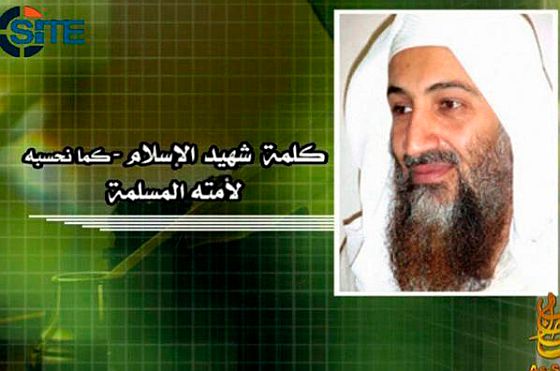
Osama bin Laden might be dead, but al Qaeda still operates a nimble media outfit.

Just as the US media drone anticipating President Obama’s speech later this morning started to grow tiresome, Obama’s words got preempted by Osama’s.

I can’t help wondering what his assassination would have looked like if it had occurred immediately after he expressed support for the Arab Awakening.

In an audio message recorded shortly before his death, Reuters reports:

Bin Laden praised the Egyptian revolution and urged Arab protesters to maintain their momentum, adding: “I believe that the winds of change will envelope the entire Muslim world.”

“This revolution was not for food and clothing. Rather, it was a revolution of glory and pride, a revolution of sacrifice and giving. It has lit the Nile’s cities and its villages from its lower reaches to the top,” he said.

“To those free rebels in all the countries — retain the initiative and be careful of dialogue. No meeting mid-way between the people of truth and those of deviation.”

Bin Laden made no specific reference to Libya, Syria, Bahrain and Yemen, where pro-democracy protesters have had less success than in Egypt and Tunisia, but said Israel, reviled by many ordinary Arabs, was worried by the unrest.

Bin Laden called on young Arabs to consult “those of experience and honesty” and to set up a framework that would allow them to “follow up events and works in parallel… to save the people that are struggling to bring down their tyrants.”

How significant is Osama’s endorsement of the uprisings? It probably won’t have much influence on the average demonstrator in Syria, Bahrain, Libya, Egypt, or Yemen. But it might result in a few would-be jihadists joining the political mainstream.

Meanwhile, how much influence is Obama likely to have two years after his previous and much-hyped Cairo speech turned out to be hollow rhetoric?

McClatchy’s Hannah Allam just took the pulse of the Arab street:

Most common responses when I asked random Egyptians about watching Obama’s #MEspeech: He’s speaking? When? About what?

Facebooktwittermail

The geopolitical battle for the Arab street

Trita Parsi and Reza Marashi write:

The Middle East is undergoing its most dynamic transformation since World War I, when Sir Mark Sykes and Georges Picot first divided the region into colonized spheres of influence. Nearly 100 years later, with the overthrow of Hosni Mubarak in Egypt and Zine El-Abidine Ben Ali in Tunisia, and the ongoing struggle in Yemen, Syria, Libya and Bahrain, all states in the region – or involved in the region – have been forced to reassess their policies and alliances.

These developments have also permanently shattered the frames through which the Middle East was understood – or presented – by various governments. The defining struggle is not between “moderates” and “radicals” – at least not if the definition of “moderate” is an Arab state allied with the U.S. and at virtual peace with Israel. The deposed dictatorships in Cairo and Tunis both fit this false definition of “moderate.” Nor is the struggle between Islamic and secular forces. As R. K. Ramazani points out, the rallying call of protesters across the region has been democracy and dignity, not Islam and Sharia. And to the extent that protests in Bahrain have taken on a sectarian tone, it is arguably due to the efforts of the Al-Khalifa royal family and its Saudi Arabian protector – both considered “moderates” in the old frame.

These recent developments have shocked not only status quo political systems, but also an increasingly intense rivalry for regional influence between Israel, Saudi Arabia and the U.S. on one side, Iran on another, and Turkey as the third vertex in an emerging triangle of competition. Rather than end the rivalry, this shock has changed its context and created both challenges and opportunities for all sides. Regional unrest has demonstrated both the Arab street’s relevance, and its ability to play a decisive role in the region’s future. Thus, if the Arab democracy wave continues unabated, it will not only test status-quo powers investing in an order that suppresses the streets, but also emerging powers that claim to champion them.

Facebooktwittermail