The Washington Post reports: Air pollution caused by energy production in the U.S. caused at least $131 billion in damages in the year 2011 alone, a new analysis concludes — but while the number sounds grim, it’s also a sign of improvement. In 2002, the damages totaled as high as $175 billion, and the decline in the past decade highlights the success of more stringent emissions regulations on the energy sector while also pointing out the need to continue cracking down.
“The bulk of the cost of emissions is the result of health impacts — so morbidity and particularly mortality,” said the paper’s lead author, Paulina Jaramillo, an assistant professor of engineering and public policy at Carnegie Mellon University. Using models, researchers can place a monetary value on the health effects caused by air pollution and come up with a “social cost” of the offending emissions — in other words, the monetary damages associated with emitting an additional ton (or other unit) of a given type of pollutant. This social cost can then be used to calculate the total monetary damages produced by a certain amount of emissions in a given time period.
The new analysis, just published in the journal Energy Policy, did just that. Using an up-to-date model and a set of data acquired from the Environmental Protection Agency on emissions from the energy sector, the researchers set about estimating the monetary damages caused by air pollution from energy production between 2002 and 2011. [Continue reading…]
Category Archives: climate change
What you need to know about the Zika virus and climate change
Climate Central reports: The rapid rise of the Zika virus is turning into a full-on public health crisis. The virus, transferred via specific types of mosquitoes, “is now spreading explosively” across Latin America, according to Margaret Chan, the head of the World Health Organization (WHO).
There could be up to 4 million cases right now, just eight months after the first case was reported in Brazil. There are 23 countries where the virus is active.
A number of factors have had to line up for the Zika virus — a disease that’s been associated with birth defects — to spread so far and wide so quickly, but chief among them is heavy rain and heat. Climate change could play a future role in this virus’ — as well as other mosquito-borne illnesses — spread as it creates conditions more favorable to the mosquitoes that transmit it. [Continue reading…]
Study: Grid for renewables key to cutting emissions

Climate Central reports: Carbon dioxide emissions from generating electricity could be cut by 78 percent within the next 15 years if the country makes the same Herculean effort to expand solar and wind technology that it did to build the Interstate Highway System.
That’s the conclusion of a National Oceanic and Atmospheric Administration (NOAA) study published Monday in Nature Climate Change, which shows that a new system of transcontinental transmission lines connected to wind and solar farms nationwide is the key to dramatically reducing emissions from the nation’s power plants.
Alexander MacDonald, retired director of NOAA’s Earth System Laboratory and the study’s lead author, said weather occurs on a very large scale and any system capturing sunshine and wind has to be built on a scale to match it. MacDonald said putting such as system in place would be like building a new Interstate Highway System, but the stakes are higher because of climate change.
“There is an opportunity to start very serious (emissions) mitigation right now, that’s what the study says,” MacDonald said. “The idea that wind and solar are too intermittent, or wind and solar are too expensive, or we have to wait for a breakthrough, this study shows that’s not true.” [Continue reading…]
By 2030, renewables will be the world’s primary power source
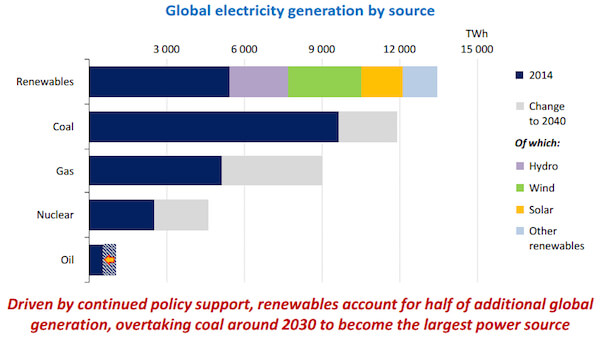
Climate Progress reports: In November, the International Energy Agency quietly dropped this bombshell projection: “Driven by continued policy support, renewables account for half of additional global generation, overtaking coal around 2030 to become the largest power source.”
In this post, I’ll dive deeper into this rapidly-approaching role reversal for coal and renewables. In Part Two, I’ll explain why the so-called “intermittency” problem for some renewables is basically solved and thus not a barrier to this reversal.
In releasing its World Energy Outlook 2015 last fall, the IEA published this chart of projected electricity generation in 2040: [Continue reading…]

People who deny climate science don’t put their money where their mouth is
By Stephan Lewandowsky, University of Bristol
At a news conference announcing that 2015 broke all previous heat records by a wide margin, one journalist started a question with “If this trend continues…” The response by the Director of NASA’s Goddard Institute for Space Studies, Gavin Schmidt, summed up the physics of climate change succinctly: “It’s not a question of if…”
Even if global emissions begin to decline, as now appears possible after the agreement signed in Paris last December, there is no reasonable scientific doubt that the upward trends in global temperature, sea levels, and extreme weather events will continue for quite some time.
Politically and ideologically motivated denial will nonetheless continue for a little while longer, until it ceases to be politically opportune.
So how does one deny that climate change is upon us and that 2015 was by far the hottest year on record? What misinformation will be disseminated to confuse the public?
SEC is criticized for lax enforcement of climate risk disclosure
The New York Times reports: As recently as 2011, shares in Peabody Energy, the world’s biggest private sector coal company, traded at the equivalent of $1,000. Today, they hover around $4 each. Over that time, investors who held the stock lost millions.
Peabody, like other coal companies, has been hammered as cheap natural gas erodes the demand for coal. But concerns about climate change are also an issue for the company as customers and investors turn away from fossil fuels.
Peabody saw this coming. Even as the company privately projected that coal demand would slump and prices would fall, it withheld this information from investors. Instead, Peabody said in filings with the Securities and Exchange Commission that it was not possible to know how changing attitudes toward climate change would affect its business.
Peabody’s double talk was revealed as part of a two-year investigation by the New York attorney general. In a settlement in November, Peabody agreed that it would disclose more about climate change risks in its regular filings with the S.E.C.
In theory, however, Peabody should have been making such disclosures all along. [Continue reading…]
We have 12 months until the next ‘hottest year’ memo – will we be ready?
By James Dyke, University of Southampton
It’s official. 2015 was the warmest year ever recorded. In fact, one would need to go back some 130,000 years to experience such high surface temperatures.
This really just confirms what we already assumed. The monster El Niño that began to erupt towards the end of 2014 further amplified the background signal of global warming that is being driven by greenhouse gas emissions. While the forecast is for a diminishing El Niño as we move towards the northern hemisphere summer, it hasn’t done with us yet – 2016 may prove to be even warmer.
Beyond this year temperatures may decrease. For a while. This of course will be seized upon by some people who continue to dispute the Earth is experiencing significant and sustained warming – let alone that humans are primarily responsible for such a trend. People with this attitude have fallen for the “escalator” fallacy; it’s possible to show a short-term decrease in temperature if you pick your start and end times carefully, but looking at the longer-term produces a clear increasing trend.
2015 was the hottest year on record, by a stunning margin

Bloomberg reports: To say that 2015 was hot is an understatement. The average recorded temperature across the surface of the planet was so far above normal that it set a record for setting records.
The year was more than a quarter of a degree Fahrenheit warmer than the last global heat record—set all the way back in 2014—according to National Oceanic and Atmospheric Administration figures released on Wednesday. A quarter of a degree may not sound like much, but on a planetary scale it’s a huge leap. Most previous records were measured by hundredths of a degree.
A powerful El Niño is largely responsible for the year’s extremes, but make no mistake: This is what global warming looks like. Temperatures are rising 10 times faster than during the bounce back from the last ice age. Fifteen of the hottest 16 years on record have come in the 21st century. [Continue reading…]
California said to target Exxon in climate inquiry
The New York Times reports: California’s attorney general is investigating Exxon Mobil on whether the company lied to the public and shareholders about the risks of climate change, and whether the company’s statements over the years constitute violations of securities laws and other statutes.
The investigation is similar to one started in November by the New York attorney general, Eric T. Schneiderman, for which the company has already produced thousands of documents.
Mr. Schneiderman, calling climate change “the defining issue of our time,” applauded the action taken by Kamala D. Harris, the attorney general.
“Just like any other publicly traded company, these energy giants have an obligation to ensure that their disclosures to investors of known and reasonably likely risks are truthful and not misleading, and to disclose to the public the risks associated with their products,” he said.
The California investigation was first reported by The Los Angeles Times, and was confirmed by people with knowledge of details of the inquiry. [Continue reading…]
Bill McKibben: The real zombie apocalypse
Here we are just a couple of weeks into 2016 and we already know that last year was the second-warmest on record in the continental United States (the winner so far being 2012); the month of December was a U.S. record-breaker for heat and also precipitation; and it’s assumed that, when the final figures come in later this month, 2015 will prove to be the hottest year on record globally. Even before this news is confirmed, we know that 14 of the 15 warmest years on record have occurred in the twenty-first century which, at least to me, looks ominously like a pattern. And early expectations are that this year will top last, with the help of a continuing monster El Niño event in the overheating waters of the Pacific that has only added to the impact of global warming and to fierce weather around the world. Everywhere it seems increasingly possible to see the signs of climate change: the melting Arctic; the destabilizing ice sheets in both the Antarctic and Greenland; the already rising sea levels that are someday destined to submerge major coastal cities; the disappearing glaciers (and so, in some regions, endangered water supplies); monster typhoons; severe droughts; and the burning that goes with a globally expanding fire season; the — in a word — extremity of it all.
With 2015 in the history books, it’s easy enough to think of our changing weather as part of that history, but that would be a mistake. Climate change, if allowed to come to full fruition, will be something else altogether — not history, but the possible end of it. History, after all, is something we’re generally familiar with. It has its surprises, but the rise and fall of nations, of empires, even of civilizations, the coming of democracy or dictators, the rising of peoples, the failure of revolutions, and yet more autocrats, all of that is the normal course of human events. All of it is part of the ongoing record. Climate change is something else entirely. Certainly, it emerges from history, since through our industrial processes — the burning of coal and oil — we created it, however inadvertently (at first). But let’s face it: global warming is the potential deal-breaker for history. It threatens not just to submerge global cities, but to sink civilization itself.
Don’t think of it as a tragedy for the planet. Give Earth a few million years and it’ll do fine. If climate change does its worst, life, in some fashion, possibly even human life, will undoubtedly survive and someday once again flourish, but the environment in which our civilizations have been built and our modest history recorded, the welcoming planet we’ve known will cease to exist in any time span that is meaningful to us. That is the future reality we face in the grim zombie world of the giant energy companies and energy states that Bill McKibben describes today. It’s why organizations like the one he founded, 350.org, are so important to our future and to the literal preservation of history. Unless we ensure that the human future is powered by alternative energy, and do so relatively quickly, while keeping the preponderance of fossil fuels in the ground, we will indeed find ourselves out of history and in the midst of a climate-change version of a zombie apocalypse. Tom Engelhardt
Night of the living dead, climate change-style
How to stop the fossil fuel industry from wrecking our world
By Bill McKibbenWhen I was a kid, I was creepily fascinated by the wrongheaded idea, current in my grade school, that your hair and your fingernails kept growing after you died. The lesson seemed to be that it was hard to kill something off — if it wanted to keep going.
Something similar is happening right now with the fossil fuel industry. Even as the global warming crisis makes it clear that coal, natural gas, and oil are yesterday’s energy, the momentum of two centuries of fossil fuel development means new projects keep emerging in a zombie-like fashion.
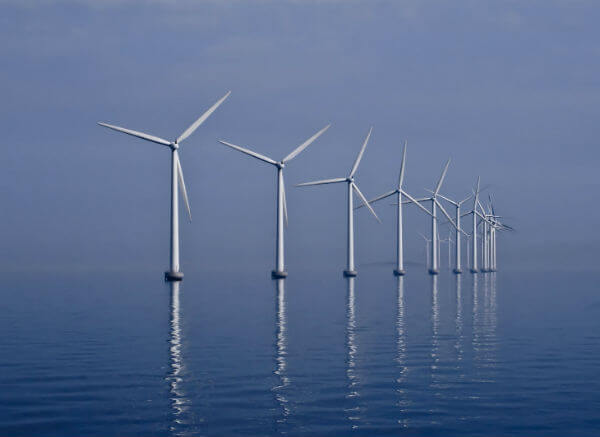
Denmark just broke a world record for wind power — again

Climate Progress reports: One European country can’t seem to stop breaking records when it comes to wind power.
In 2015, Denmark produced almost half of its electricity from wind power, breaking a world record for the most wind production ever recorded — a world record set last year, by Denmark.
The record 42 percent electricity generated from wind represents a three percent increase from the 39 percent it generated in 2014, which at the time broke the world record for the most electricity from wind production by a single country. According to the Danish national grid operator Energinet, this year’s number represents both the highest figure ever and the highest proportion of electricity from wind for any country.
Moreover, for 16 percent of the year, two Western regions in Denmark produced more electricity than the region’s residents consumed, leading to an electricity surplus. While it’s not unusual for wind power production to exceed consumption some of the time, the fact that it happened for such a significant period of time means that Denmark can sell surplus energy to consumers in Norway, Sweden, and Germany. Denmark also imports some hydroelectric power from Norway and solar energy from Germany. [Continue reading…]
This is where 90 percent of global warming is going
The Washington Post reports: Scientists have known for some time that when global warming occurs, the oceans will be the site of the most profound response.
The reason is simply that they are able to retain vastly more heat than the atmosphere. “Ninety, perhaps 95 percent of the accumulated heat is in the oceans,” said Peter Gleckler, an oceanographer at the Lawrence Livermore National Laboratory. The physical reason is that water has a far greater heat “capacity” than air, requiring more energy to raise its temperature — something that is apparent to anyone who has ever tried to boil it on a stove.
Gleckler is the lead author of a new study in the journal Nature Climate Change finding that, in the past two decades, ocean heat content has been rising rapidly and that, much more than before, heat is also mixing into the deeper layers of the ocean, rather than remaining near the surface. [Continue reading…]
Our voices and actions bring hope for the year ahead

David Suzuki writes: Like any year, 2015 had its share of good and bad, tragedy and beauty, hope and despair. It’s difficult not to get discouraged by events like the Syrian war and refugee crisis, violent outbreaks in Beirut, Paris, Burundi, the U.S. and so many other places, and the ongoing climate catastrophe.
But responses to these tragedies and disasters offer hope. It became clear during 2015 that when those who believe in protecting people and the planet, treating each other with fairness, respect and kindness and seeking solutions stand up, speak out and act for what is right and just, we will be heard.
As Syria descended deeper into chaos during 2015, people in many wealthy nations called for blocking refugees. But many more opened their hearts, homes and wallets and showed compassion. Governments responded by opening doors to people who have lost everything, including family and friends, to flee death and destruction.
Shootings and the inevitable absurd arguments against gun control continued south of the border, but many people, including the president, rallied for an end to the insanity. And while the U.S. presidential race remains mired in bigotry, ignorance and a dumbfounding rejection of climate science, many U.S. citizens, including political candidates, are speaking out for a positive approach more aligned with America’s professed values. And in 2015, voters here and elsewhere rejected fear-based election campaigns that promoted continued reliance on climate-altering coal, oil and gas.
The fossil fuel industry and its supporters continued to sow doubt and confusion about the overwhelming evidence for human-caused climate change and to rail against solutions, but many more people marched, signed petitions, sent letters, talked to friends and family, demanded action from political, religious and business leaders, and got on with innovating and implementing solutions.
The public appetite for a constructive approach to global warming led Canada to shift course in 2015, taking global warming seriously enough to make positive contributions at the Paris climate conference in December. The resulting agreement won’t lower emissions enough to prevent catastrophic warming, but it’s a significant leap from previous attempts, and it includes commitments to improve targets.
If we want to heal this world we have so badly damaged, we must do all we can. Although many necessary and profound changes must come from governments, industry and other institutions, we can all do our part. For the climate, we can conserve energy, eat less meat, drive less, improve energy efficiency in our homes and businesses and continue to stand up and speak out. [Continue reading…]
Scientists move one step closer to turning water into hydrogen fuel, affordably
Christian Science Monitor reports: Scientists have cleared one hurdle on the path to deriving hydrogen fuel from water affordably, a breakthrough that could drastically change the way we power vehicles.
Hydrogen has the potential to fuel incredibly environmentally clean cars. But making that fuel hasn’t been so efficient or economical. Pure hydrogen gas does not occur naturally on Earth, so scientists must devise ways to separate hydrogen from naturally occurring compounds, like H2 O.
Until now, cars that run on water have been out of reach. Electrolysis, the process of breaking H2 O into hydrogen and oxygen gases by passing an electric current through water, and other possible methods have been prohibitively expensive or difficult.
But a team of scientists have come up with a different mechanism to produce hydrogen fuel from water. These researchers have created a biomaterial that catalyzes the splitting of the water elements, which they describe in a paper published in the journal Nature Chemistry. [Continue reading…]
How you can play a part in tackling climate change – long after the Paris hype is over
By Stuart Capstick, Cardiff University and Adam Corner, Cardiff University
There’s a curious paradox at the heart of climate change. Despite scientists asserting the need for urgent action and the widespread acceptance of the reality of climate change by people worldwide, it is a subject that we tend not to talk about with friends, family or colleagues. Just 6% of the British public say they discuss climate change often, whereas approaching half (44%) do so at most rarely. Likewise, two-thirds of Americans rarely or never discuss the subject.
Perhaps we are too fearful of appearing worthy or hectoring to express our concerns, or maybe the issues seem too complex and overwhelming. Or we have grown tired of seeing polar bears floating on melting icebergs. Whatever the reasons for our reticence, however, it is hard to see how a global impetus for public engagement and action can be realised if it remains out of bounds for discussion by all but an interested few.
The Paris summit meant climate change was headline news for a week or two. Perhaps you did find yourself reflecting on the unusual weather or the fate of low-lying Pacific nations. But now that Christmas has come and gone, are you still worrying about these things? The discussion can’t tail off from here – after Paris, we need public conversation about climate change more than ever before. Whether you think the agreement was a resounding success or are troubled by its limitations, it is clear that the hard work still lies ahead.
Dawn of the Anthropocene: Five ways we know humans have triggered a new geological epoch
By Jan A. Zalasiewicz, University of Leicester and Mark Williams, University of Leicester
Is the Anthropocene real? That is, the vigorously debated concept of a new geological epoch driven by humans.
Our environmental impact is indeed profound – there is little debate about that – but is it significant on a geological timescale, measured over millions of years? And will humans leave a distinctive mark upon the layers of rocks that geologists of 100,000,000AD might use to investigate the present day?
Together with other members of the Anthropocene Working Group we’ve just published a study in Science that pulls much of the evidence together.
The case for the Anthropocene might be distilled into five strands:
1. Carbon in the atmosphere
Carbon is important, both due to its growing impact on global warming and because it leaves long-lived geological traces. The increased levels of carbon dioxide in the atmosphere – now higher than at any time in at least the past few million years – can be found as fossil bubbles in the geologically short-lived “rock” that is polar ice.
But there are wider and more long-lived traces too, in the form of changed patterns of carbon isotopes (absorbed by every living thing) and in tiny, virtually indestructible particles of fly ash released from furnaces and chimneys. These are leaving an indelible signal in rock and soil strata now accumulating.
China to increase wind, solar power capacity by 21% in 2016
Bloomberg reported on December 30: China, the world’s biggest clean energy investor, plans to increase wind and solar power capacity by more than 21 percent next year as it works to reduce greenhouse gas emissions by cutting its reliance on coal.
The nation is targeting at least 20 gigawatts of new wind power installations and 15 gigawatts of additional photovoltaic capacity next year, the National Energy Administration said in a statement on Tuesday.
China has pledged to peak carbon emissions around 2030, by which time it aims to derive 20 percent of the energy it uses from clean sources. China will also stop approving new coal mines in the next three years, the Xinhua News Agency reported Tuesday, citing National Energy Administration head Nur Bekri.
The world’s biggest producer of carbon emissions is expected at the end of this year to have a total of 120 gigawatts of wind power, 43 gigawatts of solar, and 320 gigawatts of hydro power, the NEA said. To accommodate the clean energy additions, China will promote the construction of electricity networks, the agency said.[Continue reading…]
Even while claiming it was uncertain, the oil industry designed its infrastructure to withstand the effects of climate change
The Los Angeles Times reports: A few weeks before seminal climate change talks in Kyoto back in 1997, Mobil Oil took out a bluntly worded advertisement in the New York Times and Washington Post.
“Let’s face it: The science of climate change is too uncertain to mandate a plan of action that could plunge economies into turmoil,” the ad said. “Scientists cannot predict with certainty if temperatures will increase, by how much and where changes will occur.”
One year earlier, though, engineers at Mobil Oil were concerned enough about climate change to design and build a collection of exploration and production facilities along the Nova Scotia coast that made structural allowances for rising temperatures and sea levels.
“An estimated rise in water level, due to global warming, of 0.5 meters may be assumed” for the 25-year life of the Sable gas field project, Mobil engineers wrote in their design specifications. The project, owned jointly by Mobil, Shell and Imperial Oil (a Canadian subsidiary of Exxon), went online in 1999; it is expected to close in 2017.
The United States has never ratified the 1997 Kyoto Protocol to reduce greenhouse emissions.
A joint investigation by the Columbia University Graduate School of Journalism’s Energy and Environmental Reporting Project and the Los Angeles Times earlier detailed how one company, Exxon, made a strategic decision in the late 1980s to publicly emphasize doubt and uncertainty regarding climate change science even as its internal research embraced the growing scientific consensus.
An examination of oil industry records and interviews with current and former executives shows that Exxon’s two-pronged strategy was widespread within the industry during the 1990s and early 2000s.
As many of the world’s major oil companies — including Exxon, Mobil and Shell — joined a multimillion-dollar industry effort to stave off new regulations to address climate change, they were quietly safeguarding billion-dollar infrastructure projects from rising sea levels, warming temperatures and increasing storm severity. [Continue reading…]