Category Archives: climate change

Doomsday Clock set at 3 minutes to midnight

LiveScience: The world is “3 minutes” from doomsday.

That’s the grim outlook from board members of The Bulletin of the Atomic Scientists. Frustrated with a lack of international action to address climate change and shrink nuclear arsenals, they decided today (Jan. 22) to push the minute hand of their iconic “Doomsday Clock” to 11:57 p.m.

It’s the first time the clock hands have moved in three years; since 2012, the clock had been fixed at 5 minutes to symbolic doom, midnight.

Bulletin of the Atomic Scientists: In 2015, unchecked climate change, global nuclear weapons modernizations, and outsized nuclear weapons arsenals pose extraordinary and undeniable threats to the continued existence of humanity, and world leaders have failed to act with the speed or on the scale required to protect citizens from potential catastrophe. These failures of political leadership endanger every person on Earth.

In 1984, as the United States began a major defense build-up that included the pursuit of a potentially destabilizing ballistic missile defense system, relations between the United States and the Soviet Union reached an icy nadir. “Every channel of communications has been constricted or shut down; every form of contact has been attenuated or cut off. And arms control negotiations have been reduced to a species of propaganda,” the Bulletin wrote then, in explaining why the hands of the Doomsday Clock had been moved to three minutes to midnight, the closest they had been to catastrophe since the early days of above-ground hydrogen bomb testing.

Today, more than 25 years after the end of the Cold War, the members of the Bulletin of the Atomic Scientists Science and Security Board have looked closely at the world situation and found it highly threatening to humanity — so threatening that the hands of the Doomsday Clock must once again be set at three minutes to midnight, two minutes closer to catastrophe than in 2014.

Despite some modestly positive developments in the climate change arena in the past year, reflecting continued advancement of renewable energy technologies, current efforts are entirely insufficient to prevent a catastrophic warming of Earth. Absent a dramatic course correction, the countries of the world will have emitted enough carbon dioxide and other greenhouse gases by the end of this century to profoundly transform Earth’s climate, harming millions upon millions of people and threatening many key ecological systems on which civilization relies. [Continue reading…]


Facebooktwittermail

Rate of environmental degradation puts life on Earth at risk, say scientists

The Guardian reports: Humans are “eating away at our own life support systems” at a rate unseen in the past 10,000 years by degrading land and freshwater systems, emitting greenhouse gases and releasing vast amounts of agricultural chemicals into the environment, new research has found.

Two major new studies by an international team of researchers have pinpointed the key factors that ensure a livable planet for humans, with stark results.

Of nine worldwide processes that underpin life on Earth, four have exceeded “safe” levels – human-driven climate change, loss of biosphere integrity, land system change and the high level of phosphorus and nitrogen flowing into the oceans due to fertiliser use.

Researchers spent five years identifying these core components of a planet suitable for human life, using the long-term average state of each measure to provide a baseline for the analysis. [Continue reading…]

Facebooktwittermail

Tropical forests soak up much more carbon than we thought

Motherboard reports: Another reason to be grateful for Earth’s tropical forests: Not only do they r​elease massive quantities of oxygen, creating a pleasantly breathable atmosphere, not only do they harbor over half​ the planet’s biodiversity, they’re also doing a bang-up job mopping up all that extra carbon we’ve been pouring into the atmosphere.

That’s the conclusion of a new​ study led by researchers at NASA and the National Center for Atmospheric Research, which finds tropical forests may be absorbing far more human-emitted carbon dioxide than we thought. To wit, some 1.4 billion metric tons of CO2 annually—roughly the same amount of carbon that’s emitted every year as we slash and burn our way through them.

“This is good news, because uptake in northern forests may already be slowing, while tropical forests may continue to take up carbon for many years,” said lead study author David Schimel in a press re​lease.

By pumping carbon into the atmosphere, we’re not just warming the planet directly, we’re setting in motion a number of different “feedback” cycles. Some of these feedbacks — methane release due to permafrost melting, for instance — accelerate climate change. But our CO2 emissions also stimulate plants to grow and suck down more carbon, a negative feedback known as the “fertilization” effect.

The CO2 fertilization effect has been known for decades, but actual data on the effect is spotty, and comes from a range of sources that aren’t necessarily comparable: ecosystem and atmospheric models, satellite images, experimental plots and so forth. And while in theory, the effect should be greater in warmer climates—plant growth depends on temperature as well as CO2—most atmospheric models have observed stronger CO2 fertilization at high latitudes. [Continue reading…]

Facebooktwittermail

Pope Francis ready to confront political challenge of tackling climate change

The Guardian reports: He has been called the “superman pope”, and it would be hard to deny that Pope Francis has had a good December. Cited by President Barack Obama as a key player in the thawing relations between the US and Cuba, the Argentinian pontiff followed that by lecturing his cardinals on the need to clean up Vatican politics. But can Francis achieve a feat that has so far eluded secular powers and inspire decisive action on climate change?

It looks as if he will give it a go. In 2015, the pope will issue a lengthy message on the subject to the world’s 1.2 billion Catholics, give an address to the UN general assembly and call a summit of the world’s main religions.

The reason for such frenetic activity, says Bishop Marcelo Sorondo, chancellor of the Vatican’s Pontifical Academy of Sciences, is the pope’s wish to directly influence next year’s crucial UN climate meeting in Paris, when countries will try to conclude 20 years of fraught negotiations with a universal commitment to reduce emissions.

“Our academics supported the pope’s initiative to influence next year’s crucial decisions,” Sorondo told Cafod, the Catholic development agency, at a meeting in London. “The idea is to convene a meeting with leaders of the main religions to make all people aware of the state of our climate and the tragedy of social exclusion.”

Following a visit in March to Tacloban, the Philippine city devastated in 2012 by typhoon Haiyan, the pope will publish a rare encyclical on climate change and human ecology. Urging all Catholics to take action on moral and scientific grounds, the document will be sent to the world’s 5,000 Catholic bishops and 400,000 priests, who will distribute it to parishioners.

According to Vatican insiders, Francis will meet other faith leaders and lobby politicians at the general assembly in New York in September, when countries will sign up to new anti-poverty and environmental goals.

In recent months, the pope has argued for a radical new financial and economic system to avoid human inequality and ecological devastation. In October he told a meeting of Latin American and Asian landless peasants and other social movements: “An economic system centred on the god of money needs to plunder nature to sustain the frenetic rhythm of consumption that is inherent to it.

“The system continues unchanged, since what dominates are the dynamics of an economy and a finance that are lacking in ethics. It is no longer man who commands, but money. Cash commands.

“The monopolising of lands, deforestation, the appropriation of water, inadequate agro-toxics are some of the evils that tear man from the land of his birth. Climate change, the loss of biodiversity and deforestation are already showing their devastating effects in the great cataclysms we witness,” he said. [Continue reading…]

Facebooktwittermail

The year the climate changed everything

Brian Merchant writes: That 2014 is turning out to be the hottest year ever recorded is, sadly, not particularly remarkable. Nor was it really notable that, despite the global swelter, most of humanity was content to pump out a record-breaking volume — 35 billion tons — of additional heat-trapping carbon pollution.

It wasn’t remarkable that the world’s climate scientists issued a series of reports bearing the international climatology community’s strongest warnings yet. (It is “extremely likely” that human influence is the “dominant cause” of today’s warming, which is scientist for “wake up.”)

Or that California experienced the worst drought in at least 1,200 years.

Or that a massive ice sheet in Antarctica thawed and collapsed, all but guaranteeing 10 feet of global sea level rise from it alone. It may take a long time — hundreds of years, even—but it’s locked in.

Or that the Pentagon is officially preparing plans for waging wars in a warming world.

Or that vast plumes of methane, a super-heat-trapping gas, are bubbling up in the Arctic at a rate not seen before.

Or that conservative politicians, pundits, and voters ignored it all, continuing their tradition of brushing off climate change as a liberal contrivance, and of convening hearings to haughtily disavow one of the most robust scientific consensuses ever established.

None of those deeply unnerving developments were particularly surprising in 2014—they all simply reflect the new machinations of the world we now inhabit. We live in the age of perpetual, incremental environmental decline. [Continue reading…]

Facebooktwittermail

Rebecca Solnit: Everything’s coming together while everything falls apart

No one would call TomDispatch a traditional website.  Still, we do have our traditions.  Among them, none is more “traditional” — a full decade old at a website that just turned 13 this November — than having Rebecca Solnit end our year.  Sometimes as the year winds down, she’s dreaming of the future, sometimes thinking about the past, sometimes focused on the last few seconds, but always, as was true from her very first moment at this website, she offers some version of hope in the face of a reality that others find almost too grim and obdurate to consider.

As this year ends, Solnit, the author of the 2014 hit book Men Explain Things to Me and an even more recent collection of essays, The Encyclopedia of Trouble and Spaciousness, considers humanity’s latest breakthrough into the apocalyptic.  She takes on climate change in a clear-eyed way without losing her sense of hope and purpose.  As ever, it’s an impressive performance and a reminder to all of us that the future remains ours, if only we care to focus on what truly endangers us.  Someday, those who sent the most recent rounds of greenhouse gases into the atmosphere utterly wittingly, with profits on the brain — and I’m talking, of course, about the CEOs of Big Energy (and the various figures who run the energy operations we’ve given names like Saudi Arabia, Russia, and “Saudi America”) — will be remembered as the greatest criminals in history, the true terrorists (or as I’ve called them, “terrarists”) of our age.  It’s one of the jokes of our time that we Americans have literally plowed trillions of dollars into what’s called “national security” in the post-9/11 years without seriously facing climate change, a phenomenon that, if not brought under control, guarantees us a kind of insecurity we’ve never known.  Call it irony or call it idiocy, but call it something.

And let me end 2014, the year that revealed to all of us so much more about the hidden world of surveillance that is ours, with my own New Year’s wish: if I could be granted one relatively modest thing to end 2014, it would be the release from prison of former Army private Chelsea Manning and former CIA Agent John Kiriakou, and the release from exile of NSA whistleblower Edward Snowden.  For their genuine service, for letting us know what no one else would about the nature of the American world we inhabit, they deserve so unbearably much better from this country than they’ve gotten.  Someday, when those who jailed or exiled them are forgotten or scorned, they will, I’m convinced, be remembered as heroes of our moment.  In the meantime, a guy can hope, can’t he?  I take my hat off to all three of them as 2014 ends. Tom Engelhardt

Everything’s coming together while everything falls apart
The climate for 2015
By Rebecca Solnit

It was the most thrilling bureaucratic document I’ve ever seen for just one reason: it was dated the 21st day of the month of Thermidor in the Year Six. Written in sepia ink on heavy paper, it recorded an ordinary land auction in France in what we would call the late summer of 1798. But the extraordinary date signaled that it was created when the French Revolution was still the overarching reality of everyday life and such fundamentals as the distribution of power and the nature of government had been reborn in astonishing ways. The new calendar that renamed 1792 as Year One had, after all, been created to start society all over again.

In that little junk shop on a quiet street in San Francisco, I held a relic from one of the great upheavals of the last millennium. It made me think of a remarkable statement the great feminist fantasy writer Ursula K. Le Guin had made only a few weeks earlier. In the course of a speech she gave while accepting a book award she noted, “We live in capitalism. Its power seems inescapable. So did the divine right of kings. Any human power can be resisted and changed by human beings.”

Continue reading

Facebooktwittermail

Last year, the world pumped out more carbon pollution than ever before

Motherboard reports: Precisely at the moment that the climate depends on carbon pollution declining, worldwide emissions continue to boom. Case in point: 2013 saw yet another record carbon high, with 35.3 billion tons of CO2 entering the atmosphere.

That’s the finding of ​the European Union’s​ Joint Research Center, which released its annual report on global emissions today. The document tallies the emissions of fossil fuel power production—coal, oil, and gas—and emissions from industry, especially cement and metal manufacturing.

The record high was reached primarily thanks to developing, coal-hungry giants: “Sharp risers include Brazil (+ 6.2 percent), India (+ 4.4 percent), China (+ 4.2 percent) and Indonesia (+2.3 percent),” the report notes.

The US — the world’s largest historic greenhouse gas emitter — grew again after a brief pause, thanks to a return to coal. [Continue reading…]

Facebooktwittermail

Earth faces sixth ‘great extinction’ with 41% of amphibians set to go the way of the dodo

The Observer reports: A stark depiction of the threat hanging over the world’s mammals, reptiles, amphibians and other life forms has been published by the prestigious scientific journal, Nature. A special analysis carried out by the journal indicates that a staggering 41% of all amphibians on the planet now face extinction while 26% of mammal species and 13% of birds are similarly threatened.

Many species are already critically endangered and close to extinction, including the Sumatran elephant, Amur leopard and mountain gorilla. But also in danger of vanishing from the wild, it now appears, are animals that are currently rated as merely being endangered: bonobos, bluefin tuna and loggerhead turtles, for example.

In each case, the finger of blame points directly at human activities. The continuing spread of agriculture is destroying millions of hectares of wild habitats every year, leaving animals without homes, while the introduction of invasive species, often helped by humans, is also devastating native populations. At the same time, pollution and overfishing are destroying marine ecosystems.

“Habitat destruction, pollution or overfishing either kills off wild creatures and plants or leaves them badly weakened,” said Derek Tittensor, a marine ecologist at the World Conservation Monitoring Centre in Cambridge. “The trouble is that in coming decades, the additional threat of worsening climate change will become more and more pronounced and could then kill off these survivors.” [Continue reading…]

Miles King writes: Humans are “the ultimate invasive species” having spread from Africa to every corner of the planet (and beyond) in 100,000 years. In doing so, we have removed the habitats of other species, or affected them by moving other invasive species around, causing pollution and driving climate change. We do so at our peril, because humans depend on nature utterly for our survival.

If it is possible to stop this mass extinction, humans need to take rapid and radical action.

Here are five actions that I think will be needed: [Continue reading…]

Facebooktwittermail

In West Africa, a model for worldwide conservation takes root

Anna Badkhen writes: An hour before sunup the Bani River uncoils through the dark Sahel in bright silver curves, a reflection of a day not yet dawned, hardships not yet known, hopes not yet broken. Onto such a magical surface the Bozo fishermen of Sindaga shove off with bamboo poles and float downstream in redwood pirogues, one silent man per boat. The fishermen work standing up: solitary Paleolithic silhouettes keeping perfect balance against the river’s luminescence, each man one with his boat like some pelagic centaur, performing one of mankind’s oldest rites. They cast their diaphanous seines into the night. Handmade sinkers kiss the surface, pucker it lightly, drag the nets under.

By the time daybreak trims burgundy the sparse savannah, the fishermen row their day’s first catch back to the village. In squat banco houses that crowd the river, the men take breakfast of rice and fish sauce. They patch up the nets while their wives and mothers sort the morning haul into giant wicker baskets and lug it to the nearest market town. After midday prayer, the men cast off again.

Such has been their fishing schedule for centuries, aligned with the orderly procession across the West African sky of 26 sequential constellations. Each new star signifies the advent of a windy season, of weeks of life-giving drizzle or days of downpour, of merciless heat or relentless malarial mosquitoes dancing in humid nights. Each star announces the arrival of the blue-tinged Nile perch, of the short-striped daggers of clown killi, of the lunar disks of the Niger stingray, of the toothless garras that like to nibble the bare ankles of laundresses, and that, in the West, are used for pedicures in foot spas.

Or so it used to be. Mali has been growing drier and hotter since the 1960s. For the past three decades, the weather has been chaotic, out of whack with the stars. The rainy season has been starting early or late or not arriving at all. Droughts throttle the land and wring dry the river. Flash floods wash away harvests and entire homesteads hand-slapped of rice straw and clay. Acres of deforested riverbank dry out and blow away, or collapse into the water. The fish run off schedule. “The river is becoming broken,” said Lasina Kayantau, a Sindaga elder. [Continue reading…]

Facebooktwittermail

UN: climate change costs to poor countries will be much higher than previously estimated

The Associated Press reports: The cost to poor countries of adjusting to ever-hotter temperatures will be twice or even three times higher than previously thought, the U.N.’s environment agency said Friday—and that assumes a best-case scenario in which greenhouse gas emissions are dramatically reduced.

“If you don’t cut emissions, we’re just going to have to ask for more money because the damage is going to be worse,” Ronald Jumeau of the Seychelles said at U.N. climate talks.

The report was bound to sharpen disputes in Lima over who pays the bills for the impacts of global warming, whose primary cause is the burning of coal, oil and gas but which also includes deforestation. It has long been the thorniest issue at the U.N. negotiations, now in their 20th round.

Rich countries have pledged to help the developing world convert to clean energy and adapt to shifts in global weather that are already adversely affecting crops, human health and economies. But poor countries say they’re not seeing enough cash.

Projecting the annual costs that poor countries will face by 2050 just to adapt, the United Nations Environment Program report deemed the previous estimate of $70 billion to $100 billion “a significant underestimate.” It had been based on 2010 World Bank numbers.

The report says new studies indicate the costs will likely be “two to three times higher,” possibly even as high as $500 billion. [Continue reading…]

Facebooktwittermail

The first victims of climate change have caused the least harm to our planet

Lily Cole writes: In September 2014, a report published by the Internal Displacement Monitoring Centre (IDMC) found that 20.6 million people were displaced by extreme weather events in 2013. That’s almost three times as many as those fleeing current conflicts.

The number one cause of global relocation now is climate change – yet there is no international recognition for the status of climate change refugees, and no insurance policies for them. They are in the shadows of international media, and often have little access to support in their home countries.

In a cruel irony, some of the world’s most fragile communities – the ones most closely connected to the natural world, who have lived most sustainably and have had the least impact on our changing climate – are the first to suffer as a result of its changes.

In October, I travelled for three days to visit two Yawanawá indigenous communities deep in the Amazon. We slept in hammocks in wooden houses, enjoyed the company of friendly people, and spent time with the village shaman, who told us of birds freezing in trees the week prior to our arrival owing to excessive cold at night. When I thanked one of the women for hosting us, she said: “We don’t own this land; we are merely its caretakers. So our house is open to visitors, and you are always welcome.” [Continue reading…]

Facebooktwittermail

The rise in killings of Peru’s environmental and land defenders

Anti-logging campaigner, Edwin Chota, was murdered in September.

A new report by Global Witness sheds light on what’s driving the high number of killings of environmental defenders in Peru, less than a month before the country hosts the UN climate talks in Lima. Peru’s Deadly Environment calls into question the commitments of Peru to protect its carbon-rich forests and the people who live in them, in light of unfettered illegal logging, disregard for indigenous land claims, and new laws that favour industrial exploitation over environmental protection.

The report comes on the heels of the killings of four indigenous leaders in Ucayali in September, including prominent anti-logging activist Edwin Chota and three of his fellow Ashéninka leaders from the Peruvian Amazon.

“The murders of Edwin Chota and his colleagues are tragic reminders of a paradox at work in the climate negotiations,” said Patrick Alley, Co-Founder of Global Witness. “While Peru’s government chairs negotiations on how to solve our climate crisis, it is failing to protect the people on the frontline of environmental protection. Environmental defenders embody the resolve we need to halt global warming. The message is clear, if you want to save the environment, then stop people killing environmental defenders.”

Peru is the fourth most dangerous country to be an environmental defender, behind Brazil, Honduras and the Philippines. At least 57 environmental and land defenders were killed in Peru between 2002 and the present day, more than 60% of them in the last four years, according to new Global Witness data. Most of these deaths involved disputes over land rights, mining and logging. 72% of Peru’s indigenous communities still have no way of demonstrating their land tenure rights, and over 20 million hectares of land claims have not yet been processed. [Continue reading…]

Facebooktwittermail

Polar bears facing ‘worst-case trajectory’ because of climate change

The Toronto Star reports: Even the High Arctic won’t remain a haven for polar bears if the Earth continues to warm at the current pace, says an alarming new study.

Published in PLOS One, an online science journal on Wednesday, the study warns that all regions of Canada’s Arctic islands could potentially be ice-free for two to five months every year by the end of the century, triggering starvation and reproductive failure for polar bears.

Conditions outside the islands could be worse for the bears.

“It doesn’t look too good,” said Andrew Derocher of the University of Alberta in Edmonton and one of the authors of the study.

Using a regionally focussed climate model, the researchers projected that sea ice in the Canadian Arctic islands will decline remarkably, leaving long periods each year when there isn’t any ice. That would force pregnant females on to land earlier than usual and could interfere with successful births, the study said. The rest of the sea ice may not persist long enough to allow bears enough time to hunt and store energy. [Continue reading…]

Facebooktwittermail

Dangerous levels of global warming are unavoidable, says the World Bank

Vice News reports: Global temperatures will rise nearly 1.5 degrees Celsius, or 2.7 degrees Fahrenheit, above pre-industrial levels by the middle of the century regardless of actions taken to curb emissions, according to a report from the World Bank released Sunday. The rising temperatures are already disproportionately affecting developing countries and the world’s poorest citizens.

Current energy demands mean the world is committed to emitting more greenhouse gases, which will stay in the atmosphere for decades. That means that even with “very ambitious mitigation action,” the report states, temperatures will continue to rise past the 0.8 degrees Celsius increase already seen today.

“That’s a big message,” Samantha Smith, head of climate for the WWF, told VICE News. “Globally, what all countries have agreed to is that they’re going to keep warming under two degrees Celsius. This report is telling us that 1.5 degrees is too much for a lot of people.”

In the three areas examined in the new report — Latin America and the Caribbean, the Middle East and North Africa, and the Western Balkans and Central Asia — climate change will lead to reduced crop yields and worsened drought, bringing threats to water supplies. In Brazil, soybean crop yields could decrease by as much as 70 percent, and wheat by as much as 50 percent, if temperatures increase two degrees by 2050. Jordan, Egypt, and Libya could see crop yields decrease by 30 percent. [Continue reading…]

Facebooktwittermail

The well-oiled politics of North Dakota

Deborah Sontag writes: In late June, as black and gold balloons bobbed above black and gold tables with oil-rig centerpieces, the theme song from “Dallas” warmed up the crowd for the “One Million Barrels, One Million Thanks” celebration.

The mood was giddy. Halliburton served barbecued crawfish from Louisiana. A commemorative firearms dealer hawked a “one-million barrel” shotgun emblazoned with the slogan “Oil Can!” Mrs. North Dakota, in banner and crown, posed for pictures. The Texas Flying Legends performed an airshow backlit by a leaping flare of burning gas. And Gov. Jack Dalrymple was the featured guest.

Traveling through the “economically struggling” nation, Mr. Dalrymple told the crowd, he encountered many people who asked, “Jack, what the heck are you doing out there in North Dakota?” to create the fastest-growing economy, lowest unemployment rate and (according to one survey) happiest population.

“And I enjoy explaining to them, ‘Yes, the oil boom is a big, big help,’ ” he said.

Outsiders, he explained, simply need to be educated out of their fear of fracking: “There is a way to explain it that really relaxes people, that makes them understand this is not a dangerous thing that we’re doing out here, that it’s really very well managed and very safe and really the key to the future of not only North Dakota but really our entire nation.”

Tioga, population 3,000, welcomed North Dakota’s first well in 1951, more than a half-century before hydraulic fracturing liberated the “tight oil” trapped in the Bakken shale formation. So it was fitting that Tioga ring in the daily production milestone that had ushered the Bakken into the rarefied company of historic oil fields worldwide.

But Tioga also claims another record: what is considered the largest on-land oil spill in recent American history. And only Brenda Jorgenson, 61, who attended “to hear what does not get said,” mentioned that one, sotto voce.

The million-barrel bash was devoid of protesters save for Ms. Jorgenson, a tall, slender grandmother who has two wells at her driveway’s end and three jars in her refrigerator containing blackened water that she said came from her faucet during the fracking process. She did not, however, utter a contrary word.

“I’m not that brave (or stupid) to protest among that,” she said in an email afterward. “I’ve said it before: we’re outgunned, outnumbered and out-suited.” [Continue reading…]

Facebooktwittermail

Between China and Keystone XL

Elizabeth Kolbert writes: On Tuesday evening, when Senate Democrats rejected efforts to force a vote approving the Keystone XL pipeline, they knew they were just delaying the inevitable. The measure was defeated by one vote, and several naysayers will no longer be around come January. The new, Republican-controlled Senate will take up the measure again — “This’ll be an early item on the agenda in the next Congress,” incoming Senate Majority Leader Mitch McConnell vowed on Tuesday night — and, the next time around, everyone knows, it will pass. In preparation for this eventuality, White House officials have begun hinting that President Barack Obama might be willing to trade approval of the pipeline for Republican acceptance of one of his favored policies.

If this is indeed the President’s plan, let’s hope he asks the right price. Otherwise, his claim to an environmental legacy will end up being what he traded away. As it happens, the Keystone vote came exactly one week after Obama and China’s President, Xi Jinping, announced that they had agreed on a plan to curb carbon emissions. Under the agreement, China, which is now the world’s largest greenhouse-gas emitter on an annual basis, would cap its emissions by 2030. For its part, the United States, which is still the world’s greatest emitter on a cumulative basis, would reduce its emissions by twenty-eight per cent by 2025. (This is against a 2005 baseline — U.S. emissions have already fallen about ten per cent since that year, owing, in part, to a substitution of natural gas for coal in electricity production.) Obama called the agreement “historic,” and rightly so. It marks the first time that China has officially acknowledged that its rapidly rising emissions need to stop rising, and it also offers a significantly more ambitious goal for the U.S. than it has previously been willing to commit to. Grist called the deal “a game changer,” while Vox labelled it a “BFD.” Many commentators noted that the odds of getting a meaningful global agreement on climate change at a summit scheduled for next year in Paris — odds that had seemed close to zero — suddenly looked a good deal better. The U.S.-China deal, as a Guardian editorial put it, “transforms the prospects” for the summit.

President Obama deserves a great deal of credit for the agreement, as does Secretary of State John Kerry, who conducted the behind-the-scenes negotiations. But, as many commentators have also noted, the deal doesn’t get the U.S. or China remotely near where they need to be if the world is to avoid disaster — which both countries, along with pretty much every other state in the world, have defined as warming of more than two degrees Celsius. Chris Hope, a policy researcher at Cambridge University, ran the terms of the agreement through what’s known as an “integrated assessment model.” He also included in his analysis a recent commitment by the European Union to cut its emissions by forty per cent before 2030. He found that even if all of the pledges made so far are fulfilled, there will be “less than a 1% chance of keeping the rise in global mean temperatures” below two degrees Celsius: “Most likely the rise will be about 3.8° C.” [Continue reading…]

Facebooktwittermail

The Keystone XL’s Senate failure isn’t the end of the pipeline as an act of war

Vi Waln writes: My Lakota people have a phrase – Mni Wiconi – which means “water of life”. Water is also Pejuta – our primary medicine. It is an extremely sacred element without which we cannot live, yet many people take it for granted. They do not realize: when our drinking-water sources are gone or contaminated, humanity will perish.

Water is also present in every single Lakota ceremony at which I pray – it is essential to our ceremonial way of life. Like our ancestors who sacrificed their very lives for our survival, many of us pray for the descendants who will soon stand in our place, and one of our most important prayers is for our descendants to always have an abundance of clean drinking water.

But TransCanada’s Keystone XL oil pipeline (KXL), which the company has proposed building directly over the Ogallala Aquifer, is still an immediate threat to all of us who drink water from that underground reservoir.

The Ogallala Aquifer is a major water supply for eight states, from here in North Dakota down to Texas and all the way out to New Mexico. Without clean water, these eight states will become uninhabitable. Many people – Indian and non-Indian alike – are prepared to fight the pipeline’s construction to protect the water and land, no matter the result of Tuesday evening’s vote in the US Senate.

Many Lakota people in particular view the construction of this pipeline through our treaty territory as a true act of war. [Continue reading…]

The Guardian reports: The most significant attempt yet to force US government approval of the Keystone XL oil pipeline failed narrowly to clear the Senate on Tuesday night as a coalition of Republicans and moderate Democrats fell one vote short of the 60 votes needed for the legislation to pass.

Fourteen Democrats, led by Louisiana senator Mary Landrieu, joined all 45 Republicans in voting for the bill, which called for the controversial energy project to be given immediate go-ahead after years of delay due to environmental concerns.

A similar bill was passed in the House of Representatives on Friday.

But, as expected, the bipartisan coalition failed to win over sufficient wavering Democrats, such as Jay Rockefeller of West Virginia and independent Maine senator Angus King, who joined the party’s leadership and opposed the bill for a total of 41 votes against.

Landrieu, who is fighting to hold on to her seat in a run-off election next month, had called for the bill in a last-ditch effort to shore up her support in Louisiana. She attempted to heal party rifts afterwards, telling reporters in the Senate: “there is no blame, there is only joy in the fight”.

Nevertheless the size of the Democratic rebellion may put additional pressure on the White House to approve construction of the pipeline in future if, as promised, Republicans make a fresh attempt to pass legislation when the new Senate is sworn in next January. [Continue reading…]

Facebooktwittermail

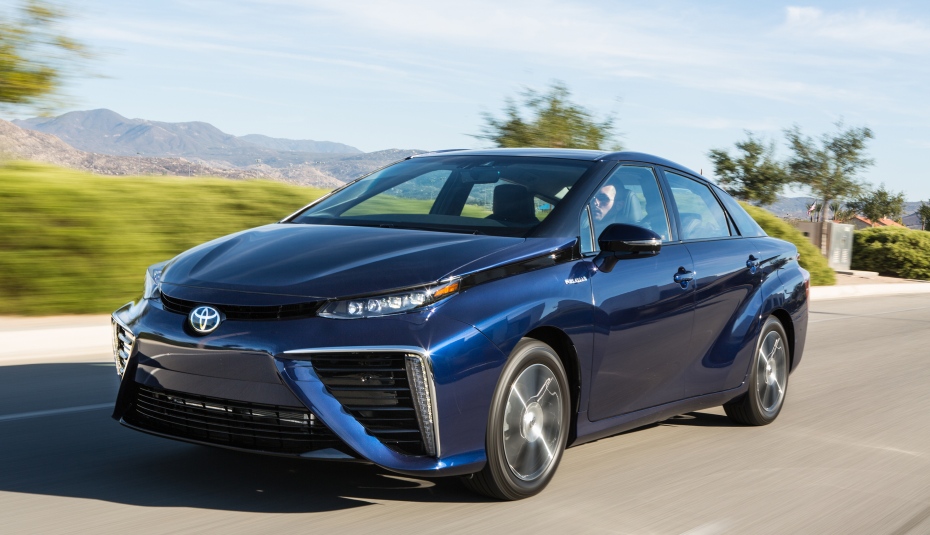
Hydrogen cars about to go on sale. Their only emission: water

The New York Times reports: Remember the hydrogen car?

A decade ago, President George W. Bush espoused the environmental promise of cars running on hydrogen, the universe’s most abundant element. “The first car driven by a child born today,” he said in his 2003 State of the Union speech, “could be powered by hydrogen, and pollution-free.”

That changed under Steven Chu, the Nobel Prize-winning physicist who was President Obama’s first Secretary of Energy. “We asked ourselves, ‘Is it likely in the next 10 or 15, 20 years that we will convert to a hydrogen-car economy?’” Dr. Chu said then. “The answer, we felt, was ‘no.’ ” The administration slashed funding for hydrogen fuel cell research.

Attention shifted to battery electric vehicles, particularly those made by the headline-grabbing Tesla Motors.

The hydrogen car, it appeared, had died. And many did not mourn its passing, particularly those who regarded the auto companies’ interest in hydrogen technology as a stunt to signal that they cared about the environment while selling millions of highly profitable gas guzzlers.

Except the companies, including General Motors, Honda, Toyota, Daimler and Hyundai, persisted.

After many years and billions of dollars of research and development, hydrogen cars are headed to the showrooms. [Continue reading…]

Facebooktwittermail