Category Archives: climate change

Michael Klare: The new Congress and planetary disaster

Looking for a little hope on climate change?  Believe it or not, it’s here and it’s real. And I’m not referring to the fact that, at least temporarily, oil prices have gone through the floor, making environmentally destructive “tough oil” projects like western oil-shale fracking and Canadian tar sands extraction look ever less profitable.  Nor do I mean the climate change deal that was just reached at the Asia-Pacific Economic Cooperation summit and is being called “historic.” It’s true that President Obama made a positive move at that summit, another symbolic gesture in its wake, and is promising more of the same in the future.  These steps to check the worst future depredations of climate change have been hailed as perhaps more transformational than they are.  Nonetheless, in the face of a new Republican Congress in which anti-climate-change hawks may outnumber war hawks (no small feat), this is well worth noting.

I’m talking, of course, about the potentially carbon-reducing long-term deal between the planet’s two major greenhouse gas polluters, between, that is, Barack Obama and Chinese President Xi Jinping.  Both of them have been running “all of the above,” drill-baby-drill — or in China’s case dig-baby-dig and import-baby-import — energy programs to devastating effect. China, for instance, is slated to bring online the equivalent of a new coal-powered plant every 10 days for the next decade, even as it’s taken a leading position in developing solar power technology.

The steps agreed to in somewhat hazy language by the two presidents fall far short of what will be needed to keep this planet from overheating drastically, and yet they do at least pave the way for the first global climate change negotiations that might actually matter in a long while.  The genuinely good news, however, was none of the above.  It has to do instead with the thinking behind Obama’s Beijing decision.  The “architect” of the American negotiating position, months in the making, was presidential senior adviser John Podesta. And here’s what you need to know about him: he’s reportedly going to leave the Obama administration early in 2015 to run Hillary Clinton’s presidential campaign. This means that he’s essentially committed the leading Democratic candidate in 2016 to run her campaign on Obama’s gesture in China and whatever other climate change moves he plans to make in the coming year — on, that is, reducing carbon emissions.

As Coral Davenport of the New York Times explained recently, the thinking behind this is clear.  Despite the historically low-turnout 2014 midterm elections, Podesta — and the Democrats — are making a different kind of bet on 2016 based on polling figures showing that, among key presidential election year Democratic demographics (young voters, Hispanics, African Americans, and unmarried women), concern over climate change is rising in striking ways.  In other words, if you can tune out an election in which an aging 19% of the prospective electorate swept a whole crew of climate deniers into office and focus on deeper, longer-term calculations, something is happening, possibly generationally, that’s potentially big enough to change future elections.

It’s big enough, at least, to catch the attention of pragmatic political types in Washington, and may be the beginning of a tectonic transformation in this country.  Despite the power of Big Energy and the present hue and cry about “job destruction,” a “war on coal,” and all the rest, a rising climate movement could potentially transform our politics and our world.  No one who attended the enormous climate change rally in New York in late September could doubt that this was so, but that John Podesta has also been paying attention matters.  It tells us in a nitty-gritty way that sometimes the work of activists does pay off.

All those years in the (overheating) wilderness organizing and proselytizing, all those years when the mainstream media managed to look the other way, all those years when climate change activists in groups like 350.org had to struggle to avoid despair, may turn out to matter.  That’s the positive side of the picture.  Then there’s the other side, and it couldn’t be grimmer, as TomDispatch’s energy and climate-change expert Michael Klare, author of The Race for What’s Left, makes clear today. Tom Engelhardt

Fossil-fueled Republicanism
The Grand Oil Party takes Washington by storm
By Michael T. Klare

Pop the champagne corks in Washington!  It’s party time for Big Energy.  In the wake of the midterm elections, Republican energy hawks are ascendant, having taken the Senate and House by storm.  They are preparing to put pressure on a president already presiding over a largely drill-baby-drill administration to take the last constraints off the development of North American fossil fuel reserves.

The new Republican majority is certain to push their agenda on a variety of key issues, including tax reform and immigration.  None of their initiatives, however, will have as catastrophic an impact as their coming drive to ensure that fossil fuels will dominate the nation’s energy landscape into the distant future, long after climate change has wrecked the planet and ruined the lives of millions of Americans.


Continue reading

Facebooktwittermail

China, U.S. agree limits on emissions, but experts see little new

Reuters reports: China and the United States agreed on Wednesday to new limits on carbon emissions starting in 2025, but the pledge by the world’s two biggest polluters appears to be more politically significant than substantive.

As China’s President Xi Jinping agreed to a date for peak CO2 emissions for the first time and also promised to raise the share of zero-carbon energy to 20 percent of the country’s total, President Barack Obama said the United States would cut its own emissions by more than a quarter by 2025.

At its best, the announcement threw the political weight of the world’s two biggest economies behind a new global climate pact to be negotiated in Paris next year.

But the United States has already pledged to cut its carbon emissions by 17 percent by 2020 and it’s not clear if the new proposals will pass a Republican-dominated Congress. [Continue reading…]

Facebooktwittermail

Climate crisis, the deindustrialization imperative and the jobs vs. environment dilemma

Richard Smith writes: Since the 1990s, climate scientists have been telling us that unless we suppress the rise of carbon dioxide emissions, we run the risk of crossing critical tipping points that could unleash runaway global warming, and precipitate the collapse of civilization and perhaps even our own extinction. To suppress those growing emissions, climate scientists and the UN Intergovernmental Panel on Climate Change (IPCC) have called on industrialized nations to slash their carbon dioxide emissions by 80 to 90 percent by 2050.

But instead of falling, carbon dioxide emissions have been soaring, even accelerating, breaking records year after year. In May 2013, carbon dioxide concentrations topped the 400 parts per million mark prompting climate scientists to warn that we’re “running out of time,” that we face a “climate emergency” and that unless we take “radical measures” to suppress emissions very soon, we’re headed for a 4-degree or even 6-degree Celsius rise before the end of the century. And not just climate scientists have made warnings, but also mainstream authorities, including the World Bank, the International Energy Agency (IEA) and others. In 2012, the IEA warned that “no more than one-third of proven reserves of fossil fuels can be consumed prior to 2050 if we hope to prevent global warming from exceeding more than 2 degrees Centigrade.” In September 2014, the global accounting and consulting giant PricewaterhouseCoopers warned that:

For the sixth year running, the global economy has missed the decarbonisation target needed to limit global warming to 2˚C . . . To avoid two degrees of warming, the global economy now needs to decarbonise at 6.2 percent a year, more than five times faster than the current rate, every year from now till 2100. On our current burn rate we blow our carbon budget by 2034, sixty-six years ahead of schedule. This trajectory, based on IPCC data, takes us to four degrees of warming by the end of the century.

Yet despite ever more dire warnings from the most conservative scientific, economic and institutional authorities, and despite record heat and drought, superstorms and floods, and melting ice caps and vanishing glaciers, “business as usual” prevails. Worse, every government on the planet is pulling out all the stops to maximize growth and consumption in the effort to hold on to the fragile recovery. [Continue reading…]

Facebooktwittermail

The life cycles of flowers and bees are getting thrown out of balance by climate change

bee-pollination

The Guardian reports: Sexual deceit, pressed flowers and Victorian bee collectors are combined in new scientific research which demonstrates for the first time that climate change threatens flower pollination, which underpins much of the world’s food production.

The work used museum records stretching back to 1848 to show that the early spider orchid and the miner bee on which it depends for reproduction have become increasingly out of sync as spring temperatures rise due to global warming.

The orchid resembles a female miner bee and exudes the same sex pheromone to seduce the male bee into “pseudocopulation” with the flower, an act which also achieves pollination. The orchids have evolved to flower at the same time as the bee emerges.

But while rising temperatures cause both the orchid and the bee to flower or fly earlier in the spring, the bees are affected much more, which leads to a mismatch.

“We have shown that plants and their pollinators show different responses to climate change and that warming will widen the timeline between bees and flowers emerging,” said Dr Karen Robbirt, at the Royal Botanic Gardens, Kew and the University of East Anglia (UEA). “If replicated in less specific systems, this could have severe implications for crop productivity.”

She said the research, published in Current Biology on Thursday, is “the first clear example, supported by long-term data, of the potential for climate change to disrupt critical [pollination] relationships between species.” [Continue reading…]

Facebooktwittermail

Breaking the power of the fossil fuel industry won’t be easy

Bill McKibben writes: The scientists have done their job [describing the effects of climate change]; no sentient person, including GOP Senate candidates, can any longer believe in their heart of hearts that there’s not a problem here. The scientific method has triumphed: over a quarter of a century, researchers have reached astonishing consensus on a basic problem in chemistry and physics.

And the engineers have done just as well. The price of a solar panel has dropped more than 90% over the last 25 years, and continues to plummet. In the few places they’ve actually been deployed at scale, the results are astonishing: there were days this summer when Germany generated 75% of its power from the wind and the sun.

That, of course, is not because Germany is so richly endowed with sunlight (it’s a rare person who books a North Sea beach holiday). It’s because the Germans have produced a remarkable quantity of political will, and put it to good use.

As opposed to the rest of the world, where the fossil fuel industry has produced an enormous amount of fear in the political class, and kept things from changing. Their vast piles of money have so far weighed more in the political balance than the vast piles of data accumulated by the scientists. In fact, the IPCC can calculate the size of the gap with great exactness. To get on the right track, they estimate, the world would have to cut fossil fuel investments by annually between now and 2029, and use the money instead to push the pace of renewables.

That’s a hard task, but not an impossible one. Indeed, the people’s movement symbolised by September’s mammoth climate march in New York, has begun to make an impact in dollars and cents. A new report this week shows that by delaying the Keystone pipeline in North America protesters have prevented at least $17bn in new investments in the tar sands of Canada – investments that would have produced carbon equivalent to 735 coal-fired power plants. That’s pretty good work. [Continue reading…]

Facebooktwittermail

Effects of climate change ‘irreversible,’ IPCC warns in new report

The Guardian reports: The Earth is locked on an “irreversible” course of climatic disruption from the buildup of greenhouse gases in the atmosphere, and the impacts will only worsen unless nations agree to dramatic cuts in pollution, an international panel of climate scientists warned Sunday.

The planet faces a future of extreme weather, rising sea levels and melting polar ice from soaring levels of carbon dioxide and other gases, the U.N. panel said. Only an unprecedented global effort to slash emissions within a relatively short time period will prevent temperatures from crossing a threshold that scientists say could trigger far more dangerous disruptions, the panel warned.

“Continued emission of greenhouse gases will cause further warming and long-lasting changes in all components of the climate system, increasing the likelihood of severe, pervasive and irreversible impacts,” concluded the report by the United Nations’ Intergovernmental Panel on Climate Change (IPCC), which draws on contributions from thousands of scientists from around the world.

The report said some impacts of climate change will “continue for centuries,” even if all emissions from fossil-fuel burning were to stop. The question facing governments is whether they can act to slow warming to a pace at which humans and natural ecosystems can adapt, or risk “abrupt and irreversible changes” as the atmosphere and oceans absorb ever-greater amounts of thermal energy within a blanket of heat-trapping gases, according to scientists who contributed to the report.

“The window of opportunity for acting in a cost-effective way — or in an effective way — is closing fast,” said Michael Oppenheimer, a Princeton University geosciences professor and contributing author to the report. [Continue reading…]

See the 40-page summary of the Climate Change 2014 Synthesis Report and the 116-page complete report.

Facebooktwittermail

Tackling climate change: America’s failure to lead by example

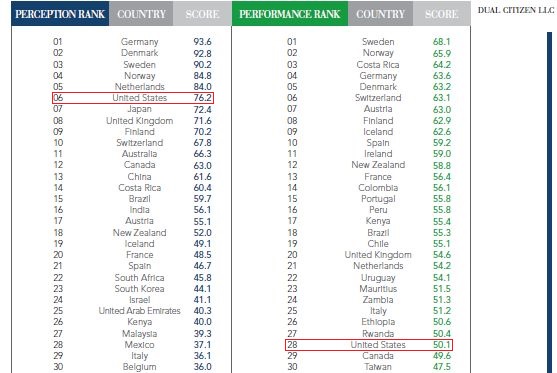
Since 2010, the Global Green Economy Index has been tracking the transition away from fossil-fuel based economies, consider two elements of a green economy: perception and performance. Countries with a high perception score are viewed as environmentally conscious leaders, while performance measures actual investment in green energy, overall infrastructure and development.

In these terms, the U.S. ranks #6 in perception, just behind the leading northern European countries, but #28 in performance, ranking below countries such as Costa Rica, Colombia, Peru, Kenya, Brazil, Chile, Uruguay, Mauritius, Zambia, Ethiopia, and Rwanda.

Global-Green-Economy-Index

China and India are also failing to match performance with perception — China ranks #13 in perception and #55 in performance, while India ranks #16 and #49.

Sweden and Norway stand out in having performance rankings (#1 and #2) that are slightly better than their perception rankings (#3 and #4) — two countries that face the high energy demands created by cold climates, short winter days, and extensive road systems.

Facebooktwittermail

Why Republicans keep telling everyone they’re not scientists

The New York Times reports: Gov. Rick Scott of Florida, a Republican who is fighting a Democratic challenge from former Gov. Charlie Crist, was asked by The Miami Herald if he believes climate change is significantly affecting the weather. “Well, I’m not a scientist,” he said.

Senator Mitch McConnell of Kentucky, who is locked in a tight re-election race, was asked this month by The Cincinnati Enquirer if he believes that climate change is a problem. “I’m not a scientist,” he said.

House Speaker John A. Boehner, when asked by reporters if climate change will play a role in the Republican agenda, came up with a now-familiar formulation. “I’m not qualified to debate the science over climate change,” he said.

“I’m not a scientist,” or a close variation, has become the go-to talking point for Republicans questioned about climate change in the 2014 campaigns. In the past, many Republican candidates questioned or denied the science of climate change, but polls show that a majority of Americans accept it — and support government policies to mitigate it — making the Republican position increasingly challenging ahead of the 2016 presidential elections.

“It’s got to be the dumbest answer I’ve ever heard,” said Michael McKenna, a Republican energy lobbyist who has advised House Republicans and conservative political advocacy groups on energy and climate change messaging. “Using that logic would disqualify politicians from voting on anything. Most politicians aren’t scientists, but they vote on science policy. They have opinions on Ebola, but they’re not epidemiologists. They shape highway and infrastructure laws, but they’re not engineers.” [Continue reading…]

Facebooktwittermail

Amazon rainforest losing ability to regulate climate, scientist warns

The Guardian reports: The Amazon rainforest has degraded to the point where it is losing its ability to benignly regulate weather systems, according to a stark new warning from one of Brazil’s leading scientists.

In a new report, Antonio Nobre, researcher in the government’s space institute, Earth System Science Centre, says the logging and burning of the world’s greatest forest might be connected to worsening droughts – such as the one currently plaguing São Paulo – and is likely to lead eventually to more extreme weather events.

The study, which is a summary drawing from more than 200 existing papers on Amazonian climate and forest science, is intended as a wake-up call.

“I realised the problem is much more serious than we realised, even in academia and the reason is that science has become so fragmented. Atmospheric scientists don’t look at forests as much as they should and vice versa,” said Nobre, who wrote the report for a lay audience. “It’s not written in academic language. I don’t need to preach to the converted. Our community is already very alarmed at what is going on.”

A draft seen by the Guardian warns that the “vegetation-climate equilibrium is teetering on the brink of the abyss.” If it tips, the Amazon will start to become a much drier savanna, which calamitous consequences. [Continue reading…]

Facebooktwittermail

Todd Gitlin: As the globe warms, so does the climate movement

Don’t call it a “march.” It was a “stand” — and a first stand at that, not a last one.  The People’s Climate March, billed as the largest climate demonstration in history, more than exceeded expectations and was an experience that has yet to desert me.  Its moment couldn’t have been grimmer in global warming terms.  That week, record-breaking concentrations of greenhouse gases were reported in the atmosphere, with the added grim news that the oceans and the forests, the planet’s major “carbon sinks,” were starting to absorb less CO2. Under the circumstances, I had the urge to do my bit to make the march huge and so organized a group of 16 friends and family members, ranging in age from 2 to 72. Marchers were to gather on New York’s Central Park West between 86th Street and Columbus Circle at 59th, where the event was to kick off at exactly 11:30 a.m.  At 11, when our crew arrived at 72nd Street, designated as a meeting place for children, families, and oldsters like me, the main route along Central Park West was already jam-packed and feeder streets like ours were filling fast.

On our small, ever-tighter stretch of cement was a typically heterogeneous crew sporting small dogs, a large penguin doll, a gazillion handmade signs, and a strutting, dancing drum-and-cymbal band. Amid cheers, music, and conversation, time passed and passed and passed. Though those younger than me were getting texts indicating that the march had set off in a timely manner, we didn’t move.  Not an inch.  And then it began to dawn on me. This demonstration was going to be so big, with so many people feeding into it, that “marching” for many of us would be an alien activity. As TomDispatch regular Todd Gitlin makes thrillingly clear today, we were quite literally in the midst of a genuine movement being born.  In fact, our crew, only 13 blocks north of the starting spot, didn’t even inch forward for more than an hour and a half after the official launch.

That’s what it turns out to mean to have 400,000 people crammed into a New York mile and cordoned off by the police (who control the streets, effectively imprisoning crowds).  By the time I reached the official beginning of the march at 59th Street, three and a half hours after we arrived, my legs were goners.  So, for another half an hour, I stopped with a friend, Peter Dimock, and watched the march pass in all its strange splendor and remarkable youthfulness, a kaleidoscope of floats and signs and costumes and performances spilling by, and still I couldn’t see the end of it. It’s the only demonstration I’ve ever attended where, officially speaking, I never began — and that represents a triumph of organizing and evidence of a growing concern for the state and fate of our planet.

Peter spent much of the march scribbling down what was on the panoply of signs around us, almost all made by individuals to express some urge about our degrading world, so many that his list of hundreds could make a dispatch in itself.  And yet he caught only a small fraction of the march’s signs.  Here are just a few of those to give you a taste of what may, as Gitlin suggests, have been a defining moment of hope in an otherwise grim era:

“Being Cool Has Never Been So Hot,” “Another Grandmother for Climate Justice,” “Our Planet is Not Something You Can Negotiate,” “I’m Sure the Dinosaurs Thought They Had Time, Too,” “Frack Off: Indigenous Women Leaders Leading Media Campaign to Defend Our Planet,” “Tax CO2,” “The Answer, My Friend, Is Blowing in the Wind” (with an image of a wind turbine), “Even Princeton” (sign held by one of a group of Princeton engineering and technology students marching together), “Don’t Panic, Learn to Swim,” “Evolve or Dissolve,” “Infinite Economic Growth (crossed out), Finite Planet,” “‘Natural Gas’ Is Not the Answer,” “There is No Planet B,” “I’m Marching for the Only Habitable Place in the Universe,” “Wall Street, Your Kingdom Must Come Down,” “Save the Snowmen,” “We Did Not Inherit the Earth from Our Ancestors. We Borrowed It From Our Grandchildren.” Tom Engelhardt

A change in the climate
The climate movement steps up
By Todd Gitlin

Less than two weeks have passed and yet it isn’t too early to say it: the People’s Climate March changed the social map — many maps, in fact, since hundreds of smaller marches took place in 162 countries. That march in New York City, spectacular as it may have been with its 400,000 participants, joyous as it was, moving as it was (slow-moving, actually, since it filled more than a mile’s worth of wide avenues and countless side streets), was no simple spectacle for a day. It represented the upwelling of something that matters so much more: a genuine global climate movement.

Continue reading

Facebooktwittermail

Causes of California drought linked to climate change

EurekAlert!: The atmospheric conditions associated with the unprecedented drought currently afflicting California are “very likely” linked to human-caused climate change, Stanford scientists say.

In a new study, a team led by Stanford climate scientist Noah Diffenbaugh used a novel combination of computer simulations and statistical techniques to show that a persistent region of high atmospheric pressure hovering over the Pacific Ocean that diverted storms away from California was much more likely to form in the presence of modern greenhouse gas concentrations.

The research, published on Sept. 29 as a supplement to this month’s issue of the Bulletin of the American Meteorological Society, is one of the most comprehensive studies to investigate the link between climate change and California’s ongoing drought.

“Our research finds that extreme atmospheric high pressure in this region—which is strongly linked to unusually low precipitation in California—is much more likely to occur today than prior to the human emission of greenhouse gases that began during the Industrial Revolution in the 1800s,” said Diffenbaugh, associate professor of Environmental Earth System Science at Stanford and a senior fellow at the Stanford Woods Institute for the Environment.

The exceptional drought currently crippling California is by some metrics the worst in state history. Combined with unusually warm temperatures and stagnant air conditions, the lack of precipitation has triggered a dangerous increase in wildfires and incidents of air pollution across the state. A recent report estimated that the water shortage would result in direct and indirect agricultural losses of at least $2.2 billion, and lead to the loss of more than 17,000 seasonal and part-time jobs in 2014 alone. Such impacts prompted California Governor Jerry Brown to declare a drought emergency, and the federal government to designate all 58 California counties as “natural disaster areas.” [Continue reading…]

Facebooktwittermail

Why U.S. airstrikes in Syria may be bad for the planet

The Washington Post reports: The United States and its partners expanded its war against Islamic State on Tuesday, with airstrikes against the extremist group striking within Syria for the first time. It’s a dramatic escalation: Strikes in Syria have been a subject of heated debate for months, and a lesser-known but widely feared group linked to al-Qaeda, known as Khorasan, is being targeted for the first time.

The strikes in Syria are clearly a big deal. It’s also possible, however, that they may overshadow an issue with an even wider importance.

On Tuesday, more than 120 world leaders were gathering at the United Nations General Assembly in New York for an unusual one-day summit on climate change. While there have been some notable absences, the scale of the event is hard to ignore: It’s one of the largest one-day meetings of world leaders in history, and it’s certainly the largest-ever summit on climate change.

However, despite a push for publicity from U.N. Secretary General Ban Ki-moon and a huge climate change march in New York City on Sunday, it’s hard not to feel like attention is elsewhere at the United Nations.

In the U.N. Correspondents Lounge, much of the talk focuses on the strikes in Syria, and while President Obama is due to speak at the summit later, his comments on the Syria strikes were dominating the news during the mid-morning.

Online data seem to confirm that the strikes in Syria are winning the war for attention: According to social analytics firm Topsy, the number of people tweeting about “Syria” on Tuesday morning was twice the number tweeting about “climate change.” Google Trends shows a spike of search traffic for Syria, but topics related to climate change are not mentioned. [Continue reading…]

Facebooktwittermail

The largest climate march in history

MSNBC: They’re calling it the largest mobilization against climate change in the history of the planet. Hundreds of thousands of demonstrators of all ages and from around the world turned out for the massive People’s Climate March Sunday, filling the streets of midtown Manhattan with demands for global leaders take action to avert catastrophic climate change.

Crowds gathered with banners, flags and floats around Columbus Circle late Sunday morning as music and chants rang out at the start of the march. At exactly 12:58 p.m., demonstrators held a moment of silence in honor of the victims of climate change, followed by a cacophony of noise with drums, cheers and horns to sound the alarm to the crisis.

Organizers estimate that as many as 310,000 demonstrators turned out for the march, though police won’t comment, telling msnbc they don’t release crowd numbers. The crowds were so massive that by mid-afternoon, organizers said they were asking people to disperse and cut the march short by nearly ten street blocks. [Continue reading…]

Facebooktwittermail

Record CO2 emissions ‘committing world to dangerous climate change’

The Guardian reports: Children born today will see the world committed to dangerous and irreversible levels of climate change by their young adulthood at current rates, as the world poured a record amount of greenhouse gases into the atmosphere this year.

Annual carbon dioxide emissions showed a strong rise of 2.5% on 2013 levels, putting the total emitted this year on track for 40bn tonnes. That means the global ‘carbon budget’, calculated as the total governments can afford to emit without pushing temperatures higher than 2C above pre-industrial levels, is likely to be used up within just one generation, or in thirty years from now.

Scientists think climate change is likely to have catastrophic and irreversible effects, including rising sea levels, polar melting, droughts, floods and increasingly extreme weather, if temperatures rise more than 2C. They have calculated that this threshold is likely to be breached if global emissions top 1,200 billion tonnes, giving a “carbon budget” to stick to in order to avoid dangerous warming.

Dave Reay, professor of carbon management at the University of Edinburgh, said: “If this were a bank statement it would say our credit is running out. We’ve already burned through two-thirds of our global carbon allowance and avoiding dangerous climate change now requires some very difficult choices. Not least of these is how a shrinking global carbon allowance can be shared equitably between more than 7bn people and where the differences between rich and poor are so immense.”

The study, by the Global Carbon Project, also found that China’s per capita emissions had surpassed those of Europe for the first time, between 2013 and 2014. [Continue reading…]

Facebooktwittermail

Ahead of UN Climate Summit, global treaty on warming looks unlikely

National Geographic: Behind all the fanfare around this week’s UN Climate Summit, which will bring 120 heads of state to New York on Tuesday, looms one big question: Will the nations of the world agree on a path to avoid the most dangerous consequences of climate change, such as dramatic sea-level rise and extreme droughts and storms?

The answer will not come during the official summit. This week’s event is not a negotiating session for the next international agreement; that will happen in December 2015, when countries that are signatories to the United Nations Framework Convention on Climate Change meet in Paris.

But it’s looking increasingly likely that the next big international agreement on climate change will not be a legally binding treaty like the 1997 Kyoto Protocol, which required developed countries to reduce greenhouse gases by specific amounts (and which was rejected by the United States and, more recently, Canada).

Nor will the next global climate deal likely require the deep reductions in greenhouse gas emissions that scientists say would be necessary to prevent catastrophic impacts from global warming, according to current and former Obama administration officials and other observers of ongoing international climate negotiations.

There are lots of reasons why a treaty is unlikely, beginning with the near certainty that the U.S. Senate would not ratify one. [Continue reading…]

Facebooktwittermail

People speaking up: #PeoplesClimate March

MSNBC: They’re calling it the largest mobilization against climate change in the history of the planet. On Sunday morning, protesters from all over the United States and the world are converging on Manhattan to demand that global leaders take action to avert catastrophic climate change. Earlier this week Bill McKibben, founder of the environmental group 350.org, projected that the march would consist of “hundreds of thousands” of participants.

Those participants include dyed-in-the-wool environmental activists, but also elected officials, union members, nationwide community organizing groups, LGBT groups, members of indigenous communities, students, clergy members, scientists, private citizens, and a plethora of other concerned parties. Actors Russell Brand and Mark Ruffalo pledged to join the walk, along with South African civil rights activist Desmond Tutu and Sen. Majority Leader Harry Reid. All told, more than 1,400 partner organizations have signed onto the march.

“Not only will it be the largest climate march that’s ever happened, but it really represents a new kind of movement that’s much more diverse,” said 350.org executive director May Boeve. “Climate change has been something of a siloed issue for a long time, but I think that’s really changed, and that’s a good thing. More and more people are seeing how climate change effects them.” [Continue reading…]

Facebooktwittermail

Rebecca Solnit: What to do when you’re running out of time

Just when no one needed more lousy news, the U.N.’s weather outfit, the World Meteorological Organization (WMO), issued its annual Greenhouse Gas Bulletin. It offered a shocking climate-change update: the concentrations of long-lasting greenhouse gases in the Earth’s atmosphere (carbon dioxide, methane, and nitrous oxide) rose at a “record-shattering pace” from 2012 to 2013, including the largest increase in CO2 in 30 years — and there was a nasty twist to this news that made it even grimmer. While such increases reflected the fact that we continue to extract and burn fossil fuels at staggering rates, something else seems to be happening as well.  Both the oceans and terrestrial plant life act as carbon sinks; that is, they absorb significant amounts of the carbon dioxide we release and store it away.  Unfortunately, both may be reaching limits of some sort and seem to be absorbing less. This is genuinely bad news if you’re thinking about the future warming of the planet. (As it happens, in the same period, according to the Yale Project on Climate Change Communication, parts of the American public stopped absorbing information in no less striking fashion: the number of those who believe that global warming isn’t happening rose 7% to 23%.)

So consider this a propitious moment for a major climate-change demonstration, possibly the largest in history, in New York City this Sunday. As the WMO’s Secretary-General Michel Jarraud pointed out, there is still time to make a difference. “We have the knowledge and we have the tools,” he said, “for action to try to keep temperature increases within 2°C to give our planet a chance and to give our children and grandchildren a future. Pleading ignorance can no longer be an excuse for not acting.” As TomDispatch regular Rebecca Solnit, author of the indie bestseller Men Explain Things to Me, points out, the pressure of mass movements can sometimes turn history upside down. Of course, the only way to find out if climate change is a candidate for this treatment is to get out in the streets. So, for those of you anywhere near New York, see you this Sunday! Tom Engelhardt

The wheel turns, the boat rocks, the sea rises
Change in a time of climate change
By Rebecca Solnit

There have undoubtedly been stable periods in human history, but you and your parents, grandparents, and great-grandparents never lived through one, and neither will any children or grandchildren you may have or come to have. Everything has been changing continuously, profoundly — from the role of women to the nature of agriculture. For the past couple of hundred years, change has been accelerating in both magnificent and nightmarish ways.

Yet when we argue for change, notably changing our ways in response to climate change, we’re arguing against people who claim we’re disrupting a stable system.  They insist that we’re rocking the boat unnecessarily.

I say: rock that boat. It’s a lifeboat; maybe the people in it will wake up and start rowing. Those who think they’re hanging onto a stable order are actually clinging to the wreckage of the old order, a ship already sinking, that we need to leave behind.

Continue reading

Facebooktwittermail