Category Archives: climate change

On early warning signs of rapid change

George Sugihara writes: At a closed meeting held in Boston in October 2009, the room was packed with high-flyers in foreign policy and finance: Henry Kissinger, Paul Volcker, Andy Haldane, and Joseph Stiglitz, among others, as well as representatives of sovereign wealth funds, pensions, and endowments worth more than a trillion dollars — a significant slice of the world’s wealth. The session opened with the following telling question: “Have the last couple of years shown that our traditional finance/risk models are irretrievably broken and that models and approaches from other fields (for example, ecology) may offer a better understanding of the interconnectedness and fragility of complex financial systems?”

Science is a creative human enterprise. Discoveries are made in the context of our creations: our models and hypotheses about how the world works. Big failures, however, can be a wake-up call about entrenched views, and nothing produces humility or gains attention faster than an event that blindsides so many so immediately.

Examples of catastrophic and systemic changes have been gathering in a variety of fields, typically in specialized contexts with little cross-connection. Only recently have we begun to look for generic patterns in the web of linked causes and effects that puts disparate events into a common framework — a framework that operates on a sufficiently high level to include geologic climate shifts, epileptic seizures, market and fishery crashes, and rapid shifts from healthy ecosystems to biological deserts.

The main themes of this framework are twofold: First, they are all complex systems of interconnected and interdependent parts. Second, they are nonlinear, non-equilibrium systems that can undergo rapid and drastic state changes.

Consider first the complex interconnections. Economics is not typically thought of as a global systems problem. Indeed, investment banks are famous for a brand of tunnel vision that focuses risk management at the individual firm level and ignores the difficult and costlier, albeit less frequent, systemic or financial-web problem. Monitoring the ecosystem-like network of firms with interlocking balance sheets is not in the risk manager’s job description. Even so, there is emerging agreement that ignoring the seemingly incomprehensible meshing of counterparty obligations and mutual interdependencies (an accountant’s nightmare, more recursive than Abbott and Costello’s “Who’s on first?”) prevented real pricing of risk premiums, which helped to propagate the current crisis.

A parallel situation exists in fisheries, where stocks are traditionally managed one species at a time. Alarm over collapsing fish stocks, however, is helping to create the current push for ecosystem-based ocean management. This is a step in the right direction, but the current ecosystem simulation models remain incapable of reproducing realistic population crashes. And the same is true of most climate simulation models: Though the geological record tells us that global temperatures can change very quickly, the models consistently underestimate that possibility. This is related to the next property, the nonlinear, non-equilibrium nature of systems. [Continue reading…]


Facebooktwittermail

Scientists report faster warming in Antarctica

The New York Times reports: West Antarctica has warmed much more than scientists had thought over the last half century, new research suggests, an ominous finding given that the huge ice sheet there may be vulnerable to long-term collapse, with potentially drastic effects on sea levels.

A paper released Sunday by the journal Nature Geoscience reports that the temperature at a research station in the middle of West Antarctica has warmed by 4.4 degrees Fahrenheit since 1958. That is roughly twice as much as scientists previously thought and three times the overall rate of global warming, making central West Antarctica one of the fastest-warming regions on earth.

“The surprises keep coming,” said Andrew J. Monaghan, a scientist at the National Center for Atmospheric Research in Boulder, Colo., who took part in the study. “When you see this type of warming, I think it’s alarming.”

Of course, warming in Antarctica is a relative concept. West Antarctica remains an exceedingly cold place, with average annual temperatures in the center of the ice sheet that are nearly 50 degrees Fahrenheit below freezing.

But the temperature there does sometimes rise above freezing in the summer, and the new research raises the possibility that it might begin to happen more often, potentially weakening the ice sheet through surface melting. The ice sheet is already under attack at the edges by warmer ocean water, and scientists are on alert for any new threat.

A potential collapse of the West Antarctic ice sheet is one of the long-term hazards that have led experts to worry about global warming. The base of the ice sheet sits below sea level, in a configuration that makes it especially vulnerable. Scientists say a breakup of the ice sheet, over a period that would presumably last at least several hundred years, could raise global sea levels by 10 feet, possibly more. [Continue reading…]

Facebooktwittermail

5 reasons our changing climate is more dangerous than you think

Alternet: This week the sane among us will scoff at those hoarding candles and food for another apocalypse that fails to materialize. We’ll laugh at the accounts of people readying their bunkers and at store shelves being wiped clean. We know that the world will not come to a cataclysmic end on December 21.

Here’s what we’re not so good at understanding: We are part of a slowly enfolding tragedy in which the end of the world as we know it may be getting closer and closer. It won’t happen on any particular day that we can pinpoint and there won’t be a giant explosion or a big flood that will wipe everything away. There will be many floods and fires over many years. One species, one crop dying off after another.

This may seem like a bad disaster flick straight out of Hollywood, but unfortunately, all of us have already been cast in this drama and it’s called Climate Change. The prognosis for heading off this catastrophe is not great … but it’s also not impossible. We don’t need fear-mongering, but we do need a kick in the pants. And that’s a gross understatement. We need decisive action on a scale that we’ve yet to see materialize. There are great things being done and wise words being written. Osha Gray Davidson has detailed Germany’s rise as an renewable energy giant, and says that we can follow in its footsteps if we want. Alex Steffen believes cities will be the key to transforming our future and has presented a path for change. Bill McKibben and 350.org have led one campaign after another to raise consciousness, fight fossil fuel giants, stop dirty energy, and ignite action. Unless more of us join in their efforts and create new ones of our own, we’ll be headed toward a disaster in which no amount of canned goods or personal bunkers will save us. Here are five scary reasons things may be about to get a whole lot worse. [Continue reading…]

Facebooktwittermail

Climate change is established — there is no scientific debate

James Lawrence Powell writes: Polls show that many members of the public believe that scientists substantially disagree about human-caused global warming. The gold standard of science is the peer-reviewed literature. If there is disagreement among scientists, based not on opinion but on hard evidence, it will be found in the peer-reviewed literature.

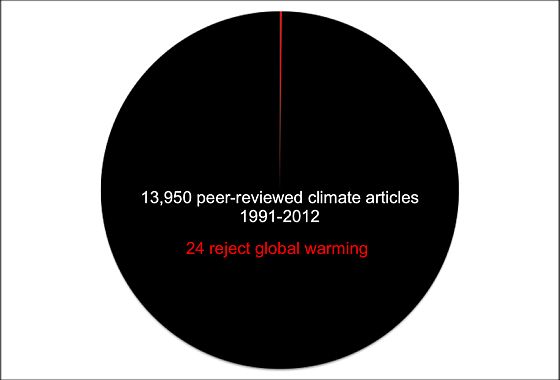
I searched the Web of Science for peer-reviewed scientific articles published between 1 January 1991 and 9 November 2012 that have the keyword phrases “global warming” or “global climate change.” The search produced 13,950 articles. See methodology.

I read whatever combination of titles, abstracts, and entire articles was necessary to identify articles that “reject” human-caused global warming. To be classified as rejecting, an article had to clearly and explicitly state that the theory of global warming is false or, as happened in a few cases, that some other process better explains the observed warming. Articles that merely claimed to have found some discrepancy, some minor flaw, some reason for doubt, I did not classify as rejecting global warming. Articles about methods, paleoclimatology, mitigation, adaptation, and effects at least implicitly accept human-caused global warming and were usually obvious from the title alone. John Cook and Dana Nuccitelli also reviewed and assigned some of these articles; John provided invaluable technical expertise.

This work follows that of Oreskes (Science, 2005) who searched for articles published between 1993 and 2003 with the keyword phrase “global climate change.” She found 928, read the abstracts of each and classified them. None rejected human-caused global warming. Using her criteria and time-span, I get the same result. Deniers attacked Oreskes and her findings, but they have held up.

Some articles on global warming may use other keywords, for example, “climate change” without the “global” prefix. But there is no reason to think that the proportion rejecting global warming would be any higher.

By my definition, 24 of the 13,950 articles, 0.17% or 1 in 581, clearly reject global warming or endorse a cause other than CO2 emissions for observed warming. [Continue reading…]

Facebooktwittermail

U.S. intelligence community warns of rising climate security threat

The Guardian reports: Climate change has the potential to stoke regional instabilities and fuel international tensions, according to a major new report from the US National Intelligence Council.

Released yesterday, the Global Trends 2030 report seeks to map out the security trends that will shape international relations over the next two decades. It is the latest in a series of studies from national security bodies around the world to acknowledge that climate change and its likely impacts on food, water, and natural resource supplies represents an emerging security threat.

“Demand for food, water, and energy will grow by approximately 35, 40 and 50 per cent respectively, owing to an increase in the global population and the consumption patterns of an expanding middle class,” the report states. “Climate change will worsen the outlook for the availability of these critical resources.”

The report argues that scarcities can be avoided, but only if co-ordinated steps are taken to improve productivity and efficiency across a raft of industries and economies.

“We are not necessarily headed into a world of scarcities, but policymakers and their private sector partners will need to be proactive to avoid such a future,” the report states. “Many countries probably won’t have the wherewithal to avoid food and water shortages without massive help from outside.”

It also acknowledges that a series of technology breakthroughs will be needed to address climate-related risks. “Key technologies likely to be at the forefront of maintaining [energy, food and water] resources in the next 15-20 years will include genetically modified crops, precision agriculture, water irrigation techniques, solar energy, advanced bio-based fuels, and enhanced oil and natural gas extraction via fracturing,” the report argues.

“Given the vulnerabilities of developing economies to key resource supplies and prices and the early impacts of climate change, key developing countries may realise substantial rewards in commercialising many next-generation resource technologies first.”

So, in order to mitigate the effects of the environmental damage caused by the excessive use of fossil fuels, the “intelligence” community recommends expanding the use of environmentally destructive fracking, increased toxification of agricultural land through the use of GMOs and in the process there will be profits to be made. Something’s wrong with this picture.

Facebooktwittermail

Video: Carving up the Arctic

AJ’s The Stream frames the question: Will the melting of the Arctic sea ice bring about a change in the geopolitical landscape?

This seems like the wrong question to be asking. When global warming caused by the use of fossil fuels is what is opening up this ‘bonanza’ of new fossil fuel reserves, it’s a bit like a man with lung cancer discovering a wonderful new source of cheap cigarettes.

Facebooktwittermail

Area of Arctic ice bigger than the United States melted this year

The Associated Press reports: An area of Arctic sea ice bigger than the United States melted this year, according the U.N. weather agency, which said the dramatic decline illustrates that climate change is happening “before our eyes.”

In a report released at U.N. climate talks in the Qatari capital of Doha, the World Meteorological Organization said the Arctic ice melt was one of a myriad of extreme and record-breaking weather events to hit the planet in 2012. Droughts devastated nearly two-thirds of the United States as well western Russia and southern Europe. Floods swamped west Africa and heat waves left much of the Northern Hemisphere sweltering.

But it was the ice melt that seemed to dominate the annual climate report, with the U.N. concluding ice cover had reached “a new record low” in the area around the North Pole and that the loss from March to September was a staggering 11.83 million square kilometers (4.57 million square miles) — an area bigger than the United States.

Facebooktwittermail

Rising seas, vanishing coastlines

Benjamin Strauss and Robert Kopp write: The oceans have risen and fallen throughout Earth’s history, following the planet’s natural temperature cycles. Twenty thousand years ago, what is now New York City was at the edge of a giant ice sheet, and the sea was roughly 400 feet lower. But as the last ice age thawed, the sea rose to where it is today.

Now we are in a new warming phase, and the oceans are rising again after thousands of years of stability. As scientists who study sea level change and storm surge, we fear that Hurricane Sandy gave only a modest preview of the dangers to come, as we continue to power our global economy by burning fuels that pollute the air with heat-trapping gases.

This past summer, a disconcerting new scientific study by the climate scientist Michiel Schaeffer and colleagues — published in the journal Nature Climate Change — suggested that no matter how quickly we cut this pollution, we are unlikely to keep the seas from climbing less than five feet.

More than six million Americans live on land less than five feet above the local high tide. (Searchable maps and analyses are available at SurgingSeas.org for every low-lying coastal community in the contiguous United States.) Worse, rising seas raise the launching pad for storm surge, the thick wall of water that the wind can drive ahead of a storm. In a world with oceans that are five feet higher, our calculations show that New York City would average one flood as high as Hurricane Sandy’s about every 15 years, even without accounting for the stronger storms and bigger surges that are likely to result from warming. [Continue reading…]

Facebooktwittermail

Obama’s ‘tough’ approach to climate change

In his press conference yesterday, when President Obama talked about tackling climate change he said it would involve making some “tough political choices.” He didn’t say what those would be. Indeed, the agenda he’s apparently willing to support has to be one that reverses climate change while boosting American prosperity (as defined by economic growth). We can save the planet and get rich in the process. In other words, Obama wants to tackle climate change but only if he can do so without making any tough political choices.

Mat McDermott responded to Obama’s comments:

Good on the President for repeatedly asserting the scientifically correct fact that the planet is indeed warming and that human activity is causing it—although it’s a bit sad that this is the state of discussion regarding climate in the United States that simply admitting the issue exists deserves kudos.

And good on the President for increasing fuel efficiency standards. Indeed it’s one his genuine environmental victories of his first term in office.

But it all goes downhill from there, quickly.

The President makes a huge rhetorical mistake in repeating and therefore reinforcing the erroneous notion that combatting climate change will cost jobs.

He also makes the intellectual mistake of continuing the fetishization of the universal good of economic growth, when the evidence is solidly on the side of, using renowned ecological economist Herman Daly’s words, future expansion of the scale of the economy is actual uneconomic growth—in other words, it actually does more harm than good. More economic growth, if defined as increased consumption of natural resources, is itself the problem of the century, of which climate change is but a subset, albeit perhaps the most dramatic one.

Facebooktwittermail

The health of the planet must come first

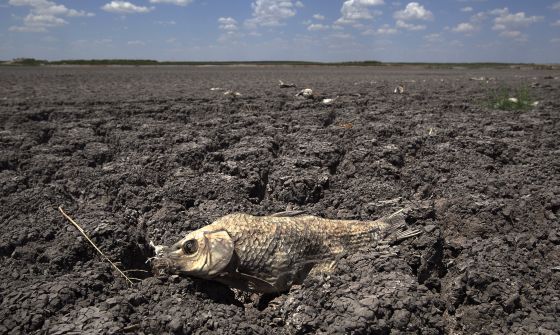
The remains of a carp in a dried out lake bed in San Angelo, Texas, August, 2011.

David Remnick writes: Barack Obama can take pride in having fought off a formidable array of deep-pocketed revanchists. As President, however, he is faced with an infinitely larger challenge, one that went unmentioned in the debates but that poses a graver threat than any “fiscal cliff.” Ever since 1988, when NASA’s James Hansen, a leading climate scientist, testified before the Senate, the public has been exposed to the issue of global warming. More recently, the consequences have come into painfully sharp focus. In 2010, the Pentagon declared, in its Quadrennial Defense Review, that changes in the global climate are increasing the frequency and the intensity of cyclones, droughts, floods, and other radical weather events, and that the effects may destabilize governments; spark mass migrations, famine, and pandemics; and prompt military conflict in particularly vulnerable areas of the world, including the Middle East, Southeast Asia, and sub-Saharan Africa. The Pentagon, that bastion of woolly radicals, did what the many denialists in the House of Representatives refuse to do: accept the basic science.

The economic impact of weather events that are almost certainly related to the warming of the earth—the European heat wave of 2003 (which left fifty thousand people dead), the Russian heat waves and forest fires of 2010, the droughts last year in Texas and Oklahoma, and the preëlection natural catastrophe known as Sandy—has been immense. The German insurer Munich Re estimates that the cost of weather-related calamities in North America over the past three decades amounts to thirty-four billion dollars a year. Governor Andrew Cuomo, of New York, has said that Sandy will cost his state alone thirty-three billion. Harder to measure is the human toll around the world—the lives and communities disrupted and destroyed.

“If we are willing to work for it, and fight for it, and believe in it,” Obama said, when he clinched the Democratic nomination in 2008, future generations will look back and say, “This was the moment when the rise of the oceans began to slow and our planet began to heal.” Those generations assuredly will not. Although Obama, unlike his predecessor, recognized the dimensions of the problem, he never pursued measures remotely equal to it. To his credit, his Administration has directed ninety billion dollars to investments in clean energy, and has secured several billion for energy-conservation upgrades; he got Detroit to agree to better gas-mileage standards, and finally introduced CO2 emission standards for commercial trucks and buses. For the most part, though, the accumulating crisis of climate change has been treated as a third-tier issue.

Last week, in his acceptance speech, Obama mentioned climate change once again. Which is good, but, at this late date, he gets no points for mentioning. The real test of his determination will be a willingness to step outside the day-to-day tumult of Washington politics and establish a sustained sense of urgency. There will always be real and consuming issues to draw his and the political class’s attention: a marital scandal at the C.I.A., a fiscal battle, an immigration bill, an international crisis. But, all the while, a greater menace grows ever more formidable. [Continue reading…]

Facebooktwittermail

Climate change: Lessons from Ronald Reagan

Cass R. Sunstein writes: The re-election of President Obama, preceded by the extraordinary damage done by Hurricane Sandy, raises a critical question: In the coming years, might it be possible for the United States to take significant steps to reduce the risks associated with climate change?

A crucial decision during Ronald Reagan’s second term suggests that the answer may well be yes. The Reagan administration was generally skeptical about costly environmental rules, but with respect to protection of the ozone layer, Reagan was an environmentalist hero. Under his leadership, the United States became the prime mover behind the Montreal Protocol, which required the phasing out of ozone-depleting chemicals.

There is a real irony here. Republicans and conservatives had ridiculed scientists who expressed concern about the destruction of the ozone layer. How did Ronald Reagan, of all people, come to favor aggressive regulatory steps and lead the world toward a strong and historic international agreement?

A large part of the answer lies in a tool disliked by many progressives but embraced by Reagan (and Mr. Obama): cost-benefit analysis. Reagan’s economists found that the costs of phasing out ozone-depleting chemicals were a lot lower than the costs of not doing so — largely measured in terms of avoiding cancers that would otherwise occur. Presented with that analysis, Reagan decided that the issue was pretty clear. [Continue reading…]

Facebooktwittermail

Climate change report outlines perils for U.S. military

The New York Times reports: Climate change is accelerating, and it will place unparalleled strains on American military and intelligence agencies in coming years by causing ever more disruptive events around the globe, the nation’s top scientific research group said in a report issued Friday.

The group, the National Research Council, says in a study commissioned by the C.I.A. and other intelligence agencies that clusters of apparently unrelated events exacerbated by a warming climate will create more frequent but unpredictable crises in water supplies, food markets, energy supply chains and public health systems.

Hurricane Sandy provided a foretaste of what can be expected more often in the near future, the report’s lead author, John D. Steinbruner, said in an interview.

“This is the sort of thing we were talking about,” said Mr. Steinbruner, a longtime authority on national security. “You can debate the specific contribution of global warming to that storm. But we’re saying climate extremes are going to be more frequent, and this was an example of what they could mean. We’re also saying it could get a whole lot worse than that.”

Mr. Steinbruner, the director of the Center for International and Security Studies at the University of Maryland, said that humans are pouring carbon dioxide and other climate-altering gases into the atmosphere at a rate never before seen. “We know there will have to be major climatic adjustments — there’s no uncertainty about that — but we just don’t know the details,” he said. “We do know they will be big.”

The study was released 10 days late: its authors had been scheduled to brief intelligence officials on their findings the day Hurricane Sandy hit the East Coast, but the federal government was shut down because of the storm. [Continue reading…]

Facebooktwittermail

America’s new mandate on climate change

Richard Schiffman writes: For Americans concerned about the environment, disaster was avoided on Tuesday. President Obama – with his somewhat lackluster record, if decidedly more exalted rhetoric, on global warming – defeated the Republican challenger who had vowed to gut federal emissions standards, and kill loan programs and tax breaks for green energy companies.

But activists say that it would be wrong to read the election as a stamp of approval for four more years of business as usual. They argue that voters have sent a clear signal that they want more aggressive action on the environment during the president’s second term.

The League of Conservation Voters (LCV) cites the defeat of three members of their “Flat Earth Five” – Anne Marie Buerlke (Republican, New York), Francisco Canseco (Repub;lican, Texas) and Joe Walsh (Republican, Illinois) – Republican representatives who were outspoken for their anti-science stance on climate change. (One race remains too close to call.) And ten of the League’s “dirty dozen” candidates – targeted for “consistently voting against clean energy and conservation” – lost their election bids.

Meanwhile, 11 out of 12 of the office-seekers dubbed “climate heroes” by a coalition led by environmental activist Bill McKibben, prevailed in Tuesday’s vote. The 12th “hero”, Jay Inslee, a gubernatorial candidate in Washington state who wants to jump-start the state’s lagging economy by transforming it into a national green-tech hub, continues to hold a small lead over Republican Rob McKenna and looks poised to win that race.

The election results overturn the conventional wisdom that voters don’t care about green issues, according to LCV’s spokesperson Jeff Gohringer:

“We went into this election cycle and the notion was that environmental champions were going to be wiped off the map. We did $3m-worth of advertising on climate change in places like Texas, and we won.”

This sentiment was echoed by Frances Beinecke, the president of the Natural Resources Defense Council who wrote to her members on Wednesday that:

“By rejecting Big Oil’s candidates, voters sent a message loud and clear that they want more clean energy, less climate denial and an end to the $4bn in taxpayer subsidies for fossil fuels.”

Some environmentalists have characterized Obama’s very re-election as a mandate for strong action on climate change. This is a hard argument to make given that the topic scarcely came up during the presidential race. [Continue reading…]

Facebooktwittermail

Obama and Romney remain silent on climate change, the biggest issue of all

George Monbiot writes: Here’s a remarkable thing. Neither Mitt Romney nor Barack Obama – with the exception of one throwaway line each – have mentioned climate change in the wake of hurricane Sandy.

They are struck dumb. During a Romney rally in Virginia on Thursday, a protester held up a banner and shouted “What about climate? That’s what caused this monster storm”. The candidate stood grinning and nodding as the crowd drowned out the heckler by chanting “USA! USA!”. Romney paused, then resumed his speech as if nothing had happened. The poster the man held up? It said “End climate silence”.

While other Democrats expound the urgent need to act, the man they support will not take up the call. Barack Obama, responding to his endorsement by the mayor of New York, mentioned climate change last week as “a threat to our children’s future”. Otherwise, I have been able to find nothing; nor have the many people I have asked on Twitter. Something has gone horribly wrong.

There are several ways in which the impact of hurricane Sandy is likely to have been exacerbated by climate breakdown. Warmer oceans make hurricanes more likely and more severe. A warmer atmosphere holds more moisture, increasing the maximum rainfall. Higher sea levels aggravate storm surges. Sandy might not have hit the United States at all, had it not been for a blocking ridge of high pressure over Greenland, which diverted the storm westwards. The blocking high – rare there at this time of year – could be the result of the record ice melt in the Arctic this autumn.

This might sound like the wisdom of hindsight. But in February the journal Nature Climate Change published an article warning that global warming is likely to “increase the surge risk for New York City”. As storms intensify and the sea level rises, it predicted that storm surges previously described as 100-year events would become between five and 30 times as frequent.

Four years ago, Obama pledged that “my presidency will mark a new chapter in America’s leadership on climate change”. He promised a federal cap and trade system and “strong annual targets” to reduce carbon pollution. But he ran into a ridge of high pressure. His cap and trade bill was killed in the Senate in 2010.

At a meeting in the White House in 2009, his strategists decided that climate change was a banned topic: it caused too much trouble. From then onwards, Obama would talk about clean energy and green jobs and improvements in fuel economy, but would seldom explain why these shifts were necessary. The problem with this approach is that you cannot engineer a sustained reduction of greenhouse gas emissions only by getting into clean energy: you also have to get out of dirty energy. And that requires statesmanship: active and persuasive engagement with the public. [Continue reading…]

As a second-term president there’s some chance that Obama could rise to that challenge. The chances of Romney taking up the issue are I would say precisely zero.

Facebooktwittermail

World on track for 6 degrees Celsius warming without carbon cuts, study shows

The Guardian reports: The slow rate of emissions cuts in major economies has put the world on track for “at least six degrees of warming” by the end of the century, analysts will warn today.

New research by consultancy giant PwC finds an unprecedented 5.1 per cent annual cut in global emissions per unit of GDP, known as carbon intensity, is needed through to 2050 if the world is to avoid the worst effects of climate change and meet an internationally agreed target of limiting average temperature increases to just two degrees above pre-industrial levels.

Such deep reductions in carbon intensity would be over six times greater than the 0.8 per cent average annual cuts achieved since 2000.

The report also confirms that greatest rises in greenhouse gas emissions came from the emerging E7 economies of China, India, Brazil, Mexico, Russia, Indonesia and Turkey, whose cumulative 7.4 per cent annual increase in emissions swamped record levels of reductions in the UK, France, and Germany.

PwC warns sustained economic growth in these countries could “lock in” high carbon assets that will make it significantly harder for them to decarbonise over the coming decades, a point likely to be raised at the UN-backed Doha Climate Summit when it kicks off later this month.

Facebooktwittermail

Why sea level is rising faster than predicted

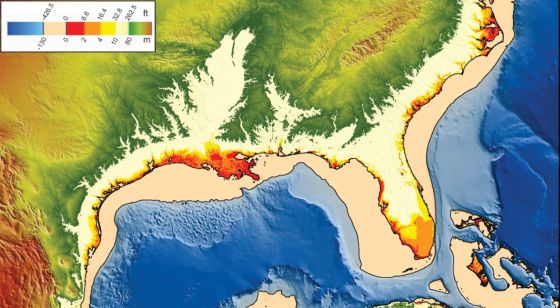
Map showing the impact on the South East U.S. coastline from changing sea levels.

Deborah Byrd writes: The 2007 IPCC report projected a global sea level rise between 0.2 and 0.5 meters by the year 2100. But current measurements of sea level rise suggest Earth’s seas are rising at the maximum rate proposed by the IPCC – or faster. These measurements suggest a rise of one meter or more by the end of the century. That’s according to University of Colorado geologist Bill Hay, who presented his results yesterday (November 4, 2012) at a meeting of The Geological Society of America. Hay said:

Modern climate models … do not include the many feedbacks we are just discovering.

For example, he said, Arctic sea ice and Greenland ice cap melting, and groundwater mining, all lead to feedbacks not included in climate models predicting sea level rise.

Arctic sea ice – which is already in the ocean – does not in itself raise sea level. But this melting plays a role in the overall warming of the Arctic, which leads to ice losses in nearby Greenland and northern Canada. In other words, when sea ice melts, it releases fresh water from the Arctic, which is then replaced by saltier, warmer water from the south. That warmer water pushes the Arctic toward more ice-free waters, which absorb sunlight rather than reflect it back into space like sea ice does. The more open water there is, the more heat is trapped in the Arctic waters, and the warmer things can get. So, according to Hay, melting Arctic sea ice is “a big heat pump that brings heat to the Arctic.” That feedback is not typically in climate models predicting sea level rise. [Continue reading…]

Facebooktwittermail

Republicans more likely to believe in demon possession than climate change

Huffington Post reports: A new poll reveals the majority of registered Republican voters believe that demonic possession is a real phenomenon.

The “Halloween-centric” poll, conducted by Public Policy Polling showed that 68 percent of Republican voters think it’s possible to be possessed by demons.

Meanwhile, as news website AlterNet notes, only 48 percent of Republicans polled in an earlier survey conducted by the Pew Research Center survey said they believe in climate change.

As the election looms ever closer, the topic of climate change and global warming has been in the air — with some experts and politicians calling the recent devastation caused by Hurricane Sandy a reality check.

However, while 88 percent of Obama supporters believe that there is “solid evidence that the earth is warming,” only 42 percent of Romney supporters said that this is true, according to the Pew survey.

But before Democrats get too smug about being less inclined to superstition, it turns out that 49 percent of Democrats believe it’s possible to be possessed by a demon and overall, only 35 percent of registered voters think demon possession is impossible.

Facebooktwittermail