Overheated: The Human Cost of Climate Change — a review: The dedication of Andrew Guzman’s book makes obvious what he hopes to convey in the couple of hundred pages to follow. “To Nicholas and Daniel,” he writes, referring to his sons, “Whose Generation Will Face The Consequences.”
Many authors have written about how global warming will damage some of the world’s most treasured landscapes and beloved species. This book aims to lay out exactly how bad it will be for human beings. Guzman, a law professor and associate dean at the University of California at Berkeley, is neither a scientist nor a trained environmental activist; he is an academic well-versed in international treaties and legal niceties. This background gives him an interesting perspective on the shifts that are sure to come as climate change rearranges the world’s traditional social and economic order and as different factions jockey for advantage.
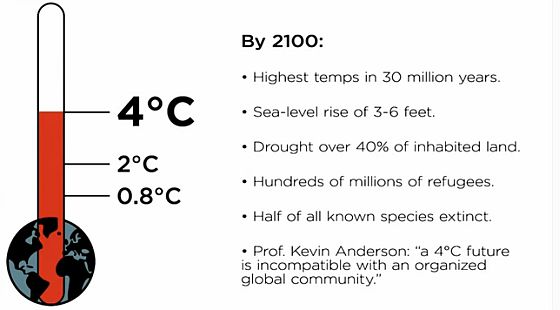
The wisest choice Guzman has made in outlining this scenario concerns the warming estimate on which he bases his projections: an increase of 2 degrees Celsius, or 3.6 degrees Fahrenheit, above pre-industrial levels by 2100. This is the threshold political leaders have pledged to keep within to have a chance of averting dangerous consequences, but every indication is that the world will warm much more by the end of the century. By adopting what Guzman himself calls “a conservative prediction,” he bolsters his case for action. After all, if things fall apart under a 2-degree scenario, how much worse would it be if the rise reached 4 degrees, which is what might very well happen given the current rate of global carbon emissions?
His answer is harsh: Plenty of disasters will unfold. The book ticks off the obvious losers in a world of rising seas, hotter temperatures and less predictable precipitation patterns: tiny Pacific island nations such as the Maldives, but also larger jurisdictions, including Bangladesh and, closer to home, California, where more than half of the state’s water supply could be disrupted if the levees in its delta region fail as a result of such effects as rising sea levels and more intense storms. Water scarcity in many regions, including the Middle East and Africa, could not only harm individuals but destabilize nations. [Continue reading…]
Ryan Lizza writes: The budget released this week by the White House is by far Obama’s most ambitious statement of his legislative priorities since 2009, when, as a newly elected President, he produced a plan brimming over with initiatives like Obamacare, education reform, new spending to aid the depressed economy, and a cap-and-trade régime to curb carbon pollution. Obama’s 2009 budget presaged two years in office that were so legislatively far-reaching that, in Washington policy circles, the document was sometimes called the Big Bang.
This new budget approaches the ambitions of 2009 — with one glaring omission. There are sections aimed at consolidating Obama’s first-term successes: the mundane but crucial details of implementing health-care and Wall Street reforms. He asks Congress to reform immigration, pass gun-control measures, overhaul the tax code, make pre-school universal, boost American manufacturing, and cut defense spending—an aggressive second-term agenda. And in the section of the two-hundred-and-forty-four-page document that has received the most attention, he details his offer — or rather, re-offer — to Republicans of a long-term deficit-reduction deal: cuts to Social Security and Medicare in return for more revenue. Like the 2009 document, the new budget is more or less the prose version of Obama’s campaign poetry.
But the second Big Bang also represents a major dodge on climate change. Over the last two years, Obama has consistently talked about his second term as the time when he would forcefully confront the challenges of a warming planet. As I reported last year, in private conversations he has told people that dealing with climate change is one of the few ways that he believes he could fundamentally improve the world decades after he’s gone from office.
In his three most important speeches of the last year, he promised to confront this threat. In his convention speech in Charlotte, North Carolina, last September, he vowed, “my plan will continue to reduce the carbon pollution that is heating our planet, because climate change is not a hoax. More droughts and floods and wildfires are not a joke. They are a threat to our children’s future.”
More powerfully, in his Inaugural Address, on January 21st, he said:
We, the people, still believe that our obligations as Americans are not just to ourselves, but to all posterity. We will respond to the threat of climate change, knowing that the failure to do so would betray our children and future generations. Some may still deny the overwhelming judgment of science, but none can avoid the devastating impact of raging fires and crippling drought and more powerful storms.
And in his State of the Union address, on February 12th, he seemed to go beyond the vagueness of his campaign rhetoric and promise action. He pointed out that the last fifteen years have included twelve of the hottest years ever recorded, and he noted that “heat waves, droughts, wildfires, floods all are now more frequent and more intense.” He promised he would “act before it’s too late.”
Indeed, he called on Congress to enact a comprehensive plan. The phrase “cap and trade” has become politically poisonous since the death of Obama’s own legislation, in 2010, but there was no mistaking what he meant. Obama demanded a “bipartisan, market-based solution to climate change, like the one John McCain and Joe Lieberman worked on together a few years ago.”
But the budget released this week makes it clear that Obama’s surprising appeal to Congress was an empty piece of rhetoric. [Continue reading…]
Scientific American: Why did James Hansen retire on April 2 after 32 years as director of NASA’s Goddard Institute for Space Studies? As he told the enterprising students of Columbia University’s Sustainability Media Lab who captured him in the following video, “I want to devote full time to trying to help the public understand the urgency of addressing climate change.”
It’s not exactly the “spend more time with my family” excuse often give by retiring government officials, but his family is nonetheless the reason for this change. He’s worried about preventing “climate chaos” and instead preserving the relatively stable climate of the past 10,000 years—when human civilization developed and flourished—for his five grandchildren.
That means full-time activism for the 72-year-old, and perhaps the risk of getting arrested at more coal-mine or tar-sand protests.
Thomas Homer-Dixon writes: If President Obama blocks the Keystone XL pipeline once and for all, he’ll do Canada a favor.
Canada’s tar sands formations, landlocked in northern Alberta, are a giant reserve of carbon-saturated energy — a mixture of sand, clay and a viscous low-grade petroleum called bitumen. Pipelines are the best way to get this resource to market, but existing pipelines to the United States are almost full. So tar sands companies, and the Alberta and Canadian governments, are desperately searching for export routes via new pipelines.
Canadians don’t universally support construction of the pipeline. A poll by Nanos Research in February 2012 found that nearly 42 percent of Canadians were opposed. Many of us, in fact, want to see the tar sands industry wound down and eventually stopped, even though it pumps tens of billions of dollars annually into our economy.
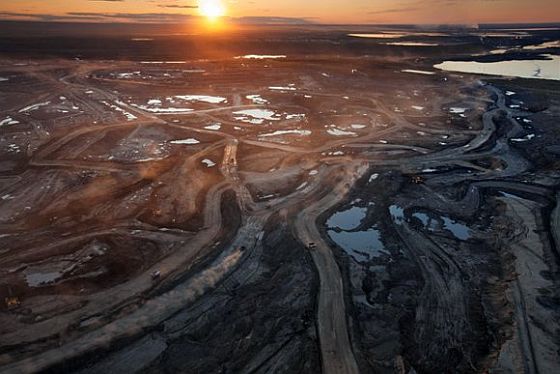
The most obvious reason is that tar sands production is one of the world’s most environmentally damaging activities. It wrecks vast areas of boreal forest through surface mining and subsurface production. It sucks up huge quantities of water from local rivers, turns it into toxic waste and dumps the contaminated water into tailing ponds that now cover nearly 70 square miles.
Also, bitumen is junk energy. A joule, or unit of energy, invested in extracting and processing bitumen returns only four to six joules in the form of crude oil. In contrast, conventional oil production in North America returns about 15 joules. Because almost all of the input energy in tar sands production comes from fossil fuels, the process generates significantly more carbon dioxide than conventional oil production.
There is a less obvious but no less important reason many Canadians want the industry stopped: it is relentlessly twisting our society into something we don’t like. Canada is beginning to exhibit the economic and political characteristics of a petro-state. [Continue reading…]
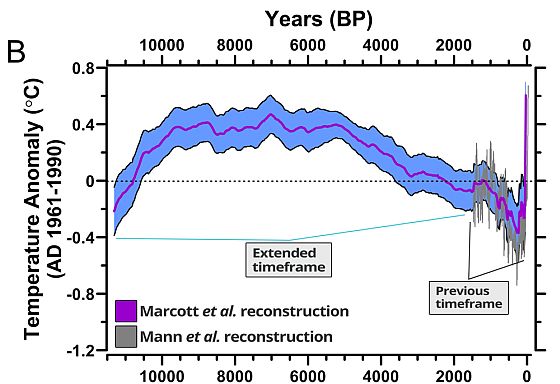
Christian Science Monitor reports: Over the past century, global average temperatures appear to have risen faster than at any time since the end of the last ice age 11,300 years ago, and perhaps longer. Meanwhile, the magnitude of the increase has been unmatched in at least the past 4,000 years.
Researchers say those are the implications of a new study that uses natural stand-ins for thermometers to trace temperature trends back to the beginning of the current warm, interglacial period. Significantly, the study’s findings suggest the current warming trend cannot be explained by some forms of naturally occurring temperature variability, a lingering issue in the debate over the impact of human activity on global warming.
The main trigger for the current warming trend, especially since the middle of the last century, has been rising emissions of heat-trapping carbon dioxide as people burn fossil fuels and change land-use patterns, researchers say.
Although other so-called paleoclimate records reach farther back into geological time, the team focused on the Holocene epoch, in which human civilizations emerged and evolved.
“To our knowledge, based on this reconstruction, the rate of change today is unprecedented” in the Holocene, says Shaun Marcott, an atmospheric scientist at Oregon State University who led a team formally reporting the results in Friday’s issue of the journal Science. Indeed, it may be unprecedented in the past 22,000 years, he adds, when previous paleoclimate research he and his colleagues have conducted is taken into account.
Bill McKibben writes: The list of reasons for not acting on climate change is long and ever-shifting. First it was “there’s no problem”; then it was “the problem’s so large there’s no hope.” There’s “China burns stuff too,” and “it would hurt the economy,” and, of course, “it would hurt the economy.” The excuses are getting tired, though. Post Sandy (which hurt the economy to the tune of $100 billion) and the drought ($150 billion), 74 percent of Americans have decided they’re very concerned about climate change and want something to happen.
But still, there’s one reason that never goes away, one evergreen excuse not to act: “you’re a hypocrite.” I’ve heard it ten thousand times myself—how can you complain about climate change and drive a car/have a house/turn on a light/raise a child? This past fall, as I headed across the country on a bus tour to push for divestment from fossil fuels, local newspapers covered each stop. I could predict, with great confidence, what the first online comment from a reader following each account would be: “Do these morons not know that their bus takes gasoline?” In fact, our bus took biodiesel—as we headed down the East Coast, one job was watching the web app that showed the nearest station pumping the good stuff. But it didn’t matter, because the next comment would be: “Don’t these morons know that the plastic fittings on their bus, and the tires, and the seats are all made from fossil fuels?”
Actually, I do know—even a moron like me. I’m fully aware that we’re embedded in the world that fossil fuel has made, that from the moment I wake up, almost every action I take somehow burns coal and gas and oil. I’ve done my best, at my house, to curtail it: we’ve got solar electricity, and solar hot water, and my new car runs on electricity—I can plug it into the roof and thus into the sun. But I try not to confuse myself into thinking that’s helping all that much: it took energy to make the car, and to make everything else that streams into my life. I’m still using far more than any responsible share of the world’s vital stuff.
And, in a sense, that’s the point. If those of us who are trying really hard are still fully enmeshed in the fossil fuel system, it makes it even clearer that what needs to change are not individuals but precisely that system. We simply can’t move fast enough, one by one, to make any real difference in how the atmosphere comes out. [Continue reading…]
Climate change has resulted from unplanned geoengineering — for most of the last two centuries, we have been pumping vast quantities of greenhouse gases into the atmosphere without pausing to consider the results. So geoengineering that would involve seeding the upper atmosphere with solar-reflecting sulfate aerosols might look like a technological fix for a technological problem.
Climate change, however, is not just a technical problem. It is a planetary crisis with a human cause. While the direct cause is human behavior, this behavior has psychological and philosophical roots. It is the expression of a worldview in which humanity has set itself apart from nature. It is the expression of a value system that respects the accumulation of wealth more than the cultivation of wisdom. It is the expression of lifestyles in which people have become increasingly dependent upon objects rather than themselves and each other.
“Solar radiation management” (SRM) far from offering a solution to climate change, seems much more like another expression of the mindset that brought us to this perilous juncture.
MIT Technology Review: Critics of SRM — and even its advocates — note that the technology has numerous limitations, and that no one is entirely sure what the consequences would be. Sulfate aerosols reflect sunlight in the upper atmosphere, thus directly cooling the planet. But greenhouse gases operate very differently, trapping long-wave infrared radiation escaping from Earth’s surface and thus warming it. While sulfates would be likely to offset warming, it’s not clear exactly how they would counteract some of the other effects of greenhouse gases, particularly changes in precipitation patterns. And SRM would do nothing to reduce the acidification of the oceans caused by rising levels of carbon dioxide in the atmosphere.
“The term ‘solar radiation management’ is positively Orwellian,” says Raymond Pierrehumbert, a geophysicist at the University of Chicago. “It’s meant to give you a feeling that we really understand what we would be doing. It’s a way to increase comfort levels with this crazy idea. What we’re really talking about is hacking the planet in a case where we don’t really know what it is going to do.” In delivering the prestigious Tyndall Lecture at the annual American Geophysical Union meeting last December, he said the idea of putting sulfate aerosols in the stratosphere was “barking mad.”
Pierrehumbert also rejects the value of doing field experiments. “The whole idea of geoengineering is so crazy and would lead to such bad consequences, it really is pretty pointless. We already know enough about sulfate albedo engineering to know it would put the world in a really precarious state. Field experiments are really a dangerous step on the way to deployment, and I have a lot of doubts what would actually be learned.”
The fundamental problem with albedo engineering, says Pierrehumbert, is that once we start using it, we’ll need to continue indefinitely. Since it only offsets warming, once the process stops, temperature changes caused by greenhouse gases will manifest themselves suddenly and dramatically. “If you stop — or if you have to stop — then you’re toast,” he says. Even using it as a temporary Band-Aid doesn’t make sense, he argues: “Once you get to the point in terms of climate changes that you feel you have to use it, then you have to use [SRM] forever.” He believes that this makes the idea a “complete nonstarter.”
Besides, Pierrehumbert says, our climate models “are nowhere near advanced enough for us to begin thinking of actually engineering the planet.” In particular, computer models don’t accurately predict specific regional precipitation patterns. And, he says, it’s not possible to use existing models to know how geoengineering might affect, say, India’s monsoons or precipitation in such drought-prone areas as northern Africa. “Our ability to actually say what the regional climate patterns will be in a geoengineered world is very limited,” he says.
Alan Robock, meanwhile, has a long list of questions concerning SRM, at the top of which is: can it even be done? Robock, an expert on how volcanoes affect climate and a professor of environmental sciences at Rutgers University, cautions that while the Pinatubo eruption confirmed the cooling effect of sulfate aerosols, it injected a massive amount of sulfur dioxide into the stratosphere over a few days. Solar geoengineering would use far less sulfur but disperse it continuously over an extended period. That could be a critical difference. The optimal way to achieve SRM is with sulfur particles only about half a micrometer in diameter. Sunlight reflects off the surface of the particles, and smaller particles have more surface area than larger ones, making them far more efficient at blocking the sun. Robock worries that as sulfur is continuously injected and concentrations build up, the small particles will clump together into large ones, necessitating far more sulfur than some current proposals assume.
These details of aerosol chemistry could help determine the viability of SRM. “David [Keith] thinks it is going to be easy and cheap, and I don’t agree,” says Robock. He estimates that several million tons of sulfur would have to be injected into the atmosphere annually to offset doubled levels of carbon dioxide, but if the particles clump together, “it could be many times that.”
Research so far shows that producing a cloud in the stratosphere — Robock’s preferred description of SRM — “could cool the climate,” he says. “But you would have a very different planet, and other things could be worse.” He points out, for example, that in the aftermath of Mount Pinatubo, rainfall decreased significantly in some parts of the world. Robock supports more modeling on solar geoengineering, but “right now, I don’t see a path in which it would be used,” he says. “I don’t see how the benefits outweigh the negatives.”
Mike Tidwell writes: In the past three weeks there’sbeenmuchdebatein U.S.environmentalcircles over a provocative new paper [PDF] from Harvard University political scientist Theda Skocpol. In it, Skocpol gives the most compelling analysis yet of why the 2009 cap-and-trade bill to fight global warming went down in flames. In sum, Skocpol argues that intense and radical opposition from Tea Party Republicans proved much stronger than the environmentalists’ insider-game, partner-with-business, harness-polls-instead-of-the-grassroots approach.
My added value in commenting here is that I experienced the run-up to — and aftermath of — the failed Waxman-Markey bill from the field. I’ve been a grassroots climate organizer for 10 years, having founded the organization I still direct: the Chesapeake Climate Action Network. CCAN straddles much of the political landscape of America, organizing in the conservative “South” (Virginia) and the liberal “Northeast” (Maryland), while staying very involved in national climate initiatives in Washington, D.C., the geographic center of our region.
I saw from the church-basement view the rise of Tea Party opposition to Waxman-Markey and the insufficient grassroots organizing response from the major green groups. What efforts were made (Sierra Club stands out as well as the short-lived but respectable field effort of the group 1Sky) fell mostly on deaf ears since average people couldn’t comprehend the complexity of the cap-and-trade bill and could see no immediate and direct benefit in their lives.
Climate Progress blogger Joe Romm has joined many environmental heads in assigning cap-and-trade’s failure in large part to Obama’s lack of leadership for the bill. Plus the economy had tanked. These two factors are important, I agree, but they don’t get to the real heart of the problem.
Skocpol, on the other hand, from my field-based perspective, nails both the key problems and the solutions we need for moving forward. She is absolutely correct to call for a completely different legislative approach for the next big push on climate in Washington. She is correct in arguing that round two should be based on the policy of “cap-and-dividend” instead of cap-and-trade. David Roberts at Grist and others have applauded Skocpol’s criticism of the cap-and-trade campaign. But they are skeptical of her view that the best alternative is a policy that caps carbon emissions through permit auctions and then rebates the money directly to all U.S. citizens with a monthly check — cap-and-dividend. [Continue reading…]
Our present course leads towards certain catastrophe.
Jeff Goodell writes: Among all the tests President Obama faced in his first term, his biggest failure was climate change. After promising in 2008 that his presidency would be “the moment when the rise of the oceans began to slow and our planet began to heal,” President Obama went silent on the most crucial issue of our time. He failed to talk openly with Americans about the risks of continuing to pump greenhouse gases into the atmosphere, failed to put political muscle behind legislation to cap carbon pollution, failed to meaningfully engage in international climate negotiations, failed to use the power of his office to end the fake “debate” about the reality of global warming and failed to prepare Americans – and the world – for life on a rapidly warming planet. It was as if the biggest challenge humanity has ever faced became a political inconvenience for the president once he was elected.
Now Obama gets another shot at it. “The politics of global warming are changing fast,” says Kevin Knobloch, the president of the Union of Concerned Scientists. Thanks to a year of extreme weather and Hurricane Sandy, a large majority of Americans – nearly 90 percent – favor action on global warming, even if there are economic costs. The U.S. economy is on the road to recovery and no longer offers an excuse for inaction. Big Coal, traditionally the loudest voice against climate action, has been weakened by a glut of cheap natural gas and the economic viability of solar and wind power. China has new political leadership that appears open to discussing a global agreement to cut carbon. And Obama himself has nothing left to lose. “The president has a big opportunity here,” says former Vice President Al Gore. “This is a moment when he can expand the ideas of what’s possible.”
Obama’s record on climate issues is not all bad. In his first term, Gore points out, the president made significant strides in promoting clean energy. “He accomplished more than any president before him,” says Gore. Obama’s biggest move was to dramatically boost fuel standards for cars and trucks, which will cut climate-warming pollution by 6 billion metric tons in the course of the program. Thanks in part to billions of dollars in federal stimulus, wind energy doubled in the last four years, while solar installations increased sixfold. By the end of the decade, in fact, America is on track to cut its carbon pollution by as much as 17 percent, meeting the long-term goal Obama pledged at the Copenhagen climate talks in 2009.
The trouble is, Obama’s accomplishments are small-bore when weighed against the immense scale of the climate crisis. 2012 was the hottest year on record in the continental U.S. The polar ice caps are melting faster than scientists predicted; wildfires torched the American West; extreme drought parched 60 percent of the country’s farms, jacking up food prices. Then came Hurricane Sandy, which devastated New York and New Jersey. “Climate change has gone from something that happens in a computer model to something that people can see in their own backyards,” says Frances Beinecke, president of the Natural Resources Defense Council. “It is a global crisis playing out before our very eyes. And it’s not happening in slow motion.”
Obama isn’t blind to the threat. “He understands this is the central problem his administration has to deal with in the second term,” says John Podesta, who headed up Obama’s transition team in 2008. “He knows the judgment of history is riding on this.” At a press conference shortly after his reelection, Obama admitted that “we hadn’t done as much as we need to” to address climate change, and promised a “wide-ranging conversation with scientists, engineers and elected officials” to make sure that global warming is “not a problem we’re passing on to future generations that’s going to be very expensive and very painful to deal with.”
But if the president is planning any bold action during his second term to combat global warming, there’s little evidence of it. “I want to do something on climate,” he told a friend and former White House staffer after the election, “but I don’t know what.” Before his 2008 inauguration, Obama solicited ideas for combating climate change from top environmentalists and energy executives. This time around, there have been no such meetings, and the president has not telegraphed any ideas on climate change to Congress. “If he has a larger strategy on this, I haven’t seen it,” says the chief of staff to a leading Democratic senator. One Democratic donor and climate activist who visited the White House in December was told point-blank by Heather Zichal, the White House adviser on energy and climate, that the president has no plans to propose any climate legislation to Congress, knowing that House Republicans would shoot it down.
“I think the president understands the climate crisis intellectually, but he has not had the ‘holy shit’ moment you arrive at when you think about this deeply enough,” says a leading climate advocate who has had private conversations with Obama about global warming. Instead of talking about the risks of climate change during the campaign, Obama touted an “all of the above” energy plan that was a soft-porn version of “drill, baby, drill.” Under Obama, in fact, oil and gas production have soared: Last year, U.S. oil production grew by 766,000 barrels a day, the largest jump ever, and domestic oil production is at its highest level in 15 years. [Continue reading…]
NASA’s analysis of Earth’s surface temperature found that 2012 ranked as the ninth-warmest year since 1880. NASA scientists at the Goddard Institute for Space Studies (GISS) compare the average global temperature each year to the average from 1951 to 1980. This 30-year period provides a baseline from which to measure the warming Earth has experienced due to increasing atmospheric levels of heat-trapping greenhouse gases. While 2012 was the ninth-warmest year on record, all 10 of the warmest years in the GISS analysis have occurred since 1998, continuing a trend of temperatures well above the mid-20th century average. The record dates back to 1880 because that is when there were enough meteorological stations around the world to provide global temperature data.
Diana Donlon writes: This past year treated us to a climate change preview in spades: crazy heat waves, prolonged drought, and epic storms like Sandy. To help us stabilize the climate, before we reach the point of no return, we must tap the immense potential of our food system.
Since becoming an agrarian society, we’ve known that growing food successfully depends on climate stability. Not enough water, crops wither and die. Too much, they rot. Beyond this, we know that crops have specific climatic requirements. Wheat, for instance, grows best in a dry, mild climate. Stone fruits like cherries need a minimum number of “chill hours” in order to blossom and later fruit. Intense heat disrupts pollination and can even shut down photosynthesis. These are basic parameters. If we continue to disregard them, food will become more scarce over time and we will go hungry. Indeed, as the National Climate Assessment, the government’s 1,146-page report released earlier this week states: “The rising incidence of weather extremes will have increasingly negative impacts on crop and livestock productivity because critical thresholds are already being exceeded.”
Agriculture, positioned as it is at the intersection of food and climate, presents a unique fulcrum. Pushed in the direction of industrial agriculture, it contributes egregiously to our climate problem: As activist Bill McKibben has noted, industrial agriculture — predominant in the U.S. — “essentially insures that your food is marinated in crude oil before you eat it.” This is because at every step, from the production of fertilizers and pesticides to the harvesting, processing, packaging, and transporting of materials, the industrial food system depends on climate-changing fossil fuels. Indeed, in a new report on climate change and food systems, the agriculture research organization CGIAR concluded that our global food system is responsible for nearly a third of all greenhouse gas emissions.
But we can tip the scale in the other direction toward sustainable agriculture, working in concert with natural systems instead of depleting them. This side of the scale presents an elegant, under-recognized opportunity to stabilize the climate. Not only do agro-ecological, organic and other sustainable farming methods emit significantly less greenhouse gas (GHG) overall, they can also sequester or store excess carbon. Given our long list of existing environmental worries — erosion, polluted watersheds, dead zones in the Gulf of Mexico — strengthening our top soil is a lot smarter than loading it up with nitrogen and washing it down the Mississippi. [Continue reading…]
Bloomberg reports: As a senator, John Kerry fought for sweeping climate change legislation, called human-induced warming among the top challenges facing the U.S., and pushed for an international accord to cut carbon dioxide emissions.
That track record has emboldened critics of TransCanada Corp’s Keystone XL pipeline who want him to scuttle the remaining $5.3 billion portion of the project if he’s confirmed as secretary of State. Appearing yesterday at a hearing on his nomination before the Senate committee he chairs, Kerry was non- committal on the Canada-U.S. pipeline, though called himself a “passionate advocate” for action on climate change.
“He’s made climate leadership a signature issue in his Senate career,” said Erich Pica, president of Friends of the Earth, an environmental group, in a phone interview yesterday. “At the State Department, Kerry has the ability to ensure the analysis that is done gives the president the full flavor of the global warming impacts from the pipeline.”
A rejection of the Keystone XL project would exacerbate a bottleneck of shipments from Alberta’s oil sands that has made Canadian heavy oil among the cheapest in the world. The shortage of pipeline capacity and rising output has widened the gap between heavy Canadian crude and a U.S. benchmark to $36 as of yesterday.
The decision ultimately rests with President Barack Obama, who in his inaugural address this week pledged to act on climate change. Kerry’s influence may come as the State Department updates an environmental assessment originally criticized by green groups as inadequately weighing how the pipeline, which would carry bitumen from tar sands in Canada, may affect climate change.
“There is a statutory process with regards to the review and that is currently ongoing,” Kerry told the Senate Foreign Relations Committee yesterday. “It will not be long before that comes across my desk, and I will make the appropriate judgments about it.”
Investors appear to be betting on Keystone approval, sending TransCanada shares to a record high this week. TransCanada, the country’s second-largest pipeline operator, has climbed 3.9 percent since Kerry was nominated Dec. 21 and has advanced 4.1 percent this year. [Continue reading…]
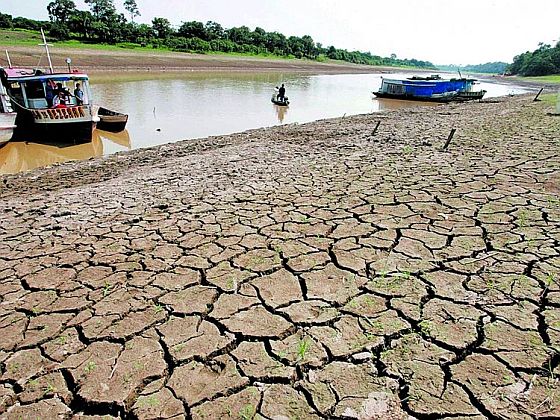
The Guardian reports: The US space agency Nasa warned last week that the Amazon rainforest may be showing the first signs of large-scale degradation due to climate change.
A team of scientists led by the agency found that an area twice the size of California continues to suffer from a mega-drought that began eight years ago.
With little time for the trees to recover between what the authors describe as a “double whammy”, 70m hectares of forest have been severely affected, the analysis of 10 years of satellite microwave radar data revealed.
The data showed a widespread change in the canopy due to the dieback of branches, especially among the older, larger trees that are most vulnerable because they provide the shelter for other vegetation.
“We had expected the forest canopy to bounce back after a year with a new flush of leaf growth, but the damage appeared to persist right up to the subsequent drought in 2010,” said study co-author Yadvinder Malhi of Oxford University.
The Amazon is experiencing a drought rate that is unprecedented in a century, said the agency.
The xenophobic slogan — we must end our dependence on Middle East oil — popularized by American politicians throughout the last decade, will soon become a reality.
It was always obvious that this was a pathological mutation of the laudable goal, we must end our dependence on oil. But political operatives couldn’t resist hijacking that aspiration, injecting America’s post 9/11 fear of the Middle East and then tying that fear to the sacrosanct American way of life.
Thus we end up with the perverse contradiction of a president who in one breath acknowledges the threat posed by climate change, yet in the next champions the goal of “energy security” — a goal which will be accomplished during the most environmentally destructive chapter in America’s oil glutenous history.
Bob Dudley’s remarks came as the company published a study predicting oil production will increase substantially, and that unconventional and high-carbon oil will make up all of the increase in global oil supply to the end of this decade, with the explosive growth of shale oil in the US behind much of the growth.
As a result, the oil and gas company forecasts that carbon dioxide emissions will rise by more than a quarter by 2030 – a disaster, according to scientists, because if the world is to avoid dangerous climate change then studies suggest emissions must peak in the next three years or so.
So-called unconventional oil – shale oil, tar sands and biofuels – are the most controversial forms of the fuel, because they are much more carbon-intensive than conventional oilfields. They require large amounts of energy and water, and have been associated with serious environmental damages.
While some new conventional oilfields are likely to come on stream before 2020, they will be balanced out by those being depleted.
BP predicts that by 2030, the US will be self-sufficient in energy, with only 1% coming from imports, the company’s analysts predict. That would be a remarkable turnaround for a country that as recently as 2005, before the shale gas boom, was one of the biggest global oil importers. [Continue reading…]
Chris Hedges writes: Clive Hamilton in his “Requiem for a Species: Why We Resist the Truth About Climate Change” describes a dark relief that comes from accepting that “catastrophic climate change is virtually certain.” This obliteration of “false hopes,” he says, requires an intellectual knowledge and an emotional knowledge. The first is attainable. The second, because it means that those we love, including our children, are almost certainly doomed to insecurity, misery and suffering within a few decades, if not a few years, is much harder to acquire. To emotionally accept impending disaster, to attain the gut-level understanding that the power elite will not respond rationally to the devastation of the ecosystem, is as difficult to accept as our own mortality. The most daunting existential struggle of our time is to ingest this awful truth — intellectually and emotionally — and continue to resist the forces that are destroying us.
The human species, led by white Europeans and Euro-Americans, has been on a 500-year-long planetwide rampage of conquering, plundering, looting, exploiting and polluting the Earth — as well as killing the indigenous communities that stood in the way. But the game is up. The technical and scientific forces that created a life of unparalleled luxury — as well as unrivaled military and economic power—for the industrial elites are the forces that now doom us. The mania for ceaseless economic expansion and exploitation has become a curse, a death sentence. But even as our economic and environmental systems unravel, after the hottest year in the contiguous 48 states since record keeping began 107 years ago, we lack the emotional and intellectual creativity to shut down the engine of global capitalism. We have bound ourselves to a doomsday machine that grinds forward, as the draft report of the National Climate Assessment and Development Advisory Committee illustrates.
Complex civilizations have a bad habit of destroying themselves. Anthropologists including Joseph Tainter in “The Collapse of Complex Societies,” Charles L. Redman in “Human Impact on Ancient Environments” and Ronald Wright in “A Short History of Progress” have laid out the familiar patterns that lead to systems breakdown. The difference this time is that when we go down the whole planet will go with us. There will, with this final collapse, be no new lands left to exploit, no new civilizations to conquer, no new peoples to subjugate. The long struggle between the human species and the Earth will conclude with the remnants of the human species learning a painful lesson about unrestrained greed and self-worship. [Continue reading…]
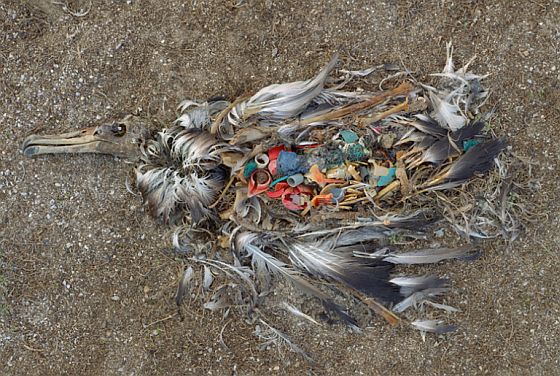
On the Midway Islands, near the heart of the Pacific Trash Gyre, thousands of birds die after consuming the detritus of modern civilization. Photo: Chris Jordan
Paul R. Ehrlich and Anne H. Ehrlich write: Virtually every past civilization has eventually undergone collapse, a loss of socio-political-economic complexity usually accompanied by a dramatic decline in population size. Some, such as those of Egypt and China, have recovered from collapses at various stages; others, such as that of Easter Island or the Classic Maya, were apparently permanent. All those previous collapses were local or regional; elsewhere, other societies and civilizations persisted unaffected. Sometimes, as in the Tigris and Euphrates valleys, new civilizations rose in succession. In many, if not most, cases, overexploitation of the environment was one proximate or an ultimate cause.
But today, for the first time, humanity’s global civilization – the worldwide, increasingly interconnected, highly technological society in which we all are to one degree or another, embedded — is threatened with collapse by an array of environmental problems. Humankind finds itself engaged in what Prince Charles described as ‘an act of suicide on a grand scale’, facing what the UK’s Chief Scientific Advisor John Beddington called a ‘perfect storm’ of environmental problems. The most serious of these problems show signs of rapidly escalating severity, especially climate disruption. But other elements could potentially also contribute to a collapse: an accelerating extinction of animal and plant populations and species, which could lead to a loss of ecosystem services essential for human survival; land degradation and land-use change; a pole-to-pole spread of toxic compounds; ocean acidification and eutrophication (dead zones); worsening of some aspects of the epidemiological environment (factors that make human populations susceptible to infectious diseases); depletion of increasingly scarce resources, including especially groundwater, which is being overexploited in many key agricultural areas; and resource wars. These are not separate problems; rather they interact in two gigantic complex adaptive systems: the biosphere system and the human socio-economic system. The negative manifestations of these interactions are often referred to as ‘the human predicament’, and determining how to prevent it from generating a global collapse is perhaps the foremost challenge confronting humanity.
The human predicament is driven by overpopulation, overconsumption of natural resources and the use of unnecessarily environmentally damaging technologies and socio-economic-political arrangements to service Homo sapiens’ aggregate consumption. How far the human population size now is above the planet’s long-term carrying capacity is suggested (conservatively) by ecological footprint analysis. It shows that to support today’s population of seven billion sustainably (i.e. with business as usual, including current technologies and standards of living) would require roughly half an additional planet; to do so, if all citizens of Earth consumed resources at the US level would take four to five more Earths. Adding the projected 2.5 billion more people by 2050 would make the human assault on civilization’s life-support systems disproportionately worse, because almost everywhere people face systems with nonlinear responses, in which environmental damage increases at a rate that becomes faster with each additional person. Of course, the claim is often made that humanity will expand Earth’s carrying capacity dramatically with technological innovation, but it is widely recognized that technologies can both add and subtract from carrying capacity. The plough evidently first expanded it and now appears to be reducing it. Overall, careful analysis of the prospects does not provide much confidence that technology will save us or that gross domestic product can be disengaged from resource use. [Continue reading…]
This website or its third-party tools use cookies, which are necessary to its functioning. By closing this banner, you agree to the use of cookies.

Many authors have written about how global warming will damage some of the world’s most treasured landscapes and beloved species. This book aims to lay out exactly how bad it will be for human beings. Guzman, a law professor and associate dean at the University of California at Berkeley, is neither a scientist nor a trained environmental activist; he is an academic well-versed in international treaties and legal niceties. This background gives him an interesting perspective on the shifts that are sure to come as climate change rearranges the world’s traditional social and economic order and as different factions jockey for advantage.