



Jason Leopold reports: Rob Richer, the No. 2 ranking official in the CIA's clandestine service, paid a visit to Glenn Carle's office in December 2002 and presented the veteran CIA operative with an urgent proposal.
"I want you to go on a temporary assignment," Carle recalls Richer telling him. "It's important for the agency, it's important for the country and it's important for you. Will you do it?"
Richer, who resigned from the CIA in 2005 and went to work for the mercenary outfit Blackwater, told Carle that agency operatives had just rendered a "high-value target," an Afghan in his mid-forties named Haji Pacha Wazir, who was purported to be Osama bin Laden's personal banker as well as financier for a number of suspected terrorists. Wazir was being held at a CIA black site prison in Morocco, and the agency needed a clandestine officer who spoke French to take over the interrogation of the detainee.
Carle, formerly the deputy national intelligence officer for transnational threats, who had no prior interrogation experience, agreed, and within 72 hours, he boarded a CIA-chartered jet bound for Morocco.
Carle recounts what unfolded next in his riveting book, "The Interrogator: An Education," which stands as a damning indictment of the CIA's torture and rendition program and the Bush administration's approach to the so-called Global War on Terror.
Al Jazeera reports: Earlier this year, as mass popular uprisings spread through the Middle East and audiences across the world sat transfixed by images of unarmed citizens confronting iron-fisted security forces in the streets of Arab capitals, powerful governments from Russia to the United States were forced to begin accounting for the weapons they had for decades sold to the very rulers they now found themselves abandoning.
In Egypt and Bahrain, protesters held up tear gas canisters stamped “Made in USA”, giving longstanding US support for autocratic Arab regimes a painful physical manifestation.
But the United States has not been the only culprit. Egyptian riot police fired shotgun shells made in Italy, and Libyan special forces wielded Belgian assault rifles. Bulgaria has led weapons sales to Yemen, and Russia likely supplies a huge amount of Syria’s armoury.
According to a report released on Wednesday by London-based human rights organisation Amnesty International, in the five years preceding the Arab Spring, a host of at least 20 governments – including Italy, the United Kingdom, France, Serbia, Switzerland and South Korea – sold more than $2.4 billion worth of small arms, tear gas, armoured vehicles and other security equipment to the the five countries that have faced – and violently combated – popular uprisings: Bahrain, Egypt, Libya, Syria, and Yemen.
What’s the good of calling yourself a Democrat if you don’t practice democracy? President Obama’s first allegiance has proved not to be the upholding of democracy, but instead the preservation and expansion of secrecy.
It is revealing that a man who in so many other domains often appears like a pushover, unable to find any principle too high to be compromised, when it comes to the issue of secrecy, is utterly uncompromising.
There is only one other practice in which Obama shows equal resolve: assassination.
In response to the killing of Abdulrahman al-Awlaki, the 16 year-old American son of Anwar Awlaki, Glenn Greenwald writes:
It is unknown whether the U.S. targeted the teenager or whether he was merely “collateral damage.” The reason that’s unknown is because the Obama administration refuses to tell us. Said the Post: “The officials would not discuss the attack in any detail, including who the target was.” So here we have yet again one of the most consequential acts a government can take — killing one of its own citizens, in this case a teenage boy — and the government refuses even to talk about what it did, why it did it, what its justification is, what evidence it possesses, or what principles it has embraced in general for such actions. Indeed, it refuses even to admit it did this, since it refuses even to admit that it has a drone program at all and that it is engaged in military action in Yemen. It’s just all shrouded in secrecy.
Of course, the same thing happened with the killing of Awlaki himself. The Executive Branch decided it has the authority to target U.S. citizens for death without due process, but told nobody (until it was leaked) and refuses to identify the principles that guide these decisions. It then concluded in a secret legal memo that Awlaki specifically could be killed, but refuses to disclose what it ruled or in which principles this ruling was grounded. And although the Obama administration repeatedly accused Awlaki of having an “operational role” in Terrorist plots, it has — as Davidson put it — “so far kept the evidence for that to itself.”
This is all part and parcel with the Obama administration’s extreme — at times unprecedented — fixation on secrecy. Even with Senators in the President’s own party warning that the administration’s secret interpretation of its domestic surveillance powers under the Patriot Act is so warped and radical that it would shock the public if they knew, Obama officials simply refuse even to release its legal memos setting forth how it is applying those powers. As EFF’s Trevor Timm told The Daily Beast today: “The government classified a staggering 77 million documents last year, a 40 percent increase on the year before.”

“To kill a teenager is just unbelievable, really, and they claim that he is an al-Qaeda militant. It’s nonsense,” said Nasser al-Awlaki, a former Yemeni agriculture minister who was Anwar al-Awlaki’s father and the boy’s grandfather, speaking in a phone interview from Sanaa on Monday. “They want to justify his killing, that’s all.”
The teenager, Abdulrahman al-Awlaki, a U.S. citizen who was born in Denver in 1995, and his 17-year-old Yemeni cousin were killed in a U.S. military strike that left nine people dead in southeastern Yemen.
The young Awlaki was the third American killed in Yemen in as many weeks. Samir Khan, an al-Qaeda propagandist from North Carolina, died alongside Anwar al-Awlaki.
Yemeni officials said the dead from the strike included Ibrahim al-Banna, the Egyptian media chief for al-Qaeda’s Yemeni affiliate, and also a brother of Fahd al-Quso, a senior al-Qaeda operative who was indicted in New York in the 2000 attack on the USS Cole in the port of Aden.
The strike occurred near the town of Azzan, an Islamist stronghold. The Defense Ministry in Yemen described Banna as one of the “most dangerous operatives” in al-Qaeda in the Arabian Peninsula, often referred to by the acronym AQAP.
U.S. officials said they were still assessing the results of the strike Monday evening to determine who was killed. The officials would not discuss the attack in any detail, including who the target was, but typically the CIA and the Pentagon focus on senior figures in al-Qaeda’s affiliate in Yemen.
“We have seen press reports that AQAP senior official Ibrahim al-Banna was killed last Friday in Yemen and that several others, including the son of Anwar al-Awlaki, were with al-Banna at the time,” said Thomas F. Vietor, a spokesman for the National Security Council. “For over the past year, the Department of State has publicly urged U.S. citizens not to travel to Yemen and has encouraged those already in Yemen to leave because of the continuing threat of violence and the presence of terrorist organizations, including AQAP, throughout the country.”
A senior congressional official who is familiar with U.S. operations in Yemen and spoke on the condition of anonymity to discuss sensitive policy issues said, “If they knew a 16-year-old was there, I think that would be cause for them to say: ‘Gee, we ought not to hit this guy. That would be considered collateral damage.’ ”
The official said that the CIA and the military’s Joint Special Operations Command are expected to ensure that women and children are not killed in airstrikes in Pakistan and Yemen but that sometimes it might not be possible to distinguish a teenager from militants.
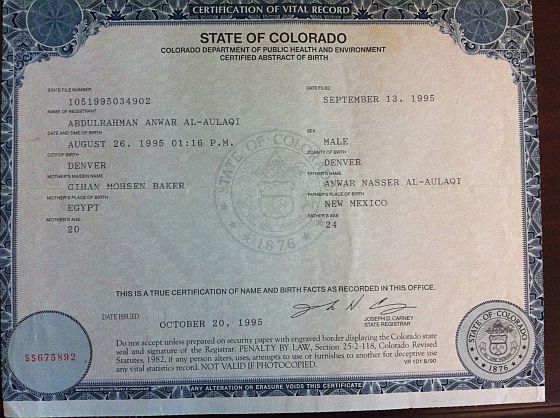
Amy Davidson writes: Here is a birth certificate, for a boy who was born in Denver, Colorado, on September 13, 1995. (Via the Washington Post.) He turned sixteen a month ago, and a few days ago he died, killed when one of his country’s drones hit him and a number of other people in Yemen. His name was Abdulrahman al-Awlaki. His father, Anwar al-Awlaki, who, as the birth certificate notes, was himself born in New Mexico, and was twenty-four years older than his son, was killed a couple of weeks ago, in a separate attack. The father was targeted for assassination. He was an American citizen, and there were no judicial proceedings against him, just, reportedly, a White House legal opinion that concluded that it would be fine to kill him anyway, because the Administration thought he was dangerous. Anwar al-Awlaki was a member of Al Qaeda in the Arabian Peninsula and wrote angry and ugly sermons for them. The Administration says that it had to kill him because he had become “operational,” but so far it has kept the evidence for that to itself.
Was the son targeted, too? The Yemeni government says that another person, a grown man, was the target in the attack that killed Abdulrahman. Maybe he was just in the wrong place, like the Yemeni seventeen-year-old who reportedly died, too. Abdulrahman’s family said that he had been at a barbecue, and told the Post that they were speaking to the paper to answer reports said that Abdulrahman was a fighter in his twenties. Looking at his birth certificate, one wonders what those assertions say either about the the quality of the government’s evidence—or the honesty of its claims—and about our own capacity for self-deception. Where does the Obama Administration see the limits of its right to kill an American citizen without a trial? (The last time I wrote about Awlaki, a reader commented that “Awlaki was a citizen in name only”; but that name is the name of the law, and is, when it comes down to it, all any of us have, unless we want to rely on how charming our government finds us.) And what are the protections for an American child?
You can, in many ways, blame Abdulrahman’s death on his father—for not staying in Colorado, for introducing his son to the wrong people, for being who he was. That would be a fair part of an assessment of Anwar al-Awlaki’s character. But it’s not sufficient. He may have put his child in a bad situation, but we were the ones with the drone. One fault does not preclude another. We have to ask ourselves what we are doing, and at what cost.

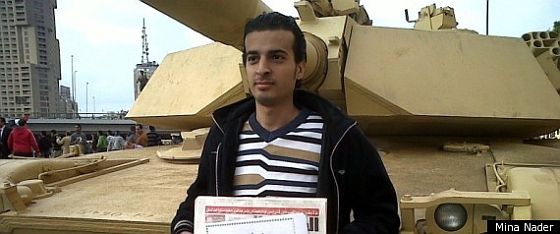
The Guardian reports: An Egyptian blogger jailed for criticising the country’s military junta has declared himself ready to die, as his hunger strike enters its 57th day.
“If the militarists thought that I would be tired of my hunger strike and accept imprisonment and enslavement, then they are dreamers,” said Maikel Nabil Sanad, in a statement announcing that he would boycott the latest court case against him, which began last Thursday. “It’s more honourable [for] me to die committing suicide than [it is] allowing a bunch of Nazi criminals to feel that they succeeded in restricting my freedom. I am bigger than that farce.”
Sanad, whom Amnesty International has declared to be a prisoner of conscience, was sentenced by a military tribunal in March to three years in jail after publishing a blog post entitled “The people and the army were never on one hand”. The online statement, which deliberately inverted a popular pro-military chant, infuriated Egypt’s ruling generals who took power after the ousting of former president Hosni Mubarak, and have since been accused of multiple human rights violations in an effort to shut down legitimate protest and stifle revolutionary change.
The 26-year-old was found guilty of “insulting the Egyptian army”. The case helped spark a nationwide opposition movement to military trials for civilians, and cast further doubt on the intentions of the Supreme Council of the Armed Forces (Scaf), whose promises regarding Egypt’s post-Mubarak transition to democracy appear increasingly hollow.
In mid-September, Saki Knafo wrote: Nabil is not the only civilian to have undergone a military trial since the revolution. An article from the Pulitzer Center for Crisis Reporting places the total number at 12,000, and says that suspects have been typically tried in three or four days and have been given sentences of between a few months to several years.
Earlier this year, Asmaa Mahfouz, a prominent Egyptian activist, wrote the following Tweet (translated from Arabic): “If the judiciary does not get us our rights, don’t be upset if armed groups carry out a series of assassinations as there is neither law nor justice.”
She was brought before the military prosecutor last month and charged with insulting the military. The case became a flashpoint in the growing movement to end the military trials, with presidential candidates and political groups criticizing the decision. The military council eventually ordered that the charges be dropped.
But Nabil is different from Mahfouz. He isn’t a star, for one thing. “Maikel isn’t a prominent public figure,” his father told the press during a recent demonstration in support of his son. “Maikel is a normal person and that is why they imprisoned him. Others who had a lot of public support and had similar charges were released. But Maikel is one of the general public and he doesn’t have anyone to defend him.”
There’s also the fact that Nabil supports Israel. He says he objected to military conscription in the first place because he refused to “point a gun at an Israeli youth who is defending his country’s right to exist,” and a section of his website is in Hebrew.
Several organizations are again calling for his release. A statement from Reporters Without Borders observed that Nabil “could very soon die” and warned that he could become “the symbol of a repressive and unjust post-Mubarak Egypt.”
In response, a military official was quoted as saying that what Nabil wrote on his blog was “a clear transgression of all boundaries of insult and libel.”
In April, shortly after Nabil’s arrest, a friend of Nabil’s and fellow blogger wrote an email to The Huffington Post in which he said that Nabil’s sentencing proved “every word Nabil has ever said about our regime.”
“The military council wants to annihilate anyone who questions what it does,” wrote the blogger, who calls himself Kefaya Punk. “That reminds me of how the Catholic church treated its opponents in the medieval ages.”

An American teenager gets blown up in a US drone strike and the only explanation provided for why he was killed is that his father was alleged to be a terrorist. And given the small amount of reporting on yesterday’s killings it appears that having covered the Obama-kills-an-American story last month, Obama-kills-another-American is a story of no great interest. But this isn’t just a story about the abuse of executive power. It would now appear that individuals can be snuffed out just because the US government objects to what they are saying.
The New York Times reports: Airstrikes, believed to have been carried out by American drones, killed at least nine people in southern Yemen, including a senior official of the regional branch of Al Qaeda and an American, the 17-year-old son of a Qaeda official killed by the United States last month, according to the government and local reports on Saturday.
Fighting also escalated in the capital, Sana, where at least 12 antigovernment protesters were killed by security forces near the Foreign Ministry and at least four civilians were killed in a battle near the airport, opposition officials said.
The fighting in Sana was the deadliest since President Ali Abdullah Saleh returned to the country last month, and coincided with rising political tensions as all sides await a statement by the United Nations Security Council expected in weeks.
Yemen has been in turmoil for months, as protesters demanding the ouster of Mr. Saleh, who has ruled for 33 years, have filled the streets, and rival political factions have fought for power. Despite tremendous domestic opposition, international pressure and an assassination attempt that severely wounded him in June, Mr. Saleh has refused to step down.
Islamic militant groups, including Al Qaeda in the Arabian Peninsula, the Yemeni branch of the terrorist organization, have exploited the chaos, taking over large regions in Shabwa and Abyan Provinces in the south.
The American drone strike last month that killed the Qaeda official, Anwar al-Awlaki, has been particularly controversial in the United States. Despite being an American citizen, Mr. Awlaki, a Qaeda propagandist, was killed without a trial. The United States has argued that he had taken on an operational role in the organization, plotting attacks against Americans, which made him a legitimate target.
The killing of his son in a drone attack on Friday night, if confirmed, would be the third time an American was killed by such a United States attack in Yemen, although it was not clear if the son was an intended target. A second American, Samir Khan, the editor of Al Qaeda’s online magazine, was killed in the attack on Mr. Awlaki, which was launched from a new secret C.I.A. base on the Arabian Peninsula.
Is this why President Obama banned torture? Just so that American hands could remain clean while its allies used torture techniques even more gruesome than the kind George Bush and Dick Cheney approved?
The New York Times reports: Detainees are hung by their hands and beaten with cables, and in some cases their genitals are twisted until the prisoners lose consciousness at sites run by the Afghan intelligence service and the Afghan National Police, according to a United Nations report [PDF] released here on Monday.
The report, based on interviews over the past year with more than 300 suspects linked to the insurgency, is the most comprehensive look at the Afghan detention system and an issue that has long concerned Western officials and human rights groups.
It paints a devastating picture of abuse, citing evidence of “systematic torture” during interrogations by Afghan intelligence and police officials even as American and other Western backers provide training and pay for nearly the entire budget of the Afghan ministries running the detention centers.
The report does not assess whether American officials knew of the abuses. But such widespread use of torture in a detention system supported by American mentors and money raises serious questions about potential complicity of American officials and whether they benefited from information obtained from suspects who had been tortured.
A week after the assassination of Anwar al-Awlaki — “a great day for America,” as one senior Obama administration official put it — and then a flurry of headlines about Obama killing US citizens, the White House clearly sees the need to change the narrative. Although it had already been stated that the president was exerting powers in accordance with legal advice, the administration wants to assure everyone that this was sound advice — the kind that would require the thoroughness of a 50-page memo drafted by a team of lawyers.
In other words, to those who are concerned about the suspension of the rule of law, the consolation is rule by procedure. It’s not due process, but it involved meetings, legal opinions, documentation, signatures — all the essential ingredients to ensure that those involved can later point to the ways in which they diligently followed procedures and ultimately no one can be held responsible. The buck stops nowhere.
Even so, since this is a presidency where secrecy often appears to be cherished more than anything else, we don’t get to actually read the Justice Department’s memorandum describing the circumstances in which Obama has the discretion to suspend the constitution. Instead, the contents of the memo get selectively revealed to a reporter.
It’s not exactly a leak — more like a drip.
The New York Times reports: The Obama administration’s secret legal memorandum that opened the door to the killing of Anwar al-Awlaki, the American-born radical Muslim cleric hiding in Yemen, found that it would be lawful only if it were not feasible to take him alive, according to people who have read the document.
The memo, written last year, followed months of extensive interagency deliberations and offers a glimpse into the legal debate that led to one of the most significant decisions made by President Obama — to move ahead with the killing of an American citizen without a trial.
The secret document provided the justification for acting despite an executive order banning assassinations, a federal law against murder, protections in the Bill of Rights and various strictures of the international laws of war, according to people familiar with the analysis. The memo, however, was narrowly drawn to the specifics of Mr. Awlaki’s case and did not establish a broad new legal doctrine to permit the targeted killing of any Americans believed to pose a terrorist threat.
The Obama administration has refused to acknowledge or discuss its role in the drone strike that killed Mr. Awlaki last month and that technically remains a covert operation. The government has also resisted growing calls that it provide a detailed public explanation of why officials deemed it lawful to kill an American citizen, setting a precedent that scholars, rights activists and others say has raised concerns about the rule of law and civil liberties.
But the document that laid out the administration’s justification — a roughly 50-page memorandum by the Justice Department’s Office of Legal Counsel, completed around June 2010 — was described on the condition of anonymity by people who have read it.
The legal analysis, in essence, concluded that Mr. Awlaki could be legally killed, if it was not feasible to capture him, because intelligence agencies said he was taking part in the war between the United States and Al Qaeda and posed a significant threat to Americans, as well as because Yemeni authorities were unable or unwilling to stop him.
The memorandum, which was written more than a year before Mr. Awlaki was killed, does not independently analyze the quality of the evidence against him.
The administration did not respond to requests for comment on this article.
The Washington Post reports: The relatively muted U.S. response to the sentencing this week of doctors, teachers and opposition activists in Bahrain is renewing calls there for the Obama administration to take a stronger line against rights abuses in the tiny Persian Gulf kingdom.
Dozens of people detained after huge anti-government protests in February have been tried under emergency law in the
quasi-military National Safety Court, and in recent days were given prison terms ranging from three years to life. A civilian court has ordered the retrial of 20 doctors, but at least 80 more people sentenced for crimes that include organizing illegal gatherings remain in prison.Ali Alekri, a surgeon sentenced to a 15-year prison term, said he had been convicted only because he had treated injured protesters and because, like most of those involved in the uprising, he is a Shiite Muslim.
“The international community did nothing,” said Alekri, speaking by telephone from Bahrain, where he has been released on bail. “We expect pressure from the Americans, and we do not know why they did not do that. Possibly there is a conflict of interest.”
Alekri said that he had been beaten, that his family had been threatened and that he had been forced to sign a confession while in prison — charges echoed by others.
Bahrain is a key Middle Eastern ally for the United States, and government opponents say that status has led Washington to look the other way amid widespread allegations of torture and illegal detentions. The U.S. Navy’s 5th Fleet is anchored in Bahrain.
State Department spokesman Mark Toner said in a statement that the United States was “deeply disturbed” by the sentencing of 20 medical professionals and urged the Bahraini government to commit to transparent judicial proceedings. But officials have stopped short of directly condemning Bahrain’s authorities.
Glenn Greenwald writes: Here is what the Democratic President has created and implemented, and what many party loyalists explicitly endorse (when there’s a Democrat in the White House) — from Reuters:
American militants like Anwar al-Awlaki are placed on a kill or capture list by a secretive panel of senior government officials, which then informs the president of its decisions . . . . There is no public record of the operations or decisions of the panel, which is a subset of the White House’s National Security Council . . . . Neither is there any law establishing its existence or setting out the rules by which it is supposed to operate. . . . The role of the president in ordering or ratifying a decision to target a citizen is fuzzy. White House spokesman Tommy Vietor declined to discuss anything about the process. . . .
Representative Dutch Ruppersberger, was asked by reporters about the killing. The process involves “going through the National Security Council, then it eventually goes to the president” . . . .Other officials said the role of the president in the process was murkier than what Ruppersberger described. They said targeting recommendations are drawn up by a committee of mid-level National Security Council and agency officials. Their recommendations are then sent to the panel of NSC “principals,” meaning Cabinet secretaries and intelligence unit chiefs, for approval . . . But one official said Obama would be notified of the principals’ decision. If he objected, the decision would be nullified, the official said.
So a panel operating out of the White House — that meets in total secrecy, with no known law or rules governing what it can do or how it operates — is empowered to place American citizens on a list to be killed by the CIA, which (by some process nobody knows) eventually makes its way to the President, who is the final Decider. It is difficult to describe the level of warped authoritarianism necessary to cause someone to lend their support to a twisted Star Chamber like that; I genuinely wonder whether the Good Democrats doing so actually first convince themselves that if this were the Bush White House’s hit list, or if it becomes Rick Perry’s, they would be supportive just the same. Seriously: if you’re willing to endorse having White House functionaries meet in secret — with no known guidelines, no oversight, no transparency — and compile lists of American citizens to be killed by the CIA without due process, what aren’t you willing to support?
Jason Leopold reports: In 2002, not long after he was subjected to so-called “enhanced interrogation techniques” by Bruce Jessen and James Mitchell, psychologists under contract to the CIA, high-value detainee Abu Zubaydah made about ten drawings depicting the torture he endured while in custody of the agency.
One of the drawings Zubaydah had sketched captured in incredible detail the waterboarding sessions he underwent. Another drawing showed him being chained by his wrists to the ceiling of a CIA black site prison where he was held and another showed him strapped to a chair and being doused with water as part of a sleep deprivation program, according to two counterterrorism officials who have seen Zubaydah’s drawings.
Zubaydah drew the pictures of the torture techniques he was subjected to on a sheet of paper measuring about 8 x 11 inches and on pieces of paper about the size of an index card. In some instances, Zubaydah drew several of the torture techniques on a single piece of paper.
Zubaydah’s “artwork is very detailed right down to the straps that were used when he was on the waterboard and almost looks like a photograph,” said one of the counterterrorism officials, who requested anonymity in order to discuss classified material.
Brent Mickum, Zubaydah’s attorney, previously told Truthout that in the absence of the 92 interrogation videotapes, which the agency destroyed, the drawings Zubaydah made contain the best description of the torture techniques used against him while he was being held at the agency’s black site prison facilities.
“These are a good group of drawings and he is a pretty good artist,” Mickum told Truthout last year. Mickum said he is prohibited from discussing the contents of Zubaydah’s drawings because it remains classified. However, he said, “the depictions would be of interest” and agreed that Zubaydah “can draw and with great detail.”
Additionally, Zubaydah wrote poetry, short stories, and articles while in CIA custody. The content of his writing, however, is not known.
But the CIA refuses to release any of his drawings or writings and won’t even acknowledge that those materials actually exist. If Zubaydah’s drawings and writings do exist, the CIA said, it would be part of the agency’s “operational files,” which means “records and files detailing the actual conduct of [CIA’s] intelligence activities.”
David Shipler writes:
The Obama administration should release the secret Justice Department memo justifying the placement of an American citizen, Anwar al-Awlaki, on the CIA’s kill list. The legal questions are far from clearcut, and the country needs to have this difficult discussion. A good many Obama supporters thought that secret legal opinions by the Justice Department—rationalizing torture and domestic military arrests, for example—had gone out the door along with the Bush administration.
But now comes a momentous change in policy with serious implications for the Constitution’s restraint on executive power, and Obama refuses to allow his lawyers’ arguments to be laid out on the table for the American public to examine. Shakespeare’s line in Hamlet on the “insolence of office” comes to mind.
The questions are legion. If U.S. government officials are being accurate and truthful in both their attributed and anonymous statements, Awlaki was placed on the list only in April 2010, after he had “gone operational” and had crossed the line between speech and action. Did the lawyers think that the First Amendment protected even his fiery rhetoric, easily available to potential jihadists by Internet, which had inflamed a few wannabe terrorists? Did they require that he actually take a hand in some planning before he could be considered worthy of the drone strike that killed him in Yemen? Hours after his death, President Obama awarded him a posthumous promotion, calling him for the first time “the leader of external operations for al-Qaeda in the Arabian Peninsula.”
What is the basis for this grand title? There is no doubt about his words—anybody can still hear and read them—but the picture of his actions is sketchy, derived from unverified intelligence. Given how wrong the CIA was about weapons of mass destruction in Iraq, is it really sufficient to base a death warrant on intelligence operatives’ untested assertions? How can their accuracy be checked? Does the Fifth Amendment’s right to due process extend to Americans overseas? Due process, after all, was the Framers’ effort to enhance the accuracy of the criminal justice system. Is there another way that an independent review can be done before a missile is sent in the direction of some named person who is not on a battlefield? Isn’t it strange that under Obama’s reasoning, the president can’t order torture but can order death, that he needs a judge’s authorization to listen to an American’s phone overseas but needs no such judicial approval to end the citizen’s life?
After Barack Obama began his presidency by deciding to close Guantanamo and ban torture, Anthony D. Romero, Executive Director of the ACLU said:
These executive orders represent a giant step forward. Putting an end to Guantanamo, torture and secret prisons is a civil liberties trifecta, and President Obama should be highly commended for this bold and decisive action so early in his administration on an issue so critical to restoring an America we can be proud of again.
What later became apparent was that Obama had less interest in civil liberties than he has in resolving the legal complications of dealing with terrorist suspects.
Should suspected terrorists be tried in civilian or military courts?
Should they be detained inside or outside the United States?
What kind of legal protections do they deserve when being interrogated?
What constitute legal interrogation methods?
For Obama, all of these questions have a simple answer: whenever possible, terrorist suspects should be killed rather than taken into detention.
He will never articulate his policy in such brutal and simple terms, but by this point the policy of the US government should be clear.
What has become apparent over the last two and a half years is that George Bush and Dick Cheney would have faced little or no criticism if there had been just one subtle difference in their approach to governance: had they been Democrats they could have avoided the political messiness of using torture and instead been global vigilante purists and said America will kill its enemies whenever and wherever we find them.
So, as Dick Cheney now applauds Obama, he does so with an apparent sense of envy and resentment.
But note also, Cheney is still promoting an old-school approach when he says: “I think you’ve got to go through the process internally, making certain it’s reviewed by the appropriate people in the Justice Department — that they take a good careful look at it — but I think they [the Obama administration] did all that in this case.”
Well, from what we know at this point, that careful review process was either not applied to Samir Khan, or, if it was applied, concluded he could not be targeted — but he got assassinated in any case.
The Associated Press reports:
Bahraini doctors and nurses convicted of links to anti-government protests and sentenced to long prison terms appealed to the U.N. chief Saturday to investigate their claims of abuse and judicial violations in the trial.
The medical professionals — whose sentences range from five to 15 years — are appealing the security court’s ruling and speaking out against the wider crackdown by the Gulf kingdom’s Sunni rulers against protests for greater rights by the Shiite majority.
The trial has been closely watched by rights groups that have criticized Bahrain’s prosecution of civilians at the special security court, which was set up under martial law-style rule that was lifted in June. The U.N. human rights office and the U.S. State Department are among those questioning the use of the court, which has military prosecutors and both civilian and military judges.
The doctors and nurses worked at the state-run Salmaniya Medical Center close to the capital’s Pearl Square, which became the epicenter of Bahrain’s uprising, inspired by other revolts across the Arab world. The authorities saw the hospital’s mostly Shiite staff — some of whom participated in pro-democracy street marches — as protest sympathizers, although the medics claimed they treated all who needed care.
“During the times of unrest in Bahrain, we honored our medical oath to treat the wounded and save lives. And as a result, we are being rewarded with unjust and harsh sentences,” said a statement released by the medics after the court’s ruling.
The group was convicted Thursday on charges that include attempting to topple the Gulf kingdom’s rulers and spreading “fabricated” stories. In a separate trial, the security court sentenced a protester to death for the killing of a police officer during the clashes that began in February.
The New York Times reports:
First there were the blindfold, the wrist-scarring handcuffs and the death threats. Then came beatings and electric shocks. In the fog of pain, the detainee, who said he had done nothing wrong, would have confessed to anything, he later recalled.
The techniques were familiar to Libyans, but the perpetrators were not: they were former rebels, according to the detainee, a 36-year-old man who said he had worked in military intelligence for the government of Col. Muammar el-Qaddafi.
The man, who requested that his name not be published because he feared retribution from his former captors, said he was arrested by armed former rebels almost two weeks ago, held in a building for four days and tortured.
His story was impossible to immediately verify, but he displayed what he said was evidence of the torture: huge bruises and welts on his legs, stripes of black and blue across the back of his thighs, and scars on his feet and ankles that he said marked the spots where his captors attached electrical wires.
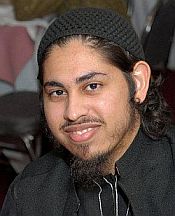 The fact that President Obama decided to target the US citizen Anwar Awlaki for extra-judicial execution, is a subject of considerable controversy. What is arguably even more questionable is the killing of Awlaki’s American companion at the time of the Hellfire missile strike in Yemen yesterday: Samir Khan.
Khan, who grew up in New York and North Carolina, had been the subject of a criminal investigation, yet the FBI could not find sufficient evidence to indict him. Neither had he been included on Obama’s list of people who he claims the right to execute, but he got killed anyway.
CNN says intelligence professionals “see Khan’s death as a ‘two-fer,’ with al-Awlaki being the primary target.”
If there is any kind of official explanation about what happened — not that we’re likely to hear one from a president who clearly values secrecy more than accountability — how might it go?
Khan’s presence alongside Awlaki was a happy coincidence? His shredded body was a welcome piece of collateral damage?
Or, Obama’s authorization was sought and Khan’s was a kind of two-for-the-price-of-one impulse killing.
What can reasonably be inferred is that careful consideration had already been given to whether Khan could be legitimately targeted and the conclusion was that he could not — hence, even though he had long been known to be in Yemen and been responsible for producing al Qaeda’s English-language Inspire magazine, he had not been added to Obama’s target list.
In response to the killing of Awlaki, ACLU Deputy Legal Director Jameel Jaffer said yesterday:
The targeted killing program violates both U.S. and international law. As we’ve seen today, this is a program under which American citizens far from any battlefield can be executed by their own government without judicial process, and on the basis of standards and evidence that are kept secret not just from the public but from the courts. The government’s authority to use lethal force against its own citizens should be limited to circumstances in which the threat to life is concrete, specific, and imminent. It is a mistake to invest the President — any President — with the unreviewable power to kill any American whom he deems to present a threat to the country.
The execution of Samir Khan would seem to indicate that Obama took a step even further: he claims the right to kill any American — even those whom he does not deem to present a threat to the country!

Glenn Greenwald interviewed on Democracy Now:
The life of Anwar Awlaki:
Interview: Yemen analyst Gregory Johnsen discusses Awlaki killing:
Anwar Awlaki on killing Innocent civilians, October 2001: