Category Archives: human rights

NEWS & EDITOR’S COMMENTS: Using torture to force “confessions”

Report: Abusive tactics were used to find Iraq-al Qaida link

The Bush administration put relentless pressure on interrogators to use harsh methods on detainees in part to find evidence of cooperation between al Qaida and the late Iraqi dictator Saddam Hussein’s regime, according to a former senior U.S. intelligence official and a former Army psychiatrist.

Such information would’ve provided a foundation for one of former President George W. Bush’s main arguments for invading Iraq in 2003. No evidence has ever been found of operational ties between Osama bin Laden’s terrorist network and Saddam’s regime.

The use of abusive interrogation — widely considered torture — as part of Bush’s quest for a rationale to invade Iraq came to light as the Senate issued a major report tracing the origin of the abuses and President Barack Obama opened the door to prosecuting former U.S. officials for approving them. [continued…]

Editor’s CommentInterrogation is used for extracting information. Torture is used to force confessions.

It’s not about getting the victim to tell you something you don’t yet know; it’s about getting the victim to say what you want to hear.

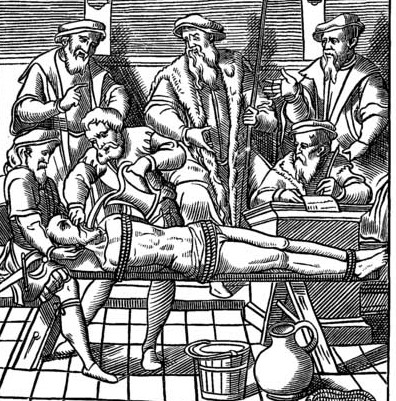
The New York Times refers to Dr James E. Mitchell as a mastermind of the torture program. In a telling quote that sounds like an account straight from the Spanish Inquisition — who’s purpose was to force confessions — we learn:

    “Jim believed that people of this ilk would confess for only one reason: sheer terror,” said one CIA official who had discussed the matter with Dr. Mitchell.

There you have it: this was about forcing confessions.

Waterboarding someone dozens of times in order to gain new information makes no sense. Repeated application in order to force a confession makes perfect sense.

In adopting harsh tactics, no inquiry into their past use

The program began with Central Intelligence Agency leaders in the grip of an alluring idea: They could get tough in terrorist interrogations without risking legal trouble by adopting a set of methods used on Americans during military training. How could that be torture?

In a series of high-level meetings in 2002, without a single dissent from cabinet members or lawmakers, the United States for the first time officially embraced the brutal methods of interrogation it had always condemned.

This extraordinary consensus was possible, an examination by The New York Times shows, largely because no one involved — not the top two C.I.A. officials who were pushing the program, not the senior aides to President George W. Bush, not the leaders of the Senate and House Intelligence Committees — investigated the gruesome origins of the techniques they were approving with little debate. [continued…]

Editor’s Comment — To hear this story the way the New York Times tells it, then-CIA director George Tenet and his sidekick John McLaughlin added up to a stellar torture sales team. The leaders of the Bush administration passively swallowed the pitch. Good faith was flowing from every direction. It’s yet another ripping yarn in the never ending tale of American innocence. How dreadful that so many eager patriots could have unwittingly become party to the very un-American practice of torture. It’s a great narrative, but somehow it doesn’t quite ring true.

The part that’s missing here is the context — not the context of the United States in a condition of high alert, but the context of an administration that months before had declared its willingness to take the gloves off and operate in the dark side.

The core premise at work here — one that flowed directly from Cheney and Bush — was that the effectiveness of counterterrorism necessarily corresponds with freedom from constraints. From that assumption it naturally follows that the closer one can operate to the boundaries imposed by law, the more effective will be the operation. The perspective on legality is that it is an operational constraint.

Which brings us to the article’s opening words: “The program began…” It began with the assumption that a SERE based interrogation program could not be called torture. Really? Or did it begin with an assignment: find a way to use the most brutal techniques you can devise without any of us running foul of the law.

The idea that brutality and effectiveness might not perfectly coincide never entered the vice president’s mind.

Banned techniques yielded ‘high value information,’ memo says

President Obama’s national intelligence director told colleagues in a private memo last week that the harsh interrogation techniques banned by the White House did produce significant information that helped the nation in its struggle with terrorists.

“High value information came from interrogations in which those methods were used and provided a deeper understanding of the al Qa’ida organization that was attacking this country,” Adm. Dennis C. Blair, the intelligence director, wrote in a memo to his staff last Thursday. [continued…]

Editor’s Comment — Some precision is called for here. Information comes from the suspect, not the technique. To say that the interrogation technique had an instrumental and indispensable role in soliciting the information depends on knowing that the information could not have been gained in any other way and that the information was reliable. As Blair acknowledged: “The information gained from these techniques was valuable in some instances, but there is no way of knowing whether the same information could have been obtained through other means.”

But as I said yesterday, the fundamental problem with the argument of expediency is that this provides a justification for torture. If you think that whatever works is justifiable and you think torture works then you have to condone torture. If you can’t condone torture then pointing to “success” stories is simply a way of deflecting attention away from the central issue: the use of torture.

Report gives new detail on approval of brutal techniques

A newly declassified Congressional report released Tuesday outlined the most detailed evidence yet that the military’s use of harsh interrogation methods on terrorism suspects was approved at high levels of the Bush administration.

The report focused solely on interrogations carried out by the military, not those conducted by the Central Intelligence Agency at its secret prisons overseas. It rejected claims by former Defense Secretary Donald H. Rumsfeld and others that Pentagon policies played no role in harsh treatment of prisoners at Abu Ghraib prison in Iraq or other military facilities.

The 232-page report, the product of an 18-month inquiry, was approved on Nov. 20 by the Senate Armed Services Committee, but has since been under Pentagon review for declassification. Some of the findings were made public in a Dec. 12 article in The New York Times; a spokesman for Mr. Rumsfeld dismissed the report at the time as “unfounded allegations against those who have served our nation.” [continued…]


Facebooktwittermail

Cheney’s bogus pragmatism on torture

Pressure grows to investigate interrogations

Pressure mounted on President Obama on Monday for more thorough investigation into harsh interrogations of terrorism suspects under the Bush administration, even as he tried to reassure the Central Intelligence Agency that it would not be blamed for following legal advice.

Mr. Obama said it was time to admit “mistakes” and “move forward.” But there were signs that he might not be able to avoid a protracted inquiry into the use of interrogation techniques that the president’s top aides and many critics say crossed the line into torture. [continued…]

Cheney wants CIA files for memoir

Researching his memoirs, former Vice President Dick Cheney is pushing the CIA to declassify files that he claims would vindicate the CIA’s use of coercive interrogation techniques that President Barack Obama has banned.

The request, which the CIA has not yet answered, sets up a showdown between the past and current administrations. Cheney can be expected to argue that the Obama administration’s publication of other files last week is a precedent for release of the reports he wants. Cheney contends that the information he seeks does not pose a threat to anyone, nor to intelligence sources and methods. [continued…]

The CIA’s questioning worked

In releasing highly classified documents on the CIA interrogation program last week, President Obama declared that the techniques used to question captured terrorists “did not make us safer.” This is patently false. The proof is in the memos Obama made public — in sections that have gone virtually unreported in the media.

Consider the Justice Department memo of May 30, 2005. It notes that “the CIA believes ‘the intelligence acquired from these interrogations has been a key reason why al Qaeda has failed to launch a spectacular attack in the West since 11 September 2001.’ . . . In particular, the CIA believes that it would have been unable to obtain critical information from numerous detainees, including [Khalid Sheik Mohammed] and Abu Zubaydah, without these enhanced techniques.” The memo continues: “Before the CIA used enhanced techniques . . . KSM resisted giving any answers to questions about future attacks, simply noting, ‘Soon you will find out.’ ” Once the techniques were applied, “interrogations have led to specific, actionable intelligence, as well as a general increase in the amount of intelligence regarding al Qaeda and its affiliates.” [continued…]

Editor’s Comment — Cheney’s interests — as always — are preeminently political, rather than legal or moral. He understands that the argument that the vast majority of Americans will buy without a second thought is that when it comes to counterterrorism, whatever can be demonstrated as having “worked” is demonstrably justifiable. If waterboarding yielded vital intelligence, it was warranted. Lives were saved. Cheney et al did the right thing.

The problem with this line of reasoning is that it provides an ironclad justification for torture. If the protection of American lives is a supreme good, it follows that success in extracting vital intelligence by torturing a terrorist suspect and thereby saving lives, would provide the necessary moral justification for torture — at least for those who subscribe to this ends-justifies-the-means line of reasoning.

Yet — and here’s the problem — the Bush administration cleaved assiduously to the line: “we do not torture.” Why? Simply because it was illegal? Laws can be changed. If the administration was unwilling to change the law then this either means the pragmatic argument didn’t hold — because torture is wrong even when if it saves lives — or, and this would be utterly contrived, the proponents of not-quite-torture believed that their “legal” torture techniques were more effective than illegal torture.

The question Cheney needs to answer is this: If torturing terrorist suspects can save American lives, do you support the use and thus the legalization of torture?

If his answer is “no,” then the documentary evidence of how CIA interrogations “made us safer” is irrelevant to the current debate. If his answer is “yes,” then this begs a further question: Why have you spent all these years arguing that the US does not torture, rather than arguing that the US needs the legal freedom to do whatever it takes — including using torture — to protect its citizens?

Of course, even if Cheney was to face such questions he would decline the debate since he knows perfectly well that torture is indefensible — unless it can be dressed up as something else. “We didn’t torture. We defended America.”

Facebooktwittermail

EDITORIAL: Power, humiliation and torture

Power, humiliation and torture

In the wake of 9/11, no phrase more succinctly projected the upwelling of popular jingoism across the United States than the words “Power of Pride.”

America needed to reassert its potency after experiencing the insult and humiliation of witnessing its power simultaneously centralized and instantaneously crushed when two drab towers acquired their national and international iconic significance in the very same moment that they collapsed.

As American power symbolically turned to a cloud of dust, its leaders scurried around in a desperate effort to salvage their authority and reclaim their dominance.

It now appears that central to that process was a calculated effort through which senior members of the Bush administration would restore their own pride and purge their own humiliation by torturing those who had collaborated in the attacks.
The fact that the CIA’s torture program was claimed to merely use “harsh interrogation” techniques was not simply a way of asserting that the legal threshold of torture had not been crossed. By using the term “interrogation” the issue of sadistic retribution was effectively screened out of consideration.

Even those who were critical of the approach the administration had adopted were inclined to confine those criticisms to questions such as whether these coercive methods would have any chance of yielding valuable intelligence. Alternatively they might press a patriotic argument by suggesting that torture was un-American.

The assumption inside the administration was that if its harsh methods could be presented as having been effective in preventing subsequent acts of terrorism, then pragmatic Americans would have less concern about the moral qualms of the administration’s critics — individuals who could be dismissed as civil liberties fanatics.

The moral question of whether the state can be allowed to use torture as a method of extra-judicial punishment and retribution rarely if ever entered the debate. But the evidence now suggests that it should.

We now learn that Khalid Sheikh Mohammed was waterboarded 183 times in March 2003 and Abu Zubaydah was waterboarded 83 times in August 2002.

The New York Times has reported:

Abu Zubaydah had provided much valuable information under less severe treatment, and the harsher handling produced no breakthroughs, according to one former intelligence official with direct knowledge of the case….

…the use of repeated waterboarding against Abu Zubaydah was ordered “at the direction of CIA headquarters,” and officials were dispatched from headquarters “to watch the last waterboard session.”

The memo, written in 2005 and signed by Steven G. Bradbury, who worked in the Office of Legal Counsel, concluded that the waterboarding was justified even if the prisoner turned out not to know as much as officials had thought.

And he did not, according to the former intelligence officer involved in the Abu Zubaydah case. “He pleaded for his life,” the official said. “But he gave up no new information. He had no more information to give.”

A line of command and a set of orders is one way of attempting to explain how it could come about that a man would be waterboarded day after day. Yet the significance of what was taking place at that time was implicit rather than explicit. What mattered most was what was left unstated.

Within a relatively short period, Zubaydah would have learned that as agonizing as waterboarding might be, it was something he could survive. In about the same amount of time, his torturers would have learned that there was no more information they could extract.

And yet the torture continued, day in, day out, multiple times a day.

Cheney knew. Bush knew. Rumsfeld knew.

Each day might yield no new intelligence but for those who had been most deeply humiliated by 9/11, unremitting waterboarding provided its own rewards.

To be able to say, “carry on” — with no reasonable justification — was to silently know: I have the power to exact retribution.

Facebooktwittermail

EDITORIAL: The scars of torture

The scars of torture

How much credit does President Obama deserve for releasing the torture memos?

Glenn Greenwald argues:

Other than mildly placating growing anger over his betrayals of his civil liberties commitments (which, by the way, is proof of the need to criticize Obama when he does the wrong thing), there wasn’t much political gain for Obama in releasing these documents. And he certainly knew that, by doing so, he would be subjected to an onslaught of accusations that he was helping Al Qaeda and endangering American National Security. And that’s exactly what happened, as in this cliché-filled tripe from Hayden and Michael Mukasey in today’s Wall St. Journal, and this from an anonymous, cowardly “top Bush official” smearing Obama while being allowed to hide behind the Jay Bybee of journalism, Politico‘s Mike Allen.

But Obama knowingly infuriated the CIA, including many of his own top intelligence advisers; purposely subjected himself to widespread attacks from the Right that he was giving Al Qaeda our “playbook”; and he released to the world documents that conclusively prove how that the U.S. Government, at the highest levels, purported to legalize torture and committed blatant war crimes. There’s just no denying that those actions are praiseworthy. I understand the argument that Obama only did what the law requires. That is absolutely true. We’re so trained to meekly accept that our Government has the right to do whatever it wants in secret — we accept that it’s best that most things be kept from us — that we forget that a core premise of our government is transparency; that the law permits secrecy only in the narrowest of cases; and that it’s certainly not legal to suppress evidence of government criminality on the grounds that it is classified.

Still, as a matter of political reality, Obama had to incur significant wrath from powerful factions by releasing these memos, and he did that. That’s an extremely unusual act for a politician, especially a President, and it deserves praise.

Really? I honestly don’t see it and I think that drawing a distinction between the act of releasing the memos and the act of throwing out a lifeline to those who might face prosecution is a way of decoupling what were actually interlocking actions.

The Obama administration had already stalled on releasing the memos. Had they continued to do so they would have put themselves in the position of appearing to be complicit in covering up a criminal conspiracy.

Central to that conspiracy was an effort to use evidence derived from observing the effects of the US military’s Survival, Evasion, Resistance and Escape (SERE) training.

In assessing the potential risk involved in the use of torture techniques such as waterboarding, the Department of Justice’s Office of Legal Council rested heavily on the proposition that if no lasting harm had been done to SERE trainees then neither would terrorist suspects be at risk.

In his memo to John Rizzo, Acting General Council of the CIA, Assistant Attorney General Jay Bybee wrote:

…the information derived from SERE training bears upon the impact of the use of the individual techniques and upon their use as a course of conduct. You have found that the use of these methods together or separately, including the use of the waterboard, has not resulted in any negative long-term mental health consequences. The continued use of these methods without mental health consequences to the trainees indicates that it is highly improbable that such consequences would result here. Because you conducted the due diligence to determine that these procedures, either alone or in combination, do not produce prolonged mental harm, we believe that you do not meet the specific intent requirement necessary to violate Section 2340A [the statute prohibiting the use of torture].

But the gaping hole in that argument was acknowledged by Steven Bradbury, a member of Bybee’s own staff, three years later:

Although we refer to the SERE experience below, we note at the outset an important limitation on reliance on that experience. Individuals undergoing SERE training are obviously in a very different situation from detainees undergoing interrogation; SERE trainees know it is part of a training program, not a real-life interrogation regime, they presumably know it will last only a short time, and they presumably have assurances that they will not be significantly harmed by the training.

What was obvious to Bradbury in 2005 somehow eluded Bybee’s grasp in 2002. Maybe it was because Bybee had spent too much time in the company of the likes of Dick Cheney, David Addington and Donald Rumsfeld.

It was Rumsfeld who had famously asserted that as someone who worked standing up, he couldn’t see the harm in forcing someone else to remain standing for many hours — as though it was neither here nor there whether the person standing was also naked, chained in position and being held in secret in a foreign country.

The point — and this is really the core issue in the whole torture debate — is that there is and always has been only one pressure point against which force is applied in the practice of torture, that being, the human mind. Its aim is to break the mind without breaking the body. Its successful practice requires that whatever scars are left behind are not clearly visible.

If its up to Obama, America will now “move forward” and the scars of torture will remain invisible.

The CIA however is bracing itself for examination.

The Washington Post reports:

For the first time, officials said yesterday that they would provide legal representation at no cost to CIA employees subjected to international tribunals or inquiries from Congress. They also said they would indemnify agency workers against any financial judgments.

The announcement appeared to be designed to soothe concerns expressed by top intelligence officials, who argued in recent weeks that the graphic detail in the memos could bring unwanted attention to interrogators and deter others from joining government service.

CIA Director Leon E. Panetta told employees that the interrogation practices won approval from the highest levels of the Bush administration and that they had nothing to fear if they followed the legal guidance from the Justice Department.

“You need to be fully confident that as you defend the nation, I will defend you,” Panetta said.

John Demjanjuk, the former Nazi death camp guard who is awaiting deportation from the United States before being sent to Germany to face trial for his part in the Holocaust, is being defended by lawyers who argue that putting the 89-year-old on trial would cause him pain amounting to torture.

If he does end up on trial, his defense may well suggest that we no longer live in a world where the Nuremberg defense is untenable.

As Barack Obama and Leon Panetta seem to be saying, “I was just following orders,” has now become an honorable American justification for torture.

Facebooktwittermail

Is Obama being blackmailed by the CIA?

Obama tilts to CIA on memos

The Obama administration is leaning toward keeping secret some graphic details of tactics allowed in Central Intelligence Agency interrogations, despite a push by some top officials to make the information public, according to people familiar with the discussions.

These people cautioned that President Barack Obama is still reviewing internal arguments over the release of Justice Department memorandums related to CIA interrogations, and how much information will be made public is in flux.

Among the details in the still-classified memos is approval for a technique in which a prisoner’s head could be struck against a wall as long as the head was being held and the force of the blow was controlled by the interrogator, according to people familiar with the memos. Another approved tactic was waterboarding, or simulated drowning. [continued…]

Editor’s Comment — No wonder there’s so much trepidation around releasing these memos. One can only imagine what kind of phrasing is involved in defining the “appropriate” amount of force with which someone’s head can be bashed against a wall.

Was it something specific like this: With less force than would be required to fracture the skull or spill blood? Or was it something more legalistic but vague, like this: With less force than could reasonably be expected to result in permanent brain damage?

The key issue here, the CIA would have us believe, is that revealing details on the torture techniques it has used would “undermine the agency’s credibility with foreign intelligence services.”

What this means, as far as I can tell from reading reports on the Binyam Mohamed case is this: When the CIA enlisted the support of MI5 (and other intelligence services) in the rendition and torture of suspected terrorists, the agreement was that information about the intelligence process would remain under the control of all participants. Another way of putting it would be to say that the co-conspirators agreed to cover each other’s backs so that they could collectively enjoy legal impunity.

Now that that impunity is in jeopardy, the lawbreakers are upping the ante by implying that exposing torture practices poses a national security threat. Ostensibly the threat comes from providing al Qaeda a propaganda coup, but the underlying threat is that the CIA will no longer get cooperation from foreign agencies and that intelligence gathering will therefore suffer. And what this boils down to is the crudest possible threat: if the administration doesn’t protect the agency, the agency won’t protect the administration. This is, in a word: blackmail.

At the White House, joking about a torture investigation?

I was asked to go on Hardball on Tuesday night to discuss the news that Spanish prosecutors are likely to recommend a full investigation be conducted to determine if six former Bush administration officials—including ex-Attorney General Alberto Gonzales—ought to be indicted for having sanctioned torture at Guantanamo. So I thought I’d ask White House press secretary Robert Gibbs about the matter.

This could become a true headache for the White House—a high-profile case in which Spanish prosecutors bring charges against Gonzales; Douglas Feith, former undersecretary of defense; David Addington, former counsel to Vice President Dick Cheney; William Haynes, a former Pentagon lawyer; and John Yoo and Jay Bybee, two former Justice Department officials. Several steps must occur before any prosecution proceeds. If the prosecutors determine a full criminal investigation is warranted–as is expected–it will be up to a Spanish judge to open a full-fledged inquiry that could produce indictments. He could decide not to accept the recommendation. And, of course, it’s possible that an investigation could end without indictments. The Spanish hook for the case is a simple one: Five Guantanamo detainees were either Spanish citizens or residents. And, by the way, Spanish courts claim jurisdiction that extends to other nations when it comes to torture and war crimes. [continued…]

Facebooktwittermail

Obama is sounding like Bush

On state secrets, Obama is sounding like Bush

In a closely watched case involving rendition and torture, a lawyer for the Obama administration seemed to surprise a panel of federal appeals judges on Monday by pressing ahead with an argument for preserving state secrets originally developed by the Bush administration.

In the case, Binyam Mohamed, an Ethiopian native, and four other detainees filed suit against a subsidiary of Boeing for arranging flights for the Bush administration’s “extraordinary rendition” program, in which terrorism suspects were secretly taken to other countries, where they say they were tortured. The Bush administration argued that the case should be dismissed because even discussing it in court could threaten national security and relations with other nations.

During the campaign, Mr. Obama harshly criticized the Bush administration’s treatment of detainees, and he has broken with that administration on questions like whether to keep open the prison camp at Guantánamo Bay, Cuba. But a government lawyer, Douglas N. Letter, made the same state-secrets argument on Monday, startling several judges on the United States Court of Appeals for the Ninth Circuit.

“Is there anything material that has happened” that might have caused the Justice Department to shift its views, asked Judge Mary M. Schroeder, an appointee of President Jimmy Carter, coyly referring to the recent election.

“No, your honor,” Mr. Letter replied.

Judge Schroeder asked, “The change in administration has no bearing?”

Once more, he said, “No, Your Honor.” The position he was taking in court on behalf of the government had been “thoroughly vetted with the appropriate officials within the new administration,” and “these are the authorized positions,” he said.

That produced an angry response from Anthony D. Romero, executive director of the American Civil Liberties Union, which is representing the plaintiffs.

“This is not change,” he said in a statement. “This is definitely more of the same. Candidate Obama ran on a platform that would reform the abuse of state secrets, but President Obama’s Justice Department has disappointingly reneged on that important civil liberties issue. If this is a harbinger of things to come, it will be a long and arduous road to give us back an America we can be proud of again.”

A Justice Department spokesman, Matt Miller, said the government did not comment on pending litigation, but he seemed to suggest that Mr. Obama would invoke the privilege more sparingly than its predecessor.

“It is the policy of this administration to invoke the state secrets privilege only when necessary and in the most appropriate cases,” he said, adding that Attorney General Eric H. Holder Jr. had asked for a review of pending cases in which the government had previously asserted a state secret privilege.

“The attorney general has directed that senior Justice Department officials review all assertions of the state secrets privilege to ensure that the privilege is being invoked only in legally appropriate situations,” he said. “It is vital that we protect information that, if released, could jeopardize national security.”

The court papers describe horrific treatment in secret prisons. Mr. Mohamed claimed that during his detention in Morocco, “he was routinely beaten, suffering broken bones and, on occasion, loss of consciousness. His clothes were cut off with a scalpel and the same scalpel was then used to make incisions on his body, including his penis. A hot stinging liquid was then poured into open wounds on his penis where he had been cut. He was frequently threatened with rape, electrocution and death.”

Ben Wizner, a lawyer for the A.C.L.U., told the judges that many of the facts that the government is trying to keep secret are scarcely secret at all, since the administration’s rendition program and the particulars of many of the cases have been revealed in news reports and in the work of government investigations from around the world. “The only place in the world where these claims can’t be discussed,” Mr. Wizner said, “is in this courtroom.”

What the A.C.L.U. is asking, he said, is that the case be allowed to go forward, giving the courts a chance to decide, based on classified information revealed solely to the judge, what should be allowed to be discussed.

But Mr. Letter said that the lower court judge, James Ware, did receive classified information and came to the correct conclusion in dismissing the case last year. He urged the judges to pore over the same material, and predicted “you will understand precisely, as Judge Ware did, why this case can’t be litigated.”

In a related matter, Patrick J. Leahy, the Vermont Democrat who is chairman of the Senate Judiciary Committee, on Monday proposed the establishment of a “truth commission” to investigate the Bush administration’s treatment of detainees and other issues, like the firings of United States attorneys by the Justice Department. The commission, he said, could grant immunity to witnesses to explore the facts without the threat of criminal prosecution.

Obama fails his first test on civil liberties and accountability — resoundingly and disgracefully

What this is clearly about is shielding the U.S. Government and Bush officials from any accountability. Worse, by keeping Bush’s secrecy architecture in place, it ensures that any future President — Obama or any other — can continue to operate behind an impenetrable wall of secrecy, with no transparency or accountability even for blatantly criminal acts. [continued…]

Leahy seeks ‘truth commission’ to investigate Bush administration

The chairman of the Senate Judiciary Committee said the government should look into creating a “truth commission” to investigate the Bush administration’s Department of Justice.

Sen. Patrick Leahy, D-Vt., said that such a commission, which would answer to both Congress and the executive branch, could probe Bush administration policies on torture, interrogation and surveillance and “get to the bottom of what happened” during the eight years the Bush administration grappled with the legal war on terror.

Leahy called his proposal a “middle ground” between those critics of the Bush administration seeking to prosecute officials, and others wishing to concentrate on the future as opposed to investigating the past. “We need to be able to read the page before we turn it,” said Leahy. [continued…]

Facebooktwittermail

Torturing Democracy


Torturing Democracy, a major documentary film more than 18 months in the making, has been airing on individual public television stations around the US since October — although PBS has been reluctant to air it nationally.

The 90-minute film, from Emmy and DuPont awarding-winning producer Sherry Jones, relies on the documentary record to connect the dots in an investigation of interrogations of prisoners in U.S. custody that became “at a minimum, cruel and inhuman treatment and, at worst, torture,” in the words of the former general counsel of the United States Navy.

Up to date with the latest revelations, Torturing Democracy details how the government set aside the rule of law in its pursuit of harsh interrogations of suspected terrorists. It features in-depth interviews with numerous senior military and government officials.

Former Deputy Secretary of State Richard Armitage describes – for the first time on-camera – being waterboarded during military training before he was sent to Vietnam. When producer Jones asked Mr. Armitage if he considered waterboarding to be torture, he answered, “Absolutely. No question.” He added: “There is no question in my mind – there’s no question in any reasonable human being, that this is torture. I’m ashamed that we’re even having this discussion.”

Torturing Democracy can be viewed in three parts (part one, part two, part three).

Facebooktwittermail

REVIEW: The Dark Side

Answering terror with terror

We can’t say we weren’t warned.

The very first Sunday after the 9/11 attacks, Vice President Dick Cheney descended like a cloud on “Meet the Press” to outline the Bush administration’s response. “We’ll have to work sort of the dark side, if you will. We’ve got to spend time in the shadows in the intelligence world. A lot of what needs to be done here will have to be done quietly, without any discussion, using sources and methods that are available to our intelligence agencies — if we are going to be successful. That’s the world these folks operate in. And, uh, so it’s going to be vital for us to use any means at our disposal basically, to achieve our objectives.”

Around the nation, one presumes, numbed heads were nodding in approval. Whatever it takes to get those bastards. The true nature of our Faustian bargain would not become clear until later, and maybe it needed a journalist as steely and tenacious as Jane Mayer to give us the full picture. “The Dark Side” is about how the war on terror became “a war on American ideals,” and Mayer gives this story all the weight and sorrow it deserves. Many books get tagged with the word “essential”; hers actually is.

Above all, it underscores one of the least remarked aspects of our nation’s counterterrorist policy: the degree to which it has been driven not by spies or generals but by pasty men in ties. “The first thing we do,” goes that crowd-pleasing line from Shakespeare’s “Henry VI,” “let’s kill all the lawyers.” Readers of “The Dark Side” might be moved to add: “Before they kill you.” Almost from the moment America was attacked, Mayer writes, Cheney “saw to it that some of the sharpest and best-trained lawyers in the country, working in secret in the White House and the United States Department of Justice, came up with legal justifications for a vast expansion of the government’s power in waging war on terror. As part of that process, for the first time in history, the United States sanctioned government officials to physically and psychologically torment U.S.-held captives, making torture the official law of the land in all but name.” This “extralegal counterterrorism program,” contends Mayer, “presented the most dramatic, sustained, and radical challenge to the rule of law in American history.” [complete article]

Facebooktwittermail

NEWS & EDITOR’S COMMENT: Refusing to end the torture debate

Inside a 9/11 mastermind’s interrogation

In a makeshift prison in the north of Poland, Al Qaeda’s engineer of mass murder faced off against his Central Intelligence Agency interrogator. It was 18 months after the 9/11 attacks, and the invasion of Iraq was giving Muslim extremists new motives for havoc. If anyone knew about the next plot, it was Khalid Shaikh Mohammed.

The interrogator, Deuce Martinez, a soft-spoken analyst who spoke no Arabic, had turned down a C.I.A. offer to be trained in waterboarding. He chose to leave the infliction of pain and panic to others, the gung-ho paramilitary types whom the more cerebral interrogators called “knuckledraggers.”

Mr. Martinez came in after the rough stuff, the ultimate good cop with the classic skills: an unimposing presence, inexhaustible patience and a willingness to listen to the gripes and musings of a pitiless killer in rambling, imperfect English. He achieved a rapport with Mr. Mohammed that astonished his fellow C.I.A. officers.

A canny opponent, Mr. Mohammed mixed disinformation and braggadocio with details of plots, past and planned. Eventually, he grew loquacious. “They’d have long talks about religion,” comparing notes on Islam and Mr. Martinez’s Catholicism, one C.I.A. officer recalled. And, the officer added, there was one other detail no one could have predicted: “He wrote poems to Deuce’s wife.”

Mr. Martinez, who by then had interrogated at least three other high-level prisoners, would bring Mr. Mohammed snacks, usually dates. He would listen to Mr. Mohammed’s despair over the likelihood that he would never see his children again and to his catalog of complaints about his accommodations.

“He wanted a view,” the C.I.A. officer recalled.

The story of Mr. Martinez’s role in the C.I.A.’s interrogation program, including his contribution to the first capture of a major figure in Al Qaeda, provides the closest look to date beneath the blanket of secrecy that hides the program from terrorists and from critics who accuse the agency of torture.

Beyond the interrogator’s successes, this account includes new details on the campaign against Al Qaeda, including the text message that led to Mr. Mohammed’s capture, the reason the C.I.A. believed his claim that he was the murderer of the Wall Street Journal reporter Daniel Pearl and the separate teams at the C.I.A.’s secret prisons of those who meted out the agony and those who asked the questions.

In the Hollywood cliché of Fox’s “24,” a torturer shouts questions at a bound terrorist while inflicting excruciating pain. The C.I.A. program worked differently. A paramilitary team put on the pressure, using cold temperatures, sleeplessness, pain and fear to force a prisoner to talk. When the prisoner signaled assent, the tormenters stepped aside. After a break that could be a day or even longer, Mr. Martinez or another interrogator took up the questioning.

Mr. Martinez’s success at building a rapport with the most ruthless of terrorists goes to the heart of the interrogation debate. Did it suggest that traditional methods alone might have obtained the same information or more? Or did Mr. Mohammed talk so expansively because he feared more of the brutal treatment he had already endured? [complete article]

Editor’s Comment — When Scott Shane refers to “the interrogation debate,” he’s already revealing an implicit position that runs as a subtle thread all the way through this article: if “it” works then it’s arguably justified.

The preponderance of the evidence he presents, suggests that the good old torture routine — which might not fit the Fox 24 cliche but falls squarely inside a long cinematic tradition where thugs and calm interrogators work hand-in-hand — really did work. And if it worked, maybe it shouldn’t be sullied with the term only critics use and be called “torture.”

Except — and this is of course where Shane egregiously misframes the debate — the heart of the debate is not whether torture can be shown to be expedient: it is whether the methods of interrogation used fit an internationally recognized definition of torture.

Since no less of a military authority than Abu Ghraib investigator, Major General Antonio Taguba, has come out and unequivocally declared that, “only question that remains to be answered is whether those who ordered the use of torture will be held to account,” one has to ask: Why is the New York Times still willing to suggest that the debate on torture has not been answered?

Facebooktwittermail

FEATURE & EDITOR’S COMMENT: Guantanamo: Beyond the law

GUANTANAMO: BEYOND THE LAW

An eight-month McClatchy investigation of the detention system created after the Sept. 11 terrorist attacks has found that the U.S. imprisoned innocent men, subjected them to abuse, stripped them of their legal rights and allowed Islamic militants to turn the prison camp at Guantanamo Bay, Cuba into a school for jihad.

America’s prison for terrorists often held the wrong men

The militants crept up behind Mohammed Akhtiar as he squatted at the spigot to wash his hands before evening prayers at the Guantanamo Bay detention camp.
They shouted “Allahu Akbar” — God is great — as one of them hefted a metal mop squeezer into the air, slammed it into Akhtiar’s head and sent thick streams of blood running down his face.

Akhtiar was among the more than 770 terrorism suspects imprisoned at the U.S. naval base at Guantanamo Bay, Cuba, after the Sept. 11, 2001, terrorist attacks. They are the men the Bush administration described as “the worst of the worst.”

But Akhtiar was no terrorist. American troops had dragged him out of his Afghanistan home in 2003 and held him in Guantanamo for three years in the belief that he was an insurgent involved in rocket attacks on U.S. forces. The Islamic radicals in Guantanamo’s Camp Four who hissed “infidel” and spat at Akhtiar, however, knew something his captors didn’t: The U.S. government had the wrong guy.

“He was not an enemy of the government, he was a friend of the government,” a senior Afghan intelligence officer told McClatchy. Akhtiar was imprisoned at Guantanamo on the basis of false information that local anti-government insurgents fed to U.S. troops, he said.

An eight-month McClatchy investigation in 11 countries on three continents has found that Akhtiar was one of dozens of men — and, according to several officials, perhaps hundreds — whom the U.S. has wrongfully imprisoned in Afghanistan, Cuba and elsewhere on the basis of flimsy or fabricated evidence, old personal scores or bounty payments. [complete article]

Editor’s Comment — McClatchy Newspapers should be commended for taking on this Pulitzer-worthy project. Even so, the real turning point in American perceptions of Guantanamo may not come until the day that former detainees are allowed to testify in Congress. Only then, when they are offered the dignity of a public hearing that receives saturation media coverage, will we start to absorb the depth of the offense that Guantanamo has been and the breadth of the culpability that Americans share in acquiescing to the Bush administration’s suspension of the law and of human rights.

Facebooktwittermail

OPINION & EDITOR’S COMMENT: The moral relativism that supports torture

Where is the outrage?

Are we Americans truly savages or merely tone-deaf in matters of morality, and therefore more guilty of terminal indifference than venality? It’s a question demanding an answer in response to the publication of the detailed 370-page report on U.S. complicity in torture, issued last week by the Justice Department’s inspector general.

Because the report was widely cited in the media and easily accessed as a pdf file on the Internet, it is fair to assume that those of our citizens who remain ignorant of the extent of their government’s commitment to torture as an official policy have made a choice not to be informed. A less appealing conclusion would be that they are aware of the heinous acts fully authorized by our president but conclude that such barbarism is not inconsistent with that American way of life that we celebrate. [complete article]

Editor’s Comment — There are many reasons that torture, as a moral and political issue, has never really gained enough traction to concern Americans as much as does, for instance, the price of gasoline. It’s not simply that it’s an issue that has very little direct impact on most people’s lives. Most importantly, we live in a culture that adheres to no moral absolutes when it comes to the use of violence.

Three out of ten Americans believe that torture is never justified. That’s the same number who oppose the death penalty. So, given that most Americans do believe that the state should be invested with the power to take away someone’s life, it doesn’t seem particularly surprising that a similar number would condone the use of torture.

Although moral relativism is supposedly the sin of the secular left, nowhere is it more starkly evident than in the co-existence of the “right to life” and support for capital punishment. What this conjunction reveals is that far from any absolute value being attached to life, the key issue for those who see no contradiction between these two views is the presence or absence of innocence. If most Americans thought that the victims of torture were also innocent, then there would undoubtedly be popular outrage.

The war on terrorism as a popular cause has always relied on the willingness of the Bush administration to toss aside the legal principal, innocent until proven guilty. Willingly, the public has accepted the idea that a terrorist suspect is no different than a terrorist. And this blurring of a distinction between guilt and suspicion is rooted in the use of the word: terrorist. It labels the person rather than the action.

Facebooktwittermail

FEATURES & EDITOR’S COMMENT: Torture and propaganda

Behind TV analysts, Pentagon’s hidden hand

In the summer of 2005, the Bush administration confronted a fresh wave of criticism over Guantánamo Bay. The detention center had just been branded “the gulag of our times” by Amnesty International, there were new allegations of abuse from United Nations human rights experts and calls were mounting for its closure.

The administration’s communications experts responded swiftly. Early one Friday morning, they put a group of retired military officers on one of the jets normally used by Vice President Dick Cheney and flew them to Cuba for a carefully orchestrated tour of Guantánamo.

To the public, these men are members of a familiar fraternity, presented tens of thousands of times on television and radio as “military analysts” whose long service has equipped them to give authoritative and unfettered judgments about the most pressing issues of the post-Sept. 11 world.

Hidden behind that appearance of objectivity, though, is a Pentagon information apparatus that has used those analysts in a campaign to generate favorable news coverage of the administration’s wartime performance, an examination by The New York Times has found.

The effort, which began with the buildup to the Iraq war and continues to this day, has sought to exploit ideological and military allegiances, and also a powerful financial dynamic: Most of the analysts have ties to military contractors vested in the very war policies they are asked to assess on air. [complete article]

Editor’s Comment — This article describes a triangle of complicity comprising Pentagon officials, retired military leaders, and television news networks. The New York Times essentially gives the networks a free pass. The final paragraphs of the article summarize the perfunctory answers the paper received in response to questions about conflicts of interest, yet the mere fact that the networks might have been unaware about the Pentagon briefings their analysts were receiving or the way these generals were cashing in on their connections, does not explain away what was always glaringly obvious: the chasm separating war news reporting on the one hand, and the military analysis being presented by the networks’ prize generals on the other hand. The networks had no interest in closing this gap. That fact in and of itself merits another investigative report but that will only happen if mainstream journalism opens itself up to some critical self-examination — and what are the chances of that happening?!

Stress hooding noise nudity dogs

When the Haynes memo reached Guantánamo on December 2 [2002], Detainee 063 was in an isolated, plywood interrogation booth at Camp X-Ray. He was bolted to the floor and secured to a chair, his hands and legs cuffed. He had been held in isolation since August 8, nearly four months earlier. He was dehydrated and in need of regular hook-ups to an intravenous drip. His feet were swollen. He was urinating on himself.

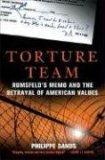
amazon-tortureteam.jpgDuring Detainee 063’s first few months at Guantánamo, the interrogators had followed established practices for military and law enforcement interrogations. Building rapport is the overriding aim of the US Army Field Manual 34-52, the rule book for military interrogators, colloquially referred to as “FM 34-52”. Legality was also essential, which meant operating in accordance with the rules set out in the US military’s Uniform Code of Military Justice and international law, in particular the four Geneva conventions.

At the heart of them lies “Common Article 3”, which expressly prohibits cruel treatment and torture, as well as “outrages upon personal dignity, in particular, humiliating and degrading treatment”. Tactics that had conformed to these principles changed dramatically. The interrogation log describes what happened immediately after Rumsfeld signed the Haynes memo.

The pattern was always the same: 20-hour interrogation sessions, followed by four hours of sleep. Sleep deprivation appears as a central theme, along with stress positions and constant humiliation, including sexual humiliation. These techniques were supplemented by the use of water, regular bouts of dehydration, the use of IV tubes, loud noise (the music of Christina Aguilera was blasted out in the first days of the new regime), nudity, female contact, pin-ups. An interrogator even tied a leash to him, led him around the room and forced him to perform a series of dog tricks. He was forced to wear a woman’s bra and a thong was placed on his head.

Rumsfeld led the charge for war in Iraq; in part he did so because of Saddam Hussein’s contempt for human life. “Torture is systematic in Iraq, and the most senior officials in the regime are involved,” Rumsfeld said, a few months before Saddam was overthrown. “Electric shock, eye gouging, acid baths, lengthy confinement in small metal boxes are only some of the crimes committed by this regime.” He spoke those words one day after secretly signing the Haynes memo and approving his own techniques of aggressive interrogation at Guantánamo.

Ironically, it was the Iraq war – in particular, events at Abu Ghraib prison – that brought the Haynes memo into the open two years later. By the autumn of 2003, Abu Ghraib was being run by the US as a detention facility. On April 28 2004, a CBS television report revealed the nature and scale of abuse being inflicted upon Iraqi prisoners. Photographs taken by US military participants were published, including one, now notorious, showing a prisoner standing on a box with his head covered and wires attached to his fingers. Another showed Private Lynndie England holding a leash tied to the neck of a naked man on the floor.

Was there a connection between the abuses at Abu Ghraib and the Bush administration’s secret interrogation policies at other places, including Guantánamo? In June 2004, President Bush, hosting the G8 summit in Savannah, Georgia, was asked by the media if he had authorised any kind of interrogation techniques necessary to pursue the “war on terror”? No, he said, his authorisation was that anything the US did would conform to US law and be consistent with international treaty obligations. “We’re a nation of law. We adhere to laws. We have laws on the books.”

Four days later, the administration unexpectedly declassified and released a number of documents relating to interrogation in the belief that this would reflect the thorough process of deliberation that, it was claimed, took place, and demonstrate a commitment to the rule of law. At the briefing, conducted by three lawyers from Bush’s inner circle, Alberto Gonzales, the president’s counsel, Jim Haynes from the Defence Department, and his deputy, Dan Dell’Orto, it was made clear that particular documents were crucial: the Haynes memo, and a decision taken a few months previously by the president, on February 7 2002, that none of the detainees at Guantánamo, whether Taliban or al-Qaida, could rely on any of the protections granted by the Geneva conventions, not even Common Article 3.

The second set of documents were legal opinions issued on August 1 2002. One of these, by two senior lawyers at the Justice Department, concluded that physical torture occurred only when the pain was “equivalent in intensity to the pain accompanying serious physical injury, such as organ failure, impairment of bodily functions, or even death”. Mental torture required “lasting psychological harm”. The memo concluded that torture of suspected terrorists under interrogation would not be unlawful if it could be justified on grounds of necessity or self-defence.

On October 11 2002, Guantánamo had request that additional techniques beyond those in FM 34-52 be approved for use against high-value detainees, in particular a Saudi Arabian, Mohammed al-Qahtani – otherwise known as Detainee 063. The underlying message of the briefing was spelled out: Rumsfeld had merely responded to a request from Guantánamo, and in doing so had acted reasonably. By contrast, the abuses at Abu Ghraib were unauthorised and unconnected to actual policies.

Much later, in March 2006, Time magazine published on its website the interrogation log of Detainee 063. Some of the Abu Ghraib images bore a resemblance to what Detainee 063 had been through: humiliation, stress, hooding, nudity, female interrogators, shackles, dogs. Was this just a coincidence? [complete article]

Facebooktwittermail

FEATURE: Why Bush should reflect on Pinochet

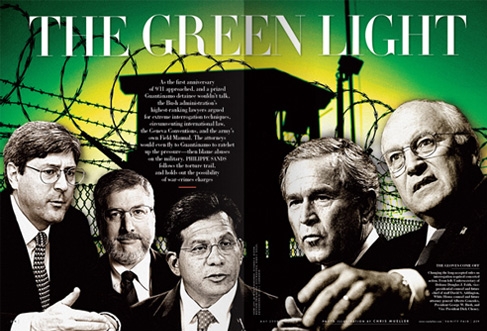
The green light

greenlight.jpg
The abuse, rising to the level of torture, of those captured and detained in the war on terror is a defining feature of the presidency of George W. Bush. Its military beginnings, however, lie not in Abu Ghraib, as is commonly thought, or in the “rendition” of prisoners to other countries for questioning, but in the treatment of the very first prisoners at Guantanamo. Starting in late 2002 a detainee bearing the number 063 was tortured over a period of more than seven weeks. In his story lies the answer to a crucial question: How was the decision made to let the U.S. military start using coercive interrogations at Guantanamo?

The Bush administration has always taken refuge behind a “trickle up” explanation: that is, the decision was generated by military commanders and interrogators on the ground. This explanation is false. The origins lie in actions taken at the very highest levels of the administration—by some of the most senior personal advisers to the president, the vice president, and the secretary of defense. At the heart of the matter stand several political appointees—lawyers—who, it can be argued, broke their ethical codes of conduct and took themselves into a zone of international criminality, where formal investigation is now a very real option. This is the story of how the torture at Guantanamo began, and how it spread. [complete article]

Facebooktwittermail

OPINION: Ordinary evil

The ultimate casualty

You know him well. His nickname was Gilligan, and he was a prisoner at Abu Ghraib, Saddam Hussein’s vast prison transformed into a vast American one and then transformed again by the Bush administration into a vast national disgrace. Gilligan was deprived of sleep, forced to stand on a small box, hooded like some medieval apparition, wired like a makeshift lamp and told (falsely) that if he fell he would be electrocuted. He was later released. Wrong man. Sorry.

The story of Gilligan is recounted in a forthcoming book and movie, both titled “Standard Operating Procedure” because that is precisely what the abuse of prisoners was at Abu Ghraib. Much of the book, written by Philip Gourevitch and Errol Morris (he made the documentary) and excerpted in last week’s New Yorker, relies on the verbatim testimony of the Americans who staffed Abu Ghraib. Some of them were the very ones who took the revolting pictures — including the iconic photo of Gilligan — that stunned the world.

What the interviews make clear is how pervasive and public the abuse of prisoners had been. Physical and mental abuse was conducted in the open. Photos were taken and passed up the chain of command. “Sleep deprivation, sexual humiliation, sensory disorientation and the imposition of physical and psychological pain,” Gourevitch and Morris write, were all permitted under the makeshift rules of the camp.

“They couldn’t say that we broke the rules because there were no rules,” said an Army reservist named Megan Ambuhl. Others talked of something even more insidious: the growing tolerance for inflicting pain. This is the stuff of famous psychology experiments (Milgram, etc.), but it also reminds me — and I know this is the extreme case — of the willingness of ordinary German soldiers in World War II to spend whole days in the routine murder of civilians. [complete article]

Facebooktwittermail

OPINION & FEATURE: American torture past and present

Debating torture and counterinsurgency — a century ago

Many Americans were puzzled by the news, in 1902, that United States soldiers were torturing Filipinos with water. The United States, throughout its emergence as a world power, had spoken the language of liberation, rescue, and freedom. This was the language that, when coupled with expanding military and commercial ambitions, had helped launch two very different wars. The first had been in 1898, against Spain, whose remaining empire was crumbling in the face of popular revolts in two of its colonies, Cuba and the Philippines. The brief campaign was pitched to the American public in terms of freedom and national honor (the U.S.S. Maine had blown up mysteriously in Havana Harbor), rather than of sugar and naval bases, and resulted in a formally independent Cuba.

The Americans were not done liberating. Rising trade in East Asia suggested to imperialists that the Philippines, Spain’s largest colony, might serve as an effective “stepping stone” to China’s markets. U.S. naval plans included provisions for an attack on the Spanish Navy in the event of war, and led to a decisive victory against the Spanish fleet at Manila Bay in May, 1898. Shortly afterward, Commodore George Dewey returned the exiled Filipino revolutionary Emilio Aguinaldo to the islands. Aguinaldo defeated Spanish forces on land, declared the Philippines independent in June, and organized a government led by the Philippine élite.

During the next half year, it became clear that American and Filipino visions for the islands’ future were at odds. U.S. forces seized Manila from Spain—keeping the army of their ostensible ally Aguinaldo from entering the city—and President William McKinley refused to recognize Filipino claims to independence, pushing his negotiators to demand that Spain cede sovereignty over the islands to the United States, while talking about Filipinos’ need for “benevolent assimilation.” Aguinaldo and some of his advisers, who had been inspired by the United States as a model republic and had greeted its soldiers as liberators, became increasingly suspicious of American motivations. When, after a period of mounting tensions, a U.S. sentry fired on Filipino soldiers outside Manila in February, 1899, the second war erupted, just days before the Senate ratified a treaty with Spain securing American sovereignty over the islands in exchange for twenty million dollars. In the next three years, U.S. troops waged a war to “free” the islands’ population from the regime that Aguinaldo had established. The conflict cost the lives of hundreds of thousands of Filipinos and about four thousand U.S. soldiers.

Within the first year of the war, news of atrocities by U.S. forces—the torching of villages, the killing of prisoners—began to appear in American newspapers. Although the U.S. military censored outgoing cables, stories crossed the Pacific through the mail, which wasn’t censored. Soldiers, in their letters home, wrote about extreme violence against Filipinos, alongside complaints about the weather, the food, and their officers; and some of these letters were published in home-town newspapers. A letter by A. F. Miller, of the 32nd Volunteer Infantry Regiment, published in the Omaha World-Herald in May, 1900, told of how Miller’s unit uncovered hidden weapons by subjecting a prisoner to what he and others called the “water cure.” “Now, this is the way we give them the water cure,” he explained. “Lay them on their backs, a man standing on each hand and each foot, then put a round stick in the mouth and pour a pail of water in the mouth and nose, and if they don’t give up pour in another pail. They swell up like toads. I’ll tell you it is a terrible torture.” [complete article]

The timing of the Guantanamo trials is not an accident

During the course of my career as a defense lawyer in the military, I’ve shrugged off many government conspiracy theories. Each time I heard one, I’d smile and say that one should never attribute to a vast government conspiracy acts that can be as readily attributed to mere government incompetence or accident. So, I did not initially assume any concerted plan or purpose behind recent activities at Guantanamo Bay.

But the government’s latest moves in the ongoing battle over the legality of its detention policies are anything but incompetent, and they’ve forced me to reassess my initial conclusion: The decision to try six Guantanamo detainees using military commissions is very clearly part of a concerted effort to use the Guantanamo commissions to subvert the goals of justice and to maintain a veil of secrecy around its questionable interrogation policies. [complete article]

Facebooktwittermail

NEWS & OPINION: Faith in elimination

Israel’s self-defeating ‘liquidation’

If a person in the street were asked to name the area of enterprise in which we Israelis excel, his answer would probably be: Hi-Tech. And indeed, in this area we have recorded some impressive achievements. It seems as if hardly a day passes without an Israeli start-up company that was born in a garage being sold for hundreds of millions. Little Israel is one of the major hi-tech powers in the world. But the profession in which Israel is not only one of the biggest, but the unchallenged Numero Uno is: liquidations.

This week this was proven once again. The Hebrew verb “lekhassel” – liquidate – in all its grammatical forms, currently dominates our public discourse. Respected professors debate with academic solemnity when to “liquidate” and whom. Used generals discuss with professional zeal the technicalities of “liquidation”, its rules and methods. Shrewd politicians compete with each other about the number and status of the candidates for “liquidation”.

Indeed, for a long time now there has not been such an orgy of jubilation and self-congratulation in the Israeli media as there was this week. Every reporter, every commentator, every political hack, every transient celeb interviewed on TV, on the radio and in the newspapers, was radiant with pride. We have done it! We have succeeded! We have “liquidated” Imad Mughniyeh! [complete article]

Israel kills terror chief with headrest bomb

At 10.35pm he decided to go home. Having exchanged customary kisses with his host, Hojatoleslam Ahmad Musavi, the newly appointed Iranian ambassador, Mughniyeh stepped into the night.

Minutes later he was seated in his silver Mitsubishi Pajero in a nearby street when a deafening blast ripped the car apart and killed him instantly.

According to Israeli intelligence sources, someone had replaced the headrest of the driver’s seat with another containing a small high-explosive charge. Israel welcomed his death but the prime minister’s office denied responsibility. Hezbollah accused the “Zionist Israelis” of killing its “brother commander” but believed the explosive had been detonated in another car by satellite.
[…]
Informed Israeli sources said that at the time of his death Mughniyeh was working for the Syrians on a terrorist attack against Israeli targets. This was to avenge Israel’s airstrike on what was believed to be a secret nuclear site in Syria last year. [complete article]

Israel’s ‘non-denial denial’ in Hezbollah death

Did they or didn’t they?

The question is still rippling across the world today. Did Israel have a hand in Tuesday’s assassination of one of its most despised enemies, the Hezbollah commander Imad Mughniyeh?

The answer remains unclear, but one thing is absolutely, positively certain: Israel has not denied it.

Several international news outlets continue today to mistakenly report that Israel has denied killing Mughniyeh. But Israel has done nothing of the sort. [complete article]

Facebooktwittermail

NEWS: American lessons on torture

Justice official defends rough CIA interrogations

The Bush administration allowed CIA interrogators to use tactics that were “quite distressing, uncomfortable, even frightening,” as long as they did not cause enough severe and lasting pain to constitute illegal torture, a senior Justice Department official said last week.

In testimony before a House subcommittee, Steven G. Bradbury, the acting chief of the Justice Department’s Office of Legal Counsel, spelled out how the administration regulated the CIA’s use of rough tactics and offered new details of how simulated drowning was used to compel disclosures by prisoners suspected of being al-Qaeda members.

The method was not, he said, like the “water torture” used during the Spanish Inquisition and by autocratic governments into the 20th century, but was subject to “strict time limits, safeguards, restrictions.” He added, “The only thing in common is, I think, the use of water.”

Bradbury indicated that no water entered the lungs of the three prisoners who were subjected to the practice, lending credence to previous accounts that the noses and mouths of CIA captives were covered in cloth or cellophane. Cellophane could pose a serious asphyxiation risk, torture experts said.

Bradbury’s unusually frank testimony Thursday before the House Judiciary Committee subcommittee stunned many civil liberties advocates and outside legal scholars who have long criticized the Bush administration’s secretive and aggressive interrogation policies.

Martin S. Lederman, a former Office of Legal Counsel official who teaches law at Georgetown University, called Bradbury’s testimony “chilling.” In an online posting, Lederman said that “to say that this is not severe physical suffering — is not torture — is absurd. And to invoke the defense that what the Spanish Inquisition did was worse and that we use a more benign, non-torture form of waterboarding . . . is obscene.” [complete article]

Facebooktwittermail

NEWS, OPINION & EDITOR’S COMMENT: The atrophy of conscience

Anybody’s guess

It’s been a banner week for water-boarding. This centuries-old practice of simulated drowning to extract false confessions and false testimony has really benefited of late from a good old legal reassessment and a smoking-hot PR campaign. In the course of a few short years, water-boarding has morphed from torture that unquestionably violates both federal and international law to an indispensable tool in the fight against terror. [complete article]

Waterboarding should be prosecuted as torture: U.N.

The controversial interrogation technique known as waterboarding and used by the United States qualifies as torture, the U.N. human rights chief said on Friday.

“I would have no problems with describing this practice as falling under the prohibition of torture,” the U.N. High Commissioner for Human Rights, Louise Arbour, told a news conference in Mexico City. [complete article]

Cheney defends U.S. use of waterboarding

The debate over waterboarding flared Thursday on Capitol Hill, with the CIA director raising doubts about whether it’s currently legal and the attorney general refusing to investigate U.S. interrogators who have used the technique on terror detainees.

Vice President Dick Cheney, meanwhile, said “it’s a good thing” that top al Qaeda figures underwent the harsh interrogation tactic in 2002 and 2003, claiming they were forced to give up information that helped protect the country and saved “thousands” of American lives. [complete article]

Justice Dept. ‘cannot’ probe waterboarding, Mukasey says

The attorney general yesterday rejected growing congressional calls for a criminal investigation of the CIA’s use of simulated drownings to extract information from its detainees, as Vice President Cheney called it a “good thing” that the CIA was able to learn what it did from those subjected to the practice.

The remarks reflected a renewed effort by the Bush administration to defend its past approval of the interrogation tactic known as waterboarding, which some lawmakers, human rights experts and international lawyers have described as illegal torture. [complete article]

CIA chief doubts tactic to interrogate is still legal

Gen. Michael V. Hayden, the director of the Central Intelligence Agency, told a Congressional committee on Thursday that waterboarding may be illegal under current law, despite assertions this week from the director of national intelligence and the White House that the harsh interrogation method may be used in the future.

General Hayden said that while “all the techniques we’ve used have been deemed to be lawful,” laws have changed since waterboarding was last used nearly five years ago.

“It is not included in the current program, and in my own view, the view of my lawyers and the Department of Justice, it is not certain that the technique would be considered to be lawful under current statute,” General Hayden said before the House Intelligence Committee. [complete article]

Waterboarding: Two questions for Michael Hayden

My questions for Mr. Hayden are simple. Firstly, if it’s true that only three detainees were subjected to waterboarding, then why did a number of “former and current intelligence officers and supervisors” tell ABC News in November 2005 that “a dozen top al-Qaeda targets incarcerated in isolation at secret locations on military bases in regions from Asia to Eastern Europe” were subjected to six “Enhanced Interrogation Techniques,” instituted in mid-March 2002?

According to the ABC News account, the six techniques used by the CIA on the “dozen top al-Qaeda targets” were “The Attention Grab,” “Attention Slap,” “The Belly Slap” and three other techniques that are particularly worrying: “Long Time Standing,” “The Cold Cell,” and, of course, “Waterboarding.”

“Long Time Standing” was described as “among the most effective [techniques],” in which prisoners “are forced to stand, handcuffed and with their feet shackled to an eye bolt in the floor for more than 40 hours.” The ABC News report added, “Exhaustion and sleep deprivation are effective in yielding confessions.” In “The Cold Cell,” the prisoner “is left to stand naked in a cell kept near 50 degrees. Throughout the time in the cell the prisoner is doused with cold water.”

The description of “Waterboarding” was as follows: “The prisoner is bound to an inclined board, feet raised and head slightly below the feet. Cellophane is wrapped over the prisoner’s face and water is poured over him. Unavoidably, the gag reflex kicks in and a terrifying fear of drowning leads to almost instant pleas to bring the treatment to a halt.” [complete article]

Editor’s Comment — There’s a simple reason why the simple-minded don’t think that waterboarding is torture. In “real” torture, the person being tortured is the innocent victim; the torturer is the evil party. When Cheney ventured over to the dark side it was in order to give good people the freedom to do bad things to bad people. If the person being tortured is bad, then it can’t be torture. It’s perverse logic but it explains how a vice president with a twisted mind can have a “clean” conscience.

Facebooktwittermail