Category Archives: Israel lobby

Why the US will not cut aid to Israel

Department of meaningless gestures

Two eminent mainstream journalists — Tom Friedman and Joe Klein — recently called for United States to disengage from the Israeli-Palestinian peace process, on the grounds that Palestinians were too divided to make a deal and the Israelis were not interested in one. Friedman couldn’t bring himself to draw the logical conclusion — if the United States [is] truly going to “disengage,” that also means cutting off its economic and military assistance — but Klein did.

I have a certain sympathy for this position (and even wrote similar things myself before I wised up), but there are two problems with this specific idea. The first is that it is a meaningless prescription: There’s no way to cut the aid package (or even put a hold on it, which is what Klein recommends) so long as Congress is in hock to AIPAC and the other groups in the status quo lobby. And unless I’ve missed something, I doubt groups like J Street would support it either.

Friedman and Klein’s statements do convey how discourse in the United States is changing, but the specific recommendation they offer here is a non-starter. Remember: we are dealing with a Congress that just voted to condemn the Goldstone Report by a vote of 344-24. The aid package may be indirectly subsidizing the settlements and threatening Israel’s future as a Jewish majority state, but a supine House and Senate will still sign the annual check. [continued…]

Editor’s Comment — The perennial debate on whether the US will ever find the will to cut off aid to Israel invariably misses what is ultimately probably the most important sticking point: a lion’s share of the money that Congress allocates as foreign military aid ends up going back into the US economy. Members of Congress face pressure not only from the Israel lobby but also the defense industry lobby and in many cases their own constituents to keep on doling out the cash.

The Israeli government is currently in the process of negotiating its largest military purchase ever: 25 F-35 fighters at a cost of $3.25 billion, paid to Lockheed-Martin who will start delivery in 2014. Interestingly, Israel has the ability to allocate funds coming from US taxpayers that will appear in US budgets that have yet to be passed or even drafted by Congress!

So, if the White House is not about to call on Congress to cut back on aid to Israel, the one lever over which it retains absolute control is the way the US casts votes in the UN Security Council. I’m not holding my breath waiting for any surprises there.

Perhaps more significant than anything happening (or not happening) in Washington, is the process unfolding around the globe through which Israel is inexorably losing its legitimacy.

When Michael Oren, the Israeli ambassador to the US, warns about the delegitimization of Israel he is giving voice to a real fear among Israelis. That fear is given form when people such as the French Foreign Minister Bernard Kouchner says Israel does not want peace:

“What really hurts me, and this shocks us, is that before there used to be a great peace movement in Israel. There was a left that made itself heard and a real desire for peace,” Kouchner said on France Inter radio.

“It seems to me, and I hope that I am completely wrong, that this desire has completely vanished, as though people no longer believe in it,” he added.

Israel clings to a tenuous claim to being a peace-loving nation. Once the world completely loses faith in that notion, the path to pariah status will be hard to avoid.


Facebooktwittermail

Is using aid to Israel as leverage becoming a mainstream idea?

Is using aid to Israel as leverage becoming a mainstream idea?

Tom Friedman today has some very harsh words for both the Israelis and Palestinians, both of whom — he claims — are not serious about reaching a peace agreement. As a result, these are the principles which Friedman — rather surprisingly — advocates the U.S. should follow:

Let’s just get out of the picture. Let all these leaders stand in front of their own people and tell them the truth: “My fellow citizens: Nothing is happening; nothing is going to happen. It’s just you and me and the problem we own.”

Indeed, it’s time for us to dust off James Baker’s line: “When you’re serious, give us a call: 202-456-1414. Ask for Barack. Otherwise, stay out of our lives. We have our own country to fix.” …

If the status quo is this tolerable for the parties, then I say, let them enjoy it. I just don’t want to subsidize it or anesthetize it anymore. We need to fix America. If and when they get serious, they’ll find us.

The only specific course of action Friedman explicitly advocates to fulfill those principles is that the U.S. cease its efforts to forge a resolution of the Israeli-Palestinian conflict and stop trying to pressure them into concessions, instead leaving each side to stew in the status quo — in other words, do exactly that which the Netanyahu government would like most. That would be a perfectly fine suggestion if not for the fact that the U.S. is heavily invested in the outcome of that process and its interests substantially and directly impacted by what happens. That’s because we single-handedly enable Israeli behavior with our massive amounts of military aid, diplomatic protection, and weapons supplying, which means Israeli behavior is rationally perceived by much of the Muslim world as being one and the same as American behavior. Muslim anger towards Israel will inevitably translate into Muslim anger towards the U.S. for as long as we continue to flood Israel with aid and cover. [continued…]

Israel’s apartheid is worse than South Africa’s

Regardless of whether there is a Democrat or a Republican in the White House, the United States became a distinctly pro-Israel world power after the 1967 war. It has no intention of being a “balanced mediator” when it comes to the conflict with the Palestinians.

Barack Obama’s public relations moves in the Arab world have frightened many average Israelis. But Netanyahu and Ehud Barak, allies of the final takeover of the West Bank, know very well that U.S. policy has not changed. It doesn’t take a genius to read the working papers of past prime ministers.

The prevailing attitude of all U.S. administrations was drafted by Henry Morgenthau, and was later updated by Kenneth Waltz. One line guided all of them – Dennis Ross, Martin Indyk, George Mitchell – essentially, that any possible settlement must match the positions of the stronger party. [continued…]

Abbas charts new course by abandoning faith in the US

‘Who lost China?” was the battle cry of a witch-hunt conducted in the US State Department following the 1949 victory of Mao Zedong’s communists. The department’s “China hands”, critics charged, had been woefully ignorant of the dynamics at work on the ground in China after the Second World War, and undermined the US ally Chiang Kai-shek. While the purge that followed is unlikely to be repeated, Washington may soon be asking itself, albeit quietly, “Who lost Fatah?”

Last week’s announcement by the Palestinian president Mahmoud Abbas that he would not seek re-election next January was a warning to the Obama administration, which had put Mr Abbas in an untenable position. Having retreated from its own demand that Israel halt all construction in East Jerusalem and the West Bank, Washington expected Mr Abbas to open talks with the Israeli prime minister Benjamin Netanyahu without conditions.

For the Palestinians, however, the settlement-freeze demand was a test of Mr Obama’s willingness to pressure the Israelis into taking steps they won’t take by choice. Mr Abbas knows that Mr Netanyahu, if it were up to him, would not yield to a viable, independent Palestinian state based on the 1967 borders. If the US is not prepared to pressure Israel, negotiations would not only be fruitless, they would actually help sustain a reality that is relatively comfortable for the Israelis but intolerable for the Palestinians. [continued…]

U.N.’s Goldstone criticizes U.S. reaction to Gaza report

The head of a U.N. investigation that accused Israel of war crimes in Gaza, Richard Goldstone, has said he is disappointed there has been such a “lukewarm” reaction to his findings in the United States.

The report by Goldstone, a South African jurist, lambasted both sides in the December-January war, which killed up to 1,387 Palestinians and 13 Israelis, but was harsher toward Israel.

It gave Israel and Palestinian Hamas militants six months to mount credible investigations or face possible prosecution in The Hague. Both Israel and Hamas denied committing war crimes. [continued…]

Facebooktwittermail

Congressman speaks out in defense of the Goldstone report

Baird on HR 867: ‘This is about whether it is right to restrict the movements and hopes of more than 1 million people every single day’

From the great Congressman Brian Baird, the clinical psychologist who represents Rachel Corrie’s district in Washington, and who has been to Gaza, warning his fellows about the vote today on a resolution to condemn the Goldstone report:

Before House Members vote on H.Res. 867, regarding the U.N. Goldstone report on the Gaza conflict, there are a few questions worth asking.

First, why are we bringing this resolution to the floor without ever giving former South African Constitutional Court Justice Richard Goldstone a hearing to explain his findings? Have those who will vote on H.Res. 867 actually read the resolution? Have they read the Goldstone report? Are they aware that Justice Goldstone has issued a paragraph-by-paragraph response, available on my Web site at baird.house.gov, to H.Res. 867 pointing out that many of its assertions are factually inaccurate or deeply misleading?

Since scarcely a dozen House Members have actually been to Gaza , what actual firsthand knowledge do the rest of the Members of Congress possess on which to base their judgment of the merits of H.Res. 867 or the Goldstone report? [continued…]

Facebooktwittermail

NIAC and J Street, progressive foreign policy groups, become political targets

NIAC and J Street, progressive foreign policy groups, become political targets

In the usually wonky world of non-profit issue-advocacy organizations, a decidedly political campaign has been waged against foreign policy institutions that promote diplomacy over militarism.

Two relatively new organizations — each covering distinctly opposite ends on the spectrum of Middle Eastern affairs — have been the target of withering public relations attacks in recent weeks and months.

The National Iranian American Council (NIAC), an organization that promotes diplomatic engagement between the U.S. and Iran, sprung to prominence recently for its active media presence in the aftermath of Iran’s disputed elections though its influence in the nation’s capital had been felt long before then. But as NIAC’s voice grew louder in foreign policy circles, so too did the vehemence of its critics. [continued…]

Facebooktwittermail

Two-State Solution: The Broadway Musical

Two-State Solution: The Broadway Musical

Remember a mere five months ago when Hillary Clinton, with all the toughness she had displayed during her primary campaign, said bluntly: “[Obama] wants to see a stop to settlements — not some settlements, not outposts, not ‘natural growth’ exceptions”?

The whole administration — presumably with expert coaching by Rahm Emanuel — was sending a strong message to Israel: We know your games and we’re not going to take any crap.

Freezing settlements — this was the litmus test for Benjamin Netanyahu to demonstrate his ability to engage in the so-called peace process.

Within a few weeks the administration’s Iran policy was in disarray — in the aftermath of the disputed presidential election — and terrified of the charge that he was being tough on Israel while soft on Iran, Obama’s resolve withered. Netanyahu bounced back and he has been riding high ever since.

Back in June, Netanyahu was admonished for not doing his homework. Now he’s thrown it in the trash and gets praise for offering “restraint on the policy of settlements” — even as Israel demolishes Palestinian homes in East Jerusalem and Palestinian citizens of Israel protest against the ethnic cleansing of Jerusalem.

Meanwhile, as Netanyahu mocks the idea that Washington has the capacity or will to apply pressure on an Israeli government, J Street, “the political arm of the pro-Israel, pro-peace movement,” after launching itself onto the stage of mainstream American politics through its first national conference last week, must somehow strive to keep the two-state-solution dream alive.

The two-state solution is indeed the stuff of dreams — at least the dreams of Zionists who find the idea of equality between Jews and non-Jews abhorrent, or as J Street’s Jeremy Ben-Ami puts it, “a nightmare for the Jewish people.”

Perhaps Washington is not the best place for dream believers. Maybe it’s time for a glitzy Two-State Solution on Broadway.

Oh look!

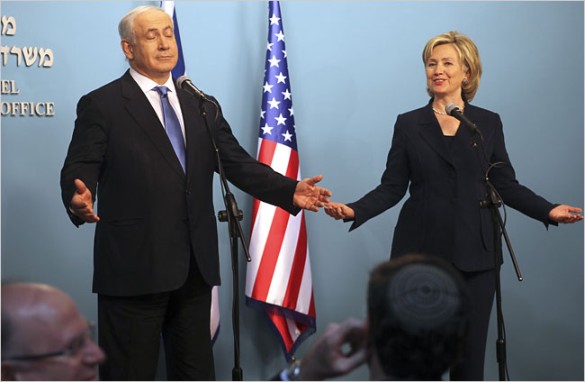
Bibi and Hillary are already auditioning.

J Street: Do we really need another Jewish-only road?

If you’re Palestinian, you know about checkpoints. There are over 600 checkpoints in the West Bank alone. They block, obstruct, frustrate and kill. Women die in childbirth at checkpoints, students are kept from attending school, parents from visiting their children, laborers from going to work. No one can swim in the sea. Israeli Jews are waved through checkpoints. They can swim in the sea. No problem. Jews travel freely on a complex system of Jewish-only roads and live on the Jewish side of the Separation Barriers along hundreds of miles of walls and fortified fences that keep Palestinians out. Palestinians live in an open air prison. Sometimes there is a moment of spring and the guards open the gates. But spring never lasts long. Blockades, nightly incursions, full-scale invasions, imprisonment, collective punishment, land theft, water theft, denial of education, health care, an economic future, frequent beatings and no freedom of movement is the daily bread of Palestinians. You can’t travel more than three miles without encountering a check point. Talk about stress.

J Street was a place where Jews talked to Jews about the Israeli-Palestinian conflict. Few Palestinians were present. Apparently they didn’t make it through the checkpoint. The narrative of J Street, like most Jewish narratives about the Israeli-Palestinian conflict, reflects the nature of the conflict as seen through a Jewish lens: Palestinians are physically absent. A Jew who seeks to express her activism in solidarity with Palestinians is in danger of loosing her ‘I love Israel’ card at a mainstream Jewish checkpoint. There were checkpoints at J Street. Some people were allowed in but not officially asked to participate, some were dis-invited, and some were not considered to be part of the conversation in the first place. [continued…]

Editor’s Comment — As Ahmed Moor eloquently puts it:

A purely Jewish focus on a more-than-Jewish problem causes many leftist Jews to take a paternalistic view of Palestinians. Rather than equals whose inalienable rights form the crux of the case against Zionism, the Palestinians are the clay of Jewish humanism, waiting to be fully actualized by thoughtful and reflective Jewish hands.

Facebooktwittermail

America, stop sucking up to Israel

America, stop sucking up to Israel

Now is the time to say to the United States: Enough flattery. If you don’t change the tone, nothing will change. As long as Israel feels the United States is in its pocket, and that America’s automatic veto will save it from condemnations and sanctions, that it will receive massive aid unconditionally, and that it can continue waging punitive, lethal campaigns without a word from Washington, killing, destroying and imprisoning without the world’s policeman making a sound, it will continue in its ways.

Illegal acts like the occupation and settlement expansion, and offensives that may have involved war crimes, as in Gaza, deserve a different approach. If America and the world had issued condemnations after Operation Summer Rains in 2006 – which left 400 Palestinians dead and severe infrastructure damage in the first major operation in Gaza since the disengagement – then Operation Cast Lead never would have been launched.

It is true that unlike all the world’s other troublemakers, Israel is viewed as a Western democracy, but Israel of 2009 is a country whose language is force. Anwar Sadat may have been the last leader to win our hearts with optimistic, hope-igniting speeches. If he were to visit Israel today, he would be jeered off the stage. The Syrian president pleads for peace and Israel callously dismisses him, the United States begs for a settlement freeze and Israel turns up its nose. This is what happens when there are no consequences for Israel’s inaction. [continued…]

Justice Goldstone and the Jews

We Jews should be very proud of Richard Goldstone. In an ancient tradition of Jewish self-questioning and uncomfortable truth-telling, the author of the recent report from the UN Fact Finding Mission on the Gaza Conflict has braved personal vilification and institutional mendacity to describe the crimes committed by Israeli forces in the course of their invasion of Gaza in December 2008.

To be sure, the Goldstone Report also itemizes the crimes of Hamas, notably in its campaign of rocket-firing into Israel. But the scale of human rights abuses by Israel vastly outdoes anything Hamas could hope to have achieved: Israeli civilian victims of Hamas rocket attacks numbered less than ten. The attack on Gaza by the IDF resulted in at least 1,100 Palestinian civilian deaths. The major perpetrator of human rights abuses in this conflict is without question the State of Israel, and Justice Goldstone records as much.

That the Israel of Benjamin Netanyahu has chosen to conduct an international campaign against Justice Goldstone and his report need not surprise us. Israel refused to cooperate with the UN investigation; long before its conclusions were published, Netanyahu had set in motion a campaign to deny and denigrate them. More dispiriting, and of greater political consequence, is the pitiful and humiliating response of the Obama Administration. The “fierce urgency of now” apparently required that Washington join Tel Aviv in discrediting the Goldstone Report, and with it the UN inquiry. [continued…]

Israel wants to seek, not have, peace with Syria

It’s hard not to marvel at Defense Minister Ehud Barak’s rhetorical skills, how he constantly invents a new way – an original expression – to not say anything. Last week he described Syria as a “central brick in any stable peace agreement.” But there will be no peace with Syria because Israel, according to Barak, “has sought in the past and will continue to seek in the future ways to advance peace with Syria.”

Still, Syria will certainly earn a few more terms of endearment, maybe even move up from “central brick” to “cornerstone,” and if it behaves itself, “linchpin.” Who knows, Syria may even win the gold and become the “bedrock” of a stable peace agreement. But because Israel is so busy seeking ways to advance peace with Syria, there will be no peace. [continued…]

Gas from Gaza, mobile phones in Palestine and a $1m peace prize …Tony Blair and the Middle Eastern Eldorado

… a Mail on Sunday investigation reveals that [Tony Blair] has been mixing business with Middle East politics since the early years of his premiership and that, since becoming a part-time peace envoy on leaving office in 2007, he has exploited his superb contacts to pursue a multi-million-pound fortune.

Some of the most potentially lucrative of those relationships can be traced back to that BG Gaza gas deal – connections that helped pave the way to the opening up of the Arab world’s new Eldorado, the colossal and mostly untapped wealth of Colonel Gaddafi’s Libya.

‘In Arabic, there is a special word – “eghtina”,’ said Khadr Musleh, a political analyst in the Palestinian West Bank capital, Ramallah.

‘It means “self-enrichment through public office”. It doesn’t imply anything illegal and in the Middle East it’s considered totally normal. Yet it is a little surprising to see a former British Prime Minister and international peace envoy behaving in the same way.’

Blair’s Middle East-focused business career has been a triumph. The access to the region’s rulers conferred by his position as an ex-PM and peace envoy must have huge attraction for potential clients of Tony Blair Associates, the secretive ‘consultancy’ that does not publish accounts which he runs with Jonathan Powell, his former Downing Street chief of staff. Its first clients are two of the world’s richest families – the royals of Kuwait and Abu Dhabi.

Tony Blair Associates is modelled on Henry Kissinger Associates, an outfit led by President Nixon’s former Secretary of State. Fittingly, perhaps, Kissinger was on the jury that awarded Blair the $1million Dan David Prize earlier this year, the ‘Israeli Nobel Prize’. Like Blair, Kissinger is employed by American bank JP Morgan. The citation praised Blair’s ‘exceptional leadership’ and ‘moral courage’.

Blair has promised to give most of the prize to his Faith Foundation, a charity set up to promote religious understanding. Thanks to his lucrative contract to advise JP Morgan for a salary of £2million a year, he does not need the money. [continued…]

Prosecutor: top scientist Nozette admitted actual spying for Israel

Did a federal prosecutor just make the inflammatory accusation that top government scientist Stewart Nozette has admitted to giving classified information to the Israeli government?

By our reading of this AP story, that’s exactly what happened at a hearing in U.S. district court in Washington yesterday.

Nozette is accused of attempted espionage for allegedly selling classified information to an FBI employee posing as a Mossad agent. But the Feds have explicitly said that Israel is not accused of any wrongdoing. [continued…]

Facebooktwittermail

Palestinian equal rights joins the progressive agenda on ‘The Daily Show’

Palestinian equal rights joins the progressive agenda on ‘The Daily Show’

The Daily Show With Jon Stewart Mon – Thurs 11p / 10c
Exclusive – Anna Baltzer & Mustafa Barghouti Extended Interview Pt. 1
www.thedailyshow.com
Daily Show
Full Episodes
Political Humor Health Care Crisis
The Daily Show With Jon Stewart Mon – Thurs 11p / 10c
Exclusive – Anna Baltzer & Mustafa Barghouti Extended Interview Pt. 2
www.thedailyshow.com
Daily Show
Full Episodes
Political Humor Health Care Crisis

Throughout the day I had been hearing on the grapevine that The Daily Show was having second thoughts about doing the show as they had been getting pressure to cancel it. [continued…]

Editor’s Comment — During a week in which J Street — an organization that is attempting to break AIPAC’s stranglehold on the issue of US-Israeli relations — held its first national conference in Washington DC, it’s interesting that Jon Stewart took the opportunity to turn to the issue of the Israeli-Palestinian conflict not by inviting J Street’s Jeremy Ben-Ami onto the show but instead, as Adam Horowitz notes, “a Palestinian leader demanding equal rights and an anti-Zionist Jew calling for boycott, divestment and sanctions to pressure Israel towards peace.”

One of the disappointing features of the way the interview got edited for broadcast was that by cutting out much of the applause, the editors took out one of the most significant messages: the Palestinian issue, framed as one of freedom and human rights, resonated well with Jon Stewart’s audience.

While Stewart himself tended to stick to the well-worn tracks that this is a seemingly intractable conflict, that the Palestinians need to stop anti-Semitic incitement, that the Arabs need to do their bit, Barghouti’s constant refrain was that the core issue here is freedom.

That’s a message the J Street and its mainstream two-state-solution supporters really don’t want to see placed at the center of the conversation. They seem to view the conflict not in terms primarily of human rights but in terms of the need to preserve the Jewish state — a state in relation to which Palestinians pose a “demographic threat”. The urgency of implementing a two-state solution is that unless it can be done fast, Palestinians will demand equal rights in a single state — a state in which (thanks to the Greater Israel project that has been in motion for the last 42 years) Jews will be in a minority. That possibility is in the eyes of some, “horrific“.

Squaring the circle and erasing the margins

The mission to move US policy through reforming the Jewish community’s debate over Israel/Palestine has clear political implications. Ben-Ami ended the opening evening by saying the movement J Street is a part of is a “movement rooted in love of Israel,” and while all are welcomed to join J Street in its work, “the heart of this movement has to be in the Jewish community.” From this perspective, it was telling that Gaza was not mentioned once the entire evening (except by Rabbi Andy Bachman who said it was no longer occupied). There was only one panel during the entire conference dedicated to “Palestinian perspectives,” and even the closing panel called “Why Two States? Why Now?” only included speakers to explain Israeli interests and American interests in promoting two states. Two of the most moving parts of the conference for me was hearing Laila El-Haddad, from the Gaza Mom blog, describe life in still occupied Gaza on the unofficial blogger’s panel. She told a story about how her family was almost unable to leave Gaza to visit her in the US and she is totally unable to enter her homeland. Later, Bassim Khoury, the ex-Minister of National Economy for the Palestinian Authority who recently quit in protest to their reaction to the Goldstone report, demonstrated “Israeli apartheid” in Jerusalem through a power point presentation outlining the gross discrepancies in municipal funding between Jews and Palestinians in the city. Both presentation injected an intense dose of reality into a proceeding that seems to be chugging along more on vision and hope.

J Street represents a very important rupture and opportunity in the supposed American Jewish consensus over Israel/Palestine which should be celebrated. Pushing this wedge into the heart of the community could only be a good thing. But, the tenor and message of the J Street conference would seem to indicate that the struggle to end the Israeli-Palestinian conflict can only be lead by Jews, after we conquer our own internal issues to reform our community, and on our agenda. Meanwhile, Palestinians will have to continue to catch the brunt of the Israel everyone loves so much. [continued…]

Elie Wiesel’s shocking stage appearance with mad preacher and anti-Semite John Hagee

On October 25, while an overflow crowd of 1,500 poured into the first convention of the progressive-leaning Israel-oriented lobbying organization J Street, Elie Wiesel addressed a crowd of 6,000 Christian Zionists at Pastor John Hagee’s “Night To Honor Israel.” According to the San Antonio Express News, while Wiesel sat by his side, Hagee trashed President Barack Obama, baselessly accusing him of “being tougher on Israel than on Russia, Iran, China and North Korea.”

Meanwhile, Israeli Ambassador Michael Oren, who appeared at Hagee’s Christians United for Israel summit earlier this year, rejected J Street’s request to speak at their convention, instead dispatching a low-level embassy official to “observe” the event. Oren then accused J Street of “impair[ing] Israel’s interests.”

In blessing Hagee while damning J Street, Wiesel and Oren chose an anti-Semitic group led by a far-right End Times theology preacher over a fledgling progressive organization that bills itself as “pro-Israel, pro-peace.” And both Wiesel and Oren seem to be embroiled in yet another controversy over involvement with the extremist preacher. [continued…]

Facebooktwittermail

Obama’s Middle East mess

Obama’s Middle East mess

As Abbas falls, have no doubt that he got pushed by an inept administration that similarly gets weak-kneed whenever it feels pressure from either the Israel lobby or the Israeli government.

Yesterday, State Department spokesman, Ian Kelly, was asked: “What role specifically did the United States play in pressuring the Palestinian Authority to make that decision [to shelve the Goldstone report]?

Kelly, squirming like an eel, responded:

Well, I don’t know if I would accept your characterization of pressuring. I think that we recognized that we had serious concerns with the recommendations and some of the allegations. We felt very strongly that while these investigations should be investigated and addressed, that we thought on the one hand that Israel had the kind of institutions that could address these allegations. And of course, we urged Israel to address these very serious allegations.

But I think we had a broader concern that we didn’t want the report to distract us from our ultimate goal, which was to address the root causes of the tragic events of last January, and that’s the lack of a regional and lasting peace between the two parties – between the Israelis and the Palestinians. So we were concerned that we stay focused on that ultimate goal.

And we are not saying that the allegations in the report – we’re not saying that they should be ignored. We simply do not want the report itself to become any kind of impediment to this ultimate goal. We appreciate the seriousness with which the Palestinians approach this very, very difficult issue, and we respect this decision to defer discussion of the report to a later date for the reasons that I just stated – that we want to make sure that we stay focused on the ultimate goal here.

(Goldstone discussion begins at 6 minutes 55 seconds.)

What kind of tortured logic is this? On the one hand war crimes committed in Gaza are somehow extraneous to an understanding of the root causes of the conflict, yet the root cause of the conflict is conflict itself?

The administration needs to make up its mind: Either this conflict is all about violence, in which case Israeli violence can’t be ruled out of the equation. Or, the violence is merely symptomatic of underlying political injustices and a natural outcome of addressing those injustices will be a long sought peace. Take your pick.

Of course, the true sentiment that few American officials are crass enough to utter, yet apparently everyone believes, is that when Israelis kill hundreds of Palestinians they really don’t intend to kill any (“we shoot and we cry”), yet when Palestinians kill a dozen Israelis they merely fall short of accomplishing their genocidal intentions.

* * *

After taking stabs at solving the Middle East conflict, engaging Iran, bringing about global nuclear disarmament, healing the rift between Muslims and the West, shoring up the global financial system, tackling climate change and reforming America’s health care system, there are strong indications that Obama came into office intoxicated by his image as a world savior.

Even so, his cool created the impression that he might actually be impervious to the influence of adulation, but even though some of us thought he had risen above the massive projections that were being imposed on him, the evidence is that to some extent he got sucked into the myth that had been created around him.

To see Obama now as either a tragic figure or as the victim of circumstances essentially absolves him of responsibility for his own actions.

I don’t think it’s premature to be conducting an autopsy on Obama’s Middle East initiative and the first question to ask is this: Did he manage to cross the most minimal threshold for a defensible approach? That is, can he claim at least to have done no harm?

Unfortunately, the harm appears grossly evident and it hinges on his choice to raise expectations across the region and then allow those expectations to founder. Expectations dashed are much more destructive than expectations never formed. (George Bush never disappointed anyone because no one took his promises seriously. In office and life he mastered the art of setting a low bar.)

So, could Obama have entered the situation differently and put himself in a better position to at least live up to the Hippocratic oath (which, incidentally, all politicians should be forced to take)?

He could have acknowledged that he had on his plate more than any human president could address (“sorry folks, I’m not the Messiah”) and he could in his first days in office have said something like this:

“The Middle East conflict is a wound to which no easy remedy can be applied. I do not come into office claiming to have any greater powers than all of my predecessors who struggled with limited success to deal with this issue.

“I do know this, however: setting aside the many intractable political issues, there is right now a humanitarian crisis in Gaza. We haven’t had time to assess the scope of this crisis but having appointed George Mitchell as my Middle East peace envoy, I’ve asked him to put the crisis in Gaza at the top of his agenda. In the next few days he will be visiting the area to assess which needs must most urgently addressed.”

At that point, the Israel Lobby’s wheels would have started spinning frantically. But how do you conduct a campaign focused on preventing Mitchell going to Gaza and addressing a humanitarian crisis?

No doubt, phones in the White House and the State Department would have been ringing off the hook as Abe Foxman and other Jewish community leaders and Israeli officials objected, saying that such a move would not be “helpful”. But seriously, how do you conduct a public campaign whose direct aim is to prevent help reaching tens of thousands of people whose homes had been flattened?

What happened in reality? Obama and Mitchell made the choice of staying out of Gaza. Neither of them had a gun pointed at his head.

Obama had the opportunity to craft a policy that grew modestly and organically from the facts on the ground. A combination of fear, arrogance and perhaps lack of political imagination, led him to pass up that opportunity.

Facebooktwittermail

Settling for failure in the Middle East

Settling for failure in the Middle East

Like so many of his predecessors, President Obama is quickly discovering that persuading Israel to change course is nearly impossible.

Obama came to office determined to achieve a two-state solution between Israelis and Palestinians. His opening move was to insist that Israel stop building settlements in the West Bank and East Jerusalem — a tough line aimed at bolstering Palestinian President Mahmoud Abbas and persuading key Arab states to make conciliatory gestures toward Israel. These steps would pave the way for the creation of a viable Palestinian state and the normalization of Israel’s relations with its Arab neighbors, and also help rebuild America’s image in the Arab and Muslim world.

Unfortunately, Israeli Prime Minister Binyamin Netanyahu has no interest in a two-state solution, much less ending settlement expansion. He and his government want a “greater Israel,” which means maintaining effective control of the West Bank and Gaza. His response to Obama’s initiative has ranged from foot-dragging to outright defiance, with little pushback from Washington. [continued…]

Facebooktwittermail

How to put pressure on Netanyahu

How to put pressure on Netanyahu

Faced with the Israeli prime minister’s delaying tactics, President Obama, who has displayed both determination and extreme caution on this issue, is well aware that he may not be able to reduce the financial aid or lay so much as a finger on the military assistance provided by the United States to Israel every year. A decision of this kind, were it to be made, would immediately be perceived as a serious attack on Israel’s security and would inevitably result in an American Israel Public Affairs Committee intervention in Congress. While the pro-Israel lobbyists may feel uncomfortable about the Jewish settlements and can hardly contest the principle of a Palestinian state, at the same time they seem prepared to stand up to the White House in order to secure continued U.S. material and financial aid to Israel.

The Obama administration, nevertheless, has a number of effective levers that it can use to make the Israeli government give way. First, it can refrain from the systematic use of its Security Council veto in favor of Israel, and thus intensify the Jewish state’s diplomatic isolation. It can then gradually reduce the level of military cooperation in crucial areas where Israel is very dependent on the United States, such as intelligence, space, communications, detection and nuclear power.

It can also insist publicly that Israel join the Non-Proliferation Treaty review conference next year, as suggested by the State Department in May. This could force Israel to acknowledge openly its nuclear arsenal and to formalize a deterrence doctrine that could be applied against its potential adversaries — steps that so far the Israelis have refused to take.

Lastly, it can reduce its loan guarantees to Israel along the lines of the measures taken by James Baker in 1991-1992 to make Yitzhak Shamir agree to the Oslo peace process.

There is of course another simple, effective and relatively painless way to put pressure on the Israeli government without going to such extremes: The Obama administration merely needs to make the Israeli government understand that the strategic interests of the two countries no longer necessarily converge. It should then leave the Israelis out of the negotiations with Iran, informing them neither of the status of discussions nor of their content.

In so doing, U.S. negotiators would convey directly to the Israeli authorities the message that not all the issues of concern to Israel necessarily dominate Washington’s agenda and should not jeopardize the outcome of negotiations as a whole. This is guaranteed to make Jerusalem edgy. [continued…]

Editor’s Comment — The question is: does Obama have the will to apply any of these types of pressure?

Facebooktwittermail

US Jewish leaders push Obama to act on Iran

US Jewish leaders push Obama to act on Iran

Several hundred Jewish leaders and activists are planning to arrive here Thursday to urge top Obama administration officials and US congressmen to take action on Iran.

They are pushing for Congress to quickly pass an Iran sanctions bill sponsored by US House Foreign Affairs Committee Chairman Howard Berman and otherwise take serious economic and diplomatic steps to pressure Iran to abandon its pursuit of nuclear capabilities that threaten Israel.

“Congress is back, legislation is on the agenda, and this is September, when at some level decisions are being made in connection with Iran,” Anti-Defamation League Washington Director Jess Hordes said of the planning of the event.

His organization will be joining the United Jewish Communities, the Jewish Council for Public Affairs, the Conference of Presidents of Major American Jewish Organizations, the National Conference of Soviet Jewry and several other groups as part of the effort. [continued…]

U.S. says Iran could expedite nuclear bomb

American intelligence agencies have concluded in recent months that Iran has created enough nuclear fuel to make a rapid, if risky, sprint for a nuclear weapon. But new intelligence reports delivered to the White House say that the country has deliberately stopped short of the critical last steps to make a bomb.

In the first public acknowledgment of the intelligence findings, the American ambassador to the International Atomic Energy Agency declared on Wednesday that Iran now had what he called a “possible breakout capacity” if it decided to enrich its stockpile of uranium, converting it to bomb-grade material.

The statement by the ambassador, Glyn Davies, was intended to put pressure on American allies to move toward far more severe sanctions against Iran this month, perhaps including a cutoff of gasoline to the country, if it failed to take up President Obama’s invitation for serious negotiations. But it could also complicate the administration’s efforts to persuade an increasingly impatient Israeli government to give diplomacy more time to work, and hold off from a military strike against Iran’s facilities. [continued…]

Iran dims hopes for diplomacy

ran rejected any compromise with the West over its nuclear program Wednesday, as blunt comments from the Obama administration over Tehran’s bomb-making capability suggested that the two sides were headed toward a renewed diplomatic crisis.

Iran offered Western officials a long-awaited package of proposals to restart negotiations over its nuclear program. But diplomats who viewed the offer Wednesday said the document of fewer than 10 pages essentially ignored questions over Iran’s production of nuclear fuel and instead focused broadly on other international issues.

It made no mention of Tehran’s willingness to suspend its uranium-enrichment activities or to enter into substantive talks about the future of its nuclear program, they said. [continued…]

Russia ‘delivers SAMs to Syria’

Russia has begun deliveries of Pantsir S1 air-defense missiles to Syria, some of which are expected to be passed on to Iran, Syria’s strategic ally that has largely bankrolled the deal, according to the Interfax-AVN military news agency.

Interfax quoted Yuriy Savenkov, deputy director general of the Instrument Design Bureau, or KBP, as saying that deliveries started several weeks ago. KBP produces the Pantsir and other high-precision weapons.

Meantime, Kommersant quoted Alexei Fedorov, head of Russia’s United Aircraft Corp., as confirming the existence of a 2007 contract with Syria for eight twin-engined MiG-31E interceptors.

This aircraft, NATO codename Foxhound, can fly at three times the speed of sound and engage several targets at a range of up to 110 miles simultaneously. [continued…]

Taking Iran seriously

Given Iran’s shortening nuclear timetable and diplomatic challenges for forging an international consensus on sanctions, we urge Mr. Obama simultaneously to begin preparations for the use of military options. Now is the time for the president to reinforce his commitment to “use all elements of American power to prevent Iran from developing a nuclear weapon,” as he stated in February. We believe only a credible U.S. military threat can make possible a peaceful solution.

By showing that he has not taken the military option off the table, Mr. Obama may also be able to convince Israel to forgo a unilateral military strike while forcing Tehran to recognize the costs of its nuclear defiance. Furthermore, making preparations now will enable the president, should all other measures fail to bring Tehran to the negotiating table, to use military force to retard Iran’s nuclear program. We do not downplay the risks of this option and recognize its complications, but we do believe it to be a feasible option of last resort. [continued…]

Facebooktwittermail

The best Congress AIPAC can buy

The best Congress AIPAC can buy

Many Americans who thought that the health care debate was important must have wondered where their congressmen were in early August during the first two weeks of the House of Representatives recess. It turns out they were not hosting town hall meetings or listening to constituents because many of them were in Israel together with their spouses on a trip paid for by the American Israel Public Affairs Committee (AIPAC). Fully 13% of the entire US House of Representatives, 56 members, traveled to Israel in the largest AIPAC-sponsored fact-finding visit by American politicians ever conducted. And the leaders of the two congressional groups, 25 Republicans for a week starting on August 2nd followed by 31 Democrats beginning on August 13th, were drawn from the top ranks of their respective parties. House Minority whip Eric Cantor headed the Republican group and House Majority leader Steny Hoyer led the Democrats.

Cantor and Hoyer are longtime enthusiasts for Israel and all its works. In January, when Israel was pounding Gaza to rubble and killing over a thousand civilians, Hoyer and Cantor wrote an op-ed entitled “A Defensive War,” which began with “During this difficult war in the Gaza Strip, we stand with Israel.” Why? Because “Instead of building roads, bridges, schools and industry, Hamas and other terrorists wasted millions turning Gaza into an armory.” Hoyer and Cantor, clearly noticing a militarization of the Gaza Strip that no else quite picked up on, also affirmed that Israel occupied the moral high ground in the conflict, “While Israel targets military combatants, Hamas aims to kill as many civilians as possible.” That Hoyer and Cantor were completely wrong on this vital point as well as others, in fact reversing the truth, has never resulted in an apology or a correction of the record from either lawmaker. [continued…]

Facebooktwittermail

With Iran — slower, please!

Under pressure from hawks, Obama tacks to the right

In the face of mounting pressure from hawks in Washington and the continued threat of military action from Israel, the Barack Obama Administration has been taking a harder line in its latest pronouncements about Iran.

Recent media reports have suggested that the administration is leaning toward an end-of-September deadline for Tehran to respond to U.S. diplomatic outreach concerning its nuclear programme, at which point it will consider stepping up sanctions against the Iranian energy sector.

This course would cut against the advice of a growing number of Iran analysts, who have cautioned both that the Tehran regime is in no position to negotiate at the moment and that sanctions are likely only to solidify the power of Supreme Leader Ali Khamenei and President Mahmoud Ahmadinejad. [continued…]

Editor’s Comment — Barack Obama has crossed a politically dangerous threshold: from actor to reactor. It’s going to be hard reversing the trend.

In the next few weeks, suppose “the Iranians” — a collective noun that should at this point only appear in quotes since no one actually knows exactly who this refers to — suppose “the Iranians” come back with this as their response to Obama’s offer of talks:

We’re ready, but clearly you aren’t. Push your healthcare plan through Congress by the end of September and then we can talk. We can’t talk to you now — you’re administration is too weighed down by domestic political issues.

How dare “the Iranians” try and dictate American affairs, everyone in Washington would scream. Indeed, the idea that a complex piece of legislation could be advanced under arbitrary external pressure would be seen as absurd.

Meanwhile, Washington appears to have picked up Michael Ledeen’s favorite mantra: “faster, please!”

Wag the dog, again

Israeli media reports that visiting National Security Adviser General Jim Jones and Secretary of Defense Robert Gates have told the government of Prime Minister Benjamin Netanyahu to stop complaining about Iran because the US is preparing to take action “in eight weeks” demonstrate that even when everything changes in Washington, nothing changes. President Barack Obama has claimed that a peaceful settlement of the Palestinian-Israeli conflict is a high priority but the Israelis and their allies in congress and the media have been able to stonewall the issue. Israel has made no concessions on its settlement policy, which is rightly seen as the single biggest obstacle to eventual creation of a Palestinian state, and has instead pushed ahead with new building and confiscations of Arab homes. Obama has protested both Israeli actions but done nothing else, meaning that Israel has determined that the new US president’s policies are toothless, giving it a free hand to deal with the Arabs. Vice President Joe Biden’s comments that Israel is free to attack Iran if it sees fit was a warning that worse might be coming. If the Israeli reports are true, it would appear that the Obama Administration has now bought completely into the Israeli view of Iran and is indicating to Tel Aviv that it will fall into line to bring the Mullahs to their knees. In short, Israel gets what it wants and Washington yet again surrenders. [continued…]

Facebooktwittermail

The pro-Israel lobby may be headed toward obsolescence

The pro-Israel lobby may be headed toward obsolescence

Given how influential the lobby is, it’s easy to forget that the airtight relationship between Israel and the United States, and between Zionism and American Jews, is a relatively recent phenomenon. Support for Israel, financial and political, is a crucial component of mainstream American Judaism. But that wasn’t always the case.

American Jewish donations to Israel actually fell throughout much of the 1960s. In 1961, when Commentary published a symposium of Jewish intellectuals contemplating Jewish identity, Israel often seemed like an afterthought, and many respondents professed a skepticism of Zionism that would be anathema to the magazine today. “The support of Israel by American Jews should … not be sentimental and uncritical support, but should be given only in a way that exerts a more liberal, internationalist, and humanitarian influence on Israeli politics,” wrote one New York University philosophy professor. “I believe Israel can effectively represent the historic mission of the Jewish people only when it sacrifices its national interests for the sake of world peace and social justice.” [continued…]

Editor’s Comment — Goldberg notes the growing divide between American Jews who, as Jeremy Ben-Ami, the executive director of J-Street, puts it have an “emotional understanding that there’s always got to be some place for the Jews to go” and those American Jews who purportedly lack such an “understanding”.

The article concludes in this way:

Ben-Ami, who loves Israel even if he abhors many of its policies, mourns this growing estrangement, and fears that liberal young people might drift away from the Jewish community altogether. “One of the motivations of J-Street is a deep worry not only about Israel but really about the American Jewish community and the extent to which the Israel issue becomes a reason why younger American Jews disconnect from the community,” he says. “The very same young Jews who don’t have that gut understanding that my grandparents may have had about why there’s a need for an Israel, they also can’t relate to values they’re being brought up with — either the way the situation is playing out on the ground in Israel or advancing within the Jewish community.”

Meanwhile, Orthodox Jews have grown progressively more hawkish on Israel over the years. Thus it’s possible that, should other Jews fall away, they could come to dominate the major American Jewish organizations — resulting in an even greater rift between the values most Jews hold and policies espoused by those who purport to speak for them. “I don’t know that there’s a clear generational happy ending to this story,” Ben-Ami says.

In 1948, the year of Israel’s birth, Hannah Arendt warned that a continuing conflict between Jews and Arabs in Palestine would result in a fundamental rift with the Diaspora. Under the pressure of constant conflict, Palestinian Jews would degenerate into a Spartan “warrior tribe,” she wrote. “Their relations with world Jewry would become problematical, since their defense interests might clash at any moment with those of other countries where large numbers of Jews lived. Palestinian Jewry would eventually separate itself from the larger body of world Jewry and in its isolation develop into an entirely new people.” This dire prediction hasn’t quite come true yet. But Jews in the United States and those in Israel are evolving in a wholly different direction, and Arendt’s analysis seems more relevant every day.

I hear the angst in a community that fears division, but if I was Jewish and not a Zionist, I would find it patronizing to be told that my lack of support for Israel was a result of my lack of understanding about why there’s “a need” for Israel.

Maybe I don’t understand the nature of this “need” but if it’s the need for a place to which Jews can flee in the event of a dangerous rise in global anti-Semitism, the image of Israel as safe haven seems utterly fanciful.

If on the other hand, the need for Israel is based on the need for the protection of Jewish heritage in a Jewish homeland, then the emerging divide among Jews appears to quite simply be a divide between Zionists and non-Zionists. This division is being obscured, however, by what I will dub the faux Zionists.

Faux Zionists have a passionate believe in the Jewish people’s need for Israel while demonstrating through their own choices that they feel no personal need to live there. Faux Zionists defend Israel in principle yet have turned away from it in practice and within that contradiction lies one of the most potent fuels for their passion.

But hey, I’m not a Jew, so what do I know?

Is the pro-Israel lobby panicking?

Is the Israeli lobby in the United States in panic mode? The Obama administration hit the ground running when it took office in January, quickly appointing George Mitchell as a special envoy to Arab-Israeli peacemaking, and making it clear that President Barack Obama himself would devote time and energy to the goal of a comprehensive peace.

Not surprisingly, an American-Israeli disagreement on Israel’s settlements in occupied Arab lands materialized quickly, and may well expand into a full blown showdown. The US says it is making equal demands of Arabs and Israelis, while Israel and its zealot-like allies and proxies in the US argue that Washington is putting undue pressure on Israel alone.

The unknown wild card in this is the pro-Israel lobby in the US, a combination of American formal organizations and individual politicians who argue Israel’s case so strongly that they are often seen as putting Israeli interests ahead of their own American interests. It remains unclear how the pro-Israel lobby will kick into action to shield Israel from the increasingly vocal demands in the US that Jewish settlements and the Zionist colonization enterprise in occupied Arab lands must stop in order to allow a peace negotiation to start. Continue reading

Facebooktwittermail

US-Middle East – 7/17

Obama, Foxman and Israel’s purpose

Abe Foxman, President of the Anti-Defamation League and a stalwart cheerleader for Israel in Washington, has been worried about President Barack Obama ever since the new Administration took office. When Obama named Senator George Mitchell as his Mideast envoy, Foxman actually complained that the problem with Mitchell was “meticulously fair and even handed,” which he insisted was not a desirable approach for the U.S. to take to the Israeli-Palestinian conflict.

Ever since Obama’s Cairo speech, Foxman’s concerns have become more pronounced. It’s not that the Anti Defamation League president didn’t take heart from Obama’s insistence that Israel’s security is sacrosanct; or that “he made strong statements against anti-Semitism and Holocaust denial.” No, his concern — among others — was that Obama should have “made clear that Israel’s right to statehood is not a result of anti-Semitism and the Holocaust.”

He’s not the only one who argues this, of course; many on the Zionist right have long insisted that the movement claimed sovereignty in Palestine not on the basis of the Holocauast, but claiming to represent the continuity of the Hebrews of Judea thousands of years ago. [continued…]

Obama meets the Lobby

This past Monday, President Obama met with the heads of a number of prominent Jewish groups, to talk about the state of U.S.-Israeli relations and the future direction of U.S. Middle East policy. Virtually all the news reports I’ve seen suggest that the attendees had a cordial and candid discussion. After reading through various accounts, I have three comments.

First, although a few individuals in the Israel lobby continue to downplay its influence, the very fact that this meeting was held is additional testimony to its important role in shaping U.S. Middle East policy. Why was Barack Obama taking time from his busy schedule to meet with the heads of groups like AIPAC, the Anti-Defamation League, J Street, Hadassah, and the Conference of Presidents of Major American Jewish Organizations (among others)? Simple: he knows that these groups have a lot of political power. He also knows that the success of his Middle East policy depends in large part on getting significant support from them. In a political system like ours, where well-organized interest groups routinely wield disproportionate influence over the issues they care about, holding a White House sit-down with these key leaders was smart politics.

Second, the meeting also makes it clear that there have been significant changes within the lobby over the past several years, and that there is an evident rift between those who think the United States should continue to the same “special relationship” with Israel, and those who believe that it would be in Israel and America’s interest if Washington adopted a more candid and nuanced policy toward the Jewish state. It is noteworthy that the invitees included representatives from both J Street and Americans for Peace Now — groups that openly favor a two-state solution and have been backing Obama’s campaign to halt all construction in the settlements. Maybe even more noteworthy, the more hard-line groups were remarkably restrained in defending the settlement enterprise. [continued…]

Israeli author’s Zionist novel creates controversy

The idea for Israeli author Alon Hilu’s latest novel, “The House of Dajani,” came to him one day in a Tel Aviv cafe when he began mentally stripping the city to its roots.

Where he ended was with an Arab boy in the 1890s, at his family farm near what would become the Jewish metropolis, hallucinating about a future in which an army invades and builds skyscrapers over the land.

The novel based on Hilu’s ruminations has now embroiled him in an intense discussion of Israeli letters and the identity of the Jewish state. Critics have labeled the book anti-Semitic, lambasted what they call its loose use of historical details and branded Hilu’s unflattering portrayal of early Zionist immigrants as an effort to undermine the state. Admirers awarded the book Israel’s richest literary prize, only to have their decision reversed over conflict-of-interest allegations. [continued…]

Palestinian Authority closes down Al Jazeera offices

The other day I mentioned the explosive allegations made by PLO political section head Farouq Qaddoumi that Mahmoud Abbas and Mohammed Dahlan had conspired with Israel and the U.S. to have Yasir Arafat killed. Abbas has called Qaddoumi’s statement “lies” and threatened punishment, and rumors are that Qaddoumi will soon be expelled from his position in the PLO; Qaddoumi has presented documents that he claims prove his contention. His comments to a group of Jordanian journalists have led to a minor diplomatic crisis between the Palestinian Authority and Jordan. That will pass. But they have also led a defensive Mahmoud Abbas to order the closure of the Al Jazeera offices in the West Bank.

That’s a major mistake, and all too typical of the way the Palestinian Authority and most other Arab governments have approached critical media over the years. Shutting down critical media outlets represents the bad habit of the official Arab order, which has never adjusted to the contentious new media (whether Al Jazeera or political blogs). [continued…]

Facebooktwittermail

EDITORIAL: Who did Rep. Harman talk to?

Who did Rep. Harman talk to?

In 1963, the American Zionist Council (AZC) — regarded as the parent organization of American Israel Public Affairs Committee (AIPAC) — was under intense pressure from the Justice Department of the Kennedy administration to register under the Foreign Agents Registration Act due to the fact that it received funding from the Zionist Agency of Israel, a branch of the Israeli government. AZC resisted, making a plea to Justice officials that if it complied this “would eventually destroy the Zionist movement.” No doubt the memory still haunts AIPAC.

The upcoming trial of former AIPAC officials, Steven J. Rosen and Keith Weissman, accused of passing classified documents to Israeli officials, has escalated fears that a thorough examination of the organization’s operations might raise unwelcome questions about the nature of the pro-Israel lobby’s ties.

For that reason, as the Rep. Jane Harman story unfolds, one of the key unanswered questions is the identity of the Israeli agent that the California representative was taped talking to. If a request to intercede with the Justice Department on behalf of Rosen and Weissman, seeking lesser charges than the ones they still face, came from an AIPAC official, that would be one thing. If that official also happened to be an intelligence agent for the Israeli government, then the case has much farther reaching implications.

Interestingly (as David Corn pointed out), when interviewed on NPR this week, Harman initially claimed to have little recollection of the conversation that was wiretapped. “I can’t recall with any specificity a conversation I may have had four years ago.” But later in the interview, she was quite specific in recalling, “The person I was talking to was an American citizen.”

“I didn’t talk to some foreigner,” Harman said. But what about an Israeli agent who also happened to be an American citizen?

If the Israeli government, in contravention with a long-standing agreement not to do so, is in fact conducting intelligence operations inside the United States, it’s hard to imagine that it would not recruit American-Israelis for this purpose. Indeed, staff inside AIPAC with their excellent access to Capital Hill and the highest levels of recent administrations, would seem to be in an ideal position for gathering political intelligence.

Since 1985, after Jonathan Pollard, a US citizen, was convicted of spying on the US for Israel, Israel agreed that it would not conduct intelligence operations inside the United States. Whether it kept to that agreement is clearly open to question. Indeed, that this remains a live issue is apparent from the fact that in 2004 Israel secretly acknowledged to American officials that Pollard was not an isolated case.

In The Forward, in the wake of the Harman accusations, Nathan Guttman writes :

for close observers of the national security establishment, the real news was the extent of its suspicions of American Jewish supporters of Israel — up to and including its willingness to wiretap a member of Congress.

“It’s rooted deep in the system,” an official with an American Jewish organization said, “and it comes from the bottom up.”

The leaked transcripts hint, among other things, at the security establishment’s continued search for an Israeli mole that some reportedly believe remained uncaught after Jonathan Pollard, an American Jewish civilian naval intelligence analyst, was discovered engaged in massive espionage for Israel in 1985. More generally, the wiretap reflects the security establishment’s continuing concern about leaks of classified information to pro-Israel activists and Israeli agents who have shown themselves adept at obtaining nonpublic information from the government.

“We know that we are closely watched, that people might be listening to our phone calls. This is our working premise,” said a former senior Israeli official who was based in Washington in recent years. The official, who spoke on condition of anonymity due to the sensitivity of the issue, said he believed that suspicion toward Israel was prevalent in the military and intelligence establishments but was not common at the political and diplomatic levels.

The disclosure of the Harman wiretaps comes at a time when the government’s most elaborate attempt to crack down on alleged wrongdoings by pro-Israel activists is at a crossroads. The prosecution of two former AIPAC lobbyists, which began more than four years ago and is scheduled to go to trial June 2, is under review and, according to press reports, might be dropped altogether. The conversations involving Harman focused on attempts to put an end to the legal proceedings against the two former AIPAC staffers, Steve Rosen and Keith Weissman.

Although no formal explanation was provided from the National Security Agency for eavesdropping on the Harman conversation, it is widely believed that the wiretap was part of the investigation into the AIPAC case.

According to court records, wiretaps and surveillance in the Rosen-Weissman case began as early as 1999. From the indictment, which is now being reviewed by the attorney general’s office, it is clear that attempts to stop the flow of information to pro-Israel activists led to a wide- ranging counterintelligence operation in which Israeli diplomats and pro-Israel lobbyists were being followed and their conversations monitored. These conversations involved senior government officials who had been in touch with the subjects of the investigation. The U.S. District Court in the Eastern District of Virginia reviewed transcripts of these wiretaps in lengthy pretrial proceedings, and parts of them are expected to be presented if the case reaches trial.

Stephen Green, a Vermont-based writer who has chronicled the counterintelligence spats between the United States and Israel since the late 1970s, said the mistrust toward Israel stems from agents working on the cases and not from an overall anti-Israel ideology. “This has nothing to do with politics or with Israeli foreign policy. These are people who deal with these issues on a daily basis and become very, very upset,” Green said.

If the Justice Department does indeed drop the case against Rosen and Weissman, the person who arguably has the deepest personal interest in this is Larry Franklin, the former Defense Department official who was sentenced to serve 12 and a half years in prison for passing classified information to the AIPAC staffers without authorization.

Although he was sentenced in January 2006, Franklin has yet to be imprisoned. At the time of his conviction, he agreed to assist prosecutors and, according to David Frum, currently works as “a parking lot attendant in West Virginia.” Even so, he has been able to retain the services of one of Washington DC’s highest profile attorneys and no doubt if AIPAC dodges this bullet, Franklin will be wondering why or if he still deserves to go behind bars.

As for Representative Harman, since all sections of the media and fellow members of Congress have happily convinced themselves that this is a story about egregious government overreach and the need for diligent intelligence oversight, the chances that we’ll ever learn the identity of the American-Israeli agent she spoke to now appear slim. Unless of course there’s another useful leak…

Facebooktwittermail

EDITORIAL: AIPAC on trial

AIPAC on trial

As the Harman-AIPAC story unfolds all I can do at this point is make a few observations whose significance (or irrelevance) will become apparent in the future.

The questions that everyone predictably grab hold of in a situation like this are: Why is the story coming out now? Who’s interests are served by the timing?

In this case a supposedly telling coincidence is the fact that the story comes out in the middle of the waterboarding controversy and, lo and behold, it turns out Harman was the only Congressional leader who had objected to the interrogation program.

Well, Jeff Stein is quite emphatic in asserting that the story came out at this particular time for prosaic rather than political reasons. When asked why it came out now he said: “No special reason. The story was not ‘planted’ on me to influence any other events – in particular the looming AIPAC trial or things related to the NSA’s warrantless wiretapping program. I’ve known about it for some time but just not been able to pull it together until now for various reasons.” He also said, “The fact is, there is no ‘timing’ to any ‘leak.’ No sources ‘came forward,’ so to speak. I learned about this quite a while ago and was just recently able to turn my full attention to it.” Stein has a reputation as a methodical, diligent journalist and I’ll take his word for it on the timing.

Meanwhile, as everyone scrambles to try and figure out what’s going on here there are vying narratives that seem to have more to do with the observers preoccupations than they do with the story.

This is a story about AIPAC. It’s not about waterboarding or warrantless wiretaps.

There are those who, even if they don’t like AIPAC, nevertheless seem to think the AIPAC investigation rests on shaky legal ground and doubt that it will ever make it to trial. But that level of skepticism is hard to square that view with what are already established facts.

Larry Franklin is sitting in jail, serving a 13-year term. Two Israelis involved in the case hold or are about to enter key positions in the new Israeli government. Naor Gilon, who was alleged to receive classified information both from Franklin and then-AIPAC officials, Steve Rosen and Keith Weissman, has just been appointed as Foreign Minister Avigdor Lieberman’s chief of staff. Another Israeli official also involved in the case, former Mosad director, Uzi Arad, is expected to become Prime Minister Netanyahu’s national security adviser.

Unless this trial is avoided (might there be a plea bargain in the works?), this isn’t going to just be about the arcane Espionage Act. It’s going to be about how AIPAC works. Potentially, it’s going to be about whether AIPAC is genuinely an independent lobbying organization, or whether its operations have become so deeply entwined with those of Likud/Kadima-led Israeli governments that AIPAC should be legally treated as an agent of a foreign government.

Sources: wiretap recorded Rep. Harman promising to intervene for AIPAC

Lieberman taps Franklin case diplomat for top slot

The Harman-AIPAC story: a timeline

Lawmaker is said to have agreed to aid lobbyists

Jeff Stein takes the Harman story to MSNBC

Who listened to Harman? NSA or FBI?

More on that “suspected Israeli agent”

Are the Harman leaks fueled by her dissent on waterboarding?

Exclusive: Feds probe a top Democrat’s relationship with AIPAC

Facebooktwittermail

Criticizing Israel

Statement by incoming Foreign Minister Avigdor Lieberman at the ministerial inauguration ceremony

The Israeli government never approved Annapolis, neither the Cabinet nor the Knesset, so anyone who wants to amuse himself can continue to do so. I have seen all the proposals made so generously by Ehud Olmert, but I have not seen any results.

So we will therefore act exactly according to the Road Map, including the Tenet document and the Zinni document. I will never agree to our waiving all the clauses – I believe there are 48 of them – and going directly to the last clause, negotiations on a permanent settlement. No. These concessions do not achieve anything. We will adhere to it to the letter, exactly as written. Clauses one, two, three, four – dismantling terrorist organizations, establishing an effective government, making a profound constitutional change in the Palestinian Authority. We will proceed exactly according to the clauses. [continued…]

Editor’s Comment — Lieberman needs to study the agreement that he just promised Israel will assiduously abide by. Phase One concludes:
— Government of Israel immediately dismantles settlement outposts erected since March 2001.

— Consistent with the Mitchell Report, GOI freezes all settlement activity (including natural growth of settlements).

Prominent gentiles must get over their hangups and start criticizing Israel

This post is not aimed at Jews. Note the headline. Many non-Jews have not come into this space–Criticizing Israel– because of fears of being called anti-Semites and written off. Years ago my friend Rob Buchanan said to me, Phil you have to speak out on this ’cause they’ll just smear non-Jews as anti-Semites. And I accepted that responsibility.

But the point of this post is that the passivity of likeminded gentiles has now become a problem. We need more prominent gentiles to step forward. [continued…]

Editor’s Comment — I can’t claim to be a prominent gentile but I’m certainly one who has never been terribly worried about being accused of being an anti-Semite. (Everyone has to be able to read their own moral compass and so long as you are confident in doing that, it doesn’t really matter what kinds of slurs get flung in your direction.)

But the challenge now is not one of recruiting gentiles; it is one of transcending tribalism.

Pro-Israel Jews have two weapons that they predictably unleash. They demean and belittle fellow Jews by calling them “self-hating” whereas they vilify non-Jews by implying that they harbor the murderous intent of anti-Semites.

This is a divide-and-rule tactic and maybe the best way of responding to it is by forging solidarity and recognizing that those who draw attention to the ethnicity of Israel’s critics are merely trying to deflect attention from the criticism to the critic.

New town may be death blow to hopes for Israel peace

The sign in big, red Hebrew letters reads “Welcome to Mevasseret Adumim, the Harbinger of the Hills”. A three-lane road with roundabouts leads up the hill to a police station and street lamps line the flyover that links the new town to neighbouring Ma’aleh Adumim, one of the largest Jewish settlements in Israel.

There are no houses, cars or people in Mevasseret Adumim: it is a town laid out, waiting to be built. That is because international pressure has so far prevented construction from going ahead. The area is the last piece of open land linking Arab East Jerusalem to the West Bank and critics said that to develop it would bury the very notion of a two-state solution to the Middle East crisis.

According to reports in the Israeli media, the area has been earmarked for development under a secret accord between Binyamin Netanyahu, the new, conservative Israeli Prime Minister, and his ultra-nationalist Foreign Minister, Avigdor Lieberman. [continued…]

Netanyahu, America and the cow in the house

To understand how Israel’s new Netanyahu government will handle relations with its neighbours, and a US administration with which it is clearly at odds, it is worth recounting an old Hasidic Jewish folktale

A man’s wife nags him relentlessly that their home is too small. A poor man, he can afford nothing larger, so he asks the advice of his rabbi. “Bring your chickens into the house,” the rabbi advises, which the man duly goes home and does. Naturally his wife’s anger escalates, which he reports back to the rabbi the following day. “Now bring in your goat,” the sage advises – a course of action with predictable consequences, but when the man returns the rabbi orders him to bring a cow into the house the next night. The man returns red-eyed and frantic after a sleepless night. “Rabbi, what can I do, my wife is threatening to leave.” To which the rabbi replies: “Now, take out the cow.”

The basic principle is simple: when you have a problem you can’t solve, create a bigger one. Plainly, Benjamin Netanyahu has a problem he can’t solve: Israel is highly dependent on US support, but America now has an administration determined to move quickly to end the conflict that has raged since Israel’s creation in 1948 by creating a viable, independent Palestinian state. And Mr Netanyahu has repeatedly insisted that he cannot accept such an outcome because he deems sovereign independence for the Palestinians to be an intolerable threat to Israel’s security. [continued…]

Facebooktwittermail