Category Archives: Issues

We are the last defense against Trump

Daron Acemoglu writes: America’s weakest point when it comes to resisting personal rule may lie in the executive’s unique relationship with the institution that makes up the very heart of government: the bureaucracy itself. In many other countries, such as the United Kingdom and Canada, where most of the bureaucracy and high-level positions in the judiciary are non-partisan civil servants, state institutions can go about the business of governing while remaining mostly immune to executive attempts to establish personal rule. Not so much in the United States, where Trump is appointing his people to oversee 4,000 high-level posts in the civil service and the judiciary, essentially shaping a bureaucracy ready to do his personal bidding. This is the sort of power that the likes Chavez, Putin, and Erdogan had to acquire more slowly. (Erdogan, for example, is still locked in an epic struggle to change the Turkish Constitution to officially assume the powers of an executive presidency, even if he has already acquired many of those powers in practice.)

Why is the United States so defenseless in the face of the Trump threat? Because, to a large extent, the Founding Fathers wanted it this way. As Woody Holton recounts in Unruly Americans and the Origins of the Constitution, despite the emphasis on the separation of power in the Federalist Papers, the main struggle that Alexander Hamilton, James Madison, and George Washington were engaged in was to build a strong federal government and reduce the excessive powers granted to the states in the Articles of Confederation, which had left the country in close to complete chaos. The separation of powers was meant only as a counterbalance to this strong presidency.

In this, they succeeded, but only partially. The U.S. president is indeed hugely powerful in the extent to which he can shape not only foreign but also domestic policy, especially if he can get Congress behind him. However, his hands are tied when it comes to the states’ rights, a concession that the framers had to give to powerful state representatives to garner enough support for the Constitution. This is the reason why some of the strongest resistance shaping up to Trump’s policies is already coming from states like New York and California, where governors have pledged to stand against his immigration policies.

But over time, the federal government has grown, as it has accrued, by necessity and choice, ever more responsibility in domestic and international politics. States, by contrast, have far less power than they did at the end of the 18th century. Massachusetts and Vermont can resist federal policies, creating, perhaps, little liberal policy bubbles. They can have very little impact, however, on the personalization of the country’s most powerful levers of government, including the federal judiciary, dozens of major agencies, trade and fiscal policy, and foreign affairs. Nor can they do much to influence the perception of the new direction of U.S. politics in the minds of Americans and the world.

This leaves us with the one true defense we have, which Hamilton, Madison, and Washington neither designed nor much approved of: civil society’s vigilance and protest. [Continue reading…]


Facebooktwittermail

As Trump orders wall, Mexico’s president considers canceling U.S. trip

The New York Times reports: When Donald J. Trump called some Mexican immigrants rapists, threatened to deport millions of them and promised to build a wall to keep others out, Mexican officials counseled caution, saying it was merely bluster from an unlikely candidate who, if elected, would never follow through.

Now, after just five days in office, President Trump is looking a lot like Candidate Trump — and the Mexicans are furious.

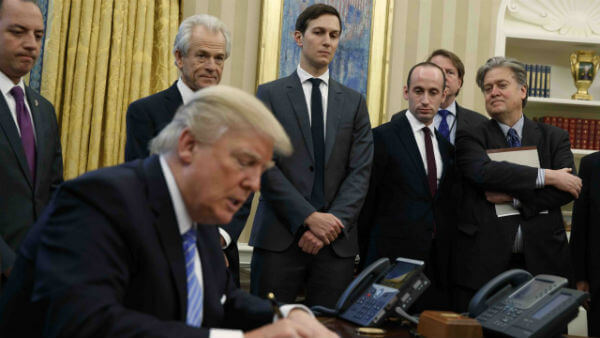
With just a few strokes of the pen on Wednesday, the new American president signed an executive order to beef up the nation’s deportation force and start construction on a new wall between the nations. Adding to the perceived insult was the timing of the order: It came on the first day of talks between top Mexican officials and their counterparts in Washington, and just days before a meeting between the two countries’ presidents.

The action was enough to prompt President Enrique Peña Nieto of Mexico to consider scrapping his plans to visit the White House on Tuesday, according to Mexican officials. In a video message delivered over Twitter on Wednesday night, Mr. Peña Nieto did not address whether he would cancel the meeting, saying only that future steps would be taken in consultation with the country’s lawmakers. Instead, he reiterated his commitment to protect the interests of Mexico and the Mexican people, and chided the move in Washington to continue with the wall.

“I regret and condemn the United States’ decision to continue with the construction of a wall that, for years now, far from uniting us, divides us,” he said.

It mattered little to Mexicans whether Mr. Trump’s order would receive congressional approval or the funding required to fulfill it.

The perceived insults endured during the campaign had finally turned into action. Decades of friendly relations between the nations — on matters involving trade, security and migration — seemed to be unraveling. [Continue reading…]

The Washington Post reports: President Trump’s proposed wall along the U.S.-Mexico border cannot be built with only the executive order he signed Wednesday and its construction will require congressional approval, border experts and former federal officials said.

While Trump can start the wall by shifting around existing federal funds, he will need Congress to appropriate the $20 billion — and perhaps significantly more — required to complete the massive structure, the experts and former officials said.

“How is he going to fund it? You need money!” Rand Beers, a former acting Department of Homeland Security secretary in the Obama administration, said Wednesday. “He’s got to have the money. And you can’t reprogram all that money without congressional authorization.” [Continue reading…]

Facebooktwittermail

Trump turns his xenophobic threats into executive orders

The New York Times reports: President Trump signed an order on Wednesday to start building a border wall with Mexico and was planning to indefinitely block Syrian refugees from entering the United States and to institute a temporary halt on all refugees from the rest of the world.

The refugee policies are part of an executive order he is expected to issue as soon as Thursday, according to an eight-page document, a copy of which was obtained by The New York Times.

The order would require tougher vetting of foreigners fleeing persecution and place a monthlong ban on allowing any person into the United States from Iraq, Syria, Iran, Sudan, Libya, Somalia or Yemen. Refugee admissions would be halted for 120 days while a review of screening procedures is completed. When it resumes, the program would be far smaller, with the total number of refugees resettled in the United States this year more than halved, to 50,000 from 110,000.

An early draft of an executive order that President Donald J. Trump is expected to issue as early as Thursday outlines his plans to indefinitely block Syrian refugees from entering the United States and institute a temporary halt on all refugees from the rest of the world.

White House officials declined to comment on the forthcoming plan, which emerged as Mr. Trump announced the construction of his long-promised Mexican border wall and aggressive new measures intended to crack down on undocumented immigrants inside the United States.

Through a pair of executive orders he signed at the headquarters of the Department of Homeland Security, Mr. Trump was laying out a new vision for fortifying the nation’s borders and sharply increasing efforts to round up and remove some of the estimated 11 million undocumented immigrants living in the United States — including by enlisting state and local officials to track and apprehend them.

“Federal agencies are going to unapologetically enforce the law — no ifs, ands or buts,” said Sean Spicer, the White House press secretary. “The American people get the final say who can and cannot enter our nation.”

The plans were a stark break with former President Barack Obama’s approach and what was once a bipartisan consensus to devise a path to citizenship for some of the nation’s undocumented immigrants. Mr. Trump, whose campaign rallies featured chants of “build the wall,” has instead described many undocumented immigrants as criminals who must be found and forcibly removed from the United States.

“They’re setting out to unleash this deportation force on steroids, and local police will be able to run wild, so we’re tremendously concerned about the impact that could have on immigrants and families across the country,” said Joanne Lin, senior legislative counsel at the American Civil Liberties Union. “After today’s announcement, the fear quotient is going to go up exponentially.” [Continue reading…]

Facebooktwittermail

Trump poised to lift ban on CIA ‘black site’ prisons

The New York Times reports: The Trump administration is preparing a sweeping executive order that would clear the way for the C.I.A. to reopen overseas “black site” prisons, like those where it detained and tortured terrorism suspects before former President Barack Obama shut them down.

President Trump’s three-page draft order, titled “Detention and Interrogation of Enemy Combatants” and obtained by The New York Times, would also undo many of the other restrictions on handling detainees that Mr. Obama put in place in response to policies of the George W. Bush administration.

If Mr. Trump signs the draft order, he would also revoke Mr. Obama’s directive to give the International Committee of the Red Cross access to all detainees in American custody. That would be another step toward reopening secret prisons outside of the normal wartime rules established by the Geneva Conventions, although statutory obstacles would remain. [Continue reading…]

The Daily Beast reports: “The President can sign whatever executive orders he likes. But the law is the law. We are not bringing back torture in the United States of America,” said Republican Senator John McCain, himself a victim of torture at the hands of his Vietnamese captors.

“We haven’t engaged in waterboarding since 2004…We haven’t used black sites since President Bush emptied the black sites, and we’ve somehow managed to keep our country safe,” said former CIA chief of staff Jeremy Bash, in answer to a Daily Beast question. “I have picked up precisely zero appetite for doing that again from intelligence officers,” a sentiment echoed by other former intelligence officers.

“With respect to torture, that’s banned,” Senate Republican Conference Chair John Thune told reporters Wednesday afternoon. “We view that to be a matter of settled law.” [Continue reading…]

Facebooktwittermail

Trump presidency turning into a bonanza for Trump Organization as Mar-a-Lago resort doubles its initiation fee to $200,000

The New York Times reports: The initiation fee at Mr. Trump’s Mar-a-Lago club in Florida — which the president himself has dubbed the Winter White House — has doubled to $200,000, after membership applications surged in the wake of Mr. Trump’s election, the head of membership there said.

Bernd Lembcke, the managing director at the Palm Beach, Fla., club, said the change in the initiation fee had been planned last fall, before the election, and that $200,000 had been the fee before 2010, when it was cut in half because of the recession.

But Mr. Lembcke, who has been at the club for 21 years, said that it also reflected the upswing in Mar-a-Lago’s popularity.

“We have had a sudden surge in requests,” he said, adding that new members must be recommended by someone who is already a member, as is the case at many private clubs.

Robert Weissman, president of Public Citizen, a nonprofit group that promotes government ethics, said the move showed that Mr. Trump and his family intended to profit from his status as president. [Continue reading…]

Facebooktwittermail

Report drafted by the late Jo Cox urges UK not to shy away from overseas intervention

The Guardian reports: The rise of unthinking pacifism and kneejerk isolationism in Britain have dangerous consequences for the safety of people around the world, according to a report started by Labour MP Jo Cox, who was murdered in June 2016.

The report, which was finished by Cox’s colleague and fellow MP Alison McGovern and Conservative MP Tom Tugendhat, makes the case that doing nothing can have a greater cost than intervention.

The findings are to be launched by the former prime minister Gordon Brown and former Tory foreign secretary William Hague on Thursday, at an event for the Policy Exchange thinktank in London.

The paper was intended to be jointly published by Cox, a former aid worker, and Tugendhat, a former soldier, before the Batley and Spen MP was shot and stabbed by far-right terrorist Thomas Mair.

It points to a number of global conflicts where intervention has been deemed successful, including a no-fly zone in Iraq in 1991 to protect Kurds from Saddam Hussein’s air attacks, the 1999 intervention in Kosovo to save civilians from ethnic cleansing and the British intervention in Sierra Leone in 2000 to help repel the Revolutionary United Front (RUF) advance. [Continue reading…]

Facebooktwittermail

California is America — only more so. The white supremacists led by Trump are a relic of the past

Governor Jerry Brown’s California State of the State address given in Sacramento yesterday begins 20 minutes into this video:


Jerry Brown: The recent election and inauguration of a new President have shown deep divisions across America.

While no one knows what the new leaders will actually do, there are signs that are disturbing. We have seen the bald assertion of “alternative facts.” We have heard the blatant attacks on science. Familiar signposts of our democracy — truth, civility, working together — have been obscured or swept aside.

But on Saturday, in cities across the country, we also witnessed a vast and inspiring fervor that is stirring in the land. Democracy doesn’t come from the top; it starts and spreads in the hearts of the people. And in the hearts of Americans, our core principles are as strong as ever.

As we face the hard journey ahead, we will have to summon, as Abraham Lincoln said, “the better angels of our nature.” Above all else, we have to live in the truth.

We all have our opinions but for democracy to work, we have to trust each other. We have to strive to understand the facts and state them clearly as we argue our points of view. As Hugo Grotius, the famous Dutch jurist, said long ago, “even God cannot cause two times two not to make four.”

When the science is clear or when our own eyes tell us that the seats in this chamber are filled or that the sun is shining, we must say so, not construct some alternate universe of non-facts that we find more pleasing.

Along with truth, we must practice civility. Although we have disagreed — often along party lines — we have generally been civil to one another and avoided the rancor of Washington. I urge you to go even further and look for new ways to work beyond party and act as Californians first.

Democrats are in the majority, but Republicans represent real Californians too. We went beyond party when we reformed workers’ compensation, when we created a rainy day fund and when we passed the water bond.

Let’s do that again and set an example for the rest of the country. And, in the process, we will earn the trust of the people of California.

Let me end in the immortal words of Woody Guthrie:

This land is your land, this land is my land
From California to the New York Island
From the Redwood Forest, to the Gulf Stream waters
This land was made for you and me…

Nobody living can ever stop me,
As I go walking that freedom highway;
Nobody living can ever make me turn back
This land was made for you and me.

California is not turning back. Not now, not ever. His truth is marching on.

Facebooktwittermail

Kim Jong-un would be prepared to launch nuclear attack on U.S. says high-ranking defector

BBC News reports: In August last year, Thae Yong-ho became one of the highest-ranking officials ever to defect from North Korea. In a wide-ranging interview in Seoul, he tells the BBC’s Stephen Evans he believes leader Kim Jong-un would be prepared to attack the US with nuclear weapons, but that the regime will one day fall.

There are moments when the usually fluent English of the North Korean defector halts. His voice quivers and he pauses. His eyes grow moist.

These moments of silent emotion come when Thae Yong-ho thinks about his brother back in North Korea.

He told the BBC that he was sure that his family have been punished for his defection. This realisation both grieves him and steels him against the regime.

“I’m sure that my relatives and my brothers and sisters are either sent to remote, closed areas or to prison camps, and that really breaks my heart,” he said.

If he could imagine his brother shouting to him in anguish from prison in North Korea, what would he reply?

“That is really a question I don’t like to even think about. That is why I am very determined to do everything possible to pull down the regime to save not only my family members but also the whole North Korean people from slavery.” [Continue reading…]

Facebooktwittermail

Trump administration tells EPA to cut climate page from website, say sources

Reuters reports: U.S. President Donald Trump’s administration has instructed the Environmental Protection Agency to remove the climate change page from its website, two agency employees told Reuters, the latest move by the newly minted leadership to erase ex-President Barack Obama’s climate change initiatives.

The employees were notified by EPA officials on Tuesday that the administration had instructed EPA’s communications team to remove the website’s climate change page, which contains links to scientific global warming research, as well as detailed data on emissions. The page could go down as early as Wednesday, the sources said.

“If the website goes dark, years of work we have done on climate change will disappear,” one of the EPA staffers told Reuters, who added some employees were scrambling to save some of the information housed on the website, or convince the Trump administration to preserve parts of it. [Continue reading…]

Facebooktwittermail

Tribes and lawyers are vowing to fight Trump’s pipelines

BuzzFeed reports: President Trump resurrected two massive pipeline projects on Tuesday, drawing ire and threats of legal action from the movement that fought to keep them off US land.

“We will see his administration in court,” Trip Van Noppen, president of the non-profit group Earthjustice that represented the Standing Rock Sioux tribe in challenging the Dakota Access Pipeline, said in a statement. “[Trump] should brace himself to contend with the laws he is flouting, and the millions of Americans who are opposed to these dangerous and destructive projects.”

“We are opposed to reckless and politically motivated development projects, like DAPL, that ignore our treaty rights and risk our water,” the chairman of the Standing Rock Sioux Tribe, Dave Archambault II, said in a statement. [Continue reading…]

Facebooktwittermail

In deference to an FBI chief who is ‘now more famous than me,’ Trump decides to retain Comey’s services

The New York Times reports: The F.B.I. director, James B. Comey, told his top agents from around the country that he had been asked by President Trump to stay on the job running the federal government’s top law enforcement agency, according to people familiar with the matter.

A decision to retain Mr. Comey would spare the president another potentially bruising confirmation battle. It also would keep Mr. Comey at the center of the F.B.I.’s investigation into several Trump associates and their potential ties with the Russian government.

Retaining Mr. Comey could also help calm the bureau’s work force, which has been rattled after a tumultuous few months in which the F.B.I. and the director himself were sharply criticized for moves that many felt influenced the outcome of the presidential election. [Continue reading…]

Politico reports: House Democrats greeted news that FBI Director James Comey will be staying in his job with a mix of disdain and relief Tuesday.

Democratic leaders say they’ve lost confidence in the bureau head to impartially investigate any links between Russia and President Donald Trump’s campaign, given how they think Comey bungled the probe into Hillary Clinton’s email server.

But the alternative, they say, could be much worse. [Continue reading…]

Facebooktwittermail

Russia is targetting French, Dutch and German elections with fake news, EU task force warns

The Telegraph reports: Russia is seeking to influence the outcome of several key elections in European countries this year with fake news, a special task force set up by the European Union has warned.

The EU is reportedly allocating more funds to its East StratCom task force to counter the disinformation, amid fears Russia will target elections in France, Germany and the Netherlands

“There is an enormous, far-reaching, at least partly organized, disinformation campaign against the EU, its politicians and its principles,” a source close to the task force told Germany’s Spiegel magazine.

It is “highly likely” Russia will try to influence European elections “as it did in the US”, the source said.

The number one target is Angela Merkel, who has been subjected to a “bombardment” of fake news over her refugee policy and support for economic sanctions against Russia.

Disinformation is “part of state policy” and a “military tool” for the Kremlin”. [Continue reading…]

Facebooktwittermail

Misogynist-in-chief: Trump takes swift action to restrict women’s rights globally

Reuters reports: U.S. President Donald Trump on Monday reinstated a global gag rule that bans U.S.-funded groups around the world from discussing abortion, a move that was widely expected but nonetheless dismayed women’s rights advocates.

The rule, which affects American non-governmental organizations working abroad, is one that incoming presidents have used to signal their positions on abortion rights. It was created under U.S. President Ronald Reagan in 1984.

Trump, an abortion opponent, signed the reinstatement directive at a ceremony in the White House on his fourth day in office. Former President Barack Obama had lifted the gag rule in 2009 when he took office.

“Women’s health and rights are now one of the first casualties of the Trump administration,” said Serra Sippel, president of the Center for Health and Gender Equity in Washington. [Continue reading…]

Facebooktwittermail

The Trump administration seems poised to further unleash the CIA’s paramilitary branch

Joshua Kurlantzick writes: [T]he Trump administration is poised to accelerate a transformation that has been happening, in fits and starts, since the 1960s, with the CIA becoming less of an outfit focused on spying and more of a paramilitary organization with a central role in violent conflicts.

Further increasing the use of CIA paramilitaries and the Pentagon’s Special Forces in places such as Syria and Afghanistan would have potentially grave consequences for U.S. foreign policy — and for the United States’ leadership in the world. These paramilitaries are almost totally unaccountable, and unaccountability encourages rash, even criminal, behavior, including disdain for civilian lives, torture and other abuses. And, as demonstrated by a secret war in the 1960s and early ’70s — the most important precedent for today’s war on terror — it’s hard to win by using the CIA and Special Forces rather than conventional troops.

Fifty-six years ago, another incoming president decided to empower the CIA’s paramilitaries, relying on covert war rather than conventional fighting.

Before taking the oath of office in 1961, John F. Kennedy had (privately) squabbled with some CIA leaders, who saw him as inexperienced and potentially reckless.

The CIA was only 14 years old then and a relatively small player in the American policymaking apparatus, one with far less power and fewer resources than the Departments of Defense and State. The agency mostly concentrated on traditional intelligence and political work, such as spying and trying to overthrow foreign governments believed unfriendly to the United States. It did a small amount of training of foreign forces, but no battlefield commanding.

Once in office, however, Kennedy approved the expansion of what would become the largest covert U.S. operation in history, in the tiny Southeast Asian nation of Laos. In a shift that could prove familiar in 2017, his decision dramatically empowered the same CIA that had worried about the new president.

The political climate at the time Kennedy took office also was in some ways similar to today’s. After a bloody stalemate in Korea, and the defeat of U.S.-backed French troops in Vietnam in 1954, many Americans were tired of conventional war and interventionism in general. Yet foreign policy elites believed that the United States faced an existential threat: Communism was spreading through Asia, first to China and North Vietnam and then to Laos, and possibly beyond. A secret war, one that used relatively few U.S. combatants and relied on foreign proxy forces and bombing from above, came to be seen as the safest choice, politically, for the Kennedy administration.

The CIA’s involvement in Laos, which expanded in 1961 with a small training program for anti-communist fighters, ramped up quickly. It would grow over the course of the 1960s and into the early 1970s, with few Americans, and not even many members of Congress, knowing anything about it. The CIA recruited tens of thousands of U.S. contractors, paramilitary fighters and local Laotian warriors in an ultimately futile attempt to transform Laotian guerillas into a conventional army capable of stopping Hanoi and its local allies. U.S. bombers, working in concert with CIA paramilitaries, destroyed much of Laos while attacking Laotian and North Vietnamese communists. They dropped more bombs on Laos than on Germany and Japan combined in World War II. The country was left with so much unexploded ordnance that, in the four decades since Laos’s civil war ended in 1975, the leftover bombs have killed 20,000 Laotians.

The war cemented the CIA’s place as an organization with power on par with the Departments of Defense and State — and one increasingly dedicated to activities such as arming and advising foreign forces, managing conflicts and even overseeing targeted killings. CIA operatives went on to play roles in covert wars in Central America and Afghanistan in the 1980s, as well as in conflict zones in the war on terror. As Foreign Policy magazine has characterized it, the CIA is now “pulling the strings of U.S. foreign policy” — overseeing drone strikes and managing many aspects of the fight against the Islamic State. And according to documents released by former National Security Agency contractor Edward Snowden, the CIA’s budget appears to be greater than the State Department’s, a dramatic reversal from the early Cold War. While Brennan is recognized for leading an effort to reduce walls between operatives and analysts and fortify some of the agency’s traditional functions, he also oversaw an increase in the strength of paramilitary operations. In 2015, he promoted a paramilitary operative to head the clandestine branch — reportedly the first time a paramilitary officer took on the top undercover position.

Although Trump’s rhetoric suggests that he could rein in the CIA, the reality, as during Kennedy’s time, will probably be the reverse. The agency’s paramilitary branch, along with the military’s Special Forces — the two have become intertwined in policy and practice — will be further unleashed in a twilight war. [Continue reading…]

Facebooktwittermail

Are we entering an era in which ‘truth’ is whatever Trump wants it to be?

Shortly before Trump took office, Ruth Ben-Ghiat wrote: Although we cannot yet know what kind of president he will be, from his June 2015 declaration of candidacy to his January 2017 inauguration, Trump has undertaken two parallel projects aimed at unsettling the mental habits and moral foundations of American democracy. First, he has cultivated a political persona that inspires adulation and unquestioning loyalty that can be mobilized for action on his behalf. Second, he has initiated Americans into a culture of threat that not only desensitizes them to the effects of bigotry but also raises the possibility of violence without consequence.

The founding moment of this era came one year ago, when Trump declared at a rally, “I could stand on Fifth Avenue and shoot someone and not lose any voters.” Trump signaled that rhetorical and actual violence might have a different place in America of the future, perhaps becoming something ordinary or unmemorable. During 2016, public hatred became part of everyday reality for many Americans: those who identify with the white supremacist alt-right like Richard Spencer openly hold rallies; elected officials feel emboldened to call for political opponents to be shot (as did New Hampshire and Oklahoma State Representatives Al Baldasaro and John Bennett, among others); journalists reporting on Trump and hijab-wearing women seek protection protocols and escorts. The bureaucratic-sounding term many use for this, “normalization,” does not fully render the operations of memory that make it possible. Driven by opportunism, pragmatism, or fear, many begin to forget that they used to think certain things were unacceptable.

The risk is that the parameters of thought and action will be nudged to align with those of the leader, easing the retrofitting of history to suit his personalization of the land’s highest office. Trump’s success at this in a country known for individualism, and with no history of living under an authoritarian ruler, shows how susceptible people are to such approaches.

Trump’s bullying charm anchors this culture of threat. From the start he cultivated a relationship with followers founded on an allegiance to his person, and not to a party or principle. He devised campaign rituals (loyalty oaths, “lock her up” chants directed at imprisoning his opponent) that created a bond of charismatic authority and accustomed his constituents to his heavy hand. At his rallies he harangued his crowds, directing them emotionally, urging them to punish protesters as he expressed his own desires to punch offenders in the face. “You were nasty and mean and vicious, you wanted to win, right?” he told his fans after the election.

Twitter has been an excellent training ground for the acceptance of Trump’s cult of personality and the memory politics that undergird it. His skill at orchestrating the news cycle through tweets keeps Americans caught in the web of an “eternal present,” their attention focused on his aggressive outbursts that are dissected by the media and the public with the fervor of Communist-era Kremlinologists. His domination of the media landscape, on Twitter and elsewhere, realizes the authoritarians’ dream: to be everywhere present while remaining in your palace, and able to influence both big policy decisions and small daily habits with a few strokes of your pen. The writer Italo Calvino, who recalled that Mussolini’s face was “always in view” during the first 20 years of his life, would have appreciated how a few critical tweets from the leader-to-be led the storied Ford Motor Company to quickly scrap long-held plans for a $1.6 billion assembly plant in Mexico, and express its “confidence” in his business acumen.

The deference to the leader allows another crucial element of authoritarian rule to fall into place: the discrediting of all alternate sources of information. The confusion sowed by Trump from the start of his campaign (“we’ve got to figure out what’s going on”), which crucially extends to the facts of his personal history (Putin? “I don’t know him”), built to a blanket denunciation of all non-Trump information. “Media is fake!” the president-elect tweeted on January 8, preparing Americans for the onset of a new era in which truth is what Trump wants it to be. [Continue reading…]

Facebooktwittermail

Europe’s far-right leaders unite at dawn of the Trump era

Time reports: After a few weeks of reading online about Donald Trump’s transition to the presidency, Marco Kopping, a 36-year-old apprentice at a car-parts supplier near Frankfurt, decided to get involved in German politics. He had never sympathized with a political party before, let alone joined one. But in December he received his glossy membership card from Alternative for Germany (AfD), one of the far-right movements now riding the updraft from Trump’s ascent. What drove him, Kopping says, “was the feeling of a revolution.” He didn’t want to be left behind.

Across the European Union, politicians on the right-wing fringe have been invigorated by Trump’s victory, which has given them a chance to attract new supporters, build coalitions and argue that, despite the often-glaring differences between them, they are all part of a movement with seemingly unstoppable momentum.

The most striking proof yet of that movement came on Saturday in the cross-section of far-right populists who met for the first time, at the AfD’s invitation, at a convention in the German city of Koblenz. A day after Trump’s Inauguration, the stars of the European right drew a direct line between Trump’s success at the ballot box and their own looming electoral battles. [Continue reading…]

Facebooktwittermail

Under President Trump, we’ll enter an age of global confrontation

Timothy Garton Ash writes: Donald Trump’s arrival in the White House reflects a wider phenomenon: a new era of nationalism. He joins Vladimir Putin of Russia, Narendra Modi of India, Xi Jinping of China, Recep Tayyip Erdoğan of Turkey and a score of other nationalist leaders around the globe.

While it might be unfair to describe Theresa May as a nationalist, her announcement that she’s going for a hard Brexit reflects the pressure of English nationalism on the British right, and will encourage the nationalism of others. Of course, eras of nationalism are nothing new. But precisely because we have experienced them before, we know that they often start with high hopes and end in tears.

For now, the nationalists are giving one another the Trumpian thumbs-up across the seas. Paul Nuttall, the Ukip leader, says he is “massively excited” by the advent of President Trump, who in turn tells Michael Gove in the Times that he thinks Brexit “is going to end up being a great thing”. In a photograph that should become notorious, the Brexiteer Gove gives Trump a sycophantic thumbs-up, with a curiously goofy expression on his face, making him look like a teenage Star Trek fan who has caught 10 seconds with Patrick Stewart. The vice-president of France’s Front National responded to May’s Brexit speech by declaring: “French independence soon.” And so it goes on. [Continue reading…]

Facebooktwittermail

Michael Flynn’s ties to Russia under investigation

The Wall Street Journal reports: U.S. counterintelligence agents have investigated communications that President Donald Trump’s national security adviser had with Russian officials, according to people familiar with the matter.

Michael Flynn is the first person inside the White House under Mr. Trump whose communications are known to have faced scrutiny as part of investigations by the Federal Bureau of Investigation, Central Intelligence Agency, National Security Agency and Treasury Department to determine the extent of Russian government contacts with people close to Mr. Trump.

It isn’t clear when the counterintelligence inquiry began, whether it produced any incriminating evidence or if it is continuing. Mr. Flynn, a retired general who became national security adviser with Mr. Trump’s inauguration, plays a key role in setting U.S. policy toward Russia.

The counterintelligence inquiry aimed to determine the nature of Mr. Flynn’s contact with Russian officials and whether such contacts may have violated laws, people familiar with the matter said.

A key issue in the investigation is a series of telephone calls Mr. Flynn made to Sergey Kislyak, the Russian ambassador to the U.S., on Dec. 29. That day, the Obama administration announced sanctions and other measures against Russia in retaliation for its alleged use of cyberattacks to interfere with the 2016 U.S. election. U.S. intelligence officials have said Russian President Vladimir Putin ordered the hacks on Democratic Party officials to try to harm Hillary Clinton’s presidential bid.

Officials also have examined earlier conversations between Mr. Flynn and Russian figures, the people familiar with the matter said. Russia has previously denied involvement in election-related hacking.

In a statement Sunday night, White House spokeswoman Sarah Sanders said: “We have absolutely no knowledge of any investigation or even a basis for such an investigation.” [Continue reading…]

Facebooktwittermail