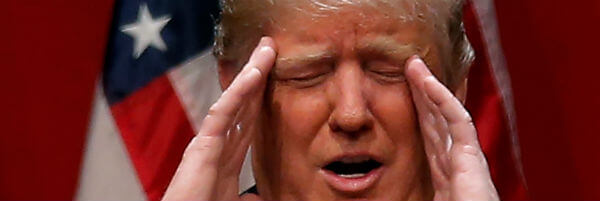
Greg Sargent writes: Trump’s attacks on the Khan family appear to have gone too far even for his core supporters. American voters overall disapprove of his handling of the exchange with the Khans by 74-13, and Trump-leaning groups agree: Non-college whites disapprove by 67-14; non-college white men disapprove by 64-19; and white evangelicals disapprove by 63-20. (By the way, Republicans and GOP-leaners disapprove by 58-23, and conservatives disapprove by 62-18.)
The overwhelming public disapproval of Trump’s battle with the Khan family is encouraging to see. It’s looking increasingly like Trump, by engaging the Khans, helpfully reinforced many of the messages coming out of the Democratic convention about Trump’s demagogic scapegoating by religion and his overall hostility towards diversifying America. If the Dem convention brought a sledgehammer down on Trump’s worldview, he basically picked up that sledgehammer and continued to hit himself over the head with it — especially in the eyes of the college educated white voters who appear increasingly repulsed by Trumpism.
And yet, even after the battle over the Khans forced a national debate over Trump’s fearmongering about Muslims, his core voting groups are still sticking by the temporary ban on their entry into the United States — which, after all, is a core tenet of the story he’s telling about America. [Continue reading…]
Category Archives: Issues
Why are some conservative thinkers falling for Trump?
Peter Beinart writes: Logically, Donald Trump should have less support among intellectuals than he had a year ago. That’s because over the past year, he has made statements that expose him as both ignorant of public policy and contemptuous of liberal-democratic norms. He has proposed banning Muslims from entering the United States, incited violence against protesters at his rallies, responded to The Washington Post’s critical coverage by warning that its owner is “getting away with murder” on his taxes and “we can’t let him get away with it,” declared a federal judge biased because he’s Mexican American, and twice revealed his unfamiliarity with the term nuclear triad.
Instead, more than a year after Trump announced his presidential bid, his support among intellectuals has grown. Of course, many prominent conservatives — from George Will to William Kristol to David Brooks to Erick Erickson — oppose him militantly. But another cluster of writers and thinkers have declared themselves supportive of, or at least open to supporting, Trump. Among Trump’s critics, the predominant explanation for this openness is opportunism: Supporting the Republican nominee can have professional benefits. But a deeper dynamic is at work. It’s just hard to recognize, because American intellectuals haven’t felt the allure of authoritarian, illiberal politics this strongly in a long time.
In 1953, Czesław Miłosz published The Captive Mind, which described how a series of Polish intellectuals came to embrace Stalinism. Miłosz detailed the role that “coercion” and “personal ambition” played in their ideological transformation. But he stressed that he was concerned “with questions more significant than mere force” or material advancement. “To belong to the masses is the great longing of the ‘alienated’ intellectual,” Miłosz argued. “The gratifications of personal ambition … are merely the outward and visible signs of social usefulness, symbols of a recognition that strengthens the intellectual’s feeling of belonging.” [Continue reading…]
Middle East bishops say U.S. has ‘moral responsibility’ to help Christians
Crux reports: Catholic leaders in the Middle East say that the United Sates has the “moral responsibility” to help stop the savagery against Christians in the region, and to provide assistance to help them stay in the region, because it was the U.S. that unleashed the chaos in the first place.
“They were the ones who invaded [Iraq] in 2003 and changed the whole region, and they had the moral responsibility to fix the situation before leaving the country,” said the Chaldean Catholic Archbishop of Erbil, Iraq, Bashar Matti Warda.
Jean-Clément Jeanbart, Greek Melkite Archbishop of Aleppo, the “martyred city” of Syria, said that the U.S. has a two-fold responsibility. On the one hand, he asked the U.S. government to ensure that the aid being sent to the region is also distributed among Christians, which, he said, means entrusting a portion of it to the churches.
As the system is set up, he said, all the aid goes to the refugee camps. Yet Christians see their lives at risk there, so they generally choose to seek shelter at churches and convents instead.
“If the help went to the churches, it wouldn’t mean that they’re giving special rights to Christians, but that they’re actually helping everyone,”Jeanbart said at a press conference held on Wednesday during the Knights of Columbus’s 134th Supreme Convention, which took place in Toronto, Canada.
The many Christian churches in the region – in Syria, there are six different Catholic rites alone – fund schools, hospitals, and provide shelter to all refugees, without distinguishing between Muslims, Yazidis or Christians, he said. [Continue reading…]
Iran says it executed nuclear scientist for spying
The Washington Post reports: Iran has executed a nuclear scientist who mysteriously turned up in the United States six years ago and returned to Tehran a few months later, authorities said Sunday, in the first official confirmation of the researcher’s fate since he arrived back in his homeland.
Iranian officials offered no details about the charges against Shahram Amiri, whose case has left unanswered questions about whether he voluntarily defected to the United States or — as he claimed — was abducted by agents while on a religious pilgrimage in Saudi Arabia in 2009.
Amiri surfaced in 2010 in videos posted online from an undisclosed location in the United States. Later that year, he arrived unannounced at the Iranian interests section at the Pakistani Embassy in Washington and demanded to be sent home. [Continue reading…]
Nuclear power is losing money at an astonishing rate
Joe Romm writes: Half of existing nuclear power plants are no longer profitable. The New York Times and others have tried to blame renewable energy for this, but the admittedly astounding price drops of renewables aren’t the primary cause of the industry’s woes — cheap fracked gas is.
The point of blaming renewables, which currently receive significant government subsidies, is apparently to argue that existing nukes deserve some sort of additional subsidy to keep running — beyond the staggering $100+ billion in subsidies the nuclear industry has received over the decades. But a major reason solar and wind energy receive federal subsidies — which are being phased out over the next few years — is because they are emerging technologies whose prices are still rapidly coming down the learning curve, whereas nuclear is an incumbent technology with a negative learning curve.
The renewable red herring aside, existing nukes can make a reasonable case for a modest subsidy on the basis of climate change — though only because they are often replaced by carbon-spewing gas plants. That said, the “$7.6 billion bailout” New York state just decided to give its nuclear plants appears to be way too large, as we’ll see. [Continue reading…]
Against all odds: #TeamRefugees at Rio
A rousing emotional welcome for #RefugeeOlympicTeam at #Rio2016 #OpeningCeremony #TeamRefugees @Refugees pic.twitter.com/R05lWDgbgt
— UN Spokesperson (@UN_Spokesperson) August 6, 2016
The Guardian reports: For the first time in Olympic history, 10 athletes will compete at Rio 2016 for the Refugee Olympic Team in a move designed to bring global attention to the magnitude of the worldwide refugee crisis.
After the International Olympic Committee president, Thomas Bach, announced in March that a team would be selected, 43 were identified as candidates and 10, displaced from South Sudan, Ethiopia and the Democratic Republic of Congo, have since been picked in three sports – athletics, swimming and judo. The athletes will march with the Olympic flag immediately before host nation Brazil at Friday’s opening ceremony.
Bach said: “These refugees have no home, no team, no flag, no national anthem. We will offer them a home in the Olympic Village together with all the athletes of the world. The Olympic anthem will be played in their honour and the Olympic flag will lead them into the Olympic Stadium.
“This will be a symbol of hope for all the refugees in our world, and will make the world better aware of the magnitude of this crisis. It is also a signal to the international community that refugees are our fellow human beings and are an enrichment to society. These refugee athletes will show the world that, despite the unimaginable tragedies they have faced, anyone can contribute to society through their talent, skills and strength of the human spirit.” [Continue reading…]
UNHCR – The UN Refugee Agency: Each day war forces thousands of families to flee their homes. People like you, people like me.
To escape the violence, they leave everything behind – everything except their hopes and dreams for a safer future. UNHCR, the UN Refugee Agency believes that all refugees deserve to live in safety.
Add your name to the #WithRefugees petition to send a clear message to governments that they must act with solidarity and shared responsibility.
Bernie Sanders: I support Hillary Clinton. So should everyone who voted for me
Bernie Sanders writes: The conventions are over and the general election has officially begun. In the primaries, I received 1,846 pledged delegates, 46% of the total. Hillary Clinton received 2,205 pledged delegates, 54%. She received 602 superdelegates. I received 48 superdelegates. Hillary Clinton is the Democratic nominee and I will vigorously support her.
Donald Trump would be a disaster and an embarrassment for our country if he were elected president. His campaign is not based on anything of substance — improving the economy, our education system, healthcare or the environment. It is based on bigotry. He is attempting to win this election by fomenting hatred against Mexicans and Muslims. He has crudely insulted women. And as a leader of the “birther movement,” he tried to undermine the legitimacy of our first African American president. That is not just my point of view. That’s the perspective of a number of conservative Republicans.
In these difficult times, we need a president who will bring our nation together, not someone who will divide us by race or religion, not someone who lacks an understanding of what our Constitution is about.
On virtually every major issue facing this country and the needs of working families, Clinton’s positions are far superior to Trump’s. Our campaigns worked together to produce the most progressive platform in the history of American politics. Trump’s campaign wrote one of the most reactionary documents. [Continue reading…]
Why we ask to see candidates’ tax returns
Mitchell Zuckoff writes: Lost in the debate over Donald J. Trump’s refusal to release his tax returns is the story of where the custom of disclosure comes from — and why it can be so valuable as a measure of character. It’s a tale of presidential tax shenanigans, political scandal and one of the most famous quotations in American history: Richard M. Nixon’s “I am not a crook.”
The story begins in July 1969, when Congress eliminated a provision of the tax code that had allowed a sitting or former president to donate his papers to a public or nonprofit archive in exchange for a very large tax deduction. Congress’s rationale was that a president’s papers already belonged to the public.
In his taxes for 1969, President Nixon indicated that four months before Congress acted, he had donated more than 1,000 boxes of documents to the National Archives. He claimed a deduction of more than $500,000. [Continue reading…]
For Putin, disinformation is power
Arkady Ostrovsky writes: Fifteen years ago, a few months into his presidency, Vladimir V. Putin told Larry King on CNN that his previous job as a K.G.B. officer had been like that of a journalist. “They have the same purpose of gathering information, synthesizing it and presenting it for the consumption of decision makers,” he said. Since then, he has excelled at using the media to consolidate power inside Russia and, increasingly, to wage an information war against the West.
So the apparent hacking by Russian security services of the Democratic National Committee emails, followed by their publication by WikiLeaks, should come as no great surprise to Americans. It is only the latest example of how Mr. Putin uses information as a weapon. And the Kremlin has cultivated ties with WikiLeaks for years.
It has also used disinformation in its annexation of Crimea and in its war in Ukraine, launched cyberattacks on Finland and the Baltic States, and planted hoax stories in Germany to embarrass Angela Merkel. During the Cold War, the Kremlin interfered in American politics for decades. The K.G.B.’s so-called active measures — subversion, media manipulations, forgery and the financing of some “peace” organizations — lay at the heart of Soviet intelligence.
Then as now, Russia exploited real grievances in the West — discontent with the war in Vietnam and racial tensions in the 1960s; anxiety and fear of Muslim immigrants today. Nevertheless, Mr. Putin’s support of the likes of Donald Trump in America, Brexiters in Britain or the right-wing Marine Le Pen in France does not mean they are his creations. [Continue reading…]
How Russia dominates your Twitter feed to promote lies (and, Trump, too)
The Daily Beast reports: “Ladies and Gentlemen, We have a situation in #Turkey #Incirlik” the cry went out on Twitter last Saturday night, as news spread of the Turkish forces surrounding the U.S. airbase in Incirlik.
Thousands of armed police had reportedly surrounded the airbase amid swirling rumors of another coup attempt, according to stories tweeted within two minutes of each other on RT.com and Sputnik, the two biggest Russian state-controlled media organizations publishing in English. The stories were instantly picked up by a popular online aggregator of breaking news and prompted hours-long storm of activity from a small, vocal circle of users.
In English, the tweets soon grouped into certain patterns of similar (and sometimes identical) content. The first were panicky expressions of concern about nuclear weapons allegedly stored at Incirlik: [Continue reading…]
Rosa Brooks examines war’s expanding boundaries
In a review of Rosa Brooks’ new book, How Everything Became War and the Military Became Everything, Harold Evans writes: Is Rosa Brooks psychic? Her book had gone to press before the killings of July 2016 broke upon us. Did she have a crystal ball to yield an image of the ambush in Dallas in which, from a sniper’s vantage point, a veteran of the Afghan war in body armor machine-gunned 12 policemen, killing five? Or of the military bomb squad robot that ended the terror without the police risking more lives? Or of the ambush in Baton Rouge by a veteran who shot three policemen to death? Or of another loner in Orlando, Fla., who was able to walk into a gun shop to buy what Army Special Ops calls a “Black Mamba”? That’s a Sig Sauer MCX assault rifle capable of firing 24 bullets in nine seconds, advertised by its makers as “an innovative weapon system built around a battle-proven core.” Forty-nine people died innovatively in the battle-proven core of the Pulse nightclub.
All these elements of the infiltration of military weapons and methods into American life are within the broad compass of Brooks’s perceptive book, “How Everything Became War and the Military Became Everything.” She has seen the paradoxical effects of the inflation of metaphor on law and institutions: how the police have become more like the military, and how soldiers, in nation-building efforts, have become more like police (and farmers); how police forces have bought hundreds of armored cars from the Pentagon for “the war on terror”; how “the war on drugs” has incarcerated more than one million Americans; how large cities now have SWAT (special weapons and tactics) teams. And she has seen how a quiet word in a drone command center can end the life of a young terror suspect thousands of miles away.
In impressive and often fascinating detail, she documents that the boundaries between war and peace have grown so hazy as to undermine hard-won global gains in human rights and the rule of law. [Continue reading…]
I ran the CIA. Now I’m endorsing Hillary Clinton
Michael Morell writes: During a 33-year career at the Central Intelligence Agency, I served presidents of both parties — three Republicans and three Democrats. I was at President George W. Bush’s side when we were attacked on Sept. 11; as deputy director of the agency, I was with President Obama when we killed Osama bin Laden in 2011.
I am neither a registered Democrat nor a registered Republican. In my 40 years of voting, I have pulled the lever for candidates of both parties. As a government official, I have always been silent about my preference for president.
No longer. On Nov. 8, I will vote for Hillary Clinton. Between now and then, I will do everything I can to ensure that she is elected as our 45th president.
Two strongly held beliefs have brought me to this decision. First, Mrs. Clinton is highly qualified to be commander in chief. I trust she will deliver on the most important duty of a president — keeping our nation safe. Second, Donald J. Trump is not only unqualified for the job, but he may well pose a threat to our national security.
I spent four years working with Mrs. Clinton when she was secretary of state, most often in the White House Situation Room. In these critically important meetings, I found her to be prepared, detail-oriented, thoughtful, inquisitive and willing to change her mind if presented with a compelling argument. [Continue reading…]
Trump’s dictator-friendly campaign manager, Paul Manafort
Adam DuBard writes: If one could find a textbook example of the Washington GOP Establishment, Manafort would certainly fit the bill. In 1976 he was a key delegate manager with Gerald Ford’s campaign, and he also produced the Republican Conventions of 1984 with Reagan and 1996 with Bob Dole. More importantly, he has gained a reputation with his lobbying firms Black, Manafort, Stone, & Kelly and later Davis, Manafort, & Freedman of representing and rehabilitating the image of anyone willing to pay the right amount, no matter how brutal or controversial their past. While he was originally hired for the primary purpose of reining in delegates and assuring their allegiances, he has since ruthlessly risen to the top of Trump’s campaign, a development that should come as no surprise once one becomes familiar with Manafort’s intriguing and controversial past.
After his political education with the campaigns of Ford and Reagan, Manafort jumped into lobbying in 1985 with the first of two lobbying firms with his name on it, Black, Manafort, Stone, & Kelly. The Stone in that name is no other than Roger Stone, the still prominent Republican strategist known for underhanded tactics and longtime friend of Manafort and Trump. Stone would later say of the now defunct firm, “Black, Manafort, Stone, and Kelly, lined up most of the dictators of the world we could find. … Dictators are in the eye of the beholder.” The amount of work Paul Manafort has done on the behalf of international dictators is long and varied, especially for someone who’s, you know, managing the campaign of a candidate for “the leader of the free world.”
In 1985 Manafort’s firm agreed to work for Philippine dictator Ferdinand Marcos to the tune of $1 million in return for shaping up his image in front of the US media and government ahead of the upcoming Philippine election. Marcos ruled as the president of the Philippines for twenty one years and gained a reputation as a brutal and corrupt leader, with martial law being the law of the land from 1972 until 1981. According to Filipino news outlets, Marcos’ reign of martial law would result in 3,257 extra-judicial killings, 35,000 torture victims, and 70,000 incarcerations. In addition to his totalitarian mean streak, Marcos and his wife Imelda made a habit of amassing money in various illegal methods. The Philippine supreme court has estimated that the Marcos family accumulated around $10 billion while in office, despite the fact that his official yearly salary never exceeded $13,500. In the end Marcos proved too corrupt even for President Reagan to support, as he was pressured to step down amid election-fixing allegations just months after hiring Black, Manafort, Stone, and Kelly. [Continue reading…]
How hackers could destroy election day
Shane Harris writes: Stealing and leaking emails from the Democratic National Committee could be just the start. Hacking the presidential election itself could be next, a bipartisan group of former intelligence and security officials recently warned. Whoever was behind the DNC hack also could target voting machines and the systems for tabulating votes, which are dangerously insecure.
“Election officials at every level of government should take this lesson to heart: our electoral process could be a target for reckless foreign governments and terrorist groups,” wrote 31 members of the Aspen Institute Homeland Security Group, which includes a former director of the Central Intelligence Agency and a former secretary of Homeland Security.
That echoes warnings computer security experts have been sounding for more than a decade: that the system for casting and counting votes in this country is also ripe for mischief. [Continue reading…]
Trump reflects white male fragility
Charles Blow writes: [Donald Trump] appeals to a regressive, patriarchal American whiteness in which white men prospered, in part because racial and ethnic minorities, to say nothing of women as a whole, were undervalued and underpaid, if not excluded altogether.
White men reigned supreme in the idealized history, and all was good with the world. (It is curious that Trump never specifies a period when America was great in his view. Did it overlap with the women’s rights, civil rights or gay rights movements? For whom was it great?)
Trump’s wall is not practical, but it is metaphor. Trump’s Muslim ban is not feasible, but it is metaphor. Trump’s huge deportation plan isn’t workable, but it is metaphor.
There is a portion of the population that feels threatened by unrelenting change — immigration, globalization, terrorism, multiculturalism — and those people want someone to, metaphorically at least, build a wall around their cultural heritage, which they conflate in equal measure with American heritage.
In their minds, whether explicitly or implicitly, America is white, Christian, straight and male-dominated. If you support Trump, you are on some level supporting his bigotry and racism. [Continue reading…]
The future of European democracy
Mervyn King, former Governor of the Bank of England, writes: As things stand, the long march toward political union desired by the elite governing the EU is not likely to reach a democratic destination. Those who decry nationalism should realize that the attempt by an elite to impose political union and free movement of people on unwilling electorates is today the main driving force of the extreme nationalist sentiments that they abhor. Whatever our grandchildren and their descendants decide to do in Europe, it must be based on a democratically legitimate process if it is to avoid recreating the very divisions that the original conception of the architects of postwar Europe so rightly strove to achieve.
Americans need to wake up from their cozy assumption that the apparatus of a supranational state is the only way to ensure a peaceful and cooperative European partner. Across Europe the younger generation wants to go beyond the nation-state to break down barriers and find new ways to resolve problems that extend beyond national boundaries. They will find ways to do this that do not require the outdated trappings of a supranational entity with its own anthem, flag, parliament, and now even steps toward an army.
Our political class would do well to recall the words of Confucius:
Three things are necessary for government: weapons, food and trust. If a ruler cannot hold on to all three, he should give up weapons first and food next. Trust should be guarded to the end: without trust we cannot stand.
Not just in Britain, but around the industrialized world, the divide between the political class and a large number of disillusioned and disaffected voters threatens trust. At times it seems that the governing class has lost faith in the people and that the people have lost faith in the government. And the two sides seem incapable of understanding each other, as we see today in the United States. But the continent on which the challenge is greatest is Europe. If any good comes out of the British referendum, it will be a renewed determination, not just in Britain but around Europe, to eliminate that divide. [Continue reading…]
Greenland melt could expose hazardous Cold War waste
Climate Central reports: When the U.S. military abandoned Camp Century, a complex of tunnels dug into the ice of northwest Greenland, in the mid-1960s, they left behind thousands of tons of waste, including hazardous radioactive and chemical materials. They expected the detritus would be safely entombed in the ice sheet for tens of thousands of years, buried ever deeper under accumulating layers of snow and ice.
But a new study suggests that because of warming temperatures that are driving substantial melting of the ice, that material could be exposed much, much sooner – possibly even by the end of this century – posing a threat to vulnerable local ecosystems.
These remnants of the Cold War are also an example of an unanticipated political issue that could arise because of the effects of climate change, particularly as countries seek to establish a presence in the Arctic as warming makes it increasingly accessible.
“We think it’s a nice case study for this kind of political tension stemming from climate change,” study author William Colgan, a glaciologist at York University in Toronto, said. [Continue reading…]
Trump’s uncontrollable reactivity: He ‘literally can’t help himself’ says former adviser

Politico reports: Amid reports suggesting that he and other staffers are beginning to “phone it in,” [Trump campaign manager, Paul] Manafort subtly shifted blame to his candidate. He admitted that Trump’s comments in response to Khizr and Ghazala Khan were “not smart.” And he made it clear that it’s Trump, not any adviser or ally bending his ear, who is responsible.
“Well, first of all, the candidate is in control of his campaign. That’s No. 1,” Manafort said in a TV interview. “And I’m in control of doing the things that he wants me to do in the campaign.”
He attempted to dismiss the “turmoil” as “another Clinton narrative that’s being put out there.” But sources close to the campaign tell a different story of dysfunction and dismay inside Trump Tower.
“There’s just not much communication going on. It’s really sad, to be honest with you. They really just aren’t working as a team. Everyone’s just doing their own little thing,” said one former Trump adviser, who spoke on the condition of anonymity. “I just wish he’d stop answering the questions. People don’t want a politician and they got someone who’s not a politician, so he’s going to make these kind of mistakes.”
This adviser said Trump “literally can’t help himself” in responding to perceived slights or taunts — and that his team and closest allies are demoralized and frustrated, especially over the apparent disconnect between Trump and the RNC.
The adviser said Trump had easily bounced back from other controversies, but this latest round borders on a point of no return. “It feels like we’re close to it.” The only silver lining? “Republicans’ intense hatred for Clinton. You remind yourself who the opposition is.”
Clinton, however, has largely skated past her own unforced errors — she wrongly asserted in an interview Sunday that FBI director James Comey had praised her truthfulness during the investigation into her use of a private email server — because Trump’s behavior since the Democratic National Convention has been all-consuming.
All week, in fact, the GOP nominee has been stomping on what might have been another opportune news cycle. The Democratic National Committee is going through a public purge as its CEO, communications director and chief financial officer all left on Tuesday, days after Chairwoman Debbie Wasserman Schultz resigned under pressure. Meanwhile, The Wall Street Journal reported on a “secretly organized” airlift of $400 million to Iran that coincided with the release of four Americans in January.
In the past 48 hours, however, Republicans criticizing Trump and, in some cases, leaving the party altogether and declaring their support for Clinton, have dominated the news cycle. Following reports that Sally Bradshaw and Maria Comella — former staffers to Jeb Bush and Chris Christie, respectively — were backing Clinton, former GOP California gubernatorial candidate and Hewlett-Packard CEO Meg Whitman announced Tuesday that she was not only following suit but planning to make a significant financial contribution to the Democrat’s campaign.
Christie and Gingrich, two of Trump’s closest allies and runners-up to serve as his running mate, have also blasted the nominee’s response to a Muslim family whose son was killed in Iraq, while also criticizing Trump’s especially undisciplined, unfocused performance over the past week. [Continue reading…]
Of late, expressions such as “unfit for high office” or “unfit to serve” have frequently been applied to Trump.
The problem with a vague concept like unfit is that it can too easily be reconstructed and taken to mean, “does not meet the approval of the establishment.”
To Trump’s supporters, this is likely to sound like Trump is yet again being condemned for the very reason they like him.
The issue is not simply that Trump is unfit to become president, but more specifically, the aspects of his personality that render him unfit.
The perennial question posed to every presidential candidate is, how will she or he handle a national security crisis?
Trump is famously unpredictable. He might see that as an asset — that it gives him an advantage over adversaries who can’t get one step ahead of him. Moreover, the fact that he’s unpredictable doesn’t explain why he’s unpredictable.
What is blindingly evident right now, however, is that Donald Trump is a man who is unpredictable because he possesses no self-control.
Faced with a crisis, no one knows — including the candidate himself — what Trump would do. This is what makes him unfit for office.
To elect Trump would be to turn the presidency into a game of Russian roulette.
Given that danger, to characterize this election as yet another contest to determine who is the lesser of two evils is to apply a crude equivalence between the candidates as though they differ merely in the degree to which each is objectionable.
But each American voter has a greater responsibility than to simply give voice to their personal likes and dislikes.
At this juncture in history, in spite of America’s ebbing power, the U.S. presidency is still the most powerful political office in the world. This isn’t a game show.
The fact that Trump has become the Republican nominee is an indication of a deep malaise in American politics and American culture in which serious issues perpetually become trivialized.
As voters, however, we aren’t mere spectators who can sit back and observe how this show plays out. We determine the outcome.

