
Category Archives: Issues

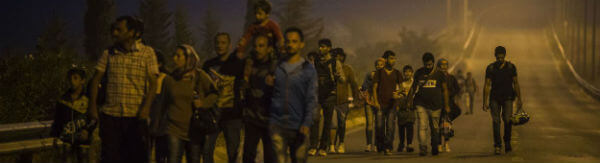
Europe’s failure on refugees echoes the moral collapse of the 1930s

refugees1

Patrick Kingsley writes: In 1938, representatives from 32 western states gathered in the pretty resort town of Evian, southern France. Evian is now famous for its water, but back then, the delegates had something else on their minds. They were there to discuss whether to admit a growing number of Jewish refugees, fleeing persecution in Germany and Austria. After several days of negotiations, most countries, including Britain, decided to do nothing.

On Monday, I was reminded of the Evian conference when British MPs voted against welcoming just 600 child refugees a year over the next half-decade. The two moments are not exactly comparable. History doesn’t necessarily repeat itself. But it does echo, and it does remind us of the consequences of ethical failure. Looking back at their inaction at Evian, delegates could claim they were unaware of what was to come. In 2016, we no longer have that excuse.

Nevertheless, both in Britain and across Europe and America, we currently seem keen to forget the lessons of the past. In Britain, many of those MPs who voted against admitting a few thousand refugees are also campaigning to unravel a mechanism – the European Union – that was created, at least in part, to heal the divisions that tore apart the continent during the first and second world wars.

Across Europe, leaders recently ripped up the 1951 refugee convention – a landmark document partly inspired by the failures of people such as the Evian delegates – in order to justify deporting Syrians back to Turkey, a country where most can’t work legally, despite recent legislative changes; where some have allegedly been deported back to Syria; and still more have been shot at the border.

Emboldened by this, the Italian and German governments have since joined David Cameron in calling for refugees to be sent back to Libya, a war zone where – in a startling display of cognitive dissonance – some of the same governments are also mulling a military intervention. Where many migrants work in conditions tantamount to slavery. Where three separate governments are vying for control. And where Isis runs part of the coastline.

In Greece, Europe’s leaders have forced the bankrupt government to lock up all arriving asylum seekers – and then reneged on a promise to help care for them, or move them to better-resourced countries elsewhere on the continent. The result is a dire situation on the Greek islands, where the world’s richest continent has contrived to jail babies, and then deny them access to adequate amounts of milk formula.

In Denmark, asylum seekers are forced to hand over valuables to pay for their stay, and volunteers have been prosecuted as smugglers for giving them lifts. In America, where boatloads of refugees were turned away from US ports in the 30s, more than 30 governors have refused to accept Muslim refugees. Some called for an outright ban on anyone fleeing a war that is ironically the partial result of catastrophic mistakes in American foreign policy over the past two decades. [Continue reading…]


Facebooktwittermail

Hillsborough: Anatomy of a disaster brought on by a failure in public service

The 1989 tragedy in which 96 Liverpool fans died while attending a football match in the North of England might to some distant observers sound like a local story of concern primarily to the bereaved and their fellow citizens, but what happened in Sheffield that day speaks to the wider issue of state powers and responsibilities as they are exercised in every democracy.

During an era in which politicians never tire of speaking solemnly about their duty for protecting national security against the threat of terrorism, the task of providing public safety now (as in the past) has much less to do with thwarting foreign and domestic threats, than it does with an ongoing commitment to public service. In turn, serving ordinary people hinges on viewing and treating them with respect.

The victims at Hillsborough were betrayed by authorities (and the media) which placed the protection of their own interests above those they were meant to serve.

The events leading up to the disaster are described in this video:

The Guardian reports: It was a year into these inquests, and 26 years since David Duckenfield, as a South Yorkshire police chief superintendent, took command of the FA Cup semi-final at Hillsborough between Liverpool and Nottingham Forest, that he finally, devastatingly, admitted his serious failures directly caused the deaths of 96 people there.

Duckenfield had arrived at the converted courtroom in Warrington with traces of his former authority, but over seven airless, agonisingly tense days in the witness box last March, he was steadily worn down, surrendering slowly into a crumpled heap. From his concession that he had inadequate experience to oversee the safety of 54,000 people, to finally accepting responsibility for the deaths, Duckenfield’s admissions were shockingly complete.

He also admitted at the inquests that even as the event was descending into horror and death, he had infamously lied, telling Graham Kelly, then secretary of the Football Association, that Liverpool fans were to blame, for gaining unauthorised entry through a large exit gate. Duckenfield had in fact himself ordered the gate to be opened, to relieve a crush in the bottleneck approach to the Leppings Lane turnstiles.

The chief constable, Peter Wright, had to state that evening that police had authorised the opening of the gate, but as these inquests, at two years the longest jury case in British history, heard in voluminous detail, Duckenfield’s lie endured. It set the template for the South Yorkshire police stance: to deny any mistakes, and instead to virulently project blame on to the people who had paid to attend a football match and been plunged into hell. [Continue reading…]

Facebooktwittermail

Hillsborough: At last, the shameful truth is out

By Jared Ficklin, University of Liverpool

Following two years of harrowing evidence, the verdicts in the inquest into the Hillsborough disaster in 1989 are a complete vindication of the 27-year campaign for justice for the 96 victims and their families. It is difficult to imagine the fortitude required to continue their fight for justice against the arrayed institutional might of the police, government and even sections of the media for so long.

But this fight for the truth did not take almost three decades, millions of pounds, and the longest court hearing in UK history because of its complexity. It was because within hours, the South Yorkshire police organised a conspiracy to protect themselves by defaming the dead and injured.

It is now clear that the police did not take blood from children to run alcohol tests or send a photographer to find empty beer cans because they wanted to understand what had really happened. It was simply to find any prop that could support the false narrative that the fans were drunk and abusive and were somehow responsible for their own deaths, and that the police had done their best under the circumstances.

We now know, from evidence heard at the inquest and admissions of senior police officers themselves, that this was so far from reality that the police had to collude to invent evidence. But even that wasn’t enough to hide the truth. There were thousands of fans there that day who knew what really happened – even in an age before everyone carried a phone with a camera, images existed that didn’t tally with the police’s claims.

But at the time the police had the most powerful allies there were: South Yorkshire police had been instrumental in breaking the miners’ strikes in 1984-1985, during which then prime minister Margaret Thatcher deployed them like her army in the north of England. The force also had form for blaming victims: we now know that South Yorkshire police had committed perjury during failed prosecutions of miners following the battle between police and strikers at Orgreave in 1984, and that senior officers were well aware of it and said nothing.

In 1989, the police needed support for their cover-up, and the Conservative government was happy to help. Thatcher herself toured the ground the morning after the disaster, and was aware that privately there were serious questions about the police propaganda, but it didn’t stop her government from backing the police. Her press secretary, Bernard Ingham, relied upon what he was told about the disaster by the police and blamed “tanked-up yobs” for the deaths. “Liverpool,” he later said, “should shut up about Hillsborough.”

Continue reading

Facebooktwittermail

Hillsborough disaster: Those responsible could face criminal charges

The Guardian reports: Officials implicated in the unlawful killing of 96 Liverpool fans in the Hillsborough disaster could face prosecution for criminal negligence and perjury, Theresa May has said.

The home secretary warned of potential criminal proceedings against police officers and other responsible groups over the 1989 tragedy while speaking in the House of Commons on Wednesday.

Reporting to MPs on the damning findings of the Hillsborough inquests, which gave their verdicts on Tuesday, May said the Crown Prosecution Service would decide later this year whether charges should be brought when two criminal investigations into the disaster were complete.

“It was this country’s worst disaster at a sporting event. For the families and survivors, the search to get to the truth of what happened on that day has been long and arduous,” May said. [Continue reading…]

Facebooktwittermail

Afghan president puts aside peace bids and vows harsher fight against Taliban

The Washington Post reports: Afghan President Ashraf Ghani stepped back Monday from attempts to engage Taliban insurgents in peace talks, vowing that Afghanistan will instead “execute” enemies of the state and undertake preparations for an extended war.

In a speech that signaled a significant shift in policies, Ghani left open the prospect of dialogue with Taliban fighters who put down their weapons. But he labeled the broader Taliban organization and its Pakistan-based offshoot, the Haqqani network, as “terrorists” and promised expanded attacks by the Afghan military.

Ghani’s remarks are a setback for the Obama administration’s hopes that the 14-year Taliban insurgency could be ended through a negotiated settlement. Back-channel discussions have been held for the past three years to try to establish a framework for such talks. [Continue reading…]

Facebooktwittermail

What cyberwar against ISIS should look like

Fred Kaplan writes: Pentagon officials have publicly said, in recent weeks, that they’re hitting ISIS not only with bullets and bombs but also with cyberoffensive operations. “We are dropping cyberbombs,” Robert Work, deputy secretary of defense, is quoted as proclaiming in Monday’s New York Times. Similar, if less colorful, statements have been made by Secretary of Defense Ash Carter and,a week ago, President Obama.

What does it mean? And what effects are these new weapons having on the overall war? After dropping his “cyberbombs” bombshell, Work said, “We have never done that before.” But in fact, the United States has done it before, against Iraqi insurgents, including al-Qaida fighters, back in 2007. And, as I discovered while researching my book Dark Territory: The Secret History of Cyber War, the effects were devastating.

Standard accounts have credited President George W. Bush’s troop surge and Gen. David Petraeus’ counterinsurgency strategy for turning the Iraq conflict in the coalition’s favor in 2007. These accounts aren’t wrong, as far as they go, but they leave out another crucial factor — cyberoffensive warfare, as conducted by the Joint Special Operations Command and the National Security Agency. [Continue reading…]

Facebooktwittermail

The CIA kidnapper facing jail in Italy

The Daily Beast reports: Former CIA employee Sabrina De Sousa, now fighting extradition from Portugal to Italy, was skiing on a mountainside far away from the action, on Feb. 17, 2003, when Hassan Mustafa Osama Nasr was snatched off a street in Milan on his way to the mosque. The cleric, known as Abu Omar, was first flown by executive jet to Germany and then to Cairo, where he was tortured for nearly seven months, according to his own testimony and Amnesty International accounts.

The kidnap was part of the infamous “extraordinary rendition” program being run at the time by the United States. The CIA was grabbing suspected terrorists from all over the world and shipping them to various countries, including Bashar al-Assad’s Syria, Muammar Gaddafi’s Libya, and Hosni Mubarak’s Egypt, to suffer the tortures of the damned and in some cases execution.

Begun under President Bill Clinton, the rendition program developed with a vengeance under President George W. Bush after the Sept. 11 terrorist attacks in America. And Abu Omar’s kidnapping took place only weeks before the U.S.-led invasion of Iraq, when the Bush administration was anxious to prove some link between Iraqi dictator Saddam Hussein and the 9/11 attacks. (None existed.)

Abu Omar was believed to have funneled jihadists into the ranks of Abu Musab al-Zarqawi, who was then operating out of northern Iraq and later founded the organization Al Qaeda in Iraq, that evolved into the so-called Islamic State. Italian authorities, backed by the CIA, believed he was plotting to blow up a busload of American students who attended an international high school in Milan. [Continue reading…]

Facebooktwittermail

Israel’s vow to keep Golan Heights brings ‘deep concern’ at Security Council

The New York Times reports: Israel’s assertion last week that it will never give up the Golan Heights, captured from Syria in the 1967 war, drew a terse response on Tuesday from the United Nations Security Council, which said that a 35-year-old resolution rejecting Israeli sovereignty over the disputed land remains in effect.

The Security Council president for April, Ambassador Liu Jieyi of China, told reporters after a closed meeting that its 15 members had “expressed their deep concern over recent Israeli statements about the Golan, and stressed that the status of the Golan remains unchanged.”

He emphasized that Resolution 497 of December 1981, a response to Israel’s annexation of the area that month, had not been rescinded. The resolution states that “the Israeli decision to impose its laws, jurisdiction and administration in the occupied Syrian Golan Heights is null and void and without international legal effect.” [Continue reading…]

Facebooktwittermail

Inside Trump adviser Manafort’s world of politics and global financial dealmaking

The Washington Post reports: Paul Manafort was hired by Donald Trump to bring the wisdom of an old Washington hand to a campaign of political novices and provide expertise on the arcane art of counting convention delegates.

But beneath the image of a campaign wise man is a more complex picture of a veteran consultant who has pursued parallel careers as a lobbyist, political adviser and global dealmaker. He has parlayed political relationships around the world into an array of intricate financial transactions with billionaire oligarchs and other controversial investors that have at times spurred legal disputes.

In one case, Manafort tried unsuccessfully to build a luxury high-rise in Manhattan with money from a billionaire backer of a Ukrainian president whom he had advised.

In another deal, real estate records show that Manafort took out and later repaid a $250,000 loan from a Middle Eastern arms dealer at the center of a French inquiry into whether kickbacks were paid to leading politicians in a 1995 presidential campaign.

And in another business venture, a Russian aluminum magnate has accused Manafort in a Cayman Islands court of taking nearly $19 million intended for investments, then failing to account for the funds, return them or respond to numerous inquiries about exactly how the money was used. [Continue reading…]

Facebooktwittermail

Italy’s most racist politician comes to Philly to help Donald Trump

The Daily Beast reports: Matteo Salvini, Italy’s most openly racist politician and leader of the far-right Northern League party, loves Donald Trump. And The Donald apparently loves him back.

Salvini, who has called German Chancellor Angela Merkel’s policy to accept Syrian refugees a disaster, and who has been pictured with a bulldozer on the edge of Roma camps, tweeted a selection of pictures of himself at a Trump rally in Philadelphia. In one, he poses with the frontrunner for the Republican presidential nomination in what appears to be a somewhat awkward “thumbs up” moment with the caption, “Go, Donald, Go!”

Salvini, who is in the United States to promote Italian culture (as opposed to any other culture), then met with Trump for around 20 minutes after the rally, which was held on April 25—the day Italy celebrates its liberation from fascism and a holiday Salvini does not celebrate. “Matteo, I hope you will soon become the prime minister of Italy,” Trump said, according to ANSA news service. Salvini then returned the sentiment, saying he hoped the Republican hopeful would be elected to the White House on November 8.

The Italian politician is widely known in Italy and throughout Europe for his radical right-wing rallies, during which it is common for him to slip on a black shirt to pay homage to the Fascist era. His rallies have often included people waving photos of Benito Mussolini, who he has praised for his “efficiency” and “dedication” to the country. [Continue reading…]

Facebooktwittermail

How wartime Washington lives in luxury

Kelley Vlahos writes: In no place in America are the abrupt changes in the nation’s security posture so keenly reflected in real estate and lifestyle than the Washington, D.C. metropolitan area. In the decade after 9/11, it has grown into a sprawling, pretentious representation of the federal government’s growth, vices and prosperity, encompassing the wealthiest counties, the best schools, and some of the highest rates of income inequality in the country.

“People hate Washington but they don’t really know why,” says Mike Lofgren, a longtime Beltway inhabitant and arch critic of its culture. But show them what is underneath the dignified facades — particularly the greed and excess financed by the overgrown military-industrial complex — and the populist resentment recently harnessed by insurgent candidates Donald Trump and Bernie Sanders just might have a concrete grievance that can drive real change.

For Lofgren, “Beltwayland” is perhaps best described as analogous to the Victorian novel the Picture of Dorian Gray — a rich, shimmering ecosystem in which all of the ugly, twisted aberrations are hidden away in an attic somewhere, or rather sadly, in the poverty-blighted wards and low income zip codes of “the DMV” (The District, Maryland, and Virginia).

Oscar Wilde might have seen a bit of his Victorian England in Washington’s self-indulgent elite, but unlike the gentry of Dorian Gray, men and women here see not leisure, but amassing personal wealth through workaholism, as a virtue of the ruling class. For them, a two-front war and Washington’s newly enlarged national-security state, much of which is hidden in plain sight, have ushered in a 21st-century gilded age only replicated in America’s few, most privileged enclaves. [Continue reading…]

Facebooktwittermail

Bernie Sanders is profoundly changing how millennials think about politics, poll shows

Max Ehrenfreund writes: After Bernie Sanders’s defeat in New York last week, his chances of winning the Democratic nomination are dwindling. Yet, even if he loses this campaign, a poll published Monday suggests that Sanders might have already won a contest that will prove crucially important in America’s political future.

The poll of Americans between the ages of 18 and 29 finds that Sanders is by far the most popular presidential candidate among the youngest voters. This group’s attitudes on a range of issues have become more liberal in the past year.

The data, collected by researchers at Harvard University, suggest that not only has Sanders’s campaign made for an unexpectedly competitive Democratic primary, he has also changed the way millennials think about politics, said polling director John Della Volpe.

“He’s not moving a party to the left. He’s moving a generation to the left,” Della Volpe said of the senator from Vermont. “Whether or not he’s winning or losing, it’s really that he’s impacting the way in which a generation — the largest generation in the history of America — thinks about politics.” [Continue reading…]

Facebooktwittermail

Austrian far-right party’s triumph in presidential poll could spell turmoil

The Guardian reports: Austria is braced for political turmoil with fears that the landslide victory for a rightwing populist and gun-carrying candidate in Sunday’s first-round presidential vote could trigger snap elections.

Norbert Hofer, of the rightwing Freedom party (FPÖ), defied pollsters’ predictions to beat the Green party’s Alexander Van der Bellen into second place, gaining 36% of the vote. The two candidates will go head to head in a run-off ballot on 22 May.

While the presidential post is mainly a ceremonial role, Hofer has threatened to make use of a right to dissolve parliament before the 2018 elections, warning other candidates in a TV debate that “you will be surprised by what can be done [by a president]”.

Hofer, a youthful 45-year-old who is partially paralysed after a paragliding accident, has campaigned for disability rights and is seen as having lent a friendly face to a party that balances virulently anti-immigration and Eurosceptic messages with leftist stances on welfare issues, led by firebrand Heinz-Christian Strache.

Hofer, who claims to protect himself in the “uncertain times” of the refugee crisis by carrying a Glock gun, scored overwhelming victories in all of Austria’s states apart from Vienna. In Styria, Burgenland and Carinthia – border states most affected by the refugee trail from the Mediterranean to central Europe – Hofer managed to gain 40% or more. [Continue reading…]

Facebooktwittermail

Italy’s plan to combat Libyan migrant smugglers could mean chasing shadows

Patrick Kingsley writes: Though migration levels from Libya are no higher than they were last year, European governments are terrified that the closure of the refugee route from Turkey to Greece will lead to a fresh surge through the north African country towards Italy.

Over the past few days, these fears prompted western leaders to discuss a two-pronged response. First, Rome proposed the deportation of Italy-bound migrants back to war-torn Libya. Then Barack Obama agreed at a meeting with European allies to add US ships to ongoing anti-smuggling operations in international waters off the Libyan coast.

Italy’s defence minister, Roberta Pinotti, told Italian media that a Nato-led anti-smuggling mission could be in operation as early as July. But such haste may have both practical and ethical pitfalls. For a start, western navies may not be able to do much against smugglers if the latter stick to international waters. By this point, senior smugglers have left their boats in the hands of either expendable juniors, or co-opted migrants.

Even if Nato gets approval from Tripoli to enter Libyan waters, they will still struggle to make an impact. Most migrant boats from Libya are rubber inflatables that carry no smugglers and are boarded from the country’s shore. Only a ground presence could stop their departure: by the time these dinghies are out at sea, there is little a naval mission can do to apprehend the smugglers who sent them. [Continue reading…]

Facebooktwittermail

As the end of the oil era approaches, Saudi Arabia is lining up a US$2 trillion sovereign wealth fund

By Shabbir Dastgir, University of Huddersfield

The falling price of oil is beginning to have a real impact on the energy-fuelled economies of the Gulf. In 2014, after almost a decade of record highs, the price of a barrel of Brent crude began to collapse from a peak of US$140 to less than US$30.

Saudi Arabia is lining up a US$2 trillion sovereign wealth fund to see it through the twilight years of the oil era. But not all the countries of the Gulf Co-operation Council, or GCC, have this kind of cash. Indeed, even for Saudi Arabia, the new era of low oil prices spells increasing budget deficits, reductions in state subsidies and a slowdown of the energy and construction sectors, which the region’s economies have been built on.

Both private and state-owned firms are starting to restructure to reduce costs and increase efficiency now that the boom is over. They are merging divisions or outsourcing certain functions, introducing performance-related earnings, offering redundancies or smaller pay increases to staff. Qatar ought to be able to continue awarding annual salary increases given the continued investment in areas such as construction thanks to the 2022 football World Cup. But others, such as Saudi Arabia – most exposed to oil price fluctuations and subject to wide-ranging public sector cuts – will likely see redundancies at a time when the rate of inflation is high and subsidies are declining.

Continue reading

Facebooktwittermail

Rethinking language: ‘Islamism’ as a dirty word

Jonathan Brown writes: Much depends on whether one thinks “Islamism” is a dirty word. This is true for policymakers in the West and leaders in the Muslim world alike. As with the moniker “The Muslim Brotherhood,” the word “Islamism” is thrown about loosely and clumsily because it is an amorphous and contested term that reflects the worldview (perhaps deepest fears?) of whoever is using it more than any fixed reality. Those who are suspicious of “Islamism” almost always imagine it, along with “The Muslim Brotherhood,” to be some durable transnational network, uniform in its most threatening characteristics wherever it appears.

Yet what was true before the Arab Spring, and what has emerged as even truer since its dismal failure, is that “Islamism” is local in both its shape and appeal. Analysis of Islamist movements continues, very sensibly, to be carried out on a country-by-country basis. This is because it is the ecosystem of the nation-state that continues to play the dominant role in shaping events. Elements of that system include the particular response of a government to Islamist opposition (Morocco’s accommodation of Islamist parties early on in the Arab Spring vs. Egypt’s return to Nasserist liquidation); the particular historical space for political involvement in a country (Kuwait’s relatively open political discourse versus Saudi Arabia’s closed discussions); the particular history of Islamist movements in that country (the Jordanian Brotherhood’s decades of subdued democratic activity versus Yemen’s Islah and its involvement in Yemen’s civil wars); or the impact of foreign policy considerations (for example, how the nationalist-cum-sectarian threat of Iran can trump Saudi Islamists’ objections).

Since the Arab Spring, Islamists, already nationally bound, have remained so. As Steven Brooke notes in his contribution to Brookings’s Rethinking Political Islam initiative: “A defining characteristic of Islamist groups has been their fundamental accommodation to the existence of current states.” He goes on to describe how “Islamist groups participated in political systems, adopted national discourses, and largely subjugated their activism to regime laws.” It is worth noting that this is essentially what distinguishes Jihadists from Islamists. Jihadists are those Muslim actors whose acts of violence proceed from their no longer considering themselves subject either to the regimes controlling the land in which they live or to the monopoly (and hence, accountability) of states on the use of violence.

A great irony since the Arab Spring has been that the truly transnational factors have not been “Islamism” but rather the clumsy and horribly damaging responses by numerous Arab regimes to its perceived threat. [Continue reading…]

Facebooktwittermail

The creatures that remember Chernobyl

Ron Broglio writes: Radioactive, wild boar are invading towns in southern Germany. They travel in packs scavenging for food. They break through fences and roam the roads shutting down highway traffic. They take down a man in a wheelchair. Police scramble to restore order in urban centers. The boar are armed with a post-apocalyptic payload: Radioactive fallout from the 1986 Chernobyl nuclear disaster, which marks its thirtieth anniversary today. By foraging on radioactive plants, the animals embody the return of a disaster many seek to repress.

After the collapse and meltdown of a reactor at Chernobyl, over a hundred thousand people were evacuated from a 30-kilometer Exclusion Zone around the nuclear power plant. Residents exposed to the ensuing radiation suffered from leukemia, thyroid cancer, and other maladies. Some 4,000 people could die from illnesses related to the accident.

In the three decades since, a range of animals have taken up residence in the Exclusion Zone. They thrive in this occasionally mutant, non-human world where radiation remains 10 to 100 times higher than is safe for human occupancy. Rare species not seen in the region for hundreds of years have returned, including the Przewalski’s horse, the European bison, the lynx, and the Eurasian brown bear. Without fear of being hunted, the animals roam the forest and the ruins of cities in what has become an eerily post-human wildlife sanctuary. [Continue reading…]

Facebooktwittermail