Category Archives: Issues

Journalist who profiled Melania Trump hit with barrage of antisemitic abuse

The Guardian reports: Journalist Julia Ioffe has experienced this kind of harassment before: in Vladimir Putin’s Russia.

In the 24 hours since her profile of Donald Trump’s wife, Melania, appeared in GQ magazine, the Russian-American journalist has received a torrent of antisemitic, vitriolic and threatening messages from supporters of the Republican frontrunner.

In the deeply disturbing response to her piece, Ioffe said she sees a frightening future of what freedom of the press – and the country – might look like under President Trump.

“What happens if Donald Trump is elected?” Ioffe said. “We’ve seen the way he bids his supporters to attack the media, his proposal to change libel laws to make it easier to sue journalists.” [Continue reading…]

Facebooktwittermail

VW and Shell accused of trying to block EU push for electric cars

The Guardian reports: VW and Shell have been accused of trying to block Europe’s push for electric cars and more efficient cars, by saying biofuels should be at heart of efforts to green the industry instead.

The EU is planning two new fuel efficiency targets for 2025 and 2030 to help meet promises made at the Paris climate summit last December.

But executives from the two industrial giants launched a study on Wednesday night proposing greater use of biofuels, CO2 car labelling, and the EU’s emissions trading system (ETS) instead.

In reality, such a package would involve the end of meaningful new regulatory action on car emissions for more than a decade, EU sources say. But Shell insisted it is not trying to block an EU push for electric cars. [Continue reading…]

Facebooktwittermail

Syria, Yemen, Afghanistan: The world’s most-needed hospitals are under attack

The Washington Post reports: The al-Quds hospital in Aleppo targeted in Wednesday night’s attacks was one of 150 hospitals supported by Doctors Without Borders in Syria. The organization directly runs six in the country, but provides funding and medical supplies to other medical facilities.

The international charity group, also referred to as Médecins Sans Frontières (MSF) in French, said the medical facility was directly hit and reduced to “rubble.” The organization has condemned the overnight attack, which also claimed the life of one of the area’s last pediatricians.

“Where is the outrage among those with the power and obligation to stop this carnage?” said Muskilda Zancada, the MSF head in Syria, in an online statement.

The United Nations estimates that at least half of Syria’s hospitals have been destroyed, and the spark of attacks on hospitals is an especially disturbing trend. In armed conflict, hospitals are protected by international law. Yet the facilities supported and run by the Nobel Prize-winning organization have frequently come under attack. And it’s not only medical structures. The group said five rescue workers from the Syrian Civil Defense organization have also been killed. [Continue reading…]

Facebooktwittermail

Tony Blair: The former prime minister for hire

The Guardian reports: hen Jonathan Powell, the gatekeeper to the corporate empire of Tony Blair, sat down to lunch with the former Saudi intelligence chief Prince Faisal Al Turki in June 2010 he could not have known how lucrative it would turn out to be for the former British prime minister.

As the high-profile mediator of the stuttering peace process in the Israeli-Palestinian conflict, Blair had to be careful not to mix business with pleasure. However, one of those lunching with Powell at the annual “global mediator’s retreat”, organised by the Norwegian Ministry of Foreign Affairs, was looking to make a deal.

Nawaf Obaid, a security analyst who accompanied Prince Faisal, emailed Powell a week later, according to documents seen by the Guardian, with a suggestion to work with his brother Tarek’s company, PetroSaudi, which he “co-founded and co-owns with Prince Turki bin Abdullah, son of King Abdullah”.

“They have several projects that [they] are working [on] and I think it would [give] a very interesting perspective to see if we could establish a strategic partnership with former PM Tony Blair and yourself,” he wrote.

Tarek Obaid was a former banker who styled himself as an adviser to members of the Saudi royal family and a director of a joint venture with Malaysia’s multibillion-dollar development fund, 1MDB. This fund had put $300m through PetroSaudi and as the latter’s chief executive, Obaid was on the lookout for deals.

On paper PetroSaudi looked impressive: its chief investment officer was a former Goldman Sachs banker, Patrick Mahony. The chief operating officer was listed as Rick Haythornthwaite, a City insider who was also chairman of Network Rail and MasterCard.

Blair’s team sold the former prime minister as someone who could help “unlock situations which might otherwise be blocked by political factors” in places such as China and Africa. PetroSaudi was interested in Beijing’s appetite for oil and how Blair’s firm could help. [Continue reading…]

Facebooktwittermail

Stop viewing the Arab world through a narrow lens

H A Hellyer writes: If, in 2011, the West’s view of the Arab world was grounded in optimism and exhilaration, it’s an entirely different story in 2016. Five years ago, there was still the sense that something was afoot, that the region could change into something better. There was the promise of a region based more on respect for fundamental rights, better governance and freedom – rather than one where these elements were constantly sacrificed to nepotism, autocracy and the cynical exploitation of concerns around security.

Five years on, the situation looks very different.

Now it is far more about security than ever before. It used to be that different Arab leaders would privately and publicly argue that they were better than the alternative of Islamism and that would be enough to get any concerns around fundamental rights of the table for discussion. Today, the equation is the same but different: many simply argue that the alternative to their rule is chaos. And, of course, no one wants chaos – and so the cycle continues.

But the region is not simply a place where one makes short-term exchanges between security concerns and everything else. It is a catastrophic mistake to look at the region in those terms alone. [Continue reading…]

Facebooktwittermail

With Iraq mired in turmoil, some call for partition

The New York Times reports: With tens of thousands of protesters marching in the streets of Baghdad to demand changes in government, Iraq’s Shiite prime minister, Haider al-Abadi, appeared before Parliament this week hoping to speed the process by introducing a slate of new ministers. He was greeted by lawmakers who tossed water bottles at him, banged on tables and chanted for his ouster.

“This session is illegal!” one of them shouted.

Leaving his squabbling opponents behind, Mr. Abadi moved to another meeting room, where supportive lawmakers declared a quorum and approved several new ministers — technocrats, not party apparatchiks — as a step to end sectarian politics and the corruption and patronage that support it.

But, like so much else in the Iraqi government, the effort fell short, with only a handful of new ministers installed and several major ministries, including oil, foreign and finance, remaining in limbo. A new session of Parliament on Thursday was canceled.

Almost two years after the Islamic State swept through northern Iraq, forcing the Obama administration to re-engage in a conflict it had celebrated as complete, Iraq’s political system is barely functioning, as the chaotic scenes in Parliament this week demonstrated. [Continue reading…]

Kevin Knodell writes: Iraqi security forces backed by the U.S.-led international coalition have launched a campaign to dislodge Islamic State militants from Mosul, Iraq’s second-largest city.

It’s an ambitious operation involving multiple factions — and one that could determine the country’s fate as it struggles to eject ISIS and hold itself together amid sectarian bickering.

For even as the anti-ISIS coalition wages this decisive battle, Kurdish troops are clashing with Shia militiamen in the town of Tuz Khurmatu, near the oil-rich city of Kirkuk.

Fighting erupted on the night of April 23 after Shia militiamen allegedly threw a grenade into the house of a Peshmerga commander in the town. Several Peshmerga and Shia fighters have died in the ensuing clashes.

Leaders from the two sides worked out a truce, but the peace is fragile. Such internal fighting is becoming a nearly monthly occurrence as the two groups in the town — ostensibly allies in the battle against Islamic State — fail to find common ground aside from their mutual enemy.

It’s a sobering reminder that even if the alliance manages to dislodge the Islamic State from Mosul, Iraq will continue to suffer sectarian violence. [Continue reading…]

Facebooktwittermail

Refugee crisis focus shifts to North Africa

Der Spiegel reports: Abdul Kadir Mohamed Moalim has seen hell. Originally from Somalia, a country ravaged by civil war, he traveled via a refugee camp in Yemen and then to Libya. From there, he crossed the Mediterranean to Europe.

On April 16, an overloaded wooden vessel capsized on the high seas and only a few people on board managed to survive. Moalim was one of them. Now, he is in Kalamata, the Greek city that rescuers brought him to. In an interview conducted there by the BBC, he was asked if he had a message for those still in Africa who are waiting for their opportunity to flee to Europe. His answer: “It’s so dangerous,” he said. “You have to believe in your country and … stay where you are.”

Moalim bore witness to a tragedy in which up to 500 Somalis, Sudanese and Ethiopians drowned, according to the UN Refugee Agency (UNHCR). That would make it the worst such accident of the last 12 months. In April 2015, a fishing boat sank while on its way from Libya toward Italy and up to 800 men, women and children died. Then, too, most of the victims were from sub-Saharan Africa.

Europe continues to focus primarily on the war refugees coming from Syria, Iraq and Afghanistan. But it is often forgotten that increasing numbers of people from countries south of the Sahara are trying to head north as well. In 2015 alone, according to the European Union border control agency Frontex, 108,000 Africans made their way illegally to Europe. That represents an increase of 42 percent over 2014 — and experts believe the total is but a harbinger of what Europe may soon be facing. [Continue reading…]

Facebooktwittermail

Don’t abandon America’s Afghan helpers

An editorial in the New York Times says: The House Armed Services Committee approved a version of the 2017 defense spending bill on Thursday that would leave thousands of Afghan interpreters who worked for the American government in Afghanistan in the lurch.

More than 10,000 applicants, many of whom submitted petitions years ago and are now under threat in their country, are waiting for visas to get to the United States. However, the State Department can approve only about 4,000 applications, given the number of visas currently authorized by Congress.

The committee’s bill provides no additional visas and imposes unreasonable eligibility criteria for applications made after next month. Under the bill, only interpreters who worked with military personnel in the field would be eligible for resettlement. That is senseless, since many interpreters who worked on military bases or in government offices are in similar danger. [Continue reading…]

Facebooktwittermail

Syria can’t get worse? Check out the Turkish border

Politico reports: The border crossing where hundreds of thousands of Syrian refugees entered Turkey in the first years of the war is almost deserted. It’s been closed for a year, and any Syrian hoping to be smuggled to safety in the neighboring country risks being shot.

Just across the frontier, in Syria, the situation is infinitely worse. Some 45,000 civilians were displaced by recent fighting between moderate rebels and ISIL in mid-April, and 20,000 are sleeping out in the open, aid workers say.

“People are sitting on blankets, sleeping under the trees,” Ali al-Sheikh, a Syrian humanitarian volunteer, said at the Kilis border crossing Saturday. “They are short of drinking water. There are very few tents. There is sewage all around.”

This is the scene that German Chancellor Angela Merkel and European Council President Donald Tusk didn’t see when they visited a model refugee camp 50 kilometers from the border last weekend. The town of Kilis, whose 90,000 inhabitants have been nominated for a Nobel Peace Prize for their warm reception of 130,000 Syrians, was deemed too dangerous to visit.

Violence is on the rise, with ISIL militants frequently firing rockets from Syria into Turkey. Since January, 17 people have been killed and 61 wounded in cross-border attacks. The latest occurred the day before Merkel and Tusk’s visit aimed at propping up the controversial EU-Turkey deal that the German chancellor regards as key to limiting the arrivals of refugees in Europe. [Continue reading…]

Facebooktwittermail

Syria: Airstrikes destroy Aleppo’s Al Quds hospital, killing 14

Médecins Sans Frontières: Fourteen people, including at least two doctors, were killed Wednesday night in the bombing of a hospital supported by Doctors Without Borders/Médecins Sans Frontières (MSF) in the northern Syrian city of Aleppo, the medical humanitarian organization said today.

According to hospital staff on the ground, the Al Quds hospital in Aleppo was destroyed by at least one airstrike which directly hit the building, reducing it to rubble. Other airstrikes in the neighborhood also hit areas close to the hospital.

“MSF categorically condemns this outrageous targeting of yet another medical facility in Syria,” said Muskilda Zancada, MSF head of mission for Syria. “This devastating attack has destroyed a vital hospital in Aleppo, and the main referral center for pediatric care in the area. Where is the outrage among those with the power and obligation to stop this carnage?”

The situation in Aleppo city, consistently at the frontlines of the brutal conflict, was critical even before this attack. An estimated 250,000 people remain in the city, which has seen dramatic increases in levels of bombardment, fighting and fatalities in recent weeks. Only one road remains open in and out of the non-government held areas. If this road becomes blocked, the city will be besieged. [Continue reading…]

The Guardian reports: The Syrian government considers any medical facilities in opposition-held territory as legitimate military targets, saying that they are de facto illegal. Hospitals in opposition-held parts of Syria are refusing to share GPS coordinates with Russian and Syrian authorities because of repeated attacks on medical facilities and workers, fearing that sharing the locations would make the hospitals targets.

As early as 2013, the UN independent commission of inquiry investigating alleged war crimes in Syria said attacks on medical facilities were being used systematically as a weapon of war by the Assad regime. Attacks by both sides on medical facilities have continued unabated in recent months. MSF said in February that a total of 94 airstrikes and shelling attacks hit facilities supported by the organisation in 2015 alone.

In February last year, the NGO Physicians for Human Rights said it had documented 224 attacks on 175 health facilities since the start of the conflict, and 599 medical personnel had been killed. The attacks continued after the Russian intervention – the organisation documented at least 10 attacks by Russian aircraft on medical facilities in October alone, the first month of Russia’s aerial campaign. [Continue reading…]

Facebooktwittermail

Sense of ‘global citizenship’ rising, poll suggests

BBC News reports: People are increasingly identifying themselves as global rather than national citizens, according to a BBC World Service poll.

The trend is particularly marked in emerging economies, where people see themselves as outward looking and internationally minded.

However, in Germany fewer people say they feel like global citizens now, compared with 2001.
Pollsters GlobeScan questioned more than 20,000 people in 18 countries.

More than half of those asked (56%) in emerging economies saw themselves first and foremost as global citizens rather than national citizens.

In Nigeria (73%), China (71%), Peru (70%) and India (67%) the data is particularly marked.

By contrast, the trend in the industrialised nations seems to be heading in the opposite direction. [Continue reading…]

Facebooktwittermail

A majority of millennials in U.S. now reject capitalism, poll shows

The Washington Post reports: In an apparent rejection of the basic principles of the U.S. economy, a new poll shows that most young people do not support capitalism.

The Harvard University survey, which polled young adults between ages 18 and 29, found that 51 percent of respondents do not support capitalism. Just 42 percent said they support it.

It isn’t clear that the young people in the poll would prefer some alternative system, though. Just 33 percent said they supported socialism. The survey had a margin of error of 2.4 percentage points.

The results of the survey are difficult to interpret, pollsters noted. Capitalism can mean different things to different people, and the newest generation of voters is frustrated with the status quo, broadly speaking.

All the same, that a majority of respondents in Harvard University’s survey of young adults said they do not support capitalism suggests that today’s youngest voters are more focused on the flaws of free markets.

“The word ‘capitalism’ doesn’t mean what it used to,” said Zach Lustbader, a senior at Harvard involved in conducting the poll, which was published Monday. For those who grew up during the Cold War, capitalism meant freedom from the Soviet Union and other totalitarian regimes. For those who grew up more recently, capitalism has meant a financial crisis from which the global economy still hasn’t completely recovered.

A subsequent survey that included people of all ages found that somewhat older Americans also are skeptical of capitalism. Only among respondents at least 50 years old was the majority in support of capitalism. [Continue reading…]

Facebooktwittermail

President Trump fills world leaders with fear: ‘It’s gone from funny to really scary’

The Guardian reports: Dangerous, foolish, irrational, scary, terrifying, irresponsible, a clown, a disaster. These are just some of the words used to describe the prospect of a Donald Trump presidency by politicians, diplomats and analysts around the world.

As the businessman gave his first major policy address since becoming frontrunner for the Republican presidential nomination on Wednesday, Guardian correspondents in Washington and around the globe asked the international community whether it was prepared for the swaggering billionaire to occupy the White House.

Many said they still cannot believe the nation that elected its first black president just eight years ago will now rush to embrace a man who has offended Mexicans, Muslims and others. The possibility that Trump might actually win fills great swaths of the planet with dread – with the apparent and notable exception of Vladimir Putin’s Russia – with concerns over everything from trade to the nuclear trigger. [Continue reading…]

Facebooktwittermail

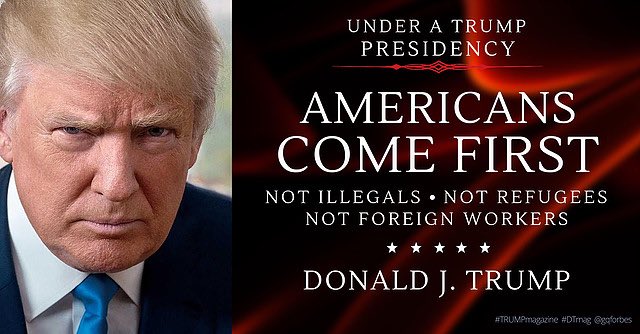
President Trump will put America first, save humanity, forever be the peacemaker, and bring home the bacon

Donald Trump says the United States needs a coherent foreign policy. Indeed. Can he offer one? Not yet.

It was only last month that Trump said on foreign policy that “my primary consultant is myself and I have a good instinct for this stuff.”

Apparently one of the results of Trump’s internal deliberations is that he now needs some input from outside.

“My goal is to establish a foreign policy that will endure for several generations. That’s why I also look and have to look for talented experts with approaches and practical ideas” — experts like Walid Phares, who apparently needing to hold his practical ideas in reserve, promised in advance: “There will be no details in this speech.”

Or to put it another way: all packaging; no content.

My foreign policy will always put the interests of the American people and American security above all else.

To our friends and allies, I say America is going to be strong again. America is going to be reliable again. It’s going to be a great and reliable ally again. It’s going to be a friend again. We’re going to finally have a coherent foreign policy based upon American interests and the shared interests of our allies.

We’re getting out of the nation-building business and instead focusing on creating stability in the world. Our moments of greatest strength came when politics ended at the water’s edge. We need a new rational American foreign policy, informed by the best minds and supported by both parties, and it will be by both parties — Democrats, Republicans, independents, everybody, as well as by our close allies.

… we must as a nation be more unpredictable. We are totally predictable. We tell everything. We’re sending troops. We tell them. We’re sending something else. We have a news conference. We have to be unpredictable. And we have to be unpredictable starting now.

I will seek a foreign policy that all Americans, whatever their party, can support, so important, and which our friends and allies will respect and totally welcome. The world must know that we do not go abroad in search of enemies, that we are always happy when old enemies become friends and when old friends become allies, that’s what we want. We want them to be our allies.

We want the world to be — we want to bring peace to the world.

No country has ever prospered that failed to put its own interests first. Both our friends and our enemies put their countries above ours and we, while being fair to them, must start doing the same. We will no longer surrender this country or its people to the false song of globalism. The nation-state remains the true foundation for happiness and harmony. I am skeptical of international unions that tie us up and bring America down and will never enter…

The world is most peaceful and most prosperous when America is strongest. America will continue and continue forever to play the role of peacemaker. We will always help save lives and indeed humanity itself, but to play the role, we must make America strong again.

Facebooktwittermail

Trump’s ‘America First’ has ugly echoes from U.S. history

Susan Dunn writes:My foreign policy will always put the interests of the American people, and American security, above all else. That will be the foundation of every decision that I will make. America First will be the major and overriding theme of my administration.”

It is extremely unfortunate that in his speech Wednesday outlining his foreign policy goals, Donald Trump chose to brand his foreign policy with the noxious slogan “America First,” the name of the isolationist, defeatist, anti-Semitic national organization that urged the United States to appease Adolf Hitler.

The America First Committee actually began at Yale University, where Douglas Stuart Jr., the son of a vice president of Quaker Oats, began organizing his fellow students in spring 1940. He and Gerald Ford, the future American president, and Potter Stewart, the future Supreme Court justice, drafted a petition stating, “We demand that Congress refrain from war, even if England is on the verge of defeat.”

Their solution to the international crisis lay in a negotiated peace with Hitler. Other Yale students — including Sargent Shriver, who served in the Kennedy and Johnson administrations, and Kingman Brewster, the chairman of the Yale Daily News, future president of Yale and ambassador to the Court of St. James — joined their isolationist crusade. [Continue reading…]

Facebooktwittermail

Obama’s last chance to end the ‘forever war’

Jennifer Daskal writes: The United States is fighting an unauthorized war. Over the past 19 months, American forces have launched more than 8,800 strikes against the Islamic State in Iraq and Syria and hit the group’s affiliate in Libya. The United States continues aerial assaults against Al Qaeda in the Arabian Peninsula in Yemen, is going after militants in Afghanistan and Pakistan, and killed more than 150 suspected Shabab fighters in Somalia just last month.

This war isn’t limited to drone strikes or aerial bombings. It includes Special Operations forces in Iraq, Syria and Afghanistan — and possibly elsewhere. This past weekend, President Obama announced that he would send an additional 250 such troops to Syria.

The primary legal authority for these strikes and deployments comes from the 60-word Authorization for Use of Military Force, passed almost a decade and a half ago. In the days after Sept. 11, 2001, President George W. Bush asked for an open-ended authorization to fight all future acts of terrorism. Wisely, Congress rejected that request, though it did give the president authority to use force against those responsible for the Sept. 11 attacks, Al Qaeda, and those that harbored them, the Taliban.

Today, the Taliban no longer rules Afghanistan, Osama bin Laden has been killed and the other key participants in the Sept. 11 attacks are either locked up or dead. But the old authorization lives on. [Continue reading…]

Facebooktwittermail

House advances Email Privacy Act, setting the stage for vital privacy reform

Electronic Frontier Foundation: The U.S. House of Representatives passed the Email Privacy Act (H.R. 699) yesterday, which would require the government to get a probable cause warrant from a judge before obtaining private communications and documents stored online with companies such as Google, Facebook, and Dropbox.

The bill provides a long-overdue update to the Electronic Communications Privacy Act (ECPA), first passed in 1986. The bill also codifies the Sixth Circuit’s ruling in U.S. v. Warshak, which held that the Fourth Amendment demands that the government first obtain a warrant before accessing emails stored with cloud service providers.

The House vote is historic, given that H.R. 699 has an amazing 315 cosponsors, almost three quarters of the entire House. The House voted unanimously, following a unanimous vote by the House Judiciary Committee earlier this month. [Continue reading…]

Facebooktwittermail

Michael Klare: The coming world of ‘peak oil demand,’ not ‘peak oil’

In a Greater Middle East in which one country after another has been plunged into chaos and possible failed statehood, two rival nations, Iran and Saudi Arabia, have been bedrock exceptions to the rule.  Iran, at the moment, remains so, but the Saudi royals, increasingly unnerved, have been steering their country erratically into the region’s chaos. The kingdom is now led by a decrepit 80-year-old monarch who, in commonplace meetings, has to be fed his lines by teleprompter.  Meanwhile, his 30-year-old son, Deputy Crown Prince Mohammed bin Salman, who has gained significant control over both the kingdom’s economic and military decision-making, launched a rash anti-Iranian war in Yemen, heavily dependent on air power.  It is not only Washington-backed but distinctly in the American mode of these last years: brutal yet ineffective, never-ending, a boon to the spread of terror groups, and seeded with potential blowback.

Meanwhile, in a cheap-oil, belt-tightening moment, in an increasingly edgy country, the royals are reining in budgets and undermining the good life they were previously financing for many of their citizens.  The one thing they continue to do is pump oil — their only form of wealth — as if there were no tomorrow, while threatening further price-depressing rises in oil production in the near future.  And that’s hardly been the end of their threats.  While taking on the Iranians (and the Russians), they have also been lashing out at the local opposition, executing a prominent dissident Shiite cleric among others and even baring their teeth at Washington.  They have reportedly threatened the Obama administration with the sell-off of hundreds of billions of dollars in American assets if a bill, now in Congress and aimed at opening the Saudis to American lawsuits over their supposed culpability for the 9/11 attacks, were to pass. (It would, however, be a sell-off that could hurt the Saudis more than anyone.)  Even at the pettiest of levels, on Barack Obama’s recent arrival in Saudi Arabia for a visit with King Salman, they essentially snubbed him, a first for a White House occupant. All in all, a previously sure-footed (if extreme) Sunni regime seems increasingly unsettled; in fact, it has something of the look these days of a person holding a gun to his own head and threatening to pull the trigger. In other words, in a region already aflame, the Saudis seem to be tossing… well, oil onto any fire in sight.

And in a way, it’s little wonder.  The very basis for the existence of the Saudi royals, their staggering oil reserves, is under attack — and not by the Iranians, the Russians, or the Americans, but as TomDispatch energy specialist Michael Klare explains, by something so much larger: the potential ending of the petroleum way of life.  Tom Engelhardt

Debacle at Doha
The collapse of the old oil order
By Michael T. Klare

Sunday, April 17th was the designated moment.  The world’s leading oil producers were expected to bring fresh discipline to the chaotic petroleum market and spark a return to high prices. Meeting in Doha, the glittering capital of petroleum-rich Qatar, the oil ministers of the Organization of the Petroleum Exporting Countries (OPEC), along with such key non-OPEC producers as Russia and Mexico, were scheduled to ratify a draft agreement obliging them to freeze their oil output at current levels. In anticipation of such a deal, oil prices had begun to creep inexorably upward, from $30 per barrel in mid-January to $43 on the eve of the gathering. But far from restoring the old oil order, the meeting ended in discord, driving prices down again and revealing deep cracks in the ranks of global energy producers.

It is hard to overstate the significance of the Doha debacle. At the very least, it will perpetuate the low oil prices that have plagued the industry for the past two years, forcing smaller firms into bankruptcy and erasing hundreds of billions of dollars of investments in new production capacity. It may also have obliterated any future prospects for cooperation between OPEC and non-OPEC producers in regulating the market. Most of all, however, it demonstrated that the petroleum-fueled world we’ve known these last decades — with oil demand always thrusting ahead of supply, ensuring steady profits for all major producers — is no more.  Replacing it is an anemic, possibly even declining, demand for oil that is likely to force suppliers to fight one another for ever-diminishing market shares.

Continue reading

Facebooktwittermail