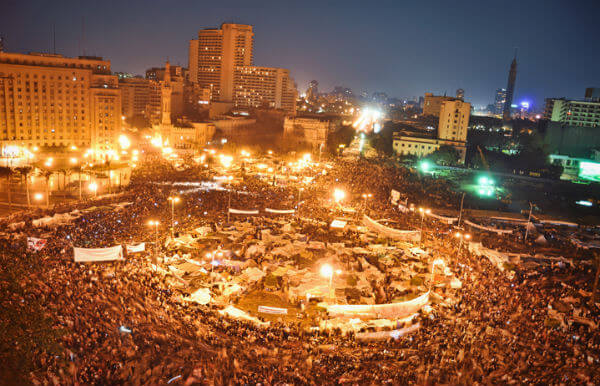
Writers from across the Arab world offer their reflections on the last five years. Robin Yassin-Kassab writes: Five years ago the Guardian asked me to evaluate the effects of the Tunisian uprising on the rest of the Arab world, and specifically Syria. I recognised the country was “by no means exempt from the pan-Arab crisis of unemployment, low wages and the stifling of civil society”, but nevertheless argued that “in the short to medium term, it seems highly unlikely that the Syrian regime will face a Tunisia-style challenge”.
That was published on 28 January 2011. On the same day a Syrian called Hasan Ali Akleh set himself alight in protest against the Assad regime in imitation of Mohamed Bouazizi’s self-immolation in Tunisia. Akleh’s act went largely unremarked, but on 17 February tradesmen at Hareeqa in Damascus responded to police brutality by gathering in their thousands to chant “The Syrian people won’t be humiliated”. This was unprecedented. Soon afterwards, the Deraa schoolboys were arrested and tortured for writing anti-regime graffiti. When their relatives protested on 18 March, and at least four were killed, the spiralling cycle of funerals, protests and gunfire was unleashed. In 2011, I wrote that Assad personally was popular, and so he remained until his 30 March speech to the ill-named People’s Assembly. Very many had suspended judgment until that moment, expecting an apology for the killings and an announcement of serious reforms. Instead, Assad threatened, indulged in conspiracy theories, and, worse, giggled repeatedly.
I underestimated the disastrous effects of Assad’s neo-liberal/crony-capitalist restructuring during the previous decade. I was soon to be wrong about many other things too. In April the regime made conciliatory gestures to Islamists and Kurds. At first I thought this showed how hopelessly out of touch it was – the protest movement at this stage was pan‑Syrian and non-sectarian. Then I understood its misinterpretation was deliberate. In the following years the regime would stick to reading the revolution through ethnic and sectarian lenses; and largely due to its own efforts, these eventually came to dominate the field. [Continue reading…]
Category Archives: Issues
On anniversary of Jan 25 uprising, Egypt’s rulers feel threatened by any possibility of dissent

The New York Times reports: The normally invasive Egyptian authorities had long left Studio Emad Eddin alone, seeing no threat from a performance space that houses rehearsal studios and offers classes in set design and drama.
But this month, 18 plainclothes men from the Interior Ministry showed up with a warrant, asked about licenses and then confiscated equipment, including some speakers and a sound mixer, according to Nevine El Ibiary, one of the studio’s founders.
The search came within weeks of similar raids at several cultural venues and amid a vast security dragnet in downtown Cairo — part of an extraordinary effort by the government of President Abdel Fattah el-Sisi to prevent any protest commemorating the uprising that started on Jan. 25, 2011, and toppled President Hosni Mubarak.
The security response has been in keeping with the government’s reputation for repressing most kinds of dissent. But the scale of the clampdown has baffled many people here, as has the level of official alarm, from a government that has faced no challenge from large-scale protests in years. In word and deed, Mr. Sisi and other officials have treated even the possibility of demonstrations on the anniversary as a grave threat to the nation.
The sense of panic has been attributed to concerns that the public is losing patience with the government amid high unemployment, rising prices and a persistent militant insurgency that, among other things, has devastated Egypt’s tourism industry.
But those factors alone were not sufficient to explain the overheated response, analysts said. From the perspective of the security services, the date — Jan. 25 — was itself a danger, as a reminder of their catastrophic, if momentary, loss of control. [Continue reading…]
Egypt: A revolution devours its children
Lauren Bohn writes: It takes about 30 minutes to drive from the teeming Cairo neighborhood of Faisal to what locals call “El Sijn” — Arabic for “the prison.” There are many in Egypt, but everyone seems to know the prison: Tora Prison, opened in 1908. It has housed a diverse assortment of the country’s dissidents, businessmen, Islamists, and statesmen — including the ousted president Hosni Mubarak, who had ruled Egypt for nearly three decades before his regime fell in the uprising that began almost exactly five years ago.
Since then, the upheaval hasn’t stopped, and it’s as much personal as it is collective. The country saw its first-ever democratic elections; another wave of protest over the rule of Mohammed Morsi, the Islamist president those elections brought to power; a military coup, led by then-Army Chief Abdel Fattah el-Sisi; and a reinstatement, under now-President Sisi, of the kind of authoritarianism protesters risked their lives to escape five years ago. The crackdown has ensnared liberals and Islamists alike, leaving the prison as a burial chamber for the aspirations of the revolution, in all their wide variety.
Nourhan Hefzy has memorized the way there. The route winds through Faisal’s trash-strewn maze of narrow streets and past the more manicured fringes of Cairo, beyond the French School and the boutiques. It ends at a sepia-toned compound of cement in a bleak, brown desert. Somewhere inside that compound is her husband, Ahmed. He has been locked away there for the past two years.
“It’s been five years since we’ve toppled Mubarak and we’re back to square one,” Nourhan says. At 26, Ahmed was one of Egypt’s most prominent liberal activists, and remains a living symbol of the revolution: once vibrant and triumphant on Cairo’s streets, now languid and silenced behind bars. The young couple used to talk for hours about their plans to open a bookstore, maybe even start a publishing house dedicated to fostering freedom and democracy in a country with a severe deficit of both. Now their conversations are limited to a hurried, supervised 20 minutes every other week.
“It is worse than square one,” corrects Ahmed’s mother Fathia, who often accompanies her daughter-in-law on visits to El Sijn. For her, the journey to the prison evokes a more-distant past, after her father and almost all her male relatives were arrested decades ago for being members of the then-banned Islamist Muslim Brotherhood. The organization, whose political party was briefly in charge of Egypt’s government following Morsi’s ascent to the presidency, has once again been banned. But Fathia never thought her son — a staunch critic of the very group she and her husband have dedicated their lives to — would also end up behind bars. [Continue reading…]
Drone strikes: The brand of detached warfare that Obama made his own
The Guardian reports: Faheem Qureshi’s uncles sat with their neighbors, chatting, cracking jokes and sipping tea, in their family’s lounge for male guests. Qureshi, almost 14, stood nearby, bored and restless, thinking about when he could go to the nearby playground where he and the other Ziraki village kids played badminton and cricket.
It had been a long day – Friday prayers, a food shopping errand at his mother’s behest, hosting – but also a happy occasion, as people stopped by to welcome an uncle home to North Waziristan, in tribal Pakistan, from a work excursion to the United Arab Emirates. Then he heard a sound like a plane taking off.
About two seconds later, the missile punched a hole through the lounge. Qureshi remembers feeling like his body was on fire. He ran outside, wanting to throw water on his face, but his priority was escape. The boy could not see.
This was the hidden civilian damage from the first drone strike Barack Obama ever ordered, on 23 January 2009, the inauguration of a counter-terrorism tactic likely to define Obama’s presidency in much of the Muslim world. It was the third day of his presidency. [Continue reading…]
SEC is criticized for lax enforcement of climate risk disclosure
The New York Times reports: As recently as 2011, shares in Peabody Energy, the world’s biggest private sector coal company, traded at the equivalent of $1,000. Today, they hover around $4 each. Over that time, investors who held the stock lost millions.
Peabody, like other coal companies, has been hammered as cheap natural gas erodes the demand for coal. But concerns about climate change are also an issue for the company as customers and investors turn away from fossil fuels.
Peabody saw this coming. Even as the company privately projected that coal demand would slump and prices would fall, it withheld this information from investors. Instead, Peabody said in filings with the Securities and Exchange Commission that it was not possible to know how changing attitudes toward climate change would affect its business.
Peabody’s double talk was revealed as part of a two-year investigation by the New York attorney general. In a settlement in November, Peabody agreed that it would disclose more about climate change risks in its regular filings with the S.E.C.
In theory, however, Peabody should have been making such disclosures all along. [Continue reading…]
British arms companies ramp up bomb sales to Saudi Arabia by 100 times despite air strikes on civilians
The Independent reports: British arms companies have cashed-in on Saudi Arabia’s military campaign in Yemen by ramping up arms sales to the country’s autocratic government by over a hundred times, new figures show.
Sales of British bombs and missiles to the Saudi Arabia surged to over £1bn just three months last year, according to an official record of arms export licences quietly released by the Government this week.
The sales, up from just £9m in the preceding three-month period, have occurred while the oil-rich autocracy conducts a military campaign in its neighbour’s territory, where the United Nations has said a “humanitarian catastrophe” is unfolding. [Continue reading…]
Remember photos of Erdogan’s aide kicking a protester? Now they’re blocked in Turkey
Erdogan aide Yusuf Yerkel REALLY wants to forget this moment, kicking a mourning miner in #Soma. Let's remind him. pic.twitter.com/ivY6YqZQG2
— Capulcu Tonella (@diehimbeertonis) January 22, 2016
Mashable reports: Famous images showing an aide to Turkey’s prime minister kicking a protester in the wake of a national tragedy are slowly vanishing from the internet in Turkey.
The photographs were taken after a fire killed 301 miners in the spring of 2014 and they quickly became symbols of the government’s callous reaction to the worst industrial accident in Turkey’s history.
Yet anyone in Turkey today who tries to find the famous photos of Yusuf Yerkel winding up for a kick aimed a protester who was already on the ground — and restrained by security — will find that many webpages showing the image are blocked. [Continue reading…]
How a few billionaires could help close the world’s poverty gap
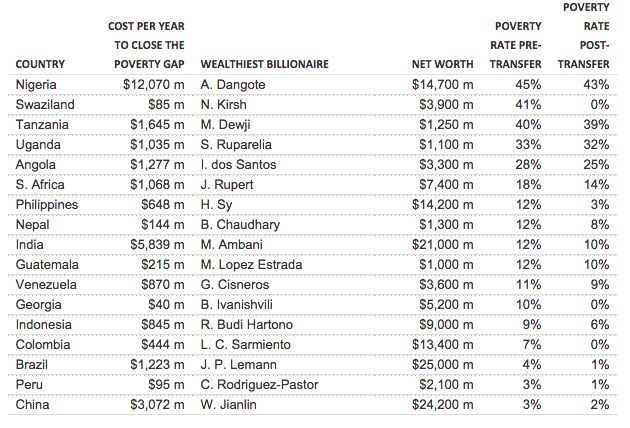
Laurence Chandy, Lorenz Noe and Christine Zhang write: What difference could a philanthropic donation from the world’s richest people make?
To explore this question, we begin by identifying those developing countries that are home to a least one billionaire. (Our analysis is restricted to billionaires by data, not by the potential largesse of the world’s multi-millionaires. We focus our attention on billionaires in the developing world given the traditional focus of philanthropy on domestic causes.) Let’s assume that the richest billionaire in each country agrees to give away half of his or her current wealth among his or her fellow citizens, disbursed evenly over the next 15 years, roughly in accordance with the Giving Pledge promoted by Bill Gates. That money would be used exclusively to finance transfers to poor people based on their current distance from the poverty line. Transfers would be sustained at the same level for the full 15-year period with the aim of providing a modicum of income security that might allow beneficiaries to sustainably escape from poverty by 2030.
The following table summarizes the key results. In each of three countries — Colombia, Georgia, and Swaziland — a single individual’s act of philanthropy could be sufficient to end extreme poverty with immediate effect. Swaziland is an especially striking case as it is among the world’s poorest countries, with 41 percent of its population living under the poverty line. In Brazil, Peru, and the Philippines, poverty could be more than halved, or eliminated altogether if the billionaires could be convinced to match Mark Zuckerberg’s example and increase their donation to 99 percent of their wealth. [Continue reading…]

This billionaire thinks you should be paid more
We have 12 months until the next ‘hottest year’ memo – will we be ready?
By James Dyke, University of Southampton
It’s official. 2015 was the warmest year ever recorded. In fact, one would need to go back some 130,000 years to experience such high surface temperatures.
This really just confirms what we already assumed. The monster El Niño that began to erupt towards the end of 2014 further amplified the background signal of global warming that is being driven by greenhouse gas emissions. While the forecast is for a diminishing El Niño as we move towards the northern hemisphere summer, it hasn’t done with us yet – 2016 may prove to be even warmer.
Beyond this year temperatures may decrease. For a while. This of course will be seized upon by some people who continue to dispute the Earth is experiencing significant and sustained warming – let alone that humans are primarily responsible for such a trend. People with this attitude have fallen for the “escalator” fallacy; it’s possible to show a short-term decrease in temperature if you pick your start and end times carefully, but looking at the longer-term produces a clear increasing trend.
French PM Manuel Valls says refugee crisis is ‘destabilising’ Europe

The Guardian reports: The French prime minister, Manuel Valls, has said Europe cannot take in all the refugees fleeing wars in Iraq and Syria and that the crisis was putting the concept of Europe itself in grave danger.
Speaking to the BBC at the economic forum in Davos, Valls said Europe needed to take urgent action to control its external borders. “Otherwise,” he said, “our societies will be totally destabilised.”
Asked about border controls inside Europe, which many fear put the passport-free Schengen zone at risk, Valls said the concept of Europe was in jeopardy. “If Europe is not capable of protecting its own borders, it’s the very idea of Europe that will be questioned,” he said.
He said a message to refugees that says “Come, you will be welcome”, provoked major shifts in population. “Today, when we speak in Europe, a few seconds later it is mainly on the smartphones in the refugee camps,” Valls said.
The large numbers of refugees in Europe has been a persistent theme of the Davos summit. The Dutch prime minister, Mark Rutte, on Thursday said Europe was close to breaking point and needed to come up with a common response or run the risk that one of the European Union’s founding principles would start to unravel. [Continue reading…]
Iraqi Kurdistan president: Time has come to redraw Middle East boundaries
The Guardian reports: The president of Iraq’s autonomous Kurdish north has called on global leaders to acknowledge that the Sykes-Picot pact that led to the boundaries of the modern Middle East has failed, and urged them to broker a new deal paving the way for a Kurdish state.
Massoud Barzani, who has led the troubled country’s Kurds for the past decade, said the international community had started to accept that Iraq and Syria in particular would never again be unified and that “compulsory co-existence” in the region had been proven wrong.
“I think that within themselves, [world leaders] have come to this conclusion that the era of Sykes-Picot is over,” Barzani told the Guardian. “Whether they say it or not, accept it or not, the reality on the ground is that. But as you know, diplomats are conservatives and they give their assessment in the late stages of things. And sometimes they can’t even keep up with developments.”
The political map of northern Iraq has changed drastically in the 18 months since Islamic State overran Iraq’s second city, Mosul. Kurdish forces are now in full control of Kirkuk and Sinjar and have claimed control of thousands more miles of land that had been under control of Iraq’s central government. [Continue reading…]
At work as at home, men reap the benefits of women’s ‘invisible labor’
Soraya Chemaly writes: Men today do a higher share of chores and household work than any generation of men before them. Yet working women, especially working mothers, continue to do significantly more.
On any given day, one fifth of men in the US, compared to almost half of all women do some form of housework. Each week, according to Pew, mothers spend nearly twice as long as fathers doing unpaid domestic work. But while it’s important to address inequality at home, it’s equally critical to acknowledge the way these problems extend into the workplace. Women’s emotional labor — which can involve everything from tending to others’ feelings to managing family dynamics to writing thank-you notes — is a big issue that’s rarely discussed.
In the early 1980s, University of California, Berkeley sociologist Arlie Russell Hochschild coined the term “emotional labor” in her book The Managed Heart. Hochschild observed that women make up the majority of service workers — flight attendants, food service workers, customer service reps — as well as the majority of of child-care and elder-care providers. All of these positions require emotional effort, from smiling on demand to prioritizing the happiness of the customer over one’s own feelings. [Continue reading…]
Woody Guthrie, ‘Old Man Trump’ and a real estate empire’s racist foundations
By Will Kaufman, University of Central Lancashire
In December 1950, Woody Guthrie signed his name to the lease of a new apartment in Brooklyn. Even now, over half a century later, that uninspiring document prompts a double-take.
Below all the legal jargon is the signature of the man who had composed “This Land Is Your Land,” the most resounding appeal to an equal share for all in America. Below that is the signature of Donald Trump’s father, Fred. No pairing could appear more unlikely.
Guthrie’s two-year tenancy in one of Fred Trump’s buildings and his relationship with the real estate mogul of New York’s outer boroughs produced some of Guthrie’s most bitter writings, which I discovered on a recent trip to the Woody Guthrie Archives in Tulsa. These writings have never before been published; they should be, for they clearly pit America’s national balladeer against the racist foundations of the Trump real estate empire.
Recalling these foundations becomes all the more relevant in the wake of the racially charged proclamations of Donald Trump, who last year announced, “My legacy has its roots in my father’s legacy.”
Google’s effort to consume its employees
Benjamin Naddaff-Hafrey writes: Few companies could announce a new office in the messianic way that Google did last February. Then again, few companies have ever built this sort of office.
‘Google’s presence in Mountain View is simply so strong that it can’t be the fortress that shuts away… the neighbours. It really needs to become a neighbourhood in Mountain View,’ intones the lead architect Bjarke Ingels of the Danish firm Bjarke Ingels Group (BIG) in the introductory video. The camera sweeps high over an edenic Mountain View in the San Francisco Bay Area. It pulls back to reveal Google’s proposed new office: a neighbourhood nested beneath glittering glass domes.
On approximately 3.5 million square feet of commercial land, Google intended to build a campus office that might best be described as a new part of town. Beneath the glass canopies, a thriving neighbourhood hosts stores, bike paths and modular office spaces. In building this new neighbourhood, Google hoped to expand their working space while accommodating the Mountain View population inclined to view them as a ‘fortress’. The utopian campus was meant to assuage fears that spiking numbers of Google employees would create a Google voting bloc, according to The New York Times. Such fears are understandable. As of 2013, the company employed roughly 10 per cent of Mountain View’s workforce and owned approximately the same proportion of taxable property. [Continue reading…]
A nation of field mice where fear runs rampant
In an article titled, “One Nation Under Fear,” Mark Edmundson writes:
How did a people who settled a continent, created enormous wealth, and fought and (mostly) won war after war devolve into a nation of such tremulous souls? And how did it happen so quickly? Where once there was the generation of the Second World War, ready to leave home and fight fascists on the far sides of the world, we now have a nation that at times seems composed largely of field mice, prone to quiver when they detect an unfriendly shadow.
In the latest wave of mass hysteria, the barriers of entry to the United States imposed on people with darker skins will once again be raised higher.
The Visa Waiver Program Improvement and Terrorist Travel Prevention Act of 2015 does not make any mention of skin color, yet the officials who are responsible for enforcing this law will inevitably notice skin color when determining if it needs to be applied. Since the law will apply, for instance, to British citizens who are also Iranian nationals simply by virtue of having an Iranian father — such an individual might have been born in the UK, have never visited Iran and not possess an Iranian passport — the way in which they will get flagged for questioning will most likely be because they are Middle Eastern in appearance.
Ostensibly, the law was designed to block U.S. entry to Europeans who have joined ISIS.
Let’s imagine how that would work: A British citizen who fought with ISIS in Syria has now returned home and then decides to fly to New York. He shows up at the airline check-in desk, presents his passport and the clerk, seeing the stamp entered when he visited Syria, says: “Sorry mate, no trip to America for you!” The thwarted traveler responds: “Damn that Terrorist Travel Prevention Act!” … except, of course, such an individual would in reality neither declare nor present any evidence that they had been in Syria or belonged to ISIS. The terrorist would — surprise, surprise — break the rules.
In truth, this isn’t a serious piece of legislation. Those who drafted and passed this law were engaged in a piece of political theater. Indeed, anyone who can coin a phrase like “terrorist travel prevention” would be better employed at The Onion than in the U.S. Congress.
The only people who will be reliably prevented from travel are those innocently trying to do what most travelers do — visit relatives and friends; engage in tourism or business.
The terrorists are not so dumb that they would run afoul of such restrictions — just as no terrorist would subvert his own objectives by tangling himself in the vetting process imposed on asylum seekers. Continue reading
Anti-Muslim profiling at airports goes beyond the TSA
Think Progress reports: A growing number of Muslims, Sikhs, and people of Middle Eastern descent are reporting incidents of racial and religious profiling while trying to board planes, sparking concerns that rising anti-Islam sentiment is sparking a new wave of discrimination at airports.
American Muslims have long encountered difficulties at airports, where security officials have been accused of unfairly profiling, questioning, searching, and detaining passengers simply for “looking” Muslim — including people who are not devotees of Islam, such as Sikhs and Arab Christians. Policies that support such profiling — many enacted in the years immediately following the September 11 attacks (although most have proven largely ineffective at catching terrorists) — remain in place today and have been defended by White House officials, even though Transportation Security Administration (TSA) agents have voiced misgivings about programs that single out people based on race or religion.
But as the United States endures an unprecedented wave of anti-Islam hatred following the terrorist attacks in Paris and San Bernardino late last year, Muslim Americans and others affected by Islamophobia are reporting a rash of new airport profiling cases — this time not just at the hands of the TSA, but also airline companies and fellow passengers. [Continue reading…]
Yassin al-Haj Saleh: ‘Syria is a unique symbol of injustice, apathy and amnesia’
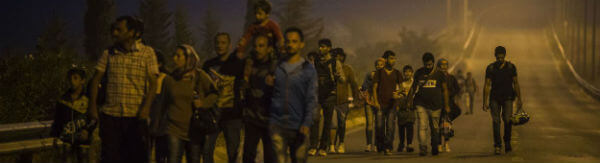
How do you feel when you see so many of your fellow citizens on the run from the most horrible conflict of our time? Did you expect an exodus like that?
Weeks ago, I helped smuggle my sister-in-law and my nephew from Turkey to Greece. As a beginner, I consulted friends, met smugglers, and chose one.
I was anxious about their safety, and was relieved when they arrived in a European country, even if it was not the one they wanted to go to. The other half of my brother’s family, he and his two younger sons, are to join the first half someday. With the help of friends, we are trying to arrange things for another brother and his family to take refuge in another European country, after a mutual friend of ours, the journalist and film maker Naji Jerf, was assassinated in Turkey on 27 December 2015.
We are helping ourselves to a world that did not help to liberate us at home. Never had I contemplated the possibility of such an exodus. I did not expect that the regime would kill hundreds of thousands of people and that its chances of staying in power would grow bigger as the numbers of its victims soared. I did not expect the emergence of a monstrous creature like Da’esh [ISIS]. I did not expect that around 70 countries would be partners in bombing my country: not against the ruling criminal, but against an offshoot of his monstrosity.
How do you see the European handling of the refugee crisis?
I am impressed by many people from many European countries, mostly individual volunteers. Their generosity, courage and humanity dignify the human race. I was touched by a message from a Norwegian woman who was in Lesbos helping refugees. As for governments, while it is not fair to include all of them in one category – Germany is not like Hungary, Sweden is not Denmark – I think they are unified in building higher walls in the face of the influx of refugees, specifically the poorest and most vulnerable ones.
For months now, European governments have been pressuring Ankara not to allow refugees to depart from Turkey. In November, they promised to pay €3 billion to the Turkish governments to guard European borders.
With all this blood that has been spilt over the past five years right under the world’s nose, humanity has led itself down the path to full ethical numbness. I suppose the indifference the world showed towards the Syrian ordeal will lead to even less sensitivity to human suffering in political institutions everywhere. [Continue reading…]