Category Archives: Issues

Israeli border officer threatens Palestinians: ‘We will gas you all until you die’

Muftah reports: An Israeli border officer threatened to “gas you all until you die,” while speaking to the residents of Aida refugee camp in Bethlehem. While the mentality behind the officer’s threat is nothing new to Palestinians, the candor with which he spoke is.

In a one minute video recorded by a camp resident on Thursday, October 29, the officer used the loud speaker on an Israeli jeep crawling down a street in the camp and announced in Arabic: “People of Aida refugee camp, we are the occupation forces. You throw stones, and we will hit you with gas until you all die. The children, the youth, the old people – you will all die. We won’t leave any of you alive.”

“We have arrested one of you,” the officer continued, referring to a twenty-five-year old Palestinian man who was arrested earlier that day. “He is with us now. We took him from his home, and we will slaughter and kill him while you watch if you keep throwing stones. Go home or we will gas you all until you die. Your families, your children, everyone – we will kill you.” [Continue reading…]

Facebooktwittermail

Exxon Mobil under investigation on lying to the public and investors about climate change

In September, Climate Change News reported: At a meeting in Exxon Corporation’s headquarters, a senior company scientist named James F. Black addressed an audience of powerful oilmen. Speaking without a text as he flipped through detailed slides, Black delivered a sobering message: carbon dioxide from the world’s use of fossil fuels would warm the planet and could eventually endanger humanity.

“In the first place, there is general scientific agreement that the most likely manner in which mankind is influencing the global climate is through carbon dioxide release from the burning of fossil fuels,” Black told Exxon’s Management Committee, according to a written version he recorded later.

It was July 1977 when Exxon’s leaders received this blunt assessment, well before most of the world had heard of the looming climate crisis.

A year later, Black, a top technical expert in Exxon’s Research & Engineering division, took an updated version of his presentation to a broader audience. He warned Exxon scientists and managers that independent researchers estimated a doubling of the carbon dioxide (CO2) concentration in the atmosphere would increase average global temperatures by 2 to 3 degrees Celsius (4 to 5 degrees Fahrenheit), and as much as 10 degrees Celsius (18 degrees Fahrenheit) at the poles. Rainfall might get heavier in some regions, and other places might turn to desert.

“Some countries would benefit but others would have their agricultural output reduced or destroyed,” Black said, in the written summary of his 1978 talk.

His presentations reflected uncertainty running through scientific circles about the details of climate change, such as the role the oceans played in absorbing emissions. Still, Black estimated quick action was needed. “Present thinking,” he wrote in the 1978 summary, “holds that man has a time window of five to ten years before the need for hard decisions regarding changes in energy strategies might become critical.”

Exxon responded swiftly. Within months the company launched its own extraordinary research into carbon dioxide from fossil fuels and its impact on the earth. Exxon’s ambitious program included both empirical CO2 sampling and rigorous climate modeling. It assembled a brain trust that would spend more than a decade deepening the company’s understanding of an environmental problem that posed an existential threat to the oil business.

Then, toward the end of the 1980s, Exxon curtailed its carbon dioxide research. In the decades that followed, Exxon worked instead at the forefront of climate denial. [Continue reading…]

In October, the Los Angeles Times reported: Back in 1990, as the debate over climate change was heating up, a dissident shareholder petitioned the board of Exxon, one of the world’s largest oil companies, imploring it to develop a plan to reduce carbon dioxide emissions from its production plants and facilities.

The board’s response: Exxon had studied the science of global warming and concluded it was too murky to warrant action. The company’s “examination of the issue supports the conclusions that the facts today and the projection of future effects are very unclear.”

Yet in the far northern regions of Canada’s Arctic frontier, researchers and engineers at Exxon and Imperial Oil were quietly incorporating climate change projections into the company’s planning and closely studying how to adapt the company’s Arctic operations to a warming planet.

Ken Croasdale, senior ice researcher for Exxon’s Canadian subsidiary, was leading a Calgary-based team of researchers and engineers that was trying to determine how global warming could affect Exxon’s Arctic operations and its bottom line. [Continue reading…]

The New York Times now reports: The New York attorney general has begun a sweeping investigation of Exxon Mobil to determine whether the company lied to the public about the risks of climate change or to investors about how those risks might hurt the oil business.

According to people with knowledge of the investigation, Attorney General Eric T. Schneiderman issued a subpoena Wednesday evening to Exxon Mobil, demanding extensive financial records, emails and other documents.

The investigation focuses on whether statements the company made to investors about climate risks as recently as this year were consistent with the company’s own long-running scientific research.

The sources said the scrutiny would include a period of at least a decade when Exxon Mobil funded outside groups that sought to undermine climate science, even as its in-house scientists were outlining the potential consequences — and uncertainties — to company executives. [Continue reading…]

Facebooktwittermail

Enforced disappearances: The Syrian government’s organized attack in which more than 58,000 civilians have gone missing

Amnesty International: The vast scale and chillingly orchestrated nature of tens of thousands of enforced disappearances by the Syrian government over the past four years is exposed in a new report by Amnesty International published today.

Between prison and the grave: Enforced disappearances in Syria reveals that the state is profiting from widespread and systematic enforced disappearances amounting to crimes against humanity, through an insidious black market in which family members desperate to find out the fates of their disappeared relatives are ruthlessly exploited for cash.

“This report describes in heart-breaking detail the devastation and trauma of the families of the tens of thousands of people who have vanished without trace in Syria, and their cruel exploitation for financial gain.”

The scale of the disappearances is harrowing. The Syrian Network for Human Rights has documented at least 65,000 disappearances since 2011 – 58,000 of them civilians. Those taken are usually held in overcrowded detention cells in appalling conditions and cut off from the outside world. Many die as a result of rampant disease, torture and extrajudicial execution. [Continue reading…]

Facebooktwittermail

Afghan refugees in Iran being sent to fight and die for Assad in Syria

The Guardian reports: Iran is recruiting Afghan refugees to fight in Syria, promising a monthly salary and residence permits in exchange for what it claims to be a sacred endeavour to save Shia shrines in Damascus.

The Fatemioun military division of Afghan refugees living in Iran and Syria is now the second largest foreign military contingent fighting in support of Bashar al-Assad, the Syrian president, after the Lebanese militia Hezbollah.

Iranian state-affiliated agencies reported in May that at least 200 Fatemioun members had been killed in Syria since the beginning of the war. How many more have died since is not clear.

Iran has always claimed it is participating in an advisory capacity in Syria, dispatching senior commanders to plan and oversee operations, but the Afghan involvement shows it is using other methods.

Recruitment is taking place on a daily basis in Mashhad and Qom, two Iranian cities with the largest population of Afghan refugees. Mashhad, the second most populous city in Iran, is only three hours’ drive from the country’s border with Afghanistan.

Iran is also accepting Afghans below the age of 18 provided they have written permission from their parents, the Guardian has learned. At least one 16-year-old Iran-based Afghan refugee was killed in Syria earlier this autumn. The rising number of funerals in Iran is a tangible sign revealing a greater involvement in the Syrian conflict in the wake of the Russian airstrikes. [Continue reading…]

Facebooktwittermail

Refugees: ‘No one puts children in a boat unless the water is safer than the land’

The New York Times reports: The rubber dinghy rolled perilously on the waves and twisted sideways, nearly flipping, as more than three dozen passengers wrapped in orange life vests screamed, wept and cried frantically to God and the volunteers waiting on the rocky beach.

Khalid Ahmed, 35, slipped over the side into the numbing waist-high water, struggled to shore and fell to his knees, bowing toward the eastern horizon and praying while tears poured into his salt-stiff beard.

“I know it is almost winter,” he said. “We knew the seas would be rough. But please, you must believe me, whatever will happen to us, it will be better than what we left behind.”

The great flood of humanity pouring out of Turkey from Syria, Afghanistan, Iraq and other roiling nations shows little sign of stopping, despite the plummeting temperatures, the increasingly turbulent seas and the rising number of drownings along the coast.

If anything, there has been a greater gush of people in recent weeks, driven by increased fighting in their homelands — including the arrival of Russian airstrikes in Syria — and the gnawing fear that the path into the heart of Europe will snap shut as bickering governments tighten their borders.

“Coming in the winter like this is unprecedented,” said Alessandra Morelli, the director of emergency operations in Greece for the United Nations High Commissioner for Refugees. “But it makes sense if you understand the logic of ‘now or never.’ That is the logic that has taken hold among these people. They believe this opportunity will not come again, so they must risk it, despite the dangers.”

The surge means that countries throughout the Balkans and Central Europe already under intense logistical and political strain will not find relief — especially Germany, the destination of choice for many of the refugees.

Hopes that weather and diplomacy would ease the emergency are unfounded so far, putting more pressure on financially strapped and emotionally overwhelmed governments to quickly find more winterized shelter.

The influx also underscores the European Union’s failure to reach a unified solution to the crisis, leaving places like this, on the Greek island of Lesbos in the northern Aegean Sea off the coast of Turkey, struggling to deal with huge numbers of desperate people and raising questions about what will happen not just this winter, but in the spring and beyond. [Continue reading…]

Facebooktwittermail

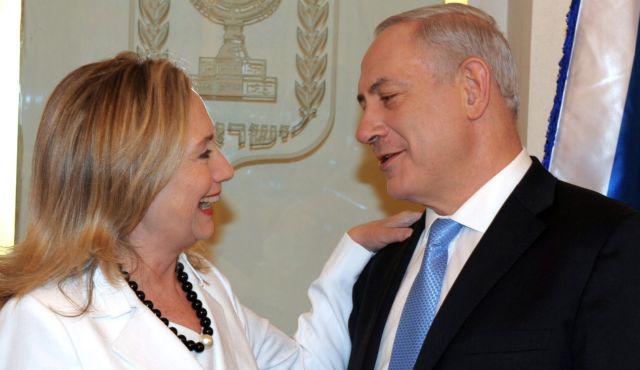
Hillary’s unbreakable bond with Bibi and her commitment to fight for Israel

Hillary Clinton writes: I will do everything I can to enhance our strategic partnership and strengthen America’s security commitment to Israel, ensuring that it always has the qualitative military edge to defend itself. That includes immediately dispatching a delegation of the Joint Chiefs of Staff to meet with senior Israeli commanders. I would also invite the Israeli prime minister to the White House in my first month in office.

The dangers facing both our nations in the Middle East require bold and united responses. We must remain committed to preventing Iran from ever acquiring a nuclear weapon, and to vigorously enforcing the new nuclear agreement. I would move to step up our partnership to confront Iran and its proxies across the region, and make sure dangerous Russian and Iranian weapons don’t end up in Hezbollah’s hands or threaten Israel. I also will combat growing efforts to isolate Israel internationally and to undermine its future as a Jewish state, including the Boycott, Divestment and Sanctions movement. I’ve spoken out against BDS in the United States and at the U.N., and will continue to do so.

For me, fighting for Israel isn’t just about policy — it’s a personal commitment to the friendship between our peoples and our vision for peace and security. [Continue reading…]

Facebooktwittermail

Diaspora Jews value communities’ unity more than connection to Israel, poll indicates

Ynet reports: The world’s Jews feel secure in their countries, including in Europe: In a survey conducted among Jewish community leaders in different places around the world, 77 percent reported that their members do not feel threatened in their places of residence, including 56 percent of European Jews.

Only 21 percent said their community members felt unsafe – about half of them due to the growth in anti-Semitism, and others because of the anger towards Israel, local criminal crime, the economic situation, the immigration problem in Europe, etc.

Ahead of the 9th World Conference of Jewish Community Centers (JCC Global), which is being held in Jerusalem this week, JCC leaders were asked whether the current situation in Israel affected them. The findings were surprising: Forty-six percent said the community’s sense of security was unaffected by the current round of conflict between Israel and the Palestinians, while 35% said they felt less secure. Ten percent even reported a higher sense of personal safety recently.

The interviewees were also asked to rank the Diaspora Jewry’s challenges. They revealed that the communities’ unity is more important to them than the connection with Israel, preventing assimilation and fighting anti-Semitism. [Continue reading…]

Facebooktwittermail

Médecins Sans Frontières releases internal review of Kunduz hospital attack

Médecins Sans Frontières reports: The international medical humanitarian organization Doctors Without Borders/Médecins Sans Frontières (MSF) today released an internal document reviewing the October 3 airstrikes by US forces on its hospital in northern Afghanistan. The chronological review of the events leading up to, during, and immediately following the airstrikes reveal no reason why the hospital should have come under attack. There were no armed combatants or fighting within or from the hospital grounds.

The document, part of an ongoing review of events undertaken by MSF, is based upon sixty debriefings of MSF national and international employees who worked at the 140-bed trauma center, internal and public information, before and after photographs of the hospital, email correspondence, and telephone call records. At least thirty people were killed in the airstrikes, including 13 staff members, 10 patients and 7 unrecognizable bodies yet to be identified.

“The view from inside the hospital is that this attack was conducted with a purpose to kill and destroy,” said Christopher Stokes, MSF general director. “But we don’t know why. We neither have the view from the cockpit, nor the knowledge of what happened within the US and Afghan military chains of command.”

The initial findings of the MSF review firmly establish the facts from inside the hospital in the days leading up to and during the attack. The review includes the details of the provision of the GPS coordinates and the log of phone calls from MSF to military authorities in attempt to stop the airstrikes. MSF had reached an agreement with all parties to the conflict to respect the neutrality of the hospital, based on international humanitarian law.

“We held up our end of the agreement — the MSF trauma center in Kunduz was fully functioning as a hospital with surgeries ongoing at the time of the US airstrikes,” said Dr. Joanne Liu, international president of MSF. “MSF’s no-weapons policy was respected and hospital staff were in full control of the facility prior to and at the time of the airstrikes.”

Among the 105 patients at the time of the airstrikes, MSF was treating wounded combatants from both sides of the conflict in Kunduz, as well as women and children.

“Some public reports are circulating that the attack on our hospital could be justified because we were treating Taliban,” said Stokes. “Wounded combatants are patients under international law, and must be free from attack and treated without discrimination. Medical staff should never be punished or attacked for providing treatment to wounded combatants.”

The MSF internal review describes patients burning in their beds, medical staff that were decapitated and had lost limbs, and others who were shot from the air while they fled the burning building.

“The attack destroyed our ability to treat patients at a time of their greatest need,” said Dr. Joanne Liu, international president of MSF. “A functioning hospital caring for patients cannot simply lose its protected status and be attacked.”

Facebooktwittermail

Ann Jones: The never-ending war

In an effort to attack Taliban fighters, an air strike by a U.S. plane killed dozens of civilians in Kunduz, Afghanistan. In the wake of the attack, an American general responded in unequivocal fashion. “I take this possible loss of life or injury to innocent Afghans very seriously,” he said. “I have ordered a complete investigation into the reasons and results of this attack, which I will share with the Afghan people.”

In an effort to attack Taliban fighters, an air strike by a U.S. plane killed dozens of civilians in Kunduz, Afghanistan. In the wake of the attack, an American general responded in unequivocal fashion. “I want to offer my deepest condolences to those innocent civilians who were harmed and killed on Saturday,” he said. “I’ve ordered a thorough investigation into this tragic incident… we will share the results of the investigation once it is complete.”

The first of those air strikes took place in 2009 and targeted fuel tankers hijacked by the Taliban. The second took place last month and targeted a hospital that Afghan officials say was used as a safe haven by the Taliban. The striking similarities between the two attacks are rooted not in uncanny coincidence but in the law of averages. Bomb a country long enough and such echoes are bound to occur.

Of course, U.S. planes have been carrying out attacks and terrorizing innocent Afghans in and around Kunduz (and elsewhere in the country) since 2001. This is, after all, America’s war in Afghanistan, which has produced eerily repetitive tragedies; a war that’s also seen almost endless announcements of achievements, improvements, and progress; a war that seems to regularly circle back on itself.

“The Taliban is gone,” Army General Tommy Franks, the chief of U.S. Central Command, announced in 2002. “Afghanistan is rising from the oppression of the Taliban into an independent, democratic nation.” Six years later, the Taliban was, oddly enough, still around. But things were still going well. “We’re clearly not done… But I do know that we’re making good progress, and each and every day we’re making a difference in the Afghan people’s lives,” said Army Major General Jeffrey Schloesser. In 2010, Army General David Petraeus offered his unique assessment of the war. “We’re making progress, and progress is winning, if you will,” he insisted. This summer, another five years having passed, Army General John Campbell weighed in: “We have done a great job, both from both a conventional perspective and our special operating forces, and from the Afghan security forces… I see [the Afghans] continue to progress and continue to be very resilient.”

There have been so many claims of “progress” these last 14 years (and so many air strike apologies as well) and yet each announcement of further success seems to signal the very opposite. Days after Campbell spoke, for instance, Brigadier General Wilson Shoffner, the U.S. deputy chief of staff for communications in Afghanistan, told reporters, “Kunduz is — is not now, and has not been in danger of being overrun by the Taliban… that’s sort of how we see it.” Just over a month later, Kunduz fell to the Taliban.

This is the war that TomDispatch regular Ann Jones has monitored, analyzed, and covered since its opening stages, first as a humanitarian worker and then as a reporter. While the military was spinning tales of progress, Jones had a far more realistic assessment. “The story of success in Afghanistan was always more fairy tale than fact — one scam used to sell another,” she wrote at this site in 2006, drawing attention to “a threefold failure: no peace, no democracy, and no reconstruction.” After embedding with U.S. troops in 2010 she said all the things America’s generals never did. “I’d been ‘on the front’ of this war for less than two weeks, and I already needed a vacation,” she wrote. “Being outside the wire had filled me with sorrow as I watched earnest, heavily armed and armored boys try to win over white-bearded Afghans — men of extraordinary dignity — who have seen all this before and know the outcome.”

All this is to say Jones has been remarkably, consistently, undeniably ahead of the curve on the conflict, a reality reflected in her revelatory look at the deeply personal costs of America’s second Afghan War in her now-classic book, They Were Soldiers: How the Wounded Return from America’s Wars — The Untold Story. She’s done what billions of U.S. taxpayer dollars, 17 U.S. intelligence agencies, the finest officers produced by America’s premier military academies, and untold numbers of analysts with access to highly classified information, have failed to do: accurately assess the situation in a country the U.S. has been intimately enmeshed in, on and off now, for the better part of four decades. With that in mind, let Jones give you the lowdown on the current state of “progress” there. When you’re through, chances are — even if you lack a top-secret clearance and have never set foot in the Greater Middle East — you’ll have a better grasp of the reality of the war than either the Pentagon or the president has ever had. Nick Turse

Afghanistan “after” the American war
Once more down the rabbit hole
By Ann Jones

Ten months ago, on December 28, 2014, a ceremony in Kabul officially marked the conclusion of America’s very long war in Afghanistan. President Obama called that day “a milestone for our country.” After more than 13 years, he said, “our combat mission in Afghanistan is ending, and the longest war in American history is coming to a responsible conclusion.”

That was then. This is now. In between, on September 28, 2015, came another milestone: the Taliban takeover of Kunduz, the capital of the province of the same name in northern Afghanistan, and with a population of about 270,000, the country’s fifth-largest city.

Continue reading

Facebooktwittermail

Lawmakers get $83,000 from pipeline company, then rush a bill favoring pipeline construction

David Sirota writes: The fossil fuel industry had already managed to shape a bill moving rapidly through Congress last summer, gaining provisions to ease its ability to export natural gas. But one key objective remained elusive: a measure limiting the authority of local communities to slow the construction of pipelines because of environmental concerns.

Then, U.S. Rep. Fred Upton, a Michigan Republican who chaired the House Energy Committee, gave the industry an opportunity to amplify its influence. Joining forces with Sen. Lisa Murkowski, the Alaska Republican who chaired the Senate Energy Committee, he launched a so-called joint fundraising committee, a campaign war chest that would accept donations from a range of contributors, with the proceeds divided between the two lawmakers.

Executives at one of the nation’s largest natural gas pipeline companies soon deposited more than $83,000 into the joint fund’s coffers. The very next day, Upton delivered on the industry’s aspirations: He rushed a bill through his legislative panel that would not only streamline the approval process for new pipelines but also empower federal officials to impose tight deadlines on state and local governments seeking to review their potential environmental impacts. [Continue reading…]

Facebooktwittermail

Russia dismisses questions about airstrikes on hospitals in Syria

EA Worldview reports: Russia’s Defense Ministry has tried a new line to dampen bad publicity over its airstrikes on hospitals in Syria, saying the medical facilities do not exist.

Major-General Igor Konashenkov said the accusations of several damaged hospitals, with the deaths of staff and patients, were “traditionally made without any proof, without any factual backing”. He claimed that, of six hospitals said to have been struck, only one is real. [Continue reading…]

Médecins Sans Frontières reports: Airstrikes in Syria have killed at least 35 Syrian patients and medical staff in 12 hospitals in northern Syria since an escalation in bombings began in late September, the international medical humanitarian organization Doctors Without Borders/Médecins Sans Frontières (MSF) said today.

According to staff at the hospitals, the attacks, which have also wounded 72 people, targeted medical facilities in Idlib, Aleppo, and Hama governorates, including six supported by MSF. Overall, six hospitals have been forced to close, including three supported by MSF, and four ambulances were destroyed. One hospital has since reopened, yet access to emergency, maternity, pediatric, and primary health care services remains severely disrupted. [Continue reading…]

Facebooktwittermail

Backlash against U.S. and reformists in Iran gathers force after nuclear deal

The New York Times reports: The backlash comes as Iran is preparing for parliamentary elections in February that constitute a litmus test of Mr. Rouhani’s policies. It seems that hard-liners, using the intelligence unit of the Revolutionary Guards Corps, have started rounding up journalists, activists and cultural figures, as a warning that the post nuclear-deal period cannot lead to further relaxation or political demands.

In recent days at least five prominent figures were arrested by the intelligence unit, among them Isa Saharkhiz, a well-known journalist and reformist, who was released from jail in 2013 after a conviction for his alleged involvement in the 2009 anti-government protests. On Sunday, Ehsan Mazandarani, the top editor of a reformist newspaper, Farhikhtegan, was arrested by the same unit, the semiofficial Tasnim news agency reported. On Tuesday, they arrested the well-known actress and newspaper columnist, Afarin Chitsaz, the Amadnews website reported.

Proponents of the nuclear deal had expected some backlash in Iran. But even they appear to have been blindsided by its intensity.

“All these arrests baffle me,” said Farshad Ghorbanpour, a political analyst who has long said the nuclear deal would lead to positive changes and more freedoms. “I cannot say more.”

State-sanctioned media have been busy producing a litany of American conspiracy theories — Iran’s Press TV website even published an article on Tuesday raising the possibility that the C.I.A. was responsible for downing a Russian jetliner in Egypt over the weekend. Iranian news has also given prominent mention to the “network of American and British spies” rounded up by the Guards’s agents.

Their most prominent targets are dual Iranian and American citizens, but on Tuesday, state television said Nizar Zakka, a Lebanese-American information technology expert who mysteriously disappeared here on Sept. 18, also had been seized. [Continue reading…]

Facebooktwittermail

China burns much more coal than reported, complicating climate talks

The New York Times reports: China, the world’s leading emitter of greenhouse gases from coal, has been burning up to 17 percent more coal a year than the government previously disclosed, according to newly released data. The finding could complicate the already difficult efforts to limit global warming.

Even for a country of China’s size, the scale of the correction is immense. The sharp upward revision in official figures means that China has released much more carbon dioxide — almost a billion more tons a year according to initial calculations — than previously estimated.

The increase alone is greater than the whole German economy emits annually from fossil fuels.

Officials from around the world will have to come to grips with the new figures when they gather in Paris this month to negotiate an international framework for curtailing greenhouse-gas pollution. The data also pose a challenge for scientists who are trying to reduce China’s smog, which often bathes whole regions in acrid, unhealthy haze. [Continue reading…]

Facebooktwittermail

Chalabi ran the little con on Iraq, but Bush ran the bigger one

Christopher Dickey writes: Ahmed Chalabi, the Iraqi mathematician, banker, schmoozer, spy and source of dubious intelligence provided to journalists and politicians alike, died today of an apparent heart attack in Baghdad at the age of 71. And at least one breaking news headline called him “the man who drove the U.S. to war in Iraq.”

That’s a common, and perhaps convenient, perception. But for my part, as someone who first met Chalabi 30 years ago, and stayed in close touch with him up to and through the first years of the disastrous American occupation of his homeland, I think the blame is misplaced.

George W. Bush, Dick Cheney and crew were hellbent on war with Saddam Hussein, and if they hadn’t had Chalabi supplying grist to their mill, they’d have found someone else. Their attachment to fantasies was infinitely greater than their attachment to facts, and, believing in American omnipotence, they wanted to make their dream of an utterly overhauled Middle East a reality. Chalabi played to their delusions and prejudices, but he didn’t create them.

Do you remember the ideas floating around Washington in those days? With a minimum of force, the United States would invade Iraq; the people would rise up; Saddam would fall; Iraq would recognize Israel (and Iraq’s Jews would return to Baghdad); Iran would be intimidated. The Middle East would be set on a path to democracy. Oh, and a grateful Iraq probably would give American companies great deals on Mesopotamian oil and gas.

Anyone who knew the region well, and there were many in the Central Intelligence Agency and the State Department who knew it very well, realized that these were pipe dreams. But the top officials in the Bush administration systematically excluded those voices. [Continue reading…]

Facebooktwittermail

Iran’s Suleimani viewed Chalabi as ‘too liberal’

Following the death of Ahmed Chalabi, one of the leading proponents of the war in Iraq, The Guardian reports: In the past five years Chalabi’s relationship with Iran’s leaders and the Revolutionary Guards (IRGC), the most powerful institution in Iran, came to define him almost as much as the invasion. Chalabi was one of a handful of senior Iraqis regarded as confidantes of the IRGC’s foreign relations arm, the Quds Force, and in particular its leader, Qassem Suleimani.

He actively promoted causes that were central to Iran’s interests, including making contacts with the opposition in Bahrain, which was almost exclusively Shia and at odds with the ruling Sunni establishment. In the early years of the Syrian war Chalabi was a regular visitor to Damascus, where he met often with the overlord of Bashar al-Assad’s security apparatus, Mohammed Nassif. In Beirut, where Chalabi maintained a house, he was regularly received by the Shia resistance bloc Hezbollah.

Chalabi’s influence within Shia circles was evident when he stepped in to rescue the Guardian’s then Iraq correspondent, Rory Carroll, in late 2005, several days after Carroll had been kidnapped by Shia militiamen in Sadr City. Chalabi received Carroll at his farm in west Baghdad after contacting the hostage takers directly.

In mid-2014, with the Sunni jihadi group Isis on the doorstep of Baghdad, Chalabi made one final play for political power, lobbying vigorously to replace Nouri al-Maliki as Iraq’s prime minister after Maliki’s authority had been crippled. His allies, including Suleimani, regarded him as a liability; perhaps one of the greater ironies of Chalabi’s life, the Iranian general had marked him down for being, in his words, “too liberal”. [Continue reading…]

Facebooktwittermail

Jerusalem: Why should things not get worse?

David Shulman writes: These days Jerusalem is a sad and scary place. The city center has largely emptied out. Whether you are Jewish Israeli or Palestinian, there is a sense of lurking danger, random, episodic, entirely unpredictable. Although the number of stabbing incidents has decreased over the last few days, in the street you still sometimes look over your shoulder. People, even in extreme situations, manage to create a veneer of normalcy, easily torn away by the next explosion. But the police report a 2,000 percent increase in the public’s demand for handguns, and the government is easing the process of obtaining one. Once people have guns, they tend to use them.

Fear, also hate, makes for a light finger on the trigger, especially in an atmosphere of rabid nationalism that is deliberately fanned by government spokesmen and the prime minister himself. Army intelligence predicts the current violence will get worse; already, Hamas is said to have directed its forces on the West Bank to carry out suicide bombings. And why should things not get worse? As many of us have been saying for years, this situation is the natural and inevitable result of the Netanyahu world.

When it began some four weeks ago, much of the violence was initially focused on Jerusalem and clearly related to events on the Haram al-Sharif (the Noble Sanctuary, containing the Dome of the Rock and the Al-Aqsa Mosque), which the Jews call the Temple Mount—the most sensitive spot in the Middle East and always a flashpoint for potential conflict. For the last several months, before the current wave of violence, there has been a small-scale Intifada in Palestinian neighborhoods in the eastern part of the city; young Palestinians have been battling police and soldiers there night after night. These confrontations escalated out of control in September and October largely because of the perceived threat to the Haram, especially the possibility that groups of religious Jews will be allowed to pray there or even to build some synagogue-like structure. There was also the matter of police raids on the Al-Aqsa mosque, allegedly to search for weapons and explosives.

Palestinian fears that the Zionists intend to harm, perhaps destroy, the Haram go back to the very earliest years of the struggle in Palestine, long before the creation of the state. This anxiety is not entirely baseless. Official Israel, under pressure from abroad, has reaffirmed (via mediation by Jordan) its commitment to the existing arrangements on the Haram, still largely run by the Waqf, the Muslim Endowment Board, with only collective Muslim prayer allowed there. But we have a Jewish extremist fringe, led by crazed and vicious men such as Moshe Feiglin—a convicted criminal, a settler, and also, to our shame, a current member of the Knesset—who are continuously trying to establish some form of permanent Jewish presence on the Temple Mount, including a building and ready access to the Haram by these hyper-nationalist fanatics. [Continue reading…]

Facebooktwittermail

How U.S. officials can kidnap and threaten American citizens without legal risk

Patrick G. Eddington writes: At exactly 5 p.m. on March 13, 2007, just as I was preparing to leave my cubicle in Washington for the day, I got a phone call from the journalist Jonathan Landay of McClatchy Newspapers. To this day, I remember his exact words.

“One of your congressman’s constituents is being held in an Ethiopian intelligence service prison, and I think your former employer is neck-deep in this.”

The congressman was Rush Holt, then a Democratic representative from New Jersey, for whom I worked for 10 years starting in 2004. The constituent was Amir Mohamed Meshal of Tinton Falls, N.J., who alleges that he was illegally taken to Ethiopia, where he was threatened with torture by American officials. My “former employer” was the Central Intelligence Agency, but it soon became apparent that the agency “neck-deep in this” was the Federal Bureau of Investigation.

Eight years after Mr. Meshal’s rendition, his case ended up before a three-judge panel of the United States Court of Appeals for the District of Columbia. The questions hanging over the proceeding were: can the United States government allow, or even facilitate, the rendition of an American citizen to another country for interrogation? And can United States officials themselves conduct rendition and interrogations of American citizens, including threats of torture, on foreign soil?

According to a decision handed down last week, the answers appear to be yes. [Continue reading…]

Facebooktwittermail