Category Archives: Issues

Israeli forces displayed ‘callous indifference’ in deadly attacks on family homes in Gaza

Amnesty: Israeli forces have killed scores of Palestinian civilians in attacks targeting houses full of families which in some cases have amounted to war crimes, Amnesty International has disclosed in a new report on the latest Israeli operation in the Gaza Strip.

Families under the Rubble: Israeli attacks on inhabited homes details eight cases where residential family homes in Gaza were attacked by Israeli forces without warning during Operation Protective Edge in July and August 2014, causing the deaths of at least 104 civilians including 62 children. The report reveals a pattern of frequent Israeli attacks using large aerial bombs to level civilian homes, sometimes killing entire families.

“Israeli forces have brazenly flouted the laws of war by carrying out a series of attacks on civilian homes, displaying callous indifference to the carnage caused,” said Philip Luther, Director of the Middle East and North Africa Programme at Amnesty International.

“The report exposes a pattern of attacks on civilian homes by Israeli forces which have shown a shocking disregard for the lives of Palestinian civilians, who were given no warning and had no chance to flee.” [Continue reading…]

Facebooktwittermail

Yazidis face genocide by ISIS after U.S. turns away

The Daily Beast reports: In August, the Obama administration intervened to stop what it called a pending genocide of Yazidi minorities in Iraq. Now the U.S. is gone, but the genocide continues.

Thousands of Yazidis remain stranded and starving on Mount Sinjar while thousands more have been sold off into slavery by ISIS, according to Yazidi leaders, several of whom are in Washington to beg for urgent assistance.

When President Obama announced U.S.-led airstrikes in Iraq in early August, he said the mission was twofold: to protect U.S. personnel in Erbil and to save the ethnic Yazidis from ISIS, who had fled from their villages, chased by ISIS, and were stranded on the mountain with no food, no supplies, and no protection.

“People are starving. And children are dying of thirst. Meanwhile, ISIL forces below have called for the systematic destruction of the entire Yazidi people, which would constitute genocide,” said Obama. “And when we have the unique capabilities to help avert a massacre, then I believe the United States of America cannot turn a blind eye. We can act, carefully and responsibly, to prevent a potential act of genocide. That’s what we’re doing on that mountain.”

At first, international airstrikes and humanitarian airdrops somewhat alleviated the Yazidi crisis and opened up an escape corridor for many Yazidis to flee. But in October, the United States turned to other parts of the battle, leaving the Yazidis largely to fend for themselves. ISIS has now surrounded Mount Sinjar again, trapping approximately 10,000 Yazidis there. Meanwhile, ISIS forces are taking over Yazidi villages near the mountain one after another, killing the men and selling the women and children into the slave trade. [Continue reading…]

Facebooktwittermail

HRW: ISIS tortured Kobane child hostages

Human Rights Watch: Kurdish children from the Syrian city of Kobani (or Ain al-`Arab in Arabic) were tortured and abused while detained by Islamic State (also known as ISIS), Human Rights Watch said today. Four children gave detailed accounts of the suffering they endured while held for four months with about 100 other children.

The children, aged 14 to 16, were among 153 Kurdish boys whom ISIS abducted on May 29, 2014, as they traveled home to Kobani. According to Syrian Kurdish officials and media reports, ISIS released the last 25 of the children on October 29. Interviewed one by one in Turkey, where they had fled to safety after ISIS released them in late September, the four boys described enduring repeated beatings with a hose and electric cable, as well as being forced to watch videos of ISIS beheadings and attacks.

“Since the beginning of the Syrian uprising, children have suffered the horrors of detention and torture, first by the Assad government and now by ISIS,” said Fred Abrahams, special advisor for children’s rights at Human Rights Watch. “This evidence of torture and abuse of children by ISIS underlines why no one should support their criminal enterprise.” [Continue reading…]

Facebooktwittermail

U.S. backs Kurds on arms for Kobane, exposing more cracks in Turkey ties

Rudaw reports: In a clear sign of further cracks in US-Turkish ties, the US Department of State said Monday it backs Erbil’s move to send more arms to Kobane, the same day the Turkish president railed against too much international attention to the besieged Syrian-Kurdish town.

A group of 150 Peshmerga fighters from the Kurdistan Region are fighting alongside Syrian-Kurdish defenders who have resisted an overrun by the Islamic State, the jihadi group most commonly known as ISIS or ISIL.

“We support what they’re (Kurds) – their help in fighting back against ISIL in Kobane, yes,” said the US State Department Spokesperson Jen Psaki, responding to a reporter’s question about whether the US supports the Kurdistan Regional Government’s (KRG) decision to resupply Kurdish fighters in Kobane.

Major general Karzan Shaqlawai of the Peshmerga Ministry told Rudaw that a new resupply convoy of arms was on its way to Kobane with weapons for the Peshmerga and Syrian People’s Protection Units (YPG). They said the convoy was going through Turkey.

Ajansa Nûçeyan a Firatê reports: YPG Commander Mahmud Berxwedan said after the peshmerga forces crossed into Kobanê they have acted like a single army, rather than in coordination. He added: “The peshmerga are endeavouring to carry out what is asked of them in a self-sacrificing way.” Mahmud Berxwedan said the peshmerga had carried out effective strikes against the ISIS gangs with the heavy weaponry they had brought with them.

Mahmud Berxwedan said that since the end of October the initiative had passed to the YPG forces and answered questions from the ANF regarding the arrival of the peshmerga, the situation of civilians and the latest state of the conflict. [Continue reading…]

Facebooktwittermail

Obama administration cuts funds for investigating Bashar al-Assad’s war crimes

Foreign Policy reports: The U.S. State Department plans to cut its entire $500,000 in annual funding next year to an organization dedicated to sneaking into abandoned Syrian military bases, prisons, and government facilities to collect documents and other evidence linking Syrian President Bashar al-Assad’s regime and its proxies to war crimes and other mass atrocities during the country’s brutal civil war, according to the recipient of the assistance and a senior U.S. official.

The move, which has not previously been reported, comes as the Obama administration is stepping up funding to collect evidence of war crimes in Iraq by the Islamic State, an extremist Islamist organization that has horrified the world with its mass killings, enslavement of women, and beheadings of ethnic minorities, foreign aid workers, and journalists, including two American reporters who were executed in recent months. The funding shift has raised concern among human rights advocates that the United States and its allies are reducing their commitment to holding the Syrian leader accountable for the majority of Syria’s atrocities because the interests of Washington and Damascus are converging over the fight against the Islamic State.

For the past two years, the U.S. State Department has channeled a total of $1 million in funds to the Commission for International Justice and Accountability (CIJA), a group of international war crimes prosecutors that sends local researchers, lawyers, and law students into Syrian battle zones to collect and extract files and other evidence that can help map the Syrian command structure and identify the military orders authorizing illegal activities, including barrel bomb campaigns, the starvation of besieged towns, and a spate of mass murders that have pushed the conflict’s death toll past 190,000 since March 2011.

The materials are part of a growing storehouse of evidence being collected inside Syria and then transported outside the country for safekeeping in the event that a court is set up at some time in the future for war crimes trials for senior regime officials. The commission has served as a critical plank of an American strategy aimed at assembling enough evidence to hold some of Syria’s worst violators of human rights accountable for their crimes at some point in the future.

But in an abrupt reversal, Obama administration officials recently notified the commission that the State Department would be eliminating its $500,000-a-year contribution, according to the group. [Continue reading…]

Facebooktwittermail

New GCHQ chief spouts fiery rhetoric but spying agenda is same as before

James Ball reports: The new chief of GCHQ, Robert Hannigan, had two options when taking his post. As a relative outsider, joining the organisation from the Foreign Office, he could choose to strike a new, conciliatory tack in the post-Snowden surveillance debate – or he could defend the agency’s practices.

Barely six days into the job, Hannigan has signalled he will go with the latter. In a Financial Times opinion piece, he went much further than his predecessor’s valedictory address in pushing the traditional spy agency pro-surveillance agenda.

US technology giants, he said, have become “the command-and-control networks of choice for terrorists and criminals”. Privacy “has never been an absolute right”. Even principles of free speech are terror aids: Isis are “capitalising on western freedom of expression”, he stated.

By the usually moribund rhetorical standards of senior UK intelligence officials, this is fiery stuff. But the agenda behind it is very much business as usual. The UK’s intelligence agencies take the approach that they will get little credit for protecting civil liberties, but would be on the receiving end of huge opprobrium were they to fail prevent an attack. As a result, they lobby successive governments every year for ever-more powers, a small step at a time. [Continue reading…]

Facebooktwittermail

106 IDF ex-generals, spy chiefs urge Netanyahu to pursue Saudi-backed peace deal

J.J. Goldberg writes: In what appears to be the largest-ever joint protest by senior Israeli security personnel, a group of 106 retired generals, Mossad directors and national police commissioners has signed a letter to Prime Minister Benjamin Netanyahu urging him to “initiate a diplomatic process” based on a regional framework for peace with the Palestinians.

Several of the signers told Israel’s Mako-Channel 2 News in interviews that Israel had the strength and the means to reach a two-state solution that “doesn’t entail a security risk,” but hadn’t managed to reach an agreement because of “weak leadership.”

“We’re on a steep slope toward an increasingly polarized society and moral decline, due to the need to keep millions of people under occupation on claims that are presented as security-related,” reserve Major General Eyal Ben-Reuven told Mako’s Roni Daniel. “I have no doubt that the prime minister seeks Israel’s welfare, but I think he suffers from some sort of political blindness that drives him to scare himself and us.”

The letter was initiated by a former Armored Corps commander, reserve Major General Amnon Reshef. He told Yediot Ahronot in an interview published Friday, and posted in English today on Yediot’s Ynetnews.com website, that he was “tired of a reality of rounds of fighting every few years instead of a genuine effort to adopt the Saudi initiative.”

He was referring to the Saudi-backed peace proposal that was adopted unanimously by the Arab League in 2002 (here is the full text) and later endorsed 56-0 by the 57-member Organization of Islamic Cooperation, with Iran abstaining. It has since been repeatedly reaffirmed and its terms softened. As currently framed, it offers full peace, diplomatic recognition and “normal relations” between the Arab states and Israel in return for Israeli withdrawal to borders based on the pre-1967 armistice lines, with negotiated land swaps, and a “just” and mutually “agreed” compromise solution to the Palestinian refugee problem. [Continue reading…]

Facebooktwittermail

Europe’s bird population has fallen by over 420 million in three decades

The Guardian reports: Bird populations across Europe have decreased by over 420 million in the past 30 years, according to a study that brings together the results of scientific surveys in 25 countries. While some rarer species have seen an increase in numbers due to concerted conservation efforts, more common species across Europe are facing a steep decline.

Some of the birds that have suffered the most alarming declines are the most well known species including the house sparrow which has fallen in number by 147m or 62%, the starling (53%) and skylark (46%).

The study looked at 144 species across Europe between 1980 and 2009. Dividing the species up into four groups, from extremely rare to most common, analysts found that a small number of common species declined by over 350 million –over 80% of the total population decline of birds in that time period overall. Rarer birds, in contrast, increased by over 21,000 in the same time period.

The results indicate that efforts at conserving rarer species seem to be having an impact but may be too narrow an approach, possibly at the expense of more common species. [Continue reading…]

Facebooktwittermail

Rebecca Solnit: Feminism and men

In my experience, when it comes to women, young men lie to each other in grotesque ways and those lies are foundational to what, at least in my youth, was men’s culture. My own learning curve on this was uncomfortable indeed and I’ve never forgotten it. In the early 1960s, I went to Yale, an elite all-male college. It was still a time when, if you were walking along a street with a friend and your hands happened to touch, you jumped as if electricity had shot through you and reflexively began to make jokes about “fags.”

My particular problem in those years when it came to male culture, women, and of course the topic of the moment, sex, was that I was experience-impaired and quite shy about that fact. Two alternatives were then available, or so it seemed to me: lie through my teeth and be one of the boys or keep quiet. I chose the latter option, not out of any essential purity of spirit but out of embarrassment, out of a feeling that I wasn’t really your basic man’s man. The result proved curiously educational, and deeply unsettling. I regularly sat through spiraling bouts of intra-male bravado in which guys pumped themselves up while denigrating each other (and above all women) by lying outrageously, and I did so in silence. The unexpected twist was this: that silence was sometimes mistaken for knowledge, for a deeper understanding.

Here’s one vivid memory of just how this worked. Yale’s residential colleges had courtyards and one day from our third-floor window I heard a roommate, returning from spring vacation, yelling from that courtyard that he was no longer a virgin, that he had “screwed” his girlfriend. He bragged ceaselessly about this for the next 24 hours, upping the ante on what he had done, and just how spectacular it all was, while others pitched in with their own tales of sexual bravado. I said nothing. Finally, clearly because I hadn’t joined in, he pulled me aside and told me the actual story of a desperately failed encounter, a nightmare for him and undoubtedly even more so for his girlfriend. It was hair-raising. Among other things, at that age I didn’t want to know how bad it could be (and keep in mind that, back then, information about sex was in distinctly short supply in the society at large).

All of this represented a truly poisonous system that was everyday life for boys. Until I grew up, until feminism came along, I wasn’t going to be privy to just what that culture felt like from the other side of the aisle, just how grimly those lies and the “truths” that went with them often played out in women’s lives, but at least I knew in a modest sort of way just how badly it all played out in my life. When I think of the online male trolls of the present moment, I imagine a modernized version of that grim male culture of self-inflicted lies running riot in a new world of social media which is open, at least, to the rest of us to see. It’s so much clearer now just how poisonous it is when young (and not so young) men lie ceaselessly to each other and everyone else at the expense of women. Such a system is also far more open to puncturing, and so to change, and it’s that reality which TomDispatch regular Rebecca Solnit, author of the bestselling book Men Explain Things to Me (just out in a new hardcover edition with two extra essays added), considers today — and thank heaven! Tom Engelhardt

Feminism: The men arrive!
(Hooray! Uh-oh!)
By Rebecca Solnit

What do the prime minister of India, retired National Football League punter Chris Kluwe, and superstar comedian Aziz Ansari have in common? It’s not that they’ve all walked into a bar, though Ansari could probably figure out the punch line to that joke. They’ve all spoken up for feminism this year, part of an unprecedented wave of men actively engaging with what’s usually called “women’s issues,” though violence and discrimination against women are only women’s issues because they’re things done to women — mostly by men, so maybe they should always have been “men’s issues.”

The arrival of the guys signifies a sea change, part of an extraordinary year for feminism, in which the conversation has been transformed, as have some crucial laws, while new voices and constituencies joined in. There have always been men who agreed on the importance of those women’s issues, and some who spoke up, but never in such numbers or with such effect. And we need them. So consider this a watershed year for feminism.

Continue reading

Facebooktwittermail

After acid attacks and execution, Iran defends human rights record

NPR reports: Iranian officials attacked the latest United Nations report on its human rights record Friday, blasting what they called efforts to impose a Western lifestyle on the Islamic republic.

But for Iranians and others who hoped President Hassan Rouhani would begin to turn around his county’s human rights record, the U.N. report provided a depressing but not surprising answer. It said executions in Rouhani’s first year in office had increased to what U.N. Special Rapporteur Ahmed Shaheed called “alarming” levels.

Coming days after a woman was executed for killing her alleged rapist, and after several acid attacks against women in the city of Isfahan, Shaheed’s report portrayed Iranians as suffering from an opaque justice system, regular oppression of women and religious persecution.

Mohammad Javad Larijani, head of Iran’s High Council for Human Rights, attacked Shaheed for including in his report people who had been charged as terrorists. He told state television that someone with “the high-flown title of U.N. rapporteur shouldn’t act as a Voice of America showman.”

“I think such words in this report devalue the entire report,” Larijani says. “I strongly advise him to resign from this post conclusively, because his background as a rapporteur is very poor.”

Shaheed and other rights advocates say Rouhani, who promised human rights reforms during his election campaign, is hampered by the country’s fractured political system. With hardliners well-placed in parliament, the judiciary, the security services and religious establishment, Rouhani and his supporters can only try for improvements on the margins.

Faraz Sanei of Human Rights Watch says one good example is the case of Nasrin Sotoudeh, a well-known defense attorney who formerly worked with the exiled Nobel Laureate Shirin Ebadi.

Under former President Mahmoud Ahmadinejad, Sotoudeh was arrested on what Sanei calls trumped-up national security charges and given a six-year prison term. After Rouhani took office, she was released halfway through her term. Then came the backlash: Sotoudeh was barred from practicing law, then briefly arrested again at a demonstration on behalf of the acid attack victims from Isfahan. [Continue reading…]

The Guardian reports: A British-Iranian woman detained in Iran for trying to watch a volleyball game has been sentenced to one year in a notorious prison, according to her family and lawyer.

Ghoncheh Ghavami, 25, a law graduate from London, was found guilty of spreading “propaganda against the regime” following a secret hearing at Tehran’s revolutionary court.

Ghavami has been detained for 127 days in prison since being arrested on 20 June at Azadi (“Freedom” in Farsi) stadium in Tehran where Iran’s national volleyball team was scheduled to play Italy. Although she had been released within a few hours after the initial arrest she was rearrested days later.

Speaking to the Guardian, Ghavami’s brother Iman, 28, said the family felt “shattered” by the court verdict.

“We are really disappointed because we felt she would get out on bail immediately. She’s been through a lot and now it’s a full-year sentence and she’s already served four months,” he said.

No reason was given for the conviction, although Ghavami had been accused of spreading propaganda against the regime, an unspecific charge often used by Iran’s judiciary. [Continue reading…]

Facebooktwittermail

Kobanê resists ISIS — but Turkey still can’t get the Kurdish question right

By Cengiz Gunes, The Open University

The biggest new development in the ongoing conflict between the Kurds and Islamic State has been the growing co-operation between the Kurdish movements in Iraq and Syria – a phase change that forces to upend the whole question of Kurdish politics.

The link-up between Kurdish movements across borders has been a major security coup. It first paved the way for a US airdrop of weapons, ammunition and medical supplies on October 20, resources which were sent to defend the town of Kobanê, which has been under siege from IS for seven weeks. We’ve also seen the deployment of Iraqi-Kurdish Peshmerga fighters, armed with heavy weapons such as artillery and anti-tank missiles.

These events have run contrary to many analysts’ initial expectation that Kobanê’s fall to IS was a foregone conclusion – and the exemplary resistance of Kurdish forces has drawn the support of both the international coalition and the Peshmerga forces.

But winning the support of the international coalition is a major development for the Kurds’ entire political cause, not just for their fight against IS.

Previously, the US authorities rejected the idea of working with the Kurds in Syria at all, on the grounds that the main Kurdish political party in Syria – Democratic Union Party (PYD) – has links to the Kurdistan Workers’ Party (PKK), which is on the US’s list of terrorist organisations.

But the Kurds’ response was astute and effective – and has forced the US’s hand. The Syrian Kurdish political parties met in Duhok, in the Kurdistan Region of Iraq, to establish a joint administration for Syria’s Kurdish-controlled areas. The Kurds of Syria and Iraq knew that closer co-operation could make them an important force in the international fight against IS – which in turn is likely to increase their clout in regional politics in general.

But even with this new-found solidarity, any effort to properly integrate the Kurds into the existing regional power equation will have to clear significant hurdles.

Continue reading

Facebooktwittermail

New Peshmerga convoy dispatched to Kobane today

Kurdish Question: The Kurdish forces have regained the control of four villages to the West of Kobane after an operation that lasted through the night.

Reports say that the YPG, Peshmerga and the FSA conducted the joint operation towards the early hours of this morning. The Peshmerga pummelled ISIS positions with mortar fire while the YPG and FSA forces clashed with ISIS.

Facebooktwittermail

Breaking the power of the fossil fuel industry won’t be easy

Bill McKibben writes: The scientists have done their job [describing the effects of climate change]; no sentient person, including GOP Senate candidates, can any longer believe in their heart of hearts that there’s not a problem here. The scientific method has triumphed: over a quarter of a century, researchers have reached astonishing consensus on a basic problem in chemistry and physics.

And the engineers have done just as well. The price of a solar panel has dropped more than 90% over the last 25 years, and continues to plummet. In the few places they’ve actually been deployed at scale, the results are astonishing: there were days this summer when Germany generated 75% of its power from the wind and the sun.

That, of course, is not because Germany is so richly endowed with sunlight (it’s a rare person who books a North Sea beach holiday). It’s because the Germans have produced a remarkable quantity of political will, and put it to good use.

As opposed to the rest of the world, where the fossil fuel industry has produced an enormous amount of fear in the political class, and kept things from changing. Their vast piles of money have so far weighed more in the political balance than the vast piles of data accumulated by the scientists. In fact, the IPCC can calculate the size of the gap with great exactness. To get on the right track, they estimate, the world would have to cut fossil fuel investments by annually between now and 2029, and use the money instead to push the pace of renewables.

That’s a hard task, but not an impossible one. Indeed, the people’s movement symbolised by September’s mammoth climate march in New York, has begun to make an impact in dollars and cents. A new report this week shows that by delaying the Keystone pipeline in North America protesters have prevented at least $17bn in new investments in the tar sands of Canada – investments that would have produced carbon equivalent to 735 coal-fired power plants. That’s pretty good work. [Continue reading…]

Facebooktwittermail

Effects of climate change ‘irreversible,’ IPCC warns in new report

The Guardian reports: The Earth is locked on an “irreversible” course of climatic disruption from the buildup of greenhouse gases in the atmosphere, and the impacts will only worsen unless nations agree to dramatic cuts in pollution, an international panel of climate scientists warned Sunday.

The planet faces a future of extreme weather, rising sea levels and melting polar ice from soaring levels of carbon dioxide and other gases, the U.N. panel said. Only an unprecedented global effort to slash emissions within a relatively short time period will prevent temperatures from crossing a threshold that scientists say could trigger far more dangerous disruptions, the panel warned.

“Continued emission of greenhouse gases will cause further warming and long-lasting changes in all components of the climate system, increasing the likelihood of severe, pervasive and irreversible impacts,” concluded the report by the United Nations’ Intergovernmental Panel on Climate Change (IPCC), which draws on contributions from thousands of scientists from around the world.

The report said some impacts of climate change will “continue for centuries,” even if all emissions from fossil-fuel burning were to stop. The question facing governments is whether they can act to slow warming to a pace at which humans and natural ecosystems can adapt, or risk “abrupt and irreversible changes” as the atmosphere and oceans absorb ever-greater amounts of thermal energy within a blanket of heat-trapping gases, according to scientists who contributed to the report.

“The window of opportunity for acting in a cost-effective way — or in an effective way — is closing fast,” said Michael Oppenheimer, a Princeton University geosciences professor and contributing author to the report. [Continue reading…]

See the 40-page summary of the Climate Change 2014 Synthesis Report and the 116-page complete report.

Facebooktwittermail

Tackling climate change: America’s failure to lead by example

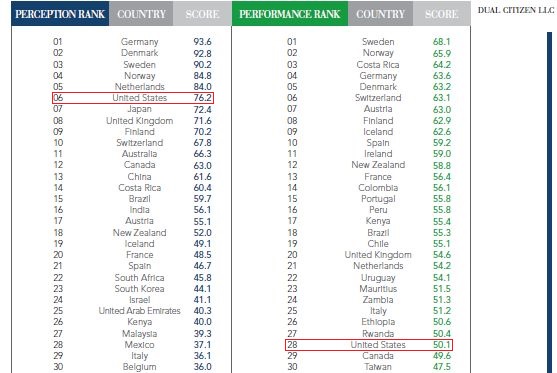
Since 2010, the Global Green Economy Index has been tracking the transition away from fossil-fuel based economies, consider two elements of a green economy: perception and performance. Countries with a high perception score are viewed as environmentally conscious leaders, while performance measures actual investment in green energy, overall infrastructure and development.

In these terms, the U.S. ranks #6 in perception, just behind the leading northern European countries, but #28 in performance, ranking below countries such as Costa Rica, Colombia, Peru, Kenya, Brazil, Chile, Uruguay, Mauritius, Zambia, Ethiopia, and Rwanda.

Global-Green-Economy-Index

China and India are also failing to match performance with perception — China ranks #13 in perception and #55 in performance, while India ranks #16 and #49.

Sweden and Norway stand out in having performance rankings (#1 and #2) that are slightly better than their perception rankings (#3 and #4) — two countries that face the high energy demands created by cold climates, short winter days, and extensive road systems.

Facebooktwittermail

Why Republicans keep telling everyone they’re not scientists

The New York Times reports: Gov. Rick Scott of Florida, a Republican who is fighting a Democratic challenge from former Gov. Charlie Crist, was asked by The Miami Herald if he believes climate change is significantly affecting the weather. “Well, I’m not a scientist,” he said.

Senator Mitch McConnell of Kentucky, who is locked in a tight re-election race, was asked this month by The Cincinnati Enquirer if he believes that climate change is a problem. “I’m not a scientist,” he said.

House Speaker John A. Boehner, when asked by reporters if climate change will play a role in the Republican agenda, came up with a now-familiar formulation. “I’m not qualified to debate the science over climate change,” he said.

“I’m not a scientist,” or a close variation, has become the go-to talking point for Republicans questioned about climate change in the 2014 campaigns. In the past, many Republican candidates questioned or denied the science of climate change, but polls show that a majority of Americans accept it — and support government policies to mitigate it — making the Republican position increasingly challenging ahead of the 2016 presidential elections.

“It’s got to be the dumbest answer I’ve ever heard,” said Michael McKenna, a Republican energy lobbyist who has advised House Republicans and conservative political advocacy groups on energy and climate change messaging. “Using that logic would disqualify politicians from voting on anything. Most politicians aren’t scientists, but they vote on science policy. They have opinions on Ebola, but they’re not epidemiologists. They shape highway and infrastructure laws, but they’re not engineers.” [Continue reading…]

Facebooktwittermail

Hustlers, con men & dupes cashing in on the war on terror

Jeff Stein writes: At long last we can retire Bob Woodward and Carl Bernstein as the icons of investigative reporting. With his second book probing the dark tunnels of the so-called war on terror, James Risen has established himself as the finest national security reporter of this generation, a field crowded with first-rank talent at The Washington Post, Wall Street Journal, Associated Press, Reuters, McClatchy Newspapers and the New York Times, his employer and sometimes bane.

Bane, because in 2004, the executive editor of the Times, cowed by Bush administration officials, twice spiked Risen’s story revealing that the National Security Agency had launched a massive, covert wiretapping program that was riffling through the personal communications of hundreds of millions of Americans without even a secret court order. Unbowed, Risen got a contract for a book that would reveal the NSA’s extralegal program. Only when the publication of State of War: The Secret History of the CIA and the Bush Administration appeared imminent did his editors, cornered, allow Risen to publish a version of it (co-authored with his colleague Eric Lichtblau) in the paper. And that disturbing saga provides the backdrop to Risen’s new book, Pay Any Price: Greed, Power and Endless War.

After turning the last page of his latest volume, one might wonder what other important stories the Times has spiked in recent years. Although parts of Risen’s new revelations have been published in the Times or elsewhere, here they are fleshed out in richly reported chapters studded with eye-popping new charges. Read together, they offer an original and deeply disturbing perspective on the war on terror. It is, Risen writes, a story of “how greed and the hunt for cash have all too often become the main objects of the war on terror.”

In fine detail, he demonstrates how the courts, Congress and the national security and law enforcement agencies of the executive branches – aided and abetted by the high priests of the media – have been corrupted in the hugely profitable business of pursuing terrorists. “[T]he search for money and power have become the hallmarks of the war on terror,” Risen writes of one of the many unsavory episodes in the book. “The story,” he says of another episode, “shows how, during the war on terror, greed and ambition have been married to unlimited rivers of cash in the sudden deregulation of American national security to create a climate in which clever men could seemingly create rogue intelligence operations with little or no adult supervision.”

The U.S.-led war in Iraq, as we already know, was rife with lax supervision and thievery. But Risen adds an astonishing new chapter to that reprehensible folly. He tells the story of how billions of dollars intended to rebuild Iraq, shrink-wrapped in packets of $100 bills, were shipped out of a Federal Reserve warehouse in New Jersey to Baghdad and eventually made their way to secret Lebanese bunkers (an account excerpted by the Times last week).

“Approximately $2 billion of the money that was flown from the United States to Baghdad” to prop up the Iraqi government after Saddam Hussein was toppled, “was stolen and secretly transported out of Iraq in what may be one of the largest robberies in modern history,” he writes. “…In addition to cash, hundreds of millions of dollars worth of gold was stolen from the Iraqi government and is also being hidden in Lebanon, current and former U.S. officials have said.”

One might assume that U.S. officials would be deeply interested in finding out what happened to that money, not to mention eager to get it back. But, no. [Continue reading…]

Facebooktwittermail

Amazon rainforest losing ability to regulate climate, scientist warns

The Guardian reports: The Amazon rainforest has degraded to the point where it is losing its ability to benignly regulate weather systems, according to a stark new warning from one of Brazil’s leading scientists.

In a new report, Antonio Nobre, researcher in the government’s space institute, Earth System Science Centre, says the logging and burning of the world’s greatest forest might be connected to worsening droughts – such as the one currently plaguing São Paulo – and is likely to lead eventually to more extreme weather events.

The study, which is a summary drawing from more than 200 existing papers on Amazonian climate and forest science, is intended as a wake-up call.

“I realised the problem is much more serious than we realised, even in academia and the reason is that science has become so fragmented. Atmospheric scientists don’t look at forests as much as they should and vice versa,” said Nobre, who wrote the report for a lay audience. “It’s not written in academic language. I don’t need to preach to the converted. Our community is already very alarmed at what is going on.”

A draft seen by the Guardian warns that the “vegetation-climate equilibrium is teetering on the brink of the abyss.” If it tips, the Amazon will start to become a much drier savanna, which calamitous consequences. [Continue reading…]

Facebooktwittermail